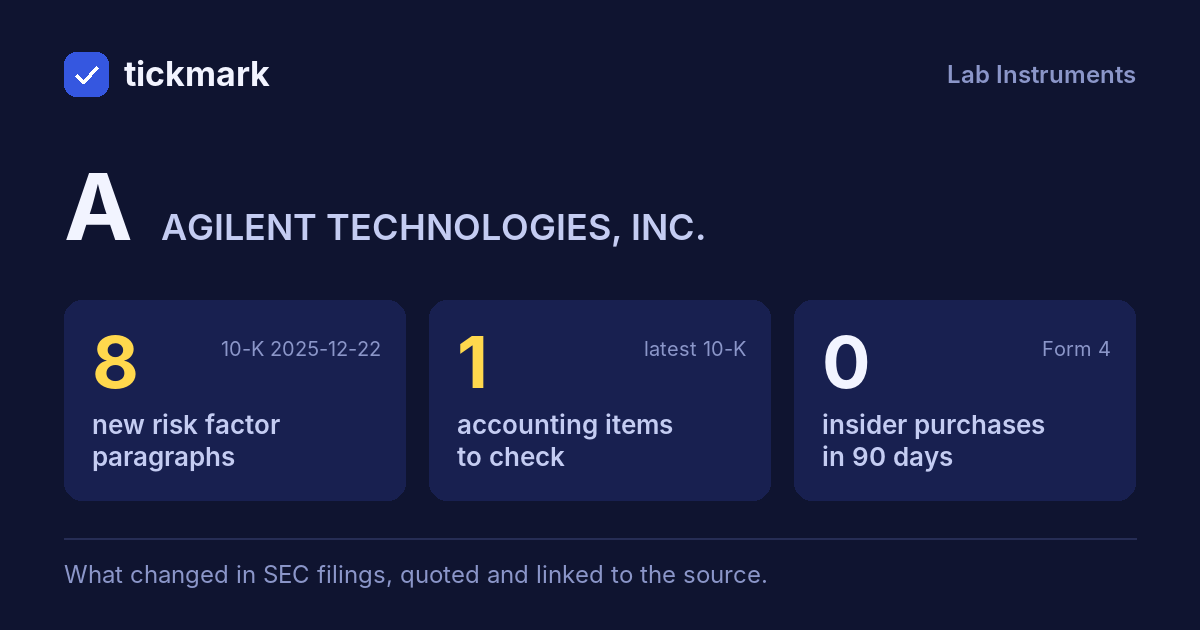
Sentences and paragraphs of A's Risk Factors and MD&A, 10-K 2025-12-22 against 10-K 2024-12-20.
Each links to the text at sec.gov.
AddedRisk Factors
Recent and dynamic government rule making and policy changes could increase our costs, affect our markets and customers and impact our results of operations.
Read it in 10-K 2025-12-22 at sec.gov ↗
AddedRisk Factors
The rapid increase in new government regulations, including tariffs and proposed tariffs in the geographies and markets in which we operate, could result in significant costs and require modifications in the way we and our customers conduct business. As we and our customers respond to newly enacted rules and legislation, effects on purchasing behavior and global trade relationships could affect our revenue. Increases in our costs and expenses related to our compliance or mitigation activities and those of our customers and suppliers could have a negative effect on our operating margin. If we are unable to respond to changing regulations in a timely and effective manner, our results of operations could be adversely affected.
Read it in 10-K 2025-12-22 at sec.gov ↗
AddedRisk Factors
In addition, geopolitical instability and evolving trade regulations, including tariffs, sanctions, and export controls, may restrict our ability to ship products globally or source critical components. These developments can increase costs, disrupt supply chains, and require operational adjustments. Failure to comply with these regulations could result in penalties, loss of export privileges, and reputational harm.
Read it in 10-K 2025-12-22 at sec.gov ↗
AddedRisk Factors
Currently, United States federal agencies are operating under a continuing resolution that is set to expire on January 30, 2026. Without appropriation of additional funding to federal agencies, our business operations related to our product sales to customers receiving funding from the U.S. federal government could be impacted. Inadequate funding for government agencies, including from government shut downs, or other disruptions to these agencies’ operations, such as actions to greatly reduce the size of the federal workforce, could hinder their ability to hire and retain key leadership and other personnel, prevent new products and services from being developed or commercialized in a timely manner, or otherwise prevent those agencies from performing normal business functions on which the operation of the businesses of certain of our customers and our business may rely, which could negatively impact our business.
Read it in 10-K 2025-12-22 at sec.gov ↗
AddedRisk Factors
The expectations and requirements of regulators and other key stakeholders, including on corporate governance and sustainability-related matters, continue to evolve and diverge, and our ability to meet these expectations and requirements could impact our risk exposure and financial conditions.
Read it in 10-K 2025-12-22 at sec.gov ↗
AddedRisk Factors
We are subject to rapidly changing and varied expectations and requirements, including on corporate governance and sustainability issues, from a wide range of stakeholders, such as governmental and self-regulatory organizations, including the Securities and Exchange Commission, U.S. federal and state governments, New York Stock Exchange, and the European Union, as well as our investors, customers and suppliers. In addition, many of our stakeholders have diverging demands, perspectives and preferences, including on topics such as climate change and diversity. We may not be able to meet the diverse expectations and demands of all of our stakeholders, which could result in an adverse impact on our business, financial results, stock price or reputation, and subject us to legal, reputational and operational risks.
Read it in 10-K 2025-12-22 at sec.gov ↗
AddedRisk Factors
For example, U.S. federal, state and local governmental authorities, as well as governmental authorities in various jurisdictions, have proposed or implemented and are likely to continue to propose or implement, legislative and regulatory initiatives around corporate governance and environmental and social practices and disclosures. Compliance with such evolving expectations, rules and regulations, including any that may emerge in the future as well as those incorporated in our contractual obligations from our customers, could increase the cost and complexity of operating our business, and could adversely impact us. In addition, various jurisdictions have adopted or proposed laws, regulations and policies that diverge from, or potentially conflict with, those adopted or proposed in other jurisdictions, making compliance more difficult and uncertain. Failure to comply with any law, regulation or policy, including as a result of making good faith interpretations that may differ from those taken by authorities in relevant jurisdictions, could potentially result in legal, reputational and operational risks.
Read it in 10-K 2025-12-22 at sec.gov ↗
AddedRisk Factors
Furthermore, any actual or perceived failure to achieve our current and future sustainability goals, including those which result from contractual obligations from our customers, or to act responsibly with respect to such matters or to effectively respond to new or additional sustainability-related legal or regulatory requirements, could result in adverse publicity and adversely affect our business and reputation. There is no assurance that we will be able to successfully achieve any sustainability-related goal or execute on any sustainability-related strategy, or adequately meet stakeholder expectations with respect to such matters. Our ability to deliver on any sustainability-related goal or strategy is subject to numerous risks, many of which are outside of our control. These factors include rapidly shifting regulatory requirements and stakeholder expectations, our ability to recruit and retain a robust workforce, the activities and availability of suppliers and other business partners, cost considerations and the development and availability of cost-effective technologies or resources.
Read it in 10-K 2025-12-22 at sec.gov ↗
Show the other 8
AddedMD&A
In November 2024, we announced a change in our organizational structure to support our market-focused, customer-centric strategy. Our former Diagnostics and Genomics segment combined with our liquid chromatography and liquid chromatography mass spectrometry instrument platforms to form our new Life Sciences and Diagnostics Markets segment. Our chemistries and supplies, laboratory automation, and software and informatics divisions moved from our former Life Sciences and Applied Markets segment to our Agilent CrossLab segment. The remaining divisions in our former Life Sciences and Applied Markets segment which includes our gas chromatography, gas chromatography mass spectrometry, remarketed instruments, spectroscopy and vacuum divisions formed our new Applied Markets segment.
Read it in 10-K 2025-12-22 at sec.gov ↗
AddedMD&A
Recent changes to tariffs and trade policies by the U.S. and other countries have increased risk and uncertainty surrounding our future results of operations. In the first half of fiscal year 2025, changes to tariffs and trade policies did not have a material impact on our results of operations. In the second half of fiscal year 2025, the U.S. government introduced additional measures related to tariffs, including certain increases, exemptions and pauses, and other countries have responded with preliminary agreements and retaliatory actions. The ultimate impact of changes to tariffs and trade policies will depend on various factors, including the timing, amount, scope, and nature of any tariffs or trade policies implemented and our ability to respond to mitigate the impact of such tariffs and trade policies. While the recent tariff changes adversely impacted our costs of revenue beginning in the second half of fiscal year 2025, we expect to substantially mitigate the impact during our fiscal year 2026. With inflationary and tariff-related pressures remaining fluid, we are actively pursuing mitigation strategies through supply chain optimization, targeted pricing actions, and other cost-efficiency initiatives to protect margins and sustain long-term growth. We continue to monitor these evolving trade dynamics closely, as they may influence future revenue and operational efficiency.
Read it in 10-K 2025-12-22 at sec.gov ↗
AddedMD&A
The Organization for Economic Co-operation and Development. ("OECD") has introduced rules to establish a global minimum tax rate of 15 percent, commonly referred to as the Pillar Two rules. We have considered the impact of currently enacted Pillar Two rules and determined that we became subject to such rules starting in fiscal year 2025 in some jurisdictions, and it did not have a material impact on our consolidated financial results for the periods presented. Additionally, the United States enacted the One Big Beautiful Bill Act ("OBBBA") on July 4, 2025, including adjustments to effective tax rates on certain types of income and an elective deduction for domestic Research and Development (R&D), which are generally applicable to Agilent in fiscal years 2026 and 2027. We expect our income taxes to increase in fiscal year 2026 due to top-up taxes under Pillar Two along with the implementation of the OBBBA rules.
Read it in 10-K 2025-12-22 at sec.gov ↗
AddedMD&A
In the U.S., tax years remain open back to the year 2022 for federal income tax purposes and 2021 for significant states. In other major jurisdictions where we conduct business, the tax years generally remain open back to the year 2014.
Read it in 10-K 2025-12-22 at sec.gov ↗
AddedMD&A
In November 2024, we announced a change in our organizational structure to support our market-focused, customer-centric strategy. Our former Diagnostics and Genomics segment combined with our liquid chromatography and liquid chromatography mass spectrometry instrument platforms to form our new Life Sciences and Diagnostics Markets segment. Our chemistries and supplies, laboratory automation, and software and informatics divisions moved from our former Life Sciences and Applied Markets segment to our Agilent CrossLab segment. The remaining divisions in our former Life Sciences and Applied Markets segment which includes our gas chromatography, gas chromatography mass spectrometry, remarketed instruments, spectroscopy and vacuum divisions formed our new Applied Markets segment.
Read it in 10-K 2025-12-22 at sec.gov ↗
AddedMD&A
Looking Forward. While the recent tariff changes adversely impacted our costs of revenue for the second half of fiscal year 2025, we expect to substantially mitigate the impact during our fiscal year 2026. Therefore, we remain optimistic about long-term growth in our end markets and continue investing to enhance our applications and solutions portfolio. The rising demand for several of the modalities provided by our specialty CDMO business positions us well to serve expanding customer demand. By leveraging our liquid chromatography and liquid chromatography mass spectrometry platforms, we are driving growth across key markets and remain optimistic about long-term life sciences opportunities. Our diagnostic and clinical markets continue to grow with the OMNIS platforms. We will continue investing in research and development, advancing our applications and solutions portfolio, and expanding our position in developing and emerging markets
Read it in 10-K 2025-12-22 at sec.gov ↗
AddedMD&A
Our Applied Markets segment provides application-focused solutions that include instruments and software that enable customers to identify, quantify and analyze the physical and biological properties of substances and products. Our gas chromatography and gas chromatography mass spectrometry businesses enable customers to perform a wide variety of testing including measuring volatile and semi-volatile contaminants to assess the safety of our foods, quality of water and consumer products while also enabling testing of fuels and purity of chemicals. Our inductively coupled plasma mass spectrometry, inductively coupled plasma optical emission spectrometry, atomic absorption and microwave plasma-atomic emission spectrometry instruments are vital for our customers to measure metals and elemental signatures in their samples and find uses in the food safety, environmental quality, chemicals manufacture, advanced materials, energy and forensics markets. Our molecular spectroscopy business including the raman, fluorescence and infrared spectroscopy instruments offer both in-field and in-lab testing solutions in a diverse variety of applications including airport security, explosives testing, narcotics, food quality and chemical characterization. Our vacuum business develops cutting edge products and technologies to test vacuum environments and find uses in a diverse variety of industries including semi-conductor, batteries, chemical manufacturing and advanced materials development. Finally, our remarketed instruments business refurbishes and resells certified pre-owned instruments to value-oriented customers who would like Agilent quality and performance at a budget conscious price.
Read it in 10-K 2025-12-22 at sec.gov ↗
AddedMD&A
On June 2, 2023, we entered into an Uncommitted Money Market Line Credit agreement with Societe Generale which
Read it in 10-K 2025-12-22 at sec.gov ↗