7 paragraphs in Risk Factors of the 10-K filed Feb 12, 2026
with nothing like them in the 10-K filed Feb 13, 2025. Quoted exactly.
Paragraphs that were only edited are under 10-K change.
Compared with the Risk Factors in the latest 10-K of the other 46 Consumer discretionary companies:
a paragraph with at least half its words the same at another company is called similar, and the companies are listed under it.
A paragraph most of them have is marked boilerplate. No line means no other company has one like it.
This counts text; it does not say how serious a risk is.
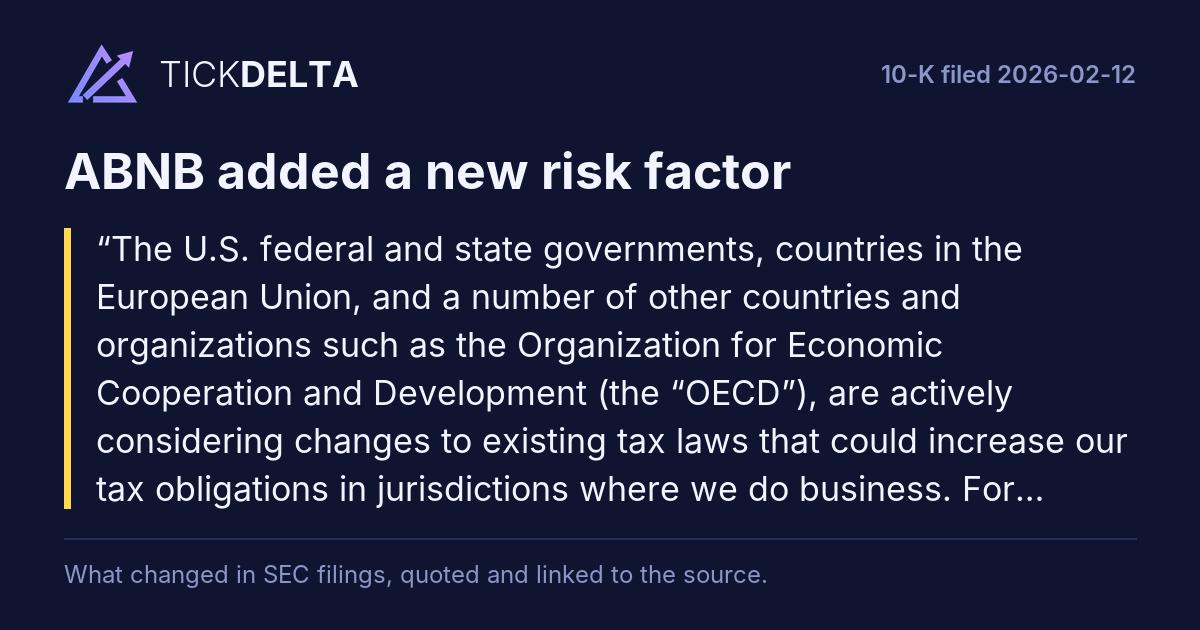
The U.S. federal and state governments, countries in the European Union, and a number of other countries and organizations such as the Organization for Economic Cooperation and Development (the “OECD”), are actively considering changes to existing tax laws that could increase our tax obligations in jurisdictions where we do business. For example, the 15% global minimum tax under Pillar Two of the OECD Base Erosion and Profit Shifting (“BEPS”) Project could increase our overall taxes and have a materially adverse impact on our business, results of operations, and financial conditions.
Similar paragraph at 1 of 46 other Consumer discretionary companies:
YUM
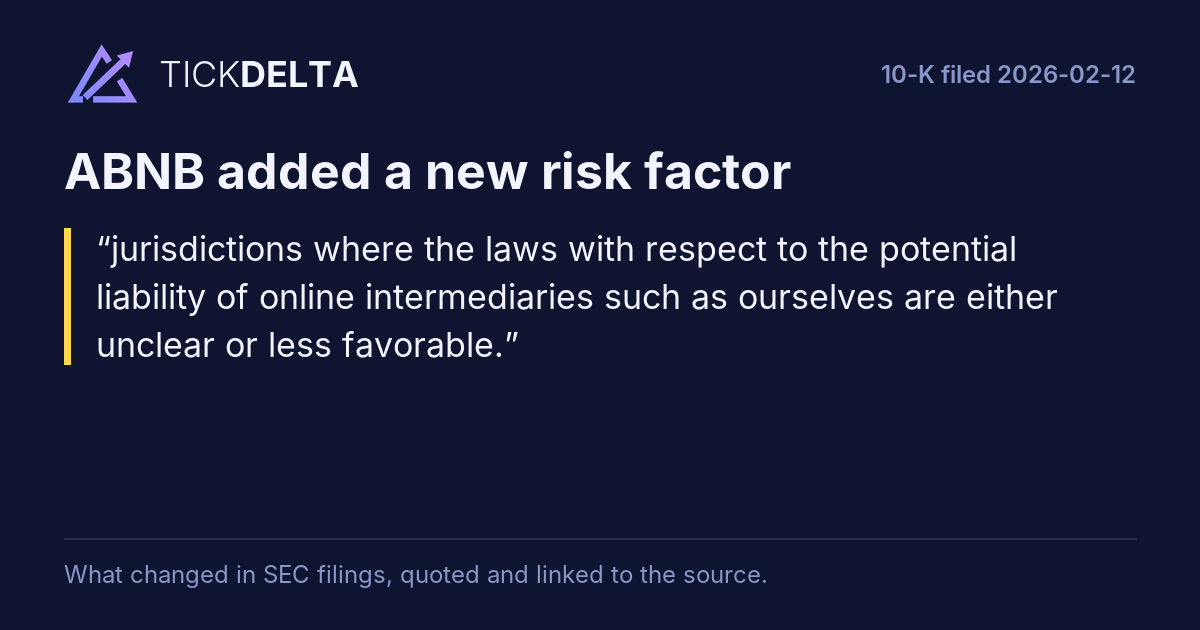
jurisdictions where the laws with respect to the potential liability of online intermediaries such as ourselves are either unclear or less favorable.
Read in the 10-K ↗
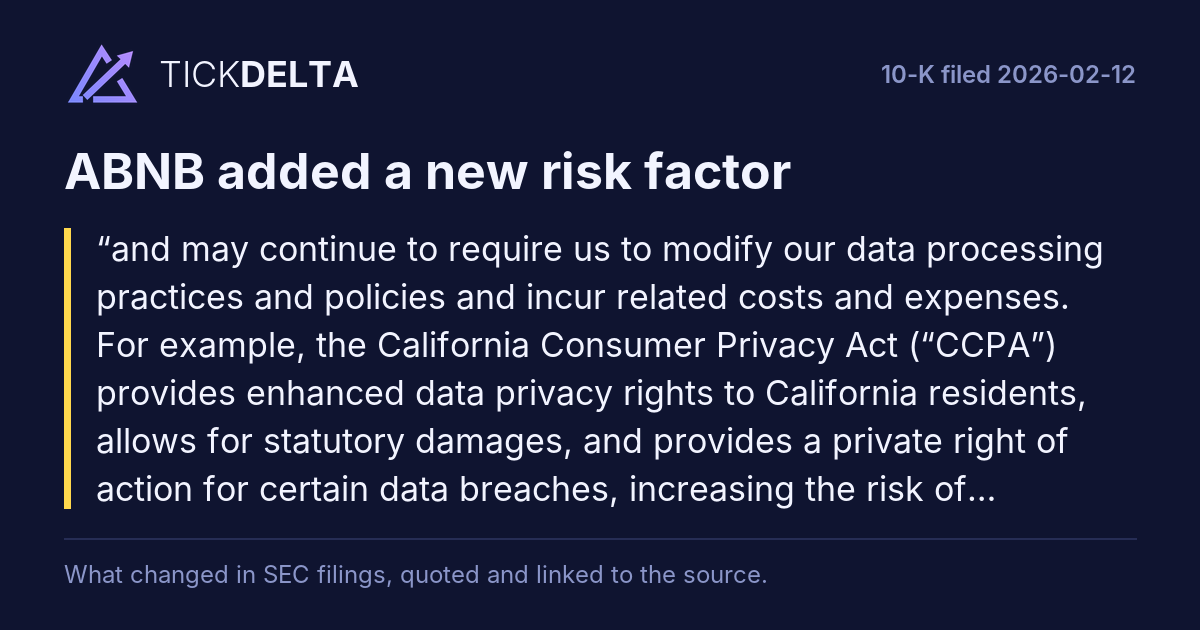
and may continue to require us to modify our data processing practices and policies and incur related costs and expenses. For example, the California Consumer Privacy Act (“CCPA”) provides enhanced data privacy rights to California residents, allows for statutory damages, and provides a private right of action for certain data breaches, increasing the risk of litigation. The enactment of the CCPA prompted a wave of similar legislative developments in over a third of other states, which created a patchwork of overlapping but different state laws.
Read in the 10-K ↗
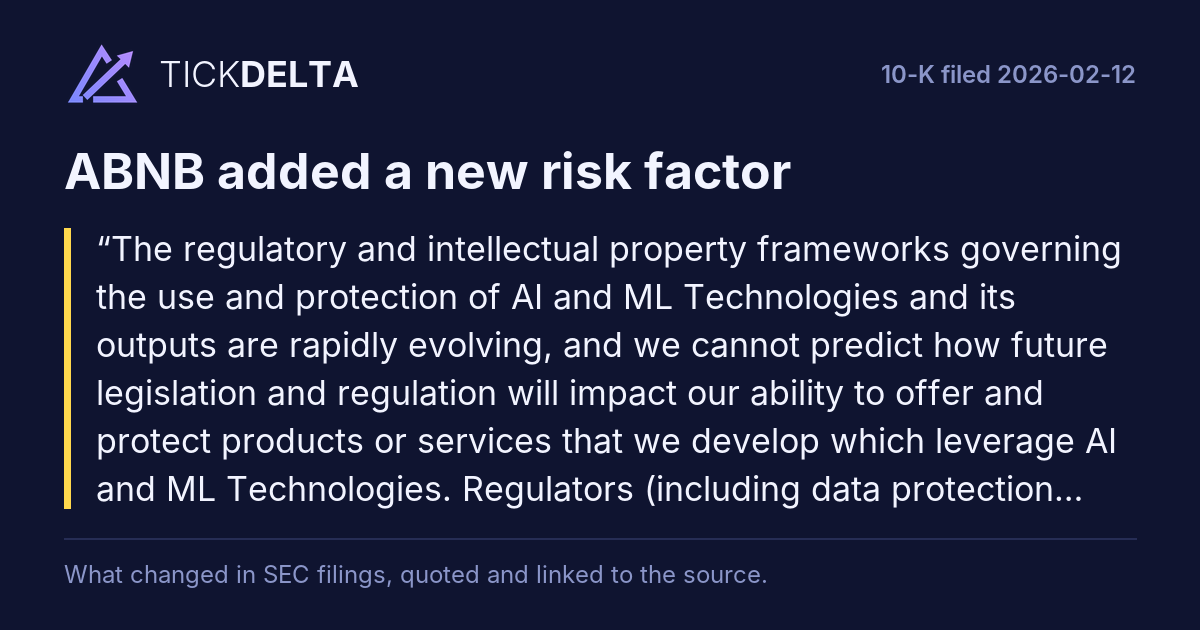
The regulatory and intellectual property frameworks governing the use and protection of AI and ML Technologies and its outputs are rapidly evolving, and we cannot predict how future legislation and regulation will impact our ability to offer and protect products or services that we develop which leverage AI and ML Technologies. Regulators (including data protection regulators) have taken, and are expected to continue to take, an increased interest in issues, such as how we and our vendors collect, maintain, process, and provide transparency on the use of personal data in this context. The increased use of AI and ML Technologies means that regulators are increasingly seeking advance engagement with businesses like ours in respect of certain types of data processing, including our lead EU data protection regulator, the Irish Data Protection Commission. In addition, certain existing legal regimes including those related to data privacy, competition, and consumer protection, may also regulate certain aspects of AI and ML Technologies, and new laws may be adopted and interpreted in ways
that would limit our ability to use AI and ML Technologies. This may affect our use of AI and ML Technologies and our ability to provide, improve or commercialize our services effectively and efficiently and result in increased costs. For example, in the United States, legislation related to AI and ML Technologies has been introduced at the federal level and enacted by various states. Several states – such as California, Colorado, Connecticut, and Texas – have enacted or proposed laws governing the development and deployment of AI and ML Technologies at varying degrees, typically focused on high-risk uses of AI. Many U.S. states continue to advance various AI regulatory frameworks, including requirements around transparency, risk management, and accountability for AI and ML Technologies. Further, the California Privacy Protection Agency has finalized regulations under the CCPA regarding the use of automated decision-making technology. Collectively, these developments signal an emerging trend towards a patchwork of state-level governance of AI in the United States. Further, the EU Artificial Intelligence Act (the “EU AI Act”) entered into force in August 2024 (with the majority of substantive requirements applying from August 2026), and establishes a broad, risk-based governance framework for AI use, development, or provision in the EU market. Applicable requirements depend on the risk level of each AI use case, and actual or perceived contraventions could expose us to material penalties, significant legal liability, and may materially adversely affect our business, results of operations, and financial condition. With regard to China, the regulatory requirements on AI and ML Technologies, export controls and other relevant regulations are still evolving and have ongoing complexity and uncertainty. The positions and interpretation of these regulations by the authorities may not align with our interpretation or may not be consistent across jurisdictions, which may impact our ability, or require additional resources (which may be substantial), to develop and/or maintain related product features.
Read in the 10-K ↗
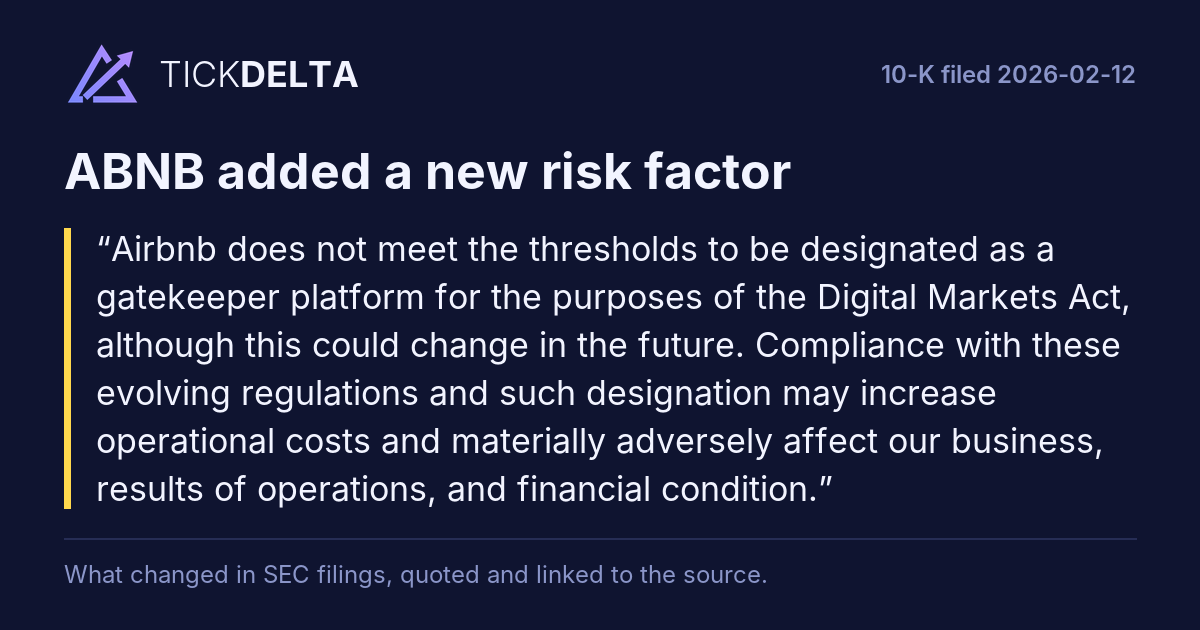
Airbnb does not meet the thresholds to be designated as a gatekeeper platform for the purposes of the Digital Markets Act, although this could change in the future. Compliance with these evolving regulations and such designation may increase operational costs and materially adversely affect our business, results of operations, and financial condition.
Read in the 10-K ↗
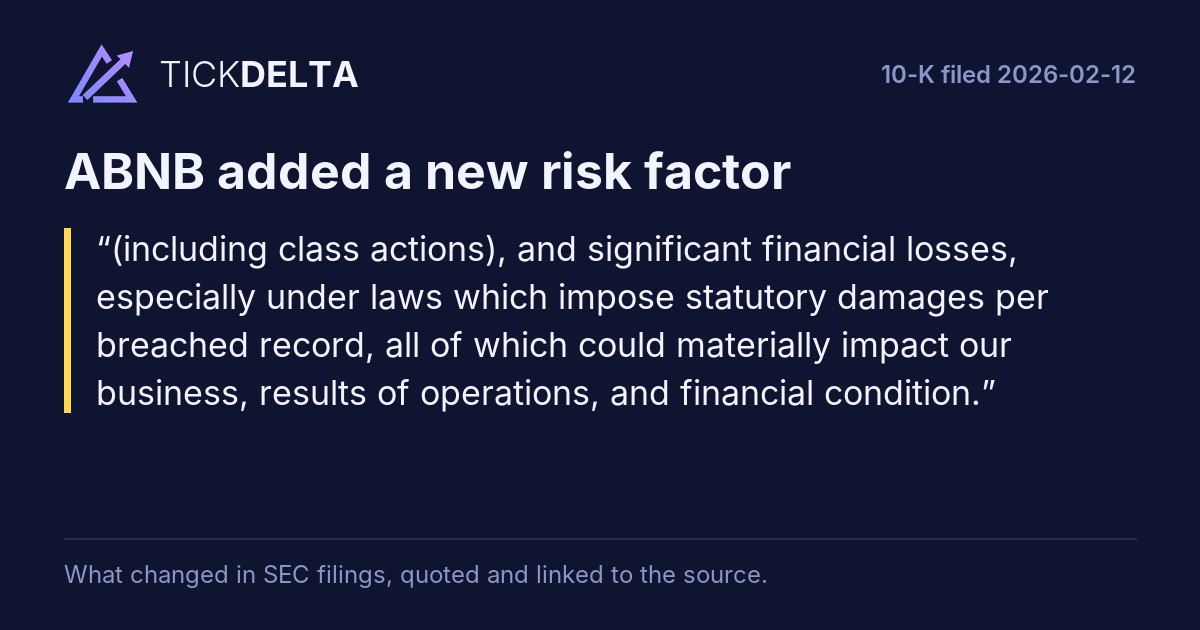
(including class actions), and significant financial losses, especially under laws which impose statutory damages per breached record, all of which could materially impact our business, results of operations, and financial condition.
Read in the 10-K ↗
New in the latest 10-Q
7 paragraphs in the 10-Q filed Nov 5, 2026 with nothing like
them in the 10-Q filed Aug 6, 2026 (at least half the words must differ; new numbers alone do not count).
Quoted exactly, grouped by the item heading above them. This is text that changed, not a judgement of how serious it is.
Financial statements and notes
(1) Derivative assets and liabilities are measured using Level 2 inputs. These inputs include currency rates and interest rate yield curves for foreign exchange contracts, and interest rate yield curves for interest rate swaps.
Read in the 10-Q ↗
On October 30, 2026, the Company entered into a five-year unsecured Revolving Credit Agreement, which provides for initial commitments by a group of lenders led by Morgan Stanley Senior Funding, Inc. of $ 1.0 billion (“2026 Credit Facility”). In connection with the consummation of the 2026 Credit Facility, the Company terminated its 2022 Credit Facility on October 30, 2026. The 2026 Credit Facility provides a $ 200 million sub-limit for the issuance of letters of credit and a $ 50 million sub-limit for swingline loans, and permits the Company to request increases in the commitments of up to an additional $ 500 million, subject to lender participation. Letters of credit of approximately $ 19 million that were outstanding under the 2022 Credit Facility were deemed issued under the 2026 Credit Facility upon closing and reduced the amount available for borrowing. The 2026 Credit Facility has a commitment fee based on the Company’s senior unsecured credit ratings with amounts that range from 0.07 % to 0.15 % per annum on any undrawn amounts, payable quarterly in arrears. Interest on borrowings is based on the Company’s senior unsecured credit ratings with amounts that range from (i) in the case of the Term SOFR borrowings, 0.75 % to 1.25 %, plus Term SOFR, subject to a floor of 0.00%, or (ii) in the case of base rate borrowings, 0.00 % to 0.25 %, plus the greatest of (a) the prime rate as established in the Wall Street Journal; (b) the federal funds effective rate plus 0.50 %; and (c) Term SOFR for a one-month period plus 1.00 %, subject to a floor of 1.00 %. Outstanding balances may be repaid prior to maturity without penalty. The 2026 Credit Facility contains customary events of default, and affirmative and negative covenants, including restrictions on the ability of certain of the Company’s subsidiaries to incur debt and on the Company and its subsidiaries’ ability to incur liens and undergo fundamental changes, as well as a financial covenant requiring the Company to maintain a maximum leverage ratio. As of the date of this Quarterly Report on Form 10-Q, no amounts were drawn under the 2026 Credit Facility.
Read in the 10-Q ↗
The increase in FCF was driven by higher net income, partially offset by working capital outflows, including the impact from the continued expansion of RNPL and purchase of property in New York in July 2026.
Read in the 10-Q ↗
The following table summarizes our cash flows for the nine months ended September 30, 2026 compared with the same period in 2025 (in millions):
Read in the 10-Q ↗
Other information
On October 30, 2026, we entered into a five-year unsecured Revolving Credit Agreement, which provides for initial commitments by a group of lenders led by Morgan Stanley Senior Funding, Inc. of $1.0 billion (“2026 Credit Facility”). In connection with the consummation of the 2026 Credit Facility, we terminated our 2022 Credit Facility on October 30, 2026. The 2026 Credit Facility provides a $200 million sub-limit for the issuance of letters of credit and a $50 million sub-limit for swingline loans, and permits us to request increases in the commitments of up to an additional $500 million, subject to lender participation. Letters of credit of approximately $19 million that were outstanding under the 2022 Credit Facility were deemed issued under the 2026 Credit Facility upon closing and reduced the amount available for borrowing. The 2026 Credit Facility has a commitment fee based on our senior unsecured credit ratings with amounts that range from 0.07% to 0.15% per annum on any undrawn amounts, payable quarterly in arrears. Interest on borrowings is based on our senior unsecured credit ratings with amounts that range from (i) in the case of the Term Secured Overnight Financing Rate (“SOFR”) borrowings, 0.75% to 1.25%, plus Term SOFR, subject to a floor of 0.00%, or (ii) in the case of base rate borrowings, 0.00% to 0.25%, plus the greatest of (a) the prime rate as established in the Wall Street Journal; (b) the federal funds effective rate plus 0.50%; and (c) Term SOFR for a one-month period plus 1.00%, subject to a floor of 1.00%. Outstanding balances may be repaid prior to maturity without penalty. The 2026 Credit Facility contains customary events of default, and affirmative and negative covenants, including restrictions on the ability of certain of our subsidiaries to incur debt and on our and our subsidiaries’ ability to incur liens and undergo fundamental changes, as well as a financial covenant requiring us to maintain a maximum leverage ratio. As of the date of this Quarterly Report on Form 10-Q, no amounts were drawn under the 2026 Credit Facility.
Read in the 10-Q ↗
The foregoing summary of the 2026 Credit Facility does not purport to be complete and is subject to, and qualified in its entirety by reference to, the Revolving Credit Agreement, which is filed as Exhibit 10.2 to this Quarterly Report on Form 10-Q and is incorporated herein by reference.
Read in the 10-Q ↗
In November 2026, Airbnb entered into an IP Sale and Transaction Agreement with a recently formed and privately held artificial intelligence lab (the “AI Lab”), pursuant to which the AI Lab acquired certain intellectual property from Airbnb and reimbursed Airbnb for certain expenses in exchange for cash consideration of $7.1 million. Airbnb also obtained (i) the right to invest in future AI Lab equity financing rounds at Airbnb’s election and (ii) a license to certain AI Lab intellectual property for internal use in Airbnb’s business. Brian Chesky, Airbnb’s co-founder, Chief Executive Officer, and Chairman of its board of directors, is the founder of, holds a controlling equity interest in, and performs services for the AI Lab. Ahmad Al-Dahle, Airbnb’s Chief Technology Officer, holds an equity interest in and performs services for the AI Lab. Their roles with the AI Lab do not change their duties and responsibilities to Airbnb, and they continue to devote the time and attention necessary to fulfill those responsibilities. The foregoing arrangement was considered and approved by a special committee of independent and disinterested members of Airbnb’s board of directors in accordance with Airbnb’s related party transaction policy.
Read in the 10-Q ↗
The 10-Q's risk factors against the 10-K
Item 1A of the 10-Q filed Nov 5, 2026 against Item 1A of the 10-K filed Feb 12, 2026.
A 10-Q repeats only the risks that changed, so a 10-K paragraph that is missing from it is not counted as removed.
Added is a paragraph with nothing like it in the 10-K, Reworded a sentence that is in both with several words changed,
Quiet changes a sentence in both where one to four words changed and one is a hedge or a modal
(cut words struck through, new words highlighted and underlined).
Text on the page, not a score; each links to the filing at sec.gov.
Reworded10-Q 2026-11-05 vs 10-K 2026-02-12
The following material factors, factors discussed in these reports, among others, could cause our actual results to differ materially from historical results and those expressed in forward-looking statements made by us or on our behalf in filings with the SEC, press releases, communications with investors, and oral statements.
Read it in the 10-Q at sec.gov ↗ · The 10-K sentence ↗
Reworded10-Q 2026-11-05 vs 10-K 2026-02-12
Our business, operations, and financial results are subject to various risks and uncertainties, including those described below, uncertainties that could materially adversely affect our business, results of operations, financial condition, and the trading price of our Class A common stock.
Read it in the 10-Q at sec.gov ↗ · The 10-K sentence ↗