tickdelta
Sign in

Tickdelta is free for now. Sign up and get Pro free

← Screener

Consumer discretionary · Building Services · Nasdaq

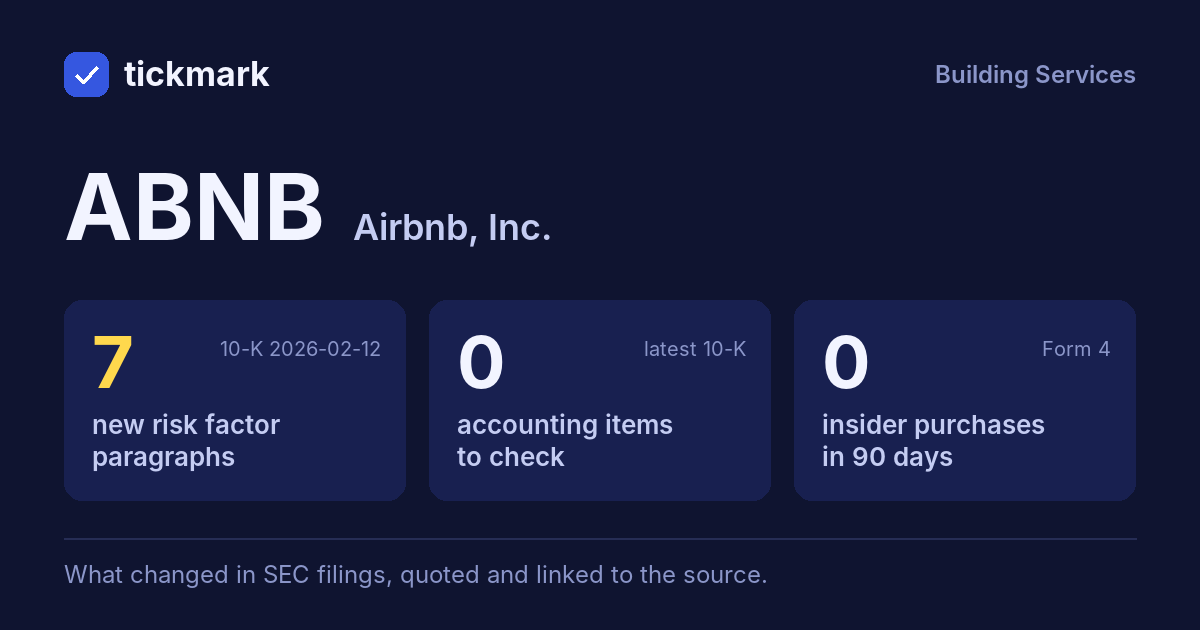
ABNBAirbnb

Compare with peers → Embed
The 10-K against last year's

193 changes: 19 added, 17 removed, 150 reworded, 7 quiet changes

10-K Feb 12, 2026 vs Feb 13, 2025
Risk FactorsRedline ↓
12.3%
of the text changed · 24,703 words now
22.8%
of the text changed · 6,491 words now
Legal ProceedingsRedline ↓
12.3%
of the text changed · 2,492 words now
Accounting PoliciesRedline ↓
22.9%
of the text changed · 5,852 words now

10-K 0001559720-26-000004 (Feb 12, 2026) vs 10-K 0001559720-25-000010 (Feb 13, 2025)

The redline

The paragraph that changed most in each section

Marked against last year's 10-K: cut words struck through, new words highlighted and underlined.

Risk Factors 298 words changed in this paragraph; it is 36% similar to last year's version.
The regulatory and intellectual property frameworks governing the use and protection of AI and ML Technologies and of its outputs are rapidly evolving, and we cannot predict how future legislation and regulation will impact our ability to offer and protect products or services that we develop which leverage AI and ML Technologies. Many federal, state Regulators (including data protection regulators) have taken, and foreign government bodies are expected to continue to take, an increased interest in issues, such as how we and agencies have introduced or proposed additional laws our vendors collect, maintain, process, and regulations. Additionally, existing laws and regulations may be interpreted provide transparency on the use of personal data in ways that would affect the operation this context. The increased use of and availability of IP protection for our AI and ML Technologies. As a result, implementation standards, enforcement practices, and available scope Technologies means that regulators are increasingly seeking advance engagement with businesses like ours in respect of certain types of data processing, including our lead EU data protection are likely to remain uncertain for regulator, the foreseeable future, and we cannot yet determine the impact future laws, regulations, or standards may have on our business (including our positioning with respect to our competition) and may not always be able to anticipate how to respond to these laws or regulations. Already, Irish Data Protection Commission. In addition, certain existing legal regimes (e.g., relating including those related to data privacy) privacy, competition, and consumer protection, may also regulate certain aspects of AI and ML Technologies, and new laws regulating AI may be adopted and ML Technologies are expected to continue to be proposed and enacted interpreted in the United States and globally. For further information related to AI laws and regulations that may affect our business, see the risk factor titled “Compliance with federal, state, and foreign laws relating to data privacy, data security, artificial intelligence, marketing and consumer protection involves significant expenditure and resources, and any actual or perceived failure by us or our vendors to comply may result in significant liability, litigation or other legal action against us, negative publicity, an erosion of trust, and/or result in regulatory scrutiny, fines and penalties and could materially adversely affect our business, results of operations, and financial condition.” ways

Source: Item 1A, 10-K 0001559720-26-000004 vs Item 1A, 10-K 0001559720-25-000010

Accounting Policies 205 words changed in this paragraph; it is 40% similar to last year's version.
The Company considers generates substantially all of its revenue from facilitating guest stays at accommodations offered by hosts on its platform. The Company’s customers are both hosts and guests to be its customers. The customers guests. Customers must agree to the Company’s Terms of Service (“ToS”) to use the Company’s platform. Upon confirmation of a booking made by a guest, the host agrees to provide the use of the property. At such time, property and both parties agree to the host booking amount which excludes taxes and guest also agree upon the applicable booking value as well as host fees and guest fees (collectively “service fees”). Company’s service fees. The Company charges Company’s service fees are charged in exchange for certain activities, including the use of the Company’s platform, platform use, customer support, and payment processing activities. These activities activities, which are not distinct from each other and are not separate collectively constitute a single performance obligations. As a result, obligation. The performance obligation, governed by the acceptance of the Company’s single performance obligation is to facilitate a stay, which occurs upon the completion of a check-in event (a “check-in”). The Company recognizes revenue upon check-in as its performance obligation ToS, is satisfied upon at the point of check-in when the guest begins their stay and the Company has the obtains an enforceable right to receive payment for payment. Accordingly, revenue is recognized on the fulfillment consolidated statements of operations, at the point of check-in. For all bookings, the guest pays the booking amount to the Company, which disburses the booking amount to the host after check-in, net of the performance obligation. host’s service fees.

Source: Item 8, Note 2 – Significant Accounting Policies, 10-K 0001559720-26-000004 vs Item 8, Note 2 – Summary of Significant Accounting Policies, 10-K 0001559720-25-000010

Legal Proceedings 159 words changed in this paragraph; it is 62% similar to last year's version.
In May 2023, the Guardia di Finanza de Milano (“GdF”) issued 2017, Italy passed a Tax Audit Report recommending law purporting to require short-term rental platforms that process payments to withhold and remit host income tax and collect and remit tourist tax, amongst other obligations (“2017 Law”). The Company challenged this law before the Italian tax authorities a formal tax assessment courts and the Court of 779 million Euro on Airbnb’s subsidiary in Ireland relating to Justice of the 2017 Law and associated withholding tax obligations. European Union (“CJEU”). On December 13, 2023, without admitting any liability, Airbnb Ireland signed an agreement with the Italian Revenue Agency (“ITA”) in settlement of the 2017-2021 audit period for an aggregate payment of 576 million Euro ($621 million). Such agreement settled a dispute about Airbnb Ireland’s obligations to withhold and remit host income tax, including taxes, interest, and penalties, for those relevant periods. The GdF conducted a withholding tax audit of Airbnb Ireland for the 2022 and 2023 tax years and issued a report to the ITA in March 2024. In December 2024, Airbnb Ireland signed a similar agreement in settlement of the 2022 audit period for an aggregate payment of 139 million Euro ($150 million). In January 2025, Airbnb Ireland entered into an agreement with the Italian Revenue Agency to close the 2023 audit period for an aggregate payment of 179 million Euro ($186 million); million). Of this amount, 123 million Euro ($148 million) was paid in December of 2024 and 2024, while 56 million Euro ($66 million), which was recognized as a liability as of December 31, 2024, was paid in January of 2025. In 2024, Airbnb Ireland started commenced withholding on host payments related to Italian listings.

Source: Item 3, via Note 13 – Commitments and Contingencies, 10-K 0001559720-26-000004 vs Item 3, via Note 13 – Commitments and Contingencies, 10-K 0001559720-25-000010

MD&A 139 words changed in this paragraph; it is 40% similar to last year's version.
During 2024, In August 2025, our board of directors approved a new share repurchase program with an authorization to purchase up to an additional $6.0 billion of our Class A common stock. Share repurchases under the share repurchase programs may be made through a variety of methods, which may include open market purchases, privately negotiated transactions, block trades, or accelerated share repurchase transactions or by any combination of such methods. Any such repurchases will be made from time to time subject to market and economic conditions, applicable legal requirements, and other relevant factors. The share repurchase programs do not obligate us to repurchase any specific number of shares and may be modified, suspended, or terminated at any time at our discretion. In 2025, we repurchased an aggregate of 24.5 29.7 million shares of Class A common stock for $3.4 billion. $3.8 billion through two share repurchase programs. As of December 31, 2024, 2025, we completed the repurchases under the August 2, 2022 February 2024 share repurchase program and had $3.3 $5.6 billion available for to repurchase shares of Class A common stock under the May 9, 2023 our August 2025 share repurchase program.

Source: Item 7, 10-K 0001559720-26-000004 vs Item 7, 10-K 0001559720-25-000010

Every change, by type

Sentences and paragraphs added, removed or reworded

Sentences and paragraphs of ABNB's Risk Factors and MD&A, 10-K Feb 12, 2026 against 10-K Feb 13, 2025. Each links to the text at sec.gov.

RemovedRisk Factors
The Organization for Economic Cooperation and Development (the “OECD”) is coordinating negotiations among more than 140 countries with the goal of achieving consensus around substantial changes to international tax policies, including the implementation of a minimum global effective tax rate of 15%. Our effective tax rate and cash tax payments could increase in future years as a result of these changes.

Read it in 10-K Feb 13, 2025 at sec.gov ↗

RemovedRisk Factors
potentially onerous requirements, including operational and payment security and strong customer authentication, which may increase compliance costs, raise risk of non-compliance, and impact the ease of usage of the payment features of the platform.

Read it in 10-K Feb 13, 2025 at sec.gov ↗

RemovedRisk Factors
Additionally, the proposed EU Third Payment Services Directive (“PSD3”) and proposed regulation on the same (“EU PSR”) will include amendments to strong customer authentication and anti-fraud obligations amongst other day-to-day requirements. The United Kingdom is also considering areas for reform for its payment services regime, including information requirements regarding currency conversion charges, and notice provisions for the termination of customer contracts. When these proposed measures are finalized and in-force, they may increase our compliance costs and require additional resources as well as changes to our processes and operations.

Read it in 10-K Feb 13, 2025 at sec.gov ↗

RemovedRisk Factors
Additionally, we note that as the use of AI and machine learning technologies (“AI and ML Technologies”) continues to grow, regulators (including data protection regulators) are expected to take an increased interest in issues, such as how we and our vendors collect, maintain and process and provide transparency on the use of personal data of our users and/ or hosts in that context. Our technology platform incorporates the use of AI and ML Technologies, for example, for fraud detection, search, enabling customized features and enhancing community support. Enhanced scrutiny of the use of AI and ML Technologies means that regulators may increasingly seek advance engagement with businesses like ours in respect of certain types of data processing. In addition, certain existing legal regimes, including those relating to data privacy and consumer protection, regulate certain aspects of AI and ML Technologies, and new laws regulating AI and ML Technologies have been or may be enacted or have entered into force in jurisdictions that we operate. This may affect our use of AI and ML Technologies and our ability to provide, improve or commercialize our services effectively and efficiently and result in increased costs. For example, in the United States, California enacted seventeen new laws in 2024 that further regulate the use of AI and ML Technologies and provide consumers with additional protections around companies’ use of AI and ML Technologies, such as requiring companies to disclose certain uses of generative AI. Other states have also passed AI-focused legislation, such as Colorado’s Artificial Intelligence Act, which will require developers and deployers of “high-risk” AI systems to implement certain safeguards against algorithmic discrimination, and Utah’s Artificial Intelligence Policy Act, which establishes disclosure requirements and accountability measures for the use of generative AI in certain consumer interactions. Other legislation has been introduced or proposed at the federal and state level, and there remains uncertainty at the federal level regarding the regulation of AI and ML Technologies. Further, the EU Artificial Intelligence Act (the “EU AI Act”) entered into force in August 2024, and establishes a comprehensive, risk-based governance framework for AI in the EU market. The majority of the substantive requirements will apply from August 2026. The EU AI Act applies to companies that develop, use and/or provide AI in the EU and – depending on the AI use case – includes requirements around transparency, conformity assessments and monitoring, risk assessments, human oversight, security, accuracy, general purpose AI and foundation models, and fines for breach of up to 7% of worldwide annual turnover. These regulations may impact our ability to use, procure and commercialize AI and ML Technologies in the future, and we may need to expend resources to adjust our products or services, including if the laws are not consistent across jurisdictions.

Read it in 10-K Feb 13, 2025 at sec.gov ↗

RemovedRisk Factors
When we are required to disclose personal data to government agencies, such as tax authorities and law enforcement agencies, this could be perceived by third parties as non-compliance with data privacy and security laws, potentially leading to legal proceedings or actions

Read it in 10-K Feb 13, 2025 at sec.gov ↗

RemovedRisk Factors
against us. Conversely, if we refuse to provide requested information due to a disagreement, such as on the interpretation of the law, we may face actions, litigation, and increased regulatory scrutiny, which could harm our relationships with governments and limit our ability to operate in certain regions. Any of the foregoing could materially adversely affect our brand, reputation, business, results of operations, and financial condition.

Read it in 10-K Feb 13, 2025 at sec.gov ↗

RemovedRisk Factors
The rapid evolution of AI and ML Technologies will continue to require the application of significant resources to adopt, develop, test, integrate, and maintain AI and ML Technologies included in our offerings in order to remain competitive and to help implement these

Read it in 10-K Feb 13, 2025 at sec.gov ↗

RemovedRisk Factors
Development, maintenance and operation of AI and ML Technologies requires additional investment in the development of proprietary datasets, machine learning models, and systems to monitor and test for accuracy, bias, and other variables, which are complex, costly, and could impact our profit margin as we expand the use of AI and ML Technologies in our offerings. Developing, testing, and deploying AI and ML Technologies also increase associated computing costs.

Read it in 10-K Feb 13, 2025 at sec.gov ↗

Show the other 9
RemovedRisk Factors
It is also possible that new laws and regulations will be adopted in the United States and in other non-U.S. jurisdictions, or that existing laws and regulations, including data privacy, consumer protection, competition laws, may be interpreted in ways that would limit our ability to use AI and ML Technologies for our business, or require us to change the way we use AI and ML Technologies in a manner that negatively affects the performance of our products, services, and business and requires us to expend resources and adjust our products or services in certain jurisdictions. Further, the cost to comply with such laws, regulations, or decisions and/or guidance interpreting existing laws, could be significant and would increase our operating expenses (such as by imposing additional reporting obligations regarding our use of AI and ML Technologies). Such an increase in operating expenses, as well as any actual or perceived failure to comply with such laws and regulations, could adversely affect our business, financial condition and results of operations.

Read it in 10-K Feb 13, 2025 at sec.gov ↗

RemovedRisk Factors
corporate transaction requiring stockholder approval. In addition, this may prevent or discourage unsolicited acquisition proposals or offers for our capital stock that stockholders may believe are in their best interest.

Read it in 10-K Feb 13, 2025 at sec.gov ↗

RemovedMD&A
In 2024, net income decreased by 45% to $2.6 billion, compared to the prior year, primarily due to the release of the majority of our valuation allowance on U.S. federal and state deferred tax assets of $2.9 billion in 2023, and the recognition of deferred tax expense related to the utilization of some of those assets in 2024 (see Note 14, Income Taxes, to our consolidated financial statements included in Item 8 of this Annual Report on Form 10-K for further details). This was partially offset due to a decrease in withholding taxes, associated fees, and penalties and interest expense due to a withholding tax settlement related to Italy of $770 million, $196 million and $64 million respectively.

Read it in 10-K Feb 13, 2025 at sec.gov ↗

RemovedMD&A
Adjusted EBITDA1 increased 11% to $4.0 billion in 2024 demonstrating the continued strength of our business, growth in revenue and discipline in managing our cost structure.

Read it in 10-K Feb 13, 2025 at sec.gov ↗

RemovedMD&A
Inflation and other macroeconomic pressures in the United States and the global economy, such as tariffs, foreign currency fluctuations, as well as wars and other geopolitical conflicts, have contributed to an increasingly complex business environment. As a result, our future operational results may be subject to volatility. Additionally, health-related events, political instability, acts of terrorism, and natural disasters, are examples of other events that could have a negative impact on the travel industry in the future.

Read it in 10-K Feb 13, 2025 at sec.gov ↗

RemovedMD&A
•lodging taxes for which we may have joint and several liability with hosts for collecting and remitting such taxes, withholding taxes on payments made to hosts and any related settlements, and transactional taxes where there is significant uncertainty as to how the taxes apply to our platform.

Read it in 10-K Feb 13, 2025 at sec.gov ↗

RemovedMD&A
The provision for income taxes during 2024 was driven by current tax on U.S. and foreign earnings and deferred tax expense resulting from prior year’s valuation allowance release on our U.S. federal and state deferred tax assets and the utilization of some of those assets in 2024. The income tax benefit for 2023, was primarily due to the release of $2.9 billion of our valuation allowance related to certain of our U.S. federal and state deferred tax assets, as a discrete tax benefit.

Read it in 10-K Feb 13, 2025 at sec.gov ↗

RemovedMD&A
In 2021, the Organization for Economic Co-operation and Development (“OECD”) established an inclusive framework on base erosion and profit shifting and agreed on a two-pillar solution to global taxation, focusing on global profit allocation, known to as Pillar One and a 15% global minimum effective tax rate, known as Pillar Two. In December of 2022, the EU member states agreed to implement the OECD’s global minimum tax rate of 15%. The OECD issued Pillar Two model rules and continues to release guidance on these rules. The inclusive framework calls for tax law changes by participating countries to take effect in 2024 and 2025. Various countries have enacted or have announced plans to enact new tax laws to implement the global minimum tax. We considered the applicable tax law changes on Pillar Two implementation in the relevant countries, and concluded there was no material impact to our tax provision for 2024. We will continue to evaluate the impact of these tax law changes on future reporting periods.

Read it in 10-K Feb 13, 2025 at sec.gov ↗

Next Related parties →