tickdelta
Sign in

Tickdelta is free for now. Sign up and get Pro free

← Screener

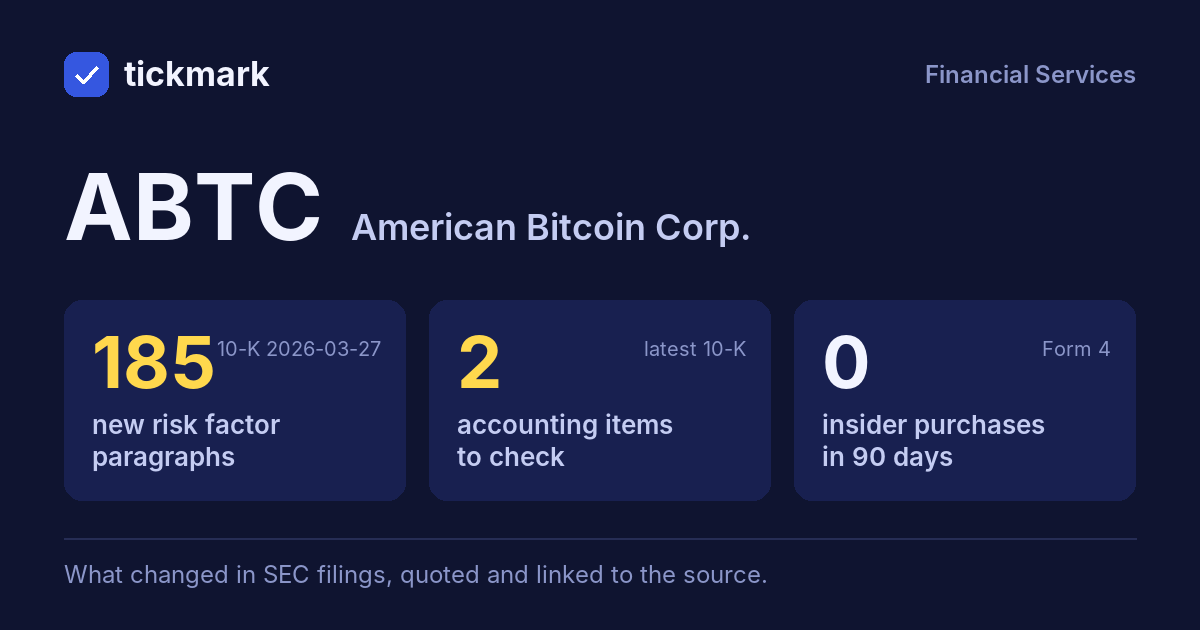
ABTCAmerican Bitcoin

Crypto · Financial Services · Nasdaq
Compare with peers → Embed
The 10-K against last year's

613 changes: 241 added, 285 removed, 87 reworded

10-K Mar 27, 2026 vs Mar 31, 2025
Risk FactorsRedline ↓
86.2%
of the text changed · 20,823 words now
93.1%
of the text changed · 6,096 words now
Legal ProceedingsRedline ↓
86.8%
of the text changed · 742 words now
Accounting PoliciesRedline ↓
87.6%
of the text changed · 6,831 words now

10-K 0001193125-26-127278 (2026-03-27) vs 10-K 0001213900-25-026404 (2025-03-31)

The redline

The paragraph that changed most in each section

Marked against last year's 10-K: cut words struck through, new words highlighted and underlined.

Risk Factors 366 words changed in this paragraph; it is 36% similar to last year's version.
Gryphon’s business is subject to extensive laws, rules, regulations, policies, orders, determinations, directives, treaties, and legal and regulatory interpretations and guidance, as well as counterparty risk in the markets in which it operates, including regulatory aspects from financial services, federal energy and other regulators, the SEC, the CFTC, credit, crypto asset custody, exchange, and transfer, cross-border and domestic money and crypto asset transmission, consumer and commercial lending, usury, foreign currency exchange, privacy, data governance, data protection, cybersecurity, fraud detection, antitrust and competition, bankruptcy, tax, anti-bribery, economic and trade sanctions, anti-money laundering, and counter-terrorist financing, as well as the same regulatory risks applicable to counterparties, most notably hosting businesses, as well as the recent economic issues and bankruptcies befalling some in this industry. Many of these legal and regulatory regimes were adopted prior to the advent of the internet, mobile technologies, crypto digital assets, and AI, and/or related technologies. As a result, some applicable laws and regulations do not contemplate or address unique issues associated with the crypto economy, are subject to significant uncertainty, and vary widely across U.S. and Canadian federal, state, provincial, and local and international jurisdictions. These legal and regulatory regimes, including the laws, rules, and regulations thereunder, evolve frequently and may be modified, interpreted, and applied in an inconsistent manner from one jurisdiction to another, another and may conflict with one another. Moreover, For example, the complexity Clarity Act was passed by the U.S. House of Representatives in July 2025, which would, if enacted, regulate digital asset markets and evolving digital asset trading platforms in the United States. It is difficult to predict whether, or when, the CLARITY Act or another bill that would regulate digital asset markets and digital asset trading platforms may become law or whether any new law will lead to Congress granting additional authorities to the SEC or other regulators, what the nature of Gryphon’s business such additional authorities might be, how additional legislation and/or regulatory oversight might impact the ability of digital asset markets to function, or how any new regulations or changes to existing regulations might impact the value of digital assets generally and the significant uncertainty surrounding the Bitcoin specifically. The consequences of increased federal regulation of the crypto economy requires Gryphon to exercise its judgment as to whether certain laws, rules, digital assets and regulations apply to us, digital asset activities could have a material adverse effect on our business, financial condition, and it is possible that governmental bodies and regulators may disagree with Gryphon’s conclusions. To the extent Gryphon has not complied with such laws, rules, and regulations, it could be subject to significant fines, revocation results of licenses, limitations on its products and services, reputational harm, and other regulatory consequences, each of which may be significant and could adversely affect its business, operating results, and financial condition. operations.

Source: Item 1A, 10-K 0001193125-26-127278 vs Item 1A, 10-K 0001213900-25-026404

MD&A 235 words changed in this paragraph; it is 32% similar to last year's version.
Mining revenues Loss on digital assets was $227.1 million for the year ended December 31, 2025 compared to gains on digital assets of $509.3 million for the year ended December 31, 2024. In connection with the Transactions on March 31, 2025, Hut 8's Bitcoin remained with Hut 8. As a result, immediately following the effectuation of the Transactions, we held no Bitcoin on our balance sheet. Starting April 1, 2025, we began to build our own strategic Bitcoin reserve. The loss on digital assets for the year ended December 31, 2025 was primarily attributable to the decline in the price of Bitcoin, which decreased from approximately $93,354 as of December 31, 2024 to $20,539,000 approximately $87,498 as of December 31, 2025. Additionally, the price of Bitcoin at the time of Transactions on March 31, 2025 was approximately $82,534 per Bitcoin, which represents a decrease from the price as of December 31, 2024, and resulted in a $112.4 million loss in digital assets recognized for the period of time up to the Transactions during the twelve months ended December 31, 2025. In contrast, gains on digital assets of $509.3 million for the year ended December 31, 2024 from $21,052,000 for the year ended December 31, 2023. The decrease in mining revenues of $513,000 is due to a combination of factors. The average value of bitcoin mined for the year ended December 31, 2024 was $66,000 compared to $29,000 for the year ended December 31, 2023, were driven by an increase in the price of $37,000, or 128%. As of December 31, 2024, the Company had Bitcoin from approximately 8,800 miners compared to approximately 8,300 $42,288 as of December 31, 2023. However, these increases in operational miners and revenue recognized per bitcoin earned were offset by the increase in global hashrate 2023 to approximately $93,354 as well as the 50% reduction in block rewards due to the halving event in April of December 31, 2024. .

Source: Item 7, 10-K 0001193125-26-127278 vs Item 7, 10-K 0001213900-25-026404

Accounting Policies 203 words changed in this paragraph; it is 34% similar to last year's version.
In November 2024, January 2025, the FASB issued Update ASU 2024-03, “Income Statement - Reporting 2025-01, Income Statement—Reporting Comprehensive Income - Expense Income—Expense Disaggregation Disclosures (Subtopic 220-40)”. 220-40): Clarifying the Effective Date ("ASU 2025-01"). ASU 2025-01 was issued to clarify the effective date for Update ASU 2024-03, Income Statement—Reporting Comprehensive Income—Expense Disaggregation Disclosures (Subtopic 220-40): Disaggregation of Income Statement Expenses ("ASU 2024-03"). ASU 2024-03 requires public business entities to provide additional disclosures in the notes to financial statements, disaggregating specific expense categories within relevant income statement captions. The amendments require the disclosure of specified information about certain costs and expenses including prescribed categories include purchases of inventory, employee compensation, depreciation, intangible asset amortization, and depreciation, depletion, and amortization recognized as part of oil and gas related to oil-and-gas producing activities. It also requires ASU 2024-03 is effective for the disclosure of a qualitative description of the amounts remaining in relevant expense captions that are not separately disaggregated quantitatively as well as the total amount of selling expenses and, in first annual reporting periods, an entity’s definition of selling expenses. The standard will be effective for fiscal years period beginning after December 15, 2026, and interim periods within annual reporting periods beginning after December 15, 2027. We are Early adoption is permitted. The Company is currently evaluating assessing the impact that of adopting the adoption of the provisions of the ASU will have on our consolidated financial statements. We are currently evaluating the impact that the adoption of the provisions of the ASU will have on our consolidated financial statements. standard.

Source: Item 8, Note 2 – Significant accounting policies and recent accounting pronouncements, 10-K 0001193125-26-127278 vs 10-K text, Note 1 – ORGANIZATION AND SUMMARY OF SIGNIFICANT ACCOUNTING POLICIES, 10-K 0001213900-25-026404

Legal Proceedings 126 words changed in this paragraph; it is 83% similar to last year's version.
The Company is subject at times to various claims, lawsuits, and governmental proceedings relating to the Company’s business and transactions arising in the ordinary course of business. The Company cannot predict the final outcome of such proceedings. Where appropriate, the Company vigorously defends such claims, lawsuits, and proceedings. Some of these claims, lawsuits lawsuits, and proceedings seek damages, including, including consequential, exemplary, or punitive damages, in amounts that could, if awarded, be significant. Certain of the claims, lawsuits, and proceedings arising in the ordinary course of business are covered by the Company’s insurance program. The Company maintains the property and various types of liability insurance in an effort to protect the Company from such claims. In terms of any matters where there is no insurance coverage available to the Company, or where coverage is available and the Company maintains a retention or deductible associated with such insurance or elects not to purchase such insurance, the Company may establish an accrual for such loss, retention, or deductible based on currently current available information. In accordance with accounting guidance, if it is probable that an asset has been impaired or a liability has been incurred as of the date of the financial statements, statements and the amount of loss is reasonably estimable, then an accrual for the cost to resolve or settle these claims is recorded by the Company in the accompanying balance sheets. Combined Balance Sheets. If it is reasonably possible that an asset may be impaired as of the date of the financial statement, then the Company discloses the range of possible loss. Expenses related to the defense of such claims are recorded by the Company as incurred and included in the accompanying statements Combined Statements of operations. Operations and Comprehensive Income (Loss). Management, with the assistance of outside counsel, may, may from time to time adjust such accruals according to new developments in the matter, court rulings, or changes in the strategy affecting the Company’s defense of such matters. On the basis The Company has established an accrued liability for certain legal and regulatory proceedings. The possible loss or range of current information, the Company does not believe there is a reasonable possibility that other than with regard to the Class Action described below, any material loss, loss resulting from such litigation and regulatory proceedings, if any, will result from in excess of the amounts accrued is inherently unpredictable and uncertain. Consequently, no reasonable estimate can be made of any claims, lawsuits, and proceedings to which possible loss or range of loss in excess of the Company is subject to either individually, or in the aggregate. accrual.

Source: Item 3, via Note 15 – Commitments and contingencies, 10-K 0001193125-26-127278 vs Item 3, via Note 8 – COMMITMENTS AND CONTINGENCIES, 10-K 0001213900-25-026404

Every change, by type

Sentences and paragraphs added, removed or reworded

Sentences and paragraphs of ABTC's Risk Factors and MD&A, 10-K 2026-03-27 against 10-K 2025-03-31. Each links to the text at sec.gov.

RemovedRisk Factors
Described below are certain risks to our business and the industry in which we operate. You should carefully consider the risks described below, together with the financial and other information contained in this Annual Report on Form 10-K and in our other public disclosures. If any of the following risks actually occurs, our business, financial condition, results of operations, cash flows and prospects could be materially and adversely affected. As a result, our future results could differ materially from historical results and from guidance we may provide regarding our expectations of our future financial performance, and the trading price of our common stock could decline.

Read it in 10-K 2025-03-31 at sec.gov ↗

RemovedRisk Factors
The market price of bitcoin is extremely volatile, and in fiscal 2024 the price range of bitcoin was between approximately $39,000 and $106,000. The cost to mine a bitcoin is independent of the then current price of bitcoin, so when bitcoin prices are low, the cost per coin to mine may consume much of our available cash, limiting our ability to invest in expansion, upgrade mining equipment and infrastructure or fund other strategic initiatives. Additionally, because our revenue is primarily derived from mining bitcoin, our profitability fluctuates in direct correlation with bitcoin price movements. A decrease in bitcoin’s price results in a corresponding decrease in the value of the bitcoin we mine, reducing our revenues and profitability on a dollar-for-dollar basis. Given the volatility of bitcoin prices, we are unable to accurately predict our future growth trajectory or reliably forecast our revenue and profitability for any given reporting period. Our ability to expand our operations depends on our assumptions regarding bitcoin’s future price. If those assumptions are incorrect, and bitcoin prices fail to reach or sustain levels high enough to justify our capital expenditures, we may be unable to generate sufficient revenue to maintain profitability or execute our growth strategy, which could materially and adversely impact our business, financial condition and results of operations.

Read it in 10-K 2025-03-31 at sec.gov ↗

RemovedRisk Factors
Gryphon’s success depends upon the value of Bitcoin; the value of Bitcoin may be subject to pricing risk and has historically been subject to wide swings.

Read it in 10-K 2025-03-31 at sec.gov ↗

RemovedRisk Factors
Gryphon’s operating results depend on the value of Bitcoin because it is the only cryptocurrency that Gryphon mines. Specifically, Gryphon’s revenues from its bitcoin mining operations are based on two factors: (1) the number of bitcoin rewards Gryphon successfully mines and (2) the value of Bitcoin. In addition, Gryphon’s operating results are directly impacted by changes in the value of Bitcoin, because under the value measurement model, impairment of Bitcoin and realized gains will be reflected in Gryphon’s statement of operations (i.e., Gryphon will be marking bitcoin to fair value each closing period). This means that Gryphon’s operating results will be subject to swings based upon increases or decreases in the value of Bitcoin. Further, Gryphon’s current application-specific integrated circuit, or ASIC, machines (which Gryphon refers to as “miners”) are principally utilized for mining bitcoin and cannot mine other cryptocurrencies, such as ether, that are not mined utilizing the “SHA-256 algorithm.” If other cryptocurrencies were to achieve acceptance at the expense of Bitcoin causing the value of Bitcoin to decline, or if Bitcoin were to switch its proof of work algorithm from SHA-256 to another algorithm for which Gryphon’s miners are not specialized, or the value of Bitcoin were to decline for other reasons, particularly if such decline were significant or over an extended period of time, Gryphon’s operating results would be adversely affected, and there could be a material adverse effect on Gryphon’s ability to continue as a going concern or to pursue Gryphon’s strategy at all, which could have a material adverse effect on Gryphon’s business, prospects or operations, and harm investors.

Read it in 10-K 2025-03-31 at sec.gov ↗

RemovedRisk Factors
Bitcoin market prices, which have historically been volatile and are impacted by a variety of factors (including those discussed below), are determined primarily using data from various exchanges, over-the-counter markets and derivative platforms. Furthermore, such prices may be subject to factors such as those that impact commodities, more so than business activities, which could be subjected to additional influence from fraudulent or illegitimate actors, real or perceived scarcity, and political, economic, regulatory or other conditions. Pricing may be the result of, and may continue to result in, speculation regarding future appreciation in the value of Bitcoin, which inflates and makes its market prices more volatile or creates “bubble” type risks for Bitcoin.

Read it in 10-K 2025-03-31 at sec.gov ↗

RemovedRisk Factors
The market price of bitcoin is subject to numerous uncertainties, including evolving regulatory frameworks, commercial adoption trends and technical risks, any of which could negatively impact its value. Regulatory treatment of digital assets remains uncertain in various jurisdictions, and new regulations, enforcement actions, or interpretations by governmental authorities could diminish bitcoin’s appeal, restrict its use or otherwise depress its market price.

Read it in 10-K 2025-03-31 at sec.gov ↗

Show the other 16
RemovedRisk Factors
Even if bitcoin adoption increases in the short term, there is no guarantee that this growth will be sustained. Since bitcoin exists solely as digital records on the Bitcoin blockchain, its value is also susceptible to technical risks, including:

Read it in 10-K 2025-03-31 at sec.gov ↗

RemovedMD&A
Information regarding market and industry statistics contained in this Report is included based on information available to the Company that the Company believes is accurate. It is generally based on industry and other publications that are not produced for purposes of securities offerings or economic analysis. The Company has not reviewed or included data from all sources and cannot assure investors of the accuracy or completeness of the data included in this Report. Forecasts and other forward-looking information obtained from these sources are subject to the same qualifications and the additional uncertainties accompanying any estimates of future market size, revenue and market acceptance of products and services. The Company does not assume any obligation to update any forward-looking statement. As a result, investors should not place undue reliance on these forward-looking statements.

Read it in 10-K 2025-03-31 at sec.gov ↗

RemovedMD&A
Founded in October 2020, Gryphon has traditionally been a bitcoin mining company based in Las Vegas, Nevada. Gryphon launched its mining operations in September 2021 upon the receipt of the first of 12 batches of 600 Bitmain S19j Pro Antminers. Gryphon’s current revenue model is to mine and hold bitcoin, and then sell only the bitcoin that is necessary to pay its operating expenses and to reinvest in operational expansion. The bitcoin that is sold to pay operating expenses and to reinvest in operational expansion is typically sold within 24-hours of receipt.

Read it in 10-K 2025-03-31 at sec.gov ↗

RemovedMD&A
Gryphon operates approximately 9,660 bitcoin ASIC mining computers, referred to as “miners,” from Bitmain Technologies Limited (“Bitmain”) that Gryphon has installed at third-party hosted mining data centers located in New York and Pennsylvania. Revenue generated by the mining of bitcoin is measured on a dollar per megawatt-hour (“MWh”) basis and is variable based on the price of Bitcoin, the measure of difficulty, transaction volume and global hash rates.

Read it in 10-K 2025-03-31 at sec.gov ↗

RemovedMD&A
For the year ended December 31, 2024 and 2023, Gryphon mined approximately 334 and 739 bitcoins, respectively. While Gryphon does not have any plans to acquire digital assets other than bitcoin, it may do so in the future.

Read it in 10-K 2025-03-31 at sec.gov ↗

RemovedMD&A
2024 2023 Mining revenues $20,539,000 $21,052,000 Bitcoin mined 334 739 Value of one mined bitcoin $61,494 $28,487 Cost of revenues (excluding depreciation) $15,818,000 $13,462,000 Cost to mine one bitcoin $47,359 $18,217 Total Bitcoin Equivalent Coins Generated (Total BTC Equivalent)* 334 771 Breakeven of Total BTC Equivalent $47,359 $17,460

Read it in 10-K 2025-03-31 at sec.gov ↗

RemovedMD&A
The breakeven analysis is computed by taking the cost of revenues for the given period and dividing that sum by the number of Bitcoin Equivalent Coins Generated during the same period. For instance, in (2024 the $15,818,000 cost of revenues is divided by the 334 Bitcoin Equivalent Coins Generated, resulting in an average of $47,359 per coin). The BTC Equivalent calculation labeled as “Total BTC Equiv” in the table, is determined by combining Gryphon’s bitcoin-mined during the period with the bitcoin equivalent amount of revenue earned from the Sphere MSA. To calculate the latter, the revenue earned from the Sphere MSA during the period is divided by the average bitcoin price as quoted by the Principal Market for that same period (labeled as “MSA BTC Equiv” in the table). The breakeven analysis is an operational metric that does not take capital expenditures or financing mechanics into consideration. The calculation only considers direct operational costs, such as electricity and hosting. The mining equipment was originally financed primarily through equity capital raises and cash flows resulting from the sale of bitcoin generating by mining operations. As of December 31, 2024, there were no financing agreements outstanding related to financing of mining equipment.

Read it in 10-K 2025-03-31 at sec.gov ↗

RemovedMD&A
The breakeven analysis is a non-GAAP measure, similar to the way the gold industry reports gold-equivalent ounces to provide uniform measure of various revenue streams from different commodities (such as gold, copper, nickel, etc.). Much like the gold industry, the purpose of this calculation is to offer the reader a bitcoin-equivalent datapoint for Gryphon’s two revenue streams within the context of its primary revenue stream. This enables readers to easily compare Gryphon’s operations with other bitcoin mining companies. By dividing the total cost of revenues by the number of bitcoin-equivalent coins generated, one arrives at the breakeven point for total BTC equiv. Therefore, if Gryphon sells a bitcoin at the same price, it would have achieved a breakeven.

Read it in 10-K 2025-03-31 at sec.gov ↗

RemovedMD&A
The breakeven cost of mining bitcoin is influenced primarily by two factors. First, the cost of electricity sourced from Gryphon’s hosting providers, which encompasses a combination of pass-through market electricity prices and profit-sharing arrangements. Second, it is affected by the global hashrate of the Bitcoin network. Over the twelve-month period through the fourth quarter of 2024, the cost of electricity plus the profit-sharing arrangement in place with the hosting provider has fluctuated due to seasonality from $0.0720 per kilowatt hour in the fourth quarter of 2023 to $0.0447 per kilowatt hour in the fourth quarter of 2024, reaching a high of $0.0905 per kilowatt hour during Q1 of 2024. In addition, the global hashrate of the Bitcoin network has shown a consistent upward trend, with sequential increases of 21.6%, 19.0%, 6.8% and 4.3% over the last four quarters ending December 31, 2024. This increase in the global hashrate has led to fewer bitcoins being mined for the same amount of energy consumption. The combined effect of these changes in the two key cost drivers has resulted in an increase in the overall breakeven level as of December 31, 2024 compared to December 31, 2023.

Read it in 10-K 2025-03-31 at sec.gov ↗

RemovedMD&A
On December 1, 2024, Gryphon entered into a Co-Location Mining Services Agreement (the “Blockfusion Agreement”), with Blockfusion USA, Inc. (“Blockfusion”) for hosting 3,780 of its bitcoin miners at Blockfusion’s facility in Niagara Falls, New York. Pursuant to the Blockfusion Agreement, the Company is entitled to 12 MW of power at a cost of $156,000 per month, as well as certain other fees set forth in the agreement. At signing, the Company paid an initial $156,000 facility fee. In addition, the Company will be required to (i) by January 31, 2025, maintain a cash deposit or (ii) by January 27, 2025, an irrevocable standby letter of credit with Blockfusion’s energy provider, in each case in the amount of $1,200,000. As of the filing date, the Company has not completed this payment and the amount is currently outstanding. The Blockfusion Agreement has a term of twelve months and automatically renews for subsequent one-month terms, until terminated on thirty days’ notice. Subsequent to December 31, 2024, the Company has delivered 3,996 bitcoin miners to Blockfusion.

Read it in 10-K 2025-03-31 at sec.gov ↗

RemovedMD&A
On January 3, 2025, Gryphon entered into a Master Co-Location Agreement (the “Mawson Agreement”) with Mawson Hosting LLC (“Mawson”) with a right to host up to 5,880 miners in Mawson’s facility in Midland, Pennsylvania. Pursuant to the Mawson Agreement, the Company is entitled to 20 MW of power at a cost of approximately $23.50 per MW/hour paid monthly with a minimum fee of approximately $165,521 per month, as well as certain other fees set forth in the agreement. The Mawson Agreement has an initial term of one year and may be terminated on sixty days’ notice. Subsequent to December 31, 2024, the Company has delivered 6,719 bitcoin miners to Mawson.

Read it in 10-K 2025-03-31 at sec.gov ↗

RemovedMD&A
On May 25, 2022, Anchorage entered into the Anchorage Loan Agreement with Gryphon Opco, an indirect wholly owned subsidiary of the Company, pursuant to which Anchorage loaned Gryphon Opco the principal amount of 933.333333 bitcoin. Gryphon Opco’s obligations under the Anchorage Loan Agreement were secured by certain equipment and software rights of Gryphon Opco and were guaranteed by Gryphon.

Read it in 10-K 2025-03-31 at sec.gov ↗

Next Related parties →