Form 10-K for the Year Ended December 31, 2023
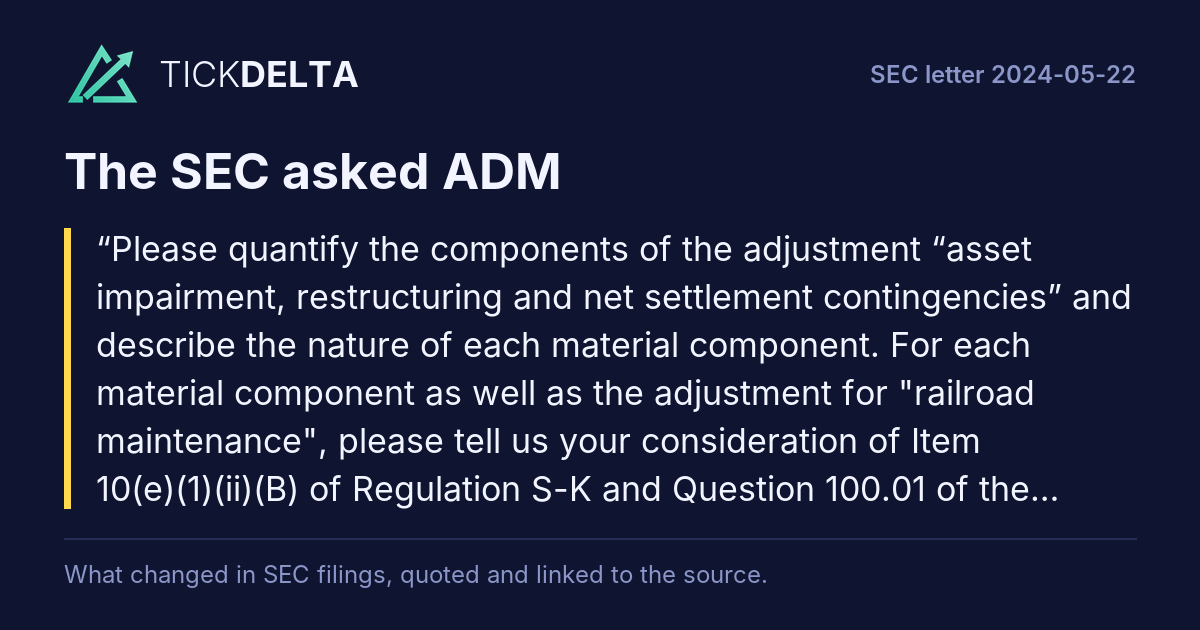
Please quantify the components of the adjustment “asset impairment, restructuring and net settlement contingencies” and describe the nature of each material component. For each material component as well as the adjustment for "railroad maintenance", please tell us your consideration of Item 10(e)(1)(ii)(B) of Regulation S-K and Question 100.01 of the SEC's Compliance & Disclosure Interpretations on Non-GAAPRest of the question
Financial Measures in determining the costs do not represent normal, recurring operating costs.
In the 10-K, the
Company reported “Asset impairment, restructuring, and net settlement contingencies (net of taxes)” on page 42 in the reconciliation of net earnings to adjusted net earnings and diluted EPS to adjusted EPS, and “Asset impairment, restructuring, and net settlement contingencies” on page 43 in the reconciliation of net earnings to adjusted EBITDA.Read in the reply ↗Rest of the answer
The components of these adjustments are described and quantified in the table below:
2023
2022
Description
In millions
Per
Share
Impairment – PPE, long lived assets, exit of businesses, and recovery on assets impacted by Ukraine war (net of tax of $43M in 2023 and $14M in 2022)
$261
$0.48
$63
$0.11
Restructuring – Severance (net of tax of $7M in 2023 and $8M in 2022)
0.05
0.04
Settlement – Contingencies for non-routine matters (net of tax of $7M in
2023 and $11M in 2022)
0.06
Total
$310
$0.57
$115
$0.21
Consistent with the guidance set forth in Question 100.01 of the SEC’s Non-GAAP Compliance and Disclosure Interpretations, the adjustment items in the table above were not viewed as normal, recurring, operating expenses necessary to operate our business, or indicative of underlying business performance. These adjustment items are discrete and separate adjustments, outside of the ordinary course of our continuing operations. We deemed the adjustment items necessary to provide additional information about the
Company’s operations, allowing for better evaluation of our underlying business performance and better period-to-period comparability. Presentation of these adjustments also enables investors to view our business’ performance in the same manner as it is viewed by the Company. Further, as per Question 102.03 of the SEC’s
Non-GAAP Compliance and Disclosure Interpretations, we do not describe such excluded costs as non-recurring, infrequent or unusual, and, therefore, do not view any of these adjustments as violating the prohibition in Item 10(e)(1)(ii)(B) of Regulation S-K.
On page
43 of the 10-K, there is an adjustment for “Railroad maintenance expense.” This item has been included in the reconciliation of net earnings to adjusted EBITDA because this expense is directly associated with 45G tax credits recorded as a benefit to the “Income tax expense” financial statement caption. Failure to exclude this expense would not provide for a proper reconciliation of net earnings to adjusted EBITDA, as the sole purpose of this expense was to realize the income tax credit, which by definition is excluded from EBITDA and adjusted EBITDA. As such, the adjustment for “Railroad maintenance expense” is consistent with the guidance in Question 100.01 of the SEC’s Non-GAAP Compliance and Disclosure Interpretations.
First report after the company's reply of 2024-06-12: 10-Q filed 2024-07-30 ↗, against the 10-Q filed 2024-04-30 ↗.
Tickdelta does not hold the text of both reports, so they are not compared here.
We note your presentation of segment operating profit, adjusted segment operating profit and segment adjusted EBITDA, which all appear to be non-GAAP measures. Please tell us how you determined these measures comply with Rule 100(b) of Regulation G. We note that the measures remove corporate overhead and other items, which appear to be normal, recurring, cash operating expenses necessary to operate your business.Rest of the question
Refer to Question 100.01 of the SEC's Non-GAAP Compliance and Disclosure Interpretations. Please revise future filings to eliminate segment total measures or tell us how you intend to revise them to comply with Regulation G and Item 10(e) of Regulation S-K. This comment also applies to your earnings releases filed on Form 8-K.
We respectfully note the Staff’s comment. In presenting segment operating profit, adjusted segment operating profit, adjusted EBITDA and adjusted EBITDA by segment, we noted that none of our adjustments from GAAP to arrive at these non-GAAP measures were expressly prohibited by Regulation G or Item 10(e) of Regulation S-K. While we acknowledge that some of the adjustments from GAAP to arrive at these non-GAAP measures include certain cash operating expenses, the adjustments are not for normal, recurring, cash operating expenses necessary to operate our business.Read in the reply ↗Rest of the answer
These non-GAAP measures provide additional information about the Company’s operations, allowing for better evaluation of our underlying business performance and better period-to-period comparability. Further, as per Question 102.03 of the SEC’s Non-GAAP Compliance and Disclosure Interpretations, we do not describe such excluded costs as non-recurring, infrequent or unusual. More broadly, these measures are presented alongside GAAP measures of performance, and we note that these non-GAAP measures are not replacements for the most directly comparable amounts reported under GAAP. In total, management is of the view that these non-GAAP measures, which are used by management in managing the business, offer investors meaningful additional insights into our operating performance.
With respect to segment operating profit, we note that it is presented in our financial statement footnotes, in accordance with ASC 280. In Note 17 to the Company’s consolidated financial statements included in the 10-K, we present total segment operating profit with a reconciliation to earnings before income taxes, in accordance with ASC 280-10-50-30(b). We also note the guidance in Question 104.04 of the SEC’s Non-GAAP Compliance and Disclosure Interpretations. In future filings, in sections outside the ASC 280 required reconciliation in the footnote, we will clearly identify segment operating profit as a non-GAAP measure, precede the presentation of segment operating profit with earnings before income taxes and then provide the requisite non-GAAP reconciliation.
Similarly, we present adjusted segment operating profit to further illustrate the Company’s performance by eliminating the effects of gains on the sale of assets and impairment, restructuring, and certain net settlement contingencies on the Company’s segment operating profit. These adjustment items are not normal, recurring, cash operating expenses necessary to operate our business and are, therefore, not misleading from the perspective of management. Management considers these adjustment items in managing our business and views them as discrete and separate adjustments, outside of the ordinary course of our continuing operations. As such, these adjustments are non-routine in the views of management and, therefore, are reasonable items for which to adjust in arriving at adjusted segment operating profit.
With respect to adjusted EBITDA, we note that we present entity-wide adjusted EBITDA and adjusted
EBITDA by segment. For clarity, we do not present an aggregate “segment adjusted EBITDA” measure. Similar to other companies, we calculate adjusted EBITDA as earnings before interest, taxes, depreciation and amortization as further adjusted in our case for (i) gains on the sale of assets, (ii) asset impairment, restructuring, and net settlement contingencies, (iii) railroad maintenance expense, and (iv) expenses related to acquisitions. Consistent with the discussion above, none of these adjustments reflect normal, recurring, operating expenses necessary to operate our business. These adjustments are non-routine in the views of management and, therefore, are reasonable items for which to adjust in arriving at adjusted EBITDA.
As it relates to the adjustment for corporate overhead, please note that in our reconciliation of segment operating profit to earnings before income taxes in accordance with ASC 280, the reconciling item labeled “Corporate” includes only unallocated corporate overhead costs. Indeed, a portion of our corporate overhead costs is allocated to our reportable segments and reflected in our segment measures of profitability. Unallocated corporate costs, on the other hand, represent corporate overhead expenses for the benefit of the entire organization which are not directly attributable to or managed by individual businesses. These segment operating profit measures are prepared and presented in accordance with ASC 280, and unallocated corporate overhead is not an expense reflected in our individual segment operating profit measures. Because unallocated corporate overhead costs are included in earnings before income taxes, our reconciliation includes a reconciling adjustment for those unallocated corporate overhead costs, which we will label as “unallocated” in future filings. For purposes of illustrating segment level performance to our investors, we do not show the effect of unallocated corporate overhead on these segment performance measures.
Given our reconciliations of these measures, and the presentation of other entity-wide GAAP measures to illustrate full entity-wide performance, management is of the view that our segment measures of profitability communicate meaningful additional information to investors, do not contain prohibited adjustments under SEC rules and are not misleading.
In future filings, we will ensure that we present the corresponding GAAP measures to segment operating profit (when presented outside the ASC 280 reconciliation), adjusted segment operating profit, adjusted EBITDA and adjusted EBITDA by segment with equal or greater prominence.
First report after the company's reply of 2024-06-12: 10-Q filed 2024-07-30 ↗, against the 10-Q filed 2024-04-30 ↗.
Tickdelta does not hold the text of both reports, so they are not compared here.
Your disclosures indicate that you performed a quantitative goodwill impairment analysis on two reporting units. Please identify for us the goodwill reporting unit beyond Animal Nutrition for which you performed the two-step quantitative assessment and quantify the amount of goodwill allocated to this reporting unit.Rest of the question
Additionally, we note that you used both income and market approaches in determining the fair value of your reporting units. Tell us the relative weighting used for each approach and how you determined such weighting was appropriate. Further, tell us and revise future disclosures to explain how you performed the market approach, including significant estimates and assumptions used.
In addition to the Animal Nutrition reporting unit, the Company performed the two-step quantitative goodwill impairment assessment for the Starches and Sweeteners reporting unit. The carrying value of goodwill allocated to the Starches and Sweeteners reporting unit was $219 million as of
December 31, 2023.
The Company used a combination of the income and market approaches when performing the quantitative assessment of goodwill for the Animal Nutrition reporting unit.Read in the reply ↗Rest of the answer
The Company weighted the income approach with a probability weight of 75%, as it is based on the future business plans and growth estimates for the Company’s Animal Nutrition business and thus considers short-term and long-term cash flow expectations for the business. The market approach was weighted less heavily at 25%, as it represents an estimate of fair value based on market guideline companies for which future growth expectations are not precisely known.
The income approach is predicated upon the value of the estimated future cash flows that a business will generate going forward. The Company used the Discounted Cash Flow (DCF) method under the income approach for the analysis of Animal Nutrition.
The market approach assumes that companies operating in the same industry will share similar characteristics and that values will correlate to those characteristics. Therefore, under the market approach, a comparison of the reporting unit to similar companies whose financial information is publicly available may provide a reasonable basis to estimate the fair value of the reporting unit.
The two forms of the market approach most commonly applied are the Guideline Public Company (GPC) method and the Guideline Merged and Acquired
Company (GMAC) method. The Company utilized the GPC method to estimate the fair value of the Animal Nutrition reporting unit under the market approach. The GMAC method was also considered, but ultimately was not relied upon due to the lack of recent transactions that were directly comparable.
The GPC method provides indications of value based upon the development of valuation multiples of various financial or operational measures calculated using stock prices of publicly traded guideline companies to develop Business Enterprise Value (BEV) multiples. The Company selected guideline public companies to use based on several factors, such as industry classification, geographic region, the specific products and services offered, and customers served. Additionally, quantitative factors such as size, growth, and profitability of the guideline public companies were considered relative to Animal Nutrition. After the guideline public companies were selected, valuation multiples were calculated using information from S&P Capital IQ database as of the valuation date. In the selection of the appropriate market multiples, the Company considered the performance of the business, the size, risks, opportunities, and a comparison of the margins and growth of the Animal Nutrition business compared to the guideline public companies. Based on this analysis, the selected fiscal year 2023 and fiscal year 2024 EBITDA multiples were applied to the corresponding financial metrics for Animal Nutrition and were equally weighted to determine the BEV for Animal Nutrition. The estimated fair value calculated by the GPC method was within 5% of the estimated fair value calculated by the income approach.
The Company acknowledges the Staff’s comments and in future filings will enhance disclosures, as requested, to explain how we performed the market approach, including significant estimates and assumptions used.
We note you have disclosed a correction of certain segment-specific historical financial information. It appears that you are classifying the errors as a revision rather than a restatement. Please explain to us how you determined your disclosure relating to this error is appropriate.Rest of the question
As part of your response, address both quantitative and qualitative factors and tell us how your treatment complies with ASC-250-10-50-7. As part of your response, provide us with your materiality analysis prepared in accordance with SAB Topic 1:M and 1:N.
As disclosed in Note 17 to the Company’s consolidated financial statements included in its 10-K, in connection with the Investigation (as defined in the 10-K), “the Company identified certain intersegment sales for the years ended December 31, 2021 through
2023 that occurred between the Company’s Nutrition segment and the Company’s Ag Services and Oilseeds and Carbohydrate Solutions segments that were not recorded at amounts approximating market.” Separately, as disclosed, “the
Company determined that a portion of the originally reported gross revenues and intersegment revenues of each ofRead in the reply ↗Rest of the answer
the Ag Services and Oilseeds, Carbohydrate Solutions, and Nutrition segments included certain intrasegment revenues (resulting from sales within the segment), and should have included exclusively intersegment revenues (resulting from sales from one segment to the other).”
As explained further below, the Company concluded that these were immaterial disclosure errors, and the retrospective correction thereof in the 10-K was viewed as a voluntary revision of an immaterial disclosure error.
ASC-250-10-50-7 provides as follows:
When financial statements are restated to correct an error, the entity shall disclose that its previously issued financial statements have been restated, along with a description of the nature of the error. The entity also shall disclose both of the following:
a.
The effect of the correction on each financial statement line item and any per-share amounts affected for each prior period presented b.
The cumulative effect of the change on retained earnings or other appropriate components of equity or net assets in the statement of financial position, as of the beginning of the earliest period presented.
In Note 17 to the Company’s consolidated financial statements included in the 10-K, the Company disclosed that “[t]he correction of these immaterial errors does not have any impact on the Company’s previously reported Consolidated Statements of Earnings, Consolidated Statements of Comprehensive Income (Loss), Consolidated Balance Sheets, Consolidated Statements of Cash Flows, or Consolidated Statements of Shareholders’ Equity for any of the periods presented below.” As such, the identified errors had no effect on per-share amounts, retained earnings or other appropriate components of equity or net assets, meaning that there was nothing to disclose with respect to these items. We considered the fact that ASC 250-10-50-7 does not expressly apply because the identified errors were determined to be immaterial, and ASC 105-10-05-6 provides that “[t]he provisions of the Codification need not be applied to immaterial items.” Nevertheless, to illustrate the effects of the identified errors on the affected segments, Note 17 to the Company’s consolidated financial statements included in the
10-K set forth the following, in each case, for each of the years ended December 31, 2023, 2022, and 2021:
(i) gross revenues, intersegment revenues and segment operating profit, as originally reported, adjustments to each as a result of the corrections, and revised gross revenues, intersegment revenues, and segment operating profit amounts for the Ag Services and Oilseeds segment;
(ii) result of the corrections, and revised gross revenues, intersegment revenues, and segment operating profit amounts for the Carbohydrate Solutions segment; and
(iii) gross revenues, intersegment revenues and segment operating profit, as originally reported, adjustments as a result of the corrections, and revised gross revenues, intersegment revenues and segment operating profit amounts for the Nutrition segment.
The Company considered the quantitative and qualitative materiality of the identified errors in determining the applicable ASC requirements and voluntary disclosures as documented more fully in a materiality analysis prepared in accordance with SAB Topic 1:M and 1:N.
The Company respectfully advises the Staff that in response to the request for the Company’s materiality analysis prepared in accordance with SAB Topic 1:M and 1:N, the requested document will be provided directly to the Staff by Faegre Drinker Biddle & Reath LLP (“Faegre”) under separate cover on a confidential and supplemental basis pursuant to Rule 12b-4 under the Securities Exchange Act of 1934, as amended (“Rule 12b-4”). In accordance with
Rule 12b-4, such materials are being provided together with a request that these materials be destroyed promptly following completion of the Staff’s review thereof. Such materials are not, and will not be, filed with or deemed to be part of the Company’s Form 10-K, including any amendments thereto. Under separate cover, request for confidential treatment of these materials pursuant to the provisions of 17 C.F.R. §200.83 will be made by Faegre.
First report after the company's reply of 2024-06-12: 10-Q filed 2024-07-30 ↗, against the 10-Q filed 2024-04-30 ↗.
Tickdelta does not hold the text of both reports, so they are not compared here.
We note your inventory accounting policy disclosure which states that certain merchandisable agricultural commodities inventories, including inventories acquired under deferred pricing contracts, are stated at market value. We further note from your segment disclosures, that intersegment sales have been recorded at "amounts approximating market".Rest of the question
Please explain why your intersegment sales differ from market value and how you determine such values.
As disclosed in Note 17 to the Company’s consolidated financial statements included in the 10-K, “Intersegment sales have been recorded using principles consistent with ASC 606, Revenue from Contracts with Customers.” Note 17 also disclosed that the Company identified and corrected certain intersegment sales that were not recorded at amounts approximating market.
Under ASC 606, entities are required to allocate the transaction price to each performance obligation on a relative standalone selling price basis.Read in the reply ↗Rest of the answer
ASC 606-10-32-32 provides that the “standalone selling price is the price at which an entity would sell a promised good or service separately to a customer.” ASC 606-10-32-32 to -34 acknowledge that while the observable price of a good or service is the “best evidence of a standalone selling price,” a standalone selling price is not always readily observable. Where a standalone selling price is not readily observable, ASC 606-10-32-33 provides that an entity shall consider all information reasonably available to the entity to estimate the standalone selling price, including market conditions, entity-specific factors, and information about the customer or class of customer. ASC 606-10-32-34 offers suitable methods for estimating standalone selling prices, including the adjusted market assessment approach, the expected cost plus a margin approach, and the residual approach.
The Company’s intersegment sales involve a number of products, not all of which have market prices (standalone selling prices) that are readily observable. For each product, the Company applies the guidance within the meaning of Topic ASC 606 to allocate the selling price based on the availability of standalone selling prices for such product. For instance, merchandisable agricultural commodities are freely traded and have quoted market prices, and may be sold without significant additional processing. As such, intersegment prices of merchandisable agricultural commodities are based on observable market prices. As this comment notes, the Company also uses observable market data to state the fair value of certain merchandisable agricultural commodities inventories, which is based on the separate guidance set forth in ASC 820, Fair Value Measurement. By contrast, certain processed products sold on an intersegment basis generally are not freely traded and lack observable market prices. When available, the intersegment pricing for processed products is based on readily observable prices sold to the Company’s third-party customers because that is the “best evidence” under ASC 606. However, for processed products where a standalone selling price is not readily observable, the Company estimates standalone selling prices using the other suitable methods under ASC 606 as described above. As a result and in recognition of the range of products sold on an intersegment basis, some of which do not have observable market prices, the Company recorded intersegment sales using principles consistent with ASC 606.
First report after the company's reply of 2024-06-12: 10-Q filed 2024-07-30 ↗, against the 10-Q filed 2024-04-30 ↗.
Tickdelta does not hold the text of both reports, so they are not compared here.
Your Full-Year 2023 Highlights discloses segment operating profit, adjusted segment operating profit and trailing four-quarter average adjusted return on invested capital which are all non-GAAP measures. Please disclose the most directly comparable GAAP measure with equal or greater prominence, whenever you present a non-GAAP measure. Refer to Item 10(e)(1)(i)(A) of Regulation S-K.
The Company acknowledges the Staff’s comments and will modify future filings as necessary in accordance with this comment.
We trust that this letter responds adequately to the Staff’s concerns. If we can facilitate the Staff’s review of this response, or if the
Staff has any questions on any of the information set forth herein, please do not hesitate to contact me at 217/451-3144 or Molly.StraderFruit@adm.com. Read in the reply ↗
First report after the company's reply of 2024-06-12: 10-Q filed 2024-07-30 ↗, against the 10-Q filed 2024-04-30 ↗.
Tickdelta does not hold the text of both reports, so they are not compared here.
We note you disclose an amount of “Gross Revenues” for each of your reportable segments, in addition to “Revenues from external customers” and “Intersegment Revenues”. Please tell us why you disclose “Gross Revenues” for each of your reportable segments and your basis for disclosure under ASC 280.
We presented “Gross Revenues” for each of our reportable segments as a supplemental revenue disclosure, in addition to “Revenues from external customers” and “Intersegment revenues.” We note that ASC 280 requires the latter two disclosures. The amount of “Gross Revenues” reflects the total amount of revenues from external customers and intersegment revenues that are generated through each of our reportable segments. In light of the Staff’s comment, though, we have decided to discontinue the reporting of “Gross Revenues” for each of our reportable segments in future filings. Read in the reply ↗
First report after the company's reply of 2024-09-30: 10-Q filed 2024-11-18 ↗, against the 10-Q filed 2024-04-30 ↗.
Tickdelta does not hold the text of both reports, so they are not compared here.
ASC 280-10-50-30(b) requires the total of the reportable segments’ measures of profit or loss be reconciled to the public entity’s consolidated income before income taxes and discontinued operations. In this regard, we note your reconciliations do not total the reportable segments’ amounts as the starting point, but present an amount of “Total segment operating profit” that includes the reportable segments, “Other”Rest of the question
and certain reconciling items. Please revise your reconciliations accordingly. Further, “Total segment operating profit” does not appear to be required by US GAAP, and accordingly, appears to be a non-GAAP measure that should be removed. If you intend to continue disclosing this measure outside the financial statements, such as on page 40, tell us how you have complied with Item 10(e) of Regulation S-K and Regulation G, as applicable. Please similarly revise other required reconciliations, such as reportable segments’ revenues and assets, to start with the total of the reportable segments’ amounts. See ASC 280-10-5030(a), (c), and (d).
We respectfully acknowledge the Staff’s comment. We are preparing updates to our segment footnote presentation in connection with the upcoming effectiveness of the updates to Accounting Standards Codification 280, which we will reflect in our upcoming Form 10-K for fiscal year 2024. In connection with those updates, we will further revise our reconciliation of the total of each reportable segment’s measures of operating profit or loss to the Company’s consolidated income before income taxes (presented as “Earnings before income taxes” in the
Company’s consolidated financial statements)Read in the reply ↗Rest of the answer
by:
i.
presenting “Total segment operating profit” as equal to the sum of the three reportable segments’ measures of profit or loss (i.e. as a sum of segment operating profit of each of Ag Services and Oilseeds, Carbohydrate Solutions, and Nutrition); and ii.
then presenting “Other” and certain reconciling items beneath “Total segment operating profit” to arrive at, and to reconcile “Total segment operating profit” to, “Earnings before income taxes.”
We will similarly revise our reconciliations of the reportable segments’ amounts for every other significant item of information disclosed in the segment footnote, including the total reportable segments’ revenues, assets and other significant items. For example, we will include a “Total segment revenues” and “Total segment assets” subtotal for the total of the reportable segments’ revenues and assets, respectively, followed by any applicable reconciling items to arrive at, and to reconcile to, corresponding amounts in the Company’s consolidated financial statements.
As reflected in our most recent Form 10-Q and earnings release for the second quarter of 2024, we have revised our presentation of “Total segment operating profit” outside of the financial statements to treat such measure as a non-GAAP financial measure that is presented after, and reconciled to, “Earnings before income taxes,” the most directly comparable GAAP measure. In our upcoming Form 10-K for fiscal year 2024, we will, of course, make any necessary conforming changes to reconciliations of “Total segment operating profit” to “Earnings before income taxes” that are presented outside of the financial statements to align with the reconciliation-related changes discussed in the preceding paragraph.
I trust that this letter responds adequately to the Staff’s concerns. If we can facilitate the
Staff’s review of this response, or if the Staff has any questions on any of the information set forth herein, please do not hesitate to contact me at 217/451-3144 or Molly.StraderFruit@adm.com.
First report after the company's reply of 2024-09-30: 10-Q filed 2024-11-18 ↗, against the 10-Q filed 2024-04-30 ↗.
Tickdelta does not hold the text of both reports, so they are not compared here.
Please note, we are evaluating your response to our prior comment number 4 and we may have further comments.
No numbered answer found in the reply. Read the reply ↗
First report after the company's reply of 2024-09-30: 10-Q filed 2024-11-18 ↗, against the 10-Q filed 2024-04-30 ↗.
Tickdelta does not hold the text of both reports, so they are not compared here.
We have considered your responses to our prior comment number 4 in our letter dated May 22, 2024. Based on the representations of the Company, we do not agree with your method of correction for errors in certain segment financial information since we believe these errors are material to the Company’s previously issued financial statements.Rest of the question
Please amend your previously filed Form 10-K for the fiscal year ended December 31, 2023, and subsequently filed Forms 10-Q to restate your consolidated financial statements to correct the identified errors and provide the disclosures required by ASC 250-10-50. As part of your amendments, please revisit your controls and procedures evaluation to determine whether any additional control 1. deficiencies exist and whether there has been any change in the assessed severity of control deficiencies that have already been identified.
On behalf of our client, Archer-Daniels-Midland Company (the “Company”), we are writing to respond to questions you asked during our October 9, 2024 call pertaining to the Securities and Exchange Commission staff’s May 22, 2024 and
September 5, 2024 comment letters regarding the Company’s Form 10-K for its fiscal year ended December 31, 2023 (the “10-K”), filed on
March 12, 2024. This letter supplements the Company’s letters to you dated June 12, 2024 and September 30, 2024.
Your questions focused on the Company’s SAB No.Read in the reply ↗Rest of the answer
99 Analysis memorandum, dated March 9, 2024 (the “SAB 99 Memo”), which was delivered to you confidentially on June 13, 2024 pursuant to 17 C.F.R. § 200.83. Below, we write
(A) in response to the follow-up questions raised during our discussion on which we indicated we would submit a supplemental writing and (B) to share additional details regarding the Company’s identification of some new errors in its reporting of intersegment sales that we previewed during our October 9 call.
A.
Responses to Follow-up Questions from October 9, 2024 Call
Rule 83 Confidential Treatment Request by Archer-Daniels-Midland Company Request #1
[**].
Archer-Daniels-Midland Company respectfully requests that the information contained in Request #1 be treated as confidential information and that the Commission provide timely notice to Molly Strader Fruit, Vice President, Corporate Controller, Archer-Daniels-Midland Company, 77 W. Wacker Drive,
Chicago, IL 60601, phone 312-634-8233, before it permits any disclosure of the bracketed information contained in Request #1.
B.
Additional Updates Regarding New Error Correction Matter
Rule 83 Confidential Treatment Request by Archer-Daniels-Midland Company Request #2 that the information contained in Request #2 be treated as confidential information and that the Commission provide timely notice to Molly Strader Fruit, Vice President, Corporate Controller, Archer-Daniels-Midland Company, 77 W. Wacker Drive,
Chicago, IL 60601, phone 312-634-8233, before it permits any disclosure of the bracketed information contained in Request #2.
* * * * *
We trust that the responses above answer your questions, but please contact me if it would be helpful to reconvene on a call to discuss in greater detail.
Best Regards,
/S/ MEREDITH B. CROSS
Appendix:
Rule 83 Confidential Treatment Request by Archer-Daniels-Midland Company Request #3
[**] that the information contained in Request #3 be treated as confidential information and that the Commission provide timely notice to Molly Strader Fruit, Vice President, Corporate Controller, Archer-Daniels-Midland Company, 77 W. Wacker Drive,
Chicago, IL 60601, phone 312-634-8233, before it permits any disclosure of the bracketed information contained in Request #3.
First report after the company's reply of 2024-11-12: 10-Q filed 2024-11-18 ↗, against the 10-Q filed 2024-04-30 ↗.
Tickdelta does not hold the text of both reports, so they are not compared here.
Also in this review: request for more time, 2024-05-29, request for more time, 2024-09-09, company letter, 2024-11-18, closing letter, 2024-12-18