ADPAutomatic Data Processing
In 1949, our founders established ADP with a simple, innovative idea: help clients focus on their business by solving their payroll challenges. 10-K, Item 1
- Headquarters
- Roseland, NJ
- CEO
- Maria Black
- Next results
- around Jan 27, 2027
6 paragraphs in Risk Factors of the 10-K filed Aug 5, 2026 with nothing like them in the 10-K filed Aug 6, 2025. Quoted exactly. Paragraphs that were only edited are under 10-K change.
Compared with the Risk Factors in the latest 10-K of the other 81 Industrials companies: a paragraph with at least half its words the same at another company is called similar, and the companies are listed under it. A paragraph most of them have is marked boilerplate. No line means no other company has one like it. This counts text; it does not say how serious a risk is.
For our PEO to sponsor many of its employee benefit plan offerings, it must qualify as the employer of the WSEs under certain provisions of the Internal Revenue Code and ERISA. Additionally, our PEO’s status as an employer for purposes of ERISA is important because ERISA preempts certain state laws that could limit our PEO’s ability to offer certain benefit plan offerings as we do today. The definition of employer under the Internal Revenue Code and ERISA is not uniform and there is no definitive judicial or legislative interpretation of employer in the context of PEOs. Because many of our PEO employee benefit plan offerings are subject to ERISA, our PEO must administer and operate these plans in accordance with ERISA requirements. We believe that our PEO benefit plans satisfy all applicable ERISA requirements, but if it were determined that the PEO benefit
plans fail to satisfy any such requirements, our PEO would likely be required to modify its current business model, and the PEO could be subject to material fines or penalties. Any such event could have an adverse impact on our financial results and liquidity.
Read in the 10-K ↗
The collection, storage, hosting, transfer, processing, disclosure, use, security and retention and destruction of personal information required to provide our services is subject to federal, state and foreign privacy, data protection and cyber security laws. These laws, which are not uniform, generally do one or more of the following: regulate the collection, storage, hosting,
Read in the 10-K ↗
In addition, laws and regulations covering marketing, advertising, and email, telephone and text messaging communications, including the Telephone Consumer Protection Act, are applicable to our business. Claims that we have violated such laws or regulations could expose us to costly litigation, and if successful, significant statutory damages or other liabilities that could adversely affect our reputation, business, financial condition or results of operations.
Read in the 10-K ↗
of confidential or proprietary information which could limit our ability to protect, or prevent us from protecting, our intellectual property rights.
Read in the 10-K ↗
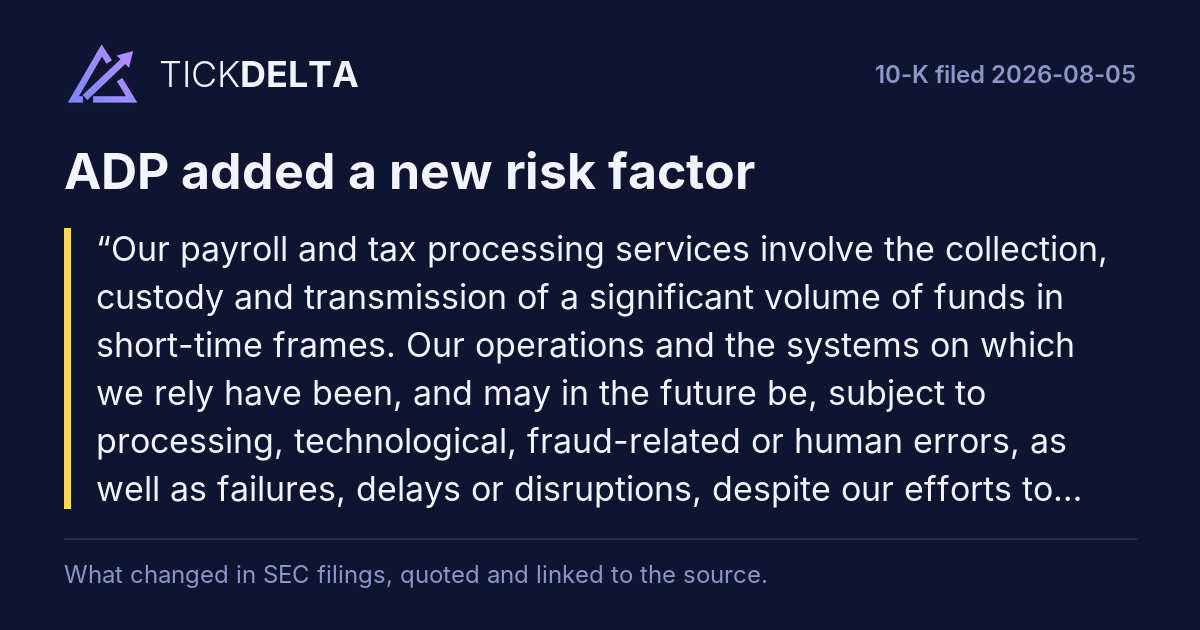
Our payroll and tax processing services involve the collection, custody and transmission of a significant volume of funds in short-time frames. Our operations and the systems on which we rely have been, and may in the future be, subject to processing, technological, fraud-related or human errors, as well as failures, delays or disruptions, despite our efforts to design and implement effective processing systems, controls and procedures. The inability to properly perform our money movement services, operational errors in the performance of these services (including as a result of human or system errors, timing mismatches, settlement failures, unauthorized transactions or failures or delays attributable to financial institutions or other third parties), or our failure to recover any funds from clients could result in significant financial losses, regulatory intervention, fines and penalties, litigation and reputational harm, which could have a material adverse effect on our business, financial condition and results of operations.
Read in the 10-K ↗
New in the latest 10-Q
19 paragraphs in the 10-Q filed Oct 30, 2026 with nothing like them in the 10-Q filed Apr 30, 2026 (at least half the words must differ; new numbers alone do not count). Quoted exactly, grouped by the item heading above them. This is text that changed, not a judgement of how serious it is.
Financial statements and notes
for clients and PEO revenues Interest on funds held for clients 329.3 286.8 PEO revenues (a) 1,805.2 1,684.9 TOTAL REVENUES 5,490.7 5,175.2 EXPENSES: Costs of revenues: Operating expenses 2,584.9 2,461.6 Research and development 251.3 251.2 Depreciation and amortization 129.0 123.3 TOTAL COSTS OF REVENUES 2,965.2 2,836.1 Selling, general, and administrative expenses 1,062.8 1,006.3 Interest expense 148.1 135.4 TOTAL EXPENSES 4,176.1 3,977.8 Other (income)/expense, net (140.3) (110.1) EARNINGS BEFORE INCOME TAXES 1,454.9 1,307.5 Provision for income taxes 329.7 294.5 NET EARNINGS $ 1,125.2 $ 1,013.0 BASIC EARNINGS PER SHARE $ 2.84 $ 2.50 DILUTED EARNINGS PER SHARE $ 2.83 $ 2.49 Basic weighted average shares outstanding 396.5 405.1 Diluted weighted average shares outstanding 397.6 406.5
Read in the 10-Q ↗
Three Months Ended September 30, 2026 2025 ────────────────────────────────────────────────────────────────────────────────────────────────────────────────────────────────────────────────────────────────── Net earnings $ 1,125.2 $ 1,013.0 Other comprehensive income/(loss): Currency translation adjustments (9.9) (15.5) Unrealized net gains/(losses) on available-for-sale securities (855.0) 215.7 Tax effect 193.4 (48.3) Reclassification of realized net (gains)/losses on available-for-sale securities to net earnings 1.4 (1.5) Tax effect (0.3) 0.3 Unrealized net gains/(losses) on cash flow hedging activities — — Tax effect — — Amortization of unrealized net (gains)/losses on cash flow hedging activities 1.4 1.5 Tax effect (0.3) (0.4) Reclassification of pension liability adjustment to net earnings 1.3 1.2 Tax effect (0.3) (0.3) Other comprehensive income/(loss), net of tax (668.3) 152.7 Comprehensive income $ 456.9 $ 1,165.7
Read in the 10-Q ↗
Three Months Ended September 30, 2026 2025 ──────────────────────────────────────────────────────────────────────────────────────────────────────────────────────────────────────────────────────────────────────────────────────────────────── Cash Flows from Operating Activities: Net earnings $ 1,125.2 $ 1,013.0 Adjustments to reconcile net earnings to cash flows provided by operating activities: Depreciation and amortization 155.0 146.7 Amortization of deferred contract costs 302.6 298.6 Deferred income taxes 80.6 64.8 Stock-based compensation expense 67.2 58.7 Bad debt expense 16.4 10.3 Net pension income (2.2) (3.8) Net accretion of discounts and amortization of premiums on available-for-sale securities (50.0) (22.5) Other 2.0 2.5 Changes in operating assets and liabilities: (Increase)/decrease in accounts receivable (21.5) 102.0 Increase in deferred contract costs (263.1) (271.4) Increase in other assets (346.2) (342.4) Decrease in accounts payable (25.6) (38.0) Decrease in accrued expenses and other liabilities (389.4) (376.2) Net cash flows provided by operating activities 651.0 642.3 Cash Flows from Investing Activities: Purchases of corporate and client funds marketable securities (2,665.7) (3,604.6) Proceeds from the sales and maturities of corporate and client funds marketable securities 1,958.5 1,896.0 Capital expenditures (52.7) (46.7) Additions to intangibles (117.1) (94.1) Acquisitions of businesses, net of cash acquired — 0.5 Other (5.4) (13.7) Net cash flows used in investing activities (882.4) (1,862.6) Cash Flows from Financing Activities: Net increase in client funds obligations 1,654.0 573.1 Net cash received/(distributed) from the Internal Revenue Service 50.9 (11.5) Payments of debt (0.3) (0.3) Repurchases of common stock (758.8) (366.0) Net repurchases for stock-based compensation plans and stock purchase plan (27.6) (57.8) Dividends paid (677.0) (626.7) Net proceeds related to reverse repurchase agreements 49.9 214.8 Net proceeds related to commercial paper — 438.5 Other 13.9 — Net cash flows provided by financing activities 305.0 164.1 Effect of exchange rate changes on cash, cash equivalents, restricted cash, and restricted cash equivalents 6.6 (6.7) Net change in cash, cash equivalents, restricted cash, and restricted cash equivalents 80.2 (1,062.9) Cash, cash equivalents, restricted cash, and restricted cash equivalents, beginning of period 10,625.2 5,054.6 Cash, cash equivalents, restricted cash, and restricted cash equivalents, end of period $ 10,705.4 $ 3,991.7 Reconciliation of cash, cash equivalents, restricted cash, and restricted cash equivalents to the Consolidated Balance Sheets Cash, cash equivalents, and restricted cash (a) $ 3,299.2 $ 2,478.0 Restricted cash and restricted cash equivalents included in funds held for clients (b) 7,406.2 1,513.7 Total cash, cash equivalents, restricted cash, and restricted cash equivalents $ 10,705.4 $ 3,991.7 Supplemental disclosures of cash flow information: Cash paid for interest $ 130.7 $ 130.3 Cash paid for income taxes, net of income tax refunds $ 187.2 $ 73.8
Read in the 10-Q ↗
Stock Units Three Months Ended September 30, 2026 Net earnings $1,125.2 $1,125.2 Weighted average shares (in millions) 396.5 0.3 0.8 397.6 EPS $2.84 $2.83 Three Months Ended September 30, 2025 Net earnings $1,013.0 $1,013.0 Weighted average shares (in millions) 405.1 0.4 1.0 406.5 EPS $2.50 $2.49
Read in the 10-Q ↗
(b) Long-term marketable securities are included within other assets on the Consolidated Balance Sheets.
Read in the 10-Q ↗
• Time-Based Restricted Stock Units. Time-based restricted stock units generally vest ratably over 3 years. Awards are generally forfeited if the employee ceases to be employed by the Company prior to vesting.
Read in the 10-Q ↗
Time-based restricted stock units granted to employees with a home country of the United States are settled in stock and cannot be transferred during the vesting period. Time-based restricted stock units granted to employees with a home country outside the United States are generally settled in cash and cannot be transferred during the vesting period. Compensation expense relating to the issuance of share-settled units is measured based on the fair value of the award on the grant date and recognized on a straight-line basis over the vesting period. Compensation expense relating to the issuance of cash-settled units is recorded over the vesting period and is initially based on the fair value of the award on the grant date and is subsequently remeasured at each reporting date during the vesting period based on the change in the ADP stock price. Dividend cash equivalents are paid on share-settled units, and dividend cash equivalents are not paid on cash-settled units.
Read in the 10-Q ↗
• Performance-Based Restricted Stock Units. Performance-based restricted stock units generally vest over a one to three-year performance period and a subsequent service period of up to 38 months. Under these programs, the Company communicates “target awards” at the beginning of the performance period with possible payouts at the end of the performance period ranging from 0 % to 200 % of the “target awards.” Awards are generally forfeited if the employee ceases to be employed by the Company prior to vesting.
Read in the 10-Q ↗
Performance-based restricted stock units cannot be transferred and are settled in either cash or stock, depending on the employee's home country. Compensation expense relating to the issuance of performance-based restricted stock units settled in cash is recognized over the vesting period initially based on the fair value of the award on the grant date with subsequent adjustments to the number of units awarded during the performance period based on probable and actual performance against targets. In addition, compensation expense is remeasured at each reporting period during the vesting period based on the change in the ADP stock price. Compensation expense relating to the issuance of performance-based restricted stock units settled in stock is recorded over the vesting period based on the fair value of the award on the grant date with subsequent adjustments to the number of units awarded based on the probable and actual performance against targets. Dividend equivalents are paid on awards under the performance-based restricted stock unit program.
Read in the 10-Q ↗
• Employee Stock Purchase Plan. The Company offers an employee stock purchase plan that allows eligible employees to purchase shares of common stock at a price equal to 95 % of the market value of the Company's common stock on the last day of the offering period. This plan has been deemed non-compensatory and, therefore, no compensation expense has been recorded.
Read in the 10-Q ↗
During the three months ended September 30, 2026, the following activity occurred under the Company’s existing plans:
Read in the 10-Q ↗
(in thousands) Restricted units outstanding at July 1, 2026 785 ─────────────────────────────────────────────────────────────────────────── Restricted units granted 405 Restricted units vested (303) Restricted units forfeited (5) Restricted units outstanding at September 30, 2026 882
Read in the 10-Q ↗
During the first quarter, we made meaningful progress against our Strategic Priorities as we continued to leverage our industry-leading data, deep domain expertise, trusted brand, service model, and global scale to help drive the HCM industry's AI transformation. ADP Assist, our cross-platform solution that combines the power of ADP data, expertise, and generative AI to simplify the world of work, became even more deeply embedded in client workflows, adding more than 100,000 clients during the quarter. We also continued to expand the capabilities of ADP Assist agents across key HR and talent processes. For example, the recently launched Recruiting AI Interviewer Agent within ADP Lyric HCM automates call handling, scheduling, and note-taking, enabling recruiters to focus more of their time on engaging and evaluating top candidates. In addition, we were pleased to expand ADP Lyric HCM into key European markets, with availability now extended to companies headquartered in the United Kingdom, France, Germany, and the Netherlands. Finally, we continued deploying AI-powered tools across our sales, service, and research and development functions to enhance the client experience, improve productivity, and further accelerate innovation across the enterprise.
Read in the 10-Q ↗
Margin Three Months Ended September 30, 2026 2025 YoY Growth Employer Services 36.5% 35.2% 130 bps PEO Services 13.0% 13.0% 0 bps
Read in the 10-Q ↗
PEO Revenues Three Months Ended Change September 30, 2026 2025 $ % PEO Services' revenues $ 1,808.1 $1,687.5 $ 120.6 7% Less: PEO zero-margin benefits pass-throughs 1,228.6 1,131.0 97.6 9% PEO Services' revenues excluding zero-margin benefits pass-throughs $ 579.5 $556.5 $ 23.0 4%
Read in the 10-Q ↗
Share sales and buybacks
(1) The Company received the Board of Directors' approval in January 2026 to repurchase $6 billion of its common stock.
Read in the 10-Q ↗
(2) Inclusive of the impact of the one-percent excise tax under the Inflation Reduction Act of 2022.
Read in the 10-Q ↗
Other information
Name & Title Date of Adoption Duration of Trading Arrangement The maximum number of securities to be sold pursuant to the trading arrangement (1) ────────────────────────────────────────────────────────────────────────────────────────────────────────────────────────────────────────────────────────────────────────────────────────────────────────────────────────────────────────────────── Maria Black, September 4, 2026 September 2, 2027 - December 31, 2027 64,009 President and Chief Executive Officer Paul Boland, September 2, 2026 January 4, 2027 - December 31, 2027 2,044 Chief Human Resources Officer Michael Bonarti, September 10, 2026 February 2, 2027 - December 31, 2027 29,710 Chief Administrative Officer Christopher D’Ambrosio, September 9, 2026 January 4, 2027 - December 31, 2027 4,306 President, Workforce Management Solutions Joseph DeSilva, September 8, 2026 January 4, 2027 – December 31, 2027 16,383 Executive Vice President, North America and Chief of Operations David Foskett, September 4, 2026 February 2, 2027 – December 31, 2027 5,504 President, Global Sales Peter Hadley, September 4, 2026 January 4, 2027 – December 31, 2027 3,631 Chief Financial Officer Sreeni Kutam, September 4, 2026 January 4, 2027 – December 31, 2027 13,833 President, Global Product and Innovation David Kwon, September 9, 2026 January 4, 2027 – December 31, 2027 1,624 Chief Legal Officer/General Counsel Jonathan Lehberger, September 8, 2026 January 4, 2027 – December 31, 2027 6,447 Corporate Controller Virginia Magliulo, September 2, 2026 January 12, 2027 – December 31, 2027 11,609 Executive Vice President, Employer Services International Brian Michaud, September 8, 2026 January 4, 2027 – December 31, 2027 16,683 Executive Vice President, Smart Compliance Solutions & Human Resources Outsourcing Carlos Rodriguez, September 2, 2026 January 5, 2027 – December 31, 2027 13,813(2) Director
Read in the 10-Q ↗
(1) Securities reported in this column reflect options, restricted stock units (“RSUs”), performance-based stock units (“PSUs”) and shares of common stock, as appropriate. In the case of RSUs, quantities included in this column reflect the full amount of RSUs as reported in an officer’s respective plan and do not reflect the impact of tax withholding which will not be determined until the RSUs vest. In the case of PSUs (which have a three-year performance period), quantities included in this column reflect the application of performance factors at target and the inclusion of accrued dividend equivalents through the date of adoption of the trading arrangement. The PSU amounts do not reflect the impact of tax withholding which will not be determined until the PSUs vest. In addition, securities reported in this column include securities subject to limit orders and such orders may not fill if limit order conditions are not met.
Read in the 10-Q ↗
The 10-Q's risk factors against the 10-K
Item 1A of the 10-Q filed Oct 30, 2026 against Item 1A of the 10-K filed Aug 5, 2026.
A 10-Q repeats only the risks that changed, so a 10-K paragraph that is missing from it is not counted as removed.
Added is a paragraph with nothing like it in the 10-K, Reworded a sentence that is in both with several words changed,
Quiet changes a sentence in both where one to four words changed and one is a hedge or a modal
(cut words struck through, new words highlighted and underlined).
Text on the page, not a score; each links to the filing at sec.gov.
What the 10-Q itself says about its risk factors:
Read in the 10-Q ↗
There have been no material changes in our risk factors disclosed in Part 1, Item 1A, of our Annual Report on Form 10-K for the fiscal year ended June 30, 2026.
1 paragraph in the 10-Q's Item 1A, and none of them adds, rewords or quietly edits a paragraph of the 10-K's.
Work on ADP in a spreadsheet:
Excel workbook (a sheet per section, ten years by column, charts, links to the filings) ·
CSV.
For a Google Sheet that stays up to date, paste =IMPORTDATA("https://tickdelta.com/company/ADP/export.csv") into a cell.