AFLAflac
- Headquarters
- Columbus, GA
- CEO
- Daniel P. Amos
- Next results
- around Feb 3, 2027
7 paragraphs in Risk Factors of the 10-K filed Feb 25, 2026 with nothing like them in the 10-K filed Feb 26, 2025. Quoted exactly. Paragraphs that were only edited are under 10-K change.
Compared with the Risk Factors in the latest 10-K of the other 75 Financials companies: a paragraph with at least half its words the same at another company is called similar, and the companies are listed under it. A paragraph most of them have is marked boilerplate. No line means no other company has one like it. This counts text; it does not say how serious a risk is.
Also in accordance with U.S. GAAP, U.S. dollar denominated assets and liabilities held by Aflac Japan are remeasured to Japanese yen and Japanese yen-denominated assets and liabilities held by Aflac Re are remeasured to U.S. dollar with the resulting foreign currency remeasurement for certain of these assets and liabilities included in earnings. Consequently, fluctuations in the yen/dollar exchange rate have resulted and could continue to result in significant earnings volatility. Japanese yen weakening in relation to the U.S. dollar increases the Japanese yen value on U.S. dollar denominated asset, while Japanese yen strengthening decreases the Japanese yen value of the U.S. dollar denominated assets.
In addition, differences between interest rates in Japan and the U.S. can lead to weakening of the Japanese yen relative to the U.S. dollar and could suppress the Company's reported financial position and results of operations relative to the comparable prior period.
Read in the 10-K ↗
pay dividends to the Parent Company. The Company has historically maintained and currently maintains the size of the unhedged portfolio at levels below the economic equity surplus in Aflac Japan, but this strategy may not be successful.
Read in the 10-K ↗
These hedging activities are limited in scope and the strategies may not be successful.
Read in the 10-K ↗
regularly reviewed by the Company and may be revised if future expectations change. These experience deviations and assumption updates could have a material adverse effect on the Company's business, results of operations and financial condition.
Similar paragraph at 10 of 75 other Financials companies: BX, CFG, FISV, GS, KKR, L, MCO, MRSH and 2 moreRead in the 10-K ↗
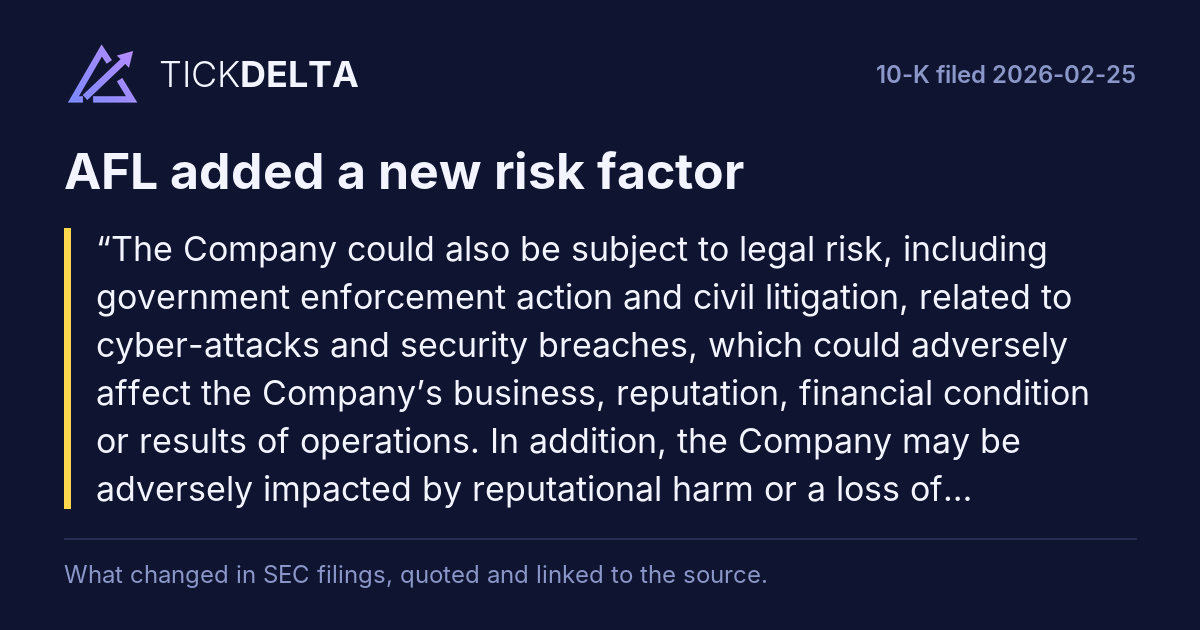
The Company could also be subject to legal risk, including government enforcement action and civil litigation, related to cyber-attacks and security breaches, which could adversely affect the Company’s business, reputation, financial condition or results of operations. In addition, the Company may be adversely impacted by reputational harm or a loss of confidence in the security and integrity of its information technology systems among customers, beneficiaries, employees, agents, and others.
Read in the 10-K ↗
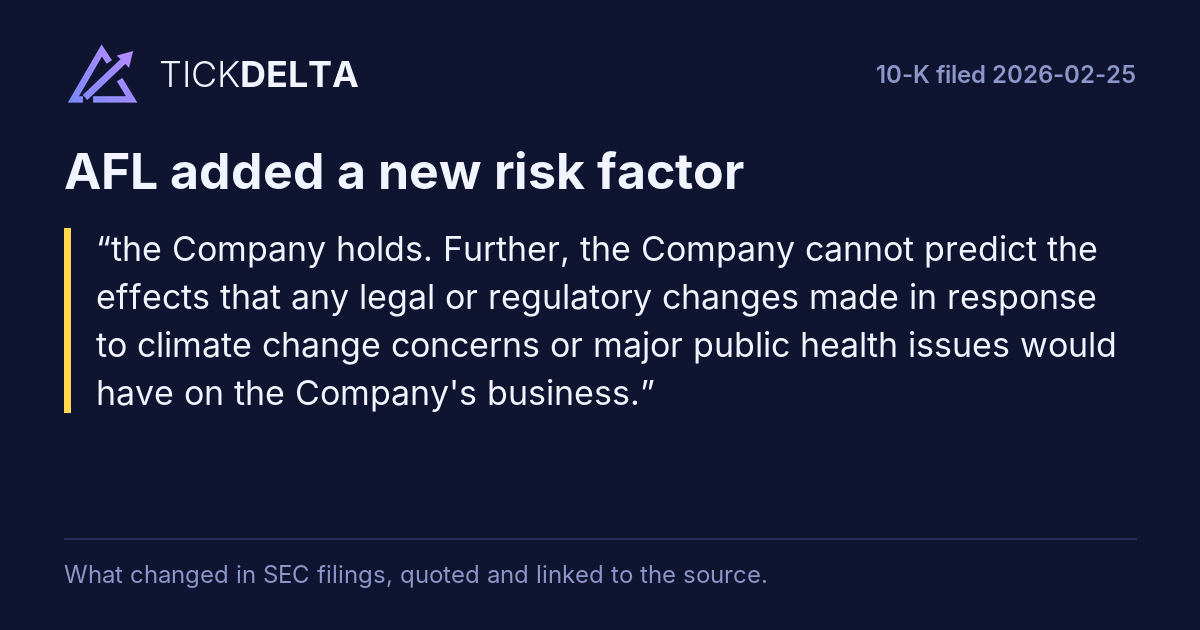
the Company holds. Further, the Company cannot predict the effects that any legal or regulatory changes made in response to climate change concerns or major public health issues would have on the Company's business.
Read in the 10-K ↗
New in the latest 10-Q
12 paragraphs in the 10-Q filed Nov 5, 2026 with nothing like them in the 10-Q filed Aug 7, 2026 (at least half the words must differ; new numbers alone do not count). Quoted exactly, grouped by the item heading above them. This is text that changed, not a judgement of how serious it is.
Financial statements and notes
during period Reclassification adjustment for (gains) losses on 842 (32) 1,100 (58)
Read in the 10-Q ↗
Accounting Standards Update (ASU) 2025-06 Intangibles - Goodwill and Other - Internal-Use Software (Subtopic 350-40) Targeted Improvements to the Accounting for Internal-Use Software
Read in the 10-Q ↗
In September 2025, the FASB issued amendments that remove all references to prescriptive and sequential software development stages (referred to as “project stages”) throughout Subtopic 350-40. Therefore, an entity is required to start capitalizing software costs when both of the following occur: i) management has authorized and committed to funding the software project, and ii) it is probable that the project will be completed and the software will be used to perform the function intended (referred to as the “probable-to complete recognition threshold”). The amendments also clarify certain disclosure requirements.
Read in the 10-Q ↗
(Addition to) release of allowance for credit losses (73) 4 (148) (11) 1 0 (227)
Read in the 10-Q ↗
The Company enters into long-term repurchase agreements under which it sells securities and agrees to repurchase those securities on a specified future date at a stated repurchase price. Repurchase agreements are accounted for as collateralized financing transactions and are recognized at the contractual amounts plus accrued interest. In these transactions, the Company receives cash in exchange for transferring securities as collateral and recognizes an obligation for the cash received. The securities pledged under these arrangements continue to be reported as investment assets in the consolidated balance sheets during the terms of the secured financing transactions. Expenses associated with repurchase agreements are recognized as interest expense. The Company monitors the fair value of collateral pledged and received. Additional collateral is pledged or returned to maintain the appropriate collateral position for the transactions. Securities pledged under such transactions may be sold or re-pledged by the transferee.
Read in the 10-Q ↗
Years Repurchase agreements: Fixed maturity securities: Japan government and agencies $240 $240 Total borrowings $240 $240 Gross amount of recognized liabilities for $240
Read in the 10-Q ↗
As of September 30, 2026, securities sold by the Company under agreements to repurchase consisted of held-to-maturity securities with a carrying value of $ 256 million.
Read in the 10-Q ↗
The Company enters into securities lending and repurchase transactions subject to master securities lending agreements, master repurchase agreements and other similar arrangements. These are legally enforceable master netting arrangements that give the Company the ability, in the event of default by the counterparty, to liquidate securities held as collateral and to offset receivables and payables with the same counterparty.
Read in the 10-Q ↗
During the third quarter of 2026, the Company established a valuation allowance of $ 215 million against a portion of its deferred tax assets associated with tax capital loss carryforwards, of which $ 164 million was included in other comprehensive income and $ 51 million was included in consolidated net earnings as a component of income taxes. In assessing the realizability of these deferred tax assets, the Company considered all available positive and negative evidence, including the increase in realized tax capital losses and the decrease in gross unrealized tax capital gains primarily related to available-for-sale securities, and concluded that it is more likely than not that a portion of the deferred tax assets related to tax capital loss carryforwards will not be realized. The valuation allowance reflects management's assessment of the amount of tax capital gains expected to be available to utilize the tax capital loss carryforwards before their expiration. The Company will continue to assess the realizability of its deferred tax assets at each reporting date.
Read in the 10-Q ↗
(In millions, except for share and per-share amounts) September 30, December 31,
Read in the 10-Q ↗
During the third quarter of 2026, sales were impacted following the June 2026 Japan Cyber Incident as Aflac Japan paused certain marketing activities, including direct mail and customer outbound calls, to prioritize customer support. As of the end of the third quarter, all normal marketing activities had resumed.
Read in the 10-Q ↗
• Total adjusted expenses increased primarily due to higher costs pertaining to business operations of $38 million and higher interest expense of $36 million.
Read in the 10-Q ↗
The 10-Q's risk factors against the 10-K
Item 1A of the 10-Q filed Nov 5, 2026 against Item 1A of the 10-K filed Feb 25, 2026.
A 10-Q repeats only the risks that changed, so a 10-K paragraph that is missing from it is not counted as removed.
Added is a paragraph with nothing like it in the 10-K, Reworded a sentence that is in both with several words changed,
Quiet changes a sentence in both where one to four words changed and one is a hedge or a modal
(cut words struck through, new words highlighted and underlined).
Text on the page, not a score; each links to the filing at sec.gov.
This 10-Q has no Item 1A (Risk Factors) text of its own, so there is nothing to compare. Many companies leave it out when their risks have not changed.
Work on AFL in a spreadsheet:
Excel workbook (a sheet per section, ten years by column, charts, links to the filings) ·
CSV.
For a Google Sheet that stays up to date, paste =IMPORTDATA("https://tickdelta.com/company/AFL/export.csv") into a cell.