Form 10-K
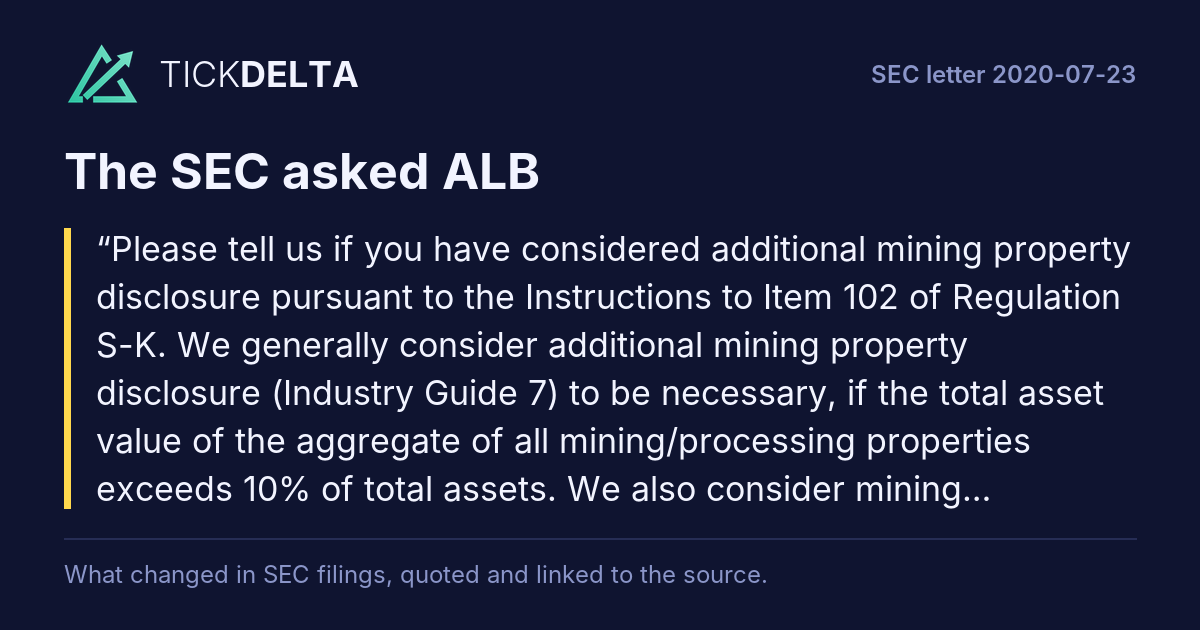
Please tell us if you have considered additional mining property disclosure pursuant to the Instructions to Item 102 of Regulation S-K. We generally consider additional mining property disclosure (Industry Guide 7) to be necessary, if the total asset value of the aggregate of all mining/processing properties exceeds 10% of total assets.Rest of the question
We also consider mining properties to include properties and related processing plants used from the point of mineral extraction to the first point of material sales. In addition, your ability to continue to reliably and economically secure raw materials, upon which rests your business plan of adding value and your ultimate profitability, would likely be viewed by most investors as material. In your response, please tell us how you measure the materiality and the significance of your mining properties. Based on your response we may have additional comments.
In response to the Staff’s comment, in preparing the 2019 Form 10-K, we did consider whether additional mining property disclosures were necessary as set forth in Industry Guide 7. In our review of Industry Guide 7, we considered factors for the locations from which we obtain our lithium to assess whether those locations qualify as significant mining operations. We extract lithium through evaporation of the brines of the Salar de Atacama, Chile and of the Clayton Valley Basin, Silver Peak, Nevada, as opposed to mining this resource from a hard rock mine.Read in the reply ↗Rest of the answer
The underground lithium brine is pumped above ground through a series of pumps and wells into a network of large evaporation ponds. Over the course of approximately eighteen months, the desert sun evaporates out other salts, leaving behind lithium brine. We then process the lithium brine into lithium carbonate and lithium chloride at a plant in nearby La Negra and into lithium carbonate at a plant in Silver Peak, Nevada. While the lithium is extracted from underground in the Salar de Atacama, Chile and Silver Peak, Nevada, we believe that it is not done so through mining activities as contemplated by Industry Guide 7. In addition, we have not established proven or probable reserves at these locations as of December 31, 2019.
Mr. George K. Schuler
We acknowledge that the Commission adopted new rules relating to property disclosures by companies with significant mining operations in 2018. See Release No. 33-10570, “Modernization of Property Disclosures for Mining Registrants” (October 31, 2018) (the “New Mining Disclosures”). The new rules rescind Industry Guide 7 and establish a new subpart 1300 of Regulation S-K effective January 1, 2021. Under the New Mining Disclosures, the definition of a mineral resource clearly includes mineral brines, such as lithium brine, and establishes a requirement to include operations in which we have a financial interest, such as joint ventures. Accordingly, we intend to comply with the disclosures required under subpart 1300 of Regulation S-K for our operations related to the Salar de Atacama, Chile and the Clayton Valley Basin, Silver Peak, Nevada during the fiscal year beginning on January 1, 2021.
In addition to extracting lithium through the evaporation of brines, we also purchase spodumene concentrate (6% lithium) from our 49%-owned Windfield Holdings Pty Ltd joint venture, which directly owns 100% of the equity of Talison Lithium Pty Ltd, a company incorporated in Australia (“Talison”). Talison owns and operates a spodumene mine in Greenbushes, Western Australia and mines spodumene ore. As described in Note 10, “Investments,” of Item 8 - Financial Statements and Supplementary Data of the 2019 Form 10-K, we are not the primary beneficiary of this joint venture, and thus do not consolidate the assets, liabilities or results of operations in our financial statements. Because we do not consolidate these mining assets or results of operations, we do not believe we are engaged in mining activities as contemplated by Industry Guide 7. As noted above, the New Mining Disclosures encompass operations in which we have a direct or indirect financial interest, including joint ventures. As a result, we intend to comply with the disclosures required under subpart 1300 of Regulation S-K, as applicable, for the Talison spodumene mine during the fiscal year beginning on January 1, 2021.
As disclosed in the 2019 Form 10-K, on October 31, 2019, we completed the acquisition of a 60% interest in Mineral Resources Limited’s (“MRL”) Wodgina hard rock spodumene mine project (“Wodgina Project”) in Western Australia and formed an unincorporated joint venture with MRL, named MARBL Lithium Joint Venture, for the exploration, development, mining, processing and production of spodumene concentrate and other minerals (other than iron ore and tantalum) from the Wodgina Project and for the operation of the Kemerton lithium hydroxide conversion assets. As previously reported, in connection with this acquisition, we immediately idled production from the Wodgina Project, and we anticipate that the Wodgina Project will remain idled until demand supports bringing the mine into production. This mine has not been operational since the acquisition, and at this time, we have not established when the mine will be brought back into production. When measuring materiality, we consider both quantitative and qualitative factors. These factors include the production levels of the mine, the impact of the mine on our operations and the resources allocated to operating the mine, among other factors. In addition, we acknowledge the Staff’s consideration of the additional mining property disclosure to be considered when the total asset value of the aggregate of all mining/processing properties exceeds 10% of total assets under Industry Guide 7. Although the assets acquired exceed 10% of our total assets, we believe that they do not constitute or contribute to a significant mining operation because we have idled production from this mine upon and since the acquisition. To date, these idled assets have not provided any mining activities for Albemarle or impacted our net sales or operations, and we expect this state of affairs to continue for the next couple of years.
While we do not believe we are engaged in significant mining operations as contemplated by Industry Guide 7 as of December 31, 2019, we have provided certain disclosures to enhance the reader’s understanding of our, and our Talison joint venture’s, lithium extraction operations, including the location, mineral rights, estimated production life and production capacity for each of the lithium sources noted above, under the Raw Materials and Significant Supply Contracts heading on page 4 of the 2019 Form 10-K.
First report after the company's reply of 2020-08-03: 10-Q filed 2020-08-05 ↗, against the 10-Q filed 2020-05-11 ↗.
Tickdelta does not hold the text of both reports, so they are not compared here.
Please disclose the information required under paragraph (b) of Industry Guide 7 for all your material properties listed under this heading. For any properties identified that are not material, please include a statement to that effect, clarifying your intentions.Rest of the question
For each material property, include the following information: • The location and means of access to your property, including the modes of transportation utilized to and from the property. • Any conditions that must be met in order to obtain or retain title to the property, whether you have surface and/or mineral rights. • A brief description of the rock formations and mineralization of existing or potential economic significance on the property. • A description of any work completed on the property and its present condition. • The details as to modernization and physical condition of the plant and equipment, including subsurface improvements and equipment. • A description of equipment, infrastructure, and other facilities. • The current state of exploration of the property. • The total costs incurred to date and all planned future costs. • The source of power and water that can be utilized at the property. • If applicable, provide a clear statement that the property is without known reserves and the proposed program is exploratory in nature. You may refer to Industry Guide 7, paragraphs (b) (1) through (5), for specific guidance pertaining to the foregoing, available on our website at the following address: www.sec.gov/about/forms/industryguides.pdf
In response to the Staff’s comment, we respectfully point the Staff to our response to the first comment above as to why we assessed that the additional mining property disclosures were not necessary for the 2019 Form 10-K. Read in the reply ↗
First report after the company's reply of 2020-08-03: 10-Q filed 2020-08-05 ↗, against the 10-Q filed 2020-05-11 ↗.
Tickdelta does not hold the text of both reports, so they are not compared here.
Please disclose your annual mine production. See Instruction 3 to Item 102 of Regulation S-K.
In response to the Staff’s comment, we respectfully point the Staff to our response to the first comment above as to why we assessed that we were not engaged in significant mining operations for the 2019 Form 10-K, and therefore did not provide information regarding annual mine production. Read in the reply ↗
First report after the company's reply of 2020-08-03: 10-Q filed 2020-08-05 ↗, against the 10-Q filed 2020-05-11 ↗.
Tickdelta does not hold the text of both reports, so they are not compared here.
We note your disclosure that life-of-mine assets are amortized over proven and probable reserves using the units of production methodology. Please expand your disclosure to state your updated proven and/or probable reserve estimates for each material mining property. Mining properties may include your In-Situ Leach (ISL), mineral brine, and/or conventional mining operations.
In response to the Staff’s comment, we respectfully point the Staff to our response to the first comment above as to why we assessed that we were not engaged in significant mining operations for the 2019 Form 10-K, and therefore did not provide information regarding proven and probable reserves.
In addition, the amounts currently being amortized using the unit of production methodology relates to the depletion of our mineral rights and not proven or probable reserves. We do not have proven or probable reserves established at our Salar de Atacama, Chile and Silver Peak, Nevada locations.Read in the reply ↗Rest of the answer
The reserves referenced in this disclosure relate to our 60% ownership of the Wodgina spodumene mine referenced above. As noted above, we do not believe this mine is considered a material mining property.
***
The Company appreciates the efforts of the Staff in reviewing our response to your letter of comment. We are fully committed to working with the Commission to respond to your comments and to provide you with all the information you require. Accordingly, should you have any questions regarding the Company’s response to your comments, please contact Scott Tozier at (980) 299-5596.
First report after the company's reply of 2020-08-03: 10-Q filed 2020-08-05 ↗, against the 10-Q filed 2020-05-11 ↗.
Tickdelta does not hold the text of both reports, so they are not compared here.
We note your response to comment one stating additional mining property disclosures were not necessary as the Salar de Atacama and Silver Peak properties are not mining operations, the Windfield Holdings Pty Ltd interests need not be disclosed as they are not consolidated with your financial statements, and your 60% interest in Mineral Resources Limited’s Wodgina mine project is not material due to its limitedRest of the question
contribution to your current operations, as it is presently on care & maintenance. We disagree with your assessments. While the Salar de Atacama/La Negra, Silver Peak, and Magnolia bromine operations are not traditional pick & shovel mining operations, they are classic in-situ mining operations, where mineral bearing solutions are pumped from the ground and processed. This type of mining operation is commonly practiced for the mining and processing of mineral salts such as potash, salt, lithium, and bromine. In addition, mineral property disclosure is required for significant mining properties even if they are accounted for under the equity method in your consolidated financial statements. We also believe the Wodgina/Kemerton operations are significant due to their purchase price/asset transfer, associated note obligations, and on-going Kemerton construction activities. Please amend your filing to provide mining disclosure that complies with Industry Guide 7 for all of your significant mining properties.
The Company recognizes that the Commission’s final rules for the Modernization of Property Disclosures for Mining Registrants (Release Nos. 33-10570; 34-84509 (October 31, 2018)) (the “Final Rule”), effective for fiscal years beginning on or after January 1, 2021, explicitly state that extracting minerals, such as lithium, from mineral brines constitutes mining. In light of this explicit requirement, the Company has been expending substantial time
Mr. George K.Read in the reply ↗Rest of the answer
Schuler and effort with both internal and external resources to gather the information necessary to comply with the disclosure requirements of the Final Rule.
Prior to the adoption of the Final Rule, the Company did not believe that extracting minerals from brines was a mining activity, and, therefore, concluded that disclosure was not required under Industry Guide 7. Nonetheless, we provided pertinent, material information required by Industry Guide 7, paragraph (b), to the extent applicable to our operations, in the Company’s 2019 Annual Report on Form 10-K (specifically, within Item 1--Business--Lithium and Advanced Materials Segment--Raw Materials and Significant Supply Contracts, Item 1--Business--Bromine Specialties Segment--Raw Materials and Significant Supply Contracts, and Item 2--Properties).
In light of the Staff’s comments and the pendency of the Final Rule, however, we intend to expand our disclosures in response to Industry Guide 7, paragraph (b), in our 2020 Annual Report on Form 10-K. Those expanded disclosures are set out in the attached Appendix, with the new language therein highlighted as underscored text. These expanded disclosures will provide more information to investors about (i) our lithium brine operations in the Salar de Atacama, Chile and the Clayton Valley Basin, Silver Peak, Nevada, (ii) our 49%-owned Windfield Holdings Pty Ltd joint venture in the Talison Lithium Pty Ltd. hard rock spodumene operations, (iii) our idled Wodgina hard rock spodumene project, and (iv) our bromine brine operations in Magnolia, Arkansas.
With respect to the Wodgina project, we recognize that it is an open-pit mine, and, thus, a more traditional mining operation. However, we continue to believe the Wodgina project was not a significant mining property of the Company in 2019. Although neither Item 102 of Regulation S-K nor Industry Guide 7 defines “significant,” we understand that the Staff historically has used 10% of a registrant’s total assets as a “rule of thumb” for the materiality of a registrant’s mining operations to be considered as part of an analysis of quantitative and qualitative factors.
Based solely on the purchase price, the Wodgina project constituted approximately 13% of the Company’s total assets as of December 31, 2019. We do not believe that this percentage, standing alone, determines whether Wodgina was a significant mining property during 2019. While a "rule of thumb," such as a threshold or percentage, may be useful as an initial step in assessing materiality, it cannot appropriately be used as a substitute for a full analysis of all relevant considerations. The Commission affirmatively rejected including an instruction to the Final Rule that would establish a presumption of materiality based on a specific threshold percentage of assets. Instead, the Commission concluded that “an assessment that takes into consideration all relevant facts and circumstances will lead to better materiality determinations.”
Taking into account all relevant considerations, the Company continues to believe that additional mining disclosure about the Wodgina project was not required for 2019 for, among others, the following reasons:
•Wodgina was not significant to our operations in 2019 because we acquired the project on October 31, 2019 and immediately idled all operations;
•The note obligations identified by the Staff are fully and unconditionally guaranteed on a senior unsecured basis by the Company, and, thus are dependent on the Company’s creditworthiness and financial stability;
•The results of our 60% ownership interest in the joint venture are reported within the Lithium segment. We reported net income in our Lithium segment of approximately $341.8 million, with Wodgina operations contributing a loss of approximately $4.4 million (excluding, as disclosed in the Company’s 2019 Annual Report on Form 10-K, transaction related costs such as the stamp duty owed for the transaction). As a result, we concluded Wodgina did not have a material impact on our results of operations of the company in 2019; and
•Construction at Kemerton did not begin until the end of the first quarter of 2019 and commissioning is not scheduled to complete until 2022.
Although we do not believe the Wodgina project was a significant mining property in 2019, as discussed above, we intend to expand our disclosures in response to Industry Guide 7, paragraph (b), in our 2020 Annual Report on Form 10-K, as set out in the attached Appendix.
First report after the company's reply of 2020-09-11: 10-Q filed 2020-11-04 ↗, against the 10-Q filed 2020-05-11 ↗.
Tickdelta does not hold the text of both reports, so they are not compared here.
We note your response to comment 2 indicating you were not engaged in significant mining operations in 2019. We reissue comment 2, please disclose the information required by Industry Guide 7 for your mining properties.
In response to the Staff’s comment, we respectfully point the Staff to our response to the first comment above, pursuant to which we will make the additional disclosures set out on the attached Appendix. Read in the reply ↗
First report after the company's reply of 2020-09-11: 10-Q filed 2020-11-04 ↗, against the 10-Q filed 2020-05-11 ↗.
Tickdelta does not hold the text of both reports, so they are not compared here.
We note your response to comment 3 indicating you were not engaged in significant mining operations in 2019. We reissue comment 3, please disclose your mining production for your mining properties in 2019.
In response to the Staff’s comment, we respectfully point the Staff to our response to the first comment above, pursuant to which we will make the additional disclosures set out on the attached Appendix. Read in the reply ↗
First report after the company's reply of 2020-09-11: 10-Q filed 2020-11-04 ↗, against the 10-Q filed 2020-05-11 ↗.
Tickdelta does not hold the text of both reports, so they are not compared here.
We note your response to comment 4 indicates that you are amortizing your mineral rights using the units of production method. Please further describe to us the process by which you amortize your mineral rights, identifying each property associated with the mineral rights being amortized and the units that serve as the basis for the amounts used in the numerator and denominator of your amortization calculation.Rest of the question
To the extent that you are utilizing anything other than proven and probable reserves in the denominator of your calculation, please clarify the reasons why these alternates would be considered a reasonable basis for determining the useful life of your mineral rights.
In response to the Staff’s comment, we respectfully note that our mineral rights at our Salar de Atacama, Chile and Clayton Valley Basin, Silver Peak, Nevada locations are depleted using the units of production method.
Our mineral rights at the Salar de Atacama, Chile are based on a contract with the Chilean government, originally entered into in 1975 and subsequently amended and restated. The contract provided us with a quota of 200,000 metric tons of lithium product that we can produce and sell.Read in the reply ↗Rest of the answer
We do not have proven or probable reserves as defined by Industry Guide 7 at the Salar de Atacama, however our mineral rights are limited to the contracted quota that we can sell. The depletion rate is calculated by dividing the carrying value of the mineral rights as established by a third party valuation when these assets were acquired in 2015 as part of the Rockwood Holdings, Inc. (“Rockwood”) acquisition (numerator) by the amount of lithium product quota permitted to be produced and sold by the mineral rights agreement with the Chilean government (denominator). This calculated depletion rate is then multiplied by actual sales on a monthly basis. We believe the quota permitted by the contract represents a more appropriate basis for determining the useful life of the mineral rights than the straight-line method because the amount of lithium produced and sold is not linear and varies per period, and, thus is more representative of the match of the cost and income for a period. As we are limited in what we can produce and sell under this contractual quota, we believe the basis for the useful life should be limited to what we are permitted to produce and sell, and not a period of time. Although these are not proven and probable reserves as defined by Industry Guide 7, we believe this quota serves as a comparable base given that we are restricted in the amount we can produce and sell, similar to a restriction of the availability of a reserve.
Our mineral rights in Clayton Valley Basin, Silver Peak, Nevada consist of our right to access lithium brine pursuant to our permitted and certified senior water rights, a settlement agreement with the U.S. government, entered into in June 1991, and our patented and unpatented land claims. Our mineral rights allow us to rights to all lithium that we can remove economically from the Clayton Valley Basin. We do not have proven or probable reserves as defined by Industry Guide 7 at Silver Peak. This valuation estimated the amount of lithium product we can produce under these mineral rights was based on an internal estimate. The depletion rate is calculated by dividing the carrying value of the mineral rights as established by the valuation when these assets were acquired in 2015 as part of the Rockwood acquisition (numerator) by the amount of estimated lithium products we can produce under our agreement (denominator). This calculated depletion rate is then multiplied by actual production on a monthly basis. We believe the estimated lithium production represents a more appropriate basis for determining the useful life of the mineral rights than the straight-line method because the amount of lithium produced and sold is not linear and varies per period, and, thus is more representative of the match of the cost and income for a period. The mineral rights and agreement in Silver Peak allow us to extract lithium until it is no longer economical to do so and not a set date, therefore we believe the basis for the useful life should be limited to what we are permitted to produce and not a period of time. Although these are not proven and probable reserves as defined by Industry Guide 7, we believe this estimated production amount serves as a comparable base given that we are restricted in the amount we can produce, similar to a restriction of the availability of a reserve.
***
The Company appreciates the efforts of the Staff in reviewing our response to your letter of comment. We are fully committed to working with the Commission to respond to your comments and to provide you with all the information you require. Accordingly, should you have any questions regarding the Company’s response to your comments, please contact Scott Tozier at (980) 299-5596.
First report after the company's reply of 2020-09-11: 10-Q filed 2020-11-04 ↗, against the 10-Q filed 2020-05-11 ↗.
Tickdelta does not hold the text of both reports, so they are not compared here.
We note your response to comment 1 thru 3, indicating that you intend to provide enhanced disclosure with your fiscal year 2020 Form 10-K filing as presented by your response’s Appendix. We have reviewed the Appendix and believe more detailed disclosure is necessary for your lithium and bromine facilities (Salar de Atacama/La Negra, Silver Peak, Talison/Jiangxi/Sichuan, Wodgina/Kemerton, and Magnolia) to comply withRest of the question
Industry Guide 7 and Item 102 of Regulation S-K. For example your discussion of your Salar de Atacama/La Negra facilities should provide a more precise description of the property’s location with a map and include a description of the transportation utilized, such as the railroads and types of highways/gravel roads. In addition a brief description of the rock formations and mineralization with a general description of the processing facilities that includes the annual tonnage or gallons produced, with the lithium content included should also be provided. This production disclosure would also include annual production quantities of salable products, such as lithium carbonate or lithium hydroxide. Please note that the aforementioned observations serve as examples of enhanced disclosure and are not all inclusive. We encourage you to review the requirements of Industry Guide 7 and Item 102 of Regulation S-K in providing expanded disclosures that comply with this guidance.
As discussed with the Staff in our call on October 9, 2020, the Company undertakes to include, in its Annual Report on Form 10-K for the fiscal year ending December 31, 2020, the requested expanded and more detailed disclosure for its lithium and bromine facilities. Read in the reply ↗
First report after the company's reply of 2020-10-27: 10-Q filed 2020-11-04 ↗, against the 10-Q filed 2020-05-11 ↗.
Tickdelta does not hold the text of both reports, so they are not compared here.
We note your response to comment 4 states that the denominator used in your units of production depletion calculation for the Salar de Atacama property is based on a contract entered into in 1975 with the Chilean government which limits the total amount of lithium that you can produce and sell.Rest of the question
Please tell us how frequently the contract is revised, amended or restated, the date of the most recent revision and what triggers the need for reassessment. Please also explain how the quota amount is determined, providing details sufficient to understand the underlying factors that impact any changes to the quota amount. To the extent that any economic studies or reserve reports are considered, please provide further details on these reports.
As a result of the Company’s acquisition of Rockwood Holdings, Inc. (“Rockwood”), which closed in January 2015, we hold temporary rights to extract lithium brine from the Salar de Atacama in northern Chile. We hold these rights pursuant to a contract previously provided to Rockwood by the Corporación de Fomento de la Producción (“CORFO”), the Chilean government’s economic development agency, and assumed by us at the closing.Read in the reply ↗Rest of the answer
This contract, originally granted to a predecessor in 1975, provided the rights to extract 200,000 metric tons of lithium metallic equivalent, and had 119,623 metric tons remaining at the time of the Rockwood acquisition. This contract quota related to lithium metallic equivalent to be used for production and sale of lithium carbonate, lithium chloride, and other lithium products, and was recorded as an asset at the acquisition date. CORFO, in its discretion, determines and allocates the quotas. We deplete this asset based on production and sales that meet the contract specifications each year under the units of production method of depreciation. This provides for an appropriate matching of costs of depletion with the production related to this acquired contractual right to the mineral rights.
We note that the most recent U.S. Geological Survey, published in January 2020, reported approximately 8.6 million metric tons of lithium reserves in Chile. As the only running lithium operations in Chile are at the Salar de Atacama, we believe this supports our position that the available lithium resource in Chile is significantly in excess of the 119,623 metric ton quota of lithium metallic equivalent that we are permitted to produce and sell under this contract. Accordingly, we believe that the denominator for our units of production depletion calculation for the contractual rights to the lithium brine in Chile is reasonable.
There is no pre-established period for revision, amendment, or renewal, of the contract with CORFO, and the only material amendment to the contract thus far occurred effective January 1, 2017. That amendment provided for a new additional quota of 262,132 metric tons of lithium product with specific production criteria distinct from the original 119,623 metric ton quota. There was no up-front payment for this new quota as the compensation to CORFO would come in the form of commission payments in the future based on production and ultimate sale. The commission costs related to the new quota are associated only with the additional 262,132 metric tons of lithium metallic equivalent and are matched against the sales of the products manufactured from this quota. Because no costs were incurred to acquire this new quota, there is no asset balance to deplete.
The original quota was not affected by the amendment. When the amendment occurred, we considered whether the depletion rate for the old quota should be reassessed and determined that no changes were necessary as the new quota is separate and distinct from the original quota with separate terms and production criteria.
First report after the company's reply of 2020-10-27: 10-Q filed 2020-11-04 ↗, against the 10-Q filed 2020-05-11 ↗.
Tickdelta does not hold the text of both reports, so they are not compared here.
We note your response to comment 4 and understand that the denominator used in your units of production depletion calculation for the Clayton Valley Basin property is based on an internal estimate of your ultimate production.Rest of the question
Please tell us how you determine this internal estimate providing details sufficient to understand the methods used and assumptions made including details of any geologic or economic studies considered. In addition, please further explain why you believe this internal estimate represents a reliable measure of the useful life of the underlying mineral rights in the absence of reserves and how frequently you re-assess the reasonableness of this estimate. To the extent you have evidence other than reserves that demonstrates that the estimated production can be achieved economically, please describe this evidence.
We note that the depletion expense recorded for our mineral rights in the Clayton Valley Basin, or Silver Peak, property is less than $3 million per year, which represented less than 1% of income before taxes in 2019. In addition, using the straight-line method to depreciate these mineral rights instead of the units of production method would not result in a material difference, with the difference in expense being an increase or decrease of less than $1 million per year based on actual production.
We originally acquired these mineral rights as part of the Company’s acquisition of RockwoodRead in the reply ↗Rest of the answer
Holdings, Inc. (“Rockwood”), which closed in January 2015. Our rights permit us to extract as much lithium from the Clayton Valley Basin as can be achieved economically. Upon acquisition, these rights were valued based on the estimated amount of lithium carbonate equivalent we could produce. We deplete this asset based on the production of lithium carbonate equivalent under the units of production method of depreciation. This provides for an appropriate matching of costs of depletion with the production related to these acquired mineral rights.
The original resource estimate, used as part of determining the amount of lithium carbonate equivalent we could produce from the Clayton Valley Basin property, was determined principally from a depletion study conducted by a third party in January 2011 while the rights were held by a predecessor. The third party based its estimate upon assumptions about the weather, flow rate of water, hydrology of the Clayton Valley Basin, lithium concentrations in the water, and recoverable yield, as well as the price of lithium, which impacts whether it is economical to recover the lithium based upon the foregoing factors. In addition, the U.S. Geological Survey publishes reserve information, which provided a substantially similar amount of lithium reserves for the United States in its January 2015 report. As noted in the U.S. Geological Survey, the only running lithium operations in the United States were in Nevada, which reflects the total estimated lithium reserve at Silver Peak. Given that our own lithium estimate at Silver Peak was substantially similar to the reserve published by the U.S. Geological Survey, we determined it was an appropriate basis to use for determining the estimated production that could be economically achieved.
We also note that subsequent U.S. Geological Survey reports have maintained a substantially similar lithium reserve estimate for the United States. Based on these consistent reserve estimates published by the U.S. Geological Survey, as well as consistent production out of our Silver Peak site, we continue to believe the denominator for our units of production depletion calculation is appropriate and that this production will continue to be achieved economically. We do not reassess the reasonableness of our estimates on a set timeline but, in accordance with US GAAP, we would do so if there is an indication of a change in conditions that could materially impact our ability to economically extract and produce lithium from the Clayton Valley Basin.
In addition, in 2018, we utilized a third party to develop a numerical groundwater model of our Silver Peak operations, which, among other things, would support future lithium reserve estimates and assess production sensitivity to the basin water balance. This model was developed based on historical drilling, seismic testing, and exploration data. The results of the model indicated that we would still be able to recover and produce the amount of lithium carbonate equivalent that is used as our denominator in the units of production depletion calculation from our Silver Peak operations, and any change to the denominator based on the results of this updated model would not result in a material change in our annual depletion expense. As a result, we continue to believe the denominator for our units of production depletion calculation is appropriate.
***
The Company appreciates the efforts of the Staff in reviewing our response to your letter of comment. We are fully committed to working with the Commission to respond to your comments and to provide you with all the information you require. Accordingly, should you have any questions regarding the Company’s response to your comments, please contact Scott Tozier at (980) 299-5596.
First report after the company's reply of 2020-10-27: 10-Q filed 2020-11-04 ↗, against the 10-Q filed 2020-05-11 ↗.
Tickdelta does not hold the text of both reports, so they are not compared here.
Also in this review: request for more time, 2020-09-03, request for more time, 2020-10-20, company letter, 2020-12-15, closing letter, 2021-01-21