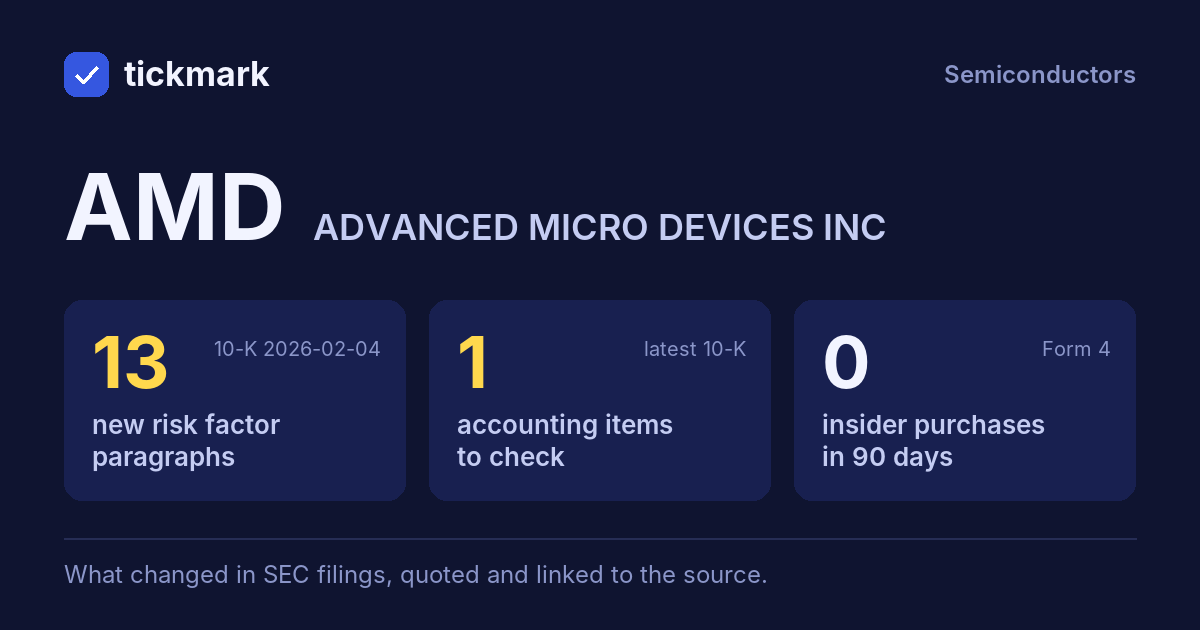
Sentences and paragraphs of AMD's Risk Factors and MD&A, 10-K 2026-02-04 against 10-K 2025-02-05.
Each links to the text at sec.gov.
AddedRisk Factors
Competition is expected to remain intense, driven by rapid technological change, evolving standards, shifting customer preferences, product obsolescence, and frequent product launches from both established and new competitors. Some of our competitors may possess stronger market positions, larger customer bases, more design wins, and greater financial, sales, marketing, and distribution resources than us. As a result, they may be able to acquire market share or limit our ability to do so, more effectively capitalize on new market opportunities, and transition their products more efficiently than we can. Some competitors are pursuing alternative computing architectures, such as Arm, which could grow the Arm ecosystem and increase competition in consumer, commercial and data center, reducing demand for our products. Additionally, we may encounter competition from customers who internally develop products to support similar AI workloads to those supported by ours.
Read it in 10-K 2026-02-04 at sec.gov ↗
AddedRisk Factors
Evolving U.S. government policy toward semiconductor exports, particularly in the context of national security and foreign policy priorities could adversely affect our business. In October 2023, the Bureau of Industry and Security (BIS) of the United States Department of Commerce issued requirements for the export of certain advanced computing items to a party headquartered in, or with an ultimate parent headquartered in, any of Country Groups D1, D4 or D5, including China (a D5 Country). These controls prevent us from shipping certain AMD Instinct™ integrated circuits and certain AMD Versal™ FPGAs to China, or to customers outside of the United States who are headquartered in—or whose ultimate parent is headquartered in—a D5 Country, without a license. BIS may not timely update performance-based licensing thresholds in the 2023 export requirements and/or may issue new licensing requirements and regulatory controls in the future. Accordingly, there is a risk that new products which exceed current licensing thresholds, or even those below current licensing thresholds, may not succeed because BIS could determine they are subject to licensing requirements. U.S. export restrictions on semiconductors and semiconductor technology to China and Chinese customers negatively impact our ability to sell to customers in China and make it easier for our China-based competitors to develop and sell their own solutions and reduce the need for our products. In April 2025, the U.S. government implemented a new license requirement for the export of certain semiconductor products to a D5 Country, and to companies headquartered in, or with an ultimate parent located in such D5 Country. This restriction impacts our AMD Instinct™ MI308 products. As a result of the restriction, we incurred approximately $800 million in inventory and related charges in the second quarter of 2025. We applied for and were granted some licenses by the U.S. government that allow us to ship our MI308 products to certain China-based customers. During the fourth quarter of fiscal year 2025, we began shipping products and reversed approximately $360 million of the charges recorded earlier in the year. Sales of our MI308 products into China depend on customer demand, China’s import control rules and our ability to obtain licenses. In August 2025, U.S. government officials expressed an expectation that the U.S. government will receive 15% of the revenue generated from licensed MI308 sales to China. However, to date, the U.S. government has not published a regulation establishing such requirement. Any request for a percentage of the revenue by the U.S. government could subject us to litigation, increase our costs and harm our competitive position and benefit competitors that are not subject to such arrangements.
Read it in 10-K 2026-02-04 at sec.gov ↗
Show the other 16
AddedRisk Factors
In January 2025, BIS issued a final rule, commonly referred to as the “AI Diffusion Rule,” that would have imposed new restrictions on the export, reexport and in-country transfer of certain advanced semiconductor devices and technology. In May 2025, BIS announced its intention to rescind the AI Diffusion Rule, publish a regulation formalizing the rescission, and issue replacement rules in the future. The replacement rules may limit our ability to engage in certain business transactions, require new export licenses, delay shipments, or necessitate changes in our compliance processes and product designs to ensure regulatory compliance. Additionally, BIS’s announced plans introduce uncertainty as we evaluate whether specific products, technologies, or software fall within the scope of any new restrictions, and whether BIS will grant licenses in a timely matter or at all. Compliance with the planned or existing rules could result in increased costs, disruption of key customer and supplier relationships, loss of competitive positioning in international markets or reputational harm.
Read it in 10-K 2026-02-04 at sec.gov ↗
AddedRisk Factors
The implementation or increase of any tariffs, trade protection measures or restrictions, or retaliatory actions from foreign governments could result in lost sales and adversely impact our reputation and business. The U.S. government has instituted or proposed changes in trade policies that include higher tariffs on imports into the U.S. and other government regulations affecting trade between the United States and other countries where we conduct our business. Such changes to U.S. trade policy have the potential to adversely impact the U.S. economy or sectors thereof and could significantly impact our business, in particular the import of products used in our business that are manufactured outside the U.S. Any retaliatory actions by affected countries and foreign governments could result in tariffs, trade protection measures or other restrictions imposed on our current and future products. Our customers’ costs of doing business may increase or their sales may be negatively affected. As such, customer demand for our products may decline, which could adversely impact our ability to generate revenue and result in inventory impairment changes. For instance, tariffs on hardware required for data centers could raise costs for our customers, potentially causing them to delay or cancel AI infrastructure investments. Further, to the extent that the United States, China or other countries seek to promote products that are produced domestically or reduce their dependence on products from another country, they may implement regulations or policies that may negatively affect our business.
Read it in 10-K 2026-02-04 at sec.gov ↗
AddedRisk Factors
We have equity interests in two joint ventures (collectively, the THATIC JV) with Higon Information Technology Co., Ltd. (THATIC), a third-party Chinese entity. In June 2019, BIS added certain Chinese entities to the Entity List, including THATIC and the THATIC JV. Since that time, the United States administration has called for changes to domestic and foreign policy, including policies with respect to China and Russia. Specifically, United States-China trade relations remain uncertain as the United States continues to add more Chinese companies to the Entity List and introduce new regulations on advanced computing, semiconductor manufacturing, and AI, while China has imposed retaliatory tariffs. Moreover, as the U.S. government continues adding companies to the Entity List, our supply chain may be negatively impacted as we may be required to suspend purchasing from such suppliers or selling to such customers or otherwise unable to fulfill our contractual obligations to them. For example, in September 2025, BIS issued a new rule designating any entity that is at least 50% owned by one or more entities on the Entity List will be subject to Entity List restrictions and this rule similarly applies to entities at least 50% owned by listed “military end users” and certain sanctioned parties. In October 2025, the U.S. government announced that it planned to suspend enforcement of this new rule for one year. However, the restrictions can be reimposed at any time. These restrictive governmental actions and any similar measures that may be imposed on U.S. companies by other governments, especially in light of ongoing trade tensions with U.S. trading partners, will likely limit or prevent us from doing business with certain of our customers or suppliers and harm our ability to compete effectively or otherwise negatively affect our ability to sell our products. If we were ever found to have violated these laws or similar applicable non-U.S. laws, even if the violation occurred without our knowledge, we may be subject to penalties, which could adversely affect our reputation, business, operating results and financial condition.
Read it in 10-K 2026-02-04 at sec.gov ↗
AddedRisk Factors
We may be required to satisfy financial obligations under guarantees and other commercial commitments.
Read it in 10-K 2026-02-04 at sec.gov ↗
AddedMD&A
Beginning in the first quarter of fiscal year 2025, we combined the Client and Gaming segments into one reportable segment to align with how we manage our business. All prior period segment data were retrospectively adjusted.
Read it in 10-K 2026-02-04 at sec.gov ↗
AddedMD&A
During 2025, we launched multiple leadership products and made significant progress executing our AI strategy. A priority in 2025 was accelerating growth in the Data Center segment. Demand for our data center AI GPU products was strong as large hyperscale customers, OEMs and ODMs deployed our AMD Instinct MI350X Series GPUs. We advanced our AMD AI GPU roadmap to deliver an annual cadence of leadership for AMD Instinct solutions, beginning with the AMD Instinct MI350 Series GPUs in 2025. Beyond GPUs, we launched the 5th Gen AMD EPYC family of server processors in 2025, which deliver leadership performance and capabilities for a wide range of data center workloads, including AI. We also expanded the data center portfolio with new networking solutions, including the AMD Pensando™ “Pollara” 400 AI NICs and “Vulcano” AI NICs, which deliver high-speed connectivity across GPU clusters providing high-performance, AI-ready, flexible solutions for scale-out networking. In addition, we previewed our Helios AI rack-scale platform solution that incorporates all of our data center products (CPUs, GPUs and Networking) to address the growing AI compute requirements.
Read it in 10-K 2026-02-04 at sec.gov ↗
AddedMD&A
Across Client and Gaming, we continued to strengthen our leadership with expanding enterprise adoption and a growing portfolio of AMD Ryzen processors. For gamers, creators and developers, we brought to market AMD Radeon 9000 Series GPUs and Radeon AI PRO 9700 GPUs based on the AMD RDNA 4 graphics architecture to market along new high-performance Ryzen Threadripper™ 9000 Series processors. Our x86 Embedded portfolio continued to expand in 2025 with the introduction of three new AMD EPYC embedded processor series: AMD EPYC Embedded 9005 Series, EPYC Embedded 4005 Series and EPYC Embedded 2005 Series.
Read it in 10-K 2026-02-04 at sec.gov ↗
AddedMD&A
We also made strategic investments through acquisitions to further advance our software capabilities including compiler and AI expertise in machine learning, inference and performance optimization, and enable highly optimized solutions across the stack; to scale our ability to support and develop a variety of photonics and co-packaged optics solutions across next-gen AI systems; and to bring deep expertise in high-speed inference and reasoning-based AI technologies for large-scale deployments, reinforcing our enterprise AI software stack.
Read it in 10-K 2026-02-04 at sec.gov ↗
AddedMD&A
In March 2025, we completed the acquisition of ZT Systems for $3.2 billion in cash and 8.3 million shares of our common stock. We retained select intellectual property and employees associated with the design operations (ZT Design Business), and in October 2025, we sold the ZT data center infrastructure manufacturing business (ZT Manufacturing Business) to Sanmina Corporation (Sanmina) for $2.4 billion in cash, subject to certain purchase price adjustments, and 1.2 million shares of Sanmina common stock. We are eligible to receive additional contingent cash consideration of up to $450 million from Sanmina to the extent certain conditions are met. Sanmina will also be our preferred partner for manufacturing capabilities in building complex AI solutions. Following the close of the sale of the ZT Manufacturing Business to Sanmina, we retained certain intellectual property and former employees of ZT Systems (ZT Design Business) and settled the contingent consideration liability with the former ZT shareholders and warrant holders.
Read it in 10-K 2026-02-04 at sec.gov ↗
AddedMD&A
In October 2025, we entered into a product purchase agreement with OpenAI OpCo, LLC, (OpenAI) to deploy 6 gigawatts of AMD GPUs, with the deployment of the first gigawatt of capacity powered by our AMD Instinct MI450 series products. Concurrent with the agreement, we issued to OpenAI a warrant to purchase up to an aggregate of 160 million shares of AMD’s common stock at an exercise price of $0.01 per share. The warrant shares will vest in tranches based on certain AMD Instinct GPU purchase milestones by OpenAI, or its affiliates, or indirectly through third parties, and achievement of specified AMD stock price targets and stock performance. Each vested tranche is further subject to the fulfillment of certain other technical and commercial conditions prior to exercise. Subject to certain conditions, the warrant is exercisable through October 5, 2030. None of the warrant shares met the vesting or exercise conditions and the warrant had no impact to our financial statements for the year ended December 27, 2025.
Read it in 10-K 2026-02-04 at sec.gov ↗
AddedMD&A
During the second quarter of fiscal year 2025, the Company recorded approximately $800 million of inventory and related charges on AMD Instinct MI308 Data Center GPU products due to new U.S. export restrictions on certain semiconductors to China. We applied for and were granted some licenses by the U.S. government that allow us to ship MI308 products to certain China-based customers. During the fourth quarter of fiscal year 2025, we began shipping products and reversed approximately $360 million of the inventory and related charges recorded earlier in the year. U.S. government officials have expressed an expectation that the U.S. government will receive 15% of the revenue generated from licensed MI308 sales to China; however, to date, the U.S. government has not published a regulation establishing such requirement.
Read it in 10-K 2026-02-04 at sec.gov ↗
AddedMD&A
Business Combinations. We allocate the fair value of purchase consideration for acquisitions meeting the requirement of business combinations to the tangible and intangible assets acquired and liabilities assumed based on their estimated fair values. Such valuations require management to make significant estimates and assumptions, especially with respect to assets and liabilities held for sale, intangible assets and contingent consideration. Significant estimates and inputs used in valuing acquired assets and liabilities held for sale, developed technology, and other identifiable intangible assets include, but are not limited to, expected future revenue, future changes in technology, useful lives, risk-adjusted discount rates and time and costs to recreate certain assets. Management's estimates of fair value are based upon assumptions believed to be reasonable, but which are inherently uncertain and unpredictable and, as a result, actual results may differ from estimates. Allocation of purchase consideration to identifiable assets and liabilities affects our amortization expense, as acquired finite-lived intangible assets are amortized over their useful life, whereas any indefinite-lived intangible assets, including goodwill, are not amortized.
Read it in 10-K 2026-02-04 at sec.gov ↗
AddedMD&A
Year Ended December 27, December 28, 2025 2024 (In millions) Net revenue: Data Center $ 16,635 $ 12,579 Client and Gaming Client 10,640 7,054 Gaming 3,910 2,595 Total Client and Gaming 14,550 9,649 Embedded 3,454 3,557 Total net revenue $ 34,639 $ 25,785 Cost of sales and operating expenses: Data Center $ 13,032 $ 9,097 Client and Gaming 11,695 8,462 Embedded 2,211 2,136 All other 4,007 4,190 Total cost of sales and operating expenses $ 30,945 $ 23,885 Operating income (loss): Data Center $ 3,603 $ 3,482 Client and Gaming 2,855 1,187 Embedded 1,243 1,421 All other (4,007) (4,190) Total operating income $ 3,694 $ 1,900
Read it in 10-K 2026-02-04 at sec.gov ↗
AddedMD&A
Gross margin of 50% increased by 1% compared to 49% in 2024, primarily due to product mix, partially offset by approximately $440 million of net inventory and related charges associated with the U.S. government export control on AMD Instinct™ MI308 Data Center GPU products.
Read it in 10-K 2026-02-04 at sec.gov ↗
AddedMD&A
In July 2025, the One Big Beautiful Bill Act (OBBBA) was enacted into law. For fiscal year 2025, the primary impact of the OBBBA to our tax provision was the accelerated expensing of domestic R&D activities which decreased our income eligible for FDII, reduced our deferred tax assets, and reduced our current income tax liability. Other OBBBA changes did not have a material impact on the financial statements.
Read it in 10-K 2026-02-04 at sec.gov ↗
AddedMD&A
In January 2026, the OECD released a "side-by-side" package introducing new safe harbors and providing an exemption for U.S.-based multinational companies from parts of the global minimum tax framework. We continue to evaluate the impact of proposed and enacted legislative changes to our effective tax rate and cash flows as new guidance becomes available in each country.
Read it in 10-K 2026-02-04 at sec.gov ↗