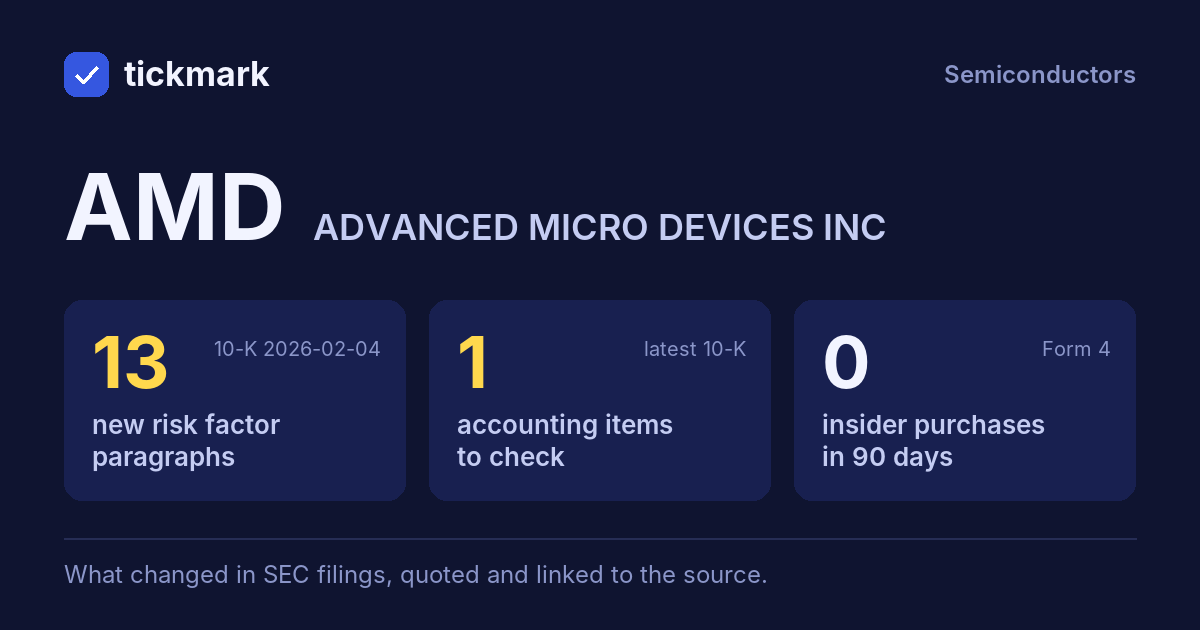
Sentences and paragraphs of AMD's Risk Factors and MD&A, 10-K 2026-02-04 against 10-K 2025-02-05.
Each links to the text at sec.gov.
RemovedRisk Factors
Intel’s microprocessor market share position, significant financial resources, introduction of competitive new products, and existing relationships with top-tier OEMs have enabled it to market and price its products aggressively, to target our customers and our channel partners with special incentives and to influence customers who do business with us. These aggressive activities have in the past resulted in lower unit sales and a lower average selling price for many of our products and adversely affected our margins and profitability. Intel also dominates the computer system platform and has a heavy influence on PC manufacturers, other PC industry participants, and benchmarks. It is able to drive de facto standards and specifications for x86 microprocessors that could cause us and other companies to have delayed access to such standards. We may be materially adversely affected by Intel’s business practices, including rebating and allocation strategies and pricing actions designed to limit our market share and margins; product mix and introduction schedules; product bundling, marketing and merchandising strategies; and exclusivity payments to its current and potential customers, retailers and channel partners. We expect Intel to continue to heavily invest substantial resources in marketing, research and development, new manufacturing facilities and other technology companies.
Read it in 10-K 2025-02-05 at sec.gov ↗
RemovedRisk Factors
In addition, we are entering markets with current and new competitors who may be able to adapt more quickly to customer requirements and emerging technologies. For example, the AI market is subject to rapid technological change, product obsolescence, frequent new product introductions and feature enhancements, changes in end-user requirements and evolving industry trends and legal standards. We cannot guarantee that we will be able to compete successfully against current or new competitors who may have stronger positions in these new markets or superior ability to anticipate customer requirements and emerging industry trends. While we see significant opportunity in AI, we expect intense competition from companies such as Nvidia in the supply of GPUs and other accelerators for the AI market. We may face competition from some of our customers who internally develop the same products as us. Increased adoption of Arm-based semiconductor designs could lead to further growth and development of the Arm ecosystem. We may also face delays or disruptions in research and development efforts, or we may be required to invest significantly greater resources in research and development than anticipated. In addition, the semiconductor industry has seen several mergers and acquisitions over the last number of years. Further consolidation could adversely impact our business due to there being fewer suppliers, customers and partners in the industry.
Read it in 10-K 2025-02-05 at sec.gov ↗
Show the other 12
RemovedRisk Factors
From time to time, governments provide incentives or make other investments that could benefit and give a competitive advantage to our competitors. For example, the United States government enacted the Creating Helpful Incentives to Produce Semiconductors for America and Science Act (CHIPS Act) of 2022 to provide financial incentives to the U.S. semiconductor industry. Government incentives, including the CHIPS Act, may not be available to us on acceptable terms or at all. If our competitors can benefit from such government incentives and we cannot, it could strengthen our competitors’ relative position and have a material adverse effect on our business.
Read it in 10-K 2025-02-05 at sec.gov ↗
RemovedRisk Factors
We have equity interests in two joint ventures (collectively, the THATIC JV) with Higon Information Technology Co., Ltd. (THATIC), a third-party Chinese entity. In June 2019, the Bureau of Industry and Security (BIS) of the United States Department of Commerce added certain Chinese entities to the Entity List, including THATIC and the THATIC JV. Since that time, the United States administration has called for changes to domestic and foreign policy, including policies with respect to China and Russia. Specifically, United States-China trade relations remain uncertain as the United States continues to add more Chinese companies to the Entity List and more regulations targeted to advanced computing, semiconductor manufacturing, and emerging technologies such as AI. Further, the United States and other countries and coalitions have issued sanctions and revisions to export control and other regulations against Russia, Belarus and the DNR and LNR regions of Ukraine, due to the conflict in Ukraine.
Read it in 10-K 2025-02-05 at sec.gov ↗
RemovedRisk Factors
In October 2023, BIS issued new requirements for certain advanced computing items that apply to the export of products classified ECCN 3A090 or 4A090 to a party headquartered in, or with an ultimate parent headquartered in, any of Country Groups D1, D4 or D5, including China. These controls prevent us from shipping certain AMD Instinct™ integrated circuits and certain AMD Versal™ FPGAs to China, or to customers outside of the United States whose ultimate parent is headquartered in a D5 country (including China), without a license. These controls also require us to file a Notified Advanced Computing (NAC) notification with BIS 25 days before shipping certain Versal FPGAs to China, or to customers outside of the United States whose ultimate parent is headquartered in a D5 country (including China). The NAC notification process could result in BIS prohibiting a shipment or requiring a license application before shipping a product that is the subject of a NAC notification. BIS may issue new licensing requirements and regulatory controls in the future. Even new products that fall below the licensing thresholds may not be successful because we have no assurances BIS will agree that the alternative products are not subject to the new licensing requirements or that future regulations will not control the alternative products. A significant trade disruption or the establishment or increase of any tariffs, trade protection measures or restrictions, or retaliatory actions from foreign governments could result in lost sales adversely impacting our reputation and business. There is also a possibility of future tariffs, trade protection measures, import or export regulations or other restrictions imposed on our current and future products, customers, or suppliers by the United States, China or other countries that could have a material adverse effect on our business. New export control restrictions may adversely impact the ability of our research and development teams located outside of the United States from executing our product roadmaps in a timely manner or at all. In addition, deemed export restrictions could further affect our ability to provide services or develop products in the United States.
Read it in 10-K 2025-02-05 at sec.gov ↗
RemovedRisk Factors
In addition, a significant amount of our deferred tax assets related to net operating losses or tax credits which remain under a valuation allowance could be subject to limitations under Internal Revenue Code Section 382 or 383, separate return loss year rules, or dual consolidated loss rules. The limitations could reduce our ability to utilize the net operating losses or tax credits before the expiration of the tax attributes.
Read it in 10-K 2025-02-05 at sec.gov ↗
RemovedMD&A
During the year, we successfully launched multiple leadership products and made significant progress executing our AI strategy. One of our priorities in 2024 was to accelerate growth in our Data Center segment. The demand for our Data Center AI accelerator products was very strong led by large hyperscale cloud customers deploying our AMD Instinct MI300X GPU accelerators. During the year, we unveiled an accelerated AMD Instinct accelerator roadmap to deliver an annual cadence of leadership AI solutions. To further expand our high-performance server CPU portfolio, we launched our 5th Gen AMD EPYC™ processors, formerly codenamed “Turin,” built with our latest “Zen 5” core architecture designed to deliver leadership performance and efficiency.
Read it in 10-K 2025-02-05 at sec.gov ↗
RemovedMD&A
We took a major step in our AI PC roadmap with the launch of AMD Ryzen AI 300 Series processors that combine leadership compute capabilities based on our “Zen 5” architecture and an industry-leading neural processing unit (NPU) powered by our XDNA 2 architecture for next-generation AI PCs. We added to our Ryzen family of desktop CPUs with the Ryzen 9000 series processors for laptop and desktop PCs that deliver leadership performance in gaming, productivity and content creation. In our Gaming segment, we extended our multigenerational partnership with Sony as they introduced the PlayStation® 5 Pro, which features a new AMD semi-custom SoC designed to deliver increases in graphics and ray tracing performance to enable AI-driven upscaling.
Read it in 10-K 2025-02-05 at sec.gov ↗
RemovedMD&A
We expanded our adaptive computing portfolio with differentiated solutions with the launch of the new Versal™ Series Gen 2 devices, including the new Versal AI Edge Series Gen 2 and Versal Prime Series Gen 2 adaptive SoCs, which bring preprocessing, AI inference, and postprocessing together in a single device for end-to-end acceleration of AI-driven embedded systems.
Read it in 10-K 2025-02-05 at sec.gov ↗
RemovedMD&A
We also focused on extending our data center infrastructure capabilities by entering into an agreement in August 2024 to acquire ZT Group Int’l, Inc. (ZT Systems), a provider of AI and general purpose compute infrastructure for hyperscale computing companies. We believe that with the acquisition of ZT Systems, we can accelerate time to market for our leadership AI training and inferencing solutions. The acquisition is expected to close in the first half of fiscal year 2025, subject to certain regulatory approvals and other customary closing conditions. We intend to seek a strategic partner to acquire ZT Systems' manufacturing business.
Read it in 10-K 2025-02-05 at sec.gov ↗
RemovedMD&A
Goodwill. Goodwill is the excess of the aggregate of the consideration transferred over the identifiable assets acquired and liabilities assumed in connection with business combinations. Our reporting units are at the operating segment level. Our goodwill is contained within four reporting units: Data Center, Client, Gaming and Embedded.
Read it in 10-K 2025-02-05 at sec.gov ↗
RemovedMD&A
We recognized $186 million of restructuring charges in 2024 due to the implementation of a restructuring plan (the 2024 Restructuring Plan). The 2024 Restructuring Plan was focused on driving efficiencies across the business and aligning resources with our largest growth opportunities in the AI and enterprise markets.
Read it in 10-K 2025-02-05 at sec.gov ↗
RemovedMD&A
We hold equity interests in two joint ventures (collectively, the THATIC JV) with Higon Information Technology Co., Ltd. (THATIC), a third-party Chinese entity. We recognized $48 million and $34 million of licensing gain from royalty income associated with the licensed IP to the THATIC JV, in 2024 and 2023, respectively.
Read it in 10-K 2025-02-05 at sec.gov ↗
RemovedMD&A
On August 17, 2024, we agreed to acquire ZT Systems. Upon closing of the acquisition, we will pay approximately $3.4 billion in cash and 8,335,852 shares of AMD common stock and to the extent certain conditions are met, we will pay an additional $300 million of cash and up to 740,964 shares of AMD common stock. The acquisition is expected to close in the first half of fiscal year 2025, subject to certain regulatory approvals and other customary closing conditions. We intend to seek a strategic partner to acquire ZT Systems' manufacturing business.
Read it in 10-K 2025-02-05 at sec.gov ↗