Added10-Q 2026-11-04 vs 10-K 2026-02-13
operations. In addition, as a result of restating previously reported price data, we may be required to pay additional rebates and provide additional discounts.
Tickdelta is free for now. Sign up and get Pro free
Amgen Inc. (including its subsidiaries, referred to as “Amgen,” “the Company,” “we,” “our” or “us”) discovers, develops, manufactures and delivers innovative medicines to fight some of the world’s toughest diseases. 10-K, Item 1
17 paragraphs in Risk Factors of the 10-K filed Feb 13, 2026 with nothing like them in the 10-K filed Feb 14, 2025. Quoted exactly. Paragraphs that were only edited are under 10-K change.
Compared with the Risk Factors in the latest 10-K of the other 59 Health care companies: a paragraph with at least half its words the same at another company is called similar, and the companies are listed under it. A paragraph most of them have is marked boilerplate. No line means no other company has one like it. This counts text; it does not say how serious a risk is.
manage, and to also impose restrictions on access to, or usage of, our products (such as Step Therapy), require that patients receive the payer’s prior authorization before covering the product, and/or to exclude certain indications for which our products are approved.
Read in the 10-K ↗
OB3 includes significant provisions related to taxation, such as the permanent extension of certain expiring provisions of the 2017 Tax Act, and modifications to the international tax framework. This legislation has multiple effective dates, with certain provisions effective in 2026 and beyond. While we have incorporated the impact of OB3 in our 2025 financial statements, the legislation is complex and guidance could be issued that could impact our 2025 or future U.S. taxes.
Read in the 10-K ↗
Acquisition activities are complex, time consuming and expensive and may result in unanticipated costs, delays, or other operational or financial problems related to integrating the acquired company and business with our company, which may divert our management’s attention from other business issues and opportunities may prevent us from realizing the anticipated benefits of such transactions within the expected timeframe or at all.
Read in the 10-K ↗
System vulnerabilities and/or cybersecurity breaches experienced by our third-party service providers have constituted a substantial share of the information security risks that have affected us. For example, in the past we have experienced cybersecurity incidents involving third-party service providers, including incidents in which unauthorized third parties accessed or exfiltrated certain information, including non-significant Amgen data and personally identifiable patient information, and we
Read in the 10-K ↗
We are also subject to various laws and regulations globally regarding cybersecurity, privacy and data protection, including laws and regulations relating to the collection, storage, handling, use, disclosure, transfer and security of personal data. The legislative and regulatory environment regarding privacy and data protection continues to evolve and receive significant attention globally. For example, we are subject to the EU’s GDPR and the California Consumer Privacy Act, as amended (CCPA), both of which impose comprehensive data protection obligations and provide for substantial penalties for noncompliance. Similar consumer privacy and data protection laws have been enacted or proposed in more than half of U.S. states, many of which impose obligations and restrictions that are comparable to, or in some cases more stringent than, those under the CCPA. Outside the United States, other jurisdictions where we operate have passed, or continue to propose, data
Read in the 10-K ↗
In response to the ongoing armed conflict in Ukraine, the U.S. government, numerous state governments, the EU and other countries in which we conduct business have imposed a wide range of economic sanctions that restrict commerce and
Read in the 10-K ↗
Under the U.S. biosimilar regulatory framework, certain biosimilars have been approved as interchangeable with their reference products, which can allow pharmacists, subject to state law, to substitute those biosimilars for our products without prior prescriber approval and could increase competitive pressure on our products. In addition, critics of the 12-year exclusivity period for biologics may continue to seek to shorten that period or encourage narrower interpretations of the statutory provisions governing eligibility for exclusivity, and the FDA could adopt interpretations of the biologics exclusivity framework that limit the scope or duration of exclusivity for certain products or product changes. Legislative and regulatory initiatives may seek to further promote competition by facilitating generic and biosimilar approval and commercialization, including by reducing regulatory requirements, limiting the scope of patent protections or disputes, or adopting reimbursement, substitution or disclosure policies that favor biosimilars. Any such developments could accelerate biosimilar competition and adversely affect the sales of our products.
Read in the 10-K ↗
regulatory approvals may be delayed or we may fail to gain approval for our product candidates or could lose our ability to market existing products in certain therapeutic areas or altogether. If we are unable to market and sell our products or product candidates or to obtain approvals in the timeframe needed to execute our product strategies, our business and results of operations could be materially and adversely affected.
Read in the 10-K ↗
Recent initiatives to reduce the size and budgets of government agencies, including the HHS, FDA and NIH, may adversely impact our operations. In particular, reductions in staffing and resources at the FDA could result in delays in regulatory review timelines and marketing application and supplement approvals. Changes in leadership at the FDA may also result in shifts in perspectives on the drug approval process and regulatory priorities. Further, implementation of new policy initiatives without guidance or rulemaking has reduced transparency and increased uncertainty with respect to agency actions. Additionally, funding reductions and caps on research overhead costs imposed on the NIH and its programs may result in grant funding cutbacks for scientific and disease-related research at academic institutions and research centers, and such reductions, over the longer term, may slow the overall discovery and development of new therapies and/or slow or interrupt the flow of innovation into the pharmaceutical development pipeline. These developments and others associated with the reduction of personnel and budgets at the regulatory agencies that oversee our industry and operations may adversely affect our business activities, including our ongoing and future clinical research and drug development programs, research collaborations, manufacturing activities and regulatory submissions.
Read in the 10-K ↗
regulatory filing efforts, delay or prevent us from obtaining regulatory approval for new product candidates or new indications for existing products, or prevent us from maintaining our current product labels.
Read in the 10-K ↗
In addition, we currently perform a substantial majority of our commercial manufacturing activities at our facility in the U.S. territory of Puerto Rico. Puerto Rico has experienced, and continues to be vulnerable to, natural disasters, including hurricanes and earthquakes, that have disrupted the functioning of critical infrastructure such as electric power, water supply, communications networks and transportation systems. The ongoing instability of the island’s electric grid has required, at times, sustained reliance on backup generation, and disruptions affecting the island have also impacted certain third-party suppliers and logistics providers. In addition, public health emergencies, labor disruptions, economic challenges and other events affecting Puerto Rico could further disrupt our manufacturing operations, the availability of labor and utilities, and/or the transportation of supplies and finished products. Although our ability to manufacture and supply our products has not, to date, been significantly affected by such events, these challenges, or a combination of these challenges, or other issues that create a substantial disruption to our ability to operate our Puerto Rico manufacturing facility or get supplies and manufactured products transported to and from that location, could make it more expensive or difficult for us to operate in Puerto Rico, and could materially and adversely affect our ability to supply our products and affect our product sales. See Manufacturing difficulties, disruptions or delays could limit supply of our products and limit our product sales.
Read in the 10-K ↗
materials required in the commercial and clinical manufacturing of our products are sourced from other countries and/or derived from biological sources, including mammalian tissues, bovine serum and human serum albumin.
Similar paragraph at 1 of 59 other Health care companies: REGNRead in the 10-K ↗
•tariffs or other trade barriers that increase costs, limit availability, or disrupt the flow of goods; and
Read in the 10-K ↗
•tariffs or other trade barriers that increase costs, limit availability, or disrupt the flow of goods; and/or
Read in the 10-K ↗
We are expanding our manufacturing capabilities to support current and anticipated demand for our products and product candidates. These expansion efforts are complex, capital-intensive and subject to significant risks, including construction, validation and quality assurance challenges; delays or unfavorable outcomes from regulatory inspections or approvals; labor availability and workforce readiness issues; supply chain disruptions; and contractual disputes with suppliers or contractors. We may be unable to realize anticipated efficiencies or returns on our investments if there are delays or failures of our product development programs or our receipt of regulatory approvals, if our new or expanded facilities require extended periods to achieve planned production capacity or expected yields, or if demand for our products or product candidates changes or fails to materialize. These efforts often rely on a single or limited number of vendors and suppliers, and identifying or qualifying alternatives may not be feasible or may require significant time and expense due to the specialized nature of our manufacturing requirements. In addition, tariffs on imported equipment, construction materials or key inputs have increased our costs to a limited extent in 2025, and, going forward, such tariffs, or other tariffs imposed in the future, could further increase costs, potentially disrupt supply chains, and put at risk the timely and cost-effective execution of these projects.
Read in the 10-K ↗
sustainability-related regulations across our global business, there could be a material adverse effect on our reputation, business and, ultimately, our stock price.
Similar paragraph at 1 of 59 other Health care companies: HSICRead in the 10-K ↗
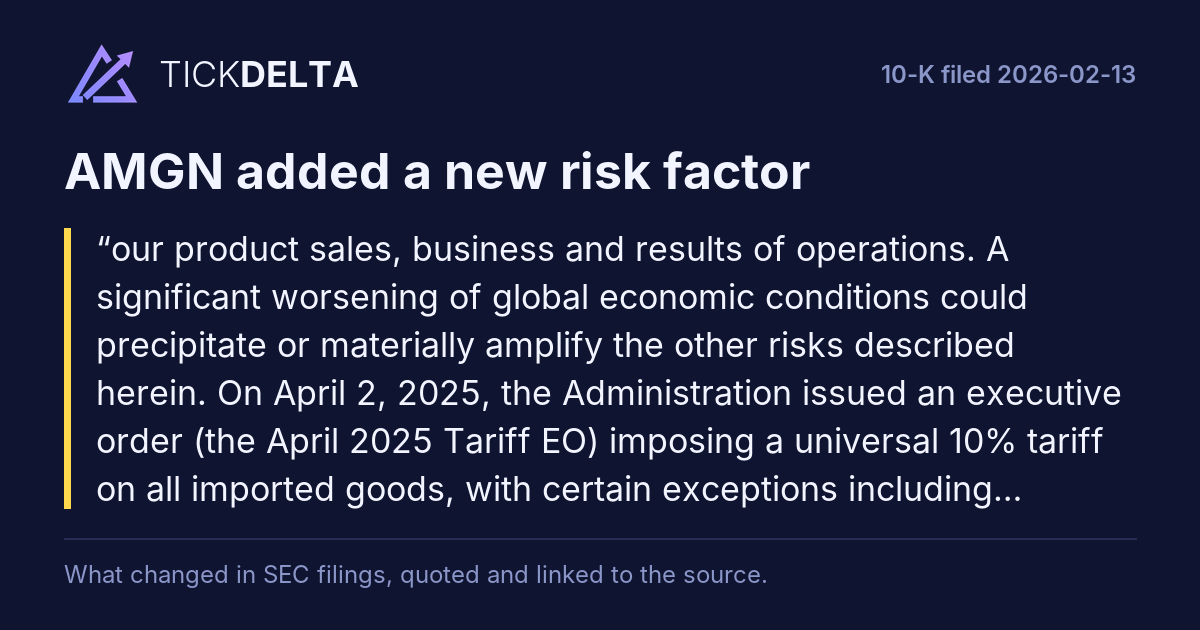
our product sales, business and results of operations. A significant worsening of global economic conditions could precipitate or materially amplify the other risks described herein. On April 2, 2025, the Administration issued an executive order (the April 2025 Tariff EO) imposing a universal 10% tariff on all imported goods, with certain exceptions including pharmaceuticals. The April 2025 Tariff EO imposed additional higher tariffs on approximately 60 countries with which the United States has trade deficits. Recent and ongoing changes in U.S. trade and tariff policies, including the imposition, modification, suspension and threatened expansion of tariffs on imported goods, as well as retaliatory measures by foreign governments, have increased uncertainty in the overall business and operating environment. Although certain pharmaceutical products are exempt from some tariffs, these measures have increased, and may continue to increase, our costs, including for materials, components and supplies used in research and development and manufacturing activities, have adversely affected, and may continue to adversely affect, our operations in various markets, and could disrupt global supply chains. On October 24, 2025, the Administration initiated, under the Trade Act of 1974, a Section 301 investigation of China’s implementation of the Economic and Trade Agreement between the U.S. and Chinese governments. This investigation, and any other 301 investigations initiated, may result in additional tariffs on imported goods from China and any other foreign markets subsequently investigated, respectively, potentially including pharmaceutical products and other goods that Amgen requires for the manufacture of our products. If subject to Section 301 tariffs, China, and other affected foreign governments, may retaliate against such tariffs by imposing tariffs of their own on U.S.-made goods. Given the many uncertainties and variables, it is currently unclear the extent, and degree, to which existing and future tariffs will disrupt and adversely affect our business activities (including product sales, and conduct of clinical trial and research and development activities), and the global economic environment, and/or amplify the other risks described herein.
Read in the 10-K ↗
26 paragraphs in the 10-Q filed Nov 4, 2026 with nothing like them in the 10-Q filed Aug 5, 2026 (at least half the words must differ; new numbers alone do not count). Quoted exactly, grouped by the item heading above them. This is text that changed, not a judgement of how serious it is.
Products referenced in this report that are not included in the above list are the properties of their respective owners.
Read in the 10-Q ↗
Three months ended September 30, 2026 Number Common Accumulated Accumulated Total
Read in the 10-Q ↗
Nine months ended September 30, 2026 Number Common Accumulated Accumulated Total
Read in the 10-Q ↗
Three months ended September 30, 2025 Number Common Accumulated Accumulated Total
Read in the 10-Q ↗
Nine months ended September 30, 2025 Number Common Accumulated Accumulated Total
Read in the 10-Q ↗
On October 2, 2026 and October 5, 2026, Amgen Inc. and Amgen Manufacturing Limited LLC filed Supplemental Complaints asserting infringement of U.S. Patent No. 12,679,865 in addition to the other asserted patents in the actions filed against Dr. Reddy’s Laboratories Ltd., et al. and Alkem Laboratories Ltd., et al., respectively. On October 23, 2026, the defendants in Dr. Reddy’s Laboratories Ltd., et al. responded to the Supplemental Complaint asserting counterclaims for declaratory judgment of non-infringement and invalidity and affirmative defenses. On October 26, 2026, the defendants in Alkem Laboratories Ltd., et al. responded to the Supplemental Complaint asserting affirmative defenses and counterclaims.
Read in the 10-Q ↗
On August 11, 2026, the U.S. District Court for the Northern District of West Virginia (the West Virginia District Court) denied Amgen’s motion for a suggestion of remand to the U.S. District Court for the Central District of California (the California Central District Court) for the 2024 Action.
Read in the 10-Q ↗
On August 20, 2026, Amgen filed its opposition brief and a conditional motion for leave to amend the pleadings. On August 27, 2026, Regeneron filed its reply brief and opposition brief to Amgen’s conditional motion. Amgen filed its reply brief in support of its conditional motion for leave to amend the pleadings on September 3, 2026.
Read in the 10-Q ↗
On October 27, 2026, the West Virginia District Court entered a stipulation and order dismissing with prejudice Regeneron’s claims concerning U.S. Patent Nos. 9,816,110 and 11,788,102, and dismissing without prejudice Amgen’s counterclaims and affirmative defenses concerning those same patents.
Read in the 10-Q ↗
The West Virginia District Court rescheduled the claim construction hearing from November 23, 2026 to December 1, 2026.
Read in the 10-Q ↗
The West Virginia District Court rescheduled the claim construction hearing from November 23, 2026 to December 1, 2026.
Read in the 10-Q ↗
Onyx Therapeutics, Inc. v. Amneal Pharmaceuticals of New York, LLC and Amneal EU, Limited.
Read in the 10-Q ↗
On October 6, 2026, the U.S. District Court for the District of Delaware (the Delaware District Court) entered a claim construction order adopting Onyx’s proposed construction of the lone patent claim term in dispute. The trial is scheduled to begin on July 28, 2027.
Read in the 10-Q ↗
On July 29, 2026, pursuant to a joint stipulation, the U.S. District Court for the District of New Jersey ordered a stay of the consolidated action in its entirety pending the FDA Commissioner’s decision on whether to withdraw approval of TAVNEOS. On August 4, 2026, pursuant to its stay order, the court administratively terminated the consolidated action without prejudice.
Read in the 10-Q ↗
Bristol-Myers Squibb Company (“BMS”), E. R. Squibb & Sons, L.L.C., and Ono Pharmaceutical Co., Ltd., v. Amgen Inc.
Read in the 10-Q ↗
On September 8, 2026, Bristol-Myers Squibb Company (BMS), E. R. Squibb & Sons, L.L.C., and Ono Pharmaceutical Co., Ltd., filed a lawsuit in the Delaware District Court alleging Amgen’s infringement of seven patents by Amgen’s submission of an application under the BPCIA for FDA licensure of ABP 206 as a biosimilar to BMS’s OPDIVO® (nivolumab) and also seeking declaratory judgment of infringement of the same seven patents. Amgen’s response to BMS’s complaint is due on November 13, 2026.
Read in the 10-Q ↗
On August 17, 2026, the California Superior Court for the County of Ventura granted Amgen’s demurrers to the complaints filed by Centene Corporation, Humana, Inc., and Molina Healthcare, Inc., with leave to amend the complaints, finding that based on the allegations Immunex and Roche did not “perdure” as separate entities following the exclusive license as required under California’s Cartwright Act. The court did not reach the other arguments Amgen raised in its demurrers. The plaintiffs have sought dismissal of these matters with prejudice; following dismissal by the court, the plaintiffs can appeal the court’s demurrer ruling.
Read in the 10-Q ↗
On September 14, 2026, defendants ChemoCentryx and its former Chief Executive Officer, Dr. Thomas Schall, entered into a settlement agreement with RA Capital Healthcare Fund, LP (RA Capital) to settle both cases. On October 19, 2026, RA Capital dismissed both the state and federal case pursuant to the terms of the settlement agreement.
Read in the 10-Q ↗
In August 2026, we and our collaboration partner AstraZeneca announced positive top-line results from the Phase 3 CROSSING trial of TEZSPIRE in patients living with eosinophilic esophagitis (EoE). TEZSPIRE demonstrated statistically significant and clinically meaningful improvements across co-primary and key secondary endpoints at week 24 which were sustained through week 52. The co-primary endpoints were histologic remission and the frequency and severity of dysphagia (difficulty swallowing). The safety profile of TEZSPIRE was generally consistent with its approved indications. Additionally, detailed results were presented in October 2026 at international medical congresses.
Read in the 10-Q ↗
In August 2026, the European Commission approved an expanded indication for the use of Repatha in adults with established or at high risk for atherosclerotic cardiovascular disease (ASCVD) to reduce cardiovascular (CV) risk by lowering low-density lipoprotein cholesterol (LDL-C) levels, as an adjunct to correction of other risk factors, based on results from the Phase 3 VESALIUS-CV trial.
Read in the 10-Q ↗
In September 2026, we announced results from the Phase 3 DeLLphi-305 study, which met its primary endpoint at a pre-specified interim analysis, demonstrating a statistically significant and clinically meaningful improvement in overall survival with IMDELLTRA/IMDYLLTRA in combination with AstraZeneca’s IMFINZI® (durvalumab) compared to IMFINZI alone. This study tested IMDELLTRA/IMDYLLTRA as a first-line maintenance treatment for people with extensive-stage small cell lung cancer (ES-SCLC) whose disease had not progressed following initial treatment with IMFINZI, platinum-based chemotherapy and etoposide. The study also demonstrated a statistically significant and clinically meaningful improvement in progression-free survival (PFS) and objective response rate (ORR) among patients treated with IMDELLTRA/IMDYLLTRA in combination with IMFINZI. Overall, the safety profile of IMDELLTRA/IMDYLLTRA in combination with IMFINZI was consistent with the known safety profiles of the individual medicines. No new or unexpected safety signals were identified in DeLLphi-305. Additionally, detailed results were presented in October 2026 at an international medical congress.
Read in the 10-Q ↗
In September 2026, we announced positive topline results from the Phase 3 OASIZ 301 study evaluating dazodalibep in adults with Sjögren’s disease and moderate-to-severe systemic disease activity. The study met its primary endpoint, demonstrating statistically significant and clinically meaningful improvement at week 48, as measured by the EULAR Sjögren’s Syndrome Disease Activity Index (ESSDAI). Improvements in ESSDAI were observed as early as week 4 with treatment with dazodalibep, which were sustained through week 48 of the study. The most common adverse events (>/= 5% incidence, reported at a higher rate in dazodalibep compared with placebo) were nasopharyngitis, urinary tract infection, hypertension and infusion-related reactions, and were generally mild to moderate in nature. Discontinuations due to adverse events occurred at a low rate and were balanced across treatment groups. No imbalance in the incidence of thromboembolic events or opportunistic infections was observed across treatment arms. Additionally, in October 2026 we released further detail of these results.
Read in the 10-Q ↗
In September 2026, we announced submission of our Biologics License Application and its acceptance for review by the FDA for ABP 206, our biosimilar candidate to OPDIVO® (nivolumab).
Read in the 10-Q ↗
In September 2026, we announced completion of the primary analysis of a pharmacokinetic/comparative clinical study of ABP 234, our biosimilar candidate to KEYTRUDA® (pembrolizumab), which met both primary and secondary endpoints.
Read in the 10-Q ↗
operations. In addition, as a result of restating previously reported price data, we may be required to pay additional rebates and provide additional discounts.
Read in the 10-Q ↗
in August 2026, the European Commission revoked the marketing authorization for TAVNEOS held by a licensee of ChemoCentryx in the EU. In a number of other jurisdictions, with respect to TAVNEOS, regulators have initiated reviews, advised against initiating treatment in new patients, or ordered or announced actions to revoke marketing authorizations, and pending applications and marketing authorizations have been voluntarily withdrawn. These developments could lead to additional adverse regulatory actions in other jurisdictions. The Company has engaged with regulatory authorities, continues to believe that TAVNEOS demonstrates clinical effectiveness and a favorable benefit-risk profile, and intends to follow the appropriate process to support its position. As the FDA’s statement reporting its proposal indicates, TAVNEOS will remain on the market during the pendency of this process. We cannot predict the outcome of these interactions with the FDA on this matter, and the FDA may require additional actions, including further labeling changes, warnings, monitoring, restrictions on use, postmarketing commitments or studies, and any such action or any withdrawal of regulatory approval for TAVNEOS could adversely affect our product sales of TAVNEOS, business and results of operations, including by adversely affecting us in connection with existing or future litigation, government investigations or other legal proceedings.
Read in the 10-Q ↗
Item 1A of the 10-Q filed Nov 4, 2026 against Item 1A of the 10-K filed Feb 13, 2026.
A 10-Q repeats only the risks that changed, so a 10-K paragraph that is missing from it is not counted as removed.
Added is a paragraph with nothing like it in the 10-K, Reworded a sentence that is in both with several words changed,
Quiet changes a sentence in both where one to four words changed and one is a hedge or a modal
(cut words struck through, new words highlighted and underlined).
Text on the page, not a score; each links to the filing at sec.gov.
What the 10-Q itself says about its risk factors:
Read in the 10-Q ↗
Below we provide in supplemental form the material changes to our risk factors that occurred during the past quarter. Our risk factors disclosed in Part I, Item 1A, of our Annual Report on Form 10-K for the year ended December 31, 2025, provide additional disclosure for these supplemental risks and are incorporated herein by reference.
The first 19 of 30 are shown (at most 12 of each type).
Work on AMGN in a spreadsheet:
Excel workbook (a sheet per section, ten years by column, charts, links to the filings) ·
CSV.
For a Google Sheet that stays up to date, paste =IMPORTDATA("https://tickdelta.com/company/AMGN/export.csv") into a cell.