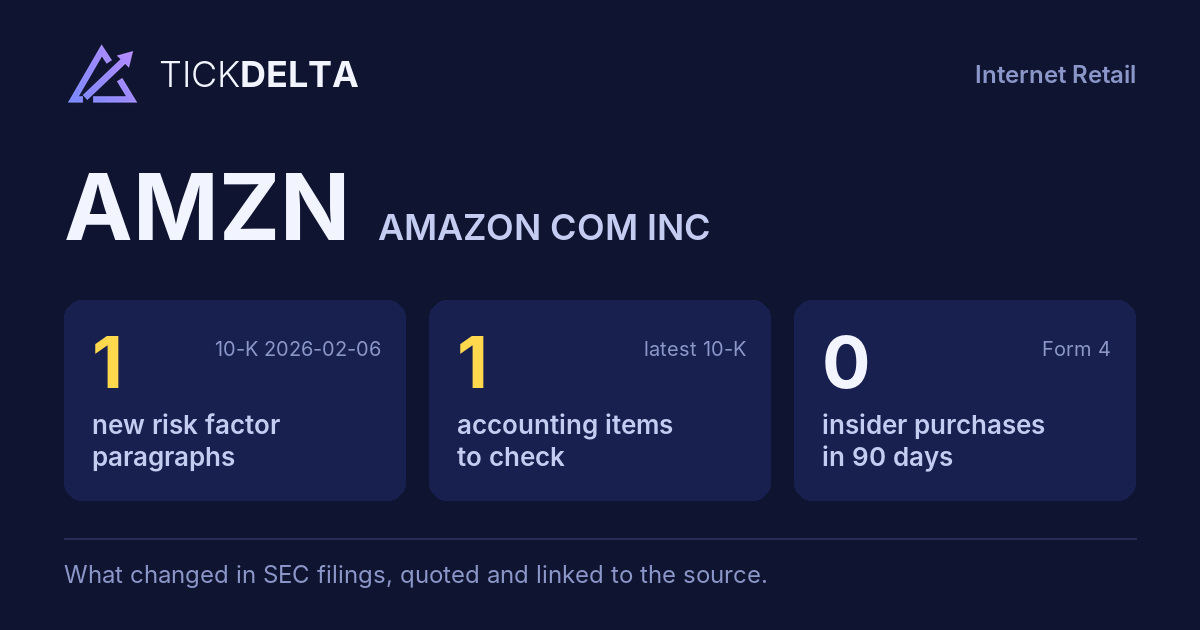
Marked against last year's 10-K:
cut words struck through, new words highlighted and underlined.
Accounting Policies 341 words changed in this paragraph; it is 41% similar to last year's version.
In From Q3 2023, we invested in a $1.25 billion note from Anthropic, PBC, which is convertible 2023 to equity. In Q1 Q4 2024, we invested $2.75 $5.3 billion in a second convertible note. In Q4 2024, we entered into an agreement and invested $1.3 billion in a third convertible note, and will invest an additional $2.7 billion by Q4 2025. The notes from Anthropic, which are classified as available-for-sale and are classified as Level 3 assets, and as of December 31, 2024 had an estimated fair value of approximately $13.8 billion. In making these estimates, we utilized valuation methods based on information available, including the rights and obligations of the convertible notes, other outstanding classes of securities, observable transactions such as new securities offerings, estimates of expected time to and type of liquidity events and anticipated securities offerings, and discounts for lack of marketability. Subsequent to December 31, 2024, a portion Some of the these notes were converted to nonvoting preferred stock. stock in Q1 2025. As a result of this conversion, conversions, a significant portion of the unrealized gain associated with the notes as of December 31, 2024 was reclassified and a gain of approximately $3.3 billion was recorded in “Other income (expense), net” in our consolidated statement of operations. The investment in nonvoting preferred stock was initially recorded at its estimated fair value at the time of the conversion and is accounted for as a component of our equity investments in private companies not accounted for under the equity-method, with future adjustments for observable changes in prices or impairments representing Level 3 fair value measurements recognized in “Other income (expense), net” on our consolidated statements of operations. In Q2 2025, we invested $1.3 billion in a new convertible note from Anthropic. In Q3 2025, an additional portion of our notes was converted to nonvoting preferred stock, and as a result of the conversion a portion of the unrealized gain associated with the notes was reclassified and a gain of approximately $2.3 billion was recorded in “Other income (expense), net.” We also recorded an upward adjustment of $7.2 billion to our nonvoting preferred stock in “Other income (expense), net” to reflect observable changes in price. In Q4 2025, we invested $1.4 billion in a new convertible note from Anthropic. As of December 31, 2025, the amount recorded on our consolidated balance sheet for nonvoting preferred stock was approximately $14.8 billion. As of December 31, 2025, the estimated fair value of our convertible notes recorded on our consolidated balance sheet was approximately $45.8 billion, and the associated pre-tax unrealized gain included in “Accumulated other comprehensive income (loss)” was $39.5 billion. We also have a commercial arrangement primarily for the provision of AWS cloud services, which includes the use of AWS chips.
Source: Item 8, Note 1 – DESCRIPTION OF BUSINESS, ACCOUNTING POLICIES, AND SUPPLEMENTAL DISCLOSURES, 10-K 0001018724-26-000004 vs Item 8, Note 1 – DESCRIPTION OF BUSINESS, ACCOUNTING POLICIES, AND SUPPLEMENTAL DISCLOSURES, 10-K 0001018724-25-000004
Legal Proceedings 202 words changed in this paragraph; it is 37% similar to last year's version.
In October 2020, Broadband iTV, Inc. December 2025, Primos Storage Technology LLC filed a complaint against Amazon.com, Inc., Amazon.com Services LLC, Inc. and Amazon Web Services, Inc. in the United States District Court for the Western District of Texas. Delaware. The complaint alleges, among other things, that certain Amazon Prime Video features S3, Amazon EMR, Amazon EC2 instances using Amazon EBS, and services Amazon FSx for Lustre infringe U.S. Patent Nos. 9,648,388, 10,546,750, 7,386,663; 7,937,528; and 10,536,751, each entitled “Video-On-Demand Content Delivery System for Providing Video-On-Demand Services to TV Services Subscribers”; 10,028,026, entitled “System for Addressing On-Demand TV Program Content on TV Services Platform of a Digital TV Services Provider”; 10,599,344, and 9,973,825, entitled “Dynamic Adjustment of Electronic Program Guide Displays Based on Viewer Preferences for Minimizing Navigation in VOD Program Selection.” that Amazon S3 and Amazon EMR infringe U.S. Patent Nos. 8,078,944 and 8,312,356. The complaint seeks injunctive relief, an ongoing royalty, an unspecified amount of damages. In April 2022, Broadband iTV alleged in its damages report that in the event of a finding of liability Amazon could be subject to $166 million to $986 million in damages. In September 2022, the district court granted summary judgment, holding that the patents are invalid. In October 2022, Broadband iTV filed a notice of appeal. In September 2024, the United States Court of Appeals for the Federal Circuit affirmed the district court’s judgment. This decision is subject to appeal. damages, enhanced damages, attorneys’ fees, costs, and interest. We dispute the allegations of wrongdoing and will continue intend to defend ourselves vigorously in this matter.
Source: Item 3, via Note 7 – COMMITMENTS AND CONTINGENCIES, 10-K 0001018724-26-000004 vs Item 3, via Note 7 – COMMITMENTS AND CONTINGENCIES, 10-K 0001018724-25-000004
Risk Factors 191 words changed in this paragraph; it is 67% similar to last year's version.
As an innovative company offering a wide range of consumer and business products and services around the world, we are regularly subject to actual and threatened claims, litigation, reviews, investigations, and other proceedings, including proceedings by governments and regulatory authorities, involving a wide range of issues, including patent and other intellectual property matters, taxes, labor and employment (including the characterization of delivery drivers), competition and antitrust, privacy, data use, data protection, data security, data localization, network security, consumer protection, commercial disputes, goods and services offered by us and by third parties (including artificial intelligence technologies and services), healthcare, and other matters. The number and scale of these proceedings have increased over time as our businesses have expanded in scope and geographic reach, as our products, services, and operations have become more complex and available to, and used by, more people, and as governments and regulatory authorities seek to regulate us on a pre-emptive basis. For example, we are litigating a number of matters alleging price fixing, monopolization, and consumer protection claims, including those brought by state attorneys general and the Federal Trade Commission. Any of these types of proceedings can have an adverse effect on us because of legal costs, disruption of our operations, diversion of management resources, negative publicity, and other factors. The outcomes of these matters are inherently unpredictable and subject to significant uncertainties. Determining legal reserves or possible losses from such matters involves judgment and may not reflect the full range of uncertainties and unpredictable outcomes. Until the final resolution of such matters, we may be exposed to losses in excess of the amount recorded, and such amounts could be material. Should any of our estimates and assumptions change or prove to have been incorrect, it could have a material effect on our business, consolidated financial position, results of operations, or cash flows. In addition, it is possible that a resolution of one or more such proceedings, including as a result of a settlement, could involve licenses, sanctions, consent decrees, or orders requiring us to make substantial future payments, preventing us from offering certain products or services, requiring us to change our business practices in a manner materially adverse to our business, requiring development of non-infringing or otherwise altered products or technologies, damaging our reputation, or otherwise having a material effect on our operations.
Source: Item 1A, 10-K 0001018724-26-000004 vs Item 1A, 10-K 0001018724-25-000004
MD&A 175 words changed in this paragraph; it is 38% similar to last year's version.
Our U.S. taxable income is reduced by accelerated depreciation deductions and increased the resulting U.S. tax liability is reduced by tax credits, primarily related to the impact of capitalized U.S. federal research and development expenses. credit. The One Big Beautiful Bill Act of 2025 (the “2025 Tax Act”) made changes to the U.S. tax rules provide for enhanced corporate income tax, including reinstating the option to claim 100% accelerated depreciation deductions by allowing us to expense a portion of on qualified property, primarily equipment. These enhanced deductions are scheduled to phase out annually from 2023 through 2026. Our federal tax provision included accelerated depreciation deductions for 2022, 2023, with retroactive application beginning January 20, 2025 and 2024. Additionally, effective January 1, 2022, immediate expensing of domestic research and development expenses are required to be capitalized and amortized for U.S. tax purposes, which delays the deductibility of these expenses. costs, with retroactive application beginning January 1, 2025. The 2025 Tax Act significantly decreased our cash taxes in 2025. Cash paid for U.S. (federal and state) and foreign income taxes (net of refunds) totaled $11.2 $12.3 billion and $12.3 $8.3 billion for 2023 2024 and 2024. 2025. We expect the 2025 Tax Act to have a similar effect on our cash taxes in 2026. See Item 8 of Part II, “Financial Statements and Supplementary Data — Note 9 — Income Taxes” for additional cash taxes paid information.
Source: Item 7, 10-K 0001018724-26-000004 vs Item 7, 10-K 0001018724-25-000004