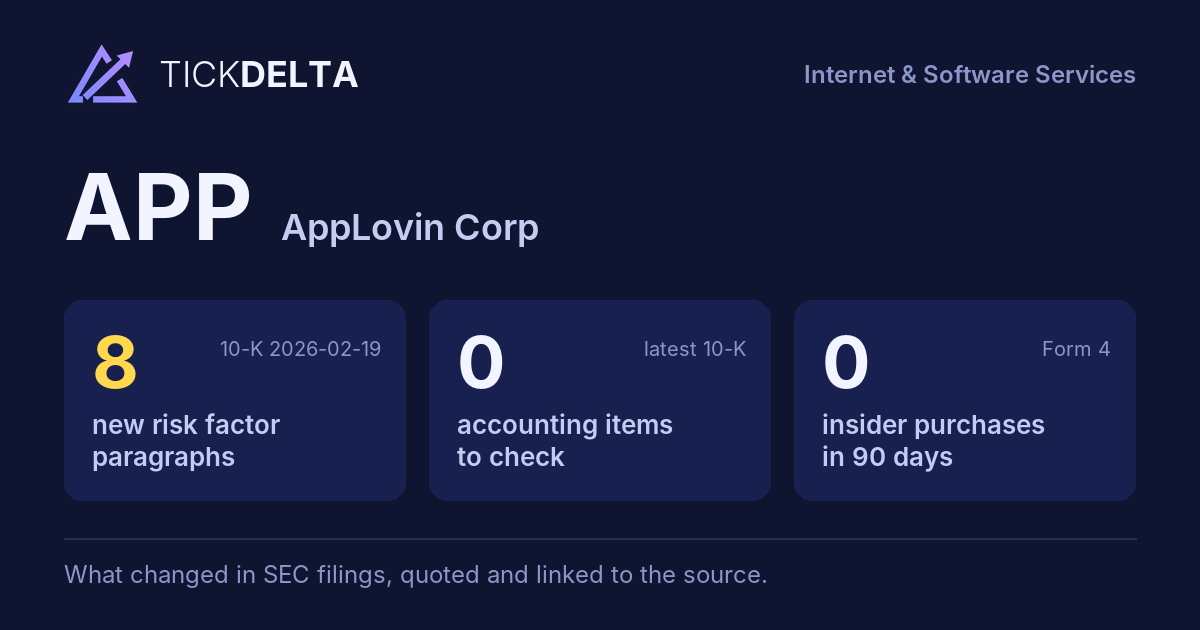
10-K 0001751008-26-000010 (2026-02-19) vs 10-K 0001751008-25-000018 (2025-02-27)
| Section | Compared text | Words now | Changed |
|---|
| Risk Factors | Item 1A | 23,051 |
25.6% |
| MD&A | Item 7 | 5,453 |
47.9% |
| Legal Proceedings | Item 3, via Note 6 – Commitments and Contingencies | 558 |
31.2% |
| Accounting Policies | Item 8, Note 2 – Summary of Significant Accounting Policies | 4,154 |
35.7% |
The redline: what was cut and what was added
In each section, the paragraph that changed most, marked against last year's 10-K:
cut words struck through, new words highlighted and underlined.
MD&A 443 words changed in this paragraph; it is 39% similar to last year's version.
Our business and results of operations are and will continue to be impacted by industry factors that drive the overall performance and growth of the mobile app and advertising ecosystems. Mobile app developers, including AppLovin, developers rely on third-party platforms, such as the Apple App Store and Google Play Store, among others, to distribute games, apps, collect payments made for IAPs, in-app purchases, and target users with relevant advertising. We expect this to continue for the foreseeable future. These third-party platforms have significant market power and discretion to set platform fees, select which apps to promote, and decide how much consumer information to provide to advertising networks that enable our Advertising advertising solutions to target users with personalized and relevant advertising and allocate marketing campaigns in an efficient and cost-effective manner. Any changes made in to the policies of third-party these third party platforms could can drive rapid change across the mobile app and advertising ecosystems. For example, Both the Apple App Store and Google Play Store have made various changes to their policies in April 2021, Apple started implementing its application tracking transparency framework that, among other things, requires users' opt-in consent for certain types of tracking. While this transparency framework has not had a significant impact on our overall business, it may do so recent years, as further discussed in the future, section titled “Risk Factors–Risks Related to Our Business, Operations and Industry–-If third-party platforms change their policies in a way that harms our business, including the design and effectiveness of our advertising solutions, our business, financial condition, and results of operations could be adversely affected.” The mobile app and advertising ecosystems also continue to be subject to an evolving legal and regulatory landscape, including with respect to data protection, privacy, and AI. We must continue to innovate and stay ahead of developments in the effectiveness of our advertising practices and/or our ability to efficiently generate revenue and mobile app ecosystems in order for our Apps. We rely in part on Identifier for Advertisers ("IDFA") business to provide us with data that helps succeed and our Advertising solutions better market and monetize Apps. In light results of the IDFA and transparency changes, we made changes to our data collection practices. To the extent we are unable to utilize IDFA or a similar offering, or if the transparency changes and any related opt-in or other requirements result in decreases in the availability or utility of data relating to Apps, our Advertising solutions may not be as effective, we may not be able operations to continue to efficiently generate revenue for our Apps, and our revenue and results of operations may be harmed. Additionally, Apple implemented new requirements for consumer disclosures regarding privacy and data processing practices in December 2020, which has resulted in increased compliance requirements and could result in decreased usage of our Apps. Apple incorporated new SDK privacy controls into iOS 17, which was released in September 2023, including privacy manifests and signatures designed to allow app developers to outline the data practices for SDKs embedded in their apps, manage tracking domains within SDKs, and curb device fingerprinting by requiring app developers to select allowed reasons for using data received through certain APIs. In February 2022, Google announced its Privacy Sandbox initiative for Android, a multi-year effort expected to restrict tracking activity and limit advertisers' ability to collect app and user data across Android devices. In January 2024, Google commenced rolling out a Chrome feature, called Tracking Protection, which limits improve.
Source: Item 7, 10-K 0001751008-26-000010 vs Item 7, 10-K 0001751008-25-000018
Risk Factors 404 words changed in this paragraph; it is 49% similar to last year's version.
Further, children’s privacy continues to be a focus of enforcement activities and subjects our business to potential liability that could adversely affect our business, financial condition, or operating results. For example, enforcement of COPPA, which requires companies to obtain parental consent before collecting personal information from children known to be under the age of thirteen or from child-directed websites or online services, has increased in recent years. In addition, the GDPR, the CCPA, as modified by the CPRA, and other laws contain their own prohibitions and requirements relating to processing the personal information of children. There also may be various laws, regulations, industry standards, codes of conduct, or other actual or asserted obligations relating to children’s privacy to which we may be, or be asserted to be, subject, or that may otherwise impact our business and operations. For example, the United Kingdom’s Age Appropriate Design Code (“AADC”) is one such regulatory framework that has been adopted in the United Kingdom that focuses on online safety and protection of children’s privacy online, and similar frameworks are being considered in other jurisdictions. While our terms of use prohibit publishers and advertisers from using our services in connection with end users who qualify as a “child” under applicable laws or content exclusively designed for or exclusively directed to children under applicable laws and app store policies, and we take reasonable efforts to comply with applicable laws and regulations and certain other standards, we may in the future face claims under COPPA, the GDPR, the CCPA, the CPRA, or other laws, regulations, or other actual or asserted obligations relating to children’s privacy. Additionally, several jurisdictions have enacted or proposed laws imposing new privacy obligations related to health-related personal information beyond traditional medical privacy laws like the Health Insurance Portability and Accountability Act, which laws can broadly define consumer health data and in certain cases include private rights of action. Ongoing developments regarding laws and regulations concerning privacy, information security, data protection, consumer protection, advertising, and other factors that may be relevant to our business may increase compliance burdens, legal risks, and operational costs for us, our clients, and others in the advertising technology ecosystem. We endeavor to comply with applicable industry standards and are subject to the terms of our privacy-related obligations and commitments to users clients, end users, and third parties. We strive to comply with all applicable laws, policies, legal obligations, and certain industry codes of conduct relating to privacy and data protection, to the extent reasonably attainable. However, it is possible that these or other actual or asserted obligations relating to privacy, data protection, or information security may be interpreted and applied in a manner that is inconsistent from one jurisdiction to another and may conflict with other rules or our practices. It is also possible that laws, policies, legal obligations, or industry codes of conduct may be implemented, modified, or interpreted, interpreted in manners that could prevent us from offering services to categories of users, persons, such as residents of a certain jurisdiction, or may make it costlier or more difficult for us to do so. Any failure or perceived failure by us to comply with our terms of service use or privacy policy, or policy; with applicable laws, regulations, or legal, contractual, or other actual or asserted obligations to users clients or third parties, parties concerning privacy, information security, data protection, consumer protection, or protection of minors; or our privacy-related legal obligations, the matters discussed in this risk factor; or any compromise of security that results, or is perceived to result, in the unauthorized release or transfer of personal
Source: Item 1A, 10-K 0001751008-26-000010 vs Item 1A, 10-K 0001751008-25-000018
Accounting Policies 147 words changed in this paragraph; it is 41% similar to last year's version.
The Company’s performance obligation is to provide customers with access to the Advertising solutions, which facilitates the advertiser’s purchase of ad inventory from Publishers. The Company does not control the ad advertising inventory prior to its transfer to the advertiser, advertiser because the Company it does not have the substantive ability to direct the use of nor of, or obtain substantially all of the remaining benefits from from, the ad advertising inventory. The In addition, the Company is not primarily responsible for fulfillment. The Therefore, the Company is an agent as it relates to the sale of third-party advertising inventory in these arrangements and presents revenue on a net basis. The transaction price is the product of either the number of completions of agreed upon actions or advertisements displayed and the contractually agreed upon price per advertising unit with the advertiser less consideration paid or payable to Publishers. The Company recognizes Advertising Revenue when the agreed upon action is completed or when the ad is displayed to users. The number of advertisements delivered and completions of agreed upon actions is determined at the end of each month, which resolves any uncertainty in the transaction price during the reporting period. inventory costs.
Source: Item 8, Note 2 – Summary of Significant Accounting Policies, 10-K 0001751008-26-000010 vs Item 8, Note 2 – Summary of Significant Accounting Policies, 10-K 0001751008-25-000018
Legal Proceedings 98 words changed in this paragraph; it is 55% similar to last year's version.
The Company records a liability for loss contingencies when it is probable that a loss has been incurred and the amount can be reasonably estimated. If it is determined that a loss is reasonably possible and the loss amount or range of loss can be reasonably estimated, the reasonably possible Company discloses the estimated loss is disclosed. or range of loss. The Company monitors legal matters and evaluates developments in legal matters that could affect the amount of liability that has been previously accrued, accrued amounts or related disclosures, or whether a previously unaccrued or undisclosed matter requires accrual or disclosure, and related reasonably possible losses disclosed, adjusts accruals and makes adjustments disclosures as appropriate. Significant judgment is required to determine Determining the likelihood of matters loss and the estimated amount or range of a loss related to such matters. Losses in connection with legal proceedings have not been material for any period presented. involves significant judgment.
Source: Item 3, via Note 6 – Commitments and Contingencies, 10-K 0001751008-26-000010 vs Item 3, via Note 5 – Commitments and Contingencies, 10-K 0001751008-25-000018
Every change, by type
Sentences and paragraphs of APP's Risk Factors and MD&A, 10-K 2026-02-19 against 10-K 2025-02-27.
Each links to the text at sec.gov.
AddedRisk Factors
•the impact of tariffs recently imposed by the U.S. government and its trading partners in response, other possible tariffs or trade protection measures, import or export licensing requirements, new or different customs duties, trade embargoes and sanctions and other trade barriers;
Read it in 10-K 2026-02-19 at sec.gov ↗
AddedRisk Factors
A deterioration in macroeconomic conditions, whether in the United States, internationally, or globally, could create uncertainty and adversely affect advertising spending or costs related to our operations. Historically, consumer purchasing and advertising spending have each declined during economic downturns and periods of uncertainty regarding future economic prospects or when disposable income or consumer lending is lower. Uncertain economic conditions may impact advertiser spending in future periods and may also adversely affect our clients, which in turn may harm our business, financial condition, and results of operations. Economic and political relations between the U.S. and other countries continue to evolve rapidly, including with respect to tariff and other policies, and changing policies may adversely affect our business by harming advertising spending or increasing our costs.
Read it in 10-K 2026-02-19 at sec.gov ↗
AddedRisk Factors
In addition, we have in the past chosen, and may in the future also choose, to divest certain businesses or product lines. For example, in June 2025, we sold our Apps business. As a result of this divestiture, we no longer generate Apps revenue and we may not achieve the desired strategic and financial benefits. Any future divestitures or similar transactions may, among other risks, result in reduced revenue, cause us to incur additional expenses, disrupt third party or employee relationships, and expose us to unanticipated or ongoing obligations and liabilities, including as a result of our indemnification obligations or any agreement to provide transition services.
Read it in 10-K 2026-02-19 at sec.gov ↗
AddedRisk Factors
Harm to our brands and reputation can arise from many sources, including actions of our business partners, service disruptions or technical issues, or legal or regulatory scrutiny. Even allegations may harm our reputation and brands and cause the market price of our Class A common stock to decline. We have, from time to time in the past, and may in the future be, the target of incomplete, inaccurate, and misleading or false statements about our company and our business that could damage our reputation and brands, divert management attention and resources, and deter clients or potential clients from using our solutions. If we do not successfully maintain, protect or enhance our brand and reputation, our business could be materially and adversely affected.
Read it in 10-K 2026-02-19 at sec.gov ↗
AddedRisk Factors
We transfer personal data relating to our employees, clients and their users from the European Economic Area (“EEA”), the United Kingdom, Switzerland, and other jurisdictions to the United States and other countries. Following the invalidation of the EU-U.S. and Swiss-U.S. Privacy Shield frameworks by the Court of Justice of the European Union in 2020 and the imposition of additional requirements regarding the use of standard contractual clauses (“SCCs”), cross-border data transfer mechanisms
Read it in 10-K 2026-02-19 at sec.gov ↗
AddedRisk Factors
have been subject to heightened regulatory scrutiny, evolving guidance, and legal challenge. The European Commission adopted updated SCCs in 2021, and the United Kingdom has implemented its own contractual transfer mechanisms, which have increased compliance complexity and costs. In July 2023, the European Commission adopted an adequacy decision for the EU-U.S. Data Privacy Framework (“EU-U.S. DPF”), and related frameworks for the United Kingdom and Switzerland subsequently became effective. We are certified under these frameworks, where applicable; however, they are subject to ongoing review and potential legal challenge and may be modified, suspended, or invalidated in the future. Regulators in certain European jurisdictions have also taken the position that specific data transfer practices, including the use of certain analytics tools, may result in unlawful transfers of personal data to the United States. If existing data transfer mechanisms are restricted or invalidated, or if additional measures are required, we and our business partners and service providers may need to implement alternative or supplemental safeguards, renegotiate contracts, or modify our operations, which could increase costs, limit our ability to process personal data, disrupt our advertising solutions or other offerings, and expose us and our customers to regulatory investigations or enforcement actions. Similar cross-border data transfer restrictions under other current or future laws such as Brazil’s General Data Protection Law and China’s Personal Information Protection Law may further increase compliance burdens and adversely affect our business, financial condition, and results of operations.
Read it in 10-K 2026-02-19 at sec.gov ↗
AddedRisk Factors
Moreover, there are increasing restrictions in the United States on certain personal sensitive data transfers to certain foreign countries. The Department of Justice finalized a final rule implementing Executive Order 14117, effective April 8, 2025, which prohibits data transfer of personal identifiers, precise geolocation data, biometric identifiers, health data, and financial data over a certain bulk threshold to identified countries of concern (i.e., China, Hong Kong, Macau, Cuba, Iran, North Korea, Russia, and Venezuela). The rule also restricts data brokerage agreements, investment agreements, employment agreements, and vendor agreements involving such data and countries of concern. Violations of the rule may be punishable by criminal and/or civil sanctions and may result in exclusion from participation in federal and state programs. These data transfer restrictions may create operational challenges and legal risks for our business, particularly with regard to China, where we have operations.
Read it in 10-K 2026-02-19 at sec.gov ↗
AddedRisk Factors
Further, the enforceability of similar exclusive forum provisions in other companies’ organizational documents has been challenged in legal proceedings, and it is possible that a court of law may rule that these types of provisions are inapplicable or unenforceable if they are challenged in a proceeding or otherwise. In the event a court finds either exclusive forum provision
Read it in 10-K 2026-02-19 at sec.gov ↗
AddedMD&A
On May 7, 2025, we, along with our subsidiaries Morocco, Inc. and AppLovin GmbH (collectively, the “Sellers”) entered into a Purchase Agreement (the “Agreement”) with Tripledot and its subsidiaries Eton Games Inc. ("Eton") and Tripledot Group Holdings Limited (collectively, with Tripledot, the “Purchasers”) relating to the sale of our Apps business. On June 30, 2025, we and Tripledot entered into an amendment to the Agreement to provide, among other things, that in lieu of the issuance of a secured promissory note by Eton to us or our designated affiliate to fund a portion of the full Cash Consideration (as defined in the Agreement), Tripledot may elect to pay such amount in cash.
Read it in 10-K 2026-02-19 at sec.gov ↗
AddedMD&A
On June 30, 2025, we consummated the sale of the Apps business to the Purchasers for $400 million in cash, subject to closing adjustments, and equity consideration representing approximately 20% of Tripledot’s fully-diluted equity at the time of closing. No promissory note was issued as part of the transaction. Following the sale of the Apps business, we operate as a single operating and reportable segment. Results related to our Apps business are presented as discontinued operations in our consolidated financial statements. See Note 2—Summary of Significant Accounting Policies and Note 3 – Discontinued Operations of the Notes to consolidated financial statements in Part II, Item 8 of this Annual Report on Form 10-K.
Read it in 10-K 2026-02-19 at sec.gov ↗
AddedMD&A
Net cash provided by (used in) investing activities $ 358,428 $ (106,754) $ (77,829)
Read it in 10-K 2026-02-19 at sec.gov ↗
AddedMD&A
We generate substantially all of our revenue from fees collected from advertisers spending on Axon Ads Manager, which are determined dynamically based on advertisers’ campaign goals. Revenue from other services was not material. Revenue does not include the results of our former Apps business, which is classified as discontinued operations.
Read it in 10-K 2026-02-19 at sec.gov ↗
AddedMD&A
The following tables summarize our historical consolidated statement of operations:
Read it in 10-K 2026-02-19 at sec.gov ↗
AddedMD&A
On July 4, 2025, the One Big Beautiful Bill Act (“OBBBA”) was enacted in the U.S. The OBBBA includes significant provisions, such as the permanent extension of certain expiring provisions of the Tax Cuts and Jobs Act, modifications to the international tax framework and the restoration of favorable tax treatment for certain business provisions. We evaluated the provisions of OBBBA effective in 2025 and its impact on the consolidated financial statements was immaterial.
Read it in 10-K 2026-02-19 at sec.gov ↗
AddedMD&A
The following table summarizes our cash flows for the periods indicated (all periods include cash flows from continuing and discontinued operations):
Read it in 10-K 2026-02-19 at sec.gov ↗
AddedMD&A
We account for investments under the equity method when we have the ability to exercise significant influence, but not control, over the financial and operating policies of an investee, unless the fair value option is elected. Equity method investments are initially recorded at cost and subsequently adjusted for our proportionate share of the investee’s net income or loss and the amortization of basis differences arising from the excess of investment cost over our share of the investee’s
Read it in 10-K 2026-02-19 at sec.gov ↗
AddedMD&A
underlying net assets. We record our share of the investee’s results and related basis difference amortization one quarter in arrears in other income (expense), net in our consolidated statements of operations.
Read it in 10-K 2026-02-19 at sec.gov ↗
AddedMD&A
We evaluate equity method investments for impairment when events or changes in circumstances indicate that the carrying amount may not be recoverable and record an impairment loss when a decline in fair value below carrying value is determined to be other than temporary. Indicators of potential impairment include, among other factors, the investee’s financial results and operating trends, implied values from transactions involving the investee’s securities, the severity and duration of any decline in value, and our intent and ability to hold the investment. If an impairment is determined to be other than temporary, we determine the investment’s fair value and record an impairment charge for the difference between fair value and carrying value. Determining fair value, particularly for investments in privately held companies, requires significant judgment and the use of estimates and assumptions. Changes in these estimates and assumptions could affect the fair value determination and the amount of any impairment charges.
Read it in 10-K 2026-02-19 at sec.gov ↗
AddedMD&A
In evaluating the exposure associated with various tax filing positions, we accrue an income tax liability when such positions do not meet the more-likely-than-not threshold for recognition. We consider changes in facts and circumstances, such as new regulations or recent judicial opinions, as well as the status of audit activities by taxing authorities.
Read it in 10-K 2026-02-19 at sec.gov ↗
AddedMD&A
While we believe we have adequately reserved for our uncertain tax positions, no assurance can be given that the final tax outcome of these matters will not be different. To the extent that the final tax outcome of these matters is different than the amounts recorded, such differences will affect the provision for income taxes and the effective tax rate in the period in which such determination is made.
Read it in 10-K 2026-02-19 at sec.gov ↗