Screener / SEC EDGAR /CIK 0001751008 /10-K filed Feb 19, 2026, compared with Feb 27, 2025 /Numbers from the XBRL of the 10-Ks
Nasdaq Communication · Internet & Software Services

AppLovin APP

Compare with peers Embed
The 10-K against last year's

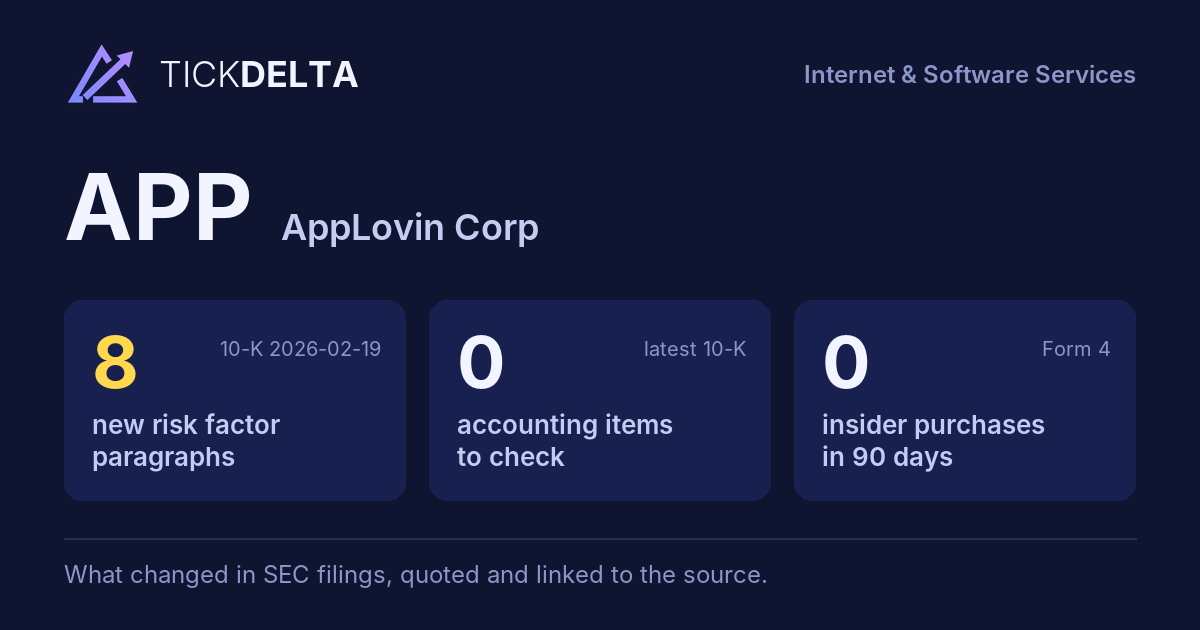
285 changes: 20 added, 98 removed, 164 reworded, 3 quiet changes

10-K Feb 19, 2026 vs Feb 27, 2025

10-K 0001751008-26-000010 (Feb 19, 2026) vs 10-K 0001751008-25-000018 (Feb 27, 2025)

The paragraph that changed most in each section

The redline

Marked against last year's 10-K: cut words struck through, new words highlighted.

MD&A443 words changed in this paragraph; it is 39% similar to last year's version.
Our business and results of operations are and will continue to be impacted by industry factors that drive the overall performance and growth of the mobile app and advertising ecosystems. Mobile app developers, including AppLovin, developers rely on third-party platforms, such as the Apple App Store and Google Play Store, among others, to distribute games, apps, collect payments made for IAPs, in-app purchases, and target users with relevant advertising. We expect this to continue for the foreseeable future. These third-party platforms have significant market power and discretion to set platform fees, select which apps to promote, and decide how much consumer information to provide to advertising networks that enable our Advertising advertising solutions to target users with personalized and relevant advertising and allocate marketing campaigns in an efficient and cost-effective manner. Any changes made in to the policies of third-party these third party platforms could can drive rapid change across the mobile app and advertising ecosystems. For example, Both the Apple App Store and Google Play Store have made various changes to their policies in April 2021, Apple started implementing its application tracking transparency framework that, among other things, requires users' opt-in consent for certain types of tracking. While this transparency framework has not had a significant impact on our overall business, it may do so recent years, as further discussed in the future, section titled “Risk Factors–Risks Related to Our Business, Operations and Industry–-If third-party platforms change their policies in a way that harms our business, including the design and effectiveness of our advertising solutions, our business, financial condition, and results of operations could be adversely affected.” The mobile app and advertising ecosystems also continue to be subject to an evolving legal and regulatory landscape, including with respect to data protection, privacy, and AI. We must continue to innovate and stay ahead of developments in the effectiveness of our advertising practices and/or our ability to efficiently generate revenue and mobile app ecosystems in order for our Apps. We rely in part on Identifier for Advertisers ("IDFA") business to provide us with data that helps succeed and our Advertising solutions better market and monetize Apps. In light results of the IDFA and transparency changes, we made changes to our data collection practices. To the extent we are unable to utilize IDFA or a similar offering, or if the transparency changes and any related opt-in or other requirements result in decreases in the availability or utility of data relating to Apps, our Advertising solutions may not be as effective, we may not be able operations to continue to efficiently generate revenue for our Apps, and our revenue and results of operations may be harmed. Additionally, Apple implemented new requirements for consumer disclosures regarding privacy and data processing practices in December 2020, which has resulted in increased compliance requirements and could result in decreased usage of our Apps. Apple incorporated new SDK privacy controls into iOS 17, which was released in September 2023, including privacy manifests and signatures designed to allow app developers to outline the data practices for SDKs embedded in their apps, manage tracking domains within SDKs, and curb device fingerprinting by requiring app developers to select allowed reasons for using data received through certain APIs. In February 2022, Google announced its Privacy Sandbox initiative for Android, a multi-year effort expected to restrict tracking activity and limit advertisers' ability to collect app and user data across Android devices. In January 2024, Google commenced rolling out a Chrome feature, called Tracking Protection, which limits improve.

Source: Item 7, 10-K 0001751008-26-000010 vs Item 7, 10-K 0001751008-25-000018

Risk Factors404 words changed in this paragraph; it is 49% similar to last year's version.
Further, children’s privacy continues to be a focus of enforcement activities and subjects our business to potential liability that could adversely affect our business, financial condition, or operating results. For example, enforcement of COPPA, which requires companies to obtain parental consent before collecting personal information from children known to be under the age of thirteen or from child-directed websites or online services, has increased in recent years. In addition, the GDPR, the CCPA, as modified by the CPRA, and other laws contain their own prohibitions and requirements relating to processing the personal information of children. There also may be various laws, regulations, industry standards, codes of conduct, or other actual or asserted obligations relating to children’s privacy to which we may be, or be asserted to be, subject, or that may otherwise impact our business and operations. For example, the United Kingdom’s Age Appropriate Design Code (“AADC”) is one such regulatory framework that has been adopted in the United Kingdom that focuses on online safety and protection of children’s privacy online, and similar frameworks are being considered in other jurisdictions. While our terms of use prohibit publishers and advertisers from using our services in connection with end users who qualify as a “child” under applicable laws or content exclusively designed for or exclusively directed to children under applicable laws and app store policies, and we take reasonable efforts to comply with applicable laws and regulations and certain other standards, we may in the future face claims under COPPA, the GDPR, the CCPA, the CPRA, or other laws, regulations, or other actual or asserted obligations relating to children’s privacy. Additionally, several jurisdictions have enacted or proposed laws imposing new privacy obligations related to health-related personal information beyond traditional medical privacy laws like the Health Insurance Portability and Accountability Act, which laws can broadly define consumer health data and in certain cases include private rights of action. Ongoing developments regarding laws and regulations concerning privacy, information security, data protection, consumer protection, advertising, and other factors that may be relevant to our business may increase compliance burdens, legal risks, and operational costs for us, our clients, and others in the advertising technology ecosystem. We endeavor to comply with applicable industry standards and are subject to the terms of our privacy-related obligations and commitments to users clients, end users, and third parties. We strive to comply with all applicable laws, policies, legal obligations, and certain industry codes of conduct relating to privacy and data protection, to the extent reasonably attainable. However, it is possible that these or other actual or asserted obligations relating to privacy, data protection, or information security may be interpreted and applied in a manner that is inconsistent from one jurisdiction to another and may conflict with other rules or our practices. It is also possible that laws, policies, legal obligations, or industry codes of conduct may be implemented, modified, or interpreted, interpreted in manners that could prevent us from offering services to categories of users, persons, such as residents of a certain jurisdiction, or may make it costlier or more difficult for us to do so. Any failure or perceived failure by us to comply with our terms of service use or privacy policy, or policy; with applicable laws, regulations, or legal, contractual, or other actual or asserted obligations to users clients or third parties, parties concerning privacy, information security, data protection, consumer protection, or protection of minors; or our privacy-related legal obligations, the matters discussed in this risk factor; or any compromise of security that results, or is perceived to result, in the unauthorized release or transfer of personal

Source: Item 1A, 10-K 0001751008-26-000010 vs Item 1A, 10-K 0001751008-25-000018
Accounting Policies147 words changed in this paragraph; it is 41% similar to last year's version.
The Company’s performance obligation is to provide customers with access to the Advertising solutions, which facilitates the advertiser’s purchase of ad inventory from Publishers. The Company does not control the ad advertising inventory prior to its transfer to the advertiser, advertiser because the Company it does not have the substantive ability to direct the use of nor of, or obtain substantially all of the remaining benefits from from, the ad advertising inventory. The In addition, the Company is not primarily responsible for fulfillment. The Therefore, the Company is an agent as it relates to the sale of third-party advertising inventory in these arrangements and presents revenue on a net basis. The transaction price is the product of either the number of completions of agreed upon actions or advertisements displayed and the contractually agreed upon price per advertising unit with the advertiser less consideration paid or payable to Publishers. The Company recognizes Advertising Revenue when the agreed upon action is completed or when the ad is displayed to users. The number of advertisements delivered and completions of agreed upon actions is determined at the end of each month, which resolves any uncertainty in the transaction price during the reporting period. inventory costs.

Source: Item 8, Note 2 – Summary of Significant Accounting Policies, 10-K 0001751008-26-000010 vs Item 8, Note 2 – Summary of Significant Accounting Policies, 10-K 0001751008-25-000018

Legal Proceedings98 words changed in this paragraph; it is 55% similar to last year's version.
The Company records a liability for loss contingencies when it is probable that a loss has been incurred and the amount can be reasonably estimated. If it is determined that a loss is reasonably possible and the loss amount or range of loss can be reasonably estimated, the reasonably possible Company discloses the estimated loss is disclosed. or range of loss. The Company monitors legal matters and evaluates developments in legal matters that could affect the amount of liability that has been previously accrued, accrued amounts or related disclosures, or whether a previously unaccrued or undisclosed matter requires accrual or disclosure, and related reasonably possible losses disclosed, adjusts accruals and makes adjustments disclosures as appropriate. Significant judgment is required to determine Determining the likelihood of matters loss and the estimated amount or range of a loss related to such matters. Losses in connection with legal proceedings have not been material for any period presented. involves significant judgment.

Source: Item 3, via Note 6 – Commitments and Contingencies, 10-K 0001751008-26-000010 vs Item 3, via Note 5 – Commitments and Contingencies, 10-K 0001751008-25-000018

Sentences and paragraphs added, removed or reworded

Every change, by type

Sentences and paragraphs of APP's Risk Factors and MD&A, 10-K Feb 19, 2026 against 10-K Feb 27, 2025. Each links to the text at sec.gov.

Quiet changes are sentences kept from last year with one to four words changed, at least one of them a hedge, a modal or a qualifier (may, could, will, not, significant, material…). A year or date rolling forward is not counted.

The full word list

adverse, adversely, all, although, anticipate, anticipates, any, approximately, believe, believes, can, cannot, certain, could, expect, expects, generally, however, if, intend, intends, largely, likely, many, material, materially, may, might, most, must, never, no, not, possible, primarily, probable, should, significant, significantly, some, substantial, substantially, unlikely, will, would

Quiet changesRisk Factors
In addition, we may need to issue significant amounts of equity or equity-linked consideration, which may would dilute our current stockholders’ ownership and could adversely affect the price of our Class A common stock.
Read it in 10-K Feb 19, 2026 at sec.gov
Quiet changesRisk Factors
Our compliance and oversight efforts regarding privacy, data protection, and security will require significant time and attention from our management and board of directors.
Read it in 10-K Feb 19, 2026 at sec.gov
Quiet changesRisk Factors
Factors that may be considered a change in circumstances, indicating a requirement to reevaluate whether our goodwill continues to be recoverable, include a significant decline in the market price of our Class A common stock and our market capitalization, slower growth rates in our industry, underperformance of certain assets, or other materially material and adverse events.
Read it in 10-K Feb 19, 2026 at sec.gov

Sources

The two latest 10-Ks on EDGAR, section by section. Each change links to the text at sec.gov.

Also

New risk factors: paragraphs with nothing like them last year, quoted in full.

Work with it

Excel workbook · CSV. Google Sheet that stays up to date: paste =IMPORTDATA("https://tickdelta.com/company/APP/export.csv") into a cell.

Next:Related parties