Form 10-K
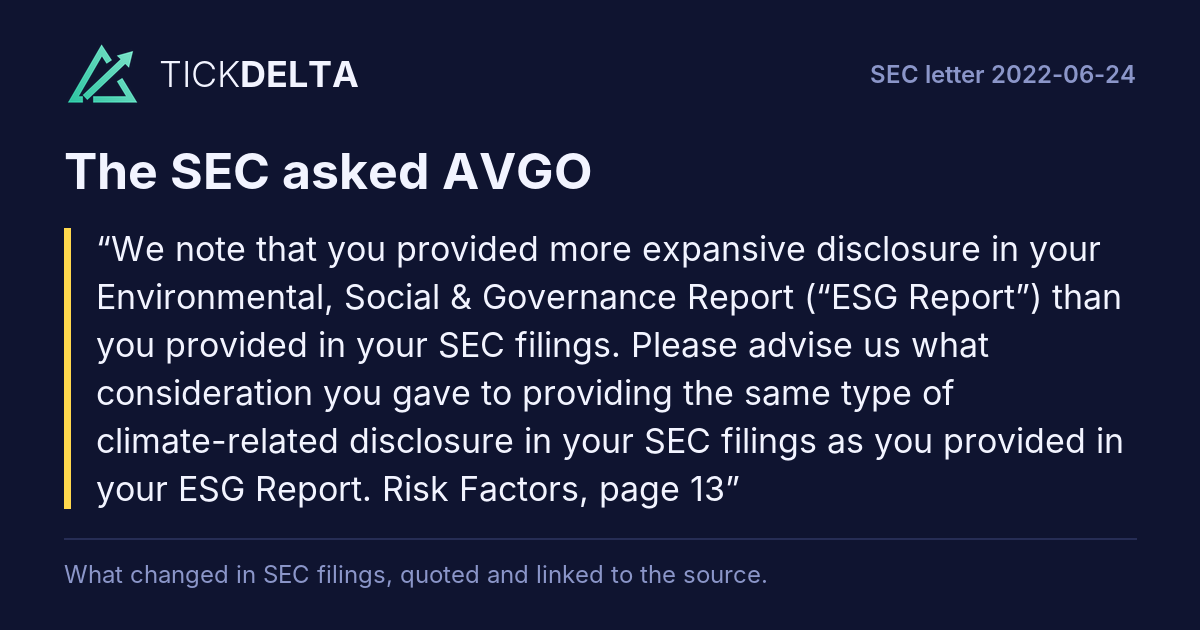
We note that you provided more expansive disclosure in your Environmental, Social & Governance Report (“ESG Report”) than you provided in your SEC filings. Please advise us what consideration you gave to providing the same type of climate-related disclosure in your SEC filings as you provided in your ESG Report. Risk Factors, page 13
The Company respectfully advises the Staff that the Company carefully considers and prepares its disclosures in accordance with applicable U.S. securities laws and regulations, Commission guidance, and Commission Compliance and Disclosure Interpretations (collectively, the “Disclosure Requirements”), including with respect to materiality within the context of the Company’s business, operating results and financial condition.
In determining the materiality of information to be included in its disclosures filed with the Commission, the Company refers to the standard of materiality set forth inRead in the reply ↗Rest of the answer
Basic Inc. v. Levinson, 485 U.S. 224 (1988) and the Disclosure Requirements. Additionally, as it relates to climate change-related disclosure, the Company considers the Commission’s Guidance Regarding Disclosure Related to Climate Change (Securities Act Rel. 33-9160, Feb. 2, 2010) (the “2010 Guidance”).
In connection with the preparation of the Company’s Annual Reports on Form 10-K and Quarterly Reports on Form 10-Q, the Company’s employees in Finance, Legal, Internal Audit and Investor Relations (the “Disclosure Committee”), including the Chief Financial Officer and the Chief Legal and Corporate Affairs Officer, review and assess potentially material developments, events, trends and risks and their potential impact on the Company’s business every quarter.
On the other hand, the Company’s Environmental, Social and Governance Report for fiscal 2021 published in February 2022 (the “ESG Report”) is prepared and designed to provide certain information that may be of interest (even when not material from a U.S. securities law perspective or otherwise required by the Disclosure Requirements or the 2010 Guidance) to a wide range of stakeholders (including certain investors, employees, customers, suppliers, business partners, and local and other communities of relevance to the Company). The ESG Report contains information that reflects the Company’s adherence to the voluntary third-party disclosure frameworks, including the disclosure frameworks promulgated by the Sustainability Accounting Standards Board, the Global Reporting Initiative (“GRI”) and the Task Force on Climate-Related Financial Disclosures (“TCFD”), and the Company’s own assessment of what might be useful or informative for the benefit of its various stakeholders. “Material” and “materiality,” as defined by GRI and reflected in the ESG Report, for example, are different and broader than how those terms are defined and used in the context of the filings with the Commission as defined under Basic Inc. v. Levinson, 485 U.S. 224 (1988) or U.S. securities laws and regulations. Additionally, the Company regularly engages with its stakeholders in regards to environmental, social and governance matters. Thus, the ESG Report also includes certain climate-related information that reflects the Company’s discussions with its stakeholders and their feedback and requests for information.
With respect to the climate-related matters in the Company’s Annual Report on Form 10-K for the fiscal year ended October 31, 2021 (the “Form 10-K”), the Company disclosed information consistent with the Disclosure Requirements and the 2010 Guidance. Although the future impact of environmental laws and regulations on its operations is currently uncertain, the risk factors in the Form 10-K reflect the Company’s current assessment of the material risks to the Company arising from climate and environmental matters. The Company therefore respectfully advises the Commission that there are no material pending or existing climate-related matters that it reasonably believes were required under the Disclosure Requirements to be further described in the Form 10-K. With respect to future filings, the Company will continue to monitor and evaluate whether the inclusion of any specific material pending and existing climate-related matters may be warranted in response to the Disclosure Requirements or the 2010 Guidance.
First report after the company's reply of 2022-07-11: 10-Q filed 2022-09-08 ↗, against the 10-Q filed 2022-06-09 ↗.
Tickdelta does not hold the text of both reports, so they are not compared here.
Disclose the material effects of transition risks related to climate change that may affect your business, financial condition, and results of operations, such as policy and regulatory changes that could impose operational and compliance burdens, market trends that may alter business opportunities, credit risks, or technological changes.
The Company’s ESG Steering Committee annually conducts assessments of climate-related risks on the Company’s business, financial condition and results of operations under the TCFD framework that considers policy and regulatory changes, market trends, credit risks and technological changes. The members of the Company’s ESG Steering Committee also share the assessments with the Company’s Disclosure Committee and the Audit Committee of the Board of Directors.Read in the reply ↗Rest of the answer
Furthermore, climate-related risks are included in the Company’s enterprise risk management process.
When preparing the Form 10-K, the transition risks applicable to the Company that were identified and reviewed included (i) potential new regulations in local and international jurisdictions that would restrict greenhouse gas (“GHG”) emissions, (ii) costs to comply with new potential regulations in local and international jurisdictions, (iii) costs to procure additional equipment to reduce GHG emissions, (iv) costs to evaluate and adopt a transition plan related to the reduction of GHG emissions, and (v) reputational risks related to GHG emissions in the semiconductor industry.
Taking into consideration the above-mentioned transition risks, the Company determined that such transition risks related to climate change were not reasonably expected to have a material effect on the Company’s business, financial condition and results of operations for the periods reported in the Form 10-K or in the foreseeable future that would require disclosure under the Disclosure Requirements or the 2010 Guidance. The Company is mindful that the consequences of climate change are evolving and will continue to monitor its impacts on the Company’s business, financial condition and results of operations. If, in the future, the Company determines that there are direct or indirect consequences material to the Company, the Company will include appropriate disclosures in future filings.
First report after the company's reply of 2022-07-11: 10-Q filed 2022-09-08 ↗, against the 10-Q filed 2022-06-09 ↗.
Tickdelta does not hold the text of both reports, so they are not compared here.
Disclose any material litigation risks related to climate change and explain the potential impact to the company.
As described in response to Comment 1, each quarter the Disclosure Committee reviews and assesses the Company’s existing risk factors to determine whether (i) new risk factors need to be added to address current or potential risks that could be material to the Company’s business, financial condition and results of operations, (ii) existing risk factors are no longer material risks and should be removed, and (iii) information regarding material continuing risks need to be updated.
The Company notes that the following risks related to climate change were included in Item 1A.Read in the reply ↗Rest of the answer
“Risk Factors” in the Form 10-K:
• Page 16 – The risk factor titled “Our business is subject to various governmental regulations, and compliance with these regulations may cause us to incur significant expense. If we fail to maintain compliance with applicable regulations, we may be forced to cease the manufacture and distribution of certain products, and we could be subject to administrative proceedings and civil or criminal penalties” identifies risks related to complying with governmental regulations (such as climate-related governmental regulations), which could adversely affect the Company’s business and results of operations.
• Page 18 – The risk factor titled “Global political and economic conditions and other factors related to our international operations could adversely affect our business, financial condition and results of operations” identifies risks related to the Company’s international operations, including the imposition of restrictive governmental actions (such as climate change regulations), which could have a material adverse effect on the Company’s business, financial condition and results of operations.
• Page 26 – The risk factor titled “We are subject to environmental, health and safety laws, which could increase our costs, restrict our operations and require expenditures that could have a material adverse effect on our results of operations and financial condition” identifies risks related to complying with environmental regulations that could require the Company to modify its manufacturing processes and acquire costly equipment and subject the Company to litigation, which could have a material adverse effect on the Company’s business, financial condition and results of operations.
• Page 26 – The risk factor titled “Social and environmental responsibility regulations, policies and provisions, as well as customer and investor demands, may make our supply chain more complex and may adversely affect our relationships with customers and investors” identifies risks related to the increased focus on corporate social and environmental responsibility within the semiconductor industry and by customers and investors, and the development of climate change-based laws or regulations, which could have a material adverse impact on the Company’s results of operations.
The Company respectfully advises the Commission that the Company has not experienced any actual or threatened litigation against the Company related to climate change. Hence, the Company believes the above-mentioned risk factors appropriately address the known material litigation risks related to climate change. Additionally, the Company believes it has disclosed its “material” risk factors and has tailored such risk factors to its circumstances and risk profile pursuant to Item 105 of Regulation S-K.
The Company’s management monitors and assesses on an ongoing basis any material litigation risks, including those related to climate change. Based on that assessment and the Company’s consideration of whether the information constituted material information “necessary to make the required statements, in the light of the circumstances under which they were made, not misleading” pursuant to Rule 12b-20 of the Securities Exchange Act of 1934, the Company considers these risk factors in the Form 10-K to adequately address all known material litigation risks related to climate and its potential impact at the time of filing.
With respect to future filings, the Company will continue to monitor and evaluate any potential material litigation risks related to climate change and will disclose such matters as warranted in response to the Disclosure Requirements.
First report after the company's reply of 2022-07-11: 10-Q filed 2022-09-08 ↗, against the 10-Q filed 2022-06-09 ↗.
Tickdelta does not hold the text of both reports, so they are not compared here.
It appears you have identified climate-related projects in your ESG Report, such as projects to save energy and reduce greenhouse gas emissions. Tell us how you considered providing disclosure regarding past and future capital expenditures for climate-related projects. Include quantitative information for the periods covered by your Form 10-K and for future periods as part of your response.
The ESG Report reflects the Company’s discussions with its stakeholders and their feedback and requests for information, including climate-related projects. While the Company believes the description of its climate-related projects in the ESG Report is meaningful for its stakeholders in reviewing the Company’s climate-related initiatives, the climate-related projects in the ESG Report have not required material capital expenditures, individually or in the aggregate, and have not otherwise been material, individually or in the aggregate, to the Company’s consolidated financial statements forRead in the reply ↗Rest of the answer
the periods covered by the Form 10-K.
The Company’s primary source of GHG emissions is from its limited manufacturing operations and use of electricity at the Company’s offices, which are the focus of the Company’s GHG emissions reduction efforts. As described in the ESG Report, the Company’s facility located at Fort Collins, Colorado is its largest manufacturing facility. The Company’s largest climate-related projects were also at the Fort Collins manufacturing facility during the periods covered by the Form 10-K. The Company disclosed in the ESG Report that in fiscal 2021 the Company purchased several GHG abatement units to reduce GHG emissions at the Fort Collins manufacturing facility (the cost of which was approximately $1.4 million) and the Company upgraded its chiller at the Fort Collins manufacturing facility to increase efficiency and provide greater capability (the cost of which was approximately $0.6 million). From fiscal 2019 to fiscal 2021, the Company spent approximately $6.5 million at the Fort Collins manufacturing facility on climate-related projects to reduce GHG emissions and electricity usage and conserve water, which the Company does not believe was material when comparing such costs to the Company’s net revenue of approximately $22.6 billion in fiscal 2019, $23.9 billion in fiscal 2020 and $27.5 billion in fiscal 2021.
The Company notes that it spent approximately $0.2 million for the climate-related projects in the ESG Report under the title “Projects to Save Energy and Reduce Emissions” that the Company implemented in fiscal 2021. These costs were not material, individually or in the aggregate, when comparing such costs to the Company’s capital expenditures of approximately $443 million in fiscal 2021.
In assessing the materiality of climate-related project costs, the Company determines whether the related costs of such projects are reasonably likely to result in a material impact to the Company’s financial condition and results of operations. To date, the Company has not incurred significant costs, individually or in the aggregate, for its climate-related projects and does not believe any currently planned projects will incur significant costs, individually or in the aggregate. For these reasons, the Company believes that the costs related to its climate-related projects have not and are not reasonably likely to result in a material impact to the Company’s financial condition and results of operations at this time. As such, the Company believes additional disclosure pursuant to the Disclosure Requirements and the 2010 Guidance is not required at this time. The Company will continue to review and monitor climate-related capital expenditures with a view to disclosing such expenditures if and when they become material or otherwise required by the Disclosure Requirements or the 2010 Guidance.
First report after the company's reply of 2022-07-11: 10-Q filed 2022-09-08 ↗, against the 10-Q filed 2022-06-09 ↗.
Tickdelta does not hold the text of both reports, so they are not compared here.
We note your risk factor disclosure on page 26 regarding social and environmental responsibility regulations, policies and provisions as well as customer and investor demands. Tell us how you considered providing disclosure regarding the indirect consequences of climate-related regulation or business trends in particular, such as the following: • decreased demand for goods or services that produce significantRest of the question
greenhouse gas emissions or are related to carbon-based energy sources; • increased demand for goods that result in lower emissions than competing products; • increased competition to develop innovative new products that result in lower emissions; • increased demand for generation and transmission of energy from alternative energy sources; • any anticipate reputational risk resulting from operations or products that produce material greenhouse gas emissions; and • potential climate-related opportunities, such as the development of new products or services and the increased requirements for high performance and low power products.
The Company is a global technology leader that designs, develops and supplies a broad range of products and solutions, including products that reduce power consumption and support green energy systems. The Company considered the indirect consequences of climate-related regulation or business trends referenced by the Staff as follows:
•decreased demand for goods or services that produce significant greenhouse gas emissions or are related to carbon-based energy sources
The Company has not experienced decreased demand for its goods or services because of customers indicating that the Company’sRead in the reply ↗Rest of the answer
products produce significant GHG emissions or are related to carbon-based energy sources. There are many reasons why customers may have demand for the Company’s products and the Company believes that demand is largely dependent on quality, technical performance, price, product features, product system compatibility, system-level design capability, engineering expertise, responsiveness to customers, new product innovation, availability, delivery timing and reliability, and customer sales and technical support, as well as the type of customer. For example, the Company believes that its customers who purchase its wireless products, which accounted for over 33% of the Company’s semiconductor revenue in fiscal 2021, purchased such products primarily for reasons related to the availability, performance, quality, reliability and cost of a particular product. To date, the Company does not believe that demand for such products is driven by GHG emissions or whether such products are related to carbon-based energy sources. The Company has not experienced a significant discernable demand related to whether any of the Company’s products produce significant GHG emissions or are related to carbon-based energy sources.
•increased demand for goods that result in lower emissions than competing products
As noted above, there are many factors that impact demand for the Company’s products and the Company does not believe the emissions of its products is a primary consideration. For instance, the Company offers products for enterprise networks and embedded Ethernet applications that support lower power consumption that comply with industry standards around an energy efficient Ethernet. However, the Company believes demand for these products is primarily a function of meeting power density requirements and reduced energy costs and the customer’s decision to purchase the Company’s products is based on performance. As such, while customers may demand products that use the least amount of energy possible, the Company believes other competitive factors, as discussed above, not lower emissions, are the primary drivers in customers purchasing the Company’s products as compared to the Company’s competitors’ products. To date, the Company has not experienced a discernable trend in customers’ demand for products that result in lower emissions as compared to the products of its competitors.
•increased competition to develop innovative new products that result in lower emissions
The Company has not experienced increased competition to develop new products that result in lower emissions. As noted above, while there is some level of demand from customers for products that use less energy, the primary considerations of the Company’s customers are unrelated to emissions. Rather, competitive factors continue to relate to, among others, quality, technical performance, product features, engineering expertise, new product innovation, product availability and product reliability. While there is increased competition to develop innovative new products, the Company does not believe such competition directly results from any climate-related regulation or business trend.
•increased demand for generation and transmission of energy from alternative energy sources
As part of its engagement program, the Company’s stakeholders, including investors and customers, have encouraged the Company to procure energy from alternative energy sources. The Company is currently evaluating alternative energy sources to reduce GHG emissions; however, the Company to date has not experienced increased or decreased demand for its products or services based on whether or not the Company generates and procures energy from alternative sources. Additionally, the Company is unaware of its investors decreasing beneficial ownership based on whether or not the Company generates or procures energy from alternative sources.
•any anticipated reputational risks resulting from operations or products that produce material greenhouse gas emissions
The Company regularly engages with the State of Colorado and the City of Fort Collins on climate-related regulations and GHG emissions with respect to its manufacturing facility. The Company also engages with its third-party manufacturers with respect to climate-related issues and is aware of climate-related regulations and risks where its third-party manufacturers are located. Based on engagement and input from the Company’s stakeholders (including investors, customers and local communities) and the Company’s third-party manufacturers, the Company does not currently anticipate any material reputational risks resulting from its operations or products that produce GHG emissions.
Additionally, the Company does not believe that its products contribute to any customer’s GHG emissions in a way that is significantly different than any of its competitors’ products. As such, the Company does not anticipate there to be any significant reputational risk related to GHG emissions of its products.
•potential climate-related opportunities, such as the development of new products or services and the increased requirements for high performance and lower power products
As noted above, the Company offers products for enterprise networks and embedded Ethernet applications that support lower power consumption that comply with industry standards around an energy efficient Ethernet in order for customers to meet power density requirements and reduced energy costs. As the Company participates in markets that are highly competitive, it continuously invests in product development and enhancements. As such, future product developments and enhancements may result in the Company offering products that will reduce power consumption. In addition, future developments and enhancements to the Company’s industrial products may increase support of green energy systems. However, as noted above, the Company does not believe customer demand directly results from any climate-related regulation or business trends to a material extent.
As described in response to Comment 1, the Company monitors and assesses the consequences of climate-related regulations and business trends. Based on that assessment, taking into account the standards set forth in Basic Inc. v. Levinson, 485 U.S. 224 (1988) and Rule 12b-20 of the Exchange Act, the Company believes that the foregoing factors have not and are not reasonably likely to result in a material impact to the Company’s financial condition and results of operations.
As such, the Company believes additional disclosure pursuant to the Disclosure Requirements and the 2010 Guidance is not required at this time.
First report after the company's reply of 2022-07-11: 10-Q filed 2022-09-08 ↗, against the 10-Q filed 2022-06-09 ↗.
Tickdelta does not hold the text of both reports, so they are not compared here.
Please discuss the physical effects of climate change on your operations and results. This disclosure may include the following: • severity of weather, such as floods, hurricanes, sea levels, extreme fires, and water availability and quality; • weather-related impacts on the cost and availability of insurance; • quantification of any weather-related damages to your property or operations; and • the potential forRest of the question
indirect weather-related impacts that have affected or may affect your major customers. Include quantitative information with your response for each of the periods covered by your Form 10-K and explain whether increased amounts are expected in future periods.
The Company regularly assesses the physical effects of climate change on its operations and results under the TCFD framework and as part of the Company’s business continuity plans, enterprise risk management and disclosure process described in response to Comment 1.
For example, the State of Colorado in fiscal 2020 experienced wildfires that affected the Company’s manufacturing facility at Fort Collins.Read in the reply ↗Rest of the answer
The Company incurred approximately $0.2 million in additional costs due to this wildfire; however, the additional costs did not materially affect the Company’s operations and results or the Company’s major customers. To protect the Company and its customers from weather-related damages, the Company improved outside air filtration at Fort Collins to overcome the particles in the air from wildfires and other particles, such as dust from winds and dry soil due to drought. Furthermore, the Company optimized the HVAC systems, increased use of the carbon filters and installed pre-filters to minimize outside particulates from entering the facility and manufacturing areas at Fort Collins. The Company respectfully advises the Staff that these additional costs were not material when comparing such costs to the Company’s net revenue of approximately $23.9 billion in fiscal 2020.
In assessing the materiality of physical effects that may have resulted from climate change or are weather-related, the Company determines whether the related costs of such effects are reasonably likely to result in a material impact to the Company’s financial condition and results of operations. The Company is unaware of the physical effects of climate change materially affecting the Company’s operations and results during the periods covered by the Form 10-K. Additionally, the Company is unaware of the physical effects of climate change on its operations that have materially affected its major customers, indirectly or directly.
To date, the Company does not have knowledge of weather-related impacts materially affecting the cost or availability of insurance. The Company notes that, generally, insurance premiums may rise in a given year due to many reasons, including as a result of weather-related impacts (such as a hurricane, flood, drought or other weather-related event), which are not specific to the Company. The Company does not believe any weather-related impacts on the cost or availability of insurance have caused or are reasonably likely to cause a material impact on the Company’s financial condition and results of operations.
The Company will continue to monitor the physical effects of climate change on its operations and results, and the Company expects increased costs in its operations due to climate change. If, in the future, the Company experiences material physical effects attributable to climate change on its operations or results, the Company will include appropriate disclosures in future filings.
First report after the company's reply of 2022-07-11: 10-Q filed 2022-09-08 ↗, against the 10-Q filed 2022-06-09 ↗.
Tickdelta does not hold the text of both reports, so they are not compared here.
We note your disclosure on page 26 regarding the costs to comply with environmental regulations. Tell us about and quantify any compliance costs related to climate change for each of the last three fiscal years and explain whether increased amounts are expected to be incurred in future periods.
In assessing the materiality of compliance costs related to climate change, the Company determines whether such costs are reasonably likely to result in a material impact to the Company’s financial condition and results of operations. To date, the Company has not incurred significant compliance costs, individually or in the aggregate, related to climate change.
As described in response to Comment 4, the Company’s primary source of direct GHG emissions is from the Company’s facility located at Fort Collins, Colorado.Read in the reply ↗Rest of the answer
The Company regularly engages with the State of Colorado and the City of Fort Collins on climate-related regulations and GHG emissions with respect to its manufacturing facility. As described in response to Comment 4, the Company spent approximately $6.5 million at the Fort Collins manufacturing facility on climate-related projects to reduce GHG emissions and electricity usage and conserve water from fiscal 2019 to fiscal 2021. Additionally, the Company spent approximately $0.1 million in climate change-related compliance costs for regulatory fees and environmental sustainability consulting services for the Fort Collins manufacturing facility from fiscal 2019 to fiscal 2021. In the context of the Company’s net revenue of approximately $22.6 billion in fiscal 2019, $23.9 billion in fiscal 2020 and $27.5 billion in fiscal 2021 and based on the above-mentioned climate change-related compliance costs for its Fort Collins manufacturing facility, the Company believes its climate change-related compliance costs were not material to its financial condition and results of operations for these years.
The Company expects its compliance costs to increase in the future, especially if proposed climate-related laws and regulations become effective. The Company’s compliance costs are expected to increase if certain localities require increased reduction of GHG emissions or increased conservation of water as the Company would be required to purchase additional equipment or implement additional measures to conserve, recycle and reclaim water. In addition, if the Commission’s proposed climate-related disclosure rules become effective, the Company respectfully advises the Commission that it would increase compliance costs due to additional disclosures, attestation reports, and additional disclosure controls and internal control over financial reporting. However, the Company currently believes the expected increase is unlikely to be material to the Company’s financial condition and results of operations.
First report after the company's reply of 2022-07-11: 10-Q filed 2022-09-08 ↗, against the 10-Q filed 2022-06-09 ↗.
Tickdelta does not hold the text of both reports, so they are not compared here.
If material, please provide disclosure about any purchase or sale of carbon credits or offsets and any material effects on your business, financial condition, and results of operations. Include quantitative information for each of the periods for which financial statements are presented in your Form 10-K and for future periods as part of your response.
The Company respectfully advises the Commission that it has not purchased or sold any carbon credits or offsets. If in the future the Company does purchase or sell carbon credits or offsets, to the extent material, it will disclose any material effects such purchase or sale has on its business, financial results and results of operations.
* * * * * * * *
In connection with its response to the Staff’s comments, the Company acknowledges that the Company and its management are responsible for the accuracy and adequacy of its disclosures, notwithstanding any review, comments, action or absenceRead in the reply ↗Rest of the answer
of action by the Staff.
First report after the company's reply of 2022-07-11: 10-Q filed 2022-09-08 ↗, against the 10-Q filed 2022-06-09 ↗.
Tickdelta does not hold the text of both reports, so they are not compared here.
Your response to comment 2 states that transition risks related to climate change were not identified as being reasonably expected to have a material effect on your business, operating results, or financial condition in connection. Please explain how you concluded on the materiality of the effects of climate change and determined that disclosure was not necessary.
No reply letter found.
First report after the SEC's letter of 2022-08-04: 10-Q filed 2022-09-08 ↗, against the 10-Q filed 2022-06-09 ↗.
Tickdelta does not hold the text of both reports, so they are not compared here.
Your response to comment 4 refers to capital expenditures for climate-related projects at your Fort Collins, Colorado facility. Please tell us about and quantify climate-related projects at your other facilities for the periods covered by your Form 10-K.
No reply letter found.
First report after the SEC's letter of 2022-08-04: 10-Q filed 2022-09-08 ↗, against the 10-Q filed 2022-06-09 ↗.
Tickdelta does not hold the text of both reports, so they are not compared here.
As your response to prior comment 6 does not provide all of the requested information, it is reissued in part. Please include the quantification requested by our comment (including with regards to the cost of insurance) on an aggregate basis, rather than as a quantitative example, for each of the periods covered by your Form 10-K and explain whether increased amounts are expected in future periods.
No reply letter found.
First report after the SEC's letter of 2022-08-04: 10-Q filed 2022-09-08 ↗, against the 10-Q filed 2022-06-09 ↗.
Tickdelta does not hold the text of both reports, so they are not compared here.
We note your response to prior comment 6. Please further explain how you considered providing disclosure regarding the physical impacts of climate change, such as effects on the severity of weather, as it appears that you may be vulnerable to severe weather or climate-related events.Rest of the question
For example, your response notes the wildfires in Colorado in fiscal 2020 and disclosure on page 22 of your Form 10-K states that many of your facilities, and those of your contract manufacturers and suppliers, are located in California and the Pacific Rim region which have severe weather activity. We also note from your ESG Report that “climate change is creating serious issues for the Colorado and western U.S. regions” and that you have response plans for various situations “including climaterelated weather events, like wildfires, hurricanes, flooding and blizzards.” In addition, explain in greater detail how you considered disclosing the effects of potential weatherrelated disruptions to the operations of your customers.
No reply letter found.
First report after the SEC's letter of 2022-08-04: 10-Q filed 2022-09-08 ↗, against the 10-Q filed 2022-06-09 ↗.
Tickdelta does not hold the text of both reports, so they are not compared here.
We note your response to prior comment one regarding transition risks related to climate change. Please clearly describe the specific transition risks you have considered, including those identified in our comment, and provide additional detail regarding their material effects, along with support for your determination of materiality for purposes of disclosure.
No reply letter found.
First report after the SEC's letter of 2022-09-14: 10-K filed 2022-12-16 ↗, against the 10-K filed 2021-12-17 ↗.
Tickdelta does not hold the text of both reports, so they are not compared here.
As your response to comment three does not provide all of the requested information, it is reissued in part. Please include the quantification requested with regards to the cost of insurance on an aggregate basis for each of the periods covered by your Form 10-K. Please contact Erin Donahue at 202-551-6063 or Sergio Chinos at 202-551-7844 with any questions.
No reply letter found.
First report after the SEC's letter of 2022-09-14: 10-K filed 2022-12-16 ↗, against the 10-K filed 2021-12-17 ↗.
Tickdelta does not hold the text of both reports, so they are not compared here.
Also in this review: closing letter, 2022-09-21