tickdelta
Sign in

Tickdelta is free for now. Sign up and get Pro free

← Screener

BABoeing

Industrials · Aerospace · NYSE
Compare with peers → Embed
SEC comment letters, last 20 years

2 reviews of BA's filings by SEC staff

UPLOAD and CORRESP
ReviewsRead ↓
2
latest letter 2024-04-12
Questions asked
7
each answered in the company's own letter
No closing letter
0
reviews without a letter saying the staff completed it

When the SEC's staff reviews a filing, it writes to the company with numbered questions, and the company answers each one in a letter. SEC publishes the exchange once the review is over, at least 20 business days later. A question is not an accusation; most reviews end with the company adding detail to its next filing.

Form 10-K

2024-04-12 to 2024-05-14 · 3 questions · 1 letter from the SEC, 1 from the company
Review closed 2024-05-14
Results discussion (MD&A)RevenueLiquidity and cashSegmentsGoodwill and impairmentCritical estimates
Management's Discussion and Analysis of Financial Condition and Results of Operations · Consolidated Results of Operations, page 23
SEC asked (1)
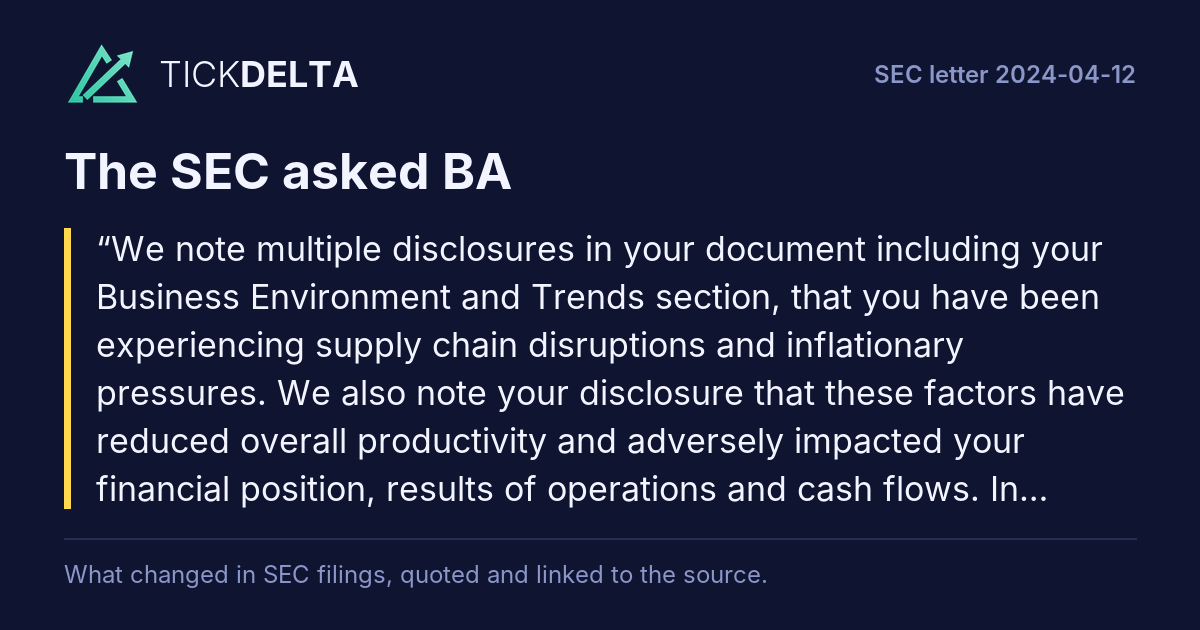
We note multiple disclosures in your document including your Business Environment and Trends section, that you have been experiencing supply chain disruptions and inflationary pressures. We also note your disclosure that these factors have reduced overall productivity and adversely impacted your financial position, results of operations and cash flows.
Rest of the question

In future filings, please expand your results of operations disclosures to quantify, if possible, the specific impacts supply chain disruption and inflation have had on your cost structure, including the impact on your revenue, profits, and/or liquidity. Accounting Quantity, page 31

BA answered
Our supply chain is integral to our operations. Late or non-conforming supplier deliveries drive higher manufacturing costs and delay deliveries to our customers. Inefficiencies in our own manufacturing process may also result in similar cost increases and delays. Therefore, it is difficult to quantify impacts solely attributable to supply chain disruption.
Rest of the answer

In future filings, beginning with our Form 10-Q for the second quarter of 2024, we will include disclosures in the Results of Operations Section of our Management’s Discussion and Analysis to the extent supply chain disruption is having a material impact on our financial position, results of operations, and cash flows, including any material impacts on revenue, profit and/or liquidity, and to the extent we are able to quantify such impacts. In future filings, we will also disclose when

Mr. Kevin Sterzel & Ms. Claire Erlanger supply chain disruption is having a material quantifiable impact on individual programs and/or contracts.

Inflation primarily impacts our supply chain and labor costs. We are subject to cost inflation risk when we have to contract new work with our suppliers or renew existing agreements with suppliers and/or our represented employees. Those cost inflation risks are most likely to have a material impact on our current results of operations and/or liquidity when the costs are associated with fixed-price contracts that are in a loss or have near-breakeven margins. Otherwise, inflationary supply chain and labor costs affect our results of operations over the duration of affected contracts through lower program and/or contract margins. It is difficult to quantify cost increases that are solely attributable to inflation. In future filings, we will expand our disclosures in the Results of Operations Section of our Management’s Discussion and Analysis to include the impacts of inflation to the extent inflation is materially impacting our financial position, results of operations, and cash flows, including any material impacts on revenue, profit and/or liquidity, and to the extent we are able to quantify such impacts.

Read in the reply ↗
In its next report

First report after the company's reply of 2024-05-09: 10-Q filed 2024-07-31 ↗, against the 10-Q filed 2023-10-25 ↗.

Tickdelta does not hold the text of both reports, so they are not compared here.
Management's Discussion and Analysis of Financial Condition and Results of Operations · Consolidated Results of Operations, page 23
SEC asked (2)
We note throughout your document, you discuss delivery and order cancellation risks associated with various commercial airplane programs, including your 777X, 737-7 and 737-10. We note your tabular presentation on page 32, which depicts undelivered units under firm orders by program.
Rest of the question

In future filings, please expand your presentation to provide additional breakdown of your 737 variants to allow investors to better understand the composition of your backlog.

BA answered
In response to your comment, we expanded our presentation in the Commercial Airplanes section of Management’s Discussion and Analysis (page 36) in our Form 10-Q filed on April 24, 2024, to provide additional breakdown of the backlog associated with the 737-7, 737-8, 737-9 and 737-10 variants. We will continue to provide such expanded disclosure in future filings. Read in the reply ↗
In its next report

First report after the company's reply of 2024-05-09: 10-Q filed 2024-07-31 ↗, against the 10-Q filed 2023-10-25 ↗.

Tickdelta does not hold the text of both reports, so they are not compared here.

Note 1 - Summary of Significant Accounting Policies · Goodwill and Other Acquired Intangibles, page 64
SEC asked (3)
We note your substantial Goodwill balance as of year end, including the balances reflected in your Commercial Airplanes and Defense, Space & Security segments. We further note these segments have sustained significant operating losses in either all, or two of the three most recent years presented in your filing.
Rest of the question

In future filings beginning with your next quarterly report, please revise the notes to the financial statements and your Critical Accounting Estimates section in MD&A to disclose whether a qualitative or quantitative impairment test was performed for the respective reporting units. For any reporting unit requiring a quantitative impairment test, disclose the methods and significant assumptions used to test for impairment. Your disclosure should also state whether or not the fair value of your reporting units "substantially exceeds" the carrying value. To the extent any reporting unit fair values are not substantially in excess of fair values, disclose the identity of those reporting units and the amount or percentage by which the fair value exceeds their carrying value. Please refer to ASC 350-10-50 and Item 303(b)(3) of Regulation S-K and Section V of SEC Release No. 33-8350. Also, if any reporting units have zero or negative carrying amounts of net assets, please disclose the identity of those reporting units with allocated goodwill, the amount of goodwill allocated to each and in which reportable segment the reporting unit is included. See requirement in ASC 350-10-50-1A. As part of your response, please also provide us with the results of your 2023 impairment testing that include the aforementioned details.

BA answered
We perform our annual goodwill impairment test as of April 1 each year. On April 1, 2023, we performed a qualitative test. The qualitative test was partly informed by quantitative valuations of each of our reporting units performed as of January 1, 2023, in connection with a reorganization of our Defense, Space & Security (“BDS”) reporting units.
Rest of the answer

As of both dates, we determined the fair value of each of our reporting units substantially exceeded their respective carrying values.

Our January 1, 2023, quantitative valuations estimated the fair value of each of our reporting units using discounted cash flows and market-based valuation methodologies (such as comparable public company trading values, where appropriate). Significant assumptions used in the valuations included our forecasts of future cash flows, discount rates derived from our market capitalization, and an estimated control premium.

We determined that the fair value of our reporting units substantially exceeded their carrying value. We did not believe that changes in estimates of the fair value of our reporting units, while subject to estimation uncertainty, were reasonably likely to result in a conclusion that goodwill was impaired. Therefore, we did not consider the estimation of the fair value of our reporting units used in our goodwill impairment testing to be a critical accounting estimate.

On April 1, 2023, our BDS reportable segment had goodwill of $3.2 billion. One of our BDS reporting units had a negative carrying amount of net assets on April 1, 2023, and a positive carrying amount of net assets on December 31, 2023. The negative carrying amount of net assets at April 1, 2023, was largely attributable to forward loss recognition on certain contracts within the reporting unit’s portfolio as well as the timing of receipts and payments. The reporting unit’s fair value substantially exceeded the carrying amount of its net assets at April 1, 2023, and we determined disclosure of the reporting unit with a negative carrying amount of net assets and its goodwill balance was not material as of April 1, 2023.

In future filings, beginning with our Form 10-Q for the second quarter of 2024, we will expand our notes to the financial statements to include a description of the type or types of goodwill impairment test performed as part of our April 1 annual goodwill impairment test (i.e., qualitative or quantitative) and indicate whether the fair values of our reporting units substantially exceed their respective carrying values. For any reporting unit where the fair value does not substantially exceed the carrying value of the reporting unit, we will disclose the identity of the reporting unit and the percentage by which the fair value exceeds the carrying value.

If we determine for any reporting unit that it is more likely than not goodwill is impaired and a quantitative impairment test is required, we will disclose the methods and significant assumptions used in performing that quantitative test. We will also continuously assess, as is our practice, whether our estimate of reporting unit fair values is a critical accounting estimate in the period and will provide disclosure in Management’s Discussion and Analysis accordingly.

Lastly, in future filings we will disclose the identity of any reporting units with zero or negative carrying values, the amount of goodwill allocated to such reporting unit, and the reportable segment in which the reporting unit is included.

*****

If you would like to speak with us about any of these matters, please do not hesitate to call me at (630) 248-6275.

Read in the reply ↗
In its next report

First report after the company's reply of 2024-05-09: 10-Q filed 2024-07-31 ↗, against the 10-Q filed 2023-10-25 ↗.

Tickdelta does not hold the text of both reports, so they are not compared here.

Also in this review: closing letter, 2024-05-14
Form 10-K

2020-06-02 to 2020-06-18 · 4 questions · 1 letter from the SEC, 1 from the company
Review closed 2020-06-18
Liquidity and cashResults discussion (MD&A)Critical estimates
Selected Financial Data, page 18
SEC asked (1)
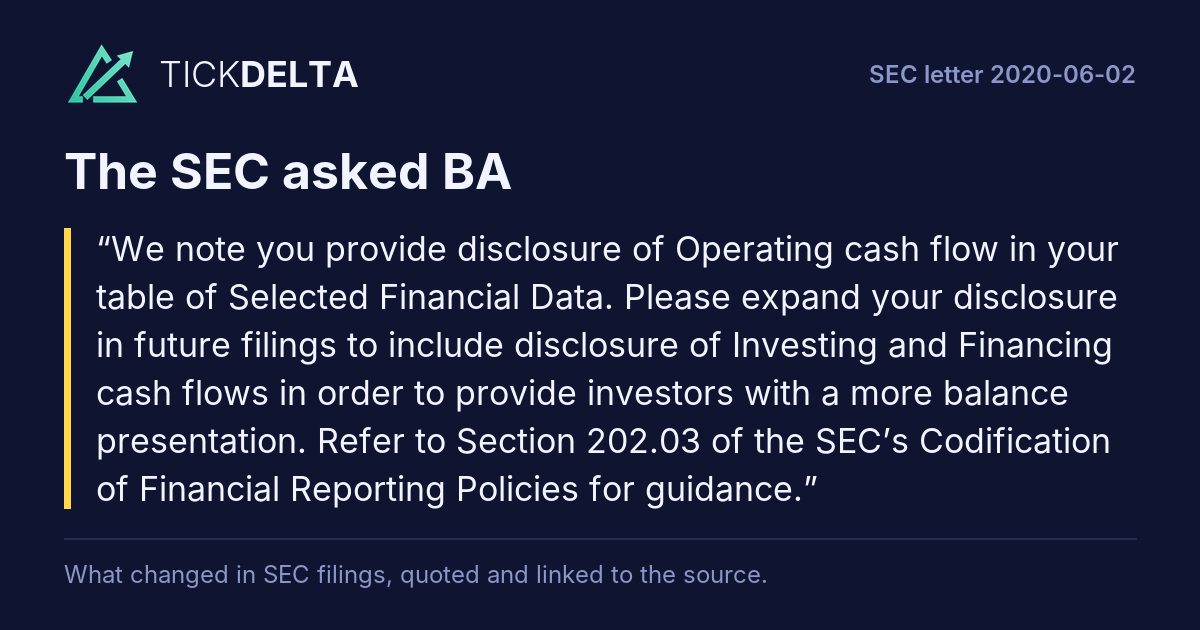
We note you provide disclosure of Operating cash flow in your table of Selected Financial Data. Please expand your disclosure in future filings to include disclosure of Investing and Financing cash flows in order to provide investors with a more balance presentation. Refer to Section 202.03 of the SEC’s Codification of Financial Reporting Policies for guidance.
BA answered
In response to your comment, we will include disclosure of Investing and Financing cash flows in the table of Selected Financial Data in future filings.

Ms. Jean Yu & Mr. Kevin Stertzel

Backlog, page 28

We note from various news sources that you have experienced significant commercial aircraft order cancellations in fiscal year 2020. We further note your response to our prior comment number two in your letter dated October 18, 2019.
Rest of the answer

As it appears order cancellations are now at significant levels, please be sure to include robust quantified and narrative disclosure of the expected impacts to your backlog, results of operations and cash flows in your future filings.

Response

We believe that our order, delivery and production rate disclosures along with our backlog disclosures provide significant insight for investors and other users of our financial statements regarding expected impacts to our backlog, results of operations and cash flows.

Our backlog excludes all canceled orders and represents the estimated transaction price on unsatisfied and partially satisfied performance obligations with customers where (i) it is probable that we will collect the consideration due and (ii) no contingencies remain before we and the customer are required to perform. Each quarter, we assess backlog in accordance with ASC 606 to determine whether we believe it is probable we will collect the consideration due and whether any new customer-controlled contingencies exist. Any amounts that we deem to be either uncollectible or subject to a customer-controlled contingency in connection with such an assessment are removed from backlog. For example, our 2019 Annual Report on Form 10-K noted that a number of our customers had contractual remedies, including rights to reject individual airplane deliveries if the actual delivery date is significantly later than the original contractual delivery date. We further noted that, if we determine that a customer has a right to reject an individual delivery, we remove that unit from backlog as we would consider that to be a customer-controlled contingency.

Our prior Annual Reports on Form 10-K and Quarterly Reports on Form 10-Q disclose the number of undelivered units under firm orders that are included in backlog, grouped by program, at each reporting date. This presentation enables a reader to track orders for each of our major airplane programs over time.

The following is an excerpt from our first quarter 2020 Form 10-Q showing this information.

The following table provides details of the accounting quantities and firm orders by program. Cumulative firm orders represent the cumulative number of commercial jet aircraft deliveries plus undelivered firm orders.

Program

As of 3/31/2020

737

747*

767

777

†

777X

787

Program accounting quantities

10,000

1,574

1,195

1,690

**

1,500

Undelivered units under firm orders

4,079

309

515

(28)

Cumulative firm orders

11,523

1,568

1,272

1,680

1,483

As of 12/31/2019

747

10,400

1,600

4,398

520

(29)

11,837

1,572

1,270

1,695

1,459

† Aircraft ordered by BCC are identified in parentheses

* At March 31, 2020, the 747 accounting quantity includes one already completed aircraft that has not been sold and is being remarketed.

** The accounting quantity for the 777X will be determined in the year of first airplane delivery.

We also disclosed in our most recent Quarterly Report on Form 10-Q that the reduction in the number of orders included in our backlog compared to the prior quarter was caused by a combination of aircraft order cancellations and orders from customers deemed to be experiencing liquidity issues. Cancellations may result from a mutual agreement with a customer or from a customer or Boeing exercising a contractual right to cancel. Customer orders typically include deliveries made over several years, and new orders or order cancellations or removals do not necessarily result in near-term financial impacts.

Each quarter we assess future production plans on each of our commercial airplane programs. These assessments include evaluations of required delivery dates for existing purchase contracts, requests from customers to accelerate or defer deliveries, customers’ credit worthiness estimates of future demand, and our capacity constraints.

We disclose current and planned production rates and deliveries for our major commercial aircraft programs. We believe that these disclosures provide investors with additional visibility into expected future impacts on operating results and cash flows. In our first quarter 2020 Form 10-Q, we disclosed that we planned to adjust production rates across several of our commercial airplane programs as a result of the projected impacts of COVID-19 on the commercial airplane industry. For example, we disclosed that we planned to reduce production rates for our 787 from 14 per month to 10 per month in 2020 and gradually reduce to 7 per month by 2022. We provided similar disclosures for all of our commercial airplane programs. We believe that these disclosures enable readers to compare our current performance with expected future performance for each of our commercial airplane programs. Our production decisions are informed by our best estimates of future delivery profiles, industry demand, and customer activity, and we believe that by providing information to readers regarding current and planned production rates and deliveries, we are providing the most meaningful information regarding estimated future impacts to our results of operations and cash flows.

In response to your comment, future filings will include, where applicable, explanations for significant changes in backlog. For example, when we record significant backlog reductions, we will explain the extent to which such reductions are due to order cancellations, ASC 606 assessments and/or deliveries made during the relevant period. In addition, we will continue to disclose current and planned production rates and deliveries to provide investors with additional insight into our expected results of operations and cash flows.

Management's Discussion and Analysis of Financial Condition and Results of Operations Critical Accounting Policies & Estimates 737 MAX Grounding, page 45

We note your disclosure regarding the 737 MAX grounding and your recognition of a $7.4 billion liability for potential concessions and other considerations to customers for disruptions related to the grounding. In future filings, please provide enhanced disclosures to better clarify the nature and amounts of the various concessions you are providing. It appears your concessions may be in the form of cash, in-kind consideration and other forms of concessions. Please consider providing a tabular presentation of the concessions by type, so that investors can better understand the expected impacts to your cash flows and operating results.

Response

Our 2019 Annual Report on Form 10-K and first quarter Quarterly Report on Form 10-Q included the following tabular summaries of the amounts and types of considerations we are providing to customers.

The following table summarizes changes in the 737 MAX customer concessions and other considerations liability during 2019.

2019

Beginning balance – January 1

Initial liability recorded in the second quarter of 2019

$6,110

Reductions for payments made

(1,237

)

Reductions for concessions and other in-kind considerations

(133

Changes in estimates

2,649

Ending balance – December 31

$7,389

The following table summarizes changes in the 737 MAX customer concessions and other considerations liability during 2020.

2020

(671

(2

(30

Ending balance – March 31

$6,686

As set forth in the above tables, most of the considerations provided to 737 MAX customers in 2019 were in the form of cash. To date, the in-kind considerations we have agreed to provide to 737 MAX customers have not been material. Of the remaining $6.7 billion, we have reached agreements with customers to pay approximately $1 billion in cash expected to be paid in 2020 and approximately $1 billion in reduced 737 MAX delivery payments. With respect to the remaining $4.7 billion, the types of considerations we may provide in the future will depend on the outcomes of negotiations with individual customers and the timing and conditions surrounding 737 MAX return to service. The tables also show how changes in estimates impacted operating results. This liability represents our best estimate of future concessions and other considerations to customers, and is necessarily based on a series of assumptions. The ultimate timing and conditions surrounding 737 MAX return to service, and the adverse impact COVID-19 is having on our airline customers create additional uncertainty regarding whether the concessions or other considerations resulting from negotiations with any particular customers is likely to consist primarily of cash payments, reduced 737 MAX delivery payments or in-kind consideration. Future filings will continue to include tabular disclosure of the nature and types of considerations provided in respect of the liability, as well as any changes in estimates. In response to your comment, we will also provide a narrative description similar to the above to disclose in future filings the expected impacts to cash flows and operating results to the extent such amounts are material.

Form 10-Q for the quarter ended March 31, 2020

Liquidity, page 37

4. We note from your liquidity footnote in note 1 to the financial statements at March 31, 2020 trade payables included $4.5 billion payable to suppliers who have elected to participate in supply chain financing programs. To the extent the supply chain finance arrangements are material to your current liquidity and/or are reasonably likely to affect liquidity in the future, please provide the following information, where relevant:

The impact these arrangements have on your operating cash flows in all periods presented;

•

The intraperiod variability in accounts payable balances attributed to the programs;

The material and relevant terms of the arrangements, including the risks along with general benefits;

Any guarantees provided by subsidiaries and/or the parent;

Any plans to further extend terms to suppliers;

Any factors that may limit your ability to continue using similar arrangements to further improve operating cash flows; and

Trends and uncertainties related to the extension of payment terms under the arrangements.

Response

In our first quarter 2020 Quarterly Report on Form 10-Q, we provided additional disclosures regarding our liquidity because of the significant negative liquidity impacts we experienced, and expected to continue to experience, related to the COVID-19 pandemic and the continued 737 MAX grounding. Cash required to fund operating activities during the first quarter of 2020 exceeded $4 billion. As such, we provided readers of our financial statements with additional insights into our sources of liquidity at March 31, 2020, as well as details regarding the risks related to our ability to access additional liquidity in future quarters. We do not consider supply chain financing programs to be material to our overall liquidity. As disclosed in our first quarter 2020 Quarterly Report on Form 10-Q, our debt balance totaled $38.9 billion at March 31, 2020, up from $27.3 billion at December 31, 2019. Subsequent to our most recent Quarterly Report on Form 10-Q, we issued $25 billion of debt securities, as disclosed on a Current Report on Form 8-K dated May 4, 2020. At March 31, 2020 and December 31, 2019, we had $9.6 billion of unused borrowing capacity on revolving credit agreements, which also represents a potential significant source of liquidity. Supply chain programs did not have a material impact on our liquidity in the first quarter of 2020. The reduction in payables to suppliers who elected to participate in supply chain financing programs was $0.7 billion in the first quarter of 2020, which is immaterial to our overall liquidity. Furthermore, this decline was primarily due to suspensions of production on certain programs and associated reductions in purchases from suppliers and not due to any changes in the availability of supply chain financing. While we disclosed in our first quarter 2020 Form 10-Q that “access to supply chain financing could be curtailed if our credit ratings are further downgraded,” we do not believe that changes in the availability of supply chain financing will have a significant impact on our liquidity.

We have concluded that supply chain finance arrangements have not historically been material to our liquidity and are not reasonably likely to materially impact our liquidity in future periods. In response to your comment, we will disclose in future filings the amounts included in accounts payable attributable to supply chain programs as well as the impact on operating cash flows in each period. This will provide users of our financial statements with information to help them understand how our supply chain financing programs affect our balance sheet and cash flow statement. In addition, we will continue to provide updates regarding our liquidity in future periodic filings.

*****

If you would like to speak with us about any of these matters, please do not hesitate to call me at (312) 544-2500 or in my absence, Michael Cleary, Vice President Accounting and Financial Reporting at (312) 544-2115.

Read in the reply ↗
In its next report

First report after the company's reply of 2020-06-15: 10-Q filed 2020-07-29 ↗, against the 10-Q filed 2020-04-29 ↗.

Tickdelta does not hold the text of both reports, so they are not compared here.

Backlog, page 28
SEC asked (2)
We note from various news sources that you have experienced significant commercial aircraft order cancellations in fiscal year 2020. We further note your response to our prior comment number two in your letter dated October 18, 2019.
Rest of the question

As it appears order cancellations are now at significant levels, please be sure to include robust quantified and narrative disclosure of the expected impacts to your backlog, results of operations and cash flows in your future filings.

BA answered

No numbered answer found in the reply. Read the reply ↗

Critical Accounting Policies & Estimates · 737 MAX Grounding, page 45
SEC asked (3)
We note your disclosure regarding the 737 MAX grounding and your recognition of a $7.4 billion liability for potential concessions and other considerations to customers for disruptions related to the grounding. In future filings, please provide enhanced disclosures to better clarify the nature and amounts of the various concessions you are providing.
Rest of the question

It appears your concessions may be in the form of cash, in-kind consideration and other forms of concessions. Please consider providing a tabular presentation of the concessions by type, so that investors can better understand the expected impacts to your cash flows and operating results.

BA answered

No numbered answer found in the reply. Read the reply ↗

In its next report

First report after the company's reply of 2020-06-15: 10-Q filed 2020-07-29 ↗, against the 10-Q filed 2020-04-29 ↗.

Tickdelta does not hold the text of both reports, so they are not compared here.

Form 10-Q for the quarter ended March 31, 2020 · Liquidity, page 37
SEC asked (4)
We note from your liquidity footnote in note 1 to the financial statements at March 31, 2020 trade payables included $4.5 billion payable to suppliers who have elected to participate in supply chain financing programs.
Rest of the question

To the extent the supply chain finance arrangements are material to your current liquidity and/or are reasonably likely to affect liquidity in the future, please provide the following information, where relevant: • The impact these arrangements have on your operating cash flows in all periods presented; • The intraperiod variability in accounts payable balances attributed to the programs; • The material and relevant terms of the arrangements, including the risks along with general benefits; • Any guarantees provided by subsidiaries and/or the parent; • Any plans to further extend terms to suppliers; • Any factors that may limit your ability to continue using similar arrangements to further improve operating cash flows; and • Trends and uncertainties related to the extension of payment terms under the arrangements.

BA answered

No numbered answer found in the reply. Read the reply ↗

In its next report

First report after the company's reply of 2020-06-15: 10-Q filed 2020-07-29 ↗, against the 10-Q filed 2020-04-29 ↗.

Tickdelta does not hold the text of both reports, so they are not compared here.

Also in this review: closing letter, 2020-06-18

Other letters

Letters without questions

UPLOAD and CORRESP
3 other letters: notices that a filing will not be reviewed, requests to declare a registration effective, and the like

From the SEC's correspondence on EDGAR: staff letters (form UPLOAD) and company letters (form CORRESP), 18 letters filed since 2019-09-05. Questions and answers are matched by their numbers; topics come from words in each question. The reports are compared word for word (same form, before the first SEC letter against the first report after the company's reply). No AI.

Next in Owners and insiders Insider trades →