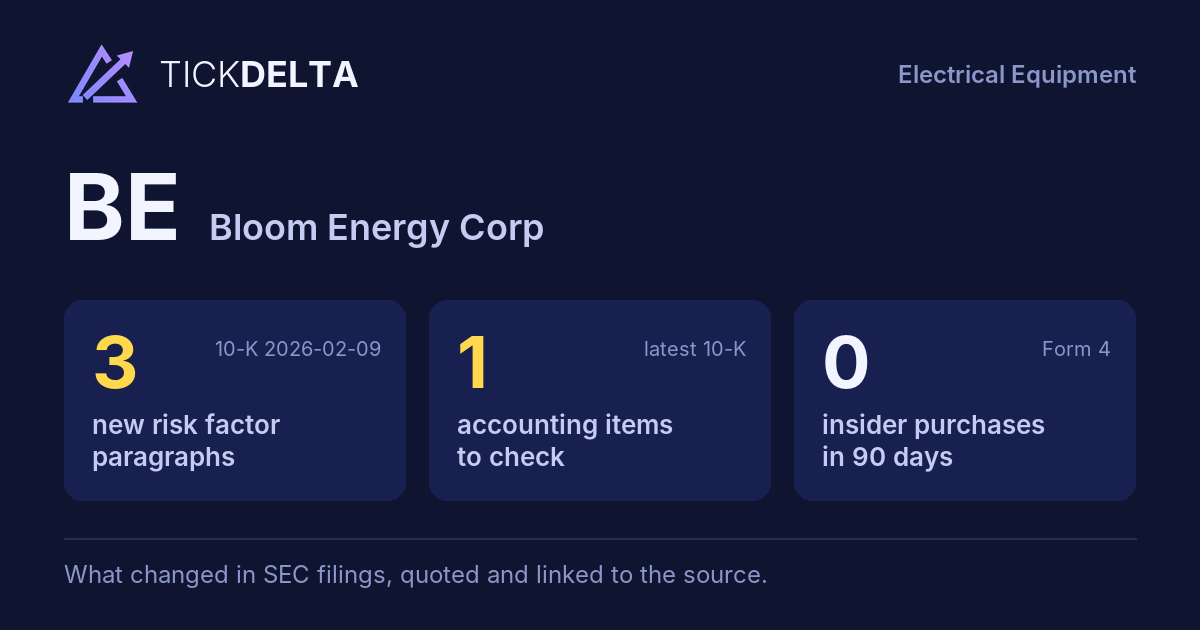
Screener / SEC EDGAR /CIK 0001664703 /10-K filed Feb 9, 2026, compared with Feb 27, 2025 /Numbers from the XBRL of the 10-Ks
NYSE Industrials · Electrical Equipment

Bloom Energy BE

Compare with peers Embed
The 10-K against last year's

415 changes: 62 added, 259 removed, 92 reworded, 2 quiet changes

10-K Feb 9, 2026 vs Feb 27, 2025

10-K 0001628280-26-006516 (Feb 9, 2026) vs 10-K 0001628280-25-008747 (Feb 27, 2025)

The paragraph that changed most in each section

The redline

Marked against last year's 10-K: cut words struck through, new words highlighted.

MD&A259 words changed in this paragraph; it is 31% similar to last year's version.
General Research and administrative development expenses increased by $4.2 $37.4 million in the for year ended December 31, 2024, as 2025, compared to the prior year period. This The increase was primarily driven by by: (1) an increase in employee compensation and benefits of $10.3 benefits, which increased by $24.2 million, largely due to higher stock-based compensation and variable compensation expenses, (2) consumable laboratory supplies and other lab-related costs, which increased by $12.3 million, reflecting expanded research activities, (3) consulting, advisory, and professional services costs, which increased by $1.9 million, predominantly due to (i) stock-based compensation expenses recognized in the fourth quarter of fiscal year 2024 as a result of an equity grant third‑party engineering, certification, and regulatory support for scaling our solid‑oxide platforms and for AI data‑center power programs, (4) computer equipment costs, which increased by $1.3 million, primarily due to our Chief Executive Officer, increased spending on hardware and (ii) software maintenance, and (5) an increase in employee compensation for executive new hires, partially offset by an effect of the restructuring efforts in the second half of fiscal year 2023, as well as the voluntary resignation of certain of our executives in the second half of fiscal year 2023, (2) an increase in depreciation travel and entertainment expenses of $3.5 million, $0.7 million for year ended December 31, 2025, due to higher in-person engagement and (3) an increase in computer equipment maintenance expenses of $3.1 million. event participation. The overall increase was partially offset by (1) a decrease in office other research and development expenses of $8.0 million, (2) a decrease in facility costs of $3.2 million, primarily due to reduction in rent and utility costs, (3) a decrease in (i) consulting, advisory and other professional services costs, (ii) travel and entertainment, and (iii) other operating expenses of $0.7 million, $0.4 million, and $0.4 million, respectively, as a result of our cost reduction efforts initiated in fiscal million for year 2023. ended December 31, 2025.

Source: Item 7, 10-K 0001628280-26-006516 vs Item 7, 10-K 0001628280-25-008747

Accounting Policies219 words changed in this paragraph; it is 30% similar to last year's version.
In March 2024, July 2025, the FASB issued ASU 2024-01, Compensation — Stock Compensation Accounting Standards Update (“ASU”) 2025-05, Financial Instruments-Credit Losses (Topic 718): Scope Application 326): Measurement of Profits Interest Credit Losses for Accounts Receivable and Similar Awards Contract Assets (“ASU 2024-01”). 2025-05”). This guidance is intended to improve U.S. GAAP. by adding an illustrative example to demonstrate how update introduces a practical expedient for all entities when estimating expected credit losses for current accounts receivable and current contract assets arising from transactions accounted for under ASC 606, Revenue from Contracts with Customers. Under the practical expedient, when developing reasonable and supportable forecasts as part of estimating expected credit losses, an entity should apply may assume that current conditions as of the scope guidance in paragraph 718-10-15-3 to determine whether profits interest and similar awards (“profits interest awards”) should be accounted balance sheet date do not change for in accordance with Topic 718, Compensation — Stock Compensation. The amendments in the remaining life of the asset. ASU 2024-01 are 2025-05 is effective for annual reporting periods beginning after December 15, 2024, 2025, and interim periods reporting within those annual reporting periods. The amendments Early adoption is permitted in ASU 2024-01 should be applied either (1) retrospectively to all prior periods presented in the financial statements or (2) prospectively to profits interest both interim and similar awards granted or modified on or after the date at which the entity first applies the amendments. annual reporting periods. We are currently evaluating this guidance, but do not expect the adoption impact of this guidance to have a material impact ASU 2025-05 on our consolidated financial statements.

Source: Item 8, Note 2 – Summary of Significant Accounting Policies, 10-K 0001628280-26-006516 vs Item 8, Note 2 – Summary of Significant Accounting Policies, 10-K 0001628280-25-008747

Legal Proceedings165 words changed in this paragraph; it is 40% similar to last year's version.
On February 23, 2023, we filed an amended complaint adding additional causes of action and filed objections to the Magistrate’s report and recommendation. On April 26, 2023, Judge Gilstrap overruled our objections to the Magistrate’s report and recommendation and stayed the district court action pending arbitrability determinations by the arbitrator in the WIPO proceeding. The arbitration had been held in abeyance awaiting the decision of the Eastern District of Texas. A hearing by the arbitrator in WIPO on arbitrability took place on June 27, 2023. On October 2, 2023, the arbitrator in the WIPO proceeding issued a ruling concluding that all the parties’ claims were arbitrable. On November 18, 2023, the arbitrator bifurcated the arbitration into a first phase that will focus focusing on Bloom’s claims directed to improper inventorship of the Patents-in-Suit and Bloom’s defective product claims. Briefing on the first phase took place throughout 2024 with a potential and the first half of 2025. An evidentiary hearing to be scheduled in with witness testimony commenced on July 21, 2025, and continued through August 1, 2025. Post hearing briefs were submitted on October 3, 2025. There is no set time frame for a decision from the Arbitrator on the first phase of the arbitration. We are unable to predict the ultimate outcome of the arbitration at this time.

Source: Item 3, via Note 13 – Commitments and Contingencies, 10-K 0001628280-26-006516 vs Item 3, via Note 13 – Commitments and Contingencies, 10-K 0001628280-25-008747

Risk Factors62 words changed in this paragraph; it is 71% similar to last year's version.
Our products have significant upfront costs, which may be a barrier for some customers who may not have the financial capability to purchase our products directly. To address this, we have developed various financing options that allow customers to use our products through third-party financing arrangements. These options enable our customers to access our products without making a direct purchase. For more information on the different financing arrangements available, please see Part II, Item 7, Management’s Discussion and Analysis of Financial Condition and Results of Operations - Purchase and Financing Options. If in any given quarter we or our customers are not able to secure funding, our financial condition and results of operations would be harmed. To attract new customers, we regularly innovate our customer contracts which may have different terms and financing conditions from prior transactions.

Source: Item 1A, 10-K 0001628280-26-006516 vs Item 1A, 10-K 0001628280-25-008747

Sentences and paragraphs added, removed or reworded

Every change, by type

Sentences and paragraphs of BE's Risk Factors and MD&A, 10-K Feb 9, 2026 against 10-K Feb 27, 2025. Each links to the text at sec.gov.

RemovedRisk Factors
• Our business is subject to risks associated with construction, utility interconnection study and transmission upgrade delays, cost overruns and delays, including those related to permits, regulatory approvals, and other contingencies.
Read it in 10-K Feb 27, 2025 at sec.gov
RemovedRisk Factors
• Data security breaches and cyberattacks could compromise our intellectual property or other confidential information and cause significant damage to our business, product performance, brand and reputation.
Read it in 10-K Feb 27, 2025 at sec.gov
RemovedRisk Factors
We rely on and need to grow committed project financing capacity with existing partners or attract additional partners to support our growth, finance new projects, and expand our product offerings. Additionally, our ability to deploy our backlog is directly tied to our ability to secure project financing, which is often an unpredictable process. Attracting third-party financing is a complex process that is influenced by factors beyond our control, including the fluctuations of interest and currency exchange rates, the availability of tax credits and government incentives for investors, our perceived creditworthiness and the prevailing condition of credit markets. We arrange financing for our customers’ purchases of our products based on certain conditions, such as their credit quality and the expected minimum internal rate of return on the customer engagement. If these conditions are not met, we may not be able to find financing for their purchases of our products, which would have a negative impact on our revenue in a particular period. If we are unable to arrange financing for our products, our business could be harmed. Additionally, certain financing options, as with all leases, are also limited by the customer’s willingness to commit to making fixed payments, regardless of the products’ performance or our performance of our obligations under the customer agreement. If we are unable to arrange future financing for any of our current projects, it could negatively impact our business.
Read it in 10-K Feb 27, 2025 at sec.gov
RemovedRisk Factors
In the U.S., our capacity to offer our Energy Server systems through financed arrangements depends in large part on the ability of financing parties to optimize the tax benefits associated with the Energy Server systems, such as the recently expired ITC for fuel cells running on a non-zero carbon fuel or accelerated depreciation. Interest rate fluctuations, and internationally, currency exchange rate fluctuations, may also impact the attractiveness of any financing offerings for our customers. Our ability to finance a PPA or a lease is also related to, and may be limited by, the creditworthiness of the customer.
Read it in 10-K Feb 27, 2025 at sec.gov
RemovedRisk Factors
In our sales process for transactions that require financing, we make certain assumptions regarding the cost of financing capital. Actual financing costs may differ materially from our estimates and financing may be more difficult or costly to secure, or may not be available, due to factors beyond our control, such as changes in customer creditworthiness, macroeconomic factors, like inflation, interest rates, a recessionary environment, geopolitical instability, and capital market volatility. The returns offered by other investment opportunities available to our financing partners and other factors may further affect financing availability. If the cost of financing ultimately exceeds our estimates, or we or our customers are unable to secure financing, we may not be able to proceed with some or all of the impacted projects, or our revenue from such projects may be less than our estimates.
Read it in 10-K Feb 27, 2025 at sec.gov
Show the other 16
RemovedRisk Factors
The economic benefits of our Energy Server systems to our customers depend on both the price of gas available from the local gas utilities and the cost of electricity available from alternative sources, including local electric utility companies, and such cost structure is subject to change.
Read it in 10-K Feb 27, 2025 at sec.gov
RemovedRisk Factors
We believe that the customer’s decision to purchase our Energy Server system is significantly influenced by its price, the price predictability of electricity generated by our Energy Server systems in comparison to the retail price, and the future price outlook of electricity from the local utility grid and other energy sources. These prices are subject to change and may affect the relative benefits of our Energy Server systems. Factors that could influence these prices and are beyond our control include the impact of energy conservation initiatives that reduce electricity consumption; construction of additional power generation plants (including renewables, storage, nuclear, coal or natural gas); technological developments by others in the electric power industry; the imposition of interconnection, “departing load,” “standby,” power factor charges, greenhouse gas emissions charges, or other charges by local electric utility or regulatory authorities; and changes in the rates offered by local electric utilities and/or in the applicability or amounts of charges and other fees imposed or incentives granted by such utilities on customers. In addition, even with available subsidies for our products, in those areas where the current cost of grid electricity is low, including in some states in the U.S. and some foreign countries, our Energy Server systems may not be economically attractive.
Read it in 10-K Feb 27, 2025 at sec.gov
RemovedRisk Factors
Furthermore, actual or perceived potential increases in the price of natural gas or other fuels or curtailment of availability (e.g., as a consequence of physical limitations or adverse regulatory conditions for the delivery or production of natural gas or other fuels) or the inability to obtain natural gas or other fuel services could make our Energy Server systems less economically attractive to potential customers and reduce demand. While our Energy Server systems can operate using hydrogen or biofuels, the availability and current high cost of those natural gas alternatives in a particular location may make them less attractive to potential customers, reducing the demand for our products.
Read it in 10-K Feb 27, 2025 at sec.gov
RemovedRisk Factors
We need to reduce the manufacturing costs for our products to expand our markets. Additionally, certain of our existing service contracts rely on projections regarding service cost reductions that may not be realized. Increases in component and raw material costs could offset our cost-cutting efforts, slowing our growth and causing our financial results and operational metrics to suffer. In the past, we have experienced price increases in raw materials, which are used in our components and subassemblies for our fuel cell products.
Read it in 10-K Feb 27, 2025 at sec.gov
RemovedMD&A
Our mission is to make clean, reliable energy affordable for everyone in the world. We developed the first large-scale, commercially viable solid oxide fuel cell based power generation platform that empowers businesses, essential services, critical infrastructure and communities to responsibly take charge of their energy.
Read it in 10-K Feb 27, 2025 at sec.gov
RemovedMD&A
Our technology, invented and manufactured in the U.S., is one of the most advanced electricity and hydrogen producing technologies on the market today. Our fuel-flexible Bloom Energy Server systems can use biogas, hydrogen, natural gas, or a blend of fuels to create resilient, reliable and sustainable power at typically significantly higher efficiencies than traditional, combustion-based resources. In addition, the same fuel cell based platform that powers our Energy Server systems can be used to create hydrogen with our Bloom Electrolyzer. Hydrogen is increasingly recognized as a critically important tool for the decarbonization of the energy economy. Our enterprise customers include some of the largest multinational corporations in the world. We also have relationships with some of the largest utility companies in the U.S. and the Republic of Korea, with a growing presence in various international markets in Europe and Asia.
Read it in 10-K Feb 27, 2025 at sec.gov
RemovedMD&A
At Bloom Energy, we look forward to a net-zero future. Our technology is designed to help enable this future by delivering reliable, low-carbon electricity in a world facing unacceptable levels of power disruptions. Our resilient solid oxide fuel cell platform has kept electricity available for our customers through hurricanes, earthquakes, typhoons, forest fires, extreme heat and grid failures. Unlike traditional combustion power generation, our platform is community-friendly — emitting no noise, installed on movable skids and designed to significantly reduce emissions of criteria air pollutants. Our Energy Server systems provide electricity using natural gas, biofuels or hydrogen as feedstock and have applications that can provide both heat and power as well as enable carbon capture. We provide energy solutions that help organizations obtain reliable, resilient, lower emissions power today, thereby supporting net-zero objectives.
Read it in 10-K Feb 27, 2025 at sec.gov
RemovedMD&A
We market and sell our Energy Server systems primarily through our direct sales organization in the U.S. and in certain international markets. We also work with utilities to offer our energy solutions to their end customers, which can be either in front of the meter or on-site. Recognizing that deploying our solutions requires significant financial commitment, we have developed a number of financing options to support sales of our Energy Server systems to customers who may prefer to finance the acquisition using third-party financing and ownership.
Read it in 10-K Feb 27, 2025 at sec.gov
RemovedMD&A
Our typical target commercial or industrial customer has historically been either an investment-grade entity or a customer with investment-grade attributes such as size, assets and revenue, liquidity, geographically diverse operations and general financial stability. Given that our customers are typically large institutions with multi-level decision-making processes, we generally experience a lengthy sales process. Once the sale is completed, we are able to deploy our Energy Server systems in a matter of months, subject to permitting requirements. We have a large multi-disciplinary team to facilitate the deployment of our projects in a wide variety of locations under a myriad of regulatory environments.
Read it in 10-K Feb 27, 2025 at sec.gov
RemovedMD&A
We continue to innovate our solid oxide platform to offer energy solutions to our customers. In February 2024, we announced our Be FlexibleTM offering which introduced load following capabilities on our Bloom Energy Server system to enable customers and utilities to meet variable electricity load and demand. We believe that our Be Flexible offering is critical for data centers, as their power needs typically vary widely throughout the day. Our products are also designed to work with existing carbon capture utilization and storage (“CCUS”) and combined heat and power (“CHP”) technologies offered by third parties. CCUS can mitigate emissions from natural gas as an Energy Server system generates a relatively pure stream of CO2 that can be used or sequestered. In our experience, CCUS is an important capability for customers who need reliable power beyond what can be provided by renewable sources, while also reducing their greenhouse gas emissions. CHP allows the exhaust heat generated by an Energy Server system to be channeled and made available for use, including for heating and cooling, further increasing the efficiency of the system. This capability is important to data centers and other large power users seeking to repurpose generated heat to improve efficiency.
Read it in 10-K Feb 27, 2025 at sec.gov
RemovedMD&A
power solutions. At the same time, ongoing natural gas supply and pricing concerns due to geopolitical stresses, as well as customers’ interest in meeting sustainability targets, have led to increased caution from potential customers in their buying decision for energy solutions. Increasing demand for power has forced utilities, states and countries to revisit less clean sources of baseload and intermediate power, which our technology is designed to replace. This supply and demand mismatch globally has threatened energy security, reliability, and availability.
Read it in 10-K Feb 27, 2025 at sec.gov
RemovedMD&A
Many data center customers and other large power users have signed exclusivity arrangements with their utilities, and this often creates a more complicated dynamic for them to move to an on-site solution. The rising cost of natural gas in some locations, increases in gas distribution rates, limited availability of natural gas supply, as well as disruptions to the world’s gas markets, has increased the cost of our power solutions for customers and, in certain cases where there is a lack of fuel supply, a complete inability to operate the systems. In the U.S., the lack or slow development of pipeline infrastructure in the past has impacted the timing of customers being able to take advantage of our power solution opportunities. In certain jurisdictions in the U.S. and Europe, natural gas bans have prevented the use of our power solutions unless alternative fuels are available.
Read it in 10-K Feb 27, 2025 at sec.gov
RemovedMD&A
In addition, many of our potential data center and industrial customers are pursuing greenfield opportunities where the development cycle is long and laden with permitting requirements, and the uncertainty of these factors is leading to a more complex customer decision-making process and longer sales cycles. Data center greenfield projects require significant investments in real estate, facility costs, and technology, among other elements, in addition to the investment in our power solutions, and the timing and sequencing of those investments is largely outside of our control.
Read it in 10-K Feb 27, 2025 at sec.gov
RemovedMD&A
Demand for power has continued to significantly outpace the available power generation supply from the grid, with the need for power becoming more acute in 2024. Key factors driving the increasing demand include the transition towards the electrification of transportation and buildings, the rapid adoption of AI that has led to the expansion of existing data centers and plans for new greenfield data centers, and Federal incentives for domestic manufacturing, including semiconductor and battery production. These factors along with economic growth have put significant stress on the supply from the grid and has led companies to consider on-site distributed power, including Bloom Energy Server systems, to meet their power needs.
Read it in 10-K Feb 27, 2025 at sec.gov

Sources

The two latest 10-Ks on EDGAR, section by section. Each change links to the text at sec.gov.

Also

New risk factors: paragraphs with nothing like them last year, quoted in full.

Work with it

Excel workbook · CSV. Google Sheet that stays up to date: paste =IMPORTDATA("https://tickdelta.com/company/BE/export.csv") into a cell.

Next:Related parties