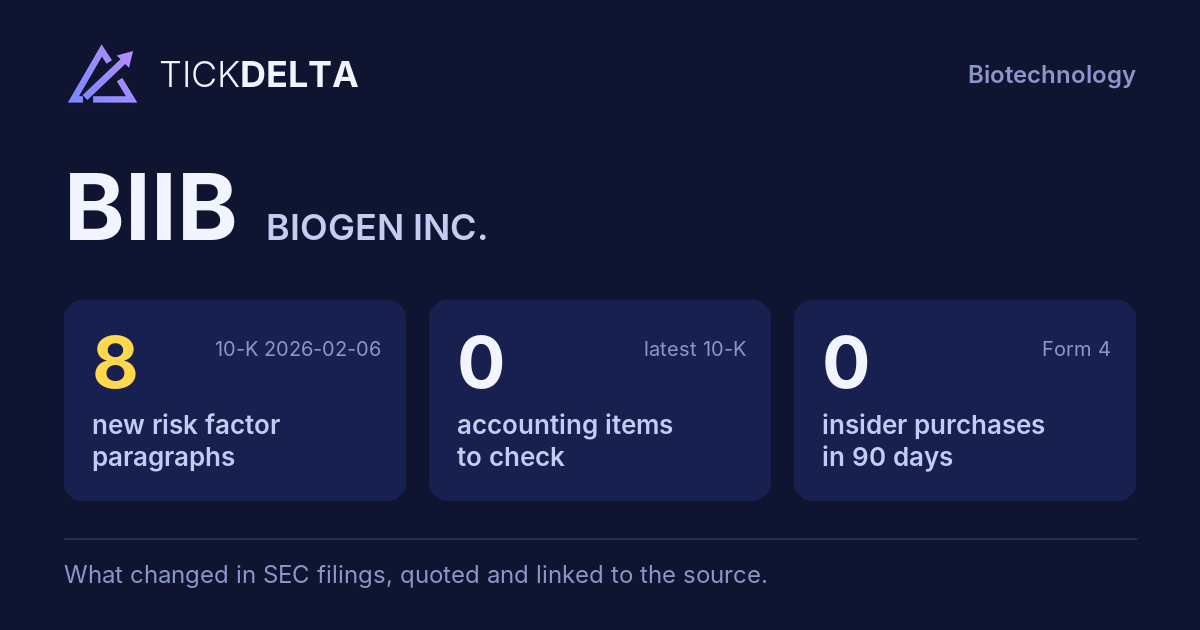
Sentences and paragraphs of BIIB's Risk Factors and MD&A, 10-K 2026-02-06 against 10-K 2025-02-12.
Each links to the text at sec.gov.
AddedRisk Factors
•disruptions, turnover or changes in strategy, priorities or capabilities at our collaborators resulting from, for example, a change in control, may impact the commercialization or manufacturing of our shared products and may result in loss of revenue or higher operating expense; and
Read it in 10-K 2026-02-06 at sec.gov ↗
AddedRisk Factors
In July 2025 the U.S. signed into law the OBBBA, which enacts significant potential changes to Medicaid funding and rescinds or does not continue elements of the PPACA. The OBBBA implements additional eligibility rules on government health plans, expands administrative procedures around enrollment, modifies how states can obtain federal funding for Medicaid and no longer extends ACA premium subsidies. Additional federal and state guidance is expected to be issued in order to implement these OBBBA provisions, most of which have effective dates in 2027 and 2028. At this time, we are unable to determine the overall impact that the OBBBA will have on our business, results of operations and financial condition, or the impact the OBBBA will have on the pharmaceutical industry as a whole because any such impact will depend upon developing interpretations of the OBBBA provisions and implementing regulations, which may be material.
Read it in 10-K 2026-02-06 at sec.gov ↗
AddedRisk Factors
Additionally, the current government administration has introduced various measures to address prescription drug pricing and access, including through issuance of an executive order aiming to establish an MFN drug pricing policy that would tie U.S. drug prices to the prices paid for drugs in other developed countries. If HHS sets MFN pricing targets for prescription drugs, including the use of international pricing reference to set drug prices in the U.S., or if legislation is passed enabling generic drug or biosimilar entry sooner than expected, our business could be materially harmed, including with respect to our ability to set adequate pricing for new drugs to recover our research and development costs. Additional proposals, regulations or initiatives related to drug pricing, such as the CMS-proposed MFN initiatives, the Global Benchmark for Efficient Drug Pricing for certain Medicare Part B drugs and the Guarding U.S. Medicare Against Rising Drug Costs for certain Medicare Part D drugs, continue to be debated, and additional executive orders or regulatory initiatives focused on drug pricing and competition may be adopted and implemented in some form. The timing and extent of implementation of any of the measures described above is uncertain and we cannot fully predict their impact on our product candidates and our business. The adoption of these and any other government controls and measures, and tightening of restrictive policies in jurisdictions with existing controls and measures, could exclude or limit our product candidates from coverage, limit payments for
Read it in 10-K 2026-02-06 at sec.gov ↗
AddedRisk Factors
pharmaceuticals, limit our ability to launch products in certain markets and impact healthcare systems and drug markets in the U.S. and abroad, thereby negatively affecting our revenue and adversely impacting our business.
Read it in 10-K 2026-02-06 at sec.gov ↗
AddedRisk Factors
•the imposition of tariffs or reciprocal tariffs, trade protection measures, embargoes, import or export licensing requirements and the imposition of trade sanctions and other similar restrictions.
Read it in 10-K 2026-02-06 at sec.gov ↗
AddedRisk Factors
Our international operations are also subject to regulation under U.S. law. For example, the U.S. federal government has initiated Section 232 investigations including with respect to pharmaceutical imports into the U.S. The result of these Section 232 investigations and any subsequent rulemaking could result in the government taking actions such as trade protection measures, embargoes, import or export licensing requirements, the imposition of trade sanctions or similar restrictions, which could have adverse consequences to our business and operations.
Read it in 10-K 2026-02-06 at sec.gov ↗
Show the other 12
AddedMD&A
An interim goodwill impairment test based on quantitative factors may be required if adverse events indicate an impairment might be present. We monitor changes to our stock price between annual impairment tests, and we believe that general deterioration in macroeconomic and industry-specific conditions may not be indicators of a goodwill impairment, as such conditions may not represent a significant adverse change to our underlying operating performance, cash flows, financial condition or liquidity. Should our market capitalization decline below the carrying value of our net assets for a sustained period, we would consider the length and severity of the decline and the reason for the decline when assessing whether potential goodwill impairment exists.
Read it in 10-K 2026-02-06 at sec.gov ↗
AddedMD&A
The U.S. has imposed a baseline tariff on imports from all countries, subject to certain exceptions. Trade-related tensions between the U.S. and China have led to a series of tariffs and sanctions being imposed by the U.S. on imports from China and retaliatory tariffs imposed by China on U.S. imports.
Read it in 10-K 2026-02-06 at sec.gov ↗
AddedMD&A
The U.S. Secretary of Commerce has further initiated an investigation to determine the effects on the national security of imports of pharmaceuticals and pharmaceutical ingredients, including finished drug products, medical countermeasures, critical inputs such as active pharmaceutical ingredients, key starting materials and derivative products of those items, under Section 232 of the Trade Expansion Act of 1962.
Read it in 10-K 2026-02-06 at sec.gov ↗
AddedMD&A
There is a high degree of uncertainty concerning what future steps countries and economic blocs will take in response to changes in global trade rules and economics.
Read it in 10-K 2026-02-06 at sec.gov ↗
AddedMD&A
Key products that are currently manufactured mainly outside the U.S. are TECFIDERA, VUMERITY and LEQEMBI. In 2024 we initiated a technology transfer process to enable us to manufacture LEQEMBI in the U.S., which was approved in January 2026.
Read it in 10-K 2026-02-06 at sec.gov ↗
AddedMD&A
Although certain starting materials for SKYCLARYS rely on a single supplier based in China, the manufacturing process, including active pharmaceutical ingredients and drug substance, is primarily conducted in the U.S.
Read it in 10-K 2026-02-06 at sec.gov ↗
AddedMD&A
As of the date of this filing, we do not expect the tariffs currently applicable to our business to result in a material adverse effect on our operations in 2026. This is based on existing tariffs either in place or potential tariffs as previously announced by the U.S. Administration, our manufacturing footprint, and our inventory levels and positioning. Should significant additional tariffs be enacted, our business could be impacted in the future and differ materially from our current expectations. We will continue to monitor the current and future global tariff landscape as it evolves.
Read it in 10-K 2026-02-06 at sec.gov ↗
AddedMD&A
Additionally, in May 2025 the U.S. government issued an executive order aiming to establish an MFN drug pricing policy that would tie U.S. drug prices to the prices paid for drugs in other developed countries. If HHS sets MFN pricing targets for prescription drugs, including the use of international reference pricing to set drug prices in the U.S., it could result in reduced prices and reimbursement for certain of the Company's products in the U.S. We continue to evaluate the potential impact of this executive order. This executive order and any additional legislation, regulations or initiatives related to drug pricing, such as the CMS-proposed MFN initiatives, the Global Benchmark for Efficient Drug Pricing for certain Medicare Part B drugs and the Guarding U.S. Medicare Against Rising Drug Costs for certain Medicare Part D drugs, could create additional uncertainty around the timing and prioritization around worldwide commercial efforts and adversely impact our business and results of operations.
Read it in 10-K 2026-02-06 at sec.gov ↗
AddedMD&A
On July 4, 2025, the U.S. signed into law the H.R.1 legislation formally titled "An Act to Provide for Reconciliation Pursuant to Title II of H. Con. Res. 14", commonly referred to as the OBBBA.
Read it in 10-K 2026-02-06 at sec.gov ↗
AddedMD&A
The OBBBA contains tax provisions, such as the permanent extension or revision of certain expiring provisions of the Tax Cuts and Jobs Act enacted in 2017, modifications to the international tax framework and the restoration of favorable tax treatment for certain business provisions. The provisions of the OBBBA have multiple effective dates, with certain provisions effective in 2025 and others implemented through 2027.
Read it in 10-K 2026-02-06 at sec.gov ↗
AddedMD&A
The OBBBA did not result in any material adjustments to our total income tax provision for the year ended December 31, 2025, and we have adjusted our deferred tax balances to reflect the impacts of the OBBBA enactment. However, given the complexity of tax laws, related regulations and interpretations, our current estimates may require revision as additional information becomes available regarding the application of the OBBBA provisions.
Read it in 10-K 2026-02-06 at sec.gov ↗
AddedMD&A
The OBBBA also enacts significant potential changes to Medicaid funding and rescinds or does not continue elements of the PPACA. The OBBBA implements additional eligibility rules on government health plans, expands administrative procedures around enrollment, modifies how states can obtain federal funding for Medicaid and no longer extends ACA premium subsidies. Additional federal and state guidance is expected to be issued in order to implement these OBBBA provisions, most of which have effective dates in 2027 and 2028.
Read it in 10-K 2026-02-06 at sec.gov ↗