tickdelta
Sign in

Tickdelta is free for now. Sign up and get Pro free

← Screener

BIIBBiogen

Health care · Biotechnology · Nasdaq
Compare with peers → Embed
SEC comment letters, last 20 years

2 reviews of BIIB's filings by SEC staff

UPLOAD and CORRESP
ReviewsRead ↓
2
latest letter 2021-03-25
Questions asked
7
each answered in the company's own letter
No closing letter
0
reviews without a letter saying the staff completed it

When the SEC's staff reviews a filing, it writes to the company with numbered questions, and the company answers each one in a letter. SEC publishes the exchange once the review is over, at least 20 business days later. A question is not an accusation; most reviews end with the company adding detail to its next filing.

Form 10-K

2021-03-25 to 2021-06-22 · 5 questions · 3 letters from the SEC, 3 from the company
Review closed 2021-06-22
Non-GAAP measuresAcquisitionsLiquidity and cash
After reviewing your response to these comments, we may have additional comments. Exhibit 99.1
SEC asked (1)
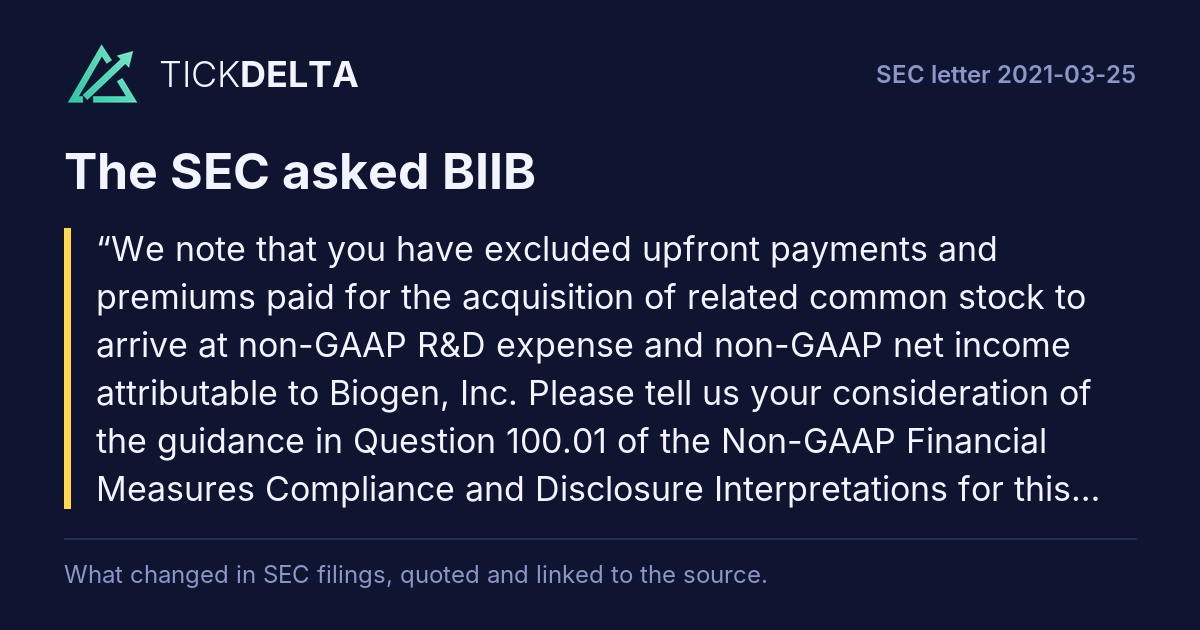
We note that you have excluded upfront payments and premiums paid for the acquisition of related common stock to arrive at non-GAAP R&D expense and non-GAAP net income attributable to Biogen, Inc. Please tell us your consideration of the guidance in Question 100.01 of the Non-GAAP Financial Measures Compliance and Disclosure Interpretations for this adjustment.
Rest of the question

In this regard, you state in Note 18 that in connection with your business strategy, you enter into these collaboration agreements, which are detailed as part of your key business developments on page 2 of your Form 10-K.

BIIB answered
to the First Comment:

We have reviewed Compliance and Disclosure Interpretations on Non-GAAP Measures issued on May 17, 2016, and advise as follows for the topics raised in Comment 1.

Our policy is to supplement our GAAP consolidated financial statements and GAAP financial measures with other financial measures, such as adjusted net income, adjusted diluted earnings per share, revenue growth at constant currency, which excludes the impact of changes in foreign exchange rates and hedging gains or losses, and free cash flow, defined as net cash flow from operations less capital expenditures.
Rest of the answer

We refer to these measures as “Non-GAAP Financial Measures.”

We believe that these Non-GAAP Financial Measures provide additional insight into the ongoing economics of our business and reflect how we manage our business internally and set operational goals, and these Non-GAAP Financial Measures inform our management incentive programs. We acknowledge that Non-GAAP Financial Measures are in addition to, not a substitute for, or superior to, measures of financial performance prepared in accordance with GAAP.

We exclude from Non-GAAP research and development (“R&D”) expense material upfront payments associated with significant collaboration and licensing arrangements (“material upfront payments”) and premiums paid for the acquisition of related common stock in order to better reflect our core operating performance.

We believe that material upfront payments and premiums paid for the acquisition of related common stock associated with significant collaborative and licensing arrangements differ from the normal, recurring, cash expenses necessary to operate our business. Below we describe our normal, recurring R&D operating expenditures and how they differ from material upfront payments and premiums paid for the acquisition of related common stock.

As discussed in Note 1, Summary of Significant Accounting Policies, to our consolidated financial statements included in the 2020 Form 10-K, our normal, recurring, cash operating expenditures associated with R&D activities include compensation and benefits for our employees, facilities and overhead expenses, clinical trial expenses and fees paid to contract research organizations, clinical supply and manufacturing expenses, write-offs of inventory that was previously capitalized in anticipation of product launch and determined to no longer be realizable and other outside expenses, paid to advance our programs, whether the programs originated within the Company or within a collaborator. Costs we share with our collaborators or that we reimburse to the collaborator as well as contingent, event-based, development milestones paid to collaborators as our programs advance are considered normal and recurring obligations and are presented both within our GAAP and Non-GAAP financial results. In each of these cases, the costs are amenable to budgeting and forecasting and are reflected within our operational goals and incentive compensation programs.

In contrast, material upfront payments and premiums paid for the acquisition of related common stock differ from normal, recurring expenses in their timing, nature and how they are viewed by our management and treated for incentive compensation purposes. Specifically, the material upfront payments and premiums paid for the acquisition of related common stock excluded from Non-GAAP R&D expense under our policy are:

•Unpredictable. Our significant collaboration and licensing arrangements are highly variable and unpredictable. Written agreements are often negotiated over lengthy periods of time with terms and conditions regularly adjusted and negotiations discontinued and restarted. In addition, our significant collaboration and licensing arrangements are often subject to regulatory review and approval prior to consummation. These factors, among others, preclude reliable prediction of timing and amounts.

The variability and unpredictability of material upfront payments result in their exclusion from our operational goals and our annual or updated budgets and forecasts. Further, we exclude material upfront payments from the performance metrics and calculations underlying our management incentive compensation plans and the financial guidance that we issue to investors. Specifically, within our discussion of the 2021 financial guidance furnished as part of the Form 8-K, we state that “this financial guidance does not include any impact from potential acquisitions or large business development transactions, as both are hard to predict.”

•Infrequent in their occurrence. For the year ended December 31, 2020, we completed three material collaborations, which we adjusted for within our Non-GAAP R&D expense. In the four years preceding 2020 we completed only two such transactions with a material upfront payment, only one of which involved the purchase of common equity at a premium. Transactions of this magnitude are infrequent.

Significant collaboration and licensing arrangements often represent the implementation or update of our business strategy or the accessing of a new technology not available internally and, therefore, we do not consider material upfront payments to be normal and recurring transactions.

•Distorting in their impact. For the three and twelve months ended December 31, 2020, the material upfront payments and premiums paid for the acquisition of related common stock that we adjusted for were approximately 63% and 47%, respectively, of our total GAAP R&D expense for the periods. The magnitude of these transactions in 2020 was unusual for us. Adjusting for these nonrecurring payments is useful for allowing readers of our financial statements to meaningfully compare R&D expense and trends across multiple reporting periods.

•Upfronts differ from normal recurring R&D expenses. Collaborative and licensing relationships are strategic, and we enter into them to access technology or discoveries that we cannot reliably or economically replicate. Because a material upfront payment is a negotiated amount and based on the fair value of the rights conveyed, usually no clear or consistent relationship exists between the amount of the upfront and the normal and recurring R&D expenses incurred by the collaboration partner prior to entering into the collaboration arrangement. They are usually discrete payments, not tied to measurable events, made at the onset of a relationship that may last many years. These material upfront payments are most similar to in-process research and development.

New collaboration and licensing arrangements, in some cases, involve our making an equity investment in the counterparty, which equity is typically purchased at a premium to the market price. The variability and unpredictability of amounts associated with equity security transactions, including both the premium paid and the unrealized gains and losses experienced in subsequent periods, results in their exclusion from our operational goals and our annual or updated budgets and forecasts. We do not consider owning equity interests to be a core part of our business strategy. As such, we exclude both premiums or discounts on our equity security investments and unrealized and realized gains and losses on these securities from our Non-GAAP Financial Measures, as we do not believe that these components of income or expense have a direct correlation to our ongoing or future core business operations.

Based on the above factors, to show measures that we believe better reflect our core business operations, we have implemented a policy to adjust for material upfront payments and equity investments associated with significant collaboration and licensing arrangements. This policy reflects the way senior management views the business and the nature of the payments. We do not believe that material upfront payments or premiums paid for the acquisition of related common stock reflect normal, recurring, expenses of our business and we do not believe that our policy causes the presentation of our Non-GAAP Financial Measures to be misleading.

Read in the reply ↗
In its next report

First report after the company's reply of 2021-04-07: 10-Q filed 2021-04-22 ↗, against the 10-Q filed 2020-10-21 ↗.

Tickdelta does not hold the text of both reports, so they are not compared here.
After reviewing your response to these comments, we may have additional comments. Exhibit 99.1
SEC asked (2)
Please provide a tabular reconciliation for each of your non-GAAP measures, including non-GAAP R&D and non-GAAP SG&A pursuant to Rule 100(a)(2) of Regulation G and Item 10(e)(i)(b) of Regulation S-K. Please also address this comment for each of your non-GAAP measures presented in your earnings and other presentations pursuant to Rule 100(a)(2) of Regulation G.
BIIB answered
to the Second Comment:

We undertake to provide, in our future Form 8-K filings, earnings releases and other presentations that include such Non-GAAP Financial Measures, tabular reconciliations for each of the Company’s Non-GAAP Financial Measures, including Non-GAAP R&D and Non-GAAP SG&A, unless the Commission’s guidance or rules change on this topic.

To facilitate your review, attached as Exhibit A to this letter is an example of such modified disclosures based on our Q4 2020 earnings results. Read in the reply ↗
In its next report

First report after the company's reply of 2021-04-07: 10-Q filed 2021-04-22 ↗, against the 10-Q filed 2020-10-21 ↗.

Tickdelta does not hold the text of both reports, so they are not compared here.

After reviewing your response to these comments, we may have additional comments. Exhibit 99.1
SEC asked (3)
For your presentation of free cash flow, please include all three major categories of the statements of cash flows with equal or greater prominence in accordance with Item 10(e)(1)(i)(a) of Regulation S-K and Question 102.06 of the Non-GAAP Financial Measures Compliance and Disclosure Interpretations.
Rest of the question

Please also address this comment in your earnings and other presentations pursuant to Rule 100(a)(1) of Regulation G. We remind you that the company and its management are responsible for the accuracy and adequacy of their disclosures, notwithstanding any review, comments, action or absence of action by the staff.

BIIB answered
to Third Comment:

We undertake to include, in our future Form 8-K filings, earnings releases and other presentations that disclose the Non-GAAP Financial Measure “Free Cash Flow”, the three major categories of the statement of cash flows (cash flows from operating, investing and financing activities) with equal or greater prominence, unless the Commission’s guidance or rules change on this topic.

To facilitate your review, attached as Exhibit B to this letter is an example of such modified disclosures based on our Q4 2020 earnings release. Read in the reply ↗
In its next report

First report after the company's reply of 2021-04-07: 10-Q filed 2021-04-22 ↗, against the 10-Q filed 2020-10-21 ↗.

Tickdelta does not hold the text of both reports, so they are not compared here.

SEC asked
We appreciate the information provided to us in your response letter and during the conference calls. We believe that your adjustments to exclude the upfront and premium payments made for collaboration agreements from R&D expense and net income attributable to Biogen, Inc. are inconsistent with the guidance in Question 100.01 of the Non-GAAP Financial Measures Compliance and Disclosure Interpretations.
Rest of the question

Please confirm to us that you will no longer include these adjustments in any non-GAAP financial measure presented in accordance with Item 10(e) of Regulation S-K or Regulation G.

BIIB answered
to the Comment: Read in the reply ↗
In its next report

First report after the company's reply of 2021-06-09: 10-Q filed 2021-07-22 ↗, against the 10-Q filed 2020-10-21 ↗.

Tickdelta does not hold the text of both reports, so they are not compared here.

Exhibit 99.1, page 1
SEC asked
We appreciate the additional information provided to us. We continue to believe that your adjustments to exclude from R&D expense and net income attributable to Biogen, Inc. the upfront and premium payments made for collaboration agreements are inconsistent with the guidance in Question 100.01 of the Non-GAAP Financial Measures Compliance and Disclosure Interpretations.
Rest of the question

Please confirm to us that you will no longer include these adjustments in any non-GAAP financial measure presented in accordance with Item 10(e) of Regulation S-K or Regulation G for all periods presented in future filings.

BIIB answered
to the Comment:

In our future Form 8-K filings, earnings releases and other presentations that include Non-GAAP financial measures, for all periods presented, we will no longer include the upfront and premium payments made for collaboration agreements as exclusions from research and development expense and net income attributable to Biogen Inc. We will recast prior period information to conform to current year presentation. Read in the reply ↗
In its next report

First report after the company's reply of 2021-06-21: 10-Q filed 2021-07-22 ↗, against the 10-Q filed 2020-10-21 ↗.

Tickdelta does not hold the text of both reports, so they are not compared here.

Also in this review: closing letter, 2021-06-22
Form 10-K for the Fiscal Year Ended December 31, 2016

2017-03-23 to 2017-05-25 · 2 questions · 2 letters from the SEC, 2 from the company
Review closed 2017-05-25
Legal and contingenciesNon-GAAP measures
Note 21 – Commitments and Contingencies · TECFIDERA Litigation Settlement and License Agreement, page F-67
SEC asked
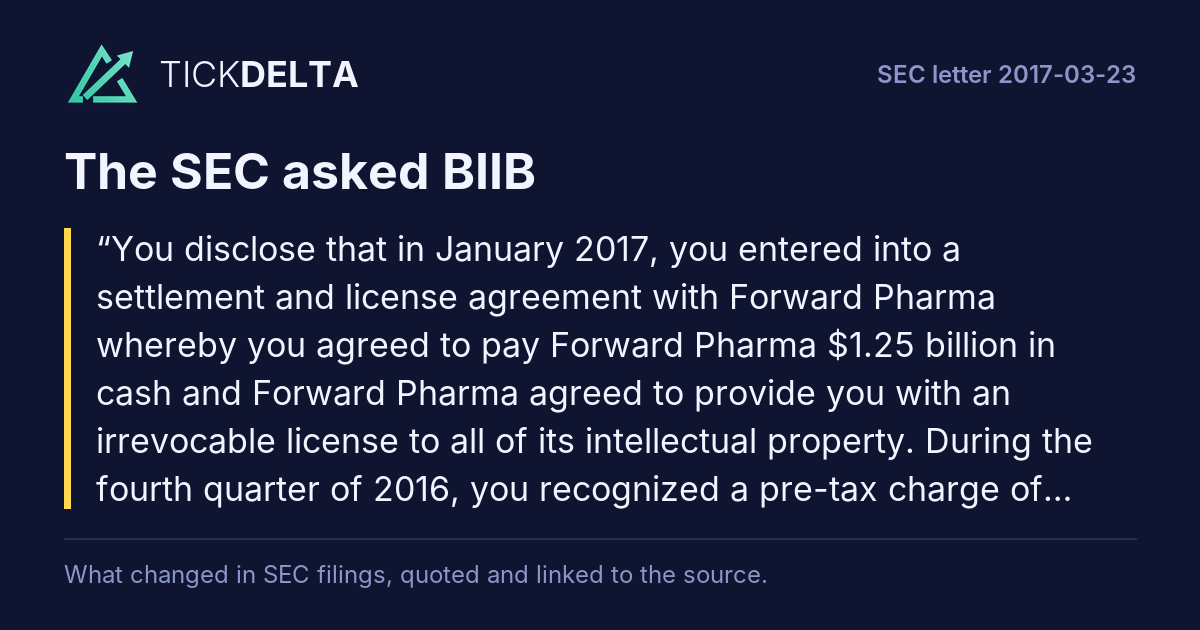
You disclose that in January 2017, you entered into a settlement and license agreement with Forward Pharma whereby you agreed to pay Forward Pharma $1.25 billion in cash and Forward Pharma agreed to provide you with an irrevocable license to all of its intellectual property.
Rest of the question

During the fourth quarter of 2016, you recognized a pre-tax charge of $454.8 million related to this matter and intend to recognize license assets of $795.2 million when you transfer payment to Forward Pharma in 2017. Please describe for us in detail your accounting for this transaction, including but not limited to the following:  Describe for us each item given and received in accordance with the settlement and license agreement and explain how you determined whether each of those items should be recognized and the appropriate period for recognition.  Describe how you determined the fair value of estimated royalties on sales of TECFIDERA resulting in a pre-tax charge of $454.8 million. Also, describe how you determined the $795.2 million fair value of the Forward Pharma irrevocable license.  Explain what the 2017 projected full year non-GAAP TECFIDERA litigation settlement and license charges totaling $190 million, as included in your January 26, 2017 Form 8-K represents, and clarify if part of the $1.25 billion cash payment; and  Tell us the accounting literature you relied upon to support your accounting.

BIIB answered
to the First Bullet:

As of February 2, 2017, the date of the filing of the 2016 Form 10-K, we had two ongoing intellectual property disputes with Forward Pharma, one in the United States ("U.S.") and one in the European Union ("E.U."), concerning intellectual property related to TECFIDERA, which is a treatment for multiple sclerosis. We refer to the interference proceeding between the Company's U.S. Patent No. 8,399,514 and Forward Pharma’s pending U.S. Patent Application No. 11/576,871, which was pending at the Patent Trial and Appeal Board (the "PTAB") of the U.S.
Rest of the answer

Patent and Trademark Office, including any appeals to the Court of Appeals for the Federal Circuit, as the “Interference Proceeding.” We refer to the pending opposition proceeding against Forward Pharma’s European patent EP 2801355 (Application No. 14172398.1), including any appeals therefrom, as the “Opposition Proceeding.” On March 31, 2017, the PTAB rejected Forward Pharma's claims, deciding the case in the Company’s favor. Forward Pharma can appeal this decision to the Federal Circuit Court of Appeals. Any appeal could take 12 to 18 months to resolve. The Opposition Proceeding remains ongoing.

In January 2017 we entered into a Settlement and License Agreement dated January 17, 2017, among Biogen Swiss Manufacturing GmbH, Biogen International Holding Ltd., Forward Pharma and certain related parties (the “License Agreement”), which was effective as of February 1, 2017. Pursuant to the License Agreement, we obtained a U.S. and rest of world license to Forward Pharma's intellectual property which is related to TECFIDERA. In exchange, we agreed to pay Forward Pharma $1.25 billion in cash. A portion of this payment represented back royalties for the period from April 2014, when we started selling TECFIDERA, to December 31, 2016. In addition, the License Agreement provides that, if Forward Pharma prevails in either the Interference Proceeding or the Opposition Proceeding, we could be obligated to pay additional royalties to Forward Pharma starting as early as January 1, 2021. For more information, please see the Company’s Current Report on Form 8-K that was filed with the Commission on January 17, 2017.

Although the License Agreement was signed in January 2017, we considered whether entering into an agreement after December 31, 2016, represented an event that required recognition of a liability as of December 31, 2016. Specifically, per Accounting Standards Codification ("ASC") 855-10-25-1, Subsequent Events ("ASC 855-10-25-1"), "[a]n entity shall recognize in its financial statements the effects of all subsequent events that provide additional evidence about conditions that existed at the balance sheet date, including estimates inherent in the process of preparing financial statements.” We concluded that as a result of entering into the License Agreement, a liability and corresponding loss should be reflected in our consolidated financial statements as of and for the year ended December 31, 2016, respectively. We also determined this liability was both probable and could be reasonably estimated in accordance with ASC 450-20, Contingencies ("ASC 450-20"). Therefore, we recognized a liability of $454.8 million as of December 31, 2016, and a corresponding loss for the fourth quarter of 2016. As discussed in more detail below, the amount of the liability and corresponding loss recognized represents the fair value of the alleged patent infringement for the period from April 2014, when we started selling TECFIDERA, to December 31, 2016.

We made the $1.25 billion cash payment in February 2017 and recognized an asset of $795.2 million. The $795.2 million represented the fair value of the U.S. ($656.3 million) and rest of world ($138.9 million) license to Forward Pharma’s intellectual property which is related to TECFIDERA for the period January 2017, the month in which we entered into the License Agreement, through December 2020, the last month before royalty payments first could commence pursuant to the License Agreement. The license to Forward Pharma’s intellectual property which is related to TECFIDERA had been acquired after regulatory approval of TECFIDERA. We capitalized the amount paid to acquire Forward Pharma's intellectual property in accordance with ASC 350-30-25-1, Intangibles - Goodwill and Other. In addition, in accordance with ASC 350-30-25, Intangibles - Goodwill and Other ("ASC 350-30-25"), and as amended by ASC 805-20, Business Combinations ("ASC 805-20"), intangible assets should be initially recorded at their fair value.

As the PTAB ruled in the Company's favor in the Interference Proceeding in March 2017, we are currently evaluating whether the acquired U.S. asset valued at $656.3 million is recoverable and we may record an impairment charge in our condensed consolidated statements of income in the first quarter of 2017.

We are also evaluating the impact of the court's ruling in the Interference Proceeding on the pending Opposition Proceeding and the impact on the recoverability of the rest of world asset valued at $138.9 million. In the first quarter of 2017, to the extent the U.S. and rest of world assets acquired are not impaired, we expect to continue amortizing the balance to our consolidated statements of income utilizing an economic consumption model in accordance with ASC 350-30-35-6, Intangibles - Goodwill and Other ("ASC 350-30-35-6"). Under this guidance, “the method of amortization shall reflect the pattern in which the economic benefits of the intangible asset are consumed or otherwise used up.” If Forward Pharma is successful in the Opposition Proceeding, we will continue to amortize the $138.9 million. If we prevail in the Opposition Proceeding, we will evaluate the continued appropriateness of the remaining value of this asset. In such circumstances the intellectual property rights acquired from Forward Pharma as a result of us prevailing in the Opposition Proceeding may no longer be needed, indicating that the future value of such asset may have diminished and that it should be impaired.

Response to the Second Bullet:

The $1.25 billion payment represented our past and future royalty obligation to Forward Pharma for the U.S. and rest of world license rights to Forward Pharma's intellectual property. Based upon the discussion above, as included in our response to the first bullet, the fair value of the U.S. and rest of world license for the period April 2014 through December 31, 2016 (that is, the litigation settlement on past sales) was determined to be $454.8 million. The fair value of the U.S. and rest of world license for the period January 2017 through December 2020 (that is, the right to use Forward Pharma's intellectual property) was determined to be $795.2 million.

We allocated the $1.25 billion payment for the U.S. and rest of world license between such jurisdictions based on fair value determined according to the relative sales of TECFIDERA in each jurisdiction. The starting point to determine the fair value was ascertaining the actual and forecasted sales of TECFIDERA in each jurisdiction for the period April 2014, when we started selling TECFIDERA, through December 2020, the last month before royalty payments first could commence pursuant to the License Agreement. After determining the sales in each jurisdiction, we then applied a royalty rate which would be considered fair value for similar intellectual property to those sales adjusted for the probability of success in the Interference Proceeding and the Opposition Proceeding. As of February 2, 2017, the date of the filing of the 2016 Form 10-K, we believed the $1.25 billion payment represented the fair value of settling claims related to past sales and obtaining a perpetual U.S. and rest of world license to Forward Pharma's intellectual property for future sales through December 31, 2020. We also believed future royalty rates on sales from January 1, 2021 and beyond were reflective of market rates.

We believe that the methodology used to determine the fair value of the U.S. and rest of world license, as well as the litigation settlement, is consistent with the December 10, 2007 speech entitled “Remarks before the 2007 AICPA Conference on Current SEC and PCAOB Developments” whereby the Associate Chief Accountant, Office of the Chief Accounting of the Commission, in discussing the accounting for litigation settlements, stated that “it would be acceptable to value each element using relative fair values” and “the company may be able to calculate the value of the settlement by applying a royalty rate to the revenues derived from the products sold using the patented technology during the infringement period.”

Response to the Third Bullet:

We refer you to the disclosure in the Company’s Current Report on Form 8-K filed with the Commission on January 26, 2017, where we estimated our 2017 TECFIDERA litigation settlement and license charges to be approximately $190 million. These charges are a component of the $1.25 billion payment. As of January 26, 2017, the date the Company's Current Report on Form 8-K was filed, the $190 million estimate represented the minimum expense that we expected to record in 2017 related to the License Agreement assuming the Interference Proceeding and the Opposition Proceeding were still pending. The timing and outcome of these types of proceedings can be unpredictable. The $190 million estimate was the amortization expense expected to be recorded in 2017 associated with the $795.2 million asset using the economic consumption model in accordance with ASC 350-30-35-6.

As the PTAB ruled in the Company's favor in the Interference Proceeding in March 2017, we are currently evaluating the assets acquired for impairment, and such evaluation could impact future amortization. Based on the outcome of this evaluation, we will revise our disclosures accordingly within our first quarter Form 10-Q filing.

Response to the Fourth Bullet:

As discussed above in the responses to the first, second and third bullets, we relied upon the following accounting literature to support our accounting:

ASC 855-10-25-1;

ASC 450-20;

ASC 350-30-25;

ASC 805-20;

ASC 350-30-35-6; and

Speech by SEC Staff: Remarks before the 2007 AIPCA National Conference on Current SEC and PCAOB Developments.

The Company acknowledges that the Company and its management are responsible for the accuracy and adequacy of its disclosure, notwithstanding any review, comments, action or absence of action by the Staff.

Read in the reply ↗
In its next report

First report after the company's reply of 2017-04-04: 10-Q filed 2017-04-25 ↗, against the 10-Q filed 2016-10-26 ↗.

Tickdelta does not hold the text of both reports, so they are not compared here.

Note 21 – Commitments and Contingencies · TECFIDERA Litigation Settlement and License Agreement, page F-67
SEC asked
We have reviewed your response to prior comment one of our March 23, 2017 letter regarding your January 2017 settlement and license agreement (“the agreement”) with Forward Pharma. Please confirm you had exclusive rights to the U.S. license or the right to sell or transfer the license upon entering into the agreement.
Rest of the question

If you did not have such rights, tell us, citing relevant accounting literature, how you determined recognition of the license as an intangible asset is appropriate. In this regard, we note Sections 3.01 and 3.02 of the agreement included in Exhibit 10.1 of your January 17, 2017 Form 8-K describe a co-exclusive license and indicate that a notice specifying your intention to take the exclusive U.S. license should be delivered on or prior to the date that is 75 days following the final decision in the Interference Proceeding. It is our understanding that the PTAB did not issue a ruling on the Interference Proceeding until March 2017.

BIIB answered
Under the License Agreement, we received a perpetual, irrevocable, co-exclusive license in the United States to all intellectual property of Forward Pharma, including Forward Pharma’s intellectual property which is related to TECFIDERA (collectively, the “U.S. Licensed Intellectual Property”). While our license rights are currently co-exclusive, we confirm that upon our payment of the upfront license fee in February 2017 and pursuant to Section 3.01 of the License Agreement, we have the unilateral right, at all times, to “sublicense, transfer or assign” our license to the U.S.
Rest of the answer

Licensed Intellectual Property. Accordingly, we recognized the license as an intangible asset in accordance with ASC 805-20-55-2 and 3, Intangibles - Goodwill and Other. Under this guidance, intangible assets are considered identifiable if they satisfy (1) the contractual-legal criterion (the intangible asset arises from contractual or legal rights) and (2) the separability criterion (the intangible asset is able to be sold, transferred, licensed, rented or exchanged separately).

The Company acknowledges that the Company and its management are responsible for the accuracy and adequacy of its disclosure, notwithstanding any review, comments, action or absence of action by the Staff.

Read in the reply ↗
In its next report

First report after the company's reply of 2017-05-10: 10-Q filed 2017-07-25 ↗, against the 10-Q filed 2016-10-26 ↗.

Tickdelta does not hold the text of both reports, so they are not compared here.

Also in this review: closing letter, 2017-05-25

Other letters

Letters without questions

UPLOAD and CORRESP
2 other letters: notices that a filing will not be reviewed, requests to declare a registration effective, and the like

From the SEC's correspondence on EDGAR: staff letters (form UPLOAD) and company letters (form CORRESP), 17 letters filed since 2017-03-23. Questions and answers are matched by their numbers; topics come from words in each question. The reports are compared word for word (same form, before the first SEC letter against the first report after the company's reply). No AI.

Next in Owners and insiders Insider trades →