Form 10-K for the Fiscal Year Ended December 31, 2017
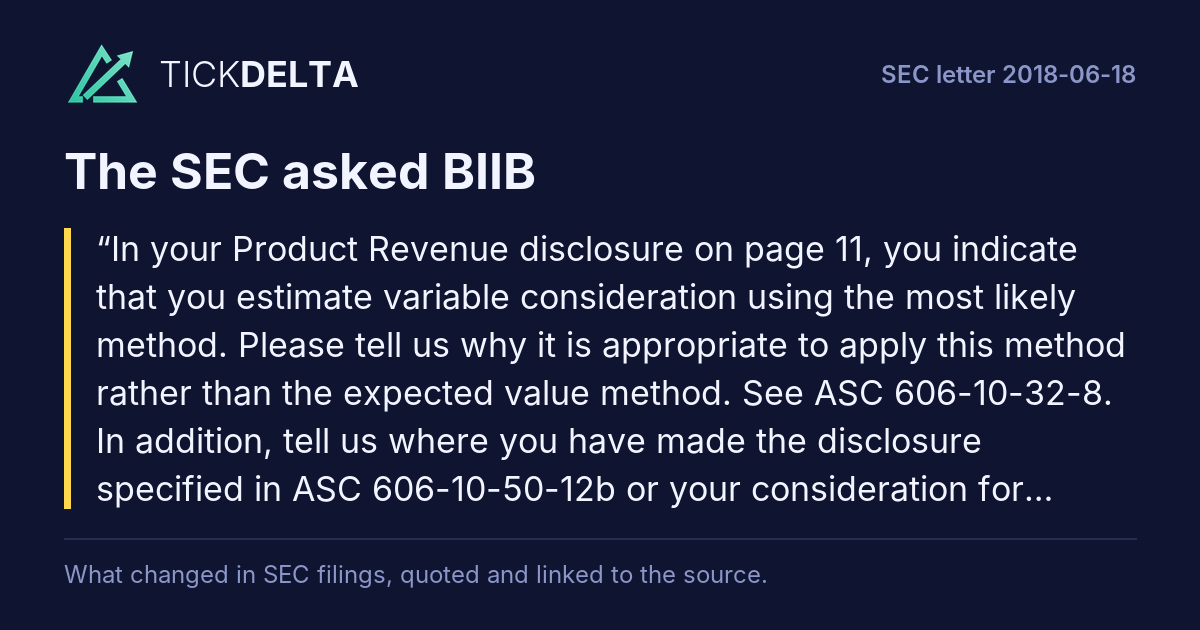
In your Product Revenue disclosure on page 11, you indicate that you estimate variable consideration using the most likely method. Please tell us why it is appropriate to apply this method rather than the expected value method. See ASC 606-10-32-8. In addition, tell us where you have made the disclosure specified in ASC 606-10-50-12b or your consideration for providing this disclosure.
to the First Comment:
Use of the “Most Likely Method”
Our process for estimating variable consideration takes into consideration our historical experience, our understanding of current contractual and statutory requirements, specific known market events and trends, industry data and forecasted customer buying and payment patterns.Read in the reply ↗Rest of the answer
Upon further analysis, including a review of industry practices and disclosures, we have gained additional perspective with respect to our interpretation of the definitions for the methods specified in ASC 606-10-32-8 and now believe our estimation process conforms to the expected value method. Accordingly, we plan to revise our disclosures on a prospective basis beginning with our Quarterly Report on Form 10-Q for the quarterly period ended June 30, 2018 ("Q2 2018 Form 10-Q") in the subsection entitled “Reserves for Discounts and Allowances” within Note 1, Summary of Significant Accounting Policies, to indicate that our estimation methodology reflects the expected value method.
Disclosures Specified in ASC 606-10-50-12b
We respectfully direct you to our disclosures included on page 12 in the subsection entitled “Accounts Receivable” within Note 1, Summary of Significant Accounting Policies, in our Q1 2018 Form 10-Q, which address the disclosures specified in ASC 606-10-50-12b with respect to whether the contract has a significant financing component.
We also respectfully direct you to our disclosures on page 11 in the subsection entitled “Reserves for Discounts and Allowances” within Note 1, Summary of Significant Accounting Policies, in our Q1 2018 Form 10-Q, which address the disclosures specified in ASC 606-10-50-12b with respect to whether any consideration is variable and whether such consideration is constrained.
In addition, we plan to revise our disclosures on a prospective basis beginning with our Q2 2018 Form 10-Q in the subsection entitled “Accounts Receivable” within Note 1, Summary of Significant Accounting Policies, to include the disclosure specified in ASC 606-10-50-12b regarding the significant payment terms related to our material revenue streams.
To facilitate your review, attached as Exhibit A to this letter is a copy of such modified disclosures based on our Q1 2018 Form 10-Q.
First report after the company's reply of 2018-06-28: 10-Q filed 2018-07-24 ↗, against the 10-Q filed 2018-04-24 ↗.
Tickdelta does not hold the text of both reports, so they are not compared here.
In your Revenues from Anti-CD20 Therapeutic Programs disclosure on page 11, you indicate that you do not have any future performance obligations under your license or collaboration agreement. Please reconcile this statement with the following disclosures that imply that you may be obligated to perform some tasks: • On page 12 you indicate that you are reimbursed for your selling and development expenses in the U.S.Rest of the question
for RITUXAN; • In the last paragraph on page F-11 of the 2017 Form10-K you indicate that your copromotion profits on RITUXAN and GAZYVA include reimbursement for joint development expenses incurred; and • In the second paragraph on page F-57 of the 2017 Form 10-K you indicate that you recognize your share of the development and commercialization expenses of GAZYVA as a reduction of your pre-tax profits.
to the Second Comment:
In relation to our Anti-CD20 Therapeutic Programs, we confirm to the Staff that we have no future performance obligations under our license and collaboration agreement with Genentech Inc. ("Genentech"). In 2010 Genentech, our licensee and collaborator, became responsible for all development and commercialization activities.
Please note, when we refer to our “share” of development and commercialization expenses for RITUXAN® and GAZYVA®, we are referring to our share of collaboration expenses incurred by Genentech, which decreases the profit share earned by us.Read in the reply ↗Rest of the answer
We plan to clarify our disclosures on a prospective basis beginning with our Q2 2018 Form 10-Q.
To facilitate your review, attached as Exhibit B to this letter is a copy of such modified disclosures based on our Q1 2018 Form 10-Q.
First report after the company's reply of 2018-06-28: 10-Q filed 2018-07-24 ↗, against the 10-Q filed 2018-04-24 ↗.
Tickdelta does not hold the text of both reports, so they are not compared here.
Please clarify for us whether you are applying the ASC 606 royalty recognition constraint to your co-promotion profits and royalties associated with your Genentech collaboration. If so, clarify for us the consideration you gave in reaching your conclusion to apply the constraint to the following: • You assigned, rather than licensed your Canadian collaboration rights.Rest of the question
See page F-57 of your 2017 Form 10-K, ASC 606-10-55-65A and paragraph BC 78b of ASU 201610. • Your obligation to provide development services and/or other goods or services.
to the Third Comment:
We account for our relationship with Genentech in accordance with ASC 808, Collaborative Arrangements, and other applicable guidance, as we share significant risks and rewards and there are joint operating activities that involve active participation from both parties. Our revenues from our collaboration arrangement with Genentech are presented separately from "Product revenues, net" as “Revenues from anti-CD20 therapeutic programs” within our consolidated statements of income and refer collectively to the commercial products RITUXAN, GAZYVA and OCREVUS®, which are soldRead in the reply ↗Rest of the answer
by Genentech.
Pursuant to the guidance specified in ASC 808-10-45-3, we analogize aspects of our relationship with Genentech to certain guidance in ASC 606, Revenue from Contracts with Customers, including the salesand usage-based royalty exception (i.e., royalty recognition constraint) because the predominant item to which the profit share and royalty income amounts relate is the license of intellectual property to Genentech. This includes our Canadian collaboration rights to RITUXAN. Subsequent to the license, we consented to the license being assigned to an affiliated entity of Genentech within the consolidated Roche/Genentech group. Following this assignment, the intellectual property is still licensed and we continue to own the rights to the intellectual property. We plan to clarify our disclosures on a prospective basis beginning with our Q2 2018 Form 10-Q with respect to the nature of the Canadian relationship, which is the license of intellectual property.
In addition, as noted in our response to the Second Comment above, we plan to revise our disclosures on a prospective basis beginning with our Q2 2018 Form 10-Q since we are not providing any on-going goods or services and have no future performance obligations under the Genentech collaboration arrangement.
To facilitate your review, attached as Exhibit C to this letter is a copy of such modified disclosures based on our 2017 Form 10-K.
First report after the company's reply of 2018-06-28: 10-Q filed 2018-07-24 ↗, against the 10-Q filed 2018-04-24 ↗.
Tickdelta does not hold the text of both reports, so they are not compared here.
Please tell us where you have made the disclosure of your accounting policy for classifying payments between participants to a collaborative arrangement or your consideration for providing this disclosure. In your response, tell us how you handle both net profits and expense reimbursements (either paid or received) and how you distinguish between the two.Rest of the question
Help us understand how your policies are the same as or differ from the example beginning at ASC 808-10-55-3 and the extent to which they are consistent with your ongoing major or central operations. In this regard, we note from disclosure: • In the last paragraph on page F-58 of your 2017 Form 10-K that you include your share of development expenses as a reduction to revenue after an anti-CD20 product is approved; • At the top of page 12 of your March 31, 2018 Form 10-Q that the reimbursement of development expenses in the U.S. for RITUXAN is included in revenues; and • In the second paragraph on page F-59 of your 2017 Form 10-K that reimbursement of research and development expenses from AbbVie are netted against research and development expense in your consolidated statements of income.
to the Fourth Comment:
Disclosures regarding our Accounting Policy for Classifying Payments for Collaborative and Other Relationships
We respectfully direct you to our disclosures included on page 12 in the subsection entitled “Collaborative and Other Relationships” within Note 1, Summary of Significant Accounting Policies, in our Q1 2018 Form 10-Q, which address our policy for classifying payments between participants to a collaborative arrangement.
We further respectfully direct you to our disclosures included on page F-19 in the subsection entitled “Research and Development Expenses”Read in the reply ↗Rest of the answer
within Note 1, Summary of Significant Accounting Policies, in our 2017 Form 10-K with respect to these payments.
We plan to modify our disclosures on a prospective basis beginning with our Q2 2018 Form 10-Q to provide additional clarity with respect to our accounting policy regarding our collaborative and other relationships.
To facilitate your review, attached as Exhibit D to this letter is a copy of such modified disclosures based on our Q1 2018 Form 10-Q and our 2017 Form 10-K.
Consideration with Respect to our Collaborations with Genentech and AbbVie
We report costs incurred and revenues generated from transactions with third parties that do not participate in the collaborative arrangement in our consolidated statements of income pursuant to the guidance on principal versus agent considerations in ASC 606-10-55-36 through 55-40.
In accordance with ASC 808-10-45-1 and ASC 606-10-55-37, a participant in a collaborative arrangement that is deemed to be the principal for a given transaction records that transaction on a gross basis in its financial statements. In accordance with ASC 808-10-45-1 and ASC 606-10-55-38, a participant in a collaborative arrangement that is deemed not to be the principal for a given transaction records that transaction on a net basis in its financial statements.
Genentech
For our approved anti-CD20 products, as discussed in our response to the Second Comment above, Genentech is the principal performing further development work associated with a commercial product. We have no future performance obligations under our license and collaboration agreement with Genentech and are not performing any development work. The development costs incurred by Genentech, in accordance with the terms of the collaboration agreement, reduce the overall profit of the collaboration, which is then allocated between the collaborators (Genentech and us). We record the net profit we receive from Genentech as "Revenues from anti-CD20 therapeutic programs" within our consolidated statements of income. Consistent with the guidance beginning at ASC 808-10-55-3, as included within Example 1 and Example 3 to ASC 808 "Collaborative Arrangements", we have concluded that the net profit received from Genentech is analogous to a royalty and should therefore be classified as revenues, similar to royalties.
AbbVie
For our relationship with AbbVie, which relates to the development and commercialization of ZINBRYTA® (which was withdrawn from the market in all jurisdictions in March 2018), we performed development services and recorded development expenses within "Research and development expense" in our consolidated statements of income. Any reimbursement of development expenses from AbbVie were recorded as a reduction to research and development expense. Research and development services are not part of our ordinary activities. Therefore, AbbVie is not considered a customer with respect to development services.
**************
The Company acknowledges that the Company and its management are responsible for the accuracy and adequacy of its disclosures, notwithstanding any review, comments, action or absence of action by the Staff.
First report after the company's reply of 2018-06-28: 10-Q filed 2018-07-24 ↗, against the 10-Q filed 2018-04-24 ↗.
Tickdelta does not hold the text of both reports, so they are not compared here.
Also in this review: closing letter, 2018-07-23