Form S-4
We note that you disclose the equity stake of stockholder groups assuming no redemption. Please revise to also disclose the equity stake of these groups assuming maximum redemption.
The Company acknowledges the Staff’s comment, and has revised its disclosure on pages 14 and 15 to disclose the equity stake of the various groups of shareholders assuming maximum redemption. Read in the reply ↗
On page 213, you disclose that VIH's Sponsor, executive officers and directors have agreed to vote in favor of the business combination. Please revise this Q&A and elsewhere to disclose the percentage of VIH shares that are subject to an agreement to vote in favor of the business combination.Rest of the question
Additionally, since the business combination proposal requires only the affirmative vote of the majority of the votes cast by VIH stockholders, also disclose the percentage of remaining shares needed to vote for the business combination proposal if only a quorum of VIH shares are present.
The Company has revised its disclosure on pages 24, 25, 138, and 139 to address the Staff’s comment. Read in the reply ↗
Please revise the post-closing company structure chart to show the percentage ownership in Bakkt Holdings Inc. held by the VIH public shareholders, the VIH sponsor and independent directors, the PIPE investors and the Bakkt equity holders. Also, show the percentage ownership in Bakkt Opco Holdings, LLC. held by Bakkt Holdings Inc. and the Bakkt equity holders.
The Company has revised its disclosure on page 32 to address the Staff’s comment. Read in the reply ↗
You state that your digital asset marketplace is designed to enable participants to transact in digital assets. Please state clearly whether you intend to include digital asset securities as part of your business. Discuss how you will determine whether a particular digital asset is not a security.Rest of the question
Add a risk factor that there may be uncertainty regarding your determination and regulators may disagree with your analysis. Discuss the regulatory oversight that you will have from the Securities and Exchange Commission and whether you would be required to register as an exchange or an ATS.
In response to the Staff’s comment, the Company has revised its disclosures to clarify that while Bakkt Holdings, LLC (“Bakkt”) plans to enable traditional equity securities trading on its platform through a broker-dealer, Bakkt does not otherwise plan to include any digital assets that are securities on its platform at this time. Bakkt has adopted a new asset listing policy, which includes review by its operational, legal and compliance functions prior to any new asset being approved for listing on the Bakkt platform.Read in the reply ↗Rest of the answer
This policy includes a requirement to evaluate whether a particular digital asset constitutes a security in accordance with existing SEC guidance. The Company has also revised its disclosures on page 87 of the Registration Statement to add a risk factor that addresses the uncertainties regarding Bakkt’s determination of whether a digital asset qualifies as a security.
Please advise whether you will be a controlled company under the rules of the NYSE following the business combination. If so, please provide risk factor disclosure of this status and the corporate governance exemptions available to you as a controlled company.
The Company does not intend to avail itself of the controlled company exemptions under the rules of the NYSE following the business combination. Read in the reply ↗
You disclose that Bakkt Marketplace is registered as a "money services business" with the U.S. U.S. Department of Treasury’s Financial Crimes Enforcement Network and that Bakkt Marketplace is subject to federal and state consumer protection laws and regulations applicable to its activities by the Consumer Financial Protection Bureau.Rest of the question
Please discuss risks and uncertainties related to being subject to the laws and regulations by FinCEN and the CFBP. Further, please clarify on page 84 that you may be subject to laws relating to securities, commodities and derivative laws.
In response to the Staff’s comment, the Company has revised its disclosures to highlight certain uncertainties and risks related to Bakkt being subject to the laws and regulations of FinCEN on pages 85 and 86 of the Registration Statement and to being subject to the rules and regulations of the CFPB on page 89 of the Registration Statement. The Company has also has added supplemental disclosure that indicates that Bakkt may be subject to laws governing securities, commodities and derivatives in the bulleted list on page 84 of the Registration Statement. Read in the reply ↗
Please provide the basis for your statement that the Commodity Futures Trading Commission has "publicly taken the position that certain virtual currencies, which can include cryptocurrencies, are commodities, and as such, exchange-traded derivatives involving bitcoin are subject to the CFTC’s jurisdiction and enforcement powers." The Proposed Certificate of Incorporation will designate a state or federal court...,Rest of the question
page 65
We acknowledge the Staff’s comment, and draw the Staff’s attention to a number of public statements that the CFTC and its staff have made in support of this statement. These include statements in connection with an enforcement action against Coinflip, Inc., and in certain informal guidance that the CFTC has issued, including LabCFTC’s Primer on Virtual Currencies and other presentation materials released by the CFTC.Read in the reply ↗Rest of the answer
In response to the Staff’s comment, the Company has revised the disclosures on page 86 of the Registration Statement to incorporate these citations and noted in the revised disclosures that some of the CFTC’s guidance on this issue is subject to change and is not necessarily binding on the CFTC.
Please revise the risk factor to state, as you do on pages 170 and 173, that the exclusive forum provision does not apply to actions arising under the Exchange Act. Also, state that under Article XII of your proposed charter, the federal district courts of the U.S.Rest of the question
will be the exclusive forum for actions arising under the Securities Act, that there is uncertainty as to whether a court would enforce such provision, and that investors cannot waive compliance with the federal securities laws and the rules and regulations thereunder.
In response to the Staff’s comment, the Company has revised its disclosure on page 174 accordingly. Read in the reply ↗
Please tell us what operating metrics you regularly review and what consideration you gave to disclosing information about those metrics. We refer you to Section III.B of SEC Release No. 33-8350.
The Company respectfully notes to the Staff that it has not engaged in any operations to date, and has not disclosed any information relating to operating metrics. Read in the reply ↗
Please disclose your timetable for adding other digital assets to your marketplace. Address any regulatory or other requirements that must be satisfied before you can add specific digital assets to your platform. Also, disclose the material terms of your agreements with loyalty sponsors. Finally, discuss the terms of your arrangement with Starbucks to use your alternative payment method.
In response to the Staff’s comment to disclose a timetable for adding other digital assets to the Bakkt marketplace, the Company has revised its disclosures on pages 261 and 275 of the Registration Statement to specify that Bakkt plans to add additional cryptocurrencies as part of its product and service offerings in the second quarter of 2021.
In response to the Staff’s comment to address any regulatory or other requirements that must be satisfied before Bakkt can add specific digital assets to Bakkt’s platform, the Company has revised its disclosures on pages 85, 86 and 261 of theRead in the reply ↗Rest of the answer
Registration Statement. Before cryptocurrencies may be added to Bakkt’s products and services, Bakkt must complete a detailed internal risk-based assessment of the applicable cryptocurrency, including with respect to conflicts of interest, legal and compliance considerations, operational viability and other factors, in accordance with its policies and procedures. These policies and procedures or the specific cryptocurrency, as applicable, must be approved by the New York State Department of Financial Services (“NYSDFS”) before Bakkt may offer it through its platform.
In response to the Staff’s comment to disclose the material terms of Bakkt’s agreements with loyalty sponsors and the arrangement with Starbucks to use Bakkt’s alternate payment method, the Company has revised its disclosures on pages 262 and 267 of the Registration Statement.
Please provide more detail about the Loyalty Redemption service and the alternative payment method. Specifically, explain how bitcoin may be used as a payment means within those programs and how digital assets may be used in those programs in the future. Bakkt, page 261
In response to the Staff’s comment, the Company has revised its disclosures on pages 260, 261 and 262 of the
Registration Statement.
The Company respectfully advises the Staff that the Bakkt platform makes different kinds of digital assets fungible in the eyes of a consumer. That is, a consumer can obtain other digital assets, or pay for goods and services, using the digital assets in that consumer’s wallet without regard to what form those assets take – bitcoin, loyalty points, or cash.Read in the reply ↗Rest of the answer
To a consumer, this will appear as a direct conversion from the assets in the consumer’s wallet into the desired asset; however, the transaction always results in a conversion to fiat currency. In response to the Staff’s comment, Bakkt has revised the disclosure on page 264 in the paragraph beginning “Alternative Payment Method” with an example from the perspective of a consumer utilizing digital assets to pay a merchant, and clarifying that the digital assets are converted into cash, which the merchant ultimately receives in exchange for the good or service.
Please clarify how you earn revenue, or expect to earn revenue, through the services provided on your platform. Also, disclose whether you accept, or plan to accept, payment for such services in the form of digital assets and, if so, whether you intend to hold the digital assets for investment or convert them into fiat currency after receipt.
In response to the Staff’s comment, Bakkt’s Critical Accounting Policies and Estimates disclosures have been revised to clarify how
Bakkt earns revenue through the services provided on the Bakkt platform (please refer to the disclosure on page 285 of the Registration Statement). In this regard, Bakkt notes that its transactions and subscription revenues are earned through trading and clearing fees associated with Bakkt’s bitcoin futures transactions, as well as custody fees associated with bitcoin custodial services, and loyalty redemption platform subscription, transaction and serviceRead in the reply ↗Rest of the answer
fees.
In response to the Staff’s comment, the Company has revised the disclosure on pages 260 and 261 of the Registration Statement to clarify that Bakkt does not accept or plan to accept digital assets as a form of payment.
Disclose how the company intends to use the funds available after the business combination to grow Bakkt's business.
In response to the Staff’s comment, the Company has revised its disclosures on page 277 of the Registration Statement. Read in the reply ↗
We note that you have identified Bakkt as the predecessor for accounting purposes. Please provide your analysis that supports this conclusion. We note that B2S Holdings, Inc. operations are significantly larger than that of Bakkt. In addition, due to its significance explain why B2S Holdings, Inc. is not included in your MD&A.Rest of the question
Alternatively, consider whether the discussion of the results of operations and financial condition should be supplemented by a discussion based upon pro forma financial information for this combination.
respectfully advise the Staff that, in considering the determination of the predecessor, Bakkt considered the authoritative guidance in Rule 405 of Regulation C, the Staff’s interpretive guidance in Financial Reporting Manual 1170.1, and public statements by the Staff at the 2015 AICPA National Conference.Read in the reply ↗Rest of the answer
In that speech, the Staff highlighted a number of factors for registrants to consider in determining the predecessor, including (but not limited to) (1) the order in which the entities are acquired, (2) the size of the entities, (3) the fair value of the entities, and (4) the ongoing management structure.
In considering the foregoing principles of predecessor determination in light of Bakkt’s specific facts and circumstances, as well as other factors outlined below, the management of Bakkt concluded that Bakkt is the predecessor for accounting purposes. Bakkt’s analysis follows:
The Order in which the Entities are Acquired.
Bakkt and Bakkt, LLC, a wholly owned subsidiary, were formed on July 31, 2018 and each executed limited liability company agreements on
August 2, 2018. Bakkt was initially capitalized on December 19, 2018 with certain assets contributed by Intercontinental Exchange Holdings, Inc. (“ICE”), then $182.5 million in capital raised at a $400 million pre-money valuation from ICE and third party institutional investors.
On
February 21, 2020, ICE acquired Bridge2 Solutions (“B2S”). On March 12, 2020, Bakkt completed a Series B round of funding in the amount of $300 million. As part of this funding, ICE contributed the B2S business to Bakkt (at an enterprise value of $250 million), plus additional cash, for a total contribution in the amount of $261 million. On a post-transaction basis, B2S’s $250 million value was only approximately 22% of the total post-money valuation of
Bakkt.
As noted in Bakkt’s MD&A and financial statements, Bakkt accounted for the B2S acquisition as a common control transaction under ASC 805. At the 2006 AICPA National Conference on Current SEC and PCAOB Developments, the SEC staff indicated that the predecessor entity in a common control transaction generally is the entity that was first controlled by the parent. ICE, as the controlling parent company of Bakkt, acquired all of the issued and outstanding equity of B2S and subsequently contributed substantially all of the assets and liabilities of B2S to Bakkt as part of a financing round.
Because Bakkt was formed and capitalized 19 months and 14 months, respectively, prior to the acquisition of B2S by ICE and ICE’s subsequent contribution of B2S to Bakkt, Bakkt’s management concluded that this factor was an indicator that Bakkt is the predecessor entity.
The Size of the Entities.
As shown below, the key financial metrics of Bakkt and B2S and the combined entities (in 2020) are mixed with respect to their relative sizes.
In millions
Bakkt
B2S
2020
2019
2018
Assets
$
468.4
177.7
182.5
45.2
52.0
Equity
388.3
151.5
162.0
(21.3
)
(24.5
Revenues
28.5
(0.9
44.3
48.7
Income (loss)
(79.4
(33.0
0.8
2.9
3.8
Bakkt’s assets and equity were significantly greater than B2S’s assets and equity as of
December 31, 2019 and 2018, and the combined assets and combined equity of the companies as of December 31, 2020 are even greater than the sum of the combined assets and combined equity of the two companies as of December 31, 2019 and
2018. B2S’s revenue and income for the fiscal years ended December 31, 2019 and 2018 were significantly greater than Bakkt’s revenue and loss for the corresponding periods. These financial disparities are explained by the following:
•
Bakkt was formed in July 2018 and initially capitalized in December 2018, with no substantial operations that year. Accordingly, Bakkt reported no revenues for 2018 and the only income recorded for 2018 related to interest income.
Bakkt incurred significant expenses and reported minimal revenues for the first time in 2019 because it spent much of the year acquiring key assets (as explained in Note 4 to Bakkt’s consolidated financial statements), scaling its operations, management and development team, and implementing and developing its core technologies.
By contrast, B2S had an operating business with revenues and ongoing operations, although its revenues were not growing and were, in fact, declining. This is demonstrated by reviewing the downward trend for B2S’s revenues from 2019 to 2018 as provided in the citation for B2S 3-05 financials, and then on a combined company basis for 2020.
In summary, Bakkt was in the start-up phase of operations in 2019 and
2018 in pursuit of a business plan with a total addressable market many times that of B2S’s total addressable market. Based on the foregoing underlying facts, when comparing the relative size of the entities based on financial metrics, revenue should not be the only, or even the primary, factor to consider.
Moreover, as discussed in more detail in the “Other Factors” section below,
Bakkt’s business plan is much broader in terms of scope and market size than B2S’s business plan. Bakkt effected the acquisition of B2S in part to leverage some of its key customer relationships in the loyalty redemption space for
Bakkt’s broader business plan. Most aspects of the prior B2S business model have been deemphasized by Bakkt (as is apparent from the 2020 combined company revenues), will continue to be deemphasized and will comprise a declining portion of
Bakkt’s revenues and operations on a go-forward basis. This focus on Bakkt’s larger business model suggests that the driver of future revenues and operating results for Bakkt will be dominated by
Bakkt’s operations rather than B2S’s operations.
Therefore, Bakkt’s management concluded that these factors support that
Bakkt is the more significant entity and indicate that Bakkt is the predecessor entity.
The Fair Value of the Entities
In assessing the fair value of the entities, Bakkt’s management considered the following:
Bakkt’s Series B financing round in February 2020 was completed at a pre-money valuation of $817 million. By contrast, ICE purchased B2S in February 2020 for an enterprise value $250 million based on arm’s-length negotiations between independent third parties, which included approximately $15 million of assumed debt net of cash acquired.
As noted above in the “The Order in which the Entities are Acquired” section, on March 12,
2020, Bakkt completed a Series C round of funding in the amount of approximately $300 million, resulting in a post-money valuation of approximately $1.1 billion. As part of this funding, ICE contributed the B2S business to Bakkt (at the enterprise value of $250 million), plus additional cash, for a total contribution in the amount of $261 million with other existing investors contributing the remaining financing. On a post-transaction basis, B2S’s portion of the overall company valuation was less than 25% of the total post-money valuation of Bakkt.
Bakkt’s management concluded that
Bakkt is the larger entity based on fair value, as evidenced by a concurrent round of equity financing in which ICE and other independent institutional investors participated at a valuation of Bakkt significantly larger than B2S’s valuation.
Therefore, management also concluded that these factors indicate that Bakkt is the predecessor entity.
The Ongoing Management
Structure
The fourth factor the Staff highlighted to consider in determining the predecessor, the ongoing management structure, was analyzed by Bakkt’s management based on the following:
Only two of the seven B2S executives holding “C-Suite” roles prior to the acquisition transitioned into C-Suite roles at the combined company. One of those executives, the COO, resigned effective as of December 31, 2020 and the second B2S executive, its CFO, will transition out of his role in April 2021 (as has been publicly announced).
Position with Bakkt post acquisition
Company
Pre
Acquisition
CEO
President
CFO
COO
General Counsel
Chief Product Officer
CTO
The Board of Managers of Bakkt as composed prior to the acquisition of B2S continued to comprise the Board post-acquisition, and all of the members of the Board of Directors of B2S resigned effective as of the closing of the transaction.
Bakkt’s management largely assumed all management responsibilities of daily B2S business operations following the closing.
Therefore, Bakkt’s management concluded that these factors support that Bakkt’s management dominates the post-acquisition combined company and indicate that Bakkt is the predecessor entity.
Other Factors
The Staff has encouraged registrants to evaluate their determination of predecessors in light of how management intends to discuss its business in its public filings (such as a registration statement in connection with an initial public offering), as well as whether financial information in its subsequent annual reports on Form 10-K would provide sufficient information to investors. As noted above, and demonstrated in the “Information About Bakkt” section of the proxy statement/prospectus that forms a part of the VIH Registration Statement, the principal focus of the Bakkt business going forward will be enabling users to buy, sell, convert, spend and send digital assets on the Bakkt platform, of which the B2S technology only will comprise an underlying part.
Bakkt management notes that the Bakkt product roadmap is anchored by its digital asset platform and the B2S business has been refocused to serve as a pipeline for adoption by loyalty and rewards sponsor users of Bakkt’s consumer app. The B2S legacy technology platforms have largely been relegated to “maintenance” with no significant investment in new feature and functionality sets absent a material benefit to Bakkt’s consumer app.
The “Information About Bakkt” section of the proxy statement/prospectus that forms a part of the VIH Registration Statement provides a detailed description of Bakkt’s product roadmap and larger business model. The description therein supports the conclusion that Bakkt’s management views its larger platform as the driver of its business and financial projections.
Therefore, Bakkt’s management concluded that these other factors indicate that Bakkt is the predecessor entity.
Conclusion
Staff guidance and general market practice indicates that no one factor should be determinative when assessing the predecessor, but rather the assessment should be based upon a collective evaluation of all factors based on the facts and circumstances as a whole. In considering the foregoing principles of predecessor determination in light of Bakkt’s specific facts and circumstances, as well as the other factors outlined above, the management of Bakkt concluded that the overwhelming weight of the evidence indicates that Bakkt is the predecessor for accounting purposes.
In addition, due to its significance explain why B2S Holdings, Inc. is not included in your MD&A. Alternatively, consider whether the discussion of the results of operations and financial condition should be supplemented by a discussion based upon pro forma financial information for this combination.
In response to the Staff’s comment, the Company respectfully directs the Staff to disclosures included in Note 4 of Bakkt’s consolidated financial statements beginning on page F-40 of the Registration Statement, which include pro forma financial information related to Bakkt’s acquisition of B2S, in accordance with the disclosure requirements in ASC 805. Further in response to the Staff’s comment, the “Our Corporate Structure” section in Bakkt’s MD&A has been updated to describe the B2S acquisition and that it was accounted for under ASC
805. Additionally, the “Results of Operations” section of Bakkt’s MD&A highlights the effect the B2S acquisition had on the results of the consolidated entity for fiscal year 2020.
You state that Bakkt Trust has been approved to, and does, offer non-trading-related, standalone custody of bitcoin to institutional customers and select individual investors. Please discuss which regulatory entity approved the activity, the form of the approval, and any conditions or limitations to the approval.
We respectfully inform the Staff that the Registration Statement has been updated at page 272 to specify that the NYSDFS approved Bakkt
Trust, a limited purpose trust company, to offer standalone custody of bitcoin and that this service is subject to ongoing regulatory oversight by the NYSDFS. Read in the reply ↗
For Messrs. Michael, Clifton and Watson, please briefly discuss the specific experience, qualifications, attributes or skills that led to the conclusion that each should serve as a director for your company, in light of your business and structure. Please also indicate any other directorships each has held during the last five years. Refer to Item 401(e)(1) of Regulation S-K.
In response to the Staff’s comment, the Company has revised its disclosures on pages 303 and 304 of the Registration Statement. Read in the reply ↗
You present operating expense by nature and by function. Please consider revising this statement to present your expenses on a consistent format. Your MD&A discussion of each expense items should describe how the nature of each expense items is attributable to a function.Rest of the question
Further, clearly indicate the amounts of compensation that represent equity compensation and indicate how the use of equity for compensation will impact future trends in compensation. Bakkt Holdings, LLC 4. Acquisitions, page F-47
respectfully advises the Staff that to determine the appropriate presentation of operating expenses, Bakkt applies the guidance in Rule 5-03 of Regulation S-X.
Bakkt’s presentation of operating expense by nature and function reflects the start-up nature of Bakkt’s business. As a start-up company, Bakkt does not operate its business in manner that allows for costs to be distinguished between their nature and function. As Bakkt works towards full product launch, its employees are focused on executing its strategy in a variety of ways, which results in responsibilities that cross functions.Read in the reply ↗Rest of the answer
Bakkt has not implemented the processes and controls to track employee time by function and therefore doing so would likely require us to make estimates or assumptions that could be arbitrary and result in financial reporting that is not meaningful to investors.
Furthermore, in response to the Staff’s comment, Bakkt has revised the disclosure on pages F-35 and F-36 of the Registration Statement in the section entitled “Summary of Significant Accounting Policies” in Note 2 to
Bakkt’s consolidated financial statements to include a description of the nature of costs included in compensation and benefits, professional services, technology and communication, selling, general and administrative, and acquisition-related expenses.
In response to the Staff’s comment, the Company has revised the disclosure on page 279 of the Registration Statement in the section entitled “Management’s Discussion and Analysis of Financial Condition and Results of Operations of Bakkt” (specifically, the “Compensation and Benefits” subsection) to clarify that all people costs are included in compensation and benefits, except for the non-cash unit-based compensation included in acquisition-related expenses resulting from the B2S acquisition. Further, Bakkt’s disclosure has been revised to indicate the portion of the compensation and benefits expense fluctuation attributable to unit-based compensation, and that Bakkt intends to continue to hire new personnel as needed and grant equity awards as part of the compensation package for new employees.
Bakkt Holdings, LLC
4. Acquisitions, page F-47
Please provide your analysis that supports your conclusion that the acquisition of Bakkt Clearing, LLC and Digital Asset Custody Company, Inc. each represents a business combination and not an asset acquisition. We refer you to ASC 805-10-25-1 and 55-3A to 55-9. In addition, please disclose a qualitative description of the factors that make up the goodwill. See ASC 805-30-50-1(a). 13.Rest of the question
Fair Value Measurements, page F-58
The Company respectfully advises the Staff that for both the acquisition of Bakkt Clearing, LLC (“Bakkt Clearing”) and Digital Asset
Custody Company, LLC (“DACC”), Bakkt applied the guidance in ASC 805-10-25-1 and
55-3A through 55-9 to determine whether the acquired sets meet the definition of a business, and thus should be accounted for as a business combination rather than an asset acquisition.Read in the reply ↗Rest of the answer
Bakkt first evaluated the “practical screen” in ASC 805-10-55 5 through 55-5C to determine if substantially all of the fair value of the gross assets acquired is concentrated in a single identifiable asset or a group of similar identifiable assets, which would mean that the acquired set is not a business. For both acquisitions, Bakkt determined that substantially all of the fair value of the gross assets acquired is not concentrated in a single identifiable asset or group of similar identifiable assets (see explanation below). Therefore, Bakkt evaluated whether the acquired assets meet the definition of a business in ASC 805-10-55-4 (i.e., it has inputs, a substantive process or workforce, and outputs). Bakkt’s analysis for each acquisition is below.
Bakkt Clearing
Bakkt acquired all of the membership interests of Bakkt Clearing. The primary assets acquired include Bakkt Clearing’s Futures Commission
Merchant (“FCM”) registration, memberships with the NFA and FICC, exchange and clearing memberships with ICE Futures U.S.(“IFUS”), ICE Clear Europe (“ICEU”) and ICE Clear U.S. (“ICUS”), various software licenses and hardware associated with a software system, prepaid expenses, and licensed intellectual property. Based on the valuation performed, the net identifiable assets acquired represent 56% of the purchase price. The remaining 44% of the purchase price represents goodwill. In accordance with ASC 805-10-55-5A, for purposes of evaluating the practical screen, the gross assets acquired should include any consideration transferred in excess of the fair value of net identifiable assets acquired (i.e., goodwill). Because the identifiable assets acquired represent 56% of the purchase price, none of the identifiable assets on their own (or combined) make up substantially all of the fair value of the gross assets acquired in the transaction. As such, the practical screen in ASC 805 is not met, and Bakkt considered whether the acquired set includes inputs, processes, and outputs, such that it meets the definition of a business in ASC 805-10-55-4.
Bakkt analyzed each of the criteria in ASC
805-10-55-4 as follows:
Inputs: Bakkt acquired many material inputs through its purchase of Bakkt Clearing. Purchased assets include, among other items, personal property leases and transferred information technology assets.
Key third-party support contracts were also assigned to Bakkt as part of the acquisition. Further, Bakkt acquired Bakkt Clearing’s FCM registration, memberships with IFUS, ICEU and ICUS, which are necessary inputs to operate as a futures commission merchant.
Processes: As part of the acquisition, Bakkt acquired 23 Bakkt Clearing employees, which is a key workforce capable of operating a FCM in the capacity desired by Bakkt. The transferred employees have roles primarily related to operations, technology, risk management, compliance, sales, product development, and administration. These employees represent the workforce that has the necessary skills capable of being applied to inputs in order to generate outputs.
Outputs: Using the inputs and outputs noted above, Bakkt will continue to operate as a registered FCM.
Based on this analysis, Bakkt concluded that the acquired Bakkt Clearing set meets the definition of a business, and therefore should be accounted for as a business combination under ASC 805.
DACC
Bakkt acquired all of the shares of common and preferred stock of DACC. The primary assets of DACC included DACC’s developed technology related to digital asset custody and material contracts. Based on the valuation performed, the net identifiable intangible assets acquired represent approximately 18.8% of the purchase price. Excluding working capital, the remaining 85% of the purchase price represents goodwill. Because the identifiable assets acquired represent less than 20% of the purchase price, none of the identifiable assets on their own (or combined) make up substantially all of the fair value of the gross assets acquired in the acquisition. As such, the practical screen in ASC 805 is not met, and Bakkt considered whether the acquired set includes inputs, processes, and outputs, such that it meets the definition of a business in ASC 805-10-55-4.
analyzed each of the criteria in ASC 805-10-55-4 as follows:
Inputs: Bakkt acquired many material inputs through its purchase of DACC. Purchased assets include, among other items, personal property leases and transferred information technology assets. Key third-party support contracts and existing customer contracts were also assigned to Bakkt as part of the acquisition.
Processes: As part of the acquisition, Bakkt acquired 11 DACC employees, which is a key workforce capable of operating digital asset custody technology in the capacity desired by Bakkt. The transferred employees have roles primarily related to operations, technology, information security, product development, and sales. These employees represent the
Outputs: Using the inputs and outputs noted above, Bakkt will be able to enhance its wallet architecture, key security, physical protections, cybersecurity programs, and operational controls, each of which represent an output.
Based on this analysis, Bakkt concluded that the acquired DACC set meets the definition of a business, and therefore should be accounted for as a business combination under ASC 805.
Qualitative description of the factors that make up goodwill
In response to the Staff’s comment, Bakkt has added the following disclosure in the section entitled “Acquisitions” in Note 4 to Bakkt’s consolidated financial statements beginning on page F-40 of the Registration Statement to comply with the requirements of ASC 805-30-50-1(a) for Bakkt Clearing and DACC:
Bakkt Clearing: The goodwill related to the acquisition represents the value paid for (1) the expertise and experience of employees required in the daily operations of an FCM, including financial expertise required for CFTC capital reporting and technical expertise related to operating a clearing system, and (2) business connections of long-tenured senior employees retained through the acquisition.
DACC: The goodwill related to the acquisition represents the value paid for the expertise of employees in digital assets and custody, blockchain technology and related cybersecurity issues.
13. Fair Value Measurements, page F-58
You disclose that the carrying amount of the deposits with clearinghouse affiliate approximate their fair values due to their short-term nature. Please tell us why you present these amounts as noncurrent assets on your balance sheet. You also disclose that a portion of the deposits is comprised of U.S. government securities.Rest of the question
Please tell us what form of financial assets comprises the remaining balance of the deposits. Please describe how you will account and present investments in digital assets.
respectfully advises the Staff that Bakkt is required to maintain deposits with its clearinghouse affiliate on an ongoing basis. These deposits may consist of cash or U.S. government securities. Bakkt deposits with clearinghouse affiliate are presented as noncurrent assets due to the ongoing requirement to maintain such deposits.Read in the reply ↗Rest of the answer
When Bakkt becomes aware that its required deposits will be returned under the clearinghouse rules within a year from the balance sheet date, Bakkt reclassifies such amounts as current.
Bitcoin that Bakkt holds in a custodial capacity on behalf of its customers are not included in Bakkt’s consolidated balance sheets; Bakkt records such assets off-balance sheet because it does not have legal ownership. As of December 31, 2020 and December 31, 2019, Bakkt did not have any material investments in digital assets.
You present operating expense by nature and function. Please consider presenting the expense items on a consistent format.
The Company respectfully advises the Staff that to determine the appropriate presentation of operating expenses, Bakkt’s B2S subsidiary applied the guidance in Rule 5-03 of Regulation S-X. B2S’s presentation of operating expense by nature and function reflected the start-up nature of B2S’s business. As a start-up company, B2S did not operate its business in manner that allowed for costs to be distinguished between their nature and function.Read in the reply ↗Rest of the answer
As B2S worked to build out its loyalty rewards program, its employees were focused on executing its strategy in a variety of ways, which resulted in responsibilities that cross functions. B2S did not implement the processes and controls to track employee time by function and doing so would have likely required them to make estimates or assumptions that could be arbitrary and result in financial reporting that was not meaningful to investors.
You disclose that professional services revenue primarily consists of fees for software development services associated with implementation and customization of the B2S’s cloudbased software platform and revenues are recognized over the longer of the estimated customer relationship period. Please clarify whether these services represent distinct performance obligations.Rest of the question
Tell us how you considered the guidance in ASC 60610-25-21 and 606-10-25-27. In addition, revise your disclosures to clearly identify the performance obligations included in your arrangements. Further, tell us whether a material right exist in these arrangements. We refer you to ASC 606-10-55-41 to 55-45.
The Company respectfully advises the Staff that Bakkt’s B2S subsidiary considered the guidance in ASC 606-10-25-14 through 25-22 to identify the distinct performance obligations in its contracts with customers. The first step in identifying performance obligations is to identify all of the promised goods and services (both implicit and explicit) in B2S’s contracts with customers. If an activity does not represent a promised good or service in the contract, then further evaluation is not performed because the activity cannot represent a performance obligation.Read in the reply ↗Rest of the answer
The Company respectfully advises the Staff that Bakkt management has concluded that implementation and customization activities (referred to as implementation and development activities herein and in the 2020 audited financial statements) do not represent a promised service in B2S’s contracts for the following reasons:
The implementation and development services are performed to B2S’s hosted platform, and therefore behind
B2S’s firewall. The customer cannot access B2S’s hosted platform until the implementation services are complete.
The only benefit provided by the implementation services is the ability for the customer to use the hosted platform as intended (i.e., as a branded platform).
B2S does not sell its white-label platform without implementation services.
Only B2S can perform the implementation services because it involves customizing the user interface of the platform to be customer-branded. A third party cannot perform the implementation services.
Although the implementation services involve customizing the user interface, these tasks represent activities that are necessary solely for the customer to access and begin to use the hosted platform.
The hosted platform is a multi-tenant environment and the implementation and development services are merely provided so that the customer has access to whatever version of the software B2S hosts in its multi-tenant environment.
Because implementation does not represent a promised service, B2S did not evaluate the guidance in ASC 606-10-25-21 to determine whether implementation is a distinct performance obligation. Implementation fees create a material right because the customer has the option to renew the contract without paying another implementation service fee, which effectively provides the customer with a discount during the renewal periods. As such, recognition of the implementation service fee should extend beyond the initial contract term.
In response to the Staff’s comment, Bakkt has revised the disclosure on pages F-33, F-34 and F-35 in the “Summary of Significant Accounting Policies – Revenue Recognition” section in Note 2 of Bakkt’s 2020 audited financial statements included in the Registration Statement to clarify that its contracts consist of two performance obligations: (1) access to the Company’s SaaS-based redemption platform and customer support services and (2) facilitation of order fulfillment services.
You disclose on page F-73 that your perpetual license is a separate performance obligation and revenues are recognized upon delivery. Please tell us if the license relates to your subscription services. Explain why your revenue recognition policy does not disclose this license. Further, indicate whether there are support services provided with the license.Rest of the question
Ensure that your disclosure clearly identifies each distinct performance obligation. In addition, tell us what consideration was given to separately presenting revenue from products (i.e. licenses) and revenue from services (i.e. subscription or services).
The Company respectfully advises the Staff that in all but one of Bakkt’s subsidiaries’ contracts, the customer does not have the contractual right to take possession of the software during the hosting period, and therefore Bakkt has concluded that these contracts do not contain licenses of software. However, Bakkt has one arrangement in which the software was downloaded onto the customer’s servers and Bakkt granted the customer a perpetual license to use the software.Read in the reply ↗Rest of the answer
Because the customer has possession of the software, Bakkt accounts for that arrangement as a software license, rather than a hosting arrangement. This arrangement containing the perpetual license and related support services was entered into in 2016 (i.e., the perpetual license was granted in 2016) and the initial term for support services expired on December 31, 2018, prior to B2S’s adoption of ASC 606. The contract for support services was subsequently renewed and continues to be in effect as of today; however, the renewal options in the original contract were not deemed to be an option that granted a material right. Further, because the original contract included the grant of a perpetual license, the renewal contracts do not include a new license grant. Rather, these contracts consist only of the ongoing support services (see additional information below). Because the perpetual license was granted in a contract that expired prior to the adoption of ASC 606 and Bakkt/B2S do not have any other arrangements that include a software license, which is why discussion of perpetual licenses is not included in the revenue recognition policy of B2S’s 2019 audited financial statements or Bakkt’s 2020 audited financial statements included in the Registration Statement.
In addition to the perpetual license granted to the customer, Bakkt provides ongoing support services, which are accounted for as a distinct performance obligation from the perpetual license. The ongoing support services represent a stand-ready obligation that is satisfied over time and meets the criteria in ASC 606-10-25-15 to be accounted for as a series of distinct services. As noted above, the original contract expired prior to the adoption of ASC 606. The renewal contracts (which were not deemed to be options granting a material right) that are currently in effect consist of a single performance obligation to provide the ongoing support services. Revenue for the ongoing support services is recognized over time.
Please disclose the revenue recognized during the reporting period that was included in deferred revenue at the beginning of the period. We refer you to ASC 606-10-50-8(b).
In response to the Staff’s comment, Bakkt has revised the disclosure in the “Deferred Revenue” section of Bakkt’s Summary of Significant Accounting Policies in Note 2 of Bakkt’s 2020 audited financial statements on page F-35 of the Registration Statement. Read in the reply ↗
Please provide your analysis for recording the transaction fee on a net basis instead of a gross basis. Identify the party that is legally obligated to provide the loyalty or reward to the end user. That is, please clarify which party controls the goods or services upon redemption of the loyalty reward before they are transferred to the end user. Refer to ASC 606-10-25-18(f).
respectfully advises the Staff that in Bakkt’s (or its subsidiaries) contracts with customers, when an end user redeems its loyalty points, multiple parties are involved in providing the goods or services to the end user. Because multiple parties are involved in providing the good or service to the end user, Bakkt’s evaluate the guidance in ASC 606-10-55-36 through 55-40 to determine whether Bakkt’s B2S subsidiary is acting as the principal or the agent. Bakkt (or its B2S subsidiary) is entitled to the transaction fee when a point holder redeems its points for a good or service.Read in the reply ↗Rest of the answer
The good or service is provided by a third-party supplier, not Bakkt (or B2S). Bakkt has determined that Bakkt (or its subsidiary) does not control the good or service prior to the good or service being provided to the point holder, for following reasons:
The third-party supplier, not B2S, is legally obligated to provide the specified good or service to the point holder upon redemption of his or her loyalty points.
When a point holder redeems his or her loyalty points, the point holder is not aware that B2S is the party placing the order with the supplier for the goods or services. Because the platform is white-labeled – that is, branded to B2S’s customer (e.g., the loyalty partner), point holders are not aware that they are transacting with B2S’s platform. As such, the point holder does not realize that B2S is involved in the process of placing the orders to acquire the good or service on the point holder’s behalf. Therefore, the point holder does not view B2S as being primarily responsible to fulfill his or her order.
If the point holder has an issue with the good or service, the point holder would either reach out to the supplier directly or reach out to the loyalty partner that the point holder earned the loyalty points through to resolve the issue. The point holder would not reach out to B2S for any issues.
B2S does not take physical possession of the good before it is delivered to the point holder. Although B2S takes title to, and risk of loss for, the good from the supplier, B2S immediately transfers title to, and risk of loss for, the product to the point holder. For services, B2S is not the party responsible to provide the service.
B2S is not responsible for accepting returns of goods from the point holder.
B2S does not set the price that the point holder will pay (i.e., the number of points to be redeemed) for the good or service. The price of the good or service is set by the supplier, and the loyalty partner is responsible for determining the number of points that are required to be redeemed.
Once an order is placed, B2S cannot redirect the good or service to another customer.
Based on this analysis Bakkt management has determined that, the third-party supplier, not B2S, controls the good or service being provided to the end user. The Company respectfully advises the Staff that, as discussed in ASC 606-10-25-18(f), B2S’s performance obligation is not to provide the good or service to the customer, but rather to arrange for the provision of the good or service (i.e., B2S acts as an agent).
As it appears from your response to prior comment 5 that you will be a controlled company following the business combination, please add a risk factor that discusses the effect, risks and uncertainties of being designated a controlled company.
The Company respectfully advises the Staff that Bakkt Pubco does not intend to avail itself of the controlled company exemptions under the rules of the NYSE, the exchange on which Bakkt Pubco will trade following the Business Combination, because Bakkt Pubco will not qualify as a “controlled company” under the applicable rules of the NYSE, as there is no single person, entity or group that will hold more than 50% of the voting power for the election of directors.
As disclosed in the Amended Registration Statement (see, e.g., page 145), concurrently with the consummation of the BusinessRead in the reply ↗Rest of the answer
Combination, Intercontinental Exchange Holdings, Inc. (“ICE”) and Bakkt Pubco will enter into a Voting
Agreement, whereby ICE has agreed to limit its ability to freely vote its shares of Bakkt Pubco to a maximum of 30% at any time when ICE (together with its affiliates) beneficially owns greater than 50% of the total voting power of Bakkt Pubco. In that circumstance, to the extent ICE’s voting power exceeds 30% of the total voting power of all of the shares of Bakkt Pubco Common Stock that are issued and outstanding and entitled to be voted as of the relevant record date (such shares beneficially owned by ICE represented thereby, the “Excess Shares”) as of a record date for a stockholder vote or consent of the Bakkt Pubco (a “Stockholder Matter”), ICE will irrevocably appoint a proxy, designated by the Company Board, to vote the Excess Shares in the same percentages for and against such Stockholder Matter as votes were cast for and against such Stockholder Matter by all stockholders of Bakkt Pubco other than ICE. The form of Voting Agreement is included as Annex H of the proxy statement/prospectus. Additionally, the Company has updated the disclosure on page 68 of the Amended Registration Statement to clarify that ICE will beneficially own approximately 65% of Bakkt Pubco Common Stock, but ICE’s voting power in respect of Bakkt Pubco Common Stock is reduced to 30% pursuant to the Voting Agreement so long as it owns shares of Bakkt Pubco Common Stock representing more than 50% of the total voting power of Bakkt Pubco.
We note that Bakkt Pubco will acquire a controlling interest in Bakkt and will be the accounting acquirer. Please clarify how you considered that since Bakkt Equity Holders will retain control over Bakkt Pubco, the transaction would be subject to guidance for common control transactions. That is, the combination would lack substance. Please advise.
The Company respectfully advises the Staff that Bakkt’s management has determined that Bakkt Equity Holders will not retain control over Bakkt Pubco. It is anticipated that, following the closing of the Proposed Transaction, Bakkt Equity Holders (without taking into account any Public Shares held by Bakkt Equity Holders prior to the consummation of the Proposed
Transaction or purchased in the PIPE Investment) are expected to own approximately 78% of the outstanding Bakkt Pubco Common Stock.Read in the reply ↗Rest of the answer
The majority of Bakkt Equity Holders’ ownership will be held by ICE, which is expected to beneficially own approximately 65% of the Company’s voting stock; however, as stated in the response to comment 1 above, ICE has agreed to limit its voting power such that ICE will never control 50% or more of the voting power of the outstanding shares of Bakkt Pubco. Management of the Company therefore considered whether ICE would be required to consolidate Bakkt Pubco under the variable interest entity (“VIE”) or voting interest entity models and determined that consolidation of Bakkt Pubco by ICE would not be appropriate under either model based on the following analysis:
Consolidation under the VIE model
To determine if ICE would be required to consolidate Bakkt Pubco under the VIE model, Bakkt’s management considered ASC 810-10-25-38A, which requires the reporting entity to perform a qualitative assessment that focuses on whether the reporting entity has two characteristics, which are referred to as the “power criterion” and “economics criterion.” We concluded that ICE does not meet the power criterion, as there is no scenario where ICE would have unilateral control over the activities that most significantly affect Bakkt Pubco’s economic performance since (1) in accordance with Section 5.12 of the Merger Agreement, only one out of the nine members of the Board of Directors of Bakkt Pubco will be affiliated with ICE, and the majority of the Board of Directors of Bakkt Pubco must be independent directors not affiliated with ICE, and (2) ICE’s voting power will be limited to 30% of the total voting power outstanding at the time of any stockholder vote, so long as it owns shares of Bakkt Pubco Common Stock representing more than 50% of the total voting power of Bakkt Pubco pursuant to the Voting Agreement, as described on page 145 of the Amended Registration Statement.
Bakkt’s management also considered whether the Sponsor is a related party or de facto agent in respect to ICE, as this could impact the power criterion analysis. However, it was determined that the Sponsor did not meet the definition of a related party pursuant to ASC 850 or a de facto agent pursuant to ASC 810-10-25-43. As an entity must meet both criteria in ASC 810-10-25-38A to be considered a VIE’s primary beneficiary, and ICE does not meet the power criterion.
Consolidation under the voting interest entity model
To determine whether ICE would be required to consolidate Bakkt Pubco under the voting interest entity model, Bakkt’s management considered that the usual condition for a controlling financial interest is ownership of a majority of the voting interest, and, therefore, as a general rule, ownership by one reporting entity, directly or indirectly, of more than 50% of the outstanding voting shares of another entity points toward consolidation. However, ICE does not meet the usual condition for a controlling financial interest in Bakkt Pubco as (1) ICE’s voting power will be limited to 30% of the total voting power outstanding at the time of any stockholder vote, so long as it owns shares of Bakkt Pubco Common Stock representing more than 50% of the total voting power of Bakkt Pubco pursuant to the Voting Agreement, as described on page 145 of the
Amended Registration Statement, and (2) ICE does not unilaterally control the Board of Directors of Bakkt Pubco, as, in accordance with Section 5.12 of the Merger Agreement, only one out of the nine members of the Board of Directors of
Bakkt Pubco will be affiliated with ICE, and the majority of the Board of Directors of Bakkt Pubco must be independent directors not affiliated with ICE. Further, Bakkt’s management considered ASC 810-10-15-8, which provides that “the power to control may also exist with a lesser percentage of ownership, for example, by contract, lease, agreement with other stockholders, or by court decree,” and determined no arrangement exists between ICE and
Bakkt Pubco which provides ICE with the power to control Bakkt Pubco.
Further in response to the Staff’s comment, the
Company has revised its disclosures on pages 49 and 214 of the Amended Registration Statement to include the following language to address the limitation on the voting power of ICE and its affiliates:
“Bakkt Equity Holders will not hold a controlling interest in Bakkt Pubco or Bakkt Opco due to (1) the limitation imposed by the
Voting Agreement on ICE and its affiliates’ voting power to 30% of the total voting power of all Bakkt Pubco Class A Shares and Bakkt Pubco Class V Shares that are issued and outstanding and entitled to vote as of the relevant record date so long as it owns shares of Bakkt Pubco Common Stock representing more than 50% of the total voting power of Bakkt Pubco, and (2) ICE and its affiliates do not unilaterally control the Board of Directors of Bakkt Pubco, as, in accordance with Section 5.12 of the Merger Agreement, only one out of the nine members of the Board of Directors of Bakkt Pubco will be affiliated with ICE, and the majority of the Board of Directors of Bakkt Pubco must be independent directors not affiliated with ICE. For additional information, see the section entitled “Voting Agreement” beginning on page 145 of this proxy statement/prospectus.”
Transaction Accounting Adjustments to Pro Forma Condensed Combined Balance Sheet, page 216 3. You disclose in footnote (G) that there have been adjustments to historical mezzanine equity in Bakkt’s historical financial statements. Please revise footnote (G) to describe the exchange terms for the incentive units.
In response to the Staff’s comment, the Company has revised Note (G) on page 225 of the Amended Registration
Statement to include the following language to describe the exchange terms for the incentive units:
“Bakkt Incentive Units will be converted into the right to receive a portion of the aggregate consideration of 208,200,000 Bakkt Opco Common Units and 208,200,000 Bakkt Pubco Class V Shares equal to the Aggregate Merger Consideration multiplied by the incentive unit holders’ pro rata percentage, determined by the aggregate number of incentive units held divided by the number of equityRead in the reply ↗Rest of the answer
interests in Bakkt on a fully diluted basis. Pursuant to its authority under the Bakkt Plan, the plan administrator determined that, in accordance with the terms of the Bakkt Plan, the Bakkt Incentive Units would be treated, as to vesting, as if the Proposed Transaction were an IPO (as defined in the Bakkt Plan). The amount of
Paired Interests that a holder of Bakkt Incentive Units will be entitled to receive at the Closing is based on the exchange ratio for the Bakkt Interests held by the Bakkt Equity Holders, equitably adjusted to give effect to the terms of such holders’ grants and the underlying threshold value applicable to a grant. Converted Bakkt Incentive Units are reflected in the pro forma noncontrolling interest in Note 3(H).”
Additionally, the Company refers the Staff to the discussion of the exchange terms for the Bakkt Incentive Units on pages 122-123 of the Amended Registration Statement.
Please clarify why the non-controlling interest is classified as stockholder's equity instead of mezzanine or temporary equity. We note your disclosure that "each Bakkt Opco Common Unit, when coupled with one Bakkt Pubco Class V Share may be exchanged for one Bakkt Pubco Class A Share or the Cash Amount in accordance with and subject to the terms of the Surviving Company LLC Agreement and the Exchange Agreement".Rest of the question
It appears that this equity may not be permanent since the Units can be exchanged for cash. See ASC 480-10-S99. Please describe the terms and the accounting analysis that supports your presentation.
The Company respectfully advises the Staff that the Non-controlling Interest
(“NCI”) shares are not required to be classified outside of permanent equity.
To determine whether or not the NCI requires presentation outside of permanent equity, the Company considered the guidance at ASC 480-10-S99 and evaluated the redemption rights. ASC 480-10- S99-3A(6) requires the issuer to evaluate whether it has the ability to settle the instrument in its equity shares in accordance with the equity classification conditions in ASC 815-40-25.Read in the reply ↗Rest of the answer
If the issuer could ever be forced to cash settle the feature (e.g., because of the lack of a share cap in the contract), the equity instrument should be classified as temporary equity even if the contract ostensibly requires or permits the issuer to settle in its equity shares. The Exchange Right entitles the holder to exchange Bakkt Opco
Common Units and Bakkt Pubco Class V Shares (together referred to as “Paired Interests”) for Bakkt Pubco Class A Shares at an exchange ratio of 1:1, or the cash value as specified in the Exchange Agreement. The
Company notes that the Bakkt Pubco Class A Shares are classified as permanent equity. However, while the Exchange Agreement provides that Paired Interests may be exchanged for cash, this only occurs at the election of Bakkt Pubco. Bakkt
Pubco cannot be “forced” to exercise its cash settlement rights. Such right would require the exercise of the judgment of Bakkt Pubco management, acting under the authority or direction of its Board of Directors. As noted above, Bakkt
Equity Holders do not have an ability to control the Board, as only one out of the nine members of the Board of Directors of Bakkt Pubco has been solely designated by Bakkt, and the majority of the Board of Directors of Bakkt Pubco must be independent directors not affiliated with ICE, in accordance with Section 5.12 of the Merger Agreement. Furthermore, as discussed in the response to comment 1 above, the Bakkt Equity Holders will not control 50% or more of the voting power of the outstanding shares of Bakkt Pubco Common Stock. Therefore, the cash election provision is outside of the control of the NCI holders.
In order to determine whether it is appropriate for the convertible shares to remain in permanent equity the Company considered the equity classification conditions in ASC 815-40-25-10 as follows:
•
Entity has sufficient authorized and unissued shares. The number of shares authorized and unissued is equal or greater than the number of shares of Bakkt Pubco would be required to provide if all equityholders of Bakkt Opco Common Units exercised their Exchange Rights.
Contract contains an explicit share limit. The Exchange Right is explicit in that it is a 1 for 1 conversion and each equityholder of Bakkt Opco owns a known number of shares.
No required cash payment (with the exception of penalty payments) if entity fails to timely file.
This does not exist with the Exchange Right; it is entirely optional as to Bakkt Pubco and not within the Bakkt Equity Holder’s control.
No cash-settled top-off or make-whole provisions. This does not exist with the Exchange Right.
Based on this assessment, the Company has determined that Bakkt Pubco will be in control of all redemption rights, controls the choice of cash or share settlement, and meets the requirements of ASC
815-40-25-10. Therefore, in accordance with the guidance cited above, the NCI shares are not required to be classified outside of permanent equity.
We have reviewed your response to prior comment 9. Given that Bakkt and B2S Holdings appear to have engaged in operations, please tell us what operating metrics are regularly reviewed for Bakkt and B2S Holdings and what consideration was given to disclosing information about those metrics. Refer to Section III.B of SEC Release No. 338350.
The Company respectfully advises the Staff that the Company has updated its disclosure to include information regarding the
Bakkt’s partners on page 283 of the Amended Registration Statement in the section “Management’s Discussion and Analysis of Financial Condition and Results of Operations of Bakkt—Key factors affecting our performance.”
However, the Company also respectfully advises the Staff that while the Company and Bakkt’s management view Bakkt’s partnerships as a key factor affecting Bakkt’s performance, it does not view the number of Bakkt’s partners as a key operating metric.Read in the reply ↗Rest of the answer
Rather, the Company has included this information in its Amended Registration Statement to give an indication to investors of the importance of Bakkt’s network of partners to the development of its user base and the potential of the Bakkt Pubco business model to generate transactions across its platform over time. The Company further advises the Staff that Bakkt management uses traditional measures reflected in the GAAP statement of operations to analyze and manage the business, including GAAP revenues, operating costs, operating loss, cash flows and EBITDA, among others.
Bakkt is in the process of determining the performance metrics it may use to evaluate the business of Bakkt Pubco in the future. Such metrics may include, but are not limited to, number of users, cost of revenue, transaction volumes and activity, as well as the number of customers utilizing its custodial solution and financial metrics.
The Company respectfully advises the Staff that currently the Company’s management does not utilize any supplemental metrics for B2S Holdings, Inc. to help evaluate the Company’s performance. Subsequent to the combination of the operating companies of B2S Holdings, Inc. (such operating companies, collectively,
“B2S”) with Bakkt’s operations in February 2020, Bakkt’s business was focused on completing the integration of the operations of B2S into Bakkt’s single operating business with commonality across products and operating infrastructure.
We note your response to prior comment 14 and references to the disclosure on page F- 40. It appears that based on that disclosure a supplemental discussion based on pro forma financial information is warranted, especially since Bakkt had negative revenues in 2019.Rest of the question
Further, presenting and analyzing pro forma revenue and cost of revenue seems to be meaningful information in order to discuss the decrease in revenue as shown on your page F-40. The revenue discussed for 2020 is primarily that of Bridge2 Solutions. In light of these factors, explain in greater detail why this pro forma information is not material information to an investor. In addition, please explain why Bridge2 Solutions’ revenue of $30,774K included in Bakkt's consolidated statements of operations from February 22, 2020 through December 31, 2020 is more than Bakkt's reported revenue of $28,495K.
In response to the Staff’s comment, the Company has supplemented the Management’s Discussion and Analysis discussion on page 293 of the Amended Registration Statement based on the pro forma financial information giving effect to the acquisition by Bakkt of Bridge2 Solutions as if the companies were combined as of January 1, 2019.Read in the reply ↗Rest of the answer
The discussion includes the pro forma revenue, contra-revenue and net loss.
The Company respectfully advises the Staff that the difference between
Bridge2 Solutions’ revenue of $30,774,000 and Bakkt’s reported revenue of $28,495,000 is due to Bakkt’s contra-revenues exceeding the amount of legacy Bakkt gross revenue recognized for the year ended December 31, 2020.
Bakkt’s contra-revenues are disclosed on page 294 in the Amended Registration Statement and are comprised of rebates, liquidity payments, exchange and clearing expenses and Class B warrant asset amortization. Below is a reconciliation of
Bridge2 Solutions’ revenue included in Bakkt’s consolidated statements of operations from February 22, 2020 through December 31, 2020 to Bakkt’s reported revenue of $28,495 for the year ended December 31, 2020:
Bridge2 Solutions revenue
$
30,774
Legacy Bakkt gross revenue
2,198
Bakkt contra-revenues
(4,477
In your response to prior comments 17 and 20, you state that you apply the guidance in Rule 5-03 of Regulation S-X. However, this does not appear to be the case given that you further explain that you do not operate your business in a manner that allows costs to be distinguished between their nature and function and you continue to present your operating expenses by nature and function.Rest of the question
Please explain how your presentation of “compensation and benefits” expense complies with Rule 5-03 of Regulation S-X when these expenses are not allocated across your other operating expenses. The amounts should be allocated on a reasonable basis in order to comply with the Rule. Bakkt Holdings, LLC 13. Fair Value Measurements, page F-57
The Company supplementally advises the Staff that as a non-reporting target providing financial statement disclosures under Item 17 of Form S-4, Bakkt is relying on the guidance provided in Section 2200.2 of the Division of Corporation Finance’s Financial Reporting Manual. Bakkt determined that it meets the criteria to qualify as a smaller reporting company (“SRC”) under Item 10(f) of Regulation S-K because its annual revenue is less than $100 million. As an SRC, Bakkt prepares its financial statements using Article 8 of Regulation S-X, which provides relief from the application of Rule 5-03.Read in the reply ↗Rest of the answer
Bakkt’s management will reassess its SRC status at the end of the second quarter 2021 (the next annual determination date) and, based on the outcome of such assessment, may be required to comply with Rule 5-03 in future filings.
However, in the event that Bakkt loses its SRC status, it will be required to apply non-scaled disclosure, including the application of Rule 5-03, which would occur no earlier than the first quarter of 2022. Furthermore, at this stage in its operations, Bakkt has limited costs of revenues as substantially all of Bakkt’s compensation costs are related to marketing and research and development that would be categorized primarily as selling, general and administrative expenses under the caption required by Rule 5-03. Therefore, the Company believes that separately reporting compensation and benefits expense provides investors with more granularity to assess Bakkt’s results. Therefore, the Company believes the information currently provided to investors and readers of Bakkt’s financial statements is an acceptable and useful presentation of
Bakkt’s operating expenses as it provides the reader with disaggregated captions of expenses captured within Bakkt’s statement of operations and additional details regarding Bakkt’s expenses provided in its footnotes. The Company supplementally advises the Staff that this presentation also is consistent with the presentation of information used by Bakkt’s chief operating decision maker, management and Board of Directors.
The Company further advises the Staff that B2S Holdings also qualifies as an SRC under Item 10(f) of Regulation S-K because its annual revenue for the most recently completed fiscal year for which audited financial statements are available is less than $100 million. As an SRC, B2S Holdings’ financial statements were prepared using Article 8 of Regulation
S-X, which provides relief from applying Rule 5-03. Therefore, the above analysis also applies to B2S Holdings’ financial statements as of and for the years ended
December 31, 2019 and 2018, which are included in the Amended Registration Statement pursuant to Rule 3-05.
Bakkt Holdings, LLC
13. Fair Value Measurements, page
Your response to prior comment 19 states that "Bitcoin that Bakkt holds in a custodial capacity on behalf of its customers are not included in Bakkt’s consolidated balance sheets". Please provide an analysis of whether you have legal and accounting control of the Bitcoin. That is, explain in greater detail why the Bitcoin is an off-balance sheet asset. See ASC 606-10-55-36 and 36A.
The Company advises the Staff that bitcoin held by Bakkt in a custodial capacity on behalf of its customers is specifically held by Bakkt Trust Company LLC (“Bakkt Trust”), a wholly-owned subsidiary of Bakkt that is a limited purpose trust company registered with the New York Department of Financial Services (“NYDFS”). As further detailed below, Bakkt Trust does not have legal and accounting control of this bitcoin.Read in the reply ↗Rest of the answer
Therefore such assets are not recognized on Bakkt’s consolidated balance sheets.
From a legal perspective, Bakkt and its legal counsel considered direct and indirect case law, the Uniform Commercial Code in effect in the State of New York (“NYUCC”), the terms of the Digital Currency Warehouse Agreements between Bakkt Trust and its customers, and the capacity in which Bakkt Trust acts under those agreements, to conclude that legal ownership of the bitcoin lies with the customer and not with Bakkt Trust. Bakkt’s legal analysis further concluded that the customer bitcoin should not be subject to claims of general creditors of Bakkt Trust. Specifically, the terms of the Digital Currency Warehouse Agreement between Bakkt Trust and its customers provides that Bakkt Trust is acting as a securities intermediary under the NYUCC and as a bailee with respect to the deposited bitcoin. That agreement also provides that
Bakkt Trust has right of possession only, not title or ownership, with a duty to treat the bitcoin as property of the customer. Viewed as securities accounts subject to the NYUCC or a bailment relationship, these accounts, and bitcoin held therein, would not legally be considered assets of Bakkt Trust. Further, under the New York Banking Law (“NYBL”), which is applicable to Bakkt Trust, Bakkt Trust cannot lend or rehypothecate the bitcoin it holds in custody, and the bitcoin in these accounts would not be part of Bakkt Trust’s insolvency estate or made available to general creditors in the event of Bakkt Trust’s insolvency under the NYBL.
The Company advises the Staff that, from an accounting perspective, Bakkt acknowledges that there are no authoritative generally accepted accounting principles in the United States (“US GAAP”) on control of customer digital assets. Therefore, Bakkt considered by analogy the definition of an asset in FASB Statements of Financial Accounting
Concepts No. 6, Elements of Financial Statements, the concept of control in ASC 606-10-25-25, and factors included in nonauthoritative guidance in the AICPA’s Digital Assets Working Group Accounting for and Auditing of Digital Assets Practice Aid (“AICPA Guide”), specifically Q&A 10. Based on this analysis, Bakkt concluded that the customer bitcoin is not an asset of Bakkt. Bakkt does not have control of the customer bitcoin, and therefore the customer bitcoin is not recognized in Bakkt’s consolidated balance sheets. Factors that support this conclusion include the following, which are based on specific provisions in the Agreement with the customers:
The customer bitcoin does not hold a future economic benefit to Bakkt Trust based on past transactions or events, as Bakkt has no right to transact with the bitcoin and Bakkt does not receive any future economic benefit from those assets (i.e., asset appreciation).
Legal ownership does not pass to Bakkt Trust when a customer deposits digital assets through Bakkt Trust’s services. Rather, title, interest and ownership remain with the customer.
Bakkt Trust may not use the customer bitcoin in any circumstance (i.e. provide services, settle expenses, sell, exchange, or pledge, etc.)
Bakkt Trust cannot direct the use of the customer bitcoin as any and all transactions require customer authorization.
Customers may withdraw its bitcoin from Bakkt Trust’s services through an external transfer at any time and for any reason. While the Company may enforce a delay in the withdrawal, these limits are solely for preventing fraud and are for the customer’s protection and benefit and can be resolved through additional verification procedures.
Bakkt Trust cannot prevent its customers from directing the use of or obtaining substantially all the remaining benefits of the bitcoin.
With respect to the consideration in ASC 606-10-55-36 and 36A, the Company concluded that Bakkt Trust is: (1) the principal in providing standalone custodial services to institutional customers and select individual customers in exchange for consideration, and (2) the agent in trading bitcoin futures and options contracts on behalf of its customers.
We note your response to prior comment 1. Please add disclosure to the Q&A section or the summary explaining that although ICE will beneficially own approximately 65% of Bakkt Pubco common stock following the business combination, the company will not be a controlled company under the applicable rules of the NYSE because of the terms of the voting agreement between ICE and Bakkt Pubco.
The Company will revise page 32 the Registration Statement to include the aforementioned summary with the disclosure of the post-closing company structure. Please refer to the corresponding proposed disclosure set forth in Annex A-1 to this letter. Read in the reply ↗
Please consider revising the column labeled as revenue to use a more appropriate description. Revenue in this table appears to include the asset value of the cryptocurrency and defining that value as revenue is contrary to your response to prior comment no. 8. Alternatively, consider presenting the asset value in a separate column that does not imply that the amount is revenue.
We respectfully acknowledge the Staff’s comments and inform the Staff that the Company will revise page 162 of the
Registration Statement to show the sub-components included in the above-referenced revenue information, as set forth in the corresponding proposed disclosure set forth in Annex A-2 to this letter. In addition, the Company has clarified the disclosure corresponding to the accounting treatment relating to the use of financial projections.Read in the reply ↗Rest of the answer
These proposed revisions have also been reflected in the risk factors on page 96 and 102 of the Registration Statement and in the projected financial information section on page 161 of the Registration Statement, which disclosures also are included in Annex A-2.
Further, the Company informs the Staff that the activities described by the Company in response to the Staff’s prior comment 8, which relate to Bakkt’s custody activity within Bakkt Trust, constitute separate and distinct activities from activity in the Bakkt consumer app. The sales of cryptocurrency relate to transactions executed on Bakkt’s consumer app within Bakkt Marketplace, which activities are currently immaterial. Bakkt intends to pre-clear its accounting policy for revenue recognition related to these transactions with the Staff before the activity becomes material.
In response to prior comment 5, you revised your disclosures to state Bakkt has over 250 partners currently accessible through the platform. Additionally, you disclose in your results of operations that revenue materially increased due to the expansion of your loyalty business. Given the material increase, please disclose the partners accessible for all periods presented.
The Company will revise the Registration Statement on page 288 to clarify that the increase in revenue related to the increased activity from the Company’s loyalty redemption business following the acquisition of Bridge2 Solutions and, with respect to the increase in the first quarter of 2021, increased revenue from higher customer activity in the Company’s loyalty redemption business.Read in the reply ↗Rest of the answer
Furthermore, the Company will clarify on page 284 that the number of partners increased significantly following the launch of the Company’s consumer app in March 2021, which enabled the Company to add gift card partners and
“view only” partners (meaning that users can view, but not transact in, their loyalty point balances with such partners). As such, the Company believes that a comparison of partners to periods prior March 2021 would not be meaningful to readers of the Registration Statement. Corresponding proposed disclosure in response to this comment is set forth in Annex A-3 to this letter.
We have reviewed your response to prior comment 6. Please include the reconciliation of Bridge2 Solutions’ revenue included in Bakkt’s consolidated statements of operations from February 22, 2020 through December 31, 2020 to Bakkt’s reported revenue of $28,495K for the year ended December 31, 2020 in your Results of Operations.
The Company will revise pages 287 and 291 of the Registration Statement accordingly as set forth in the corresponding proposed disclosure set forth in Annex A-4 to this letter. Read in the reply ↗
We continue to consider your response to prior comment 8 and may have further comments.
The Company acknowledges the Staff’s comment. Read in the reply ↗
We note your response to prior comment no. 2 from our June 17, 2021. We note that you state "sales of cryptocurrency relate to transactions executed on Bakkt’s consumer app within Bakkt Marketplace, which activities are currently immaterial". You further disclose that "The revenue activity relates to the launch of Bakkt’s consumer app, which became broadly available in March 2021".Rest of the question
Tell us how much Cryptocurrency revenue was recognized in the first quarter and the amount you expect to be recognized in the second quarter. Tell us whether this revenue is material to your revenues in these periods. That is, tell us how you determined that this revenue is immaterial. General
The Company respectfully advises the Staff that Bakkt considered the materiality of the app revenue stream in relation to Bakkt’s consolidated revenues. For the reasons discussed below, the Company has concluded that further disclosure of the app revenue stream is not necessary at this time, as it is presently immaterial to Bakkt from a qualitative and quantitative perspective.Read in the reply ↗Rest of the answer
As this revenue stream grows, Bakkt will disclose appropriate detail regarding such revenues.
From a quantitative perspective, Bakkt recognized $169,000 of revenue from its app in the first quarter of 2021, and expects to recognize approximately $190,000 of revenue in the second quarter of 2021 from the app. Actual and expected revenues from first quarter and second quarter of 2021 represented approximately 2.1% and 2.2% respectively, of consolidated net revenues, which were
$8.1 million and $8.5 million, respectively.
In addition, if Bakkt were to compare the $169,000 of app revenue within first quarter of 2021 to the first quarter net loss of $28.8 million, this would result in a percentage of only 0.6% of net loss. Total revenues from the app were only $56,000 in 2020, which also is immaterial given the total consolidated net revenues, which were $28.5 million and net loss of $79.6 million.
From a qualitative perspective, Bakkt considered the fact that during the periods covered by its historical financial statements, the app was in a development stage. Beginning in November of 2020 and through March 2021, the app was in beta version, available only to a select number of test users in order to test the functionality and minimize expected disruption upon widespread release. While the app is now generally available, and Bakkt expects it to be a significant growth driver as described in response to Comment 2 below, during the annual and interim periods presented in the Amended Registration Statement it did not represent a significant portion of revenues. Further, Bakkt expects that the increased growth of app revenue will depend in part upon increased sales and marketing support for partner outreach and marketing efforts, which will expand after the closing of the Business Combination.
In response to prior comment 2, you state that the revenue projections attributable to Crypto Trades were based, among other things, on estimates of active and transacting user base, transaction volume and the price of cryptocurrency. Please disclose the estimates for each measure that you relied on and the material assumptions and limitations underlying those estimates.Rest of the question
In addition, explain in more detail how revenue activity relating to the launch of Bakkt’s consumer app, which became widely available in March 2021, was taken into account. We note that the projections were prepared on January 10, 2021. Response letter dated June 28, 2021
The Company respectfully advises the Staff that, in preparing the projections disclosed in the Amended Registration Statement, Bakkt expected the app to become a significant growth driver of its business and that the increased growth of the app revenue would largely result from the revenues it would receive following Bakkt’s deployment of the cash from the Business Combination and the PIPE investment to fund sales and marketing efforts for outreach to enterprise partners (e.g., retailers, merchants, and financial institutions).Read in the reply ↗Rest of the answer
As such, while the revenue activity relating to the launch of Bakkt’s app, which became widely available in March 2021, was relevant at the time Bakkt’s management prepared the financial projections, it was not a primary driver in how Bakkt’s management arrived at the projected revenues attributable to Crypto Trade (i.e., gross revenue from sales of cryptocurrency in which Bakkt acts as the principal in transactions with its third-party trading relationships and consumers using its app). Further, Bakkt’s projected Crypto Trade revenue assumed, among other factors, an increasing number of active users, with the largest increase for each category occurring between 2021 and 2022 following the initial engagement and integration of enterprise partners on the Bakkt platform, and maintaining a certain level of monthly crypto purchases and crypto sales within the app. The Company has revised its disclosures on pages 161 and 162 of the Amended Registration Statement to reflect a discussion related to these assumptions.
The Company respectfully advises the Staff that the specific inputs to the revenue projections attributable to Crypto Trades were not provided to the board of directors of the Company, nor to the PIPE investors, as reflected in the investor presentation filed by the Company as Exhibit 99.2 to its Current Report on Form 8-K on January 11, 2021 in connection with the announcement of the Business Combination. As a result, the Company does not believe the additional disclosure of the specific inputs to these assumptions would be material to the understanding of the projected financial information, as these ancillary data points individually were not material to the valuation of the Business Combination and they represented only a limited set of data among a large number of components taken in consideration for purposes of arriving at the projected financial information. Furthermore, the nature of such information is not only private and confidential but also commercially sensitive, and disclosure would result in competitive harm for the Company and Bakkt.
Response Letter dated June 28, 2021
Please reconcile for us your disclosure that your performance obligation for customer contracts for custody services is a stand ready obligation that is recognized quarterly over the related contract term with your assertion in response 2 that contract duration is a single day.Rest of the question
Please also revise your revenue recognition description for custody services to conform to the representations and acknowledgement included in response 2 and the requirements in ASC 606-10-50-1b and ASC 606-10-50-12. For example, revise the disclosure to describe: • the duration of the contract (that is, the contractual period) in which the parties to the contract have present enforceable rights and obligations. See e.g., ASC 606-10-25-4. • whether the customer has a present contractual right to choose the amount of additional distinct services that it purchases, and if so whether such options represent material rights, including the reason why or why not, and how you account for the options. See e.g., ASC 606-10-55-42. • the significant payment terms for the contract, which you assert has a duration of one day. For example, your disclosure references a fixed monthly fee invoiced quarterly while your response references a fixed annual fee. See e.g., ASC 606-10-50-12.
respectfully advises the Staff that Bakkt proposes to modify its disclosure for the custody revenue stream as set forth on page 305 and Note 2 – Summary of Significant Accounting Policies of Bakkt’s Consolidated Financial Statements on page F-60 of the Amended Registration Statement to more explicitly include disclosures for the referenced paragraphs above from ASC 606. As a reference, custody revenues for fiscal year 2020 and first quarter 2021 were $304,000 and $112,000, respectively, which are 1.1% and 1.4% of consolidated net revenues in such periods, respectively.Read in the reply ↗Rest of the answer
More specifically, the Company respectfully advises the Staff as follows in responses to the specific bulleted items noted in the Staff’s comment.
Contract Term
Bakkt’s custody contracts (the Warehouse Agreements described in the Explanatory Note above) include a clause that allows a customer to cancel, or terminate for convenience, the contract at any time without prior notice so long as it removes all bitcoin from Bakkt’s custody (which can generally be accomplished in one business day or less). Bakkt also can terminate the contract for convenience, without a penalty, but must provide 30 days’ notice to the customer. Bakkt believes that because its customers can terminate at any time, without penalty, a contract has legally enforceable rights and obligations only for performance completed to date when taking into account the guidance in ASC 606-10-25-3 (as identified below). This is also consistent with the conclusions reached by the FASB Transition Research Group as documented in Memo No. 10, Contract enforceability and termination clauses.
…An entity shall apply the guidance in this Topic to the duration of the contract (that is, the contractual period) in which the parties to the contract have present enforceable rights and obligations...
Further, the contract is not wholly unperformed under ASC 606-10-25-4 (as identified below) once services begin:
For the purpose of applying the guidance in this Topic, a contract does not exist if each party to the contract has the unilateral enforceable right to terminate a wholly unperformed contract without compensating the other party (or parties). A contract is wholly unperformed if both of the following criteria are met: ASU 2014-09, paragraph 5 a. The entity has not yet transferred any promised goods or services to the customer. ASU 2014-09, paragraph 5 b. The entity has not yet received, and is not yet entitled to receive, any consideration in exchange for promised goods or services
Consequently, as it may take Bakkt’s customer a small amount of time to logistically remove bitcoin from its custody prior to giving notice, Bakkt treats its contracts as lasting one day.
Material Right Evaluation
Because Bakkt determined its accounting contract term to be one day, Bakkt ostensibly provides for 364 one-day renewal periods at the same price charged as the first day of the contract. In evaluating whether this represents a material right according to ASC 606-10-55-42, Bakkt considered the fact that there is no incremental discount to the customer within the contract directly. More significantly, however, Bakkt does not provide a discount relative to its other customers as it prices its custodial services consistently across its institutional customers. This puts Bakkt in line with the guidance on ASC 606-10 -55-42, which states in part (emphasis added):
…If, in a contract, an entity grants a customer the option to acquire additional goods or services, that option gives rise to a performance obligation in the contract only if the option provides a material right to the customer that it would not receive without entering into that contract (for example, a discount that is incremental to the range of discounts typically given for those goods or services to that class of customer in that geographical area or market)…
Accordingly, Bakkt does not believe a material right exists as a result of the accounting conclusion that a contract is one day.
Disclosure requirements of ASC 606-10-50-12
ASC 606-10-50-12 provides as follows:
An entity shall disclose information about its performance obligations in contracts with customers, including a description of all of the following: ASU 2014-09, paragraph 5 a. When the entity typically satisfies its performance obligations (for example, upon shipment, upon delivery, as services are rendered, or upon completion of service) including when performance obligations are satisfied in a bill-and-hold arrangement ASU 2014-09, paragraph 5
As Bakkt’s performance obligation for its warehouse agreements represents a stand-ready obligation to provide its custodial services over time when requested by customers, the Company has disclosed on page 305 and in Note 2 – Summary of Significant Accounting Policies of
Bakkt’s Consolidated Financial Statements on page F-60 of the Amended Registration Statement that the revenue is recognized over time as the services are performed in an equal amount each day.
b. The significant payment terms (for example, when payment typically is due, whether the contract has a significant financing component, whether the consideration amount is variable, and whether the estimate of variable consideration is typically constrained in accordance with paragraphs 606-10-32-11 through 32-13) ASU
2014-09, paragraph 5
With respect to ASC 606-10-50-12 (a) and (b), above, distinct from the accounting contract term of one day, Bakkt bills for its custody services based upon a fixed amount one quarter in arrears. Bakkt does not intend to provide its customers with financing; rather this invoicing timeline is a commercial term to ensure that customers maintain bitcoin in custody for the full period, and Bakkt then invoices them for that quarterly period. As a result, Bakkt may have an immaterial contract asset if the quarterly billing period crosses a financial reporting quarter or year-end. Overall, Bakkt always has a legally enforceable right to bill for the services performed in the prior quarter consistent with the requirement described in paragraph 55-12:
…in assessing whether it has a right to payment for performance completed to date, an entity should consider whether it would have an enforceable right to demand or retain payment for performance completed to date if the contract were to be terminated before completion for reasons other than the entity’s failure to perform as promised…
The Company has disclosed these terms on page 305 and in Note 2 – Summary of Significant Accounting Policies of
Bakkt’s Consolidated Financial Statements on page F-60 of the Amended Registration Statement.
c. The nature of the goods or services that the entity has promised to transfer, highlighting any performance obligations to arrange for another party to transfer goods or services (that is, if the entity is acting as an agent) ASU 2014-09, paragraph 5
With respect to ASC
606-10-50-12 (c), Bakkt’s performance obligation represents a series of time increments and a stand-ready obligation to provide custody services for digital assets when requested. Bakkt charges the customer a fixed monthly fee to custody assets when and if transferred to Bakkt from institutional customers and certain high net worth individuals. There is no maximum amount of bitcoin that customers can custody, in part because the custodial services are digital in nature which allows for substantial storage ability.
The Company has disclosed these terms on page 305 and in Note 2 – Summary of
Significant Accounting Policies of Bakkt’s Consolidated Financial Statements on page F-60 of the Amended Registration Statement.
d. Obligations for returns, refunds, and other similar obligations ASU 2014-09, paragraph
606-10-50-12 (d), Bakkt does not have obligations for refund because it provides a service over time. Bakkt does not have a service level agreement or other obligation that could be construed to be a refund obligation.
e. Types of warranties and related obligations. ASU 2014-09, paragraph 5
With respect to ASC 606 606-10-50-12 (e), Bakkt does not have warranties as part of its custody services contract and as such there is no warranty or related obligation to disclose.
As such, the Company describes below how Bakkt evaluated these disclosure requirements.
Disclosure requirements of ASC 606-10-50-1(b)
The disclosure requirements of ASC 606-10-50-1(b) specifically reference to paragraphs 606-10-50-17 through 606-10-50-21, as provided below:
50-17
An entity shall disclose the judgments, and changes in the judgments, made in applying the guidance in this Topic that significantly affect the determination of the amount and timing of revenue from contracts with customers. In particular, an entity shall explain the judgments, and changes in the judgments, used in determining both of the following: ASU 2014-09, paragraph 5 a. The timing of satisfaction of performance obligations (see paragraphs 606-10-50-18 through 50-19) ASU b. The transaction price and the amounts allocated to performance obligations (see paragraph 606-10-50-20). ASU 2014-09, paragraph 5
50-18
For performance obligations that an entity satisfies over time, an entity shall disclose both of the following: ASU 2014-09, paragraph 5 a. The methods used to recognize revenue (for example, a description of the output methods or input methods used and how those methods are applied) ASU 2014-09, paragraph 5
The Company has disclosed on page 305 and in Note 2 – Summary of Significant
Accounting Policies of Bakkt’s Consolidated Financial Statements on page F-60 of the Amended Registration Statement that Bakkt’s method for recognition is over time based upon number of days.
b. An explanation of why the methods used provide a faithful depiction of the transfer of goods or services. ASU 2014-09, paragraph 5
The Company has disclosed on page 305 and in Note 2 – Summary of
Significant Accounting Policies of Bakkt’s Consolidated Financial Statements on page F-60 of the Amended Registration Statement that Bakkt transfers the services each day through the contract and its renewal periods.
50-19
For performance obligations satisfied at a point in time, an entity shall disclose the significant judgments made in evaluating when a customer obtains control of promised goods or services. ASU 2014-09, paragraph 5
As Bakkt’s performance obligations are not satisfied at a point in time, this paragraph is not applicable.
50-20
An entity shall disclose information about the methods, inputs, and assumptions used for all of the following: ASU 2014-09, paragraph 5 a. Determining the transaction price, which includes, but is not limited to, estimating variable consideration, adjusting the consideration for the effects of the time value of money, and measuring noncash consideration ASU 2014-09, paragraph 5
Bakkt’s transaction price is generally a fixed annual fee and is disclosed on page 305 and in Note 2 – Summary of Significant
Accounting Policies of Bakkt’s Consolidated Financial Statements on page F-60 of the Amended Registration Statement.
b. Assessing whether an estimate of variable consideration is constrained ASU 2014-09,
Bakkt has the right to charge certain fees upon withdrawal of bitcoin from custody. However, because Bakkt’s contracts are day-to-day, the stated withdrawal fee represents future pricing and Bakkt prices its withdrawal fees consistent amongst its institutional customers such that a material right does not exist. Thus, while this fee is transactional in nature, it is recognized in the period (day) in which the transaction (withdrawal) occurs in accordance with ASC 606-10-32-40.
c. Allocating the transaction price, including estimating standalone selling prices of promised goods or services and allocating discounts and variable consideration to a specific part of the contract (if applicable) ASU 2014-09, paragraph 5
Bakkt’s performance obligation is a stand-ready obligation to provide for a series of activities as requested by the customer in an equal amount each time period, Bakkt recognizes revenue equally each day, as disclosed on page 305 and in Note 2 – Summary of Significant Accounting Policies of Bakkt’s Consolidated Financial Statements on page F-60 of the Amended Registration Statement.
d. Measuring obligations for returns, refunds, and other similar obligations. ASU 2014-09, paragraph 5
Bakkt does not have such obligations and accordingly, no such obligations are disclosed in the Amended Registration Statement.
50-21
An entity except for a public business entity, a not-for-profit entity that has issued, or is a conduit bond obligor for, securities that are traded, listed, or quoted on an exchange or an over-the-counter market, or an employee benefit plan that files or furnishes financial statements with or to the SEC, may elect not to provide any or all of the following disclosures…
As Bakkt will be publicly traded upon closing of the transaction, Bakkt has not taken the practical expedients described in paragraph 50-21.
We note response 2 is limited to the contracts you enter with institutional custody customers, but that your disclosure suggests you provide custody services to high net worth individuals, consumers and enterprises. See e.g., the description of Digital Asset Marketplace on page 270. Please consider the need to further revise your revenue recognition description for custody services to encompass these customers.
As described in the Explanatory Note, above, Bakkt’s custody service has two customer bases: (i) customers trading the PDF
Contracts; and (ii) customers who do not trade the PDF Contracts, but nevertheless desire secure, standalone custody of their bitcoin. With respect to the second category, these customers are primarily institutions, though some high net worth individuals also are customers of this service.Read in the reply ↗Rest of the answer
Bakkt generally markets this service as “institutional custody” because it believes that its custody is institutional-grade, especially with respect to its security features and regulatory status. As explained in the Explanatory Note above, Bakkt’s custody service also supports bitcoin-related aspects of the app.
Bakkt’s custody solution does not provide services directly to “non-institutional” consumers and enterprises (i.e., retailers, merchants, and financial institutions). Rather, as described in the Explanatory
Note and on page 269 of the Amended Registration Statement, Bakkt’s custody operation supports Bakkt’s offerings to consumers and enterprises. In this way, the custody service allows consumers to buy and sell bitcoin, store bitcoin securely, and to convert it into other supported digital assets, including loyalty and reward points of participating enterprises. As noted in the Explanatory Note above, consumers cannot deposit bitcoin from an external wallet or trade with any third party, and instead trade with Bakkt’s “house” account. We have revised disclosure of the revenue recognition policy related to trading and clearing and to custody in the
Amended Registration Statement on pages 304 and 305 and in Note 2 – Summary of Significant Accounting Policies of Bakkt’s Consolidated Financial Statements on pages F-59 and F-60 of the Amended Registration Statement to clarify the customers involved in these services.
Please provide a more fulsome accounting analysis in support of your conclusion that you are not the principal in trade and clearing services. Include in your analysis, but do not limit it to, the following: • A description of how a cryptocurrency buy or sell order is entered into and then fulfilled through your app, including an understanding of how cryptocurrency and cash transfer between the involved parties.Rest of the question
• The considerations, in addition to a regulatory license, and analysis included in your evaluation of ASC 606-10-55-36Ab. • The consideration you gave to each of the indicators in ASC 606-10-55-39, including the relevant facts and circumstances and how you evaluated them. • The relevant terms and conditions under your contract with IFUS and ICUS that help inform your conclusion. • Your evaluation of the terms of service, including, but not limited to, for example within the Supplemental Terms – Cryptocurrency Purchase and Sale Terms of Services:o Section 6 Role of Bakkt, which states in part, “In buying or selling Cryptocurrencies, Bakkt will act as your counterparty, meaning it will act as seller when you buy Cryptocurrency, and it will act as buyer when you sell Cryptocurrency. Bakkt will not be your agent or broker.” o Section 7 Cryptocurrency Holdings, which states in part, “Following your purchase of Cryptocurrency from Bakkt, all rights in the Cryptocurrency pass to you from Bakkt,…” o Section 5 Exchange Rates, which states in part, “Bakkt will determine the exchange rates for Cryptocurrencies in its sole discretion,” “In establishing exchange rates, Bakkt is not required to act in your best interest, and Bakkt has no obligation to seek or provide the best available price at any given time,” and “[T]he exchange rates offered to you may also include a markup, spread or other fee charged by Bakkt as compensation with respect to the transaction.” o Section 1 Buying Cryptocurrency – “You may purchase cryptocurrency from Bakkt at the exchange rate provided by Bakkt at the time of sale. You may not transfer Cryptocurrencies from any external source into your Wallet.”
Please refer to the Explanatory Note above for more information. Trading and clearing services for the PDF Contracts are provided directly to
PDF Contracts customers by IFUS and ICUS in accordance with the Triparty Agreement.
The “cryptocurrency buy and sell” activity is conducted within the app and is not associated with the trading and clearing services provided by IFUS and ICUS in connection with PDF Contracts.Read in the reply ↗Rest of the answer
As described in the response to Comment 1 above, this activity is currently immaterial, and, considering the complexity of this activity, the Company plans to engage with the Staff to pre-clear its accounting policy with the SEC prior to such revenue reaching a level of materiality.
Pursuant to the Triparty Agreement, IFUS, ICUS and Bakkt Trust have agreed to provide the three primary functions needed to supply PDF
Contracts to customers – trade execution (by IFUS), clearing (by ICUS), and custody (by Bakkt Trust). Through the Triparty Agreement, IFUS and ICUS agreed to make their trading and clearing services available to PDF Contracts customers so that, collectively, the parties could offer PDF Contracts in an end-to-end regulated environment. IFUS and ICUS perform these services as agreed upon with Bakkt Trust (and in consideration of their regulatory obligations as a DCM and DCO, respectively, under the Commodities Exchange Act, as further described in the response to Comment 6 below).
Bakkt Trust concluded that it is an agent with respect to the trading and clearing services and a principal with respect to the custody service pursuant to ASC 606. Specifically, with respect to the trading and clearing services, Bakkt Trust evaluated whether it controls the trading and clearing services pursuant to ASC
606-10-55-37A.b, which states that an entity that is a principal obtains control of “[a] right to a service to be performed by the other party, which gives the entity the ability to direct that party to provide the service to the customer on the entity’s behalf.” Bakkt Trust has not obtained a right to the services from IFUS or ICUS that it can transfer to the
PDF Contract customers or ability to direct IFUS or ICUS to provide the services to PDF Contract customers. Bakkt Trust has not obtained the right or ability to direct IFUS and ICUS to provide trading and clearing services to PDF Contracts customers, because it does not hold the required regulatory licenses to conduct execution or clearing of PDF Contracts, which regulatory licenses are held by IFUS and ICUS, respectively. Further, Bakkt’s PDF Contract customers enter into agreements separately with each of IFUS, ICUS and Bakkt Trust for trading, clearing and custody related services, respectively, with respect to the PDF Contracts and none of these agreements contain cross-provisions. As described in the Explanatory
Note above and in the following discussion, Bakkt Trust is a party to the Triparty Agreement with IFUS and ICUS, with each party agreeing to provide its services to the PDF Contracts customer. It is not a distribution agreement for Bakkt Trust to sell trading and clearing services directly to customers. As part of the assessment, Bakkt Trust considered the fact that pursuant to the Triparty Agreement, IFUS and ICUS have agreed to not offer trading and clearing services for digital currency contracts for any other custodians. However, Bakkt Trust does not believe that this fact alone would suggest that it controls the trading and clearing services. Therefore, Bakkt concluded it does not control the trading and clearing services provided by IFUS and ICUS.
Even though Bakkt concluded it does not control the trading and clearing services, Bakkt evaluated the indicators in ASC 606-10-55-39 as follows:
Responsibility for fulfilling the promise to provide goods/services
Bakkt Trust is not responsible for fulfilling the trading and clearing services. Under the Triparty Agreement, Bakkt Trust is responsible for proposing new digital cryptocurrency contracts, including the types of cryptocurrency, pricing and product size. The terms of new products are subject to acceptance by IFUS and ICUS with consideration to the expenses, additional risks and overall regulatory requirements.
Notwithstanding these facts, the Triparty Agreement states that the IFUS Services and ICUS Services will be governed by and subject to the rules of IFUS and ICUS. IFUS and ICUS are regulated by the CFTC based on their regulatory status as a designated contract market (“DCM”) and a derivatives clearing organization
(“DCO”), respectively. The Triparty Agreement also requires that Bakkt Trust must provide its services under the supervision of IFUS and ICUS (e.g., Bakkt Trust debits and credits customer warehouse accounts according to instructions it receives from ICUS upon contract maturity). Most importantly, pursuant to the regulations to which IFUS and ICUS are subject to in providing trading and clearing services for futures contracts, customers transacting in PDF Contracts must enter into those contracts directly with IFUS and ICUS for trading and clearing services under their established rules. These factors suggest that IFUS and ICUS, and not Bakkt Trust, are the primarily responsible parties.
Inventory risk
This indicator is not applicable for evaluation, as there is no physical good for which to assume inventory risk. Further, although inventory risk could be present when an entity commits to pay for a service before a customer is identified, this is not the fact pattern under the Triparty Agreement. Additionally, Bakkt Trust is not exposed to counterparty risk or price risk of the bitcoin underlying the PDF Contracts.
Establishing price
The Triparty Agreement states that “The Parties will consult with each other as to such fees and charges, and IFUS and ICUS agree not to implement or change any such fees or changes without the prior written consent of Bakkt.” Bakkt Trust cannot unilaterally change the price of the trading and clearing services. These factors suggest Bakkt is not the primarily responsible party for establishing price.
Based on the evaluation of the indicators above, Bakkt concluded that Bakkt Trust does not control the trading or clearing services provided by IFUS and ICUS. Bakkt Trust is not the party primarily responsible for providing trading and clearing services for PDF Contracts, does not take inventory risk and is not solely responsible for setting the prices. Therefore, Bakkt Trust is considered to be the agent for the trading and clearing services.
The Company has revised its disclosures on pages 304 and 305 and in Note 2 – Summary of Significant Accounting Policies of Bakkt’s Consolidated Financial Statements on pages F-59 and
F-60 of the Amended Registration Statement.
Please revise your revenue recognition description for trade and clearing to address the following: • Clarify who your customers are. To the extent your customers are related parties, please also revise your financial statements to comply with Rule 4-08(k) of Regulation SX. • More clearly articulate the specific nature of your performance obligation for each customer.Rest of the question
For example, it does not appear that either “trade execution/clearing novation” or “risk management of open interest” are described in your filing. Please ensure the description is sufficiently clear to understand why they are satisfied “almost simultaneously when the trade is executed (by IFUS) and cleared (by ICUS).” • Provide the disclosures required by ASC 606-10-50-1b and 50-12. For example, clarify the significant payment terms for each performance obligation, including a more fulsome description of the nature and terms of “rebates” and “liquidity payments,” whether they are only provided to related parties, and how the nature and terms relate to your statement that you “measure and resolve these rebates within the same reporting period.” • Disclose the amount of revenue earned from trading and clearing as well as the other revenue streams.
advises the Staff of the following:
A.
Customers
Bakkt Trust’s customers for trading and clearing are (1) PDF Contracts customers, for whom Bakkt Trust provides custody services, and
(2) IFUS and ICUS, which are related parties. Bakkt Trust introduces prospective PDF Contracts customers to IFUS and ICUS for trading and clearing.Read in the reply ↗Rest of the answer
Bakkt Trust’s PDF Contracts customers are generally institutions and market makers, and the services Bakkt Trust provides with respect to PDF Contracts do not vary based upon customer type.
B.
Performance Obligations
Bakkt Trust’s performance obligation is to provide custody services to PDF Contracts customers and to introduce prospective PDF Contracts customers to IFUS and ICUS for trade execution and clearing services. The specified services to be provided by IFUS and ICUS consist of trade execution/clearing novation and risk management of open interest, and are generally satisfied almost simultaneously when the trade is executed by IFUS, acting as a DCM, under the Commodities Exchange Act (“CEA”) and cleared by ICUS, acting as a DCO under the CEA, at which point Bakkt Trust recognizes revenue for being the agent for IFUS and ICUS for their trading and clearing services. Bakkt Trust’s performance obligation in operating as an agent is to introduce PDF Contracts customers to IFUS and ICUS for trade execution and clearing services, respectively.
Bakkt Trust does not charge a separate custody fee for PDF Contract customers and does not allocate any transaction price to the custody performance obligation, because the contracts are day-to-day contracts. In addition, allocating consideration to custody of PDF Contracts would be immaterial because in Bakkt Trust’s historical experience, fewer than less than 1% of PDF Contracts go to contract maturity where physical delivery would be required, thus obviating the need for custody services.
C.
ASC 606-10-50
Customers trading PDF Contracts pay a transaction fee for trade execution and clearing which is collected by ICUS. Per the terms of the Triparty Agreement, IFUS and ICUS pass all trading and clearing transaction fees to Bakkt Trust, net of rebates and liquidity payments. In order to attract customers and increase volumes and market liquidity, IFUS offers rebates and liquidity payments to PDF Contracts customers. Such rebates and liquidity payments reduce the trade execution and clearing fees paid to Bakkt Trust. The rebates and liquidity payments are paid to PDF Contracts customers, none of which are related parties, based on the level of trading activity in a particular month, and therefore Bakkt Trust is able to measure and resolve the rebates/liquidity payments within the same reporting period.
As further explained in response to Comment 7 below, the transaction revenues earned by Bakkt Trust as a result of the Triparty Agreement are shown net of expenses incurred by IFUS and ICUS in providing the trading and clearing services.
The Company has revised its disclosures on pages 304 and 305 and in Note 2 – Summary of Significant Accounting Policies of Bakkt’s Consolidated Financial Statements on pages F-59 and F-60 of the Amended Registration Statement.
Please describe for us, and consider the need for further revised disclosure related to, the significant payment terms included in your contracts with your customers for trade and clearing and what the transaction price is for each type of contract.Rest of the question
For example, your revenue recognition description for trade and clearing services refers to both Note 7 as well as to applicable commission rates, but it is unclear how or whether they relate to each other. Further, it is unclear whether the Note 7 reference to payment to you of all trading and clearing revenues of ICUS and IFUS relates to the promised services you provide and how the expenses incurred by IFUS and ICUS related to their exchange and clearing services, which you record net of revenue, relate to the significant payment terms of and transaction price for the promised services you provide. Please provide us with a representative example of the flow of the payments upon execution of the trade and clearing services. The example should illustrate how your net revenue amount is determined while showing the various components or payments that occur.
The Company respectfully advises the Staff that, as described in Comment 6 above, customers trading PDF Contracts pay a transaction fee for trade execution and clearing, which is collected by ICUS. Subsequently, per the terms of the Triparty Agreement, IFUS and ICUS pass all trading and clearing fees, net of the rebates and liquidity payments described below, to Bakkt Trust. In order to attract customers and increase volumes and market liquidity, IFUS offers rebates and liquidity payments to PDF Contracts customers.Read in the reply ↗Rest of the answer
Such rebates and liquidity payments reduce the trade execution and clearing fees paid to Bakkt Trust. The rebates and liquidity payments are paid to PDF Contracts customers based on the level of trading activity in a particular month.
As noted in the response to Comment 5, Bakkt is considered to be the agent for the trading and clearing services, therefore the expenses incurred by IFUS and ICUS related to their trading and clearing services are recorded net of revenue. The services IFUS and ICUS provides to Bakkt Trust are in accordance with the Triparty Agreement and involve the transfer of services over time. Bakkt Trust recognizes the trading and clearing covered by a related party as an expense (contra-revenue) with a corresponding increase to equity to reflect a capital contribution related to the services as they are performed.
Note 7 – Related Parties to Bakkt’s Consolidated Financial Statements and Unaudited Consolidated Financial Statements regarding transactions with related parties includes a description of the Triparty Agreement and related arrangement between Bakkt Trust, IFUS and ICUS because IFUS and ICUS, as wholly owned subsidiaries of ICE, are considered related parties. Further, the Company has revised its disclosures on pages 304 and 305 and in Note 2 – Summary of Significant Accounting Policies of Bakkt’s
Consolidated Financial Statements on pages F-59 and F-60 of the Amended Registration Statement.
In your May 25, 2021 response to prior comment no.8 you indicated that “Customers may withdraw its bitcoin from Bakkt Trust’s services through an external transfer at any time and for any reason.” Please address the following in the context of the accounting analysis previously summarized as to whether: • Reconcile for us this statement with Sections 1 and 3 of the Supplemental Terms – Cryptocurrency Purchase andRest of the question
Sale Terms of Services. • If prohibitions on external transfer exist, clarify for us how that prohibition when combined with the other rights retained by the company, such as, but not limited to, those in Section 5 of the Supplemental that specify that the Company is not required to act in its customers best interest, impacts the accounting analysis described in your May 25, 2021 response. • Clarify whether customer cryptocurrencies are held in one or more omnibus wallets controlled by the Company and whether such wallets at any time hold Company cryptocurrencies. • Clarify the nature of the Company’s rights described in Section 7.3 of the general terms of service, which state in part that “Bakkt may add or remove any Digital Asset class from the Services at any time and for any reason and will seek to provide you with advance notice of the addition or removal of any Digital Assets, unless such notice is prohibited by law, governmental authority or other legal process.” • Clarify whether the customers to which the terms of service apply are parties to the Digital Asset Warehouse Agreement described in your prior response.
The Company respectfully advises the Staff that its response to Comment 8 contained in the Staff’s letter dated April 19, 2021 was related to the standalone custody services provided by Bakkt Trust in accordance with the Warehouse Agreement. In contrast, the Supplemental Terms – Cryptocurrency Purchase and Sale Terms of Services to which the Staff refers above are related to the Bakkt app and are not related to standalone custody services. Therefore, such terms were not considered in the off-balance sheet analysis related to custody services, as described in response to Comment 8 above.Read in the reply ↗Rest of the answer
Please refer to the Explanatory Note above for more information. As noted above, Bakkt’s cryptocurrency activity conducted within the app was launched at the end of March 2021 and is currently immaterial (as described in the response to Comment 1 above). Considering the complexity of the app bitcoin buy/sell activity, Bakkt plans to pre-clear its accounting policy, including the onor off-balance sheet treatment of cryptocurrency purchased by app customers, with the SEC.
As it relates to Bakkt Trust’s standalone custody services, in accordance with the Warehouse Agreement, customers may withdraw their bitcoin from Bakkt Trust at any time and for any reason. Customer bitcoin is commingled in a series of warm and cold wallets to provide security; Bakkt Trust utilizes an accounting warehouse ledger to track ownership and legal segregation of such bitcoin. Bakkt Trust maintains a de minimis amount of bitcoin in custody, which is primarily to cover the cost of transfer fees that must be paid in connection with withdrawals and transfers between Bakkt’s warm and cold wallets due to the structure of the bitcoin blockchain. This bitcoin is commingled with customer bitcoin in the same wallet infrastructure previously described and is tracked via the warehouse accounting ledger for segregation.
We note your disclosure that Bakkt offers a monthly bitcoin futures contract (your page 273). Bakkt also offers bitcoin options based on this futures contract and a cashsettled Bitcoin futures contract traded on ICE Singapore. Please describe the company's role in issuing the monthly bitcoin futures contract. Provide your analysis of how you account for these transaction and indicate whether you are the principal.Rest of the question
Cite the accounting literature that supports your accounting.
respectfully advises the Staff that Bakkt’s cash-settled bitcoin futures contracts are offered in Singapore pursuant to a Digital Asset Trading, Clearing and Licensing Agreement (the “Singapore Triparty Agreement”) among
Bakkt Holdings, LLC, ICE Futures Singapore Pte. Ltd. (“IFS”) and ICE Clear Singapore Pte. Ltd. (“ICS”).
Similar to the PDF Contracts offered in the US, the cash-settled futures are traded on IFS and cleared on ICS.Read in the reply ↗Rest of the answer
Unlike the PDF Contracts, however, these futures contracts are settled in cash rather than bitcoin – and because no bitcoin is physically delivered at contract maturity, there is no need for physical custody of bitcoin (hence, Bakkt Trust is not a party). As such,
Bakkt’s role in this offering involves (i) licensing its name and marks to IFS and ICS for purposes of marketing the futures contracts, and (ii) making available to IFS and ICS the market price data of its PDF Contracts, on which the market price of the cash-settled futures contracts is based. In return, IFS and ICS pay Bakkt 35% of the net revenue earned by them from the cash-settled futures contracts.
Unlike the PDF Contracts, Bakkt is not a party to contracts with customers that trade the cash-settled futures; also, to date, the cash-settled contracts have resulted in no net revenue payable to Bakkt (as disclosed on page 266 of the Amended Registration Statement). The Company has revised the disclosure in Note 7 – Related Parties to Bakkt’s Consolidated
Financial Statements and Unaudited Consolidated Financial Statements on pages F-74, F-75 and F-104 of the Amended Registration
Statement to include similar disclosure.
Please add a discussion to your Digital Asset Marketplace, Loyalty Redemption, and Alternative Payment Method disclosure to describe how you recognize revenue for each of these offerings. The overview section should bridge your discussion between your business offering and how revenue is recognized. Also, please add a statement that substantially all your revenue is recognized from the Loyalty program.Rest of the question
As it relates to custody, note that revenue is immaterial with “less than 1% of PDF Contracts go to contract maturity.” Also, note that the remaining revenue is recognized from providing services to IFUS and ICUS under the Triparty Agreements.
The Company respectfully acknowledges the Staff’s comment and has concurrently revised pages 286-287, 312-314 of the Amended Registration Statement and has made conforming revisions to Bakkt’s Consolidated
Financial Statements and Bakkt’s Unaudited Interim Consolidated Financial Statements beginning on pages F-60 and F-100 of the Amended Registration Statement, respectively, to address the Staff’s Comment 1.
As it relates to custody and PDF Contracts, respectively, the Company has added disclosure stating that (i) the standalone custody revenue is currently immaterial (on page 286), andRead in the reply ↗Rest of the answer
(ii) less than 1% of PDF Contracts go to contract maturity (on page 292, with conforming disclosure on pages 286, 313, F-60 and F-101). However, the Company respectfully suggests that, technically, these two facts are unrelated, as further explained below.
Bakkt does not charge a separate custody fee to parties that trade PDF Contracts. Bakkt earns direct custody revenue only with respect to
“standalone” custody that it offers directly to third party customers (which generates the revenue discussed on page 314 of the Amended Registration Statement), which is unrelated to the PDF Contracts. Further, whether or not any particular PDF Contract goes to maturity, Bakkt earns net revenue from IFUS and ICUS, as applicable, with respect to that PDF Contract. The Company has revised the Amended Registration Statement on pages 286, 314,
F-61 and F-102 to enhance these disclosures.
Revise to discuss The Triparty Agreement and the related party nature of this arrangement. This disclosure should include, but not limited to, describing the promised goods or services that you provide (i.e., custody and bullets identified in your response 2(c)) and the reasons for negative revenue.Rest of the question
In addition, your results of operations disclosure should separately discuss and analyze the revenue recognized under this agreement.
The Company has revised pages 286, 291-292, 294, 297, 301 and 312-314 of the Amended Registration
Statement and has made conforming revisions to Bakkt’s Consolidated Financial Statements and Bakkt’s Unaudited Interim Consolidated Financial Statements beginning on pages F-60 and F-100 of the Amended Registration Statement, respectively, and Note 7 – Related Parties to Bakkt’s Consolidated Financial Statements and Bakkt’s Unaudited Interim Consolidated
Financial Statements on pages F-76 and F-112-F-113 of Amended Registration
Statement, respectively. Read in the reply ↗
Based on your financial projections, we note that you expect to generate a substantial portion of your revenue in 2021 in Crypto Trades, which are sales of cryptocurrency in which Bakkt acts as the principal in transactions with its third-party trading relationships and consumers using its app.Rest of the question
Discuss the material risks and uncertainties related to your plans to rely on Crypto Trades as a significant driver of your business. To the extent known, discuss the “certain additional cryptocurrencies” that you intend to include in the third quarter of 2021. For aspects of your business that did not generate positive revenue, discuss the circumstances that need to occur to begin generating positive revenue.
respectfully advises the Staff that it has revised the Amended Registration Statement on pages 287 and 288 to describe the material risks and uncertainties related to the significant drivers of Bakkt’s business generally, including, but not limited to, those related to crypto trades. The Company also informs the Staff that Bakkt expects that revenues related to transactions, crypto trades, subscriptions and services all will be significant drivers of Bakkt’s business.Read in the reply ↗Rest of the answer
As such, the Company has revised its disclosure to state that the risks and uncertainties related to each of the Company’s revenue-generating activities are largely the same.
The Company has revised the Amended Registration Statement on pages 271, 272, 286 and 287 to explain the ongoing regulatory process undertaken in connection with adding more cryptocurrencies to its platform, including to clarify that it now anticipates adding such cryptocurrencies in the fourth (rather than the third) quarter of 2021. The Company respectfully advises the Staff that, at this time, Bakkt cannot publicly identify which cryptocurrencies it plans to add to its platform in the fourth quarter of 2021. Bakkt cannot begin its formal process to evaluate adding new cryptocurrencies to its platform until
New York State Department of Financial Services (“NYSDFS”) has approved Bakkt’s proposed risk assessment process for making that determination, which has already been submitted to NYSDFS for review. Following receipt of NYSDFS’s approval of its risk assessment process, Bakkt expects to complete its evaluation of potential new cryptocurrencies and determine which cryptocurrencies it proposes to add to its platform. Once it does so, that determination will also be subject to final approval by NYSDFS. Bakkt currently expects to have completed this process (including the associated NYSDFS reviews) and to add the new cryptocurrencies during the fourth quarter of 2021.
With respect to the Staff’s comment to discuss the circumstances that need to occur for Bakkt to begin generating positive revenue for the aspects of its business that currently do not generate positive revenue, the Company has revised the Amended Registration Statement on pages 291 and 292 to describe the nature of the revenue it receives under the Triparty Agreement and the circumstances that Bakkt believes need to occur for Bakkt to begin generating positive revenue for such activities.
Revise your statement that “you recognize revenue… for trading and clearing services” to agree to your performance obligations as outline in your response 2(c) for Bakkt Trust. In this regard, we note your representation that you are not providing the trading and clearing services. Make corresponding revision throughout your filing.
The Company has revised Note 2 – Summary of Significant Accounting Policies – Revenue Recognition –
Triparty Agreement to Bakkt’s Consolidated Financial Statements and Bakkt’s Unaudited Interim Consolidated Financial Statements beginning on pages F-60 and
F-100 of the Amended Registration Statement, respectively, and has made corresponding revisions to Note 7 – Related Parties to Bakkt’s Consolidated Financial Statements and
Bakkt’s Unaudited Interim Consolidated Financial Statements on pages F-76 and
F-112-F-113 of Amended Registration Statement, respectively, and on pages 286, 291, 305,Read in the reply ↗Rest of the answer
312 and 313 of the Amended
Registration Statement.
Please clarify the meaning of “help facilitate the trading and clearing services of IFUS and ICUS” by identifying your promised goods or services. For example, are your promised goods and services outlined in 2(c) and custody?
has revised Note 2 – Summary of Significant Accounting Policies – Revenue Recognition – Triparty Agreement to Bakkt’s Consolidated Financial Statements and Bakkt’s Unaudited Interim Consolidated
Financial Statements beginning on pages F-60 and F-100 of the Amended Registration Statement, respectively, and has made corresponding revisions on pages 312 and 313 of the Amended Registration Statement. Read in the reply ↗
Revise your revenue recognition footnote for the Triparty agreement to describe your performance obligations. In this regard, the current disclosure focuses more on the tasks and duties of IFUS and ICUS instead of on your task and duties.Rest of the question
This disclosure should clearly articulate what promised goods or services are distinct, how many performance obligations you have, and what promised goods or services are included in each performance obligation.
has revised Note 2 – Summary of Significant Accounting Policies – Revenue Recognition – Triparty Agreement to Bakkt’s Consolidated Financial Statements and Bakkt’s Unaudited Interim Consolidated
Financial Statements on pages beginning F-60 and F-100 of the Amended Registration Statement, respectively, and has made corresponding revisions on pages 312-314 of the Amended Registration Statement. Read in the reply ↗
Please clarify when you recognize revenue for each performance obligation in the Triparty Agreement and what the ASC 606 contract period is for each performance obligation. Also, revise to state whether revenue is recognized at a point in time or over time.
has revised Note 2 – Summary of Significant Accounting Policies – Revenue Recognition – Triparty Agreement to Bakkt’s Consolidated Financial Statements and Bakkt’s Unaudited Interim Consolidated
Financial Statements beginning on pages F-60 and F-100 of the Amended Registration Statement, respectively, and has made corresponding revisions on page 313 of Read in the reply ↗
Please disclose the transaction price for each performance obligation. We note that in your statement in response to 2(b) the transaction price is 100% of the trading and clearing fees collected by IFUS and ICUS less rebates and incentive payments made by IFUS and ICUS to their customers.Rest of the question
Also, disclose your obligation to make the shortfall payment describe in note 7 and include your assertion that you recognize this payment as a reduction of revenue because such payments are made to your customers, IFUS and ICUS, and you do not receive a distinct good or service for such payment.
Triparty Agreement to Bakkt’s Consolidated Financial Statements and Bakkt’s Unaudited Interim Consolidated Financial Statements beginning on pages F-60 and
F-100 of the Amended Registration Statement, respectively, and has made corresponding revisions on page 313 of the Amended Registration Statement. Read in the reply ↗
Please confirm whether our understanding of your response is correct that the rebates and incentive payments are part of the transaction price and the shortfall payment is consideration payable to your customer and make corresponding revision to your proposed disclosure discussing variable consideration on page 17.Rest of the question
Also, we note your reference that you generally do not need to estimate, describe instances where you do need to make estimates and whether those instances are material.
respectfully advises the Staff that Bakkt records the rebates and incentives payments each month based on the actual trading activity, which are then settled the following month. Any minor adjustments are made the subsequent month, which are immaterial to the month. To clarify this process, the Company has revised Note 2 – Summary of Significant Accounting Policies –
Revenue Recognition – Triparty Agreement to Bakkt’s Consolidated Financial Statements and Bakkt’s Unaudited Interim Consolidated Financial Statements beginning on pages F-60 and F-100 of the Amended Registration Statement,Read in the reply ↗Rest of the answer
respectively, and has made corresponding revisions on page 313 of the Amended Registration Statement.
Please revise your custody revenue recognition policy to reconcile the discussion of “PDF Contract customers” with your Triparty Agreement policy in which you state the PDF contract holder is not your customer.
has revised Note 2 – Summary of Significant Accounting Policies – Revenue Recognition – Custody to Bakkt’s Consolidated Financial Statements and Bakkt’s Unaudited Interim Consolidated Financial
Statements on pages F-61 and F-102 of the Amended Registration Statement, respectively, and has made corresponding revisions on page 313 of the Amended
. Read in the reply ↗
We note your revised disclosure in response to prior comment 6 regarding the projected financial information. Please provide a discussion of the "large amount of components...that were taken in consideration for purposes of arriving at the projected financial information" and were evaluated by the VIH Board.
The Amended
Registration Statement has been revised accordingly on pages 161-163. Read in the reply ↗
Please revise the introductory discussion of Bakkt's business to include a bullet point list explaining how the company currently generates revenue and how it expects to generate revenue in the future. Include the following: • Disclose the percentage of revenue that Bakkt currently generates from its loyalty redemption service; • Disclose clearly that revenue from Bakkt's other offerings are currently immaterial; •Rest of the question
Describe how Bakkt will generate revenue through its consumer app; and • Explain why Bakkt believes crypto trades will be a significant driver of its future revenue. For example, we note the statement in your July 9th response letter that “The consumer app is separate from, and the buy/sell activity on Bakkt Marketplace does not provide consumers with access to, Bakkt’s institutionally-focused offerings. The current level of activity on the app is immaterial.”
The Company has revised the Amended Registration Statement accordingly on pages 271, 272 and 273 and, also on page 272, has included additional detail regarding more recent activity by Bakkt related to its ongoing partnership negotiations and onboarding efforts. Read in the reply ↗
We note your reference to "our physically-delivered bitcoin futures contracts and the options contracts that are based on those futures contracts (collectively, “PDF Contracts”). Since you are the agent under the Triparty Agreement, clarify why you reference the PDF Contracts as being your contracts. Your customers are IFUS and ICUS under this agreement. Please revise your disclosure here and on page 289.
The Company has revised the Amended Registration Statement accordingly on pages 289 and 291. Read in the reply ↗
In order to help us evaluate your response 5, please revise your accounting policy disclosure (and make corresponding revision as necessary throughout the filing) to more clearly articulate the nature of your promises by: • Clarifying the distinction, if any, between the custody function and the warehousing function.Rest of the question
We note page 51 defines the Bakkt Warehouse as “the custody operations conducted by Bakkt Trust,” thus it is unclear whether the reference to warehousing is meant to describe a promise incremental to the promise to provide custody and promises (i) through (vi); • Clarifying when for a PDF Contract you commence providing custody (e.g. only upon maturity of the PDF Contract); • As a follow-up to the preceding bullet, clarifying the meaning of promise (iii), which refers to accepting bitcoin deposits, and its relationship to the custody service you provide. For example, is promise (iii) stating that you accept bitcoin deposits for a PDF contract between contract execution and its settlement or maturity, such that you provide custody prior to contract settlement or maturity? • Clarifying whether all promises, other than custody, are completed within the one month PDF contract period; and • Revising the description of promise (ii) to clarify to whom you provide custody service. We note that the preceding sentence states that Bakkt’s customers under the TriParty Agreement are IFUS and ICUS and that promise (ii) includes “ensuring safe storage of bitcoin for PDF Contract Traders.”
has revised Bakkt’s consolidated financial statements in the Amended Registration Statement accordingly on pages F-60 and F-61 and has made conforming revisions on pages 286, 291, 312 and 313 and in Bakkt’s unaudited interim consolidated financial statements on pages F-100 and F-101. The Company also respectfully advises the
Staff that Bakkt’s custody function and its warehousing function are the same. “Bakkt Warehouse” is the brand Bakkt uses in connection with its custody services, as explained in page 271 of the Amended Registration Statement. Read in the reply ↗
In order to help us evaluate your response 7 related to recognition, please revise your disclosure to: • Clarify whether you are applying the practical expedient described in ASC 606-1010-4. • Clarify what you mean in the description of the average obligation period by the phrase “until the PDF Contract is settled by the PDF Contract Trader” and how that point in time relates to the maturity of the PDF contract.Rest of the question
For example, the description of promise (ii) refers to when PDF Contracts settle through physical delivery, which occurs upon maturity, and notes that a number of PDF contracts settle prior to maturity.
The Company has revised Bakkt’s consolidated financial statements on pages F-60, F-61 and F-63 of the Amended Registration Statement and has made conforming revisions on pages 286, 312, 313 and 315 and in Bakkt’s unaudited interim consolidated financial statements on pages F-100, F-101 and F-104. Read in the reply ↗
It is unclear from response 6 your basis for asserting that a single performance obligation exists. In order to help us evaluate your response, please either explain to us whether the timing and amount of recognition of revenue would change materially if custody and/or promises (i) through (vi) were separate performance obligations and the reasons why or why not or provide an accounting analysis supportive of yourRest of the question
conclusion that a single performance obligation exists.
As disclosed in the Amended Registration Statement, the Company respectfully advises the Staff that Bakkt has never reported positive revenue from the Triparty Agreement. Revenue from the Triparty Agreement has decreased on both a gross and net basis from 2020 to 2021 due to a reduction in incentives and rebates, which in turn has resulted in a decline in volume, and as such the revenue generated under the Triparty Agreement is immaterial in 2021.
As disclosed on page 313 of the Amended Registration Statement, Bakkt has concluded that it has a single performance obligation to provide aRead in the reply ↗Rest of the answer
stand-ready custody function that supports the trading and clearing services as required for the PDF Contracts for PDF Contract Traders, so that IFUS can execute its trading services and ICUS can clear and arrange for the settlement of the PDF
Contracts. Bakkt has concluded that the related activities that collectively comprise this single performance obligation are not separately identifiable within the context of the Triparty Agreement, as all are necessary in order for IFUS and ICUS to offer PDF Contracts. This is consistent with the basis for conclusions in ASU 2016-10, BC 33.b, regarding the evaluation of whether two or more promises in a contract are separately identifiable. Similar to the rationale in the basis for conclusions, in order for IFUS and ICUS to receive the intended benefit of custody, Bakkt must have the custody services available at the time of the execution of the PDF Contract and be able to accept and store the bitcoin once the PDF Contract has been settled. The ability for IFUS and ICUS to derive the intended benefit of Bakkt’s custody services depends on Bakkt fulfilling all promises collectively, and not each promise separately, under the contract.
Further, for the reasons described below, the Company respectfully advises the Staff that, even if promises (i) through (vi) were considered separate performance obligations, rather than a single performance obligation as Bakkt has concluded, the timing and amount of revenue recognition would not materially change. Also, for the reasons described below, the timing and amount of revenue recognition would not materially change if promise (vi), which is related to providing custody for physically delivered bitcoin, was considered a separate performance obligation from promises
(i) through (v), which are related to the stand-ready custody services.
Each PDF Contract is for one bitcoin. IFUS and ICUS pay
Bakkt fees are on a per-contract basis. Approximately 96% of PDF Contracts are traded and settled within the month of trade execution and less than 1% of PDF Contracts on a monthly basis go to maturity and require physical delivery of bitcoin.
Promises (i) through (v) extend from trade execution through settlement. As noted above, since the inception of trading in September 2019, approximately 96% of PDF Contracts were settled in the month they were executed. The Triparty Agreement revenue inclusive of discounts associated with the PDF Contracts that remain open the month after they were executed represented 3.2%, (0.2)% and 0.1% of Bakkt’s total revenue in 2019, 2020 and the six months ended June 30, 2021, respectively. As such, Bakkt believes that deferral of that revenue for longer than the average one-month performance obligation would not materially change the timing and amount of revenue recognition.
Furthermore, as noted above, less than 1% of PDF Contracts on a monthly basis go to maturity and require physical delivery of bitcoin. The inception to date gross revenue (i.e., prior to rebates that are netted as contra-revenue) associated with all PDF Contracts that have gone to physical settlement is less than $15,000, which is immaterial to Bakkt’s financial statements.
Therefore, any allocation of this revenue to a separate performance obligation with a separate performance obligation period would also be immaterial.
Given the short duration of the PDF Contract Trade lifecycle, the overall insignificance of Triparty Agreement revenues, and the fact that all of the promises made under the custody service must be delivered in order to have a PDF Contract, we believe accounting for Triparty Agreement performance obligations as a single performance obligation over the average performance period results in appropriate revenue recognition under ASC 606.
Please file as an exhibit your Digital Currency Trading, Clearing, and Warehouse Services Agreement with IFUS and ICUS (the “Triparty Agreement”).
The Company acknowledges the Staff’s comment and advises the Staff that it considered whether to file the Triparty Agreement as an exhibit to the Amended Registration Statement pursuant to Item 601 of Regulation S-K, and concluded that it is not required to file such agreement as an exhibit to the Amended Registration Statement.Read in the reply ↗Rest of the answer
As of the date of effectiveness of the Amended Registration Statement, the Company will not be a party to the Triparty Agreement, will not have succeeded as a party to such agreement by assumption or assignment, and will not have a beneficial interest in such agreement as would otherwise be required by Item 601(b)(10)(i)(B) of Regulation S-K. We also note for the Staff that Item 17 In Part C of Form S-4, which requires disclosure of information about the company being acquired, does not require the filing of agreements material to the acquired company’s business as exhibits to a registrant’s registration statement. Additionally, the Company also considered the guidance provided by Regulation S-K Compliance and Disclosure Interpretation #246.08, and believes that the guidance does not apply to the transaction described in the Amended Registration
Statement because such guidance is limited to a “joint Form S-4 registration statement for a stock-for-assets acquisition.”
The Company also acknowledges its obligations under the Securities Act of 1933, as amended and Rule 408 thereunder regarding the requirement, among others, that a registration statement include all material information that is necessary to make the required statements contained therein, in light of the circumstances under which they are made, not misleading. To that end, the Company believes that the summary of the Triparty Agreement contained on pages 291, 292 and 312-314 of the Amended Registration Statement contains all of the information related to this agreement that a shareholder would reasonably consider to be relevant when making a decision as to how to vote such shareholder’s shares. Accordingly, the filing of the Triparty Agreement itself will not add to the shareholders’ understanding of the requirements of the agreement applicable to Bakkt’s business, given the extensive summary of such requirements in the Amended Registration Statement, and therefore will serve no useful purpose to the voting shareholders. Finally, upon the closing of the Business Combination, Bakkt Holdings, Inc. will file its material agreements as exhibits to the “Super 8-K” in accordance with the requirements of Item 5.01 of Form 8-K and Item 15(b) of Form 10.
We note your response to prior comment 6. Because Bakkt's business will be the business of VPC Impact Acquisition Holdings following the business combination, investors voting on the business combination should have access to material information about Bakkt, including certain material contracts such as related party agreements, in order to make an informed investment decision.Rest of the question
Accordingly, please file the Triparty Agreement as an exhibit to the registration statement.
In response to the Staff’s comment, we have filed the Triparty Agreement, including the amendments thereto, as Exhibit 10.12 to the Amended Registration Statement. Read in the reply ↗
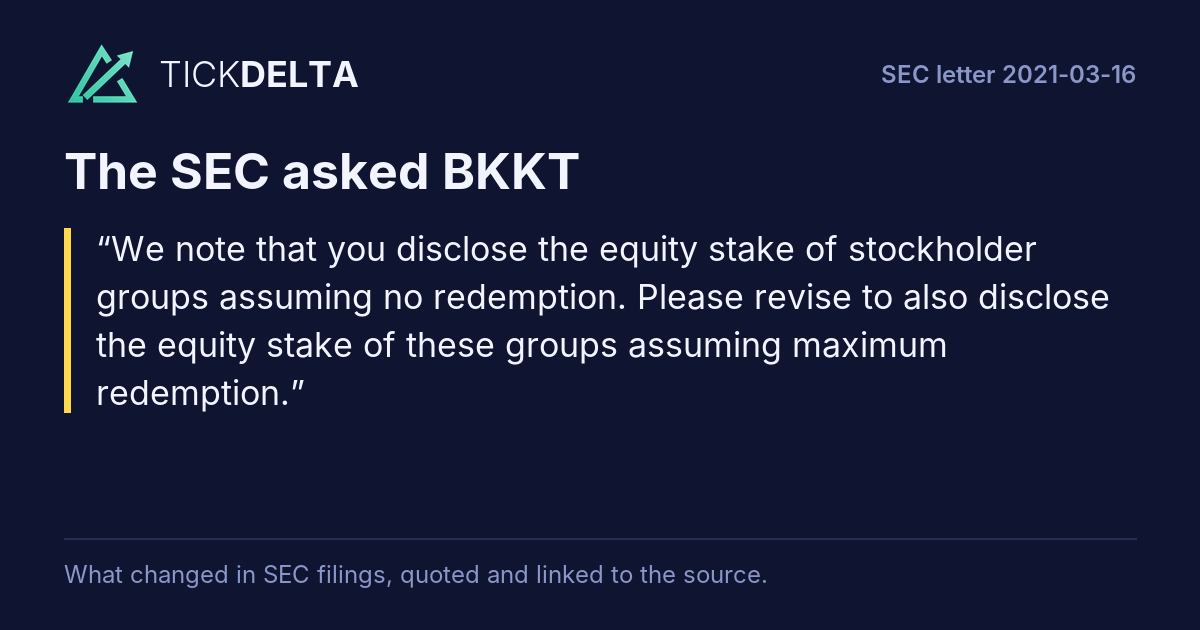
Also in this review: company letter, 2021-06-28, company letter, 2021-08-04, company letter, 2021-09-15