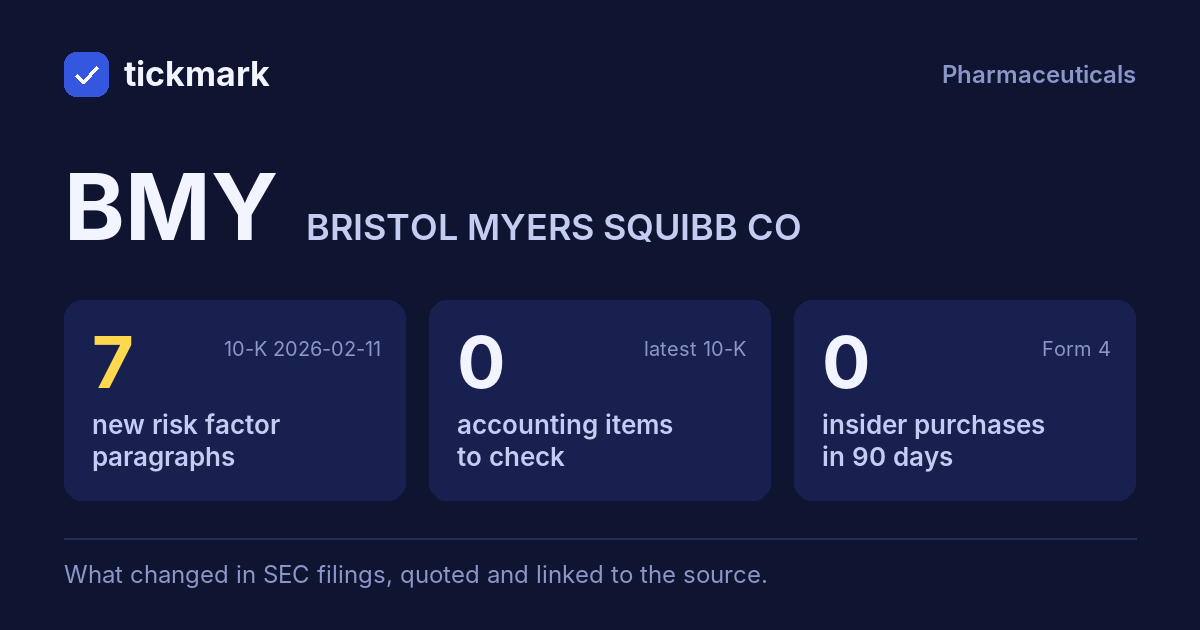
Marked against last year's 10-K:
cut words struck through, new words highlighted and underlined.
Risk Factors 280 words changed in this paragraph; it is 56% similar to last year's version.
Our product supply and related patient access has been, and could in the future be, negatively impacted by difficulties, delays and disruptions in the manufacturing, distribution and sale of our products. Some of the difficulties, delays and disruptions include: (i) product seizures or recalls or forced closings of manufacturing plants; (ii) our failure, or the failure of any of our vendors or suppliers, to comply with cGMP and other applicable regulations or quality assurance guidelines that could lead to manufacturing shutdowns, product shortages or delays in product manufacturing; (iii) manufacturing, quality assurance/quality control, supply problems or governmental approval delays; (iv) the failure of a supplier, including sole source or single source suppliers, to provide us with the necessary raw materials, supplies or finished goods within a reasonable timeframe and with required quality; (v) the failure of a third-party manufacturer to supply us with bulk active or finished product on time; (vi) construction or regulatory approval delays for new facilities or the expansion of existing facilities, including those intended to support future demand for our biologics products; (vii) the failure to meet new and emerging regulations requiring products to be tracked throughout the distribution channels using unique identifiers to verify their authenticity in the supply chain; (viii) other manufacturing or distribution issues, including limits to manufacturing capacity and changes in the types of products produced, such as biologics, physical limitations, labor disputes or shortages, or other business interruptions; (ix) geopolitical factors in a specific country or region, including any new, or changes in or interpretations of existing, trade regulations, including for example, any new tariffs imposed in the jurisdictions in which we operate, or compliance requirements of other legislation; (v) the failure of a supplier, including sole source or single source suppliers, to provide us with the necessary raw materials, supplies or finished goods within a reasonable timeframe and with required quality; (vi) the failure of a third-party manufacturer to supply us with bulk active or finished product on time; (vii) construction or regulatory approval delays for new facilities or the expansion of existing facilities, including those intended to support future demand for our biologics products; (viii) the failure to meet new and emerging regulations requiring products to be tracked throughout the distribution channels using unique identifiers to verify their authenticity in the supply chain; (ix) other manufacturing or distribution issues, including limits to manufacturing capacity and changes in the types of products produced, such as biologics, physical limitations, labor disputes or shortages, or other business interruptions; and (x) disruptions in supply chain continuity, including from market forces, natural disasters, global disease outbreaks or pandemics (including COVID-19), pandemics, acts of war or terrorism or other unforeseeable or unavoidable events that materially impact one or more of our facilities or a critical supplier.
Source: Item 1A, 10-K 0000014272-26-000004 vs Item 1A, 10-K 0000014272-25-000039
MD&A 205 words changed in this paragraph; it is 33% similar to last year's version.
In 2024, 2025, we have achieved multiple clinical and regulatory milestones approvals across our portfolio portfolio, including the: (i) approvals for approval of Breyanzi in the U.S. and Japan for adults with relapsed or refractory FL and MCL in the U.S. EU, (ii) approval of Camzyos for adults with relapsed or refractory CLL/SLL and MCL; (ii) Reblozyl's expanded the treatment of symptomatic obstructive HCM in Japan, (iii) approval to include the of Opdivo + Yervoy as a first-line treatment of adult patients with transfusion-dependent anemia due to very low, low unresectable or advanced HCC in both the U.S. and intermediate-risk MDS the EU, (iv) approval of Opdivo + Yervoy for first-line treatment of adults and pediatric patients 12 years and older with unresectable or metastatic MSI-High or dMMR colorectal cancer in the EU U.S. and Japan; (iii) FDA Japan, (v) approval of Opdivo as a perioperative regimen for resectable high risk NSCLC in the EU, (vi) approval of Opdivo Qvantig injection for subcutaneous use in most previously approved across multiple adult solid tumor Opdivo indications; (iv) FDA tumors in the EU, and (vii) approval of Opdivo Breyanzi for the treatment of adult patients adults with resectable NSCLC, relapsed or refractory MZL in combination the U.S. Additionally, we received label updates from the FDA that have reduced or removed certain patient monitoring requirements associated with platinum-doublet chemotherapy, followed by single-agent Opdivo as adjuvant treatment after surgery; the use of Camzyos, Breyanzi and (v) FDA approval and subsequent launch of Cobenfy for the treatment of schizophrenia in adults. Abecma.
Source: Item 7, 10-K 0000014272-26-000004 vs Item 7, 10-K 0000014272-25-000039
Legal Proceedings 118 words changed in this paragraph; it is 57% similar to last year's version.
In November 2024, the same entity claiming to be successor trustee filed a new lawsuit against BMS making similar allegations to the previously dismissed case and attempting to remedy its jurisdictional deficiency. The plaintiff’s new complaint also names named the current original CVR Agreement Trustee and seeks sought a judgment that plaintiff is Trustee. In January February 2025, plaintiff filed an amended complaint. In March 2025, BMS filed a motion to dismiss the amended complaint for lack of subject matter jurisdiction and failure to state a claim. In February December 2025, the court denied that motion in substantial part, finding the plaintiff to be the successor trustee, but dismissed two of the five claims asserted in the amended complaint. BMS has filed an amended complaint a motion for reconsideration or, in lieu of responding the alternative, certification for immediate appeal. In the same case, the original trustee (which also has been named a defendant) filed putative crossclaims against BMS in the event that it is later found to BMS’s be the trustee. In December 2025, BMS filed a motion to dismiss. dismiss the crossclaims for lack of subject matter jurisdiction or failure to state a claim.
Source: Item 3, via Note 20 – LEGAL PROCEEDINGS AND CONTINGENCIES, 10-K 0000014272-26-000004 vs Item 3, via Note 20 – LEGAL PROCEEDINGS AND CONTINGENCIES, 10-K 0000014272-25-000039
Accounting Policies 109 words changed in this paragraph; it is 35% similar to last year's version.
In November 2024, September 2025, the FASB issued amended guidance to refine the scope of derivative accounting and clarify the accounting for share-based noncash consideration from a customer in a revenue contract. Among other provisions, the amendment excludes from derivative accounting non-exchange-traded contracts with underlyings that are based on income statement disclosures. operations or activities specific to one of the parties in the contract. The guidance aims to provide enhanced disclosures of income expense categories to improve transparency and provide financial statement users with more detailed information about the nature, amount and timing of expenses impacting financial performance. The new amended guidance is effective for annual periods beginning after December 15, 2026 and interim periods within fiscal years beginning after December 15, 2027. those annual periods. Early adoption is permitted. The Company is assessing the potential impact of the amended standard.
Source: Item 8, Note 1 – ACCOUNTING POLICIES AND RECENTLY ISSUED ACCOUNTING STANDARDS, 10-K 0000014272-26-000004 vs Item 8, Note 1 – ACCOUNTING POLICIES AND RECENTLY ISSUED ACCOUNTING STANDARDS, 10-K 0000014272-25-000039