Form 10-K for the Fiscal Year Ended December 31, 2016
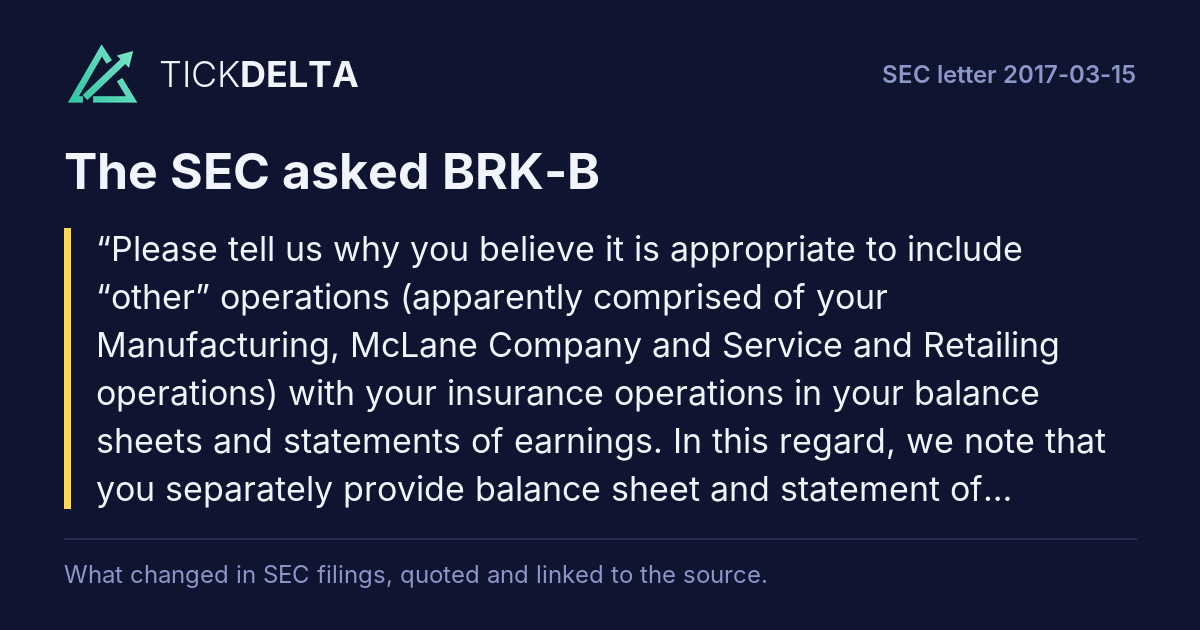
Please tell us why you believe it is appropriate to include “other” operations (apparently comprised of your Manufacturing, McLane Company and Service and Retailing operations) with your insurance operations in your balance sheets and statements of earnings. In this regard, we note that you separately provide balance sheet and statement of earnings information for what appears to be these operations in Mr.Rest of the question
Buffett’s February 25, 2017 letter to shareholders on page 14 of your 2016 Annual Report. In your response, please tell us what is different between these “other” operations and your Railroad, Utilities and Energy and Finance and Financial Products operations to cause the latter two groups to be presented separately in your basic financial statements. Reference for us the authoritative literature you rely upon to support your presentation, including an analysis of the appropriate provisions of Articles 5 and 7 of Regulation S-X.
The presentations in the consolidated balance sheets and statements of earnings in Item 8 of Form 10-K reflect the significant industry diversification of our subsidiaries, which include significant businesses that fit into Articles 5 and 7 of Regulation S-X. Among these subsidiaries are insurance, regulated utilities and railroad, and finance and financial products businesses, which each possess unique characteristics. As a result, we developed a three-tiered approach for the balance sheet and statement of earnings presentations.
We have used this tiered presentation for the past 10 years.Read in the reply ↗Rest of the answer
We believe these presentations provide a more meaningful and informative communication of our financial position and results of operations than traditional aggregate presentations. Our presentations utilize line item descriptions from Articles 5 and 7 to the extent applicable and material. Additional discussion on the unique elements in each of the three tiers follows.
Office of Healthcare and Insurance
United States Securities and
Exchange Commission
Page
Historically, the Insurance and Other businesses were weighted primarily to insurance, although that weighting has declined over the past decade, primarily due to business acquisitions. For instance, about 80% of the assets of our Insurance and Other businesses related to insurance operations at December 31, 2006 compared to about 60% at December 31, 2016. At December 31, 2016, insurance subsidiaries held approximately 90% of Insurance and Other business cash and investments. Such amount (approximately $206 billion) represented about 82% of insurance business assets. In addition, approximately 95% of our insurance business non-income tax liabilities were specifically identified in our balance sheet. Insurance businesses accounted for approximately 90% of Insurance and Other investment income and investment gains in 2016, and all underwriting-related revenues and expenses were specifically identified in the statements of earnings. Other businesses include manufacturing, service and retailing businesses, as well as the parent company. Except for the parent company, this group generally does not issue new debt.
The Railroad, Utilities and Energy businesses are regulated operations that possess material long-lived assets, and relatively significant levels of long-term debt to fund operations and capital expenditures. The debt of these entities is non-recourse to Berkshire and Berkshire regularly discloses that it does not guaranty and is not obligated to support the debt issued by the entities in this group. We believe these distinctions are important and justify the separate presentation in the consolidated balance sheets and statements of earnings.
The Finance and Financial Products businesses are currently concentrated in asset leasing
(railcars, trailers and furniture) and manufactured housing (construction and financing). We view each of these business activities as possessing significant financing elements pertaining to sizable portfolios of assets held for lease and manufactured housing installment loans. This group includes a wholly-owned financing subsidiary that provides funding to support the leasing business and the lending activities of the manufactured housing business. We believe this distinction is important and justifies the separate presentation in the consolidated balance sheets and statements of earnings.
To summarize, we believe that our consolidated balance sheet and statement of earnings presentations are informative and reasonable given our significant diversification and the unique characteristics of certain of our businesses. We also believe our existing balance sheet and statement of earnings formats comply with Regulation S-X. Were more traditional presentations used, we would eliminate or combine several identical or similar captions, which would condense the presentations, but we believe would reduce transparency. We also believe that traditional presentations would result in no new line items presented compared to our current three-tier presentations.
First report after the company's reply of 2017-04-14: 10-Q filed 2017-05-05 ↗.
No earlier 10-Q before the SEC's letter is in Tickdelta, so there is nothing to compare with.
Please tell us why it is appropriate to present your investments in U.S. Treasury Bills in a subtotal along with your cash and cash equivalents instead of classifying these investments as fixed maturity securities. Tell us how your presentation complies with Rules 7-03(a)1 and 7-03(a)2 of Regulation S-X and why you do not classify U.S. Treasury Bills as debt securities as defined in ASC 320-10-20.Rest of the question
Reference for us the authoritative literature you relied upon to support your presentation.
U.S. Treasury Bills are highly liquid and in our view the safest alternative available for cash management purposes. The maximum maturity of U.S. Treasury Bills is 52 weeks and therefore these investments present minimal risk from interest rate changes.
Our balance sheet caption “U.S. Treasury Bills” includes U.S. Treasury Bills that were in excess of three months and within a year of maturity at the time of their acquisition.Read in the reply ↗Rest of the answer
Accordingly, we believe these holdings meet the definition of short-term investments under Rule 7-03(a)1(g)—Short-term investments, as clarified by Note 4 to the Rule, which indicates that such investments mature within one year. In addition, Rule 7-03(a)1(a), as clarified by Note 2 to the Rule, indicates that fixed maturity securities have maturities beyond one year. Our presentation of such holdings as a separate line item also reflects the significant concentration of our holdings as of December 31, 2016, which we believe is meaningful and relevant to financial statement users.
First report after the company's reply of 2017-04-14: 10-Q filed 2017-05-05 ↗.
No earlier 10-Q before the SEC's letter is in Tickdelta, so there is nothing to compare with.
Please tell us why you do not present sales revenues and service revenues on separate lines as stipulated in Rule 5-03(b)1 of Regulation S-X.
We concluded that service revenues were not significant in each period presented for purposes of separate disclosure in the consolidated statements of earnings. Rule 5-03(b) also provides that income under Rule 5-03(b)1, which is not more than 10% of the sum of the items may be combined with another class. Consolidated service revenues (including rental income) were less than 5% of gross revenues in each of the past three years.Read in the reply ↗Rest of the answer
We intend to continue monitoring service revenue levels and, if significant, agree to present such amounts separately in the consolidated statement of earnings.
A summary of service revenues follows (dollars in millions):
2016
2015
2014
Insurance and Other
$
7,260
6,273
5,517
Finance and Financial Products (1)
3,240
3,053
2,907
Total service revenues
10,500
9,326
8,424
Total revenues
223,604
210,943
194,699
Percentage of service to total revenues
4.7
%
4.4
4.3
(1) Includes rental income of equipment and furniture leasing businesses.
First report after the company's reply of 2017-04-14: 10-Q filed 2017-05-05 ↗.
No earlier 10-Q before the SEC's letter is in Tickdelta, so there is nothing to compare with.
Please tell us how you account for your warrants to purchase 700 million shares of Bank of America common stock and reference for us the authoritative literature you rely upon to support your accounting. In your response tell us the fair value and cost of the warrants depicted in the table on this page and how you determined each amount.Rest of the question
Also reconcile the cost and fair value to the apparent $10.5 billion intrinsic value inherent in the warrants as disclosed in Mr. Buffett’s February 25, 2017 letter to shareholders on page 19 of your 2016 Annual Report and explain why the fair value of all your other investments is not at least $10.5 billion greater than their cost.
In 2011, we acquired Bank of America perpetual preferred stock with a liquidation value of $5 billion and common stock warrants to acquire 700 million shares of Bank of America common stock. The preferred stock is callable by Bank of America beginning in May 2019. The warrants expire in 2021. We may exercise the warrants by paying $5 billion in cash or we may use the preferred stock as consideration for the cost of the warrant shares. The warrants are legally detached from the preferred stock and are exercisable separately.Read in the reply ↗Rest of the answer
The preferred stock may be called by Bank of America without affecting the warrants.
In determining the applicable accounting for the warrants, we evaluated their terms and conditions and concluded they were freestanding financial instruments for accounting purposes based on the definition in ASC 480-10. The warrants can only be settled by physical delivery of shares and cannot be effectively net settled. Accordingly, the warrants did not meet the definition of a derivative under ASC 815-10-15-83, as one of the three criteria in that definition, the ability to net settle the contract, was not met. Therefore, we concluded the warrants were equity securities and we applied the guidance in ASC 944-325, which provides that equity securities are carried at fair value with the unrealized gains and losses reflected in other comprehensive income.
Since their acquisition, we have estimated the fair value of the warrants utilizing a warrant valuation model which has many of the same inputs as a call option valuation model. The warrant model also considers the potential dilution of the value of existing common stock upon exercising the warrants. As of
December 31, 2016, the common stock to be received upon the exercise of the warrants represented about 6.5% of the outstanding shares of Bank of America common stock on a diluted basis. Further, under the terms of our related investment agreement with Bank of America, we cannot enter into hedging transactions with respect to either the warrants or the common shares issuable upon exercise. Our valuation model includes a valuation discount for these restrictions.
The intrinsic value referred to in the Chairman’s letter represents the fair value of the underlying common stock at
December 31, 2016 reduced by the $5 billion exercise price. It does not include adjustments for potential stock price volatility, time value or certain other inputs used in the warrant valuation model.
The aggregate cost of the Bank of America investments was $5 billion, of which we allocated $4 billion to the preferred stock and $1 billion to the warrants based on our evaluation of the fair values at the acquisition date. At December 31, 2016, the estimated fair value of the warrants reflected in Note 5 to the consolidated financial statements was $9,597 million, which was $873 million less than the intrinsic value at December 31, 2016. The difference was primarily due to the impact of potential common stock price dilution upon exercise and valuation discount attributable to the contractual restrictions that prohibit us from entering into hedging transactions. As of December 31, 2016, the estimated fair value of the preferred stock was $4,862 million and, thus, the aggregate estimated fair value of the preferred stock and warrants was $14,459 million.
First report after the company's reply of 2017-04-14: 10-Q filed 2017-05-05 ↗.
No earlier 10-Q before the SEC's letter is in Tickdelta, so there is nothing to compare with.
Please tell us the types of contracts included in each of your General Re, BHRG and BH Primary claims development tables and explain how you determined your disclosures do not obscure useful information by aggregating contracts that have significantly different characteristics.Rest of the question
In addition, specifically address the following in your response: Tell us why the General Re claims development table includes workers’ compensation coverage when the disclosure beginning on page 3 does not appear to indicate that General Re writes this coverage. Confirm that the health reinsurance portion of General Re’s life/health reinsurance business is included in its claims development table and that the life portion is excluded. If this is not true, tell us why. Tell us how workers’ compensation, medical professional and commercial auto coverages in your BH Primary table have similar characteristics. Refer to ASC 944-40-50-4H.
Note 14 to the consolidated financial statements reflects a significant expansion of disclosures related to unpaid losses and loss adjustment expenses, and includes disaggregated accident year incurred and paid loss and allocated loss adjustment expenses (“ALAE”) information for certain business categories. The information in Note 14 relates to amounts reported in the consolidated balance sheets as losses and loss adjustment expenses and on amounts reported in the consolidated statements of earnings as insurance losses and loss adjustment expenses.Read in the reply ↗Rest of the answer
The amounts reported under these captions derive from property and casualty insurance and reinsurance contracts.
Our property and casualty insurance and reinsurance contracts include various lines of business or coverage, which are considered short-duration contracts under ASC 944. The caption “property and casualty” is consistent with the U.S. statutory reporting by property and casualty insurance companies and the format of the accident year data required by ASC 944-40-50 was based on schedules provided by U.S. property and casualty insurance companies to their regulators. In describing General Re’s business in Item 1 of Form 10-K, “property and casualty” was used merely to distinguish that business from life and health business. We consider workers’ compensation insurance as a form of casualty insurance.
In determining the level of disaggregated disclosures under ASC 944-40-50, we considered the guidance provided under ASC
944-40-55-9B and ASC 944-40-55-9C. The disaggregation of our business is consistent with our presentations for segment reporting in Note 23 to the consolidated financial statements, and with the presentations in Management’s Discussion and
Analysis with respect to underwriting results and critical accounting policies regarding unpaid losses and loss adjustment expenses. In our view, maintaining consistency with segment and management’s discussion presentations was important, particularly in the first year of the new disclosure requirements.
We provided disaggregated disclosures for General Re and BHRG, as each was disclosed separately in our segment note. However, there is overlap between these groups relative to the types of business written, processes and management. General Re and BHRG are primarily engaged in reinsurance and the types of contracts are similar. BHRG and General Re reinsure property and casualty risks. Coverages are provided under excess-of-loss and quota-share contracts and the risks assumed can be on a facultative or treaty basis. Under certain contracts, the coverage can apply to multiple lines of business written by the ceding company, whether property, casualty or combined, and the ceding company may not report loss data by line of business consistently, if at all. Further, line of business classifications used in non-U.S. jurisdictions may not be consistent with those in the U.S. In those instances, we allocate losses to coverage based on internal estimates, which may be broadly limited to property or casualty.
As of December 31, 2016, General Re’s and BHRG’s net unpaid losses and ALAE were primarily attributable to casualty coverages. General Re’s net unpaid losses and ALAE attributable to casualty coverages were about 85% of its $14.0 billion total, while BHRG’s liabilities attributable to casualty coverages were about 55% of its $10.2 billion total. We recognize that property claims usually have a shorter claim-tail than casualty claims. However, in our judgment, further disaggregation by line of business or contract type would not be as meaningful or useful to financial statement users as our disclosed aggregate information in understanding the potential uncertainty in the timing and amount of General Re’s and BHRG’s cash flows arising from unpaid losses and loss adjustment expenses.
All claim liabilities arising from life and health insurance contracts were included in life, annuity and health insurance benefits in our consolidated balance sheets. Such amounts are not included in the disclosures in Note 14. Depending on a contract’s terms, health insurance can be either a long-duration or short-duration contract under ASC 944. General
Re’s health insurance claim liabilities from short-duration contracts at December 31, 2016 were less than $350 million. We concluded such amounts were immaterial in relation to consolidated unpaid losses and loss adjustment expenses and did not include these liabilities in General Re’s claim development tables.
BH Primary operates a large number of distinct operations that offer a wide variety of insurance contracts primarily to commercial customers. At December 31, 2016, net unpaid losses and ALAE of such operations were approximately $10.2 billion or approximately 14% of our consolidated net unpaid losses and ALAE, including retroactive reinsurance. The most significant types of contracts relate to workers’ compensation, medical professional and other liability (general and commercial auto). At December 31,
2016, the largest component of BH Primary’s net liabilities was medical professional, which was $3.7 billion, representing approximately 35% of BH Primary’s total net unpaid losses and ALAE and approximately 5% of our consolidated net unpaid losses and ALAE, including retroactive reinsurance. Claim-tails can be long in all three categories of business cited. As a result, we concluded that as of December 31, 2016, further disaggregation would not be useful in understanding the potential uncertainty in the timing and amount of BH Primary’s cash flows arising from unpaid losses and loss adjustment expenses.
First report after the company's reply of 2017-04-14: 10-Q filed 2017-05-05 ↗.
No earlier 10-Q before the SEC's letter is in Tickdelta, so there is nothing to compare with.
Please tell us why the net unpaid losses and allocated loss adjustment expenses for accident years before the oldest year presented in each of your claims development tables is unaudited. ASC 944-40-50-4B identifies all periods presented in the disclosure about claims development that precede the most recent reporting period as supplementary information.Rest of the question
However, the aggregate remaining liability for unpaid losses and allocated loss adjustment expenses for accident years prior to the oldest year presented must be audited as it is necessary to reconcile the ending obligation in each claims development table to the liability on the ending balance sheet.
We did not believe ASC 944-40-50 was clear on this matter and, after consulting with our auditors, interpreted it to mean that the information that preceded the earliest year presented was supplemental. However, we acknowledge that net unpaid losses and ALAE was audited. We also acknowledge that net unpaid losses and ALAE derived from the cumulative accident year incurred and paid losses and ALAE were also audited. Therefore, the difference representing earlier accident years was audited.Read in the reply ↗Rest of the answer
In future filings, net unpaid losses for accident years before the earliest year presented will not be described as unaudited supplemental information.
First report after the company's reply of 2017-04-14: 10-Q filed 2017-05-05 ↗.
No earlier 10-Q before the SEC's letter is in Tickdelta, so there is nothing to compare with.
Please represent to us that you will revise future earnings releases furnished under Item 2.02 of Form 8-K to: Reorder your non-GAAP reconciliation to start with net earnings attributable to Berkshire shareholders and reconcile to “operating earnings;” and Separately present the income tax effect of your non-GAAP adjustments.Rest of the question
For more guidance, refer to Questions 102.10 and 102.11 of the Compliance and Disclosure Interpretations for Non-GAAP Financial Measures revised on May 17, 2016.
We will revise future earnings releases to start with net earnings attributable to Berkshire shareholders and reconcile to operating earnings. We will separately present the income tax effect of non-GAAP adjustments. Read in the reply ↗
First report after the company's reply of 2017-04-14: 10-Q filed 2017-05-05 ↗.
No earlier 10-Q before the SEC's letter is in Tickdelta, so there is nothing to compare with.
In your response to prior comment 2 you acknowledge that your investments in U.S. Treasury Bills are short-term investments under Rule 7-03(a)1(g) of Regulation S-X. We note that the classification as investments is also consistent with the definition of debt securities in ASC 320-10-20. Under Rules 7-03(a)1 and 7-03(a)2 of Regulation S-X investments are to be presented separately from cash.Rest of the question
Please represent to us that in future filings you will present your investments in U.S. Treasury Bills as short-term investments included with your other investments and not with your cash and cash equivalents. In this regard, you are not precluded from highlighting the nature of these short-term investments in a liquidity discussion in Management’s Discussion and Analysis. This comment also applies to the presentation in the Finance and Financial Products section of your balance sheet as Rules 5-02.1 and 5-02.2 of Regulation S-X do not contemplate a subtotal combining marketable securities with cash.
We acknowledge that listing short-term investments under an investment heading in the Consolidated Balance Sheets is a strict application of Regulation S-X Rule 210.7-03(a)1. As stated in our prior response dated April 14, 2017, our consolidated financial statements include significant businesses that fit into Articles 5 and 7 of Regulation S-X. We also note that, as stated at the beginning of Articles 5 and 7 of Regulation S-X, the captions described in the Rules should appear on the face of the statements or notes, except as otherwise permitted by the Commission.
Our
U.S.Read in the reply ↗Rest of the answer
Treasury Bill investments were not included in cash and cash equivalents. We believe that the presentation of U.S. Treasury Bills between cash and cash equivalents and other investments is logical, given their short-durations, and that they are readily convertible to known amounts of cash and possess an insignificant risk of changes in values due to changes in interest rates. We described that position as U.S. Treasury Bills to illustrate the concentration of the asset position.
We believe our presentations were clear, meaningful and relevant given the magnitude of the balances. Nevertheless, in future filings, investments in short-term U.S. Treasury Bills will not be shown under a heading with cash and cash equivalents. To illustrate, our December 31, 2016 and 2015 Consolidated Balance Sheets with the proposed presentations follow.
Ms. Sharon M. Blume, Accounting Branch Chief
United States Securities and
Exchange Commission
Page and Subsidiaries
CONSOLIDATED BALANCE SHEETS
(dollars in millions)
December 31,
2016
2015
ASSETS
Insurance and Other:
Cash and cash equivalents
$
23,581
56,612
Short-term investments in U.S. Treasury Bills
47,338
4,569
Investments in fixed maturity securities
23,432
25,988
Investments in equity securities
120,471
110,527
Other investments
14,364
15,683
Investments in The Kraft Heinz Company (Fair Value: 2016 – $28,418, 2015 –
$32,042)
15,345
23,424
Receivables
27,097
23,303
Inventories
15,727
11,916
Property, plant and equipment
19,325
15,540
Goodwill
53,994
37,188
Other intangible assets
33,481
9,148
Deferred charges reinsurance assumed
8,047
7,687
Other
7,126
6,697
409,328
348,282
Railroad, Utilities and Energy:
3,939
3,437
123,759
120,279
24,111
24,178
Regulatory assets
4,457
4,285
13,550
12,833
169,816
165,012
Finance and Financial Products:
First report after the company's reply of 2017-06-02: 10-Q filed 2017-08-04 ↗.
No earlier 10-Q before the SEC's letter is in Tickdelta, so there is nothing to compare with.
We acknowledge your response to prior comment 4. Please tell us why your warrants to purchase 700 million shares of Bank of America common stock cannot effectively be net settled and therefore do not qualify for derivative accounting.Rest of the question
In this regard, it appears from the warrant agreement included as Annex B to the Securities Purchase Agreement filed as Exhibit 1.1 to Bank of America’s Form 8-K filed on August 25, 2011, that you may exercise the warrant in whole or in part. Since Bank of America common stock is exchange traded and the smallest warrant exercise amount appears to be a single share, it appears that the underlying common stock is readily convertible into cash and that the warrants meet the net settlement criterion as outlined in Case A of Example 7 at ASC 815-10-55-99.
The determination of whether the shares of common stock received upon the exercise of the warrants are readily convertible to cash under ASC 815-10-15-119 requires analysis and judgment. That section provides that if the asset delivered is readily convertible to cash, then it can result in the net settlement criteria being met.Read in the reply ↗Rest of the answer
ASC 815-10-15-131 also provides that
“shares of stock in a publicly traded entity to be received upon the exercise of a stock purchase warrant do not meet the characteristic of being readily convertible to cash if both of the following conditions exist: (a) the stock purchase warrant is issued by an entity only for its own stock (or stock of its consolidated subsidiaries) and (b) the sale or transfer of the issued shares is restricted (other than in connection with being pledged as collateral) for a period of 32 or more days from the date the stock purchase warrant is exercised.” Based on these provisions, the ability to readily convert the instrument to cash can be precluded if there are significant restrictions to the ability to exercise, sell or dispose of the instrument.
While the warrants may be converted in whole or in part, as described in Annex B (Form of
Warrant) of the Securities Purchase Agreement, we also considered Article IV of the Securities Purchase Agreement and Annex C (Form of Registration Rights Agreement) to the Securities Purchase Agreement. Article IV provides that the warrants are exercisable only into the stock of the issuer (Bank of America), and the shares received upon exercising the warrants will not be registered under the Securities Act of 1933 (“Act”) when issued, and may not be transferred, except under
Rule 144 or under an exemption from registration under the Act. We believe that the sale under Rule 144 or under a registration exemption significantly restricts our ability to readily convert the shares of common stock received upon exercising of the warrants to cash.
Berkshire possesses registration rights pursuant to a Registration Rights Agreement under Annex C to the Securities Purchase Agreement. Those rights allow Berkshire to request that Bank of America register the shares issued upon exercise of the warrants on a best efforts basis. However, that request may only be made after the warrants are exercised and the common shares are issued. Also, while Bank of America is required to use its best efforts to file a registration statement for resale of shares issued upon exercise of the warrants, it has up to 45 days to file a registration statement. In addition, Berkshire is limited to three “demand registration” requests and one “shelf registration” request, which must each occur at least six months apart. The value of common shares to be registered must be in increments of at least $1 billion. Further, the issuer may further delay the registration of the shares under other conditions, as provided in the Registration Rights Agreement.
We believe the restrictions/delays under Article IV and Annex C of the Securities Purchase Agreement significantly impede
Berkshire’s ability to readily convert the warrants and the common stock received upon the exercise of the warrants to cash. We, therefore, believe the warrants are not readily convertible to cash based on ASC 815-10-15-119 and that the warrants do not meet the net settlement requirement in paragraph ASC 815-10-15-83 c. Accordingly, we concluded that the warrants did not meet the definition of a derivative.
First report after the company's reply of 2017-06-02: 10-Q filed 2017-08-04 ↗.
No earlier 10-Q before the SEC's letter is in Tickdelta, so there is nothing to compare with.
We acknowledge your response to prior comment 5. Please elaborate on your conclusion for each of your General Re, BHRG and BH Primary claims development tables that you believe that further disaggregation (either by line of business, contract type or claims settlement tail) would not be as meaningful or useful to users of your financial statements as your disclosed aggregate information in understanding potentialRest of the question
uncertainty in the timing and amount of cash flows from claims. In your response, specifically address the following: Tell us your consideration for including the development of loss reserve estimates in your conclusion, consistent with the basic principle outlined in paragraph BC2 of ASU 2015-09. Provide us the information that would be provided in the separate tables by material line of business for each of these segments, if available. Provide us the information that would be provided in the separate tables for short-tail business versus long-tail business for your BHRG segment, if available. If the information requested in the preceding two bullets is not available, demonstrate to us otherwise that material differing development trends by line of business and/or settlement tail are not obscured by aggregating differing lines of business. In other words, tell us whether material favorable development trends in some lines of business are offset by material unfavorable development trends in other lines of business within your currently presented tables.
In determining the level of detail to include in our Consolidated Financial Statements, we considered the disclosure objectives discussed in BC2 of ASU 2015-09 and ASC
944-40-50-4H. As indicated in BC2, the primary objectives are to increase transparency into the estimation process, improve comparability by requiring consistent disclosure of information, and provide information on the timing, amount and uncertainty of cash flows.Read in the reply ↗Rest of the answer
As further indicated in BC2, “there is no method to objectively measure the costs to implement the new guidance or the value of improved information in the financial statements.”
We operate a wide variety of property and casualty insurance and reinsurance businesses that offer a wide variety of contracts and coverages. For certain of those businesses, particularly reinsurance, the mix of contracts and coverages can vary widely from year to year and over time based upon changes in prevailing market conditions and underwriting opportunities. As a result, we believe selecting lines of business or contract types that are likely to be significant over time for purposes of these disclosures can be difficult, given the current level of diversification and business levels within General Re, BHRG and BH Primary.
As noted in BC33 of ASU
2015-09, the guidance does not prescribe any specific factor to be used as the basis for disaggregating the disclosures. Rather, it provides flexibility for preparers to consider different approaches. It also provides principal-based guidance and examples concerning approaches to disaggregation. We elected to disaggregate our consolidated loss and loss adjustment expense liabilities based upon our four reportable insurance underwriting segments consistent with one of the examples provided in
ASC 944-40-55-9C. As discussed in ASC 944-40-55-9B and as noted in our response dated April 14, 2017, we considered how insurance liabilities for unpaid losses and loss adjustment expenses were presented for other purposes.
The level of disaggregation is ultimately a matter of judgment based on the facts and circumstances. We continue to believe that the disaggregated disclosures included in our Consolidated Financial Statements were meaningful and reasonable under the circumstances.
The following table summarizes our consolidated liability for unpaid losses and loss adjustment expenses as of December 31, 2016. Dollars are in millions.
December 31, 2016
Percentage of consolidated unpaid losses and loss adjustment expenses
Unpaid losses and ALAE, net of reinsurance recoverable:
GEICO
12,981
16.9
%
General Re (18.2% of consolidated liabilities):
Property
1,917
2.5
Casualty
12,056
15.7
BHRG (13.2% of consolidated liabilities):
4,555
5.9
5,617
7.3
BH Primary (13.2% of consolidated liabilities):
Medical professional liability
3,713
4.8
Workers’ compensation
3,357
4.4
All other property and casualty lines
3,103
4.0
47,299
61.5
Reinsurance recoverable:
1,084
1.4
General Re
611
0.8
BHRG
121
0.2
BH Primary
1,099
2,915
3.8
Retroactive reinsurance, unpaid losses and loss adjustment expenses
24,675
32.1
Other short-duration insurance, unpaid losses and loss adjustment expenses
1,390
1.8
Discount on workers’ compensation reinsurance liabilities
(1,433
)
(1.9
)%
Unpaid unallocated loss adjustment expenses
2,072
2.7
26,704
34.7
Unpaid losses and loss adjustment expenses
76,918
100.0
With respect to the unpaid losses and ALAE of General Re, BHRG and BH Primary, and using 10% of consolidated unpaid losses and loss adjustment expenses as a measure of materiality, only General Re’s casualty liabilities meet that threshold. It should also be noted that while GEICO’s unpaid losses and ALAE represented 16.9% of consolidated unpaid losses and loss adjustment expenses, GEICO’s losses and loss adjustment expenses incurred in 2016, 2015 and 2014 were approximately 68%, 70% and 60%, respectively, of Berkshire’s consolidated losses and loss adjustment expenses incurred in those years. As disclosed in Note 14 to the Consolidated Financial Statements, a substantial portion of GEICO’s claims over the past several accident years were paid within five years of the occurrence.
In the pages that follow, we are providing further disaggregated net losses and ALAE data for
General Re, BHRG and BH Primary in response to the Commission’s request. With respect to General Re and BHRG, the disaggregated data is based on losses that are expected to have short-tails (described as property) and those expected to have long-tails (described as casualty). The processes and methods used by BHRG and General Re in estimating losses are similar. General Re’s net unpaid property losses and ALAE were approximately 2.5% of our consolidated unpaid losses and loss adjustment expenses as of December 31, 2016. Accordingly, such liabilities could be considered immaterial for separate disclosure purposes.
As stated in our prior response dated April 14, 2017, BHRG and General Re reinsure property and casualty risks. Coverages are provided under excess-of-loss and quota-share contracts and the risks assumed can be on a facultative or treaty basis. Under certain contracts, the coverage can apply to multiple lines of business written by the ceding company, whether property, casualty or combined, and the ceding company may not report loss data by line of business consistently, if at all. Further, line of business classifications used in non-U.S. jurisdictions may not be consistent with those in the U.S. In those instances, we allocate losses to coverage based on internal estimates, which may be broadly limited to property or casualty.
With respect to BH Primary, we are providing disaggregated data for medical professional liability and workers’ compensation lines of business. As of December 31, 2016, these were BH Primary’s two largest individual lines of business in terms of unpaid losses and ALAE. The actuarial processes and methods used in estimating medical professional liability and workers’ compensation losses are similar. BH Primary’s “all other” net unpaid losses and ALAE ($3,103 million or 4% of our consolidated unpaid losses and loss adjustment expenses) were attributable to various lines of business, including commercial auto, other liability and various other property and casualty coverages. We believe that such net unpaid losses and ALAE are immaterial for purposes of disaggregated disclosures.
In applying disclosure guidance under ASC 944-40-50, we believe companies are compelled to re-evaluate disaggregated disclosures each year due to changes in facts and circumstances, which may result in changes to the disaggregated components. For instance, significant business acquisitions or reinsurance transactions during the period may result in significant changes in the composition of unpaid losses and loss adjustment expenses, which may result in new or expanded disclosures for categories that become significant or the reduction or elimination of disclosures for categories that are no longer significant. We will re-evaluate our disclosures in 2017 and consider the effects of significant business acquisitions and reinsurance transactions occurring during the year as well as other changes in our businesses and will make appropriate modifications to our disaggregated disclosures.
General Re – Property
Accident Year
Incurred Losses and ALAE through December 31,
IBNR and Case
Development
Liabilities
2007
2008
2009
2010
2011
2012
2013
2014
900
938
866
847
836
829
822
819
821
1,032
1,075
1,027
1,007
974
958
942
935
934
820
858
803
765
746
740
736
733
1,015
1,121
1,065
1,022
964
956
1,228
1,179
1,070
1,019
977
963
917
853
755
718
702
1,060
1,078
1,012
967
768
767
728
870
875
141
783
387
Incurred losses and ALAE
8,462
Cumulative Paid Losses and ALAE through December 31,
219
627
729
762
776
805
807
811
277
724
826
876
898
907
909
910
913
213
554
658
695
704
709
712
714
195
589
813
860
890
248
664
824
856
869
881
143
493
585
595
615
218
635
784
825
116
455
558
163
495
120
Paid losses and ALAE
6,842
Net unpaid losses and ALAE for 2007—2016 accident years
1,620
Net unpaid losses and ALAE for accident years before
297
Net unpaid losses and ALAE
General Re – Casualty
957
952
880
745
737
716
691
888
936
772
727
713
701
883
932
901
777
750
735
698
117
874
823
748
135
947
827
773
706
152
893
997
885
833
295
1,017
982
887
360
972
1,076
1,066
500
941
1,124
636
786
8,356
194
291
370
419
486
504
515
524
170
311
348
382
406
420
441
180
239
299
361
433
447
193
261
334
383
414
449
177
262
390
436
171
244
321
376
276
337
211
306
198
3,565
4,791
7,265
Supplemental average historical claims duration information based on General Re’s net losses and ALAE incurred and paid accident year data follows.
Average Annual Percentage Payout of Incurred Losses by Age, Net of Reinsurance
In Years
General Re Combined
14.8%
31.0%
12.2%
6.8%
4.6%
3.2%
2.6%
1.1%
1.2%
0.9%
General Re Property
22.4%
45.1%
14.0%
4.5%
2.4%
1.4%
1.3%
0.1%
0.3%
0.5%
General Re Casualty
6.7%
16.5%
10.3%
9.4%
7.1%
5.5%
4.2%
2.2%
2.3%
BHRG – Property
812
666
659
602
563
555
553
551
1,944
1,592
1,696
1,427
1,369
1,429
1,399
1,373
1,367
1,520
1,154
1,404
1,365
1,288
1,268
1,231
1,483
1,568
1,502
1,354
1,328
1,319
2,712
2,708
2,544
2,513
2,554
2,537
2,190
1,955
1,851
1,649
1,612
2,079
1,904
1,629
1,585
1,828
1,641
1,570
2,343
2,195
2,444
1,355
16,408
343
467
512
532
537
544
545
548
546
182
692
1,138
1,219
1,256
1,290
1,344
1,353
183
538
1,062
1,120
1,186
1,215
1,223
134
567
1,081
1,194
1,254
320
1,480
1,948
2,184
2,280
2,350
111
1,198
1,325
1,393
287
756
1,040
1,193
346
999
401
579
11,968
4,440
115
BHRG – Casualty
998
1,008
993
1,025
988
1,020
1,005
920
131
1,444
1,538
1,292
1,476
1,466
1,284
1,232
1,211
241
1,454
1,704
1,561
1,559
1,491
1,460
1,440
214
1,406
1,247
1,706
1,836
1,814
1,927
1,835
393
1,864
1,923
1,797
1,934
1,919
601
1,240
1,306
494
944
922
415
864
363
946
552
12,540
139
424
481
523
583
626
651
663
675
454
757
800
841
861
189
644
669
1,140
322
655
923
232
650
924
1,131
1,195
1,250
249
566
882
1,126
229
314
581
254
149
199
7,365
5,175
442
Supplemental average historical claims duration information based on BHRG’s net losses and ALAE incurred and paid accident year data follows.
BHRG Combined
14.7%
28.2%
17.2%
6.3%
3.9%
1.9%
1.0%
0.7%
BHRG Property
14.6%
36.3%
22.2%
10.6%
5.2%
2.7%
1.6%
0.6%
(0.4)%
BHRG Casualty
19.4%
12.7%
8.1%
7.4%
4.8%
2.5%
BH Primary – Medical Professional Liability
IBNR and
Case
Cumulative
Number of
Reported
Claims
(in thousands)
653
637
617
428
394
331
315
671
620
580
488
438
404
373
350
694
665
608
437
403
685
639
571
505
462
693
647
147
680
599
227
312
793
791
769
928
886
6,004
153
237
289
294
148
200
279
307
(6
First report after the company's reply of 2017-06-02: 10-Q filed 2017-08-04 ↗.
No earlier 10-Q before the SEC's letter is in Tickdelta, so there is nothing to compare with.
Also in this review: request for more time, 2017-03-17, request for more time, 2017-05-15, closing letter, 2017-06-29