Form 20-F
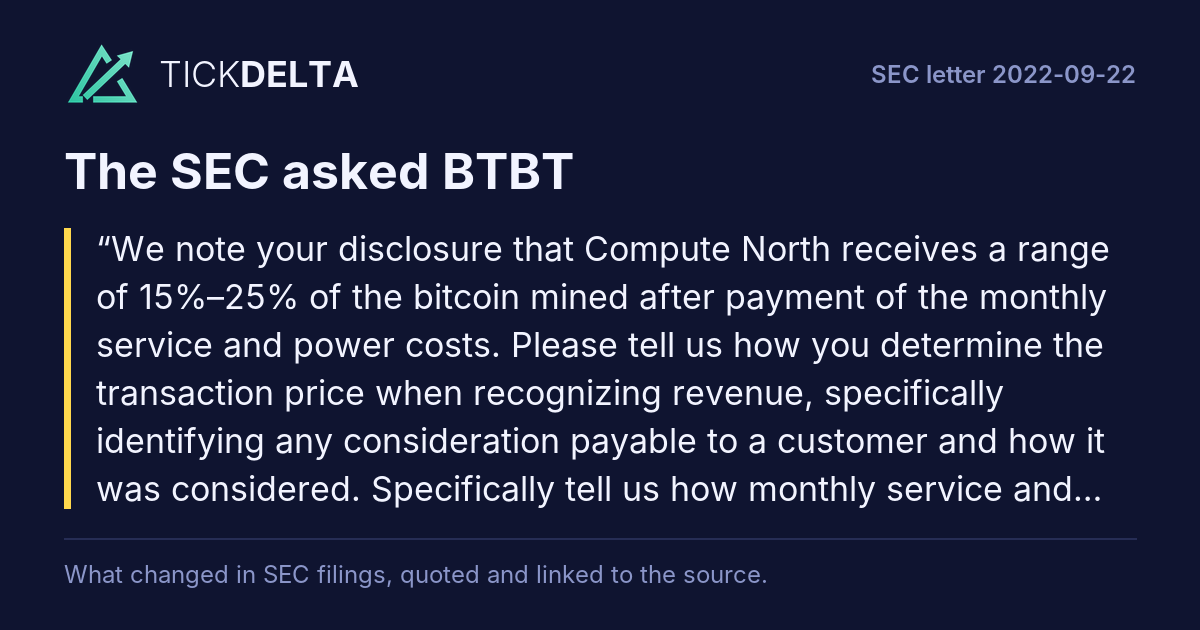
We note your disclosure that Compute North receives a range of 15%–25% of the bitcoin mined after payment of the monthly service and power costs. Please tell us how you determine the transaction price when recognizing revenue, specifically identifying any consideration payable to a customer and how it was considered.Rest of the question
Specifically tell us how monthly service and power costs and the portion of digital assets that Compute North receives are considered in determining the transaction price and/or are considered in determining costs of revenue. Please tell us the accounting guidance you considered in making your determination.
Pursuant to agreements with Compute North, Compute North provides digital asset mining facilities and IT consulting, maintenance and repair work on site for us. In accordance with ASC 606-10-15-3, Compute North is not a customer to the Company.
The
Company acts as a digital asset mining company and provides computing power to the digital asset mining pool.Read in the reply ↗Rest of the answer
In return, the Company receives consideration in the form of digital assets, the value of which is determined using the market price of the related digital asset at the time of receipt.
Currently, the Company participates only in the Foundry USA Pool (“Foundry”) mining pool. Foundry provides the Company with a digital asset mining pool and ancillary services and products. The mining of digital assets in exchange for consideration involves the delivery of computing power which is an output of the Company’s ordinary business activities. The Company has concluded that the mining pool operator, rather than Compute North (or any other host) would be considered a “customer” per the definition of “customer” in ASC Master Glossary - a party that has contracted with an entity to obtain goods or services that are an output of the entity’s ordinary activities in exchange for consideration.
Division of Corporation Finance
U.S. Securities and Exchange Commission
November 28, 2022
Page
Company recognizes revenue under ASC 606, Revenue from Contracts with Customers. The transaction price is the amount of consideration to which an entity expects to be entitled in exchange for transferring promised goods or services to a customer. The consideration promised in a contract with a customer may include fixed amounts, variable amounts, or both. When determining the transaction price, an entity must consider the effects of all of the following:
● Variable consideration
● Constraining estimates of variable consideration
● The existence of a significant financing component in the contract
● Noncash
● Consideration payable to a customer
In accordance with ASC 606-10-32-6, … The promised consideration also can vary if an entity’s entitlement to the consideration is contingent on the occurrence or nonoccurrence of a future event. In exchange for providing computing power, the Company is entitled to a fractional share of the fixed digital asset rewards the mining pool operator receives, for successfully adding a block to the blockchain.
The Company’s fractional share of the pool’s aggregate rewards may vary. Thus, the Company has determined that the non-cash consideration received is variable.
When the Company considers whether any consideration is payable to our customer, Foundry, the Company considered ASC 606-10-32-25. Foundry has not charged the Company a fee for its services due to the fact of the Company being an early strategic customer of Foundry and in view of competition. While Foundry has orally advised the Company that it has no present intention to charge fees to the Pool participants, it may do so in the future.
As stated above, the consideration received by the Company is variable. Likewise, the number of digital assets mined by the miners hosted by Compute North is variable. The monthly service, power costs and profit sharing charge are not used in determining the variable consideration.
Company’s cost of revenue to operate and maintain the Company’s miners consists primarily of direct production costs related to our mining operations. The monthly management service, power costs and profit share charged by Compute North are included in the Company’s cost of revenue.
Please tell us and revise future filings to disclose how often digital asset rewards are transferred to you from mining pools (e.g., - weekly, monthly, as each reward is awarded, etc.).
digital asset rewards are deposited to our custodian wallet addresses by Foundry on a daily basis.
Digihost, Read in the reply ↗
We note that that you entered into a co-mining agreement with Digihost technologies in which they are entitled to 20% of the profit generated by the miners, paid weekly. Please tell us and revise future filings to clarify how “profit generated by miners” is determined.
to the Colocation Services Agreements signed with Digihost, profit is defined per calendar month as (a) the fair value of digital assets mined by the miners hosted by Digihost less (b) the amount of digital assets that have a value that is equal to all costs related to the operation of the Company’s miners, including power cost, maintenance cost, and service cost. Read in the reply ↗
Please tell us how you determine the transaction price when recognizing revenue, specifically identifying any consideration payable to a customer and how it was considered. Specifically tell us how the portion of digital assets that Digihost is entitled to and any costs paid to Digihost are considered in determining the transaction price and/or are considered in determining costs of revenue.Rest of the question
Please tell us the accounting guidance you considered in making your determination.
Please refer to our response to comment #1 as to when we determine the transaction price when recognizing revenue, specifically identifying any consideration payable to a customer and how it was considered.
stated previously, the consideration received by the Company is variable. Likewise, the number of digital assets mined by the miners hosted by Digihost is variable.Read in the reply ↗Rest of the answer
The monthly power costs, maintenance and service costs, and profit share are not used in determining the variable consideration.
Company’s cost of revenue consists primarily of direct production costs related to our mining operations. The monthly power costs, maintenance and service costs, and profit share charged by Digihost are included in the Company’s cost of revenue.
Blockfusion,
We note that Blockfusion is entitled to variable performance fees. Please tell us and revise future filings to disclose how the performance fees are determined.
to the Mining Services Agreement signed with Blockfusion, the performance fee, in respect of the services provided by Blockfusion relating to the first 20.0 megawatt hours (“MWHrs”) of load power, is equal to thirty percent (30%) of the Net Digital Assets, mined for any period, adjusted downward for any Uptime Adjustments, Cost adjustments, or any other deductions provided in the mining service
Agreement.Read in the reply ↗Rest of the answer
In respect of the services provided by Blockfusion relating to the subsequent 15.0 MWHrs of load power, is equal to twenty percent (20%) of the Net Digital Assets, adjusted downward for any Uptime Adjustments, Cost adjustments, or any other deductions provided in the mining service Agreement. The “Net Digital Assets” for a Payout Period means the digital assets generated by the miners hosted by Blockfusion minus the amount of digital assets that have a value that is equal to the estimated daily costs in such Payout
Period incurred to operate and maintain the Company’s miners, including power cost and management cost.
Please tell us how you determine the transaction price when recognizing revenue, specifically, identifying any consideration payable to a customer and how it was considered. Specifically tell us how the variable performance fees that Blockfusion is entitled to and any costs paid to Blockfusion are considered in determining the transaction price and/or are considered in determining costs of revenue.Rest of the question
Please tell us the accounting guidance you considered in making your determination.
Please tell us how you determine the transaction price when recognizing revenue, specifically, identifying the variable performance fees that Blockfusion is entitled to and any costs paid to Blockfusion refer to our response to comment #1 as to when we determine the transaction price when recognizing revenue, specifically identifying stated previously, the consideration received by the Company is variable. Likewise, the number of digital assets mined by the miners hosted by Blockfusion are variable.Read in the reply ↗Rest of the answer
The monthly power costs, management costs, and performance fee are not used in determining the variable consideration.
Company’s cost of revenue consists primarily of direct production costs related to our mining operations. The monthly power costs, management costs, and performance fee charged by Blockfusion are included in the Company’s cost of revenue.
Item
5. Operating and Financial Review and Prospects, page 68
Please tell us and revise future filings to include a discussion of the changes in financial condition for each of the periods presented. Refer to Item 5 of Form 20-F. Revenues, page 73
to the Staff’s comments, the Company will disclose the discussion and analysis of changes in financial condition for each of the periods presented in future filings substantially in the same form as follows:
Discussion of Certain Balance Sheet Items following table sets forth selected information from our consolidated balance sheets as of December 31, 2021 and 2020.Read in the reply ↗Rest of the answer
This information should be read together with our consolidated financial statements and related notes included elsewhere in this report.
December 31,
Variance in
2021
2020
Amount
ASSETS
Current Assets
Cash and cash equivalents
$ 42,398,528
$ 405,133
$ 41,993,395
Digital assets
51,112,146
6,293,922
44,818,224
Other current assets
3,050,616
2,020,374
1,030,242
Total Current Assets
96,561,290
8,719,429
87,841,861
Investment security
1,000,000
-
Deposits for property and equipment
43,094,881
1,324,963
41,769,918
Property and equipment, net
32,489,158
29,849,157
2,640,001
Deferred tax assets
58,081
Other noncurrent assets
6,714,571
Total Assets
$ 179,917,981
$ 39,893,549
$ 140,024,432
LIABILITIES AND SHAREHOLDERS’ EQUITY
Current Liabilities
Accounts payable
$ 2,608,899
$ 1,365,716
$ 1,243,183
Due to related parties
336,722
(336,722 )
Income tax payable
559,774
Other payables and accrued liabilities
1,875,933
191,536
1,684,397
Total Current Liabilities
5,044,606
1,893,974
3,150,632
Deferred tax liabilities
462,372
Long-term income tax payable
2,767,276
Total Liabilities
$ 8,274,254
$ 1,893,974
$ 6,380,280
Cash and cash equivalents and cash equivalents primarily consist of cash on hand and demand deposits in accounts maintained with commercial banks, which are highly liquid and are unrestricted as to withdrawal or use. The total balance of cash and cash equivalents were $42.4 million and $0.4 million as of December 31, 2021 and 2020, respectively. The increase was due to net effect of $23.3 million used in our operating activities,
$40.9 million used in investing activities and $106.2 million provided by financing activities.
Digital assets assets primarily consist of bitcoin, ETH and USDC. As compared with the balance as of December 31, 2020, the balance of digital assets as of December 31, 2021 increased by $44.8 million, which was a combined effect of 1) increased number of bitcoins mined from mining activities and 2) overall increased market price of bitcoin during the year ended December 31, 2021.
Deposits for property and equipment for property and equipment represented advance payments for miner purchase. The balance was derecognized once the control of the miners was transferred to us.
of December 31, 2021, the balance of deposits for property and equipment increased by $41.8 million, which was mainly due to prepayments of $39.0 million advanced to Bitmain Technology Limited for the purchase of miners.
Property and equipment, net and equipment was primarily comprised of bitcoin miners and ETH miners, both with 3-year useful life. As of December 31, 2021, the balance of property and equipment was increased by $2.6 million. The increase was due to purchases of bitcoin miners of $16.4 million, and ETH miners of $5.8 million, partially offset by sales of 15,808 miners with net book value of $8.8 million and disposal of 1,779 miners with net book value of $4.4 million.
Other noncurrent assets other noncurrent assets primarily consisted of refundable deposits made to service providers who paid utility charges in mining facilities on behalf of the Company. These deposits are expected to be refunded over 12 months from the effective date of the agreement.
of December 31, 2021, the other noncurrent assets represented deposits made to three service providers.
Accounts payable payable represented the amount due to service providers for maintenance services for our miners. As of December 31, 2021, the balance of accounts payable increased by $1.2 million which was attributable to increase of our mining activities.
Long-term income tax payable
By virtue of the territorial source system adopted in Hong Kong, Bit Digital Hong Kong Limited is in the process of applying for the Offshore
Non-taxable Claim on its bitcoin mining income earned in FY2021 and FY2020 under Hong Kong profits tax with the Hong Kong Inland Revenue
Department (“HKIRD”) on the ground that the said income is not arising in or derived from Hong Kong. Given the Offshore Non-taxable
Claim is still subject to review and agreement by the HKIRD and there are uncertainties surrounding the claim, the Hong Kong subsidiary recorded an unrecognized tax benefit of $2.7 million as long-term income tax payable as of December 31, 2021 for its FY2021 and FY2020 taxable profits and the related share-based compensation tax deductions.
Revenues,
We note your disclosure that you received bitcoins from three mining pool operators in 2021 and two mining pool operators in 2020. Please tell us and revise future filings to disclose the percentage of revenue received from each pool operator.
Company respectfully advises the Staff that the Company recognized revenue at an aggregate level from all mining pool operators, and disclosing revenue recognized from each pool operator for prior years would be very difficult to ensure its accuracy. This is because one of the mining pool operators has closed down, and another is no longer engaged by the Company. As we have disclosed, the Company currently only participates in the Foundry USA Pool mining pool.Read in the reply ↗Rest of the answer
In future filings, we will state that all bitcoins were received from the Foundry pool and/or any others we may then use.
Nonetheless, as requested, the Company was able to disaggregate to its best efforts the total bitcoins mined by the mining pool operators in 2021 and 2020 for your reference.
2021, we received 589.4, 1,267.1 and 208.8 bitcoins from Foundry, Huobi Pool and Antpool, accounting, respectively, for 28.5%, 61.3% and 10.2% of the total bitcoins mined in 2021.
2020, we received 77.1, 1,408.2 and 24.9 bitcoins from Poolin, Huobi Pool and Antpool, accounting, respectively, for 5.1%, 93.2% and
1.7% of the total bitcoins mined in 2020.
We note your disclosure regarding the various items that comprise cost of revenue. Please tell us and revise future filings to quantify the main components of cost of revenue and discuss any trends. Refer to Items 5.A and 5.D of Form 20-F.
main components of cost of revenue were already disclosed under Item 5. Operating And Financial Review And Prospects:
“Cost of revenues of $30,739,776 for the year ended December 31, 2021 was primarily comprised of direct production cost of the mining operations, including utilities and other service charges, but excluding depreciation and amortization expenses which are separately presented.
For the year ended December 31, 2020, we incurred cost of revenues of $14,104,628 from utilities and other service charges, excluding depreciation and amortization expenses which are separatelyRead in the reply ↗Rest of the answer
presented.” the future filings, the Company will include a discussion of trends substantially in the same form as follows:
of revenue in 2021 increased by $16,635,148 or 117% compared to 2020.
We note your disclosures regarding impairment of digital assets on page 74. Please tell us and revise future filings to disclose the amount of impairment recognized by cryptocurrency (Bitcoin, Ether, etc.).
of digital assets totaling $9,045,007 for the year ended December 31, 2021 was comprised of $8,985,662 impairment of bitcoin and $59,345 impairment of Ether, which were recorded to reflect our digital assets at the lower of carrying value or fair value as of December 31,
2021. Read in the reply ↗
We note certain of your non-GAAP measures back out impairment of digital assets. Please explain why you believe that adjusting for impairment of digital assets provides useful information to investors given that you use your digital assets to, in part, fund your operations and also considering the recurring nature of this charge. Refer to Item 10(e)(1)(i)(C) of Regulation S-K.Rest of the question
Please also tell us how you considered whether these measures substitute an individually tailored recognition and measurement method for those of GAAP which results in a misleading non-GAAP measure that violates Rule 100(b) of Regulation G. Please refer to Question 100.04 of the Compliance and Disclosure Interpretations on Non-GAAP Financial Measures for guidance.
Company will revise its disclosures of non-GAAP measures in future filings to remove the adjustment for impairment of digital assets, as requested by the Commission, and/or present different non-GAAP measures that do not include such adjustment.
15. Controls and Procedures, page 102 Read in the reply ↗
Noting the length of time your material weaknesses have existed, please tell us and revise future filings to discuss the status of and estimated time remaining to complete each remediation action disclosed.
2021, as part of the remediation initiative, the Company hired personnel with strong SOX experience. The Company implemented NetSuite
ERP system to improve segregation of duties, access controls and change management. In addition, the Company currently is in the process of selecting and engaging a third party consulting firm to further our remediation effort and for future compliance. Read in the reply ↗
Please tell us how you determined that it was appropriate to present Impairment of digital assets and Realized gain on exchange of digital assets as Other Income and (Expenses) and not as Income (loss) from Operations. Please tell us any authoritative or nonauthoritative guidance you considered.
No numbered answer found in the reply. Read the reply ↗
Please tell us how you considered whether proceeds from sales of digital assets should be presented as investing activities or operating activities. Please tell us any authoritative or non-authoritative accounting guidance you considered.
to the Staff’s comment, we will revise future filings to present Proceeds from sales of intangible assets as operating activities. Read in the reply ↗
Please tell us and revise future filings to disclose revenue, for each period presented, derived by country. Refer to ASC 280-10-50-41. 2. Summary of Significant Accounting Policies, page F-9
will revise future filings to disclose revenue derived by country in future filings substantially in the same form as follows:
2021, we earned revenue of $61,864,588 in Hong Kong, $33,573,426 in USA, and $640,556 in Canada. In 2020, we earned revenue of $20,789,728 in Hong Kong and $275,385 in USA. Read in the reply ↗
Please tell us and revise future filings to explain the nature of the balance sheet line item titled “Deposits for property and equipment,” to disclose your accounting policy and to present a roll forward of the balance.
to the Staff’s comment, we clarify that the balance of deposits for property and equipment represents advance payments for miner purchase. The Company initially recognizes deposits for property and equipment when cash is advanced to suppliers of our miners. Subsequently, the Company derecognizes and reclassifies deposit for property and equipment to property and equipment when control over these miners is transferred to and obtained by the Company.Read in the reply ↗Rest of the answer
We will revise future filings to disclose a roll forward of the balance in future filings substantially in the same form as follows:
the years ended December 31, 2021, the roll forward of the balance is as below:
Opening balance as of January 1, 2021
$ 1,324,963
Addition of deposits for property and equipment
Reclassification to property and equipment
(1,199,913 )
Write-off of deposit
(125,050 )
Please tell us why you believe your digital assets meet the definition of current assets considering the guidance in the ASC Master Glossary.
Per the FASB ASC Master Glossary, Current assets is used to designate cash and other assets or resources commonly identified as those that are reasonably expected to be realized in cash or sold or consumed during the normal operating cycle of the business. As there are no limitations or restrictions on the Company’s ability to sell digital assets for fiat currencies by the Company during the normal operations of our business, digital assets are classified as current assets in the Company’s balance sheet. Read in the reply ↗
Please tell us and revise future filings to clarify the frequency and/or point(s) in time when you measure impairment of your digital assets. If you do not measure impairment based on the lowest price of a digital asset during the period, please tell us how you considered whether your policy is consistent with the guidance in ASC 350-30-35-19.
Prior to January 1, 2022, our digital assets were tested for impairment annually and more frequently if events or changes in circumstances indicate that it is more likely than not that the asset is impaired in accordance with ASC 350. The prices of digital assets on the reporting date were used to determine and measure the impairment.
However, we observed a significant fluctuation in the market price of digital assets, including bitcoin and ETH, from November 2021, and the Company decided to take a more cautious approach to impairment of digital assets for 2022.Read in the reply ↗Rest of the answer
When a digital asset is reportedly bought and sold on a market at a price below its current carrying value during the reporting period, we consider it an impairment indicator. In other words, we measure impairment based on the lowest market price of a digital asset during the period. In accordance with ASC 350-30-35-19, as the carrying amount of an intangible asset exceeds its fair value, an impairment loss was recognized in an amount equal to that excess.
After an impairment loss is recognized, the adjusted carrying amount of the digital assets becomes its new accounting basis.
We note your disclosure on page F-10 that you account for your digital assets, including USDC, as indefinite-lived intangible assets. Please tell us the basis for your conclusion to account for stablecoins as indefinite-lived intangible assets in accordance with ASC 350. Additionally, please tell us your contractual rights related to redeeming the USDC and specifically if you can redeem USDC for US fiat.Rest of the question
If you can redeem the USDC for US fiat, please tell us how you considered whether USDC is a financial asset, if it is a security and if it would be accounted for in accordance with ASC 320 or 310.
There is no limitation on when the Company can redeem USDC for USD fiat. The Circle website, which issues USDC, states:
“Known as a fully-reserved stablecoin, every digital dollar of USDC on the internet is 100% backed by cash and short-dated U.S. treasuries, so that it’s always redeemable 1:1 for U.S. dollars.
USDC reserves are held in the custody and management of leading U.S. financial institutions, including BlackRock and BNY Mellon.Read in the reply ↗Rest of the answer
Each month,
Grant Thornton LLP, one of America’s largest audit, tax and advisory firms, provides third-party assurance as to the size of the USDC reserve.” addition, in accordance Section 2 Scope of USDC and Key Terms in USDC Terms published by Circle on https://www.circle.com/en/legal/usdc-terms, the Company can always redeem USDC for USD from Circle.
evaluating whether USDC is a financial asset, the Company considers the guidance in Question 23 of the AICPA’s Digital Assets Practice
Aid, which discusses classification of USDC. In particular, the response to Question 23 states that “Entity A’s stablecoin holding would not be a derivative but does meet the definition of a financial asset under GAAP because it can be redeemed for cash.” addition, the Company considered the definition of Financial Asset in the ASC Master Glossary, Cash, evidence of an ownership interest in an entity, or a contract that conveys to one entity a right to do either of the following: a) Receive cash or another financial instrument from a second entity, (b) Exchange other financial instruments on potentially favorable terms with the second entity. As the Company can redeem USDC for cash, the Company determined that USDC meets the definition of a financial asset.
Furthermore, the Company considered the definition of Security in the ASC Master Glossary and determined that USDC does not meet the definition of a security.
Please tell us and revise future filings to disclose the principal market used to measure the fair value of each material digital asset, if different. Please tell us how you determined the principal market for each material digital asset. Refer to ASC 820-10-35-5A.
digital assets held by the Company are traded on a number of active markets globally. The Company does not use any exchanges to buy or sell of digital assets. Instead, the Company uses Amber Group’s OTC desk for selling or exchanging bitcoins for U.S. dollars or vice versa. ASC 820 defines “principal market” as the market with the greatest volume and level of activity for the asset or liability.Read in the reply ↗Rest of the answer
The determination of the principal market (and, as a result, the market participants in the principal market) is made from the perspective of the reporting entity.
EY
Fair Value Measure guidance states, Existing guidance indicates that the principal market for an asset or liability should be determined based on the market with the greatest volume and level of activity that the reporting entity can access, and not the entity’s own level of activity in a particular market. That is, the determination as to which market(s) a particular company can access is entity-specific, but once the accessible markets are identified, market based volume and activity determines the principal market. CoinMarketCap was one of the earliest and the most trusted sources by users, institutions, and media for comparing thousands of crypto assets and is commonly cited by CNBC, Bloomberg, and other major news outlets. In addition, the U.S. government uses CoinMarketCap’s data for research and reports.
Further, CoinMarketCap calculates price for a digital asset by taking the volume weighted average of all market pair prices reported for the digital asset instead of price from one single exchange. Thus, the Company determined that CoinMarketCap is the principal market for the digital assets owned.
2022, we implemented a third-party crypto accounting software company to automate revenue recognition from our digital asset mining activities.
However, the CoinMarketCap pricing engine was not offered by the third-party firm. From the list of pricing sources available, the Company selected CryptoCompare, which provides hourly close price to recognize revenue from our digital asset mining activities. The Company believes the hourly close price can better reflect revenue recognized from our digital asset mining activities as compared to daily close price from CoinMarketCap.
We note you state "…the Company is entitled to a fractional share of the fixed digital assets award the mining pool operator receives, for successfully adding a block to the blockchain”. We also note your disclosure on page 49 that “Fees are paid to the mining pool operator to cover the costs of maintaining the pool.Rest of the question
While we do not pay pool fees directly, pool fees are deducted from amounts we may otherwise earn.” Please tell us and revise future filings to clarify where pool fees are presented in your income statement and tell us how you considered the guidance in ASC 606-10-32-25 and any other relevant guidance in making your determination.
indicated in the response to comment #1, Foundry has not charged the Company a fee for its services due to the fact of the Company being an early strategic customer of Foundry and in view of competition. We will disclose the fact that while “Foundry has orally advised the Company it has no present intention to charge fees to the Pool participants, it may do so in the future.”
The Company will remove the statement “Fees are paid to the mining pool operator to cover the costs of maintaining the pool.
While we do not pay pool fees directly, pool fees are deducted from amounts we may otherwiseRead in the reply ↗Rest of the answer
earn,” in our future filings.
We note your disclosure on page 18 that you receive transaction fees paid in bitcoin by participants who initiated transactions with new blocks that you mine. Please tell us and revise future filings to disclose: • The amount of revenue recognized from mining rewards separately from the amount recognized from transaction fees, if applicable.Rest of the question
• If you also pay transaction fees related to bitcoin transactions and disclose the amount recognized and where the costs are presented. • Your revenue recognition policies related to receiving transaction fees and your accounting policies related to paying transaction fees. 3. Digital Assets, page F-17
to the Staff’s comment, we will clarify that we pay transaction fees when we conduct bitcoin transactions for our own account, unrelated to our mining activities. Transaction fees the Company paid when conducting bitcoin transactions are recognized as gas fee expense and included in Other income (expense) in the Statement of Operations since the amount is immaterial.
● Your revenue recognition policies related to receiving transaction fees and your accounting policies related to paying transaction fees.
Revenue recognition policies related to receiving transaction fees is not applicable toRead in the reply ↗Rest of the answer
the Company. Refer to our response to comment #22 for further explanations.
accounting polices related to paying transaction fees described to the comment above will be continued to be included under Other income
(expense) in the Statement of Operations in the future filings.
Please tell us and revise your financial statement footnotes in future filings to disclose the information required by ASC 280-10-50-42 including the total revenue from each customer that provided 10% or more of your revenues for each period presented. 8. Share Capital, page F-22
#1, we have determined that the mining pool operator is our customer. Refer to our response to Comment #8 for bitcoins mined from each pool operator. Read in the reply ↗
Please tell us and revise future filings to disclose how and where (e.g. expense, equity, etc.) you present the $4.8 million cost related to liquidated damages recognized during 2021. Please tell us the accounting guidance you considered in making your determination. 9. Income Taxes, page F-25
Financing Transactions Guide provides the following guidance on registration payment arrangements:
“There is no recognition of a registration payment arrangement unless transfer of consideration under the arrangement is probable and the payment amount or a range of payment amounts can be reasonably estimated. In that case, the contingent liability under the registration payment arrangement should be included in the allocation of proceeds from the related financing transaction.Read in the reply ↗Rest of the answer
The remaining proceeds should then be allocated to the financial instruments issued based on the provisions of other US GAAP. For example, if a registration payment arrangement relates to debt issued with warrants, the registration payment proceeds should be recognized and measured under ASC 450, Contingencies, first, then the remaining proceeds should be allocated between the debt and warrants.” accordance with PwC’s guidance above, a portion of the proceeds was allocated to the contingent liquidated payment under the registration payment arrangements and the remaining proceeds were allocated to the private placement. The outstanding liquidated damages liability was included in the Other payables and accrued liabilities in our balance sheet as of December 31, 2021.
Please tell us and revise future filings to disclose the information required by ASC 74010-50-15 and 15A. 12. Contingencies, page F-28
Company will disclose the information required by ASC 74010-50-15 and 15A in future filings substantially in the same form as follows:
A reconciliation of gross unrecognized tax benefits was as follows:
For the Years Ended December 31, Read in the reply ↗
In accordance with ASC 450-20-50, please tell us and revise future filings to disclose the following information for your legal contingencies in the aggregate or individually: • The amount or range of reasonably possible losses in addition to amounts accrued; or • That reasonably possible losses cannot be estimated; or • That any reasonably possible losses in addition to the amounts accrued are not material to yourRest of the question
financial statements. Form 6-K filed August 30, 2022 6. Investment Security, page 30
to the Staff’s comment, additional information regarding the class action lawsuit is added to the disclosure. Current status will be reflected in the future filing.
On
January 20, 2021, a securities class action lawsuit was filed against the Company and its Chief Executive Officer and Chief Financial
Officer titled Anthony Pauwels v. Bit Digital, Inc., Min Hu and Erke Huang (Case No. 1:21-cv-00515) (U.S.D.C. S.D.N.Y.). A second class action lawsuit was filed, substantially identical on January 26, 2021, titled, Yang v. Bit Digital, Inc., Min Hu and Erke Huang
(Case No. 1:21-cv00721).Read in the reply ↗Rest of the answer
Several other related cases have since been filed seeking lead plaintiff status. The class action is on behalf of persons that purchased or acquired our ordinary shares between December 21, 2020 and January 8, 2021, a period of volatility in our stock, as well as volatility in the price of bitcoin. We believe the complaints are based solely upon a research article issued on January 11, 2021, which included false claims and to which the Company responded in a press release filed on Form 6-K on January 19,
2021. On April 21, 2021, the Court consolidated several related cases under the caption In re Bit Digital Securities Litigation. Joseph
Franklin Monkam Nitcheu was appointed as lead plaintiff. We have filed a motion to dismiss the lawsuits and will continue to vigorously defend the action. As of the date of this report, we cannot reasonably estimate the likelihood of an unfavorable outcome or the magnitude of such an outcome, if any.
Noting your disclosure on page F-10 of your Form 20-F that you elected to record equity investments in privately held companies using the measurement alternative at cost, less impairment, with subsequent adjustments for observable price changes resulting from orderly transactions for identical or similar investments of the same issuer, please tell us why you did not recognize an upward adjustment on your investmentRest of the question
considering your sale of two thirds of the investment for a large gain during 2022.
to the Staff’s comment, we did not recognize an upward adjustment on our investment security, representing the Company’s investment in one privately held company, because the sale of two-thirds of the investment in the first quarter of 2022 was not considered an orderly transaction. Under ASC 321-10-35-2, “An entity may elect to measure an equity security without a readily determinable fair value that does not qualify for the practical expedient to estimate fair value in accordance with paragraph 820-10-35-59 at its cost minus impairment, if any.Read in the reply ↗Rest of the answer
If an entity identifies observable price changes in orderly transactions for the identical or a similar investment of the same issuer, it shall measure the equity security at fair value as of the date that the observable transaction occurred.” accordance with ASC 820-10-35-541, Circumstances that may indicate that a transaction is not orderly include the following:
a. There was not adequate exposure to the market for a period before the measurement date to allow for marketing activities that are usual and customary for transactions involving such assets or liabilities under current market conditions.
b. There was a usual and customary marketing period, but the seller marketed the asset or liability to a single market participant.
...
the sales of two-thirds of our investment, we were approached by only one market participant during a short period of time. We closed the transaction with the market participant shortly after the initial discussion and recognized a large gain. We do not believe the transaction is characteristic of an orderly transaction, so we did not record an upward adjustment on the investment in the subsequent period.
do not hesitate to contact the undersigned at (347) 328 3680 or erkeh@bit-digital.com.
DIGITAL, INC.
By:
We note you present the purchase of digital assets (USDC) as an investing activity. Please tell us how you considered the guidance in ASC 230 in determining to present this activity as an investing activity. 6. Property and Equipment, Net, page 31
to the Staff’s comment, we will revise future filings to present purchase of digital assets (USDC) as operating activities since the Company purchased and held
USDC for operational purposes.
6. Property and Equipment, Net, page 31 Read in the reply ↗
We note your disclosure that you can no longer use any of your ETH miners to mine ETH. Please tell how you determined the carrying amount of your ETH miners was recoverable at September 30, 2022 and no impairment was required. Specifically tell us how you considered the guidance in ASC 360.
As indicated in our response filed on October 26, 2022 to comment 8 in the SEC Staff’s Comment Letter dated September 22, 2022, we are unable to provide an estimate of revenue generation from these ETH miners. While we suspect the Merge has devalued these miners, due to the uncertainty of revenue generation from these miners, we cannot determine whether impairment has occurred.Read in the reply ↗Rest of the answer
At the time of filing our third quarter of 2022 financial results on December 7, 2022, we had not decided how to use the ETH miners in the future.
In the fourth quarter of 2022, the
Company planned to use these ETH miners to mine ETH classic when it’s economical for us to turn on these miners. Pursuant to ASC
360, there are 2 steps needed to recognize impairment loss. Under Step 1 - recoverability test, the undiscounted expected future cash flows from an asset group are compared to the asset group’s carrying amount. If the carrying amount exceeds the undiscounted estimated future cash flows, the entity is required to perform Step 2 - measurement of an impairment loss, fair Value of the asset group is compared to the carrying amount of the asset group in order to derive an impairment loss. The Company performed the impairment testing in the fourth quarter of 2022 and recognized an impairment loss of $3,669,555.13 for the ETH miners in the consolidated financial statements for the year ended December 31, 2022.
Please refer to comments 3 and 5. To the extent that profit-sharing, variable performance fees or any other similar costs paid to hosting facilities are significant individually or in total, please revise future filings to quantify the amounts and provide additional disclosure regarding how the costs are determined to allow an investor to more clearly understand underlying trends and variability in your cost ofRest of the question
revenue.
to the Staff’s comment, the Company will quantify the main components of cost of revenue, including electricity costs, profit-sharing fees/variable performance fees and/or other relevant costs paid to our hosting facilities in future filings. See our response to comment #5 below for the detailed breakdown of cost of revenue in
2020, 2021 and 2022. Read in the reply ↗
Please refer to comments 4 and 6. Please revise your summary of significant accounting policies in future filings to clarify, if true, that all costs related to hosting agreements are presented in cost of revenue.
to the Staff’s comment, the Company will revise to clarify that all costs related to hosting agreements are presented as cost of revenue in Note 2 – Summary of Significant Accounting Policies to the consolidated financial statements in future filings. Read in the reply ↗
Please refer to comment 9. We note the significant variability in cost of revenue during 2022, 2021 and 2020. In order to provide the information that is necessary for an investor to understand your results of operations, please tell us and revise future filings to quantify the main components of cost of revenue for each period presented and discuss the underlying drivers in the variability of the these costs ofRest of the question
revenue and related trends. Refer to Items 5.A and 5.D of Form 20-F.
to the Staff’s comment, the Company will revise future filings to disclose a breakdown of the main components of cost of revenue, including electricity costs, profit-sharing fees and/or other relevant costs for the applicable periods. Additionally, the Company will discuss the underlying drivers in the variability of these cost of revenues and related trends substantially in the same form as follows:
For the Years Ended December 31,
2022
2021
2020
Electricity costs
$ 15,113,046
$ 24,790,688
$ 14,104,628
Profit-sharingRead in the reply ↗Rest of the answer
fees
4,027,597
5,669,700
-
Others
1,233,990
279,388
Total
$ 20,374,633
$ 30,739,776
Electricity costs. These expenses were incurred by mining facilities for the miners in operation and were closely correlated with the number of deployed miners.
In
2022, electricity costs decreased by $9.7 million, or 39%, compared to 2021. The decline primarily resulted from a reduced number of deployed miners due to i) the sale or disposal of certain miners before relocating from Hong Kong to North America, and ii) partial offline status of miners in two facilities because of previously announced power cut-off incidents.
2021, electricity costs increased by $10.7 million, or 76%, compared to 2020. Although the Company had launched its bitcoin mining operations in February 2020, the number of miners deployed in the first half of that year was considerably lower than in the second half. However, throughout 2021, the Company deployed more miners resulting in a higher hash rate, which, in turn, demanded greater electricity usage, thereby contributing to the surge in electricity costs.
Profit-sharing fees. In 2021, we entered into hosting agreements with certain mining facilities, which included performance fees calculated as a fixed percentage of net profit generated by the miners. We refer to these fee as profit-sharing fees.
In 2022, profit-sharing fees decreased by $1.6 million, or 29%, compared to 2021. This reduction was primarily due to a decrease in the number of digital assets generated and the comparatively lower average price of bitcoin during 2022.
We note your response to comment 12 and re-issue the comment in part. Please tell us and revise future filings to discuss the estimated time remaining to complete each remediation action disclosed. Please also confirm that you will include the information provided in your prior response in future filings.
In the first quarter of 2023, our Company has taken significant steps towards improving our internal control over financial reporting (ICFR) with the hiring of an experienced consultant. The consultant will be working closely with our management team to address any issues with the design, implementation, and documentation of our ICFR.
To further enhance our efforts, we have engaged a well-established advisory firm in partnership with our ICFR consultant.Read in the reply ↗Rest of the answer
Together, they will provide independent reviews of our ICFR and offer valuable insights to assist with remediation.
Additionally, our Company has also hired an IT consultant to assist with remediation efforts around ITGCs.
This project will begin in April and will continue throughout the year.
Please refer to comment 18. It appears that your pre January 1, 2022 policy to measure impairment based on the prices of digital assets on the reporting date is not consistent with the guidance in ASC 350. Please tell us how you considered if your misapplication of this accounting policy was an error, if the error was material to your financial statements prior to January 1, 2022 considering the guidance in SABRest of the question
Topic 1M, and whether financial statement restatements and an amendment to your Form 20-F were warranted. Please ensure your provided materiality analysis includes both quantitative and qualitative considerations.
The Company recently determined that its method of calculating impairment using prices of digital assets on the reporting date prior to January 1, 2022 and on a daily basis using a standard cutoff time in 2022 were not in compliance with the ASC 350-30-35-19 requirement to recognize impairment whenever carrying value exceeds fair value, which effectively calls for the intraday low price to be utilized in calculating impairment whenever events or changes in circumstances indicate it is more likely than not that the asset is impaired.
After conducting a preliminary analysis, we have concludedRead in the reply ↗Rest of the answer
that the Company needs to restate its impairment loss in compliance with the guidelines outlined in SAB Topic 1M. After consultation with our auditor, we have determined that the most appropriate course of action is to disclose the restated impairment loss in our upcoming 2022 annual financial statements on Form 20-F, accompanied by an audit report, as we anticipate their release to be imminent.
This approach will enable us to make the required disclosure without any delay. Rather than filing separate restatements for the previous periods, we will include the restated impairment loss based on the intraday low price for 2020, 2021, and 2022 in our 20-F filing for the year 2022, which will be submitted at a later date.
Please refer to comments 1 and 21. We note that you generated revenue from several pool operators during 2021 and 2020, including Huobi, Poolin, and Antpool. Please quantify for us the amount of mining pool fees charged to you during each period and tell us the nature of those fees.Rest of the question
Also, please tell us how you presented these fees in your income statement, detail the accounting guidance you considered in making your determination and revise future filings to disclose your policy.
As indicated in responses to comments
#1 and #21 in our response letter dated November 28, 2022, Foundry has not charged the Company a fee for its services due to the fact of the Company being an early strategic customer of Foundry and in view of competition. In addition, Huobi, Poolin and Antpool did not charge the Company a fee for its services either.
We will disclose in future filings the fact that “Our former pool operators didn’t charge mining pool fees.Read in the reply ↗Rest of the answer
Our current pool operator, Foundry, has orally advised the Company it has no present intention to charge fees to the Pool participants, it may do so in the future.”. The Company will remove the statement “Fees are paid to the mining pool operator to cover the costs of maintaining the pool. While we do not pay pool fees directly, pool fees are deducted from amounts we may otherwise earn,” in our future filings.
We note your disclosure that the fair value of the digital assets award received is determined using the quoted price of the related digital assets at the time of receipt, which is not materially different than the fair value at contract inception.Rest of the question
Please tell us all the facts and circumstances and the relevant accounting guidance you considered in determining each “contract inception” including explaining when and how often the criteria in paragraph ASC 606-10-25-1 is met to have a new contract. Also, explain the typical amount of time between “contract inception” and the time of receipt and how you determined that the fair value between these two times was not materially different. Lastly, please clarify if you recognize revenue when you receive confirmation of the consideration you will receive or when you actually receive it and explain the typical amount of time between these two times. Please revise future filings as necessary to ensure your accounting policies are clear related to these areas.
The Company provides its response in three parts below:
1) Please tell us all the facts and circumstances and the relevant accounting guidance you considered in determining each “contract inception” including explaining when and how often the criteria in paragraph ASC 606-10-25-1 is met to have a new contract.
We entered into a mining pool contract with Foundry, providing computing power to the mining pool. The contract is terminable at any time by either party with no termination penalty.Read in the reply ↗Rest of the answer
Our enforceable right to compensation begins when, and lasts for as long as, we provide computing power to the mining pool operator;
our performance obligation extends over the contract term given our continuous provision of computing power. This period of time corresponds with the period of service for which the mining pool operator determines compensation due to us. Given cancellation terms of the contract, and our customary business practice, the contract effectively provides the option to renew for successive contract terms daily. The options to renew are not material rights because they are offered at the standalone selling price of computing power. KPMG’s Revenue Recognition
Handbook provides the following guidance on Step 1: Identify the contract(s) with a customer, Period-to-period contracts (with or without stated terms) may be referred to as evergreen contracts. In a period-to-period contract, the contract term does not extend beyond the period that can be cancelled without penalty. Thus, the inception of each contract is determined to be daily.
In addition, we have assessed the contract with Foundry in accordance with ASC606-10-25-1 below:
a. The parties to the contract have approved the contract (in writing, orally, or in accordance with other customary business practices) and are committed to perform their respective obligations.
We and Foundry have signed and approved the mining pool service agreement and were committed to perform our respective obligations.
b. The entity can identify each party’s rights.
The provision of computing power in accordance with the mining pool operator’s terms of service is the only performance obligation in the Company’s contract with the mining pool operator. In exchange for providing computing power pursuant to Foundry’s terms of service, the Company is entitled to noncash consideration in the form of bitcoin.
c. The entity can identify the payment terms.
The Company receives considerations from the pool operator once performance obligations is fulfilled.
The Company’s noncash consideration is based on the computing power the Company contributed to the mining pool operator solving the current algorithm on the bitcoin blockchain.
d. The contract has commercial substance
(that is, the risk, timing, or amount of the entity’s future cash flows is expected to change as a result of the contract).
The contract enables the Company to provide computing power to the pool operator and receive bitcoin in return. Bitcoin subsequently can be exchange for fiat currency.
e. It is probable that the entity will collect substantially all of the consideration to which it will be entitled in exchange for the goods or services that will be transferred to the customer.
Foundry is a subsidiary of cryptocurrency conglomerate, Digital Currency Group. By assessing Foundry’s ability and intent to pay as considerations become due, the Company determined that it’s probable we will collect substantially all of the considerations.
2) Also, explain the typical amount of time between “contract inception” and the time of receipt and how you determined that the fair value between these two times was not materially different.
The transaction consideration the Company receives, if any, is noncash consideration in the form of Bitcoin. In accordance with ASC 606-10-32-21, To determine the transaction price for contracts in which a customer promises consideration in a form other than cash, an entity shall measure the estimated fair value of the noncash consideration at contract inception (that is, the date at which the criteria in paragraph 606-10-25-1 are met), noncash revenue should be estimated and recognized based on the spot price of Bitcoin on CoinMarketCap at the inception of each contract, which is determined to be daily.
The Company usually receives the deposit of bitcoin 9 hours later on the following day. However, as a practical matter, the closing bitcoin price on the day of receipt was used for revenue recognition in 2021. Thus, the typical amount of time between “contract inception” and the “time of receipt” is 48 hours. We analyzed the “open price” and “close price” in the following day in 2021 published on CoinMarketCap, the average difference is 0.4%. Thus, the Company determined that the fair value between these two times was not materially different.
3) Lastly, please clarify if you recognize revenue when you receive confirmation of the consideration you will receive or when you actually receive it and explain the typical amount of time between these two times.
In practice, the Company uses its accounting convention to recognize revenue when the Company actually receives the consideration in the form of bitcoin. Confirmation of the consideration and receipt of consideration occur on the same day. The typical amount of time between these two times is 8 hours. As mentioned previously, the Company earns the reward daily once the performance obligations are fulfilled even when the performance obligation extends over the contract term given the Company’s continuous provision of hashrate.
Because it is probable that a significant reversal of cumulative revenue will not occur and the Company is able to calculate the payout based on the contractual formula, the Company should recognize the revenue on the same day when the performance obligations is fulfilled. In practice, the revenue was recognized in the following day using the daily closing price when the bitcoin reward is deposited into our wallet. The Company recalculated 99.3% of the total revenue earned in 2021 based on the fair value at the inception of contract. The recalculated result shows a difference of $520,408.70 which represents approximately 0.5% of to the total revenue of $96,078,570.00 reported for the year. Thus, the Company discloses that the transaction consideration the Company receives, if any, is noncash consideration, which the Company measures at fair value on the date received, which is not materially different than the fair value at contract inception or the time the Company has earned the award from the pools.
Please refer to comment 2. Please confirm that you will include the information provided in your responses in future filings.
to the Staff’s comment, the Company include information provided in our responses in future filings. Read in the reply ↗
Also in this review: closing letter, 2023-04-13