Form 10-K for the fiscal year ended December 31, 2016
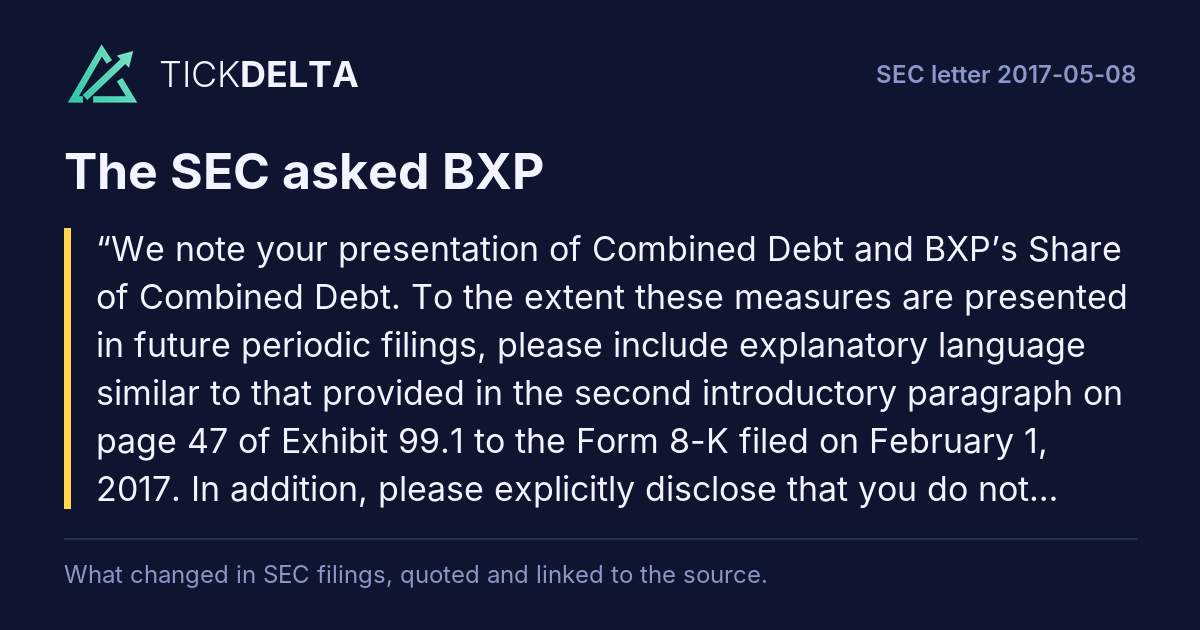
We note your presentation of Combined Debt and BXP’s Share of Combined Debt. To the extent these measures are presented in future periodic filings, please include explanatory language similar to that provided in the second introductory paragraph on page 47 of Exhibit 99.1 to the Form 8-K filed on February 1, 2017.Rest of the question
In addition, please explicitly disclose that you do not control your investments in unconsolidated entities here and in the aforementioned Form 8-K disclosure.
We acknowledge the Staff’s comment and confirm that, to the extent the Company presents Combined Debt or BXP’s Share of Combined Debt in future periodic reports filed with the Commission, the Company will include explanatory language similar to that provided in the second introductory paragraph on page 47 of Exhibit 99.1 to the Form 8-K furnished on February 1, 2017.Read in the reply ↗Rest of the answer
For example, the Company intends to continue to include explanatory language such as that contained in (1) the third paragraph on page 88 of the Company’s Form 10-K for the fiscal year ended December 31, 2016 filed with the Commission on February 28, 2017 (the “2016 Form 10-K”) and (2) the second paragraph on page 57 of the Company’s Form 10-Q for the fiscal quarter ended March 31, 2017 filed with the Commission on May 8, 2017 (the “Q1 Form 10-Q”).
In addition, to the extent the Company presents the aforementioned measures in future periodic reports filed with, or within Item 2.02 disclosures contained in current reports on Form 8-K furnished to, the Commission, the Company will disclose that it does not control its investments in unconsolidated entities. The Company notes, for example, that it included such language on page 57 of the Q1 Form 10-Q. For the Staff’s convenience, the following is the language included in such Q1 Form 10-Q, marked to show the changes made to the language previously included in the Company’s 2016 Form 10-K:
“For example, in addition to partners’ interests in profits and capital, partnership venture agreements vary in the allocation of rights regarding decision making (both for routine and major decisions), distributions, transferability of interests, liquidations, etcand other matters. Moreover, in some cases we exercise significant influence over, but do not control, the joint venture in which case GAAP requires that we account for the joint venture entity using the equity method of accounting and we do not consolidate it for financial reporting purposes. As a result, presentations of measures on a Combined basis and showing BXP’s Share of a Combined amountfinancial measure should be considered with and as a supplement to our financial information presented in accordance with GAAP.”
Also in this review: closing letter, 2017-06-02