tickdelta
Sign in

Tickdelta is free for now. Sign up and get Pro free

← Screener

Financials · Exchanges & Brokers · CBOE

CBOECboe Global Markets

Compare with peers → Embed
The 10-K against last year's

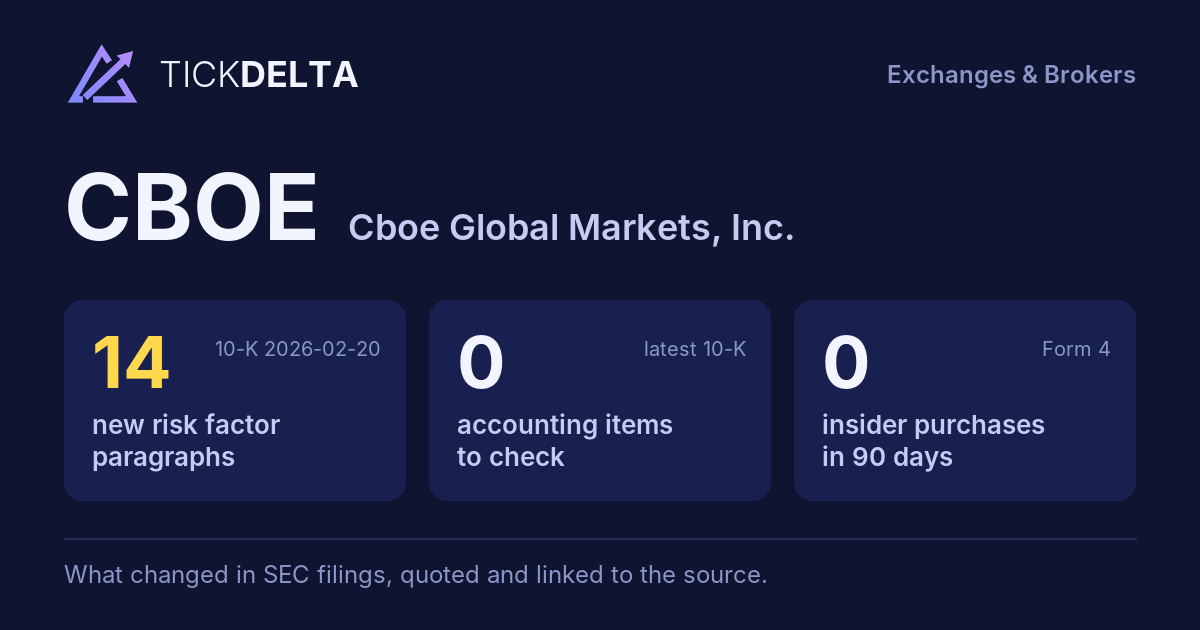
232 changes: 47 added, 22 removed, 163 reworded

10-K Feb 20, 2026 vs Feb 21, 2025
Risk FactorsRedline ↓
16.2%
of the text changed · 16,244 words now
31.6%
of the text changed · 14,384 words now
Legal ProceedingsRedline ↓
36.0%
of the text changed · 1,867 words now
Accounting PoliciesRedline ↓
19.0%
of the text changed · 3,541 words now

10-K 0001628280-26-010013 (2026-02-20) vs 10-K 0001628280-25-006984 (2025-02-21)

The redline

The paragraph that changed most in each section

Marked against last year's 10-K: cut words struck through, new words highlighted and underlined.

MD&A 263 words changed in this paragraph; it is 40% similar to last year's version.
(4)Adjusted earnings is defined as net income adjusted for acquisition-related costs, amortization of acquired intangible assets, gain on Cboe Digital non-recourse notes and warrants wind down, contra-revenue associated with the Cboe Digital syndication wind down, change in contingent consideration, impairment of intangible assets, income from minority investment, loss on minority investments, costs related to the Cboe Digital wind down, gain on sale of property held for sale, certain tax reserve changes, and net income or loss allocated to participating securities, net of the income tax effects We believe our presentation of these adjustments. Adjusted earnings does not represent, measures provides additional and should not be considered as, comparative information to assess trends in our core operations and a means to evaluate period-to-period comparisons. Non-GAAP financial measures are provided as additional information to investors in order to provide them with an alternative method for assessing our financial condition and operating results. We have presented the following non-GAAP measures because we consider them important supplemental measures of our performance and believe that they are frequently used by analysts, investors, and other interested parties in the evaluation of companies. We use adjusted EBITDA as a measure of operating performance for preparation of our forecasts and evaluating our leverage ratio for the debt to net income or loss, as determined earnings covenant included in accordance with GAAP. We our outstanding credit facility. In addition, we have presented adjusted earnings because we consider it an important supplemental measure of our performance and we use it as the basis for monitoring our own core operating financial performance relative to other operators of exchanges. We also believe that it is frequently used by analysts, investors investors, and other interested parties in the evaluation of companies. We believe that investors may find this non-GAAP measure useful in evaluating our performance compared to that of peer companies in our industry. Other companies may calculate adjusted earnings differently than we do. Adjusted earnings has limitations as an analytical tool, and you should not consider it in isolation or as a substitute for analysis of our results as reported under GAAP.

Source: Item 7, 10-K 0001628280-26-010013 vs Item 7, 10-K 0001628280-25-006984

Legal Proceedings 211 words changed in this paragraph; it is 38% similar to last year's version.
of the U.S. Constitution when it promulgated Rule 613 in 2012 mandating the creation and funding of the CAT. Plaintiffs’ motion for a preliminary injunction and stay was denied. On September 13, 2024, Citadel July 7, 2025, the U.S. District Court for the Western District of Texas ("Texas Federal District Court") granted the SEC's opposed motion to hold the case in abeyance and stay all deadlines until January 15, 2026. On January 15, 2026, the SEC filed a status report and an opposed Motion to Continue the Abeyance for an additional six months. On January 23, 2026, Plaintiffs filed a motion for class certification. On January 30, 2026, Plaintiffs filed a Renewed Motion for a Preliminary Injunction. On February 4, 2026, the Texas Federal District Court granted the SEC's opposed Motion to stay Continue the CAT Funding Model Order and to enjoin the collection of certain CAT fees during the pendency of this litigation, which the 11th Circuit denied on November 27, 2024. Oral argument on the merits was held on February 3, 2025. Abeyance until July 15, 2026. This challenge or any other challenge to the CAT Funding Model Order and/or Plan Participant(s) fee filings on behalf constitutionality of CATLLC may significantly delay efforts by CATLLC to continue collecting the CAT fees. may delay CATLLC’s assessment of CAT fees to recover a portion of CAT costs. As a result, the Plan Participants may continue to incur additional significant costs, and/or it may result in them not being able to collect on the promissory notes related to the funding of the implementation and operation of the CAT. The Company believes the challenge is without merit and intends to vigorously litigate the matter.

Source: Item 3, via Note 23 – COMMITMENTS, CONTINGENCIES, AND GUARANTEES, 10-K 0001628280-26-010013 vs Item 3, via Note 23 – COMMITMENTS, CONTINGENCIES, AND GUARANTEES, 10-K 0001628280-25-006984

Risk Factors 179 words changed in this paragraph; it is 77% similar to last year's version.
In addition, with respect to orders Cboe Trading routes to other markets for execution on behalf of our customers, Exchanges, Cboe Trading is exposed to some counterparty credit risk in the case of failure to perform on the part of our routing and clearing firms firms: Wedbush, Morgan Stanley, Goldman Sachs, Wolverine, and BOA, that are involved in processing equities and options transactions on our behalf, as well as failure on the part of such brokers to pass back any transactional rebates. Wedbush and Morgan Stanley guarantee equity trades until the trade has been submitted to and validated by NSCC, after which time NSCC provides a guarantee until the trade settles (T+1). Thus, Cboe Trading is potentially exposed to credit risk to the counterparty to from an equity trade routed to another market center until the trade has been processed and validated by NSCC on the trade date in the event that Wedbush or Morgan Stanley fails to perform. Additionally, BIDS Trading has counterparty credit risk exposure to BOA related to clearing until the trade has been processed and validated by the NSCC on the trade date. With respect to U.S. listed equity options and futures, options, we deliver matched trades of our customers to the OCC, which acts as a central counterparty on for all transactions occurring on Cboe Options, C2, BZX, EDGX, and CFE, and, EDGX. OCC also acts as a central counterparty for transactions in CFE products that are cleared by OCC. As such, OCC guarantees clearance and settlement of all of our matched touched options and all of our matched futures trades. and options on futures trades in CFE products cleared by OCC. With respect to Canadian equities, we deliver reports of matched trades of our customers to CDS, which acts as a central counterparty on all transactions occurring on Cboe Canada Inc. and, as such, guarantees clearance and settlement of all of our matched Canadian equities trades. With respect to trades in options and futures occurring on Cboe Europe Derivatives, CEDX, Cboe Clear Europe acts as a central counterparty that, for its clearing participants, members, becomes the buyer to every seller and the seller to every buyer. As a result, Cboe Clear Europe guarantees the timely performance of the settlement obligations of buyers and sellers and takes on the risk of the performance of the transactions that it clears. With respect to Australian equities and derivatives, we deliver matched trades of our customers to ASX Clear Pty Ltd and ASX Settlement Pty Ltd. ASX Clear Pty Ltd acts as a central counterparty on all transactions occurring on Cboe Australia and, as such, guarantees clearance and settlement on all of our matched trades in Australia. With respect to trades in CFE products cleared by Cboe Clear U.S., we deliver matched trades of our customers to Cboe Clear U.S., which acts as a central counterparty and guarantees clearance and settlement for those transactions.

Source: Item 1A, 10-K 0001628280-26-010013 vs Item 1A, 10-K 0001628280-25-006984

Accounting Policies 126 words changed in this paragraph; it is 54% similar to last year's version.
Goodwill represents the excess of purchase price over the value assigned to the net tangible and identifiable intangible assets of a business acquired. Goodwill is allocated to the Company’s reporting units based on the assignment of the fair values of each reporting unit of the acquired company. The Company tests goodwill for impairment at the reporting unit level annually, or in interim periods if certain events occur indicating that the carrying value may be impaired. Interim impairment testing was performed during the quarter ended June 30, 2022 due to the acquisition of Cboe Digital, resulting in an impairment charge to goodwill. During the quarter ended September 30, 2022 the Company concluded that the factors indicative of impairment were still relevant, resulting in the write-down of the remaining carrying value of goodwill to zero. See Note 10 ("Goodwill, Intangible Assets, Net and Digital Assets Held") for additional information. The annual impairment test is performed during the fourth quarter using October 1 carrying values, and if the fair value of the reporting unit is found to be less than the carrying value, an impairment loss is recorded. The Company performed its 2024 annual goodwill impairment test and determined that no additional impairment existed.

Source: Item 8, Note 2 – SUMMARY OF SIGNIFICANT ACCOUNTING POLICIES, 10-K 0001628280-26-010013 vs Item 8, Note 2 – SUMMARY OF SIGNIFICANT ACCOUNTING POLICIES, 10-K 0001628280-25-006984

Every change, by type

Sentences and paragraphs added, removed or reworded

Sentences and paragraphs of CBOE's Risk Factors and MD&A, 10-K 2026-02-20 against 10-K 2025-02-21. Each links to the text at sec.gov.

AddedRisk Factors
Emerging technologies, alternative settlement mechanisms, and 24-hour trading may also affect our traditional business models. For example, the adoption of tokenization or other emerging settlement technologies that enable self-clearing may reduce demand for traditional clearing services. New or existing competitors may also develop products or technologies that provide similar economic exposure or functionality to our existing offerings through different mechanisms, which may reduce demand for our products.

Read it in 10-K 2026-02-20 at sec.gov ↗

AddedRisk Factors
•Trading in certain of our products is dependent on the operational availability of markets operated by third parties. These intermarket dependencies can necessitate coordinated responses to disruptions across multiple market participants and may impact our ability to maintain orderly markets in dependent products. For example, in November 2025, trading of futures and options on the Chicago Mercantile Exchange was halted by a data-center fault, resulting in disruptions to markets across equities, foreign exchange, bonds, and commodities.

Read it in 10-K 2026-02-20 at sec.gov ↗

AddedRisk Factors
•general economic, social, and political conditions, including increased political tensions and disagreements, including as a result of tariffs and trade policies, and geopolitical activity;

Read it in 10-K 2026-02-20 at sec.gov ↗

AddedRisk Factors
Global trade policies, including the assessment of tariffs and other impositions on imported goods, may have a material adverse impact on our business.

Read it in 10-K 2026-02-20 at sec.gov ↗

Show the other 16
AddedRisk Factors
Countries have announced new or increased tariffs on imported goods and that additional tariffs or increases in tariffs could be assessed in the future. If any such tariffs were to increase the costs of the products and services we use in our business, in particular the technology, communications, cloud, computer, and networking products and services that we use, and we were unable to mitigate the impacts of any such increased costs, it could have a material adverse impact on our business and our results of operations.

Read it in 10-K 2026-02-20 at sec.gov ↗

AddedRisk Factors
Although our clearinghouses have rules, policies, and procedures that are reasonably designed to help protect them from the aforementioned risks, such policies and procedures may not succeed in preventing losses after a member's or counterparty’s default. In addition, although we believe that we have carefully analyzed the process for setting margins and our financial safeguards, it is a complex process and there is no guarantee that our procedures will adequately protect us from the risks related to operating our clearinghouses. For example, we have previously identified and addressed potential procedure enhancement opportunities. We cannot assure you that the mitigating measures, policies, safeguards, and risk management procedures will be sufficient to detect problems or to protect us from a default or that we will not be materially and adversely affected in the event of a significant default.

Read it in 10-K 2026-02-20 at sec.gov ↗

AddedRisk Factors
related to the credit of the banks and prime brokers that trade spot FX on the Cboe FX platform, or NDFs on Cboe SEF. In addition, disruptions at third parties may necessitate coordinated responses across multiple market participants and may impact our ability to maintain orderly markets in dependent products.

Read it in 10-K 2026-02-20 at sec.gov ↗

AddedRisk Factors
In addition to risks associated with acquisitions and integrations, we may also face risks in executing strategic exits, divestitures, or wind downs of businesses. For example, we have announced the wind down of our Japan equities business, initiated sale processes for our Australia and Canada equities businesses and, subsequent to December 31, 2025, announced the wind down of CEDX. These actions may involve transitional disruptions, regulatory complexities, loss of customer relationships, reputational impacts, or challenges in retaining key personnel during the transition. If we are unable to effectively manage these exits or realize the anticipated cost savings and strategic benefits, our business, financial condition, and operating results could be materially adversely affected.

Read it in 10-K 2026-02-20 at sec.gov ↗

AddedMD&A
In 2025, following a comprehensive strategic review of its global business operations, Cboe initiated the wind down of its Japanese equities business, including the cessation of operations of its Cboe Japan proprietary trading system and Cboe BIDS Japan block trading platform, initiated a sales process for its Cboe Australia and Cboe Canada businesses, discontinued its U.S. and European Corporate Listings efforts, and reduced costs associated with its U.S. and European ETP Listings businesses, Cboe Europe Derivatives ("CEDX"), and several of Cboe’s smaller Risk and Market Analytics businesses. Subsequent to the year ended December 31, 2025, after further review of its global business operations, Cboe initiated the wind down of CEDX.

Read it in 10-K 2026-02-20 at sec.gov ↗

AddedMD&A
On May 1, 2025, the Company announced that its Board of Directors appointed longtime global financial markets executive, Craig S. Donohue, as the Company's new Chief Executive Officer and a member of the Board, effective May 7, 2025. Mr. Donohue succeeded Fredric J. Tomczyk who, as previously announced, has stepped down as Chief Executive Officer and will remain on the Board.

Read it in 10-K 2026-02-20 at sec.gov ↗

AddedMD&A
On May 28, 2025, the Company announced that Dave Howson, Executive Vice President and Global President, resigned from the Company, with his employment terminating at the end of the day on August 1, 2025. In connection with Mr. Howson's resignation, the Board appointed Mr. Donohue, Chief Executive Officer of the Company, as President of the Company, effective following August 1, 2025.

Read it in 10-K 2026-02-20 at sec.gov ↗

AddedMD&A
On August 18, 2025, the Company announced the appointment of Prashant A. Bhatia as Executive Vice President, Head of Enterprise Strategy & Corporate Development, effective September 2, 2025. Mr. Bhatia has advised the Company since December 2023 and previously led enterprise strategy and corporate development at TD Ameritrade for 11 years.

Read it in 10-K 2026-02-20 at sec.gov ↗

AddedMD&A
On September 30, 2025, the Company announced the appointment of two industry veterans to lead its Derivatives and Data Vantage businesses. Effective October 1, 2025, Robert A. Hocking rejoined as Executive Vice President, Global Head of Derivatives, and Brian McElligott joined as Senior Vice President, Global Head of Cboe Data Vantage. Mr. Hocking succeeded Cathy Clay who departed the Company in October 2025.

Read it in 10-K 2026-02-20 at sec.gov ↗

AddedMD&A
Subsequent to December 31, 2025, on January 26, 2026, the Company announced the planned appointments of Scott Johnston as Executive Vice President, Chief Operating Officer, and Heidi Fischer as Executive Vice President, Global Head of Equities and Spot Markets. Mr. Johnston will take over chief operating duties from Chris Isaacson, Executive Vice President and Chief Operating Officer, who is retiring from his role effective March 6, 2026. Ms. Fischer will assume oversight of Cboe’s global cash equities and spot markets, which Mr. Isaacson also oversaw. Mr. Isaacson will continue to serve as an advisor to Cboe through the end of 2026.

Read it in 10-K 2026-02-20 at sec.gov ↗

AddedMD&A
Comparative-period results for the Digital segment have been presented for historical purposes but have not been recast as the historical results of the Digital segment were not material, nor do they materially impact the financial results, trends, or forecasts of the Futures segment. As a result, for the year ended December 31, 2025, operating results included within the Digital operating segment are presented within the Futures reporting segment. See Note 16 (“Segment Reporting”) for more information.

Read it in 10-K 2026-02-20 at sec.gov ↗

AddedMD&A
•the potential introduction of new or competing financial products or services by competitors in the industry, including those enabled by new technologies;

Read it in 10-K 2026-02-20 at sec.gov ↗

AddedMD&A
•implementation of the SEC's reduced equity access fee cap and other potential market structure changes may lead to decreased exchange trading, and reduced transaction fee revenue;

Read it in 10-K 2026-02-20 at sec.gov ↗

AddedMD&A
•ongoing costs and uncertainties related to the historical, current, and future funding of the implementation and operation of the CAT, litigation and regulatory developments related to CAT, and the ability to collect on the promissory notes related to the funding of CAT; and

Read it in 10-K 2026-02-20 at sec.gov ↗

AddedMD&A
(1)Adjusted operating income is defined as operating income after relevant operating adjustments, which includes revenue, cost of revenues, and operating expense adjustments, as applicable. Adjusted operating margin represents adjusted operating income divided by revenues less cost of revenues. Operating EBITDA is defined as operating income before depreciation and amortization. Operating EBITDA margin represents operating EBITDA divided by revenues less cost of revenues. Adjusted operating EBITDA is calculated by adding back to operating EBITDA relevant operating adjustments, which includes revenue, cost of revenues, and operating expense adjustments, as applicable. Adjusted operating EBITDA margin represents adjusted operating EBITDA divided by revenues less cost of revenues. Relevant adjustments are detailed in the reconciliations that follow.

Read it in 10-K 2026-02-20 at sec.gov ↗
AddedMD&A
(2)EBITDA is defined as income before interest, net, income taxes, and depreciation and amortization. EBITDA margin represents EBITDA divided by revenues less cost of revenues. Adjusted EBITDA is calculated by adding back to EBITDA relevant adjustments, which includes revenue, cost of revenues, operating expense, and non-operating adjustments, as applicable. Adjusted EBITDA margin represents adjusted EBITDA divided by revenues less cost of revenues. Adjusted earnings is defined as net income after relevant adjustments, which includes revenue, cost of revenues, operating expense, non-operating adjustments, certain tax adjustments, and net income or loss allocated to participating securities, net of income tax effects of these adjustments, as applicable. Adjusted diluted earnings per share represents adjusted earnings divided by diluted weighted average shares outstanding. Relevant adjustments are detailed in the reconciliations that follow.

Read it in 10-K 2026-02-20 at sec.gov ↗

Next Related parties →