Form 10-K
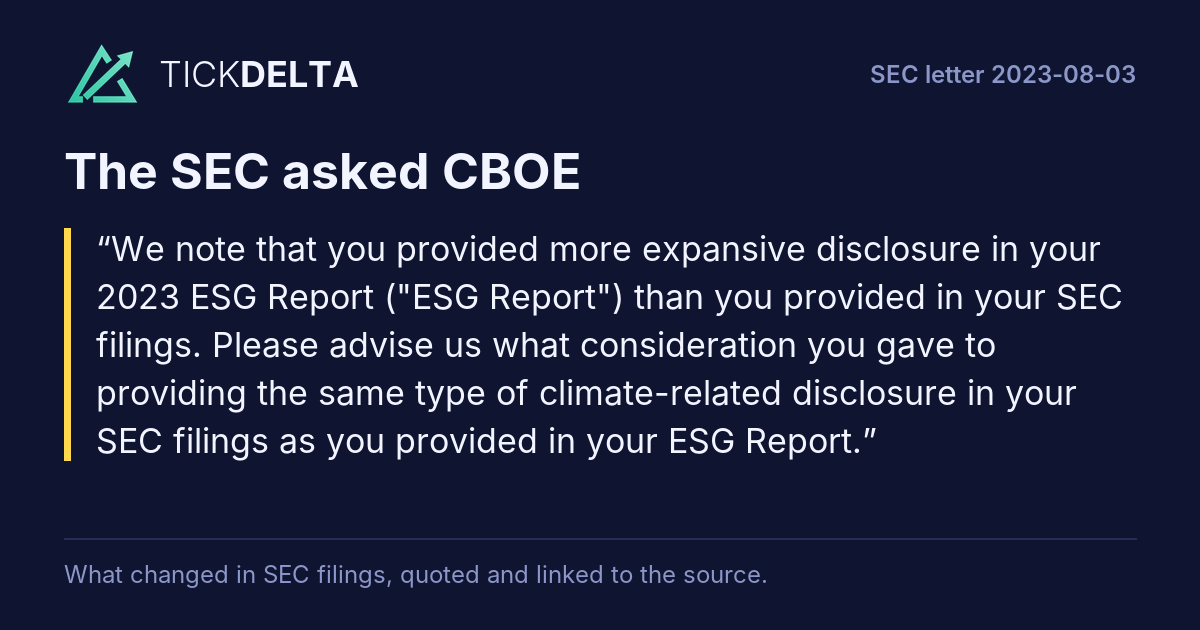
We note that you provided more expansive disclosure in your 2023 ESG Report ("ESG Report") than you provided in your SEC filings. Please advise us what consideration you gave to providing the same type of climate-related disclosure in your SEC filings as you provided in your ESG Report.
The Company regularly evaluates climate-related topics and trends in order to identify those topics that are either quantitatively or qualitatively material which would require disclosure within the Company’s Securities and Exchange Commission (“SEC”) filings. Further, the Company’s approach to public reporting on environmental, social, and governance issues differs between the Company’s SEC filings and its annual ESG reports due to the unique reporting requirements and interests of the Company’s stakeholders concerned with the sustainability of the Company.Read in the reply ↗Rest of the answer
From the perspective of the Company’s SEC filings, the Company believes current or prospective investors make up the primary audience. The SEC filings have unique disclosure rules and materiality standards that apply to those filings and the Company’s consolidated financial results are such that they create a high quantitative threshold of materiality. As a result, the Company’s disclosures regarding ESG within its SEC filings tend to be relatively limited as compared to the voluntary ESG reports. When the Company evaluated its climate-related items from the 2022 ESG report, it was determined that these items did not meet or exceed the threshold for inclusion within the 2022 10-K and the Company’s other SEC filings. Additionally, the Company plans to evaluate its climate-related items from the 2023 ESG report to determine whether they are material for the upcoming 2023 Form 10-K (“2023 10-K”), but the Company does not currently expect these items to meet or exceed the threshold for inclusion within the 2023 10-K or the Company’s other SEC filings. The Company’s ESG reports are designed to provide certain information to a wider range of stakeholders, including, but not limited to customers, current and prospective employees, and suppliers. As a result, the ESG reports may include disclosures regardless of the materiality to the Company’s business and financial results, meaning the ESG reports provide more detailed data and information gathered and disclosed on a best efforts basis and subject to availability of information. The 2022 ESG report’s more detailed data and information includes, but is not limited to,
433 West Van Buren Street › Chicago, IL 60607 › cboe.com environmental metrics, a 3-year breakdown of Scope 1 and 2 emissions, and energy, water, and waste consumption. The Company concluded that this information was not material when considered for inclusion within the Company’s 2022 10-K. The 2023 ESG report’s more detailed data and information additionally includes, but is not limited to, a 4-year breakdown of Scope 1, 2, and certain Scope 3 emissions, and the Company’s plans to reduce Scope 1, 2, and certain Scope 3 emissions. The Company plans to evaluate this information to determine whether it is material for inclusion within the Company’s 2023 10-K, but the Company does not currently expect this information to meet or exceed the threshold for inclusion within the 2023 10-K.
Finally, the Company included navigation in the 2022 10-K to, but did not incorporate by reference, the ESG section of the Company’s website, where a comprehensive overview of the Company’s environmental, social, and governance initiatives is provided. As a result of the increasing awareness of climate change, the Company will continue to monitor new regulations from the SEC and other rule-making bodies to determine whether further disclosure is necessary in future SEC filings.
To the extent material, discuss the indirect consequences of climate-related regulation or business trends, such as the following: • decreased demand for goods or services that produce significant greenhouse gas emissions or are related to carbon-based energy sources; • increased demand for goods that result in lower emissions than competing products; • increased competition to develop innovative new products thatRest of the question
result in lower emissions; • increased demand for generation and transmission of energy from alternative energy sources; • any anticipated reputational risks resulting from operations or products that produce material greenhouse gas emissions; and • potential climate-related opportunities, such as developing ESG-related indices and products.
The Company reviewed the applicable disclosure standards in preparation of the Company’s 2022 10-K and concluded that indirect consequences of climate-related regulation or business trends, including the items highlighted below, have not been materially impactful to the Company’s business, financial condition, or results of operations and are not expected to have a material impact to the Company on a go-forward basis.
As the world’s leading derivatives and securities exchange network, the Company delivers cutting-edge trading, clearing and investment solutions to people around the world.Read in the reply ↗Rest of the answer
The Company primarily provides trading solutions and products in multiple asset classes, including equities, derivatives, and FX, across North America, Europe, and Asia Pacific, however these asset classes generally do not involve the manufacture or sale of physical products or the delivery of services that directly produce significant greenhouse gas emissions. As such, the Company is generally not at material risk to experience indirect consequences of climate-related regulation or business trends, such as decreased demand for goods or services that produce significant greenhouse gas emissions or are related to carbon-based energy sources, increased demand for goods that result in lower emissions than competing products, increased competition to develop innovative new products that result in lower emissions, increased demand for generation and transmission of energy from alternative energy sources, or reputational risks resulting from operations or products that produce greenhouse gas emissions. However, although not material to the Company’s business, financial condition, or results of operations, the Company understands it has potential climate-related opportunities, including, but not limited to, exchange-traded products, such as ESG-themed ETFs, the development of ESG-themed indices, and the development of ESG-themed derivatives products.
Although the Company has concluded that indirect consequences of climate-related regulation or business trends have not been materially impactful to the Company’s business, financial condition, or results of operations and are not expected to have a material impact to the Company on a go-forward basis, as noted within the Company’s 2023 ESG report, the Company has joined the Net Zero Financial Services Providers Alliance as a demonstration of the Company’s commitment to supporting the global transition to a low carbon future. The Company is in the early stages of its commitment to net zero emissions by 2050 and has not incurred related costs that the Company deemed material during the year ended December 31, 2022.
The Company plans to continue to assess materiality of climate-related regulation or business trends in preparation of its SEC filings and expects to disclose any applicable material consequences of climate-related regulation or business trends as they become material, resulting in a required disclosure, or if the Company determines any additional disclosure is necessary.
First report after the company's reply of 2023-08-16: 10-Q filed 2023-11-03 ↗, against the 10-Q filed 2023-05-05 ↗.
Tickdelta does not hold the text of both reports, so they are not compared here.
We note your ESG Report identifies physical climate risks for your largest offices and data centers as a potential climate-related risk. Please discuss the physical effects of climate change on your operations and results, such as weather-related damages to your property or operations and weather-related impacts on the cost or availability of insurance.Rest of the question
Include quantitative information for each of the periods covered by your most recent Form 10-K and explain whether increased amounts are expected in future periods. In addition, please discuss the potential for indirect weather-related impacts that have affected or may affect your major customers or suppliers.
The Company reviewed the applicable disclosure standards while preparing the 2022 10-K and determined that the physical effects of climate change did not result in a material impact to the Company’s operations and results during the periods covered by the 2022 10-K. Further, these potential physical effects are not expected to materially impact the business, financial condition, or results of operations of the Company going forward.Read in the reply ↗Rest of the answer
The Company plans to continue to assess materiality of the physical effects of climate change on the Company’s operations and results in preparation of its SEC filings and expects to disclose any applicable material consequences of the physical effects of climate change as they become material, resulting in a required disclosure, or if the Company determines any additional disclosure is necessary.
The Company’s technology has not been materially impacted by weather-related events, such as Hurricane Sandy. However, the Company experienced two events which caused physical damage which necessitated incurring remediation expenses during 2022. First, the Cboe Volatility Index (VIX) pit on the Company’s trading floor was temporarily closed due to water damage sustained from a burst pipe above the trading floor in December 2022 potentially due to cold weather. Second, the Company experienced a flooding event in its Lenexa office in July 2022 from a burst underground pipe which the Company determined was most likely not weather-related. The total damages and expenses to remediate these floods totaled approximately $1.0M, which were not material to necessitate specific disclosures within the Company’s SEC filings.
However, the Company disclosed in its 2022 10-K Risk Factors section on pages 40, 42, and 43, as similarly noted in the 2023 ESG report, that (i) the Company is heavily dependent on technology, including third-party data centers and third-party cloud service providers, which may be unavailable, as a result of a number of potential causes, including technical failure, natural disasters, and extreme weather events, and that (ii) the Company’s global operations may face certain risks related to natural disasters and extreme weather events.
Further, the Company does not believe that it has experienced any material impact to its insurance costs or to the availability of insurance as a result of weather-related factors. The Company’s total property insurance premiums were less than 0.1% of total operating expenses in each fiscal year 2022, 2021, and 2020, an amount that the Company does not consider material. The Company notes that property insurance premiums increased more than 50% from 2021 to 2022. The Company believes the increases were due to broader macroeconomic factors in the insurance industry, including rising expenses as a result of weather-related incidents and increased repair and replacement costs. While the Company’s property insurance premiums have increased over time, the Company does not anticipate weather-related factors to materially impact the Company’s ability to obtain property insurance coverage or to increase at such a rate that would materially impact the Company’s financial results.
The Company acknowledges the potential that its customers, such as trading firms, may be impacted by weather-related events, such as power outages or flooding, and as the Company and its customers are heavily dependent on technology, this could impact the customers’ ability to carry out transactions on the Company’s marketplaces. However, the Company is not aware of any weather-related impacts that have materially affected any of the Company’s major customers or suppliers and it does not expect to be materially affected by weather-related impacts to its major customers or suppliers, nevertheless, as noted above, the Company has disclosed potential risks related to potential weather-related impacts.
First report after the company's reply of 2023-08-16: 10-Q filed 2023-11-03 ↗, against the 10-Q filed 2023-05-05 ↗.
Tickdelta does not hold the text of both reports, so they are not compared here.
You reference the purchase of carbon offsets and Renewable Energy Certificates or RECs in your ESG Report. Please provide disclosure about these purchases and any material effects on your business, financial condition, and results of operations.Rest of the question
Provide us with quantitative information for each of the periods covered by your most recent Form 10-K and the amounts budgeted for or expected to be incurred in future periods. We remind you that the company and its management are responsible for the accuracy and adequacy of their disclosures, notwithstanding any review, comments, action or absence of action by the staff.
The Company reviewed the applicable disclosure standards while preparing the 2022 10-K and determined that the purchase of (i) Renewable Energy Certificates (“RECs”) to reduce emissions from the Company’s purchased energy in facilities and (ii) carbon offsets to support projects that reduce global greenhouse gas emissions were not considered material to the Company’s consolidated financial condition and results of operations for the periods covered by the 2022 10-K.
The Company spent approximately $120,000, $80,000, and $0 on carbon credits in 2022, 2021, and 2020, respectively, whichRead in the reply ↗Rest of the answer
represents less than 0.1% of total operating expenses in each fiscal year 2022, 2021, and 2020. The Company expects these purchases to continue into future periods and has budgeted $500,000 for 2023 for potential additional carbon credits, RECs, or other relevant projects, which represents less than 0.1% of budgeted operating expenses in 2023, and they are not expected to materially impact the business, financial condition, or results of the operations of the Company going forward. Separately, for a subset of the Company’s energy demand, the Company purchased energy that also included RECs. The combined cost of energy consumption/RECs for these purchases was approximately $110,000 in 2022. Similar costs are expected in 2023.
The Company plans to continue to assess materiality of these purchases on the Company’s operations and results in preparation of its SEC filings and expects to disclose any applicable purchases if they become material, resulting in a required disclosure, or if the Company determines any additional disclosure is necessary.
The Company acknowledges its responsibility for the accuracy and adequacy of its disclosures. If you have any questions or would like to discuss this response, please contact the undersigned at 312-786-7215 or by email at jgriebenow@cboe.com.
First report after the company's reply of 2023-08-16: 10-Q filed 2023-11-03 ↗, against the 10-Q filed 2023-05-05 ↗.
Tickdelta does not hold the text of both reports, so they are not compared here.
Your response to prior comment two appears to be conclusory in nature without providing sufficient detail regarding the indirect consequences of climate-related regulation or business trends, including the specific items noted in our comment, and your assessment thereof.Rest of the question
Please further address the following: • More fully describe the indirect consequences of climate change and tell us how you concluded they were not material. Provide support for your assessment in relation to your principal operations, including, without limitation, your operation of trading markets and platforms. • Your response indicates you are in the early stages of your commitment to net zero emissions by 2050 and have not incurred related costs deemed material in 2022. Provide us with additional information regarding the steps you have taken and expect to take in connection with this commitment. Include quantification of the costs incurred during the periods covered by your Form 10-K and expected to be incurred in future periods, and tell us how you assessed materiality. • Tell us how you assessed the materiality of the potential climate-related opportunities identified in your response for purposes of disclosure.
As noted in the Company’s prior response, as a provider of market infrastructure and tradable products, the Company focuses on delivering trading, clearing and investment services to market participants around the world. The Company operates trading systems that facilitate transactions between buyers and sellers, introduces tradable products in multiple asset classes to meet the needs of investors, and provides index and data offerings across expansive geographies.Read in the reply ↗Rest of the answer
The Company’s main sources of revenue consist of transaction and clearing fees, access and capacity fees, market data fees, and regulatory fees. As the Company operates in the financial asset trading and technology space, its workforce is overwhelmingly office based. Importantly, the vast majority of trading that occurs on the Company’s markets is
433 West Van Buren Street › Chicago, IL 60607 › cboe.com electronic (there is one traditional open outcry trading floor in Chicago, Illinois). The Company is not involved in the manufacturing, selling, shipping, or storing of physical products. Accordingly, the Company believes it is not materially impacted by the indirect consequences of climate-related regulation or business trends.
At this time, the Company does not consider the following indirect consequences of climate-related regulation or business trends to be material to the Company for the reasons stated below. The Company is also not aware of incurring any material indirect consequences of climate-related regulation or business trends. Nevertheless, as part of the Company’s ongoing evaluation of its operations, to the extent management assesses that indirect consequences of climate-related regulation or business trends are reasonably likely to have a material impact to the Company, relevant disclosure will be provided in future periods.
● decreased demand for goods or services that produce significant greenhouse gas emissions or are related to carbon-based energy sources; and
● increased demand for goods that result in lower emissions than competing products.
The Company is not involved in the production, transportation, manufacturing, sale, or provision of services related to goods or services that directly produce significant greenhouse gas emissions, or goods that result in lower emissions, or are related to carbon-based energy sources or traditional physical commodities, including oil, natural gas, metals, etc. The Company is also not involved in the storing of goods or commodities and does not own or lease any warehouses or storage facilities. The Company’s primary goods and services relate to financial products, such as trading of equities, derivatives, and FX, which generally do not involve the manufacture or sale of physical products, including potentially lower emission goods, or the delivery of services that directly produce significant greenhouse gas emissions. While the Company does not offer trading in oil, natural gas, metals, etc., the Company does offer trading of financial products related to digital commodities, but as noted in the following paragraph the associated financials are immaterial. For the periods covered by the Company’s 2022 10-K, over 63% of the Company’s revenues less cost of revenues (“net revenues”) were generated by the Company’s transaction and clearing-based business. This business is dependent on the ability to maintain trading and clearing volumes related to various financial products, such as trading of equities, derivatives, and FX. The Company’s transaction and clearing-based business is primarily conducted electronically, with only one open outcry physical trading floor located in Chicago, Illinois. As the Company’s transaction and clearing business does not involve goods or services that produce significant greenhouse gas emissions or are related to carbon-based energy sources, the Company believes that it is not exposed to material impacts from the potential indirect consequences of climate-related regulation or business related to (i) decreased demand for goods or services that produce significant greenhouse gas emissions or are related to carbon-based energy sources or (ii) increased demand for goods that result in lower emissions than competing products.
The Company also operates a U.S. based digital asset spot market, regulated futures exchange, and regulated clearinghouse, following the acquisition of Cboe Digital in May 2022. The Company acknowledges that the production and mining of certain digital assets, such as Bitcoin (which trades on Cboe Digital), have been connected by some to higher greenhouse gas emissions, the Company believes they are not material to the Company. As disclosed in the Company’s 2022 10-K, the Digital segment is not material to the Company with only $(0.4) million in net revenue in 2022, nor does the Company reasonably believe it is likely to be a material driver of earnings for the Company in the near future. As of December 31, 2022, the Company held $0.9 million, which is an immaterial amount, of Bitcoin and other digital assets on its consolidated balance sheet. Therefore, the Company believes that it is not exposed to material impacts from the potential indirect consequences of climate-related regulation or business related to (i) decreased demand for goods or services, such as digital assets, that potentially produce significant greenhouse gas emissions or are related to carbon-based energy sources or (ii) increased demand for goods, such as alternative digital assets, that result in lower emissions than competing products.
● increased competition to develop innovative new products that result in lower emissions;
The market for trade execution services, clearing and financial related products is intensely competitive in the asset classes and geographies in which the Company operates. The Company competes with a number of entities on several different fronts, including cost, quality and speed of trade execution, functionality and ease of use of trading and clearing platforms, range of products and services, technological innovation and adaptation, and company reputation. Increased competition due to several different fronts may result in a decline in the Company’s share of trading activity and a decline in the Company’s revenues from transaction and clearing fees and market data fees. However, the Company’s primary asset classes and trading and clearing platforms, including financial products, such as trading of equities, derivatives, and FX, are generally not related to emissions and the Company is not expected to be materially impacted by competition to develop innovative new products that may result in lower emissions. For more detail, the Company addressed potential competition risks in its 2022 10-K Risk Factors section.
● increased demand for generation and transmission of energy from alternative energy sources;
The Company’s primary goods and services relate to financial products, such as trading of equities, derivatives, and FX, and the Company is not involved in the production, transportation, manufacturing, sale, or provision of services related to physical goods that produce significant greenhouse gas emissions or are related to carbon-based energy sources or commodities. As such, the Company believes it has not experienced any material impact from increased demand for the generation and transmission of energy from alternative sources. The Company’s primary direct consumption of energy relates to the Company’s leased office spaces, one physical trading floor, leased data center space, a remote network operations center and third-party production and disaster recovery data centers, and such energy is in the form of utilities consisting of electricity, water, and waste. For the periods covered in the Company’s 2022 10-K, the Company’s global utilities costs have contributed less than 0.5% to the Company’s overall operating expenses, and have been relatively consistent year-over-year during that period. Additionally, from 2020 to 2022, all costs related to the Company’s third-party production and back-up data centers, which house the majority of the Company’s technology, have contributed less than 2% to the Company’s overall operating expenses, and have been relatively consistent year-over-year during that period. As such, the Company believes that it is not exposed to material impacts from the potential indirect consequences of climate-related regulation or business, such as its global utilities costs, related to increased demand for generation and transmission of energy from alternative energy sources.
As noted within the Company’s 2023 ESG report, the Company is in the early stages of its commitment to net zero emissions by 2050 (“net zero”). This initiative consists of procuring renewable energy where possible and purchasing Renewable Energy Certificates (“RECs”) to help address emissions. As described below in further detail, the costs incurred related to this initiative are not material, thus the Company believes that it is not exposed to material impacts from the potential indirect consequences of climate-related regulation or business related to increased demand for generation and transmission of energy from alternative energy sources.
● any anticipated reputational risks resulting from operations or products that produce material greenhouse gas emissions;
The Company believes that one of its competitive strengths is its strong industry reputation and it addressed potential risks to this reputation in its 2022 10-K Risk Factors section. As outlined above, the Company’s primary asset classes and trading and clearing platforms, including financial products, such as trading of equities, derivatives, and FX, do not involve the operations, production, transportation, manufacturing, sale, or provision of services related to goods or services that produce material greenhouse gas emission, and therefore the Company believes it is not exposed to material impacts, nor is the Company aware of suffering any material harm to its operations, related to anticipated reputational risks resulting from operations or products that produce material greenhouse gas emissions.
However, as noted above and within the Company’s 2023 ESG report, the Company’s office and technology-based operations do produce some greenhouse emissions due to utilities consumption, such as electricity, water, and waste. For the periods covered in the Company’s 2022 10-K, the Company’s global utilities costs have contributed less than 0.5% to the Company’s overall operating expenses, and have been relatively consistent year-over-year during that period. To help demonstrate the Company’s overall commitment to supporting the global transition to a low carbon future and helping eliminate greenhouse gas emissions, as noted within the Company’s 2023 ESG report, the Company joined the Net Zero Financial Service Providers Alliance (“NZFSPA”) and is in the early stages of its commitment to net zero emissions by 2050. As described below in further detail, the costs incurred related to this initiative are not material to the Company for purposes of disclosure.
● potential climate-related opportunities, such as developing ESG-related indices and products.
While not considered material to the Company’s business, financial condition, or results of operations, the Company understands it has potential climate-related opportunities, including, but not limited to, exchange-traded products, such as ESG-focused ETFs, the development of ESG-focused indices, and the development of ESG-focused derivatives products. The Company launched S&P 500® ESG Index Options in September 2020 to help meet and expand demand for ESG and sustainability-focused investment strategies. In assessing materiality, the Company considered that these products contributed less than 0.01% to the Company’s total index-options average daily volumes within the Options segment for 2020, 2021, and 2022, and have contributed less than $10,000 in total revenue as of the second quarter of 2023. In comparison, the Company’s non-ESGrelated index options contributed $377.0 million, $416.1 million, and $632.5 million in transaction fees to the Company’s overall total revenues in 2020, 2021, and 2022, respectively. Additionally, due to immateriality, the Company does not separately track revenues and expenses directly related to other ESG-related indices and products. As such, these products, including other ESG-related indices and products, are not material to the Company to have required disclosure in the 2022 10-K and the Company believes it is not exposed to material impacts from such climate-related products.
As part of the Company’s long-term growth plan, in 2023 the Company is expanding its global listings business, which focuses on growth companies and asset managers that are committed to innovation with a global impact. As such, the Company may experience indirect consequences of climate-related regulation or business trends related to potential climate-related opportunities and as more climate-related companies grow and develop they may seek to broaden their investor base and access to global capital and liquidity via listing on the Company’s exchanges. However, these consequences are expected to be immaterial for 2023 as corporate listings are anticipated to contribute less than $3.5 million in total revenue for 2023 (in 2022, the Company reported $3,958.5 million in total revenues), which is not material to the Company for purposes of disclosure.
Lastly, the Company has incurred additional costs, such as employee compensation and benefits, for those employees dedicated solely to ESG-related work. In 2022, out of the Company’s approximately 1,500 global employees, the Company employed one individual to fully specialize in ESG-related work. The costs associated with ESG-specific employees contributed less than 0.1% to the Company’s total compensation and benefits expenses in 2022. The Company did not employ any ESG-specific individuals in the years ended 2021 or 2020. There are two other employees who are also involved in supporting the Company’s ESG program in addition to their primary job responsibilities. As ESG-related matters touch many different functional areas in the Company, such as accounting, finance, human resources, risk, legal, operations, and technology, there are other individuals at the Company who are tangentially involved in ESG-related matters generally. The Company does not believe there will be a material increase in employee compensation and benefits related to potentially hiring additional ESG-specialized individuals in the foreseeable future.
As noted in the Company’s prior response, the Company is in the early stages of its commitment to net zero emissions by 2050. The Company plans to set interim targets to assist in reaching the relevant milestones. To help facilitate engagement with industry peers on potential best practices to help achieve net zero, in November 2022, the Company became a member and signatory of Net Zero Financial Service Providers Alliance, which is affiliated with the Glasgow Financial Alliance for Net Zero (“GFANZ”). The Company has not incurred any membership fees related to either of these organizations. Additionally, the Company calculated and published 2022 GHG emissions across Scopes 1, 2, and relevant Scope 3 categories in the Company’s 2023 ESG Report. The Company engaged with consulting firms in 2023 to provide support for the calculations, provide strategic net zero-related guidance, and complete data reviews for select climate data. The Company does not track net zero commitment related expenditures as a separate line item, so the following costs are provided on a best-efforts basis by identifying expenditures that would not have been incurred in the absence of the Company’s net zero commitment. Costs associated with consulting services in connection with the Company’s net zero commitment have been approximately $83,000 in 2023. The Company also engaged with an ESG-focused consulting firm in 2020, 2021, and 2022 to provide general ESG program and strategic support for prior ESG reports, strategic guidance, advisory services related to the net zero commitment, and to calculate GHG emission and other select climate data. Costs associated with these consulting services were approximately $70,000 in 2020, $120,000 in 2021, and $150,000 in 2022.
Several of the Company’s offices and third-party data centers utilize renewable energy sources, and for those that do not, the Company purchased RECs to help address the U.S.-based Scope 2 emissions. The cost of RECs purchased by the Company in 2022 was approximately $38,000. In 2021, the Company spent approximately $27,000 on the purchase of RECs. Prior to 2021, the Company did not purchase RECs. The costs incurred during the periods covered by the 2022 10-K represented less than 0.1% of total operating expenses in each fiscal year ended December 31, 2020, 2021, and 2022. As such, the Company determined that such costs were not material to necessitate disclosure in the 2022 10-K.
The Company expects to continue to engage with consulting firms in the future related to the Company’s ESG program generally and net zero commitment specifically and anticipates incurring similar consulting fees as well as modest increases to these expenses; however, the Company does not anticipate that these costs are reasonably likely to become material in the foreseeable future, as the Company budgeted $250,000 for 2023 for such costs. The Company’s current estimate for costs associated with RECs in 2023 is between $20,000 to $50,000, barring any unforeseen significant increases in REC pricing or change in Company strategy. Beyond 2023, costs associated with RECs, and their international equivalents, may rise to up to $100,000 annually, although it is difficult to predict future REC pricing and fees with any certainty. The Company has also considered the potential consequences if the Company’s third-party data center provider(s), which currently purchase(s) RECs to offset the Company’s energy usage, were to cease doing so. In such event, the Company would plan to cover that energy usage by purchasing its own RECs and the Company expects the total costs would likely increase to less than $2 million per year based on current REC pricing. While the Company believes that such additional REC purchasing is highly unlikely, the Company has noted it here to show the range estimate for a REC strategy to help support the Company’s net zero goals. In 2023 or 2024, the Company intends to set science-based targets. To the extent that the Company pursues independent target validation, the related target validation fees are budgeted to be approximately $15,000. As such, the aforementioned costs are not reasonably likely to be considered material given the Company’s total operating expenses were $592.1 million in 2020, $670.2 million in 2021, and $1,252.1 million in 2022.
Please see the Company’s response above under the bullet point “potential climate-related opportunities, such as developing ESG-related indices and products” for an explanation of how the Company assessed the materiality of the potential climate-related opportunities for purposes of disclosure.
First report after the company's reply of 2023-09-13: 10-Q filed 2023-11-03 ↗, against the 10-Q filed 2023-05-05 ↗.
Tickdelta does not hold the text of both reports, so they are not compared here.
We note your response to prior comment three. Please include the quantification requested by our comment with respect to the weather-related damages to your property or operations for each of the periods covered by your Form 10-K, rather than limited to two events in 2022.Rest of the question
Please also tell us how you considered disclosing the risks that the physical effects of climate change may have on global operations, your third-party data centers and cloud service providers, and customers, given the heavy dependence on technology noted in your response and the risk factors cited therein.
The Company monitors weather event risks and discloses the applicable risks associated with weather events that may impact the Company’s global operations. For each of the periods covered by the 2022 10-K, the Company’s property or operations have not been materially impacted by weather-related damages. As noted in the Company’s prior response, during the fiscal year ended December 31, 2022, the Company experienced two potentially weather-related events which caused physical damage and which necessitated incurring remediation expenses.Read in the reply ↗Rest of the answer
First, the Cboe Volatility Index (VIX) options pit on the Company’s trading floor was temporarily closed due to water damage sustained from a burst pipe above the trading floor in December 2022 potentially due to cold weather. Despite the trading floor being temporarily closed, the Company’s VIX and VIXW options were traded in electronic-only mode while open outcry trading was unavailable. Second, the Company experienced a flooding event in its Lenexa office in July 2022 from a burst underground pipe which the Company determined was most likely not weather-related. The total damages and expenses to remediate these potentially weather-related damages during the fiscal year ended December 31, 2022 totaled approximately $1.0 million, which was not material to necessitate specific disclosures within the Company’s periodic report for any 2022 fiscal period. During the fiscal year ended December 31, 2021, the Company experienced a flooding event in its Lenexa office in September 2021 from a malfunctioning water heater which the Company determined was most likely not weather-related. The total damages and expenses to remediate this potentially weather-related damage during the fiscal year ended December 31, 2021 totaled approximately $0.6 million, which was not material to necessitate specific disclosures within the Company’s periodic report for any 2021 fiscal period. During the fiscal year ended December 31, 2020, the Company did not experience any potentially weather-related damages to its property or operations.
The Company maintains a robust and interactive process through which it monitors and evaluates risks faced by its business. The Company’s board of directors is responsible for overseeing the Company’s general risk management strategy, the risk mitigation strategies employed by management, including adequacy of resources, and the significant risks facing the Company, including, for example, competition, reputation, compliance, operational, and technology risks. The board stays apprised of particular risk management matters in accordance with its general oversight responsibilities. The board has delegated to its committees, including its audit committee and risk committee, oversight over the specific areas discussed below and all committees report to the full board on a routine basis, including on a quarterly basis, and when a matter rises to a material or enterprise-level risk.
As part of this disclosure process, the Company considered the provisions of Regulation S-K, Item 303 with respect to the disclosure of the physical effects of climate change. In light of this consideration, the Company currently assesses the probability that climate-related risks will have a material effect on the Company’s financial condition or operating performance to be not reasonably likely. In particular, the Company considered disclosing these risks based on the following analysis with respect to each of the Company’s global operations, third-party data centers and cloud service providers, and customers:
● Global Operations – In evaluating its disclosure on the potential impact of the physical effects of climate change on the Company’s global operations, the Company considered whether a significant weather event or series of events are likely to result in a material impact to the Company’s significant trading and key corporate systems. To minimize business interruptions and help ensure the capacity to continue operations during an incident regardless of duration, the Company maintains backup and recovery infrastructure, a geographically dispersed workforce, has the capability to shift global employees to remote work, routinely tests business continuity and disaster recovery plans, has an incident management program, and has the capability to transition open outcry trading to all electronic trading. Further, given the Company’s trading solutions and products generally do not involve the manufacture or sale of physical products or the delivery of services and that the Company’s global operations are overwhelmingly office based, the Company determined that such risks of the physical effects of climate change are not expected to materially impact the business, financial condition, or results of operations of the Company.
● Third-Party Data Centers and Cloud Service Providers – In evaluating its disclosure on the potential impact of the physical effects of climate change on the Company’s third-party data centers and cloud service providers, the Company considered the likelihood that a significant weather event or series of events involving one or more of the Company’s third-party data centers or cloud service providers would occur. Given that the Company’s primary and back-up data centers and cloud service providers are located in geographically diverse areas, have redundancies, the Company’s vendor policy requires that critical vendors, such as third-party data centers, are subject to ongoing, enhanced diligence procedures, and that the Company’s trading technology platforms are not hosted with cloud service providers, the Company concluded it is reasonably unlikely that such an event occurring in a particular country or region where the Company has third-party data centers or cloud service providers would have a material financial impact on the Company’s financial statements in any reporting period.
● Customers – The Company considered its global reach and broad portfolio of customers in evaluating its disclosure on the potential impact of the physical effects of climate change on the Company’s customers and the demand for the Company’s products and services. Given that the Company has not experienced material reductions in customer demand as a result of severe weather events in the past, is not aware of any weather-related impacts that have materially affected demand from the Company’s major customers, and customers are able to trade certain products electronically nearly 24 hours a day and 5 days a week globally, thereby being able to move their trading needs to areas not impacted by potential events, the Company does not consider the potential impact of the physical effects of climate change on the Company’s customers would have a material financial impact on the Company’s financial statements in any reporting period.
As noted in the Company’s prior response, the Company has previously included appropriate risk factor disclosure with respect to the risk of extreme weather events on the Company’s global operations, third-party data center and cloud service providers, and customers. The Company has not identified risks that the physical effects of climate change may have on the Company’s global operations, third-party data centers and cloud service providers, and customers that are distinct from these risks. The Company remains comfortable that the Company’s risk factor disclosure appropriately conveys to investors the potential risks resulting from direct and indirect impacts to the Company from weather-related disruptions to its global operations, third-party data centers and cloud service providers, and customers.
As the Company recognizes that this is a dynamic and evolving topic, the Company plans to continue to assess materiality of the physical effects of climate change on the Company’s operations, third-party data centers and cloud service providers and customers and to the extent the Company deems those risks to be reasonably likely to have a material effect on the Company’s business, financial condition or results of operations, the Company will evaluate updating disclosures in future SEC filings as appropriate.
First report after the company's reply of 2023-09-13: 10-Q filed 2023-11-03 ↗, against the 10-Q filed 2023-05-05 ↗.
Tickdelta does not hold the text of both reports, so they are not compared here.
Also in this review: closing letter, 2023-09-25