Form 10-Q
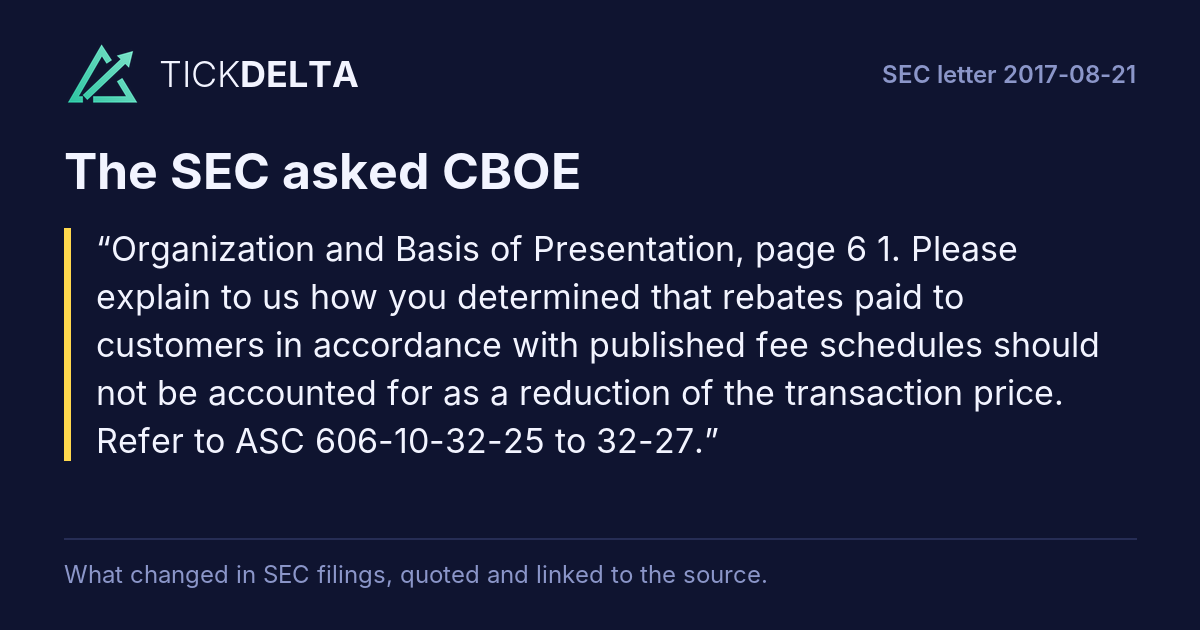
Organization and Basis of Presentation, page 6 1. Please explain to us how you determined that rebates paid to customers in accordance with published fee schedules should not be accounted for as a reduction of the transaction price. Refer to ASC 606-10-32-25 to 32-27.
In applying ASC 606-10-32-25, we identified two types of rebates paid to customers. The first type are tiered discounts offered to customers based on the amount of trades that are executed on our exchanges. As these are volume driven, they reduce the transaction price and are recorded net in transaction fees on the consolidated statements of income. The second type of rebates paid to customers are liquidity payments, which we consider a distinct transaction and record as a cost of revenue in liquidity payments on the consolidated statements of income.Read in the reply ↗Rest of the answer
We believe that providing (or removing) liquidity is a distinct service that is provided by customers, as we benefit from having an enhanced liquidity pool available on our markets, and that it is separately identifiable given its separation on the published fee schedules. We believe the enhanced liquidity pool attracts order flow and promotes order execution on our trading platforms. Through enhanced order flow, and therefore higher market share, we also earn additional market data revenue from the Securities Information Processor (SIP) plans and the Options Price Reporting Authority (OPRA), and our own proprietary market data becomes more valuable as more trades are included. Also as our market share grows, so does the need for our customers to become connected to markets, which results in higher connectivity revenue. Therefore, we account for the purchase of this service from our customers as an expense, just as we would account for the purchase of services acquired from any other vendor, in accordance with ASC 606-10-32-26.
For clarity, in future filings, we propose amending the paragraph below found on page 6 by removing the italicized phrase as follows:
In 2017, the Company changed the presentation of liquidity payments, or rebates paid to customers in accordance with published fee schedules, to be a cost of revenues, which historically had been netted against transaction fees. The Company also changed the presentation of royalty fees to be a cost of revenues. The presentation of routing fees and costs were also changed. Routing fees were presented in transaction fees in total revenues and routing and clearing costs in total cost of revenues. These fees were previously presented as a net operating expense. These changes were made to conform to current presentation and the changes have been reflected in all periods presented.
First report after the company's reply of 2017-09-01: 10-Q filed 2017-11-07 ↗, against the 10-Q filed 2017-08-04 ↗.
Tickdelta does not hold the text of both reports, so they are not compared here.
Revenue Recognition, page 8 2. We note your disclosure that you recognize revenue for certain services over time. Please tell us how you considered the requirements in ASC 606-10-50-13 to 50-15 to disclose information about remaining performance obligations or application of optional exemptions.
In our analysis of ASC 606, we considered certain revenue streams as services transferred over time. Primarily, these revenue streams are recorded in access fees, exchanges services and other fees, and market data fees on our consolidated statements of income. The nature of the services provided in these streams are subscription-based where the customer is billed monthly for its subscription to our market data or its monthly connectivity to our markets. While the services are provided over time, the revenue amounts are known and recognized monthly.Read in the reply ↗Rest of the answer
Therefore there are no remaining performance obligations related to these services transferred over time at the end of the reporting period.
The balance of contract liabilities at the end of the reporting period that required disclosure under ASC 606-10-50-13 primarily consisted of prepayments of transaction fees and certain access and market data fees, both of which have been categorized in the respective point-in-time or over-time categories as determined by the nature of the revenue stream. Based on the amount of total deferred revenue disclosed in the table on page 10, we determined that any remaining performance obligations that would require disclosure under ASC 606-10-50-13 were immaterial to our financial statements, and as such, we omitted the disclosure.
First report after the company's reply of 2017-09-01: 10-Q filed 2017-11-07 ↗, against the 10-Q filed 2017-08-04 ↗.
Tickdelta does not hold the text of both reports, so they are not compared here.
Also in this review: closing letter, 2017-09-28