27 paragraphs in Risk Factors of the 10-K filed Feb 24, 2026
with nothing like them in the 10-K filed Feb 18, 2025. Quoted exactly.
Paragraphs that were only edited are under 10-K change.
Compared with the Risk Factors in the latest 10-K of the other 30 Utilities companies:
a paragraph with at least half its words the same at another company is called similar, and the companies are listed under it.
A paragraph most of them have is marked boilerplate. No line means no other company has one like it.
This counts text; it does not say how serious a risk is.
Market Design. The wholesale markets vary from region to region with distinct rules, practices, and procedures. Changes in these market rules, problems with rule implementation, or failure of any of these markets could adversely affect our business with little notice. The imposition of price caps, the issuance of orders extending the operation of generation resources slated for retirement, the imposition of requirements that new large load secure supply from new generation resources or agree to be interrupted, policies allowing utility-owned generation in restructured states, and policies favoring new resources at the expense of existing resources may lead to a market design that results in the premature retirement of existing resources, which would negatively affect our portfolio of assets as well as the market as a whole. For example, PJM is considering market rule changes as part of its stakeholder process, and the Trump administration, in conjunction with Governors of PJM states, have proposed a framework to govern new load connection and the generation that can serve that load. The outcome of this process is uncertain. See Item 7. Management’s Discussion and Analysis of Financial
Condition and Results of Operations - Other Key Business Drivers for additional information on proposed PJM market reforms.
Read in the 10-K ↗
Expiration or termination of our PPAs and other contractual agreements may significantly reduce our revenue and allow the counterparty or customer to seek liquidated damages.
A material portion of our portfolio is sold under PPAs that expire at various times. We seek to extend contracts or sell any generation not sold under PPAs on a short-term basis as market opportunities arise. Our non-contracted generation is generally sold on the spot market at current market prices as merchant energy. When the terms of each of our various PPAs expire, it is possible that the price paid to us for generation under subsequent arrangements or in short-term markets may be significantly less than the price paid to us under the PPA. Without the benefit of PPAs, we may not be able to sell any or all of the capacity from these generation facilities at commercially attractive rates, and these generation facilities may not be able to operate profitably.
The counterparty or customer may terminate or fail to comply with the terms of our PPAs, construction agreements, commodity contracts, maintenance agreements and other contractual arrangements. Additionally, if we fail to meet our contractual obligations they may seek to enforce the liquidated damages provisions contained in such agreements.
Read in the 10-K ↗
Following the Calpine acquisition in January 2026, we have several government awards for projects involving cost-share agreements with the DOE, which could be affected by our inadvertent failure to comply with certain laws, rules, and regulations.
At five facilities, Calpine has completed or commenced front-end engineering design studies for post-combustion CCUS technology and has also received funding from the DOE for certain geothermal drilling technologies for the Geysers Assets.
As a recipient of federal funds under grants and cooperative agreements, in addition to our ordinary contractual obligations, we must comply with various rules and regulations applicable to entities that perform awards in support of government entities. Many of these additional obligations are contained in the terms of the awards themselves and in federal regulations, which regulate the formation, administration and performance of non-procurement federal financial assistance awards, which are subject to change. We must also comply with various national policy requirements prescribed by statute, executive order, policy guidance issued by the Executive Office of the President or other regulations subject to change.
Additionally, our contractors must also comply with these federal requirements, and any non-compliance by our contractors or their subcontractors could similarly affect our grant status and expose us to additional risks and liabilities. While we will continue to implement audits and monitor contractual rights for our contractors, failure by our contractors to comply with all regulatory requirements fully could materially affect our business and prospects.
Our performance under our U.S. government awards and our compliance with the terms of those awards and applicable laws and regulations are subject to periodic investigation audits, reviews and investigations by various U.S. government agencies. The current environment may lead to increased regulatory scrutiny and sanctions for non-compliance by such agencies.
Compliance with these laws and regulations affects how we do business and may impose added costs on our business. Failure to comply may lead to penalties, including whole or partial suspension or termination of our U.S. government awards and/or suspension or debarment from contracting with federal agencies.
Read in the 10-K ↗
We are subject to risks associated with weather, including its effect on the supply and demand for electricity, as well as impacts from climate change, including extreme weather events.
Read in the 10-K ↗
Various forms of power generation and energy-intensive activities, such as data centers, depend on water access to operate. Certain of our assets in the West and Texas Regions, including Calpine's Geysers Assets acquired in January 2026, have experienced drought conditions in the recent past. Disruptions in water
availability such as droughts, curtailment, or high prices may impact our ability to generate energy or serve customers, adversely impacting our operations and financial condition. Further, disruptions in water availability at the Geysers Assets may affect the water injection program, steam production and generation levels.
Read in the 10-K ↗
We are subject to certain risks associated with the operation and maintenance of generation facilities.
Similar paragraph at 5 of 30 other Utilities companies:
EVRG,
EXC,
NI,
PPL,
XEL
In addition, we depend on facilities and assets that we do not own or control for the transmission to our customers or the distribution to our generation facilities. If these transmission and distribution systems are disrupted or the capacity of those systems is inadequate, our ability to sell and deliver power products or obtain fuel may be hindered.
Read in the 10-K ↗
We do not procure the fuel for the sites we do not operate. If the operator is unable to procure fuel sufficient to operate the plant or at an uneconomical price, our results of operations could be adversely impacted.
Read in the 10-K ↗
5 more
The productivity of Calpine's geothermal resources acquired in January 2026 may be lower than expected, and it is possible that certain of leases for geothermal steam fields may not be renewed or may be renewed at less favorable terms.
Geothermal resource productivity can decline unexpectedly, leading to insufficient reserves for sustained power generation at desired power capacity. Mismanagement or inaccurate estimates of steam reserves could adversely affect our results of operations or financial condition.
Geothermal steam fields are leased for the Geysers Assets, with most leases lasting 5 to 20 years initially and continuing as long as resources are produced and sold. Many leases are over 30 years old and remain active. Federal leases start at 10 years and can be renewed for up to 50 years. Most other leases continue for the economic life of the assets, with renewal options if resources remain commercially viable. While we expect to renew leases as needed, some may not be renewed or could have less favorable terms.
Read in the 10-K ↗
Our acquisition of Calpine in January 2026 introduces expanded cybersecurity and physical security risks. As part of the integration, we have and expect to continue to evolve our systems, processes, and technical controls in connection with Calpine's information technology and operational technology. Our acquisition of Calpine and the visibility of the transaction will likely increase attention from potential cyber threat actors, potential insider threats, and opportunistic adversaries.
Read in the 10-K ↗
The rapid development and integration of AI technologies into our processes presents several risks to our business.
The use of AI technologies in our operations presents risks that could adversely affect our business, financial condition, results of operations and reputation. AI systems, whether developed internally or used by our vendors, service providers or business partners, may produce inaccurate, biased or misleading outputs or experience errors, security vulnerabilities or other failures, which could result in operational disruptions, flawed decision‑making, data loss, cybersecurity incidents or reputational harm. The use of AI may also increase the risk of inadvertent disclosure or misuse of proprietary, confidential or personal information. In addition, the legal and regulatory landscape governing AI technologies is rapidly evolving and uncertain, and compliance with new or changing requirements may impose significant costs or limit our ability to develop, deploy or use AI. If we fail to keep pace with the rapid evolution of AI technologies in our industry and the segments we serve, our competitive position and business results could be negatively impacted.
Read in the 10-K ↗
Some of Calpine's geothermal, natural gas power plants, and battery storage sites, which were acquired in January 2026 are exposed to frequent minor earthquakes and wildfire risks, mainly in the West. Severe weather and wildfires, especially in California, have disrupted operations and damaged assets like the Geysers Assets. Such events can cause injuries, property damage, and service interruptions, resulting in significant liabilities. Electric utilities may shut down power for public safety reasons during periods of extreme fire hazard. Any shutdown that halts operation at our power plants may reduce our revenues.
Read in the 10-K ↗
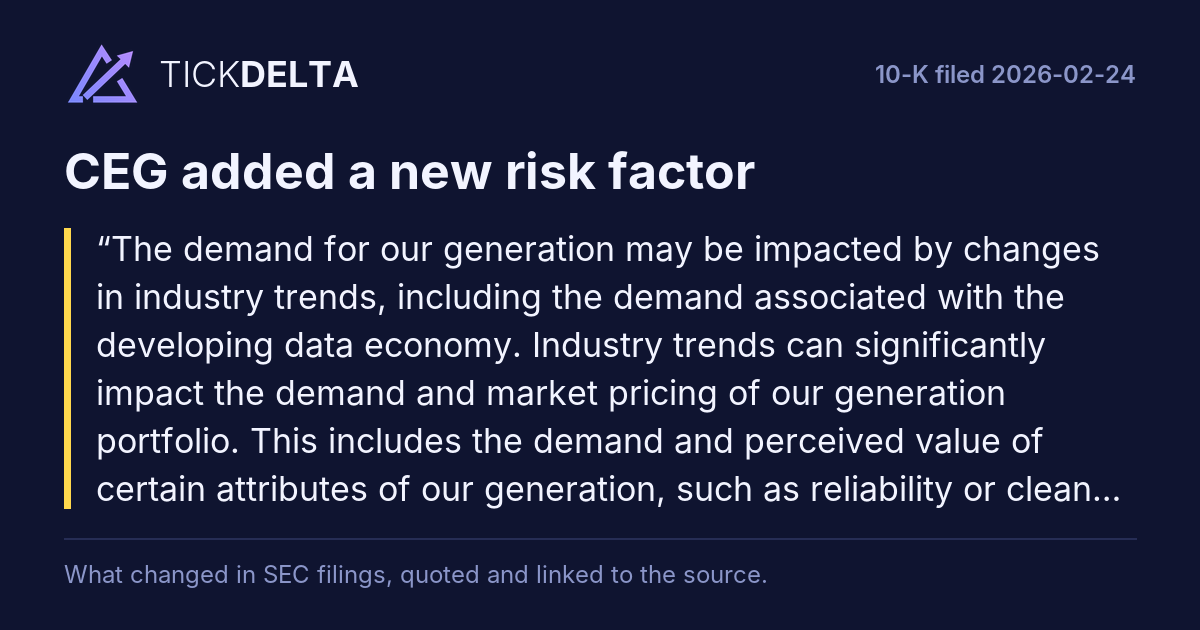
The demand for our generation may be impacted by changes in industry trends, including the demand associated with the developing data economy.
Industry trends can significantly impact the demand and market pricing of our generation portfolio. This includes the demand and perceived value of certain attributes of our generation, such as reliability or clean energy, as well as the overall demand for energy in the markets in which we operate.
Recently, we have benefited from increased demand for our generation as a result of the developing data economy, including demand driven by data centers and AI and other high-performance computing applications, evidenced by the execution of long-term contracts with technology companies as well as increased interest in prospective contracts from our customers. Demand associated with data centers and AI applications may be subject to technological change, shifts in customer behavior, regulatory developments, or changes in capital investment cycles and may not grow at the pace currently anticipated by the market. Our results of operations, growth opportunities, and the price of our common stock could be adversely impacted if the demand for energy driven by the data economy does not continue or fails to achieve current market expectations.
Read in the 10-K ↗
New in the latest 10-Q
21 paragraphs in the 10-Q filed Nov 9, 2026 with nothing like
them in the 10-Q filed Aug 6, 2026 (at least half the words must differ; new numbers alone do not count).
Quoted exactly, grouped by the item heading above them. This is text that changed, not a judgement of how serious it is.
Financial statements and notes
In September 2026, we entered into an agreement to acquire all of the equity interests in RISEC Holdings, LLC, the owner of the Rhode Island State Energy Center, from Shell Energy North America (US), L.P. for $ 715 million, subject to customary purchase price adjustments. The Rhode Island State Energy Center is a natural gas-fired combined-cycle electric generation facility with a generating capacity of 609 MW. Completion of the transaction is subject to receipt of required regulatory approvals and other customary closing conditions.
Read in the 10-Q ↗
Under the terms of the DOJ resolution, which provided the final regulatory clearance for the merger, we were required to enter into definitive agreements to divest our minority interest in the Gregory Power Plant, five generation assets in PJM, and the Brazos Valley Energy Center (f/k/a Jack A. Fusco Energy Center) in ERCOT within 240 days after the acquisition closed, or by September 4, 2026.
Read in the 10-Q ↗
In January 2026, we completed the divestiture of Calpine's minority ownership interest in the Gregory Power Plant for $ 136 million. In October 2026, we completed the divestiture of the Brazos Valley Energy Center, a 606 MW natural gas-fired plant in ERCOT, to LS Power Equity Advisors, LLC (LS Power) for $ 860 million before closing adjustments, which we expect to result in a gain on sale of approximately $ 250 million in the fourth quarter of 2026.
Read in the 10-Q ↗
including the NRC comprehensive safety and environmental review, as well as permits from relevant state and local agencies.
Read in the 10-Q ↗
that are not significant to our overall results of operations. Further, our unrealized gains and losses on economic hedging activities and our amortization of certain intangible assets and liabilities relating to commodity contracts recorded at fair value from mergers and acquisitions are also excluded from the reportable segment amounts. The CODM does not use a measure of total assets in making decisions regarding allocating resources to or assessing the performance of these reportable segments.
Read in the 10-Q ↗
allowance for credit losses is not materially impacted by our sale of receivables under supplier tariffs with recourse.
Read in the 10-Q ↗
• Increase of $ 127 million due primarily to higher escalation rates partially offset by higher discount rates and SNF shipment timing.
Read in the 10-Q ↗
(e) In October 2026, we cancelled any outstanding letters of credit and terminated all commitments under the CDHI Revolver as part of the facility termination.
Read in the 10-Q ↗
In October 2026, we completed the divestiture of the Brazos Valley Energy Center (f/k/a Jack A. Fusco Energy Center), a 606 MW natural gas-fired plant in ERCOT, to LS Power for $860 million before closing adjustments.
Read in the 10-Q ↗
In September 2026, we announced a 20-year, 690 MW PPA with Amazon and a related retail supply agreement supporting Amazon's operations in PJM. The agreements will enable more than $3 billion of investment in our Calvert Cliffs Clean Energy Center, including facility improvements and a 190 MW capacity expansion expected to come online between 2030 and 2032, while supporting the facility's continued operation and future relicensing.
Read in the 10-Q ↗
In October 2026, we announced a 20-year PPA with Google that will enable more than $4.3 billion of investment across 11 of our nuclear units in Illinois, Pennsylvania, and New Jersey to add approximately 890 MW of incremental generation capacity to the PJM grid, with the first uprate expected in 2028. We also entered into a 15-year financial energy load following agreement with Google for 2,700 MW in PJM.
Read in the 10-Q ↗
These agreements reflect continued demand from large-load customers for reliable, clean energy. Realization of the anticipated investments and capacity expansions remains subject to regulatory approvals, successful completion of the planned uprates, continued operation and relicensing of the applicable facilities, and other conditions.
Read in the 10-Q ↗
In September 2026, we entered into an agreement to acquire all of the equity interests in RISEC Holdings, LLC, the owner of the Rhode Island State Energy Center, from Shell Energy North America (US), L.P. for $715 million, subject to customary purchase price adjustments. The Rhode Island State Energy Center is a natural gas-fired combined-cycle electric generation facility with a generating capacity of 609 MW. The facility sells electricity and capacity into the competitive ISO New England wholesale power market and is expected to become part of our merchant generation portfolio. Completion of the transaction is subject to receipt of required regulatory approvals and other customary closing conditions.
Read in the 10-Q ↗
In July 2026, PJM proposed a one-time reliability backstop procurement. In September 2026, FERC accepted the proposal and suspended it to become effective February 28, 2027, subject to refund and subject to the outcome of a paper hearing. FERC also encouraged PJM to re-file an updated proposal within 30 days rather than proceeding with the paper hearing. PJM submitted an updated auction filing on October 29, 2026 and proposed that the one-time procurement open March 1, 2027 and close on March 28, 2027, with results announced on May 10, 2027. Many of the proposed auction parameters are the same, with the exception that the load forecast that is used to clear the auction will not be finalized until April 28, 2027. Separately, in August 2026, PJM filed its Interim Resource Adequacy Service proposal, which would have imposed curtailment risk on new large loads over 50 MW coming online after June 1, 2027 that did not contract for new capacity. FERC largely rejected the proposal, finding that it improperly intruded on state jurisdiction over retail rates and that PJM had not established the lawfulness of certain provisions. PJM has indicated that they will make a subsequent filing, but no details are available at this time.
Read in the 10-Q ↗
Regulation of GHGs from Power Plants under the Clean Air Act. In February 2026, EPA issued a final rule to repeal the 2009 Endangerment Finding underpinning all GHG regulation by EPA. In September 2026, EPA issued a final rule to repeal its 2024 GHG power plant standards, except for efficiency-based standards that apply to new gas power plants. With the repeal, new baseload gas plants will no longer face compliance obligations based on carbon capture and sequestration/storage beginning in 2032. Both the February 2026 and September 2026 rules have been challenged in the D.C. Circuit. EPA also issued a supplemental proposal in September 2026 to repeal its full suite of power plant GHG regulations, including the efficiency-based standards for new gas power plants, based on its reinterpretation of section 111 of the Clean Air Act. EPA recently accepted comments on the proposal. EPA's approach in the supplemental proposal, if finalized and upheld in court, would limit and/or delay options for future action on climate for the power sector by EPA.
Read in the 10-Q ↗
Noncontrolling Interests(g) (1) — (1) — Adjusted (non-GAAP) Operating Earnings $ 1,792 $ 5.06 $ 952 $ 3.04 Nine Months Ended September 30, 2026 2025 (In millions, except per share data) Earnings Per Share(a) Earnings Per Share(a) GAAP Net Income (Loss) Attributable to Common Shareholders $ 3,938 $ 11.06 $ 1,887 $ 6.02 Unrealized (Gain) Loss on Fair Value Adjustments (net of taxes of $175 and $163, respectively)(b) (508) (1.43) 478 1.52 Decommissioning-Related Activities (net of taxes of $354 and $426, respectively)(c) (339) (0.95) (242) (0.77) Amortization of Acquired Commodity Contracts (net of taxes of $117 and $—, respectively)(d) 342 0.96 — — Calpine Merger and Integration Costs (net of taxes of $69 and $17, respectively)(e) 276 0.77 50 0.16 Plant Retirements and Divestitures (net of taxes of $3 and $4, respectively) (9) (0.03) 13 0.04 Pension & OPEB Non-Service (Credits) Costs (net of taxes of $22 and $9, respectively) 65 0.18 27 0.09 Change in Legal and Environmental Liabilities (net of taxes of $15 and $1, respectively) 44 0.12 2 0.01 Income Tax-Related Adjustments(f) (121) (0.34) 13 0.04 Noncontrolling Interests(g) (4) (0.01) (4) (0.01) Adjusted (non-GAAP) Operating Earnings $ 3,684 $ 10.34 $ 2,224 $ 7.09
Read in the 10-Q ↗
(f) Adjustment to deferred income taxes due to changes in forecasted apportionment.
Read in the 10-Q ↗
• Favorable net adjustments to deferred income taxes due to changes in forecasted apportionment.
Read in the 10-Q ↗
• Favorable net adjustments to deferred income taxes due to changes in forecasted apportionment; and
Read in the 10-Q ↗
• Unfavorable interest expense primarily driven by increased long-term debt outstanding; and
Read in the 10-Q ↗
significant activity. Prices reflect the weighted average prices for the various auction periods within the three and nine months ended September 30, 2026 and 2025.
Read in the 10-Q ↗
The 10-Q's risk factors against the 10-K
Item 1A of the 10-Q filed Nov 9, 2026 against Item 1A of the 10-K filed Feb 24, 2026.
A 10-Q repeats only the risks that changed, so a 10-K paragraph that is missing from it is not counted as removed.
Added is a paragraph with nothing like it in the 10-K, Reworded a sentence that is in both with several words changed,
Quiet changes a sentence in both where one to four words changed and one is a hedge or a modal
(cut words struck through, new words highlighted and underlined).
Text on the page, not a score; each links to the filing at sec.gov.
What the 10-Q itself says about its risk factors:
At September 30, 2026, our risk factors were consistent with the risk factors described in our 2025 Form 10-K in ITEM 1A. RISK FACTORS which was inclusive of the risks related to the Calpine acquisition and its operations.
Read in the 10-Q ↗
Added10-Q 2026-11-09 vs 10-K 2026-02-24
During 2026, our Board of Directors approved a $4.4 billion increase relative to the remaining $0.6 billion authorization under our share repurchase program. No other repurchase plans or programs have been authorized. As of the date of this filing, we have approximately $2.0 billion of remaining authority for repurchases. See Note 16 - Shareholders' Equity of the Combined Notes to Consolidated Financial Statements for additional information regarding our share repurchase program.
Read it in the 10-Q at sec.gov ↗
Added10-Q 2026-11-09 vs 10-K 2026-02-24
The following table provides information regarding our share repurchases under the program during the three months ended September 30, 2026.
Read it in the 10-Q at sec.gov ↗
Added10-Q 2026-11-09 vs 10-K 2026-02-24
(a) We have not made any purchases of shares other than in connection with the publicly announced share repurchase program described above.
Read it in the 10-Q at sec.gov ↗
Added10-Q 2026-11-09 vs 10-K 2026-02-24
(b) Approximate dollar value of shares that may yet be purchased under the program includes taxes and commissions.
Read it in the 10-Q at sec.gov ↗
Reworded10-Q 2026-11-09 vs 10-K 2026-02-24
See Note 10 — Asset Retirement Obligations 16 - Shareholders' Equity of the Combined Notes to Consolidated Financial Statements for additional information.
Read it in the 10-Q at sec.gov ↗ · The 10-K sentence ↗