9 paragraphs in Risk Factors of the 10-K filed Feb 10, 2026
with nothing like them in the 10-K filed Feb 11, 2025. Quoted exactly.
Paragraphs that were only edited are under 10-K change.
Compared with the Risk Factors in the latest 10-K of the other 81 Industrials companies:
a paragraph with at least half its words the same at another company is called similar, and the companies are listed under it.
A paragraph most of them have is marked boilerplate. No line means no other company has one like it.
This counts text; it does not say how serious a risk is.
We manufacture, sell and service products globally and rely upon a global supply chain to deliver the raw materials, components, systems and parts that we need to manufacture and service our products. There is currently significant uncertainty about the future relationship between the U.S. and various other countries with respect to tariffs and other trade disruptions (such as embargoes, sanctions and export controls). The uncertain tariff environment, marked by the U.S. imposition of tariffs on certain countries, followed by the imposition of retaliatory tariffs on U.S. goods and services by certain countries has introduced significant market volatility and raised concerns about potential economic impacts. The extent to which tariffs and/or other trade disruptions will be enacted and the duration for which enacted tariffs and/or other trade disruptions will be in place remain uncertain and could adversely impact our production costs, customer demand and our relationships with customers and suppliers. Any of these consequences could have a material adverse effect on our results of operations, financial condition and cash flows. In addition, our compliance with any such newly enacted tariffs and/or other trade disruptions is likely to require significant resources and data management systems and could increase our cost of doing business, restrict our ability to operate our business or execute our strategies, and could result in fines and penalties or reputational harm if we are found to not be in full compliance.
Read in the 10-K ↗
Deregulation could impair our investments in future products and negatively impact our long-term growth and competitiveness.
Our strategy includes significant investments in the development of new products and technologies, particularly those designed to meet or exceed current and anticipated regulatory requirements related to emissions, safety and environmental performance. Any significant reduction, delay, or elimination of, or failure to adopt or enforce, such regulatory requirements in key markets could reduce or delay demand for our products and services, increase our costs of producing or delay the introduction of new or modified products and services or restrict our existing activities, products, and services. In addition, any discontinuation or reduction of incentives or benefits for the development of technologies limiting the impact of climate change, or significant uncertainty regarding such efforts, may cause demand for certain of our future products to be less than we anticipate. Any such change in regulatory requirements or incentives may ultimately weaken or render obsolete the business case for certain research and development initiatives or capital investments. As a result, we may be required to reassess, scale back or discontinue investments in future products that were originally intended to address more stringent regulatory standards, and may fail to realize the intended benefits of, or recover the investments we have already made in, developing new products and technologies. In addition, the adoption of new regulations or industry standards which our products and services are not positioned to address, could adversely affect demand for our products and services.
Deregulation or reduction in incentives may also lead to reduced industry-wide innovation, as both we and our competitors could deprioritize or delay the introduction of advanced technologies that are no longer mandated. This could limit our ability to differentiate our products, respond to evolving customer expectations or maintain leadership in markets where regulatory requirements remain in place or are later reinstated. Furthermore, if we have already made substantial investments in anticipation of future regulations that are subsequently rolled back, we may not be able to recover those costs, which could result in asset impairments or reduced returns on investment.
Any of these outcomes could adversely affect our long-term growth prospects, competitive position and financial results.
Similar paragraph at 3 of 81 other Industrials companies:
AXON,
FTV,
GEV
If the energy transition landscape changes faster than anticipated or in a manner that we do not anticipate, demand for our products and services, as well as our relationships with various stakeholders, could be adversely affected. Alternatively, if the energy transition occurs more slowly than anticipated, demand for our new products and technologies may be lower than expected or we may need to reassess, scale back or discontinue investments in future products, and as a result, we may fail to realize the anticipated benefits of our investments in new products and technologies. Furthermore, if we fail or are perceived to not effectively implement an energy transition strategy, or if investors or financial institutions shift funding away from companies in fossil fuel-related industries, our access to capital or the market for our securities could be negatively impacted.
Read in the 10-K ↗
We are incorporating AI solutions into our business, products, services and features, and we are leveraging AI, including generative AI, machine learning and similar tools and technologies, in our product development, operations and software programming. There is inherent risk and uncertainty involved in using AI. The use of AI in the development of our products and services could cause loss or theft of intellectual property, as well as subject us to risks related to intellectual property infringement or misappropriation, data privacy and cybersecurity. The use of AI by us, our vendors or our suppliers can lead to unintended consequences, including
generating content that appears correct but is factually inaccurate, misleading or otherwise flawed, or that results in unintended biases and discriminatory outcomes, which could harm our stakeholders, our reputation and our business and expose us to risks related to inaccuracies or errors in the output of such technologies. If the AI tools that we use are deficient, inaccurate or controversial, we could incur operational inefficiencies, competitive harm, legal liability, brand or reputational harm, or other adverse impacts on our business and financial results. If we do not have sufficient rights to use the data or other material or content on which the AI tools we use rely, we also may incur liability through the violation of applicable laws and regulations, third-party intellectual property, data privacy, or other rights or contracts to which we are a party. In addition, our personnel could, unbeknownst to us, improperly utilize AI and machine learning-technology while carrying out their responsibilities.
Similar paragraph at 3 of 81 other Industrials companies:
HII,
JCI,
NDSN
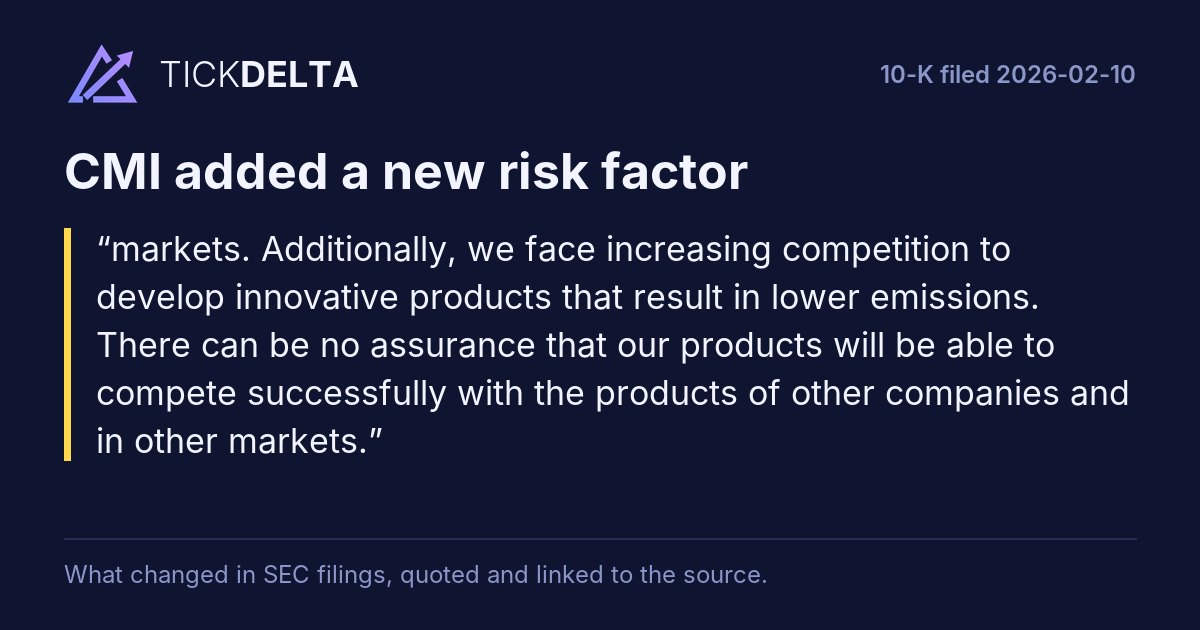
markets. Additionally, we face increasing competition to develop innovative products that result in lower emissions. There can be no assurance that our products will be able to compete successfully with the products of other companies and in other markets.
Read in the 10-K ↗
New in the latest 10-Q
11 paragraphs in the 10-Q filed Nov 5, 2026 with nothing like
them in the 10-Q filed Aug 4, 2026 (at least half the words must differ; new numbers alone do not count).
Quoted exactly, grouped by the item heading above them. This is text that changed, not a judgement of how serious it is.
Financial statements and notes
In September 2026, two wholly-owned subsidiaries, Hydrogenics Corporation and Hydrogenics Europe N.V. (Hydrogenics), issued a stop-use recommendation to customers of HyLYZER electrolyzer products following a planned review of operational data from the installed fleet (Electrolyzer Matter). At this time, Hydrogenics has not initiated a recall campaign and continues to evaluate, which, if any, modifications are required with respect to returning the electrolyzers to service. While we have not been able to estimate the costs associated with the Electrolyzer Matter, there can be no assurance that the final resolution of the Electrolyzer Matter will not have a material adverse effect on results of operations or cash flows.
Read in the 10-Q ↗
Amounts reclassified from accumulated other comprehensive income (loss) (1) 9 — (4) 5 — 5
Read in the 10-Q ↗
Amounts reclassified from accumulated other comprehensive income (loss) (1) 7 — (5) 2 — 2
Read in the 10-Q ↗
Net current period other comprehensive income (loss) 8 (49) (3) (44) $ (18) $ (62)
Read in the 10-Q ↗
During the third quarter of 2025, in our Accelera segment, we observed rapidly deteriorating conditions in our electrolyzer markets and overall hydrogen markets, along with significant uncertainty in the alternative power markets resulting from reductions in government incentives. As a result, we determined that a triggering event occurred for our electrolyzer reporting unit, warranting an interim impairment test of goodwill and the related asset group. We also re-evaluated the recoverability of certain inventory in this business due to the declining customer demand, resulting in a $ 30 million excess and obsolete inventory write-down. We concluded
Read in the 10-Q ↗
that the undiscounted cash flows exceeded the carrying value of the related asset group and thus an impairment did not exist for the related long-lived assets. However, we determined that on a fair value basis our goodwill was fully impaired and recorded a charge of $ 210 million in other operating expense, net. The fair value of this reporting unit was determined using primarily a discounted cash flow model (a form of the income approach). This model incorporated a number of assumptions and judgements surrounding current market and economic conditions, internal forecasts of future business performance including short and long-term growth rates, earnings or losses before interest expense, income taxes, depreciation and amortization and noncontrolling interests (EBITDA) margins and discount rates. The $ 240 million of charges were non-deductible for income taxes purposes. These non-cash charges were reflected in net cash provided by operating activities as a change in inventory of $ 30 million and other, net of $ 210 million.
Read in the 10-Q ↗
Other information
Name Title Action Taken Date Type of Trading Agreement (1) Duration of Trading Agreement (2) Aggregate Number of Shares to be Sold
Read in the 10-Q ↗
Amy R. Davis Vice President and President - Accelera and Components Adoption 8/25/2026 Rule 10b5-1 trading arrangement 12/24/2026 11,292 shares (3)
Read in the 10-Q ↗
(1) Each trading arrangement marked as a Rule 10b5-1 trading arrangement is intended to satisfy the affirmative defense of Rule 10b5-1(c).
Read in the 10-Q ↗
(2) Each trading arrangement permits transactions through and including the earlier to occur of the completion of all sales under the trading arrangement or the date listed in the table.
Read in the 10-Q ↗
(3) The aggregate number of shares to be sold includes shares subject to the vesting of restricted stock unit and performance share unit awards, and accordingly the actual amount may vary based on tax withholding and satisfaction of performance conditions.
Read in the 10-Q ↗
The 10-Q's risk factors against the 10-K
Item 1A of the 10-Q filed Nov 5, 2026 against Item 1A of the 10-K filed Feb 10, 2026.
A 10-Q repeats only the risks that changed, so a 10-K paragraph that is missing from it is not counted as removed.
Added is a paragraph with nothing like it in the 10-K, Reworded a sentence that is in both with several words changed,
Quiet changes a sentence in both where one to four words changed and one is a hedge or a modal
(cut words struck through, new words highlighted and underlined).
Text on the page, not a score; each links to the filing at sec.gov.
Added10-Q 2026-11-05 vs 10-K 2026-02-10
In addition to other information set forth in this report, you should consider other risk factors discussed in Part I, “Item 1A. Risk Factors” in our Annual Report on Form 10-K for the year ended December 31, 2025, which could materially affect our business, financial condition or future results. The risks described in our 2025 Annual Report on Form 10-K or the “CAUTIONARY STATEMENTS REGARDING FORWARD-LOOKING INFORMATION” in this Quarterly report are not the only risks we face. Additional risks and uncertainties not currently known to us or that we currently judge to be immaterial also may materially adversely affect our business, financial condition or operating results.
Read it in the 10-Q at sec.gov ↗