RemovedRisk Factors
The 10-K against last year's
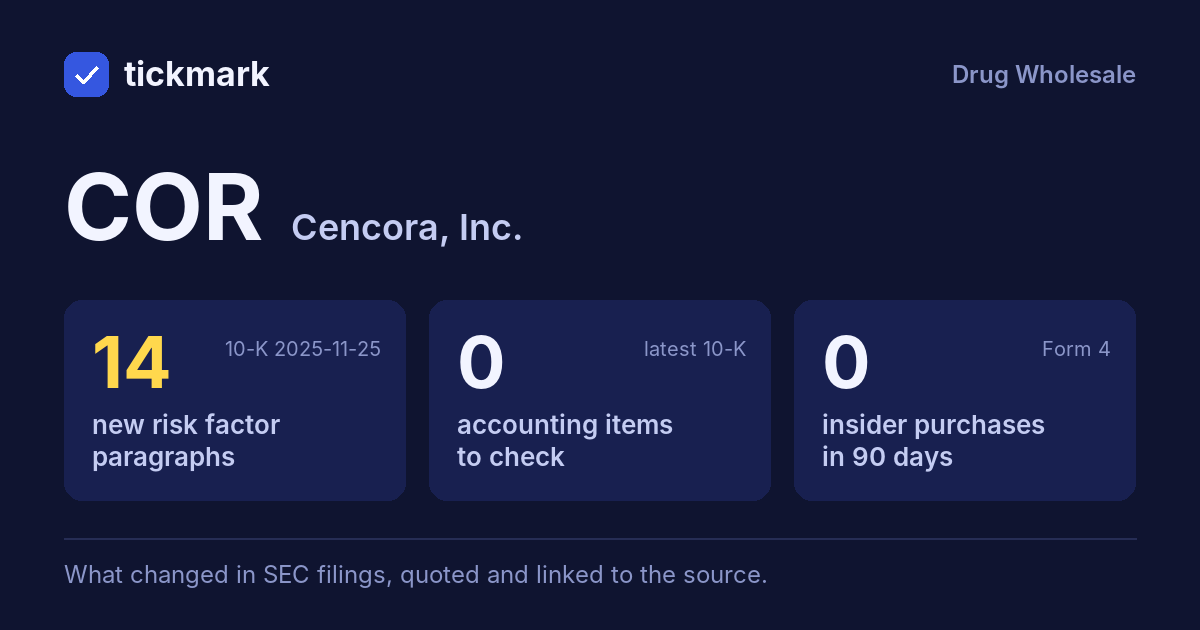
202 changes: 19 added, 19 removed, 160 reworded, 4 quiet changes
10-K 0001140859-25-000131 (Nov 25, 2025) vs 10-K 0001140859-24-000177 (Nov 26, 2024)
The redline
The paragraph that changed most in each section
Marked against last year's 10-K:
cut words struck through, new words highlighted and underlined.
Risk Factors 312 words changed in this paragraph; it is 46% similar to last year's version.
We believe that maintaining and enhancing our reputation is critical to our ability to expand and retain our customer base, strategic partnerships and other key relationships. Any negative publicity about us or our industry may adversely impact our business and operations. Furthermore, any actual or perceived failure to comply with ethical, social, regulatory, product, labor, health and safety, quality, accounting, or environmental requirements or standards could also jeopardize our reputation and potentially lead to various adverse actions, including litigation, audits, investigations, or adverse stakeholder action. Negative claims or publicity, including on social media, could adversely affect our reputation and business, regardless of their accuracy. Our reputation may also depend on the success of our environmental, social and governance ("ESG") initiatives, inclusive of sustainability, social impact and corporate responsibility, which responsibility initiatives that require Company-wide coordination and alignment. Risks associated with these initiatives include, without limitation, alignment among varying jurisdictions. For example, there continues to be an increased focus on ESG targets, goals and disclosure, including by governmental and nongovernmental organizations, organizations on corporate responsibility and sustainability-related actions, targets, and disclosures; increased costs and investment associated with sustainability efforts, corporate responsibility efforts (including supply chain due diligence); and increasing compliance obligations with laws related laws, regulations, and regulations. standards (including the Corporate Sustainability Reporting Directive and the Corporate Sustainability Due Diligence Directive in the EU). Given the varied and at times divergent views of different stakeholder groups, any action or inaction by us with respect to corporate responsibility initiatives may be perceived negatively by some stakeholders. Furthermore, the regulatory landscape surrounding corporate responsibility matters continues to evolve and remains uncertain. All of the foregoing could expose us to market, operational and execution costs or risks. risks, as well as litigation, audits, investigations, or adverse stakeholder action. Any ESG corporate responsibility or sustainability metrics that we currently or may in the future disclose, whether based on the standards that we set for ourselves or those set by third parties, may influence our reputation and the value of our brands. There is also increased continued focus, including by investors, customers, and other stakeholders, on ESG corporate responsibility matters, including with respect to the use of materials, climate change, certain materials and minerals, fleet electrification, sustainable packaging, emissions reporting, waste generation, supply chain, chain diligence, human capital, and health equity and worker safety. Our reputation could be damaged if we do not, or are perceived to not, not to, act responsibly in a way that is aligned with stakeholder expectations with respect to sustainability corporate responsibility matters, which could also have a material adverse effect on our business, financial position, results of operations, and cash flows. the Company.
Source: Item 1A, 10-K 0001140859-25-000131 vs Item 1A, 10-K 0001140859-24-000177
Legal Proceedings 299 words changed in this paragraph; it is 34% similar to last year's version.
In Maryland, a trial commenced on September 16, 2024 in a case filed by the Mayor and City Council of Baltimore in the Circuit Court for Baltimore City. On November 12, 2024, the jury returned a verdict finding ABDC (and another national distributor) liable for public nuisance and assessing approximately $274 million total in compensatory damages, approximately $74 million of which was assessed against ABDC. A second phase of the trial is scheduled to commence began on December 11, 2024 related to the City of Baltimore's Baltimore’s request for an abatement remedy, which will proceed remedy and proceeded as a bench trial. While On June 12, 2025, the judgment is not yet final, Court issued a ruling on the Company is evaluating next steps, including defendants’ post-trial motions relating to the first phase of the trial. The Court upheld the jury’s finding of liability, but granted the defendants a possible appeal. new trial on the extent of damages to correct certain errors and due to the excessive nature of the jury’s damages award. In the alternative, the Court granted remittitur, through which the Court reduced the compensatory damages assessed against ABDC to approximately $14.4 million. The $74 Court issued its ruling regarding the City of Baltimore’s request for abatement on August 8, 2025, assessing approximately $28 million against ABDC for abatement measures, bringing the overall monetary award assessed against ABDC to approximately $42.5 million. On August 14, 2025, the City of Baltimore informed the Court that it would accept the reduced damages award as reflected in the Court’s post-trial ruling, in lieu of a new trial. On September 2, 2025, the Court entered final judgment. In October 2025, ABDC (and the other national distributor) filed a notice of appeal to the Appellate Court of Maryland, and the City of Baltimore filed a notice of cross-appeal. In November 2025, both the City of Baltimore and ABDC (and the other national distributor) filed petitions for a writ of certiorari (bypass) with the Supreme Court of Maryland. If the Court grants the petitions, then the appeal will proceed directly in that Court, instead of in the Appellate Court. The $42.4 million is a component of the Company's $4.9 Company’s $4.3 billion litigation liability as of September 30, 2024 2025, as described below. above.
Source: Item 3, via Note 12 – Legal Matters and Contingencies, 10-K 0001140859-25-000131 vs Item 3, via Note 13 – Legal Matters and Contingencies, 10-K 0001140859-24-000177
MD&A 144 words changed in this paragraph; it is 36% similar to last year's version.
Interest expense, net decreased $71.9 increased $134.6 million, or 31.4%, 85.7%, from the prior fiscal year due to the increase in interest income expense, offset in part by an increase in interest income. The increase in interest expense was primarily due to the issuance of our $1.8 billion of senior notes in December 2024 and the decrease $1.5 billion variable-rate term loan, which we borrowed in interest expense. January 2025 to finance a portion of the RCA acquisition, increased revolving credit facility borrowings to cover short-term working capital needs, and the May 2025 issuance of our €1.0 billion of senior notes, offset in part by the repayment of our $500 million of senior notes that matured in March 2025. The increase in interest income was driven by higher investment interest rates and higher average investment cash balances in the current fiscal year 2025 in comparison to the prior fiscal year. The decrease in interest expense was primarily driven by a decrease in interest expense at our European distribution business primarily due to the September 2023 divestiture of our less-than-wholly-owned subsidiary in Egypt and decreased borrowings in Turkey. 2024.
Source: Item 7, 10-K 0001140859-25-000131 vs Item 7, 10-K 0001140859-24-000177
Accounting Policies 72 words changed in this paragraph; it is 68% similar to last year's version.
In November 2023, the Financial Accounting Standards Board ("FASB") (“FASB”) issued ASU Accounting Standards Update (“ASU”) No. 2023-07, "Segment “Segment Reporting (Topic 280): Improvements to Reportable Segment Disclosures ("ASU 2023-07")." (“ASU 2023-07”).” ASU 2023-07 requires public entities to disclose significant segment expenses on an annual and interim basis and to provide in interim periods all disclosures about a reportable segment's segment’s profit or loss that are currently required annually. ASU 2023-07 is effective for annual periods beginning after December 15, 2023 and interim periods beginning after December 15, 2024. Early adoption is permitted. The guidance should be applied retrospectively to all periods presented in the financial statements. The Company is currently evaluating adopted ASU 2023-07 and retrospectively reflected segment cost of goods sold and segment operating expenses in Note 14. The adoption of ASU 2023-07 had no impact on the impact of adopting this new accounting guidance. Company’s Consolidated Financial Statements.
Source: Item 8, Note 1 – Summary of Significant Accounting Policies, 10-K 0001140859-25-000131 vs Item 8, Note 1 – Summary of Significant Accounting Policies, 10-K 0001140859-24-000177
Every change, by type
Sentences and paragraphs added, removed or reworded
Sentences and paragraphs of COR's Risk Factors and MD&A, 10-K Nov 25, 2025 against 10-K Nov 26, 2024. Each links to the text at sec.gov.
RemovedRisk Factors
RemovedRisk Factors
RemovedRisk Factors
RemovedRisk Factors
RemovedRisk Factors
RemovedRisk Factors
RemovedRisk Factors
Show the other 7
RemovedRisk Factors
RemovedRisk Factors
RemovedRisk Factors
RemovedRisk Factors
RemovedMD&A
RemovedMD&A
RemovedMD&A