tickdelta
Sign in

Tickdelta is free for now. Sign up and get Pro free

← Screener

CPRTCopart

Industrials · Auto Dealers · Nasdaq

We were incorporated in California in 1982, became a public company in 1994, and were reincorporated in Delaware in January 2012. 10-K, Item 1

Headquarters
Dallas, TX
CEO
Jeffrey Liaw
Next results
around Nov 19, 2026
Compare with peers → Embed

When the SEC's staff reviews a filing, it writes to the company with numbered questions, and the company answers each one in a letter. SEC publishes the exchange once the review is over, at least 20 business days later. Below: what the staff asked CPRT, and the company's answer to each question, quoted from the letters. A question is not an accusation; most reviews end with the company adding detail to its next filing.

Form 10-K

2017-01-27 to 2017-02-13 · 2 questions · 1 letter from the SEC, 1 from the company
Review closed 2017-02-13
Results discussion (MD&A)Goodwill and impairmentCritical estimatesRisk factorsLiquidity and cashDebt
Critical Accounting Policies and Estimates · Valuation of Goodwill, page 45
SEC asked (1)
We note your risk factor disclosure on page 23 that testing goodwill requires management to make significant estimates and assumptions. Given the significance of goodwill to your financial position, please expand your disclosure to discuss the degree of uncertainty associated with key assumptions underlying the fair value estimates used in your impairment testing that have the reasonable possibility of changing and
Rest of the question

could lead to a material goodwill impairment charge in the future. In the case of material uncertainties associated with a potential goodwill impairment charge, please also disclose the percentage by which fair value exceeded carrying value. Refer to Item 303(a)(3)(ii) of Regulation S-K and SEC Release No. 34-48960 available on our website at www.sec.gov.

CPRT answered
to the Staff’s comments, the Company will include additional disclosures in its future filings concerning (i) the degree of uncertainty associated with key assumptions underlying the fair value estimates used in the Company’s impairment testing that have the reasonable possibility of changing and could lead to a material goodwill impairment charge in the future, and (ii) the percentage by which fair value exceeded carrying value, in the case of material uncertainties associated with a potential goodwill impairment charge. Read in the reply ↗
In its next report

First report after the company's reply of 2017-02-07: 10-Q filed 2017-02-28 ↗, against the 10-Q filed 2016-11-30 ↗.

Tickdelta does not hold the text of both reports, so they are not compared here.

Note 8 – Long Term Debt, page 76
SEC asked (2)
We note your disclosure in the third paragraph on page 27 that alternative potential uses of your cash balances and cash flows from operations may include the payment of dividends, among other things. We also note your Credit Agreement and Notes Purchase Agreement contain covenants that limit your ability to pay dividends.
Rest of the question

Please describe in future filings the most significant restrictions on the payment of dividends, their pertinent provisions, and the amount of retained earnings or net income restricted or free of restrictions. Refer to Regulation S-X 4-08(e)(1).

CPRT answered
to the Staff’s comments, the Company will include additional disclosures in its future filings concerning the most significant restrictions on the payment of dividends, their pertinent provisions, and the amount of retained earnings or net income restricted or free of restrictions. Read in the reply ↗
In its next report

First report after the company's reply of 2017-02-07: 10-Q filed 2017-02-28 ↗, against the 10-Q filed 2016-11-30 ↗.

Tickdelta does not hold the text of both reports, so they are not compared here.

Also in this review: closing letter, 2017-02-13

Form 10-K

2008-12-17 to 2009-04-02 · 31 questions · 3 letters from the SEC, 3 from the company
Review closed 2009-04-02
RevenueExecutive payResults discussion (MD&A)Liquidity and cashSegmentsCritical estimatesAcquisitionsLeasesDebtDerivatives and hedgingNon-GAAP measuresIncome taxes
Purchases of Equity Securities, page 31 · Performance Graph, page 33
SEC asked (1)
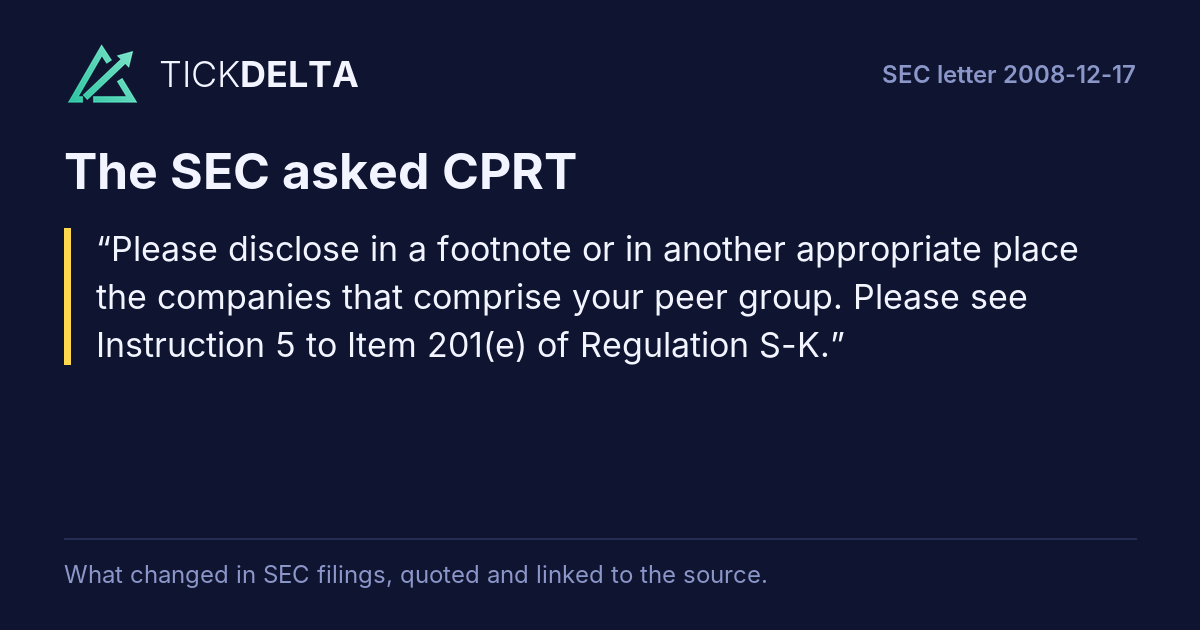
Please disclose in a footnote or in another appropriate place the companies that comprise your peer group. Please see Instruction 5 to Item 201(e) of Regulation S-K.
CPRT answered
to the Staff’s comment, in future filings the Company will disclose in a footnote the companies that comprise its peer group in accordance with Instruction 5 to Item 201(e) of Regulation S-K. Read in the reply ↗
In its next report

First report after the company's reply of 2009-01-21: 10-Q filed 2009-03-12 ↗, against the 10-Q filed 2008-12-10 ↗.

Tickdelta does not hold the text of both reports, so they are not compared here.

Operations, page 35 · Results of Operations, page 37
SEC asked (2)
You disclose in the description of your business that you believe your business has grown as a result of acquisitions, increases in the overall volume in the salvage car market, increases in the amount of revenue generated per sales transaction resulting from increases in gross selling prices and the addition of value added services for both buyers and sellers and the growth in non-insurance company sellers.
Rest of the question

You also disclose various risks and uncertainties related to operating risks. Yet, it does not appear that you have provided an assessment of these trends and uncertainties in your discussion and analysis to enable a reader to ascertain the likelihood that past performance is indicative of future performance. In addition, it does not appear that you have identified and provided a discussion and analysis of the key variables and other qualitative and quantitative factors which are necessary for an understanding and evaluation of the business and results of operations through the eyes of management. Please revise your discussion and analysis to describe known trends and/or uncertainties that have had or that are reasonably likely to have a material impact on revenues or income from operations. Please also provide a discussion and analysis of the key variables and other factors necessary for an understanding of revenues and operating results. For example, consider providing operating data regarding the volume of vehicle sales and revenues per sales transaction in the North American and UK markets for each year and describe the extent to which increases in same stores in North America are attributable to increases in prices or to increases in volume or amount of goods or services sold, or the introduction of new value added services. Similar enhancements should be made to your discussions and analysis of operating expenses for each year. Refer to Item 303(a) of Regulation S-K and the Commission’s Guidance Regarding Management’s Discussion and Analysis of Financial Condition and Results of Operations, Release No 33-8350, available at www.sec.gov.

CPRT answered
to the Staff’s comment, in future filings the Company will disclose in Management’s Discussion & Analysis (MD&A) the principal trends and uncertainties known to management to have had, or that management believes are reasonably likely to have in the future, a material impact on the Company’s results of operations.
Rest of the answer

Naturally, trends identified in

MD&A would not be exclusive, and the Company would continue to identify other trends and uncertainties in its risk factor disclosure.

The Company supplementally informs the Staff that management has identified four primary trends that it believes are currently having or that could in the future have a material impact on revenue or income from operations: commodity pricing, used car pricing, foreign currency exchange rates and accident frequency.

The Company believes that commodity pricing, particularly the per ton price for crushed car bodies, has an impact on the ultimate selling price of vehicles sold for scrap and vehicles to be dismantled. Subsequent to harvesting the valuable car parts by a dismantler, the carcass of the car will often be sold for scrap.

Because a portion of our revenue is based to some extent on the selling price of the vehicle, fluctuations in the average selling price may lead to variations in revenue.

The Company believes that used car pricing has an impact on the ultimate selling price of those vehicles that are purchased for retail sale. Management believes that decreases in the overall used car pricing will tend to reduce the resale value of vehicles that Copart processes and reduce the amount that buyers will pay at auction.

The Company believes that fluctuations in foreign currency exchange rates may have an impact on those cars being purchased for export as, for example, a stronger dollar increases the purchase price paid in our international buyer’s local currency and may lead to a reduction in the ultimate selling price of a vehicle.

The Company cannot know which cars are purchased for scrap, dismantling, resale or for export. Accordingly, the Company cannot quantify the specific impact that fluctuations in commodity pricing, used car pricing and foreign currency exchange rates have on the selling price of vehicles and on the Company’s revenue.

In addition, the Company believes that fluctuations in accident frequency may have a material impact on the number of units sold on behalf of insurance companies since vehicles that are salvaged as a result of a collision or other type of accident are the primary source of vehicles sold. Accident frequency can be correlated, in part, with weather conditions. The Company is not aware of a source of information reported on a contemporaneous basis that would allow the Company to quantify the impact that fluctuations in accident frequency have had or could have on the Company’s revenue or consolidated results of operations.

Further, the Company will in future periods, pursuant to Item 303(a)(3)(iii) of

Regulation S-K, provide a narrative discussion of the extent to which changes in revenue are attributable to changes in prices or to changes in volume or to the introduction of new services. Similar enhancements will be made to the Company’s discussion and analysis of operating expenses in future periods.

Read in the reply ↗
In its next report

First report after the company's reply of 2009-01-21: 10-Q filed 2009-03-12 ↗, against the 10-Q filed 2008-12-10 ↗.

Tickdelta does not hold the text of both reports, so they are not compared here.

Liquidity and Capital Resources, page 40
SEC asked (3)
Please expand this section to discuss known trends, demands, commitments, events or uncertainties that will result in or are reasonably likely to in result in your liquidity decreasing or increasing in any material way and provide additional information about the variability and certainty of cash flows.
Rest of the question

Also identify and separately describe internal and external sources of liquidity, and briefly discuss any material unused sources of liquid assets. In addition, describe material commitments for capital expenditures as of the end of the year, and indicate the general purpose of such commitments and the anticipated source of funds needed to fulfill such commitments. Refer to Item 303(a) of Regulation S-K and the Commission’s Guidance Regarding Management’s Discussion and Analysis of Financial Condition and Results of Operations.

CPRT answered
to the Staff’s comment, in future filings the Company will disclose under the caption Liquidity and Capital Resources the principal trends and uncertainties known to management to have had, or that management believes are reasonably likely to have in the future, a material impact on the Company’s liquidity.
Rest of the answer

The Company will also identify and describe principal internal or external sources of liquidity and material unused sources of liquid assets.

Finally, to the extent applicable, the Company will describe material commitments for capital expenditures, indicate the general purpose of the commitments, and the anticipated source of funds.

The Company supplementally advises the Staff that, historically, the principal operational factor influencing the Company’s liquidity has been seasonality. Specifically, during the winter months, the

Company has historically experienced higher inventories as a result of increased weather-related accident rates, and this trend tends to result in the consumption of working capital.

Subsequently, during the spring and summer, the Company’s working capital position tends to improve as inventories are liquidated and converted to cash. The Company notes that it currently includes disclosure about seasonality in the Liquidity and Capital

Resources sections of its Annual Reports on Form 10-K and its Quarterly

Reports on Form 10-Q. Other principal factors that could affect the Company’s liquidity consist of the same factors that would be expected to have an impact on the Company’s revenues and operating results, including the factors described in response to Comment 2 above and the factors discussed in the Company’s risk factor disclosure. In future filings, the Company will include additional disclosure under Liquidity and Capital Resources, noting that factors affecting the Company’s consolidated operating results, such as those discussed above and under the risk factors caption, would also be expected to have an impact on liquidity.

As noted in the Company’s current disclosure, the Company’s principal source of liquidity is existing cash and short-term investment balances and cash generated by operations. From time to time in the past, the Company has raised money through equity or debt financings but has not raised any material amounts of cash through sales of equity securities since 2001. The

Company did recently enter into a $200 million revolving credit facility with

Bank of America, N.A., which is described in the Company’s current filings. The Company will continue to include in Liquidity and Capital Resources disclosure concerning the facility, including a discussion of debt covenants and potential limitations of the credit facility. As of July 31,

2008, no amounts were outstanding under the Bank of America credit facility.

As indicated, the Company will make appropriate disclosure of material commitments for capital expenditures.

The Company notes, however, that it had no material outstanding commitments for capital expenditures as of July 31, 2008.

Read in the reply ↗
In its next report

First report after the company's reply of 2009-01-21: 10-Q filed 2009-03-12 ↗, against the 10-Q filed 2008-12-10 ↗.

Tickdelta does not hold the text of both reports, so they are not compared here.

Contractual Obligations, page 43
SEC asked (4)
Please disclose whether operating lease obligations include insurance, taxes, maintenance and other costs required by operating lease agreements. Also, provide a context for readers to understand the impact of such costs on your operating lease obligations. See Section IV.A and footnote 46 to the Commission’s Guidance Regarding Management’s Discussion and Analysis of Financial Condition and Results of Operations.
CPRT answered
to the Staff’s comment, in future filings the Company will maintenance and other costs required by operating lease agreements. In addition we will expand the footnote to provide a context for the readers to understand the impact on such costs on our operating lease obligations.

Proposed Footnote Language

The Company leases certain domestic and foreign facilities, and certain equipment under noncancelable operating leases.

In addition to the minimum future lease commitments presented, the leases generally require the Company to pay property taxes, insurance, maintenance and repair costs
Rest of the answer

which are not included in the table because the Company has determined these items are not material.

Read in the reply ↗
In its next report

First report after the company's reply of 2009-01-21: 10-Q filed 2009-03-12 ↗, against the 10-Q filed 2008-12-10 ↗.

Tickdelta does not hold the text of both reports, so they are not compared here.

Critical Accounting Policies and Estimates, page 44
SEC asked (5)
Please revise to describe the material implications of uncertainties associated with the methods, assumptions and estimates underlying your critical accounting measurements that have had or that you reasonably expect will have a material impact on financial condition and operating performance and on the comparability of reported information among periods.
Rest of the question

Such disclosure should supplement, not duplicate, the accounting policies disclosed in the notes to the financial statements. In doing so, please identify those accounting estimates or assumptions where there is a significant amount of subjectivity involved, the estimates or assumptions are susceptible to change, and the impact of the estimates and assumptions on your financial condition or operating performance is material. Discuss, to the extent material, such factors as how you arrived at each estimate, how accurate the estimate/assumption has been in the past, how much the estimate/assumption has changed in the past and whether the estimate/assumption is reasonably likely to change in the future. We would expect you to provide quantitative as well as qualitative disclosure when quantitative information is reasonably available and to provide greater insight into the quality and variability of information regarding financial condition and operating performance. Also, since critical accounting estimates and assumptions are based on matters that are uncertain or difficult to measure, you should analyze and disclose their specific sensitivity to change, based on other outcomes that are reasonably likely to occur and would have a material effect. Please refer to Item 303(a)(3)(ii) of Regulation S-K as well as the Commission’s Guidance Regarding Management’s Discussion and Analysis of Financial Condition and Results of Operations.

CPRT answered
to the Staff’s comment, in future filings the Company will revise its disclosure on critical accounting assumptions and estimates to more fully comply with Item 303(a)(3)(ii) of Regulation S-K and the Commission’s

Guidance Regarding Management’s Discussion and Analysis of Financial Condition and Results of Operations and not simply duplicate the accounting policies disclosed in the notes to the financial statements.
Rest of the answer

The Company has provided updated language below for income taxes and retained insurance liabilities as examples of the types of revisions that will be made in future periods.

Example 1:

Income Taxes and Deferred Tax Assets

We account for income taxes in accordance with SFAS No.109 Accounting for Income Taxes. We are subject to income taxes in the US, Canada and UK. In arriving at a provision for income taxes, we first calculate taxes payable in accordance with the prevailing tax laws in the jurisdictions which we operate; we then analyze the timing differences between the financial reporting and tax bases of our assets and liabilities, such as various accruals, depreciation and amortization. The tax effects of the timing difference are presented as deferred tax assets and liabilities in the consolidated balance sheet. We assess the possibility that the deferred tax assets will be realized based on our ability in generating future taxable income. In the event that it is more likely than not the full benefit would not be realized from the deferred tax assets we carry on our consolidated balance sheet, a valuation allowance is to be established. As of July 31 2008, we had approximately $0.6 million of valuation allowance arising from the net operating losses in states where we had withdrawn our operations in prior years. To the extent we establish a valuation allowance or change the amount of valuation allowance in a period, we reflect the change with a corresponding increase or decrease in our income tax provision in the consolidated statements of income.

Historically, our income taxes have been sufficiently provided to cover our actual income tax liabilities among the jurisdictions we operate in. Nonetheless, our future effective tax rate could still be adversely affected by the following factors, including the geographical allocation of our future earnings, the change in tax laws or our interpretation of tax laws, the changes in governing regulations and accounting principles, the changes in the valuation of our deferred tax assets and liabilities and the outcome of the income tax examinations. As a result, we routinely assess the possibilities of material changes resulting from the aforementioned factors to determine the adequacy of our income tax provision.

Effective August 1, 2008, we adopted

Financial Interpretation No. 48, Accounting for Uncertainty in Income Taxes-an interpretation of FASB Statement No. 109

(FIN 48). FIN 48 contains a two-step approach to recognizing and measuring uncertain tax positions accounted for in accordance with

SFAS No. 109, Accounting for Income

Taxes. The first step is to evaluate the tax position for recognition by determining if the weight of available evidence indicates that it is more likely than not that the position will be sustained on audit, including resolution of related appeals or litigation processes, if any. The second step is to measure the tax benefit as the largest amount that is more than 50% likely of being realized upon settlement.

Although we believe we have adequately reserved for our uncertain tax positions, no assurance can be given that the final tax outcome of these matters will not be different. We adjust these reserves in light of changing facts and circumstances, such as the closing of a tax audit or the refinement of an estimate. To the extent that the final tax outcome of these matters is different than the amounts recorded, such differences will impact the provision for income taxes in the period in which such determination is made. The provision for income taxes includes the impact of reserve provisions and changes to reserves that are considered appropriate, as well as the related net interest Settlement of any particular position could require the use of cash. In addition, we are subject to the continuous examination of our income tax returns by various taxing authorities including the Internal Revenue Service and US states. We regularly assess the likelihood of adverse outcomes resulting from these examinations to determine the adequacy of our income taxes provision.

Example 2:

Retained Insurance Liabilities

We are partially self-insured for certain losses related to medical, general liability, workers’ compensation and auto liability. Our insurance policies are subject to a $250,000 deductible per claim with the exception of our medical policy which is $150,000 per claim.

In addition, each of our policies contains an aggregate stop loss which limits our ultimate exposure. Our liability represents an estimate of the ultimate cost of claims incurred as of the balance sheet date. The estimated liability is not discounted and is established based upon analysis of historical data and actuarial estimates. The primary estimates used in the actuarial analysis include total payroll and revenue. Our estimates have not materially fluctuated from actual results.

While we believe these estimates are reasonable based on the information currently available, if actual trends, including the severity of claims and medical cost inflation, differ from our estimates, our consolidated financial position, results of operations or cash flows could be impacted.

Read in the reply ↗
In its next report

First report after the company's reply of 2009-01-21: 10-Q filed 2009-03-12 ↗, against the 10-Q filed 2008-12-10 ↗.

Tickdelta does not hold the text of both reports, so they are not compared here.

Item 7A. Quantitative and Qualitative Disclosures About Market Risk, page 47
SEC asked (6)
On page 47 you state that “[a]s the interest rates on a material portion of our cash and cash equivalents are variable, a change in interest rates earned on our investment portfolio would impact interest income along with cash flows, but would not materially impact the fair market value of the related underlying instruments.” Please clarify if you consider the potential impact on your interest income and cash flows
Rest of the question

from a potential change in interest rates to be material. If the impact is material, please disclose the information regarding this market risk required under Item 305(a) and (b) of Regulation S-K. If you do not believe you are required to disclose this information, please advise why you believe you are not required to disclose it.

CPRT answered
The Company supplementally informs that Staff that during the year the

Company maintained an average cash balance of $109.7 million on which the

Company generated an average yield of 3.85%.

Accordingly, management believes that a 10% change in our average yield would not have a material impact on net income and operating cash flows. We will disclose this in future filings. Read in the reply ↗
In its next report

First report after the company's reply of 2009-01-21: 10-Q filed 2009-03-12 ↗, against the 10-Q filed 2008-12-10 ↗.

Tickdelta does not hold the text of both reports, so they are not compared here.

Item 7A. Quantitative and Qualitative Disclosures About Market Risk, page 47
SEC asked (7)
On page 47 you indicated that you have exposure to foreign currency transactions gains and losses arising from the translation of the assets and liabilities of your Canadian and U.K. subsidiaries to U.S. dollars during consolidation. Please discuss what actions you take, if any, to mitigate this particular market risk or advise why you believe you are not required to disclose it.
Rest of the question

Please refer to Item 305(b) of Regulation S-K.

CPRT answered
The Company supplementally informs the Staff that the Company currently takes no action to mitigate our exposure to foreign currency transactions gains and losses arising from the translation of the assets and liabilities of our

Canadian and UK subsidiaries to US dollars during consolidation, as disclosed in Item 7A, Quantitative and Qualitative Disclosures about Market Risk. The Company will disclose in future filings any changes to our risk mitigation practices related to foreign currency exchange rates. Read in the reply ↗
In its next report

First report after the company's reply of 2009-01-21: 10-Q filed 2009-03-12 ↗, against the 10-Q filed 2008-12-10 ↗.

Tickdelta does not hold the text of both reports, so they are not compared here.

Note (1) Summary of Significant Accounting Policies, page 64 · Foreign Currency translation, page 64
SEC asked (8)
Please tell us, and disclose if material, the aggregate transaction gain or loss included in determining net income for each year presented. Please refer to paragraph 30 of SFAS 52.
CPRT answered
The Company supplementally informs the Staff that the aggregate amounts of loss from foreign currency translation included in determining net income were $36,000 in 2008 and less than $1,000 in each 2007 and 2006. These amounts are immaterial and, accordingly, were not separately disclosed in the financial statements or footnotes. The Company will disclose in future filings, if material, the aggregate transaction gain or loss in determining net income. Read in the reply ↗
In its next report

First report after the company's reply of 2009-01-21: 10-Q filed 2009-03-12 ↗, against the 10-Q filed 2008-12-10 ↗.

Tickdelta does not hold the text of both reports, so they are not compared here.

Revenue Recognition, page 65
SEC asked (9)
Please separately state net revenues from vehicles sales, remarketing services and other sources, such as annual registration fees, on the face of the consolidated statements of income. Please also separately state costs and expenses applicable to vehicles sales, remarketing services and other revenue sources. Refer to Rule 5-03(b) of Regulation S- X.
Rest of the question

Please note that income, and related costs and expenses, from each class described in Rule 5-03(b) of Regulation S-X which is less than 10 percent of total revenues may be combined. Please show us what your revised disclosure would look like for each year presented and tell us the classes combined pursuant to Rule 5-03(b).

CPRT answered
The Company’s revenues are principally generated through the remarketing of vehicles on behalf of sellers or, in some cases, for the Company’s own account though the Company’s internet selling platform Virtual Bidding

Second Generation (VB(2)). Whether vehicles are remarketed on behalf of sellers or on our account, the receiving, recording and handling processes are identical for both types of vehicles.
Rest of the answer

All vehicles are sold on the same Internet auction platform to the same buyers with the same terms and conditions.

Further, the Company’s obligation to purchase a vehicle does not arise until the insurance company finalizes settlement of the claim with its insured. At this time, the vehicle is placed in the facility’s weekly auction and the vehicle becomes the property of the buyer at the time of the award to the high bidder at the time of the

The Company has considered the requirement pursuant to rule 5-03(b) to separately present different classes of revenues and related costs on the

Company’s statements of income. Given the above considerations, the Company has determined that revenues recognized related to the remarketing of vehicles on behalf of sellers or the Company’s own account comprise a single class of revenues as the services provided and the processes implemented are identical for both types of transactions.

Other than the fees charged specifically for remarketing vehicles, there are no other classes of revenue that represent over 10% of total revenue.

Read in the reply ↗
In its next report

First report after the company's reply of 2009-01-21: 10-Q filed 2009-03-12 ↗, against the 10-Q filed 2008-12-10 ↗.

Tickdelta does not hold the text of both reports, so they are not compared here.

Revenue Recognition, page 65
SEC asked (10)
Please tell us the terms and conditions of the customer agreements related to vehicles purchased and remarketed on your own behalf through your auction process. Please specifically address terms and conditions with respect to delivery, transfer of title and assumption of the risks and rewards of ownership by customers.
Rest of the question

Also explain to us your rationale for recognizing revenue when a legal binding contract is formed upon high bid acceptance and your basis for concluding that delivery has occurred at that point. Refer to SAB Topic 13. In addition, please disclose the terms of the contracts that specify when customers take title to the vehicles and assume the risks and rewards of ownership.

CPRT answered
The Company supplementally provides the Staff with the following information with respect to remarketing transactions between the Company and its buyers:

Please see key excerpts from the Company’s Buyer Terms and Conditions attached hereto as Exhibit 10-A which provide information related to delivery, transfer of title and assumption of the risks and rewards of ownership by customers.
Rest of the answer

In addition, please refer to the excerpts from the Company’s Revenue Recognition Policy attached hereto as Exhibit 10-B which set forth the underlying legal analysis with respect to (i) creation of a legally binding contract,

(ii) transfer of risk, and (iii) the Company’s responsibility as bailee.

The Company has considered the guidance in SAB Topic 13 specifically as it relates to delivery, transfer of title and the assumption of the risks and rewards of ownership by the buyer:

· Persuasive evidence of arrangement exists – Upon high bid acceptance, a binding agreement is established between the Company and the buyer. This binding agreement stipulates the terms of the transaction including sales price and conveyance of rights and obligations.

· Delivery has occurred or services have been rendered - Under the terms of the Company’s agreement with a buyer, and pursuant to the legal analysis attached hereto as Exhibit 10-B, the buyer immediately takes valid title and risk of loss to the vehicle upon high bid acceptance with the buyers rights to the vehicle “As-Is, Where-Is”. The buyer is responsible for picking up the vehicle from the Company’s facility, generally within four [4] business days from high bid acceptance.

· The seller’s price to the buyer is fixed or determinable – Upon high bid acceptance, the price at which the vehicle is being sold to the buyer has been determined.

· Collectibility is reasonably assured – The Company assesses the collectability of amounts due from buyers as transactions occur and, based on historical analyses regarding buyer non-performance, the Company has determined that collectability is reasonably assured upon high bid acceptance.

Based on the Company’s legal analysis (as described in the excerpt from the Company’s Revenue Recognition Policy attached hereto as Exhibit 10-B), the terms and conditions of the Company’s agreement with the buyer, and the

Company’s considerations of the guidance contained in SAB Topic 13, the Company believes it has completed its obligations under the agreement with title, risk of loss, and the risks and rewards of ownership transferring to the buyer at the time of high bid acceptance.

Read in the reply ↗
In its next report

First report after the company's reply of 2009-01-21: 10-Q filed 2009-03-12 ↗, against the 10-Q filed 2008-12-10 ↗.

Tickdelta does not hold the text of both reports, so they are not compared here.

Revenue Recognition, page 65
SEC asked (11)
It appears from your disclosure in the fifth paragraph that post-sale services represent the undelivered item and that you are allocating consideration to post-sale services using the reverse residual method as opposed to using the residual method to allocate consideration to auction services, which appear to represent the delivered item.
Rest of the question

Please tell us why your measurement and allocation of consideration to sales services and post-sale services complies with paragraph 12 of EITF 00-21. In addition, clarify your disclosure as appropriate.

CPRT answered
The Company explicitly states in its disclosure that “fees for the post-sale services are recognized upon successful completion of those services using the residual method.” This method is mandated by paragraph 12 of EITF 00-21 which holds that: If there is objective and reliable evidence of fair value (as discussed in paragraph 16) for all units of accounting in an arrangement, the arrangement consideration should be allocated to the separate units of accounting based on their relative fair values (the relative fair value method), except as specified in paragraph 13.
Rest of the answer

However, there may be cases in which there is objective and reliable evidence of the fair value(s) of the undelivered item(s) in an arrangement but no such evidence for the delivered item(s). In those cases, the residual method should be used to allocate the arrangement consideration. Under the residual method, the amount of consideration allocated to the delivered item(s) equals the total arrangement consideration less the aggregate fair value of the undelivered item(s). The “reverse” residual method (that is, using a residual method to determine the fair value of an undelivered item) is not an acceptable method of allocating arrangement consideration to the separate units of accounting, except as described in paragraph 13.

The post-sale service provided by the Company is the loading of a vehicle on to the buyer’s transport.

This service’s fair value was established by objective and reliable evidence of fair value pursuant to paragraph 16 of EITF 00-21.

Read in the reply ↗
In its next report

First report after the company's reply of 2009-01-21: 10-Q filed 2009-03-12 ↗, against the 10-Q filed 2008-12-10 ↗.

Tickdelta does not hold the text of both reports, so they are not compared here.

Note (10) Long-Term Debt, page 80
SEC asked (12)
We note that your Credit Facility contains restrictive covenants related to dividends, distributions and redemption of capital stock. As such, please disclose the amount of retained earnings or net income restricted or free of restrictions. Please refer to Rule 408(e)(1) of Regulation S-X.
CPRT answered
The Company supplementally informs the Staff that although the Credit

Facility contains restrictions with respect to investments, mergers and acquisitions, dividends and distributions and redemptions of capital stock, these restrictions become effective only after the Company’s debt to EBITDA ratio exceeds 1.0:1.0. At July 31,

2008, the debt to EBITDA ratio was less than 1.0:1.0. This information will be disclosed in future filings. Read in the reply ↗
In its next report

First report after the company's reply of 2009-01-21: 10-Q filed 2009-03-12 ↗, against the 10-Q filed 2008-12-10 ↗.

Tickdelta does not hold the text of both reports, so they are not compared here.

Note (14) Segments and Other Geographic Information, page 87
SEC asked (13)
Please tell us how you have determined that your operations are managed as one operating segment. In this regard, it appears that your U.S., Canada and United Kingdom operations may fit the definition of separate operating segments.
Rest of the question

Please ensure you tell us the operations for which discrete financial information is available as well as the level of financial information reviewed by your chief operating decision maker to make decisions about resources to be allocated to various business components and assess performance. Also, please tell us the basis of the structure of your organization and whether you have chosen to organize the business around differences in products and services or geographic areas. Please refer to paragraphs 10-15 of SFAS 131.

CPRT answered
The Company was founded in 1982 by Willis J.

Johnson, founder and CEO when he purchased a single salvage facility in California. The Company continued to grow by acquiring and opening new salvage facilities. From

1982 to 1994, Mr. Johnson added an additional 14 salvage facilities primarily on the West Coast.
Rest of the answer

In 1994, with 15 salvage facilities, the Company completed its initial public offering and continued to acquire additional salvage facilities in order to build a salvage company with national coverage to meet the demands of its vehicle suppliers, primarily national insurance companies, and its international buyer base. The Company maintained, at the end of its fiscal year 2008, 131 facilities, or yards, in the U.S., 2 facilities in

Canada and 10 facilities in the United Kingdom (UK), all of which were used for the storage, processing and remarketing of salvage vehicles. All vehicles stored at these facilities are ultimately remarketed on behalf of the sellers, or in some cases for the

Company’s own account, to similar buyers that consist principally of licensed vehicle dismantlers, rebuilders, repair licensees, used vehicle dealers and exporters. The vehicle remarketing services are conducted through weekly auctions on the Company’s internet based selling platform Virtual Bidding Second Generation (VB2). Prospective buyers from approximately 100 different countries have the ability to place bids on the Company’s weekly auctions. Buyers have limited direct contact with the storage yards other than to pick up the vehicle purchased and, in some cases, to make payments. All facilities utilize our internal management information system called “CAS”. The CAS system requires the use of uniform processes and procedures at all locations.

As previously indicated, the Company has historically been very successful in growing its salvage business by adding additional locations in the United States. The Company believes its UK and Canadian expansion is an extension of that strategy in a different geographical location. These additional locations provide Copart with the ability to gain additional supply of salvage vehicles from sellers to be remarketed on the Company’s VB2 internet auction platform. Although the UK and Canadian yards are located internationally, these yards are managed and monitored by corporate executive management and operate under pre-existing Copart company policies and procedures. In addition all yards provide similar vehicle remarketing services and use the same processes for storing and remarketing vehicles.

The Company determines its segment reporting in accordance with Statement of Financial Accounting Standards No. 131, Disclosures about Segments of an Enterprise and Related Information

(SFAS 131), and has historically defined its operating segments using the

“management approach” described in paragraph 4 of SFAS 131 based on the internal structure of the Company. Each salvage yard is run by a general manager with oversight by regional managers who report to one of four Vice Presidents of Operations or, in the case of the

UK, to a Managing Director, which is equivalent to the position of a Vice President of Operations in the U.S. These five report to the Chief Operating Officer who in turn reports to the Executive Vice

President. The Executive Vice President reports to the President who reports to the CEO. The CEO is the Company’s chief operating decision maker (CODM), as defined in SFAS 131 and as described below.

From fiscal 2004 through fiscal 2006, the

Company reported two operating segments: the salvage operating segment and the

Motors Auction Group (MAG) operating segment.

The MAG segment sold used cars via a live auction to the general public at 6 locations and had separate segment management that reported directly to the CODM. Subsequent to disposing of its

MAG operating segment during fiscal year 2006, the Company retained the salvage segment as its only operating segment.

The Company’s CEO is responsible for making decisions about resources to be allocated within the Company; as such he is the deemed the CODM in accordance with paragraph 12 of SFAS 131. The Company maintains financial information that presents results of operations at the yard level. This data is used by the general manager, regional managers and the Chief Operating Officer for performance reviews. The CODM receives and reviews financial information that presents the results of operations for the salvage segment on a consolidated basis and on a geographic basis, showing North

America (U.S. and Canada) and the UK separately. Balance sheet and cash flow information are presented to the CODM on a consolidated basis. The

Company notes that, while results of operations for both the North America and

UK operations are discreetly provided to and reviewed by the CODM, the overall decision making for the allocation of resources is made for the salvage segment on a consolidated, rather than geographic, basis. The Company determined that its segment reporting based on “products and services” (i.e., salvage vehicle remarketing services, and, formerly, its MAG operations), as described in paragraph 15 of

SFAS 131, is the appropriate basis for its segment reporting and is consistent with the guidance contained in paragraphs 13 - 15 of SFAS 131 to address situations where more than one type of financial information is reviewed by the

CODM. In addition, the international buyer base (i.e. customers in 100 countries bid on the Company’s auctions using

VB2), extensive integration of IT platforms, and common executive management shared by all Copart yards in North America and the UK further support the determination of a single operating segment for remarketing of salvage vehicles.

Read in the reply ↗
In its next report

First report after the company's reply of 2009-01-21: 10-Q filed 2009-03-12 ↗, against the 10-Q filed 2008-12-10 ↗.

Tickdelta does not hold the text of both reports, so they are not compared here.

Note (14) Segments and Other Geographic Information, page 87
SEC asked (14)
We note that your revenues include, among others, vehicle sales, sales merchandising fees, transportation fees, buyer services fees and annual membership fees. Please disclose revenues for each group of similar products and services for each year presented or tell us why you believe disclosure of information about products and services is not required.
Rest of the question

If providing the information is impracticable, please disclose that fact. Please refer to paragraph 37 of SFAS 131.

CPRT answered
The Company supplementally informs the Staff that it has one class of revenue: vehicle remarketing. Items like transportation fees, sales merchandising fees and buyer service fees are all part of the process of remarketing cars on behalf of sellers or on the Company’s own account and are aggregated. On a stand-alone basis, no service fee, other than remarketing transaction fees, represents more than 5% of total revenue and, in fact, transportation fees and annual registration fees represented 4.0% and 0.7% of total revenue in 2008, respectively. Read in the reply ↗
In its next report

First report after the company's reply of 2009-01-21: 10-Q filed 2009-03-12 ↗, against the 10-Q filed 2008-12-10 ↗.

Tickdelta does not hold the text of both reports, so they are not compared here.

Executive Compensation, page 18 · Compensation Discussion and Analysis, page 18
SEC asked (15)
Please discuss why the compensation committee determined that Mr. Johnson and Mr. Adair were the only named executive officers eligible to participate in your Executive Bonus Plan for the fiscal year 2008. Also, please discuss the eligibility requirements of the Executive Bonus Plan.
Rest of the question

If no specific eligibility requirements exist, please discuss the factors that the compensation committee considers when deciding if someone is eligible to participate in the plan.

CPRT answered
to the Staff’s comment, in applicable future filings, the Company intends to discuss the eligibility requirements of the Plan or, if none exist, the factors the compensation committee considers when deciding whether someone is eligible to participate in the Plan. Read in the reply ↗
In its next report

First report after the company's reply of 2009-01-21: 10-Q filed 2009-03-12 ↗, against the 10-Q filed 2008-12-10 ↗.

Tickdelta does not hold the text of both reports, so they are not compared here.

Executive Compensation, page 18 · Compensation Discussion and Analysis, page 18
SEC asked (16)
In your “Compensation Discussion and Analysis” section, you indicate that you consider a named executive officer’s individual performance in setting compensation. Please discuss how you structure and implement specific forms of compensation to reflect the named executive officer’s individual performance or contribution and describe the elements of individual performance or contribution that you have taken into
Rest of the question

consideration. For example, in the first paragraph on page 22 you indicate that the discretionary bonuses were based, in part, on individual and corporate performance. Please discuss the specific elements of individual performance or contribution that you have taken into consideration. See Item 402(b)(2)(vii) of Regulation S-K.

CPRT answered
to the Staff’s comment, in future filings, the Company will provide additional disclosure concerning the process of structuring and implementing specific forms of compensation and the specific elements of performance and contribution that are taken into consideration.

The Company supplementally advises the Staff that as part of the Company’s annual goal-setting and performance measurement process, each executive officer proposes qualitative individual goals and objectives for the coming fiscal year that are intended to (i) promote continuing organizational and process improvements, and (ii)
Rest of the answer

contribute to the financial strength of the

Company. These proposed goals are then reviewed with each executive officer and approved by the Company’s Chief

Executive Officer, President and Executive Vice President. The Compensation

Committee does not participate in the setting of qualitative goals and objectives for the executive officers.

Each officer’s goals are specifically tailored to his or her function and vary from year to year. For example, for fiscal year 2008, Mr. Franklin’s individual performance goals related to his oversight of the finance, compliance, treasury and internal audit functions; Mr. Mitz’s individual performance goals related to improving operational efficiencies and business processes and the integration and expansion of our international operations; and Mr. Bauer’s individual performance goals focused on systems development and process improvement.

As described in the CD&A on page 18 in the section entitled “Role of Management and

Outside Consultants in Compensation Process,” our CEO reviews the actual performance of the executive officers against their individual performance goals at the end of the applicable fiscal year and our CEO and President then recommend to the compensation committee adjustments to the executive officers’ base salaries, bonuses and equity awards, which then reviews the recommendations and makes a final determination.. Assessment of individual performance may include objective criteria, such as the execution of projects in a timely manner, but is largely subjective. The compensation committee does not apply a pre-established formula to determine the extent to which our named executive officers achieve their individual performance goals.

Read in the reply ↗
In its next report

First report after the company's reply of 2009-01-21: 10-Q filed 2009-03-12 ↗, against the 10-Q filed 2008-12-10 ↗.

Tickdelta does not hold the text of both reports, so they are not compared here.

Executive Compensation, page 18 · Compensation Discussion and Analysis, page 18
SEC asked (17)
On page 19 you state that “[t]he compensation committee believes that a substantial portion of an executive officer’s compensation should be performance-based, whether in the form of cash bonus or equity compensation.” Please expand your discussion to clarify your statement since it would appear all compensation would be based on performance.
Rest of the question

If, you are referring to incentive compensation, please discuss the basis for their belief.

CPRT answered
to the Staff’s comment that all compensation appears to be based on performance, the Company will clarify its disclosure in future filings. The Company does not believe, however, that all forms of compensation are performance based. Specifically, base salaries are not paid contingent on performance although annual adjustments would take into consideration individual performance as well as “competitive factors . . .

[and] our budget requirements”.
Rest of the answer

(See the last sentence of the first paragraph under the heading “Base Salary” on page 19 of our proxy statement.) In addition, equity-based incentive grants are based in part on “competitive factors, the individual’s current level of compensation and equity participation, and the recommendation of our chief executive officer and president” in addition to performance. (See the last sentence of the first paragraph on page 22 of our proxy statement.)

Read in the reply ↗
In its next report

First report after the company's reply of 2009-01-21: 10-Q filed 2009-03-12 ↗, against the 10-Q filed 2008-12-10 ↗.

Tickdelta does not hold the text of both reports, so they are not compared here.

Executive Compensation, page 18 · Compensation Discussion and Analysis, page 18
SEC asked (18)
In the last paragraph on page 19 you state that “[a]lthough the committee has historically not identified specific financial performance targets (except in connection with the Executive Bonus Plan, as discussed below), its annual analysis has focused on quantitative factors such as trends in our revenues and earnings per share.” Please expand this section to discuss all the quantitative factors that you consider.
CPRT answered
to the Staff’s comments, in future filings, the Company will provide expanded disclosure concerning the quantitative factors considered by the compensation committee in connection with making compensation determinations.

supplementally advises the Staff that Copart’s Board of Directors reviews management’s detailed operating plan for each fiscal year.
Rest of the answer

As part of its annual determination of compensation levels for our executive officers, the compensation committee then reviews the Company’s actual results against the operating plan for the applicable fiscal year with a focus on revenue and earnings per share. Please see the answer to question 19 below for additional information with respect to the compensation committee’s consideration of quantitative factors when determining whether the Company’s levels of executive compensation program are reasonable and appropriate.

Read in the reply ↗
In its next report

First report after the company's reply of 2009-01-21: 10-Q filed 2009-03-12 ↗, against the 10-Q filed 2008-12-10 ↗.

Tickdelta does not hold the text of both reports, so they are not compared here.

Executive Compensation, page 18 · Compensation Discussion and Analysis, page 18
SEC asked (19)
In the first full paragraph on page 20 you state “[t]he committee believes that growth in executive compensation at Copart has been appropriately correlated with the substantial growth in our business.” Please expand this section to discuss the basis for the compensation committee’s belief.
CPRT answered
to disclosure concerning the correlation between growth in its business and increases in executive compensation, if such discussion is appropriate in the context of the compensation committee’s decisions related to the Company’s executive compensation program for the period covered by the CD&A.

supplementally advises the Staff that as noted in the response to question 18 above, the compensation committee reviews the Company’s actual results against management’s operating plan for each fiscal year, with a focus on revenue and earnings per share.
Rest of the answer

While the compensation committee does not take a formulaic approach to setting compensation levels for our executive officers, the committee takes into consideration as part of its assessment whether or not the Company has met or exceeded its operating plan for a particular fiscal year when making its determinations of appropriate levels of executive compensation for that year.

Please see the following chart which (i) compares Copart’s fiscal year 2004 and 2008 revenues and earnings per share (diluted), and cash compensation paid to our

Chief Executive Officer and President, and (ii) supports the assertion that growth in executive compensation has been “appropriately correlated” with the growth in the Company’s business, as measured by revenue and earnings per share:

Read in the reply ↗
In its next report

First report after the company's reply of 2009-01-21: 10-Q filed 2009-03-12 ↗, against the 10-Q filed 2008-12-10 ↗.

Tickdelta does not hold the text of both reports, so they are not compared here.

Executive Compensation, page 18 · Compensation Discussion and Analysis, page 18
SEC asked (20)
In the third full paragraph on page 21 you indicate that the compensation committee can establish target awards based on achievement of established goals including, but not limited to earnings per share, operating cash flow, operating income etc.
Rest of the question

Please expand your discussion to discuss why the compensation committee selected revenue growth as its sole performance goal and please describe how this performance goal aligns the interests of executives and shareholders. Also, please discuss how the compensation committee determined that a 5% revenue growth goal was an appropriate target beyond their determination that the attainment of such a goal would “…require substantial management time and attention.”

CPRT answered
to disclosure concerning the compensation committee’s determinations with respect to performance goals.

supplementally advises the Staff that management considers revenue a key metric when measuring Company performance.

Management uses increases or decreases in revenue to assess how well the

Company is performing in four important areas:

(1) whether the Company has been successful in its efforts to expand its market; (2) whether the Company has been able to retain existing suppliers; (3) whether the Company has been able to successfully offer new products and services; and (4) whether the
Rest of the answer

Company has been able to increase its revenue per transaction.

The compensation committee chose revenue growth as its sole performance measure under the Executive Bonus Plan because it believes revenue is the simplest measure to assess the success of both the Company’s business strategy and its operating efficiency.

The compensation committee and management believe that strong financial performance by Copart, on a sustained basis, is an effective means of enhancing long-term shareholder returns, and that revenue growth is one effective measure of the

Company’s financial performance.

In response to the Staff’s comment asking for additional discussion supporting the choice of a performance goal of 5% revenue growth in North America, the Company directs the

Staff to the last two sentences on page 20 of the CD&A which read in full as follows: “In particular, with our acquisition of Universal Salvage plc in the UK, the geographic scope and complexity of our business expanded substantially. In order to achieve the performance goals under the 2008 bonus plan, our executive officers were required to manage and grow our business in North America while at the same time integrating our recent UK acquisitions into our existing businesses, including our Internet auction business.” The Company supplementally informs the Staff that, as disclosed in our Form 10-K for the fiscal year ended July 31, 2008, we had no experience operating outside of North America prior to our UK acquisition. As a result, when setting the revenue target the compensation committee took into consideration substantial uncertainties related to the resources and management attention required to simultaneously and successfully expand our operations on an international scale and grow revenue in existing operations.

Read in the reply ↗
In its next report

First report after the company's reply of 2009-01-21: 10-Q filed 2009-03-12 ↗, against the 10-Q filed 2008-12-10 ↗.

Tickdelta does not hold the text of both reports, so they are not compared here.

Executive Compensation, page 18 · Compensation Discussion and Analysis, page 18
SEC asked (21)
Please discuss if you have any equity or other security ownership requirements or guidelines (specifying applicable amounts and forms of ownership), and any policies regarding hedging the economic risk of such ownership. Please refer to Item 402(b)(xiii) of Regulation S-K. As appropriate, please respond to these comments within 10 business days or tell us when you will provide us with a response.
Rest of the question

If you amend one of your filings, you may wish to provide us with marked copies of the amendment to expedite our review. Please furnish a letter that keys your responses to our comments and provides any requested information. Detailed letters greatly facilitate our review. Please understand that we may have additional comments after reviewing your amendment and responses to our comments.

CPRT answered
to the Staff’s comments asking for disclosure of any equity or other security ownership requirements or guidelines, please see the second sentence of the last paragraph on page 21 of our proxy statement under the heading “Equity

Incentive Plans” which reads in full as follows: “We have not adopted any specific stock ownership guidelines for our executive officers or directors.” While the

Company has not adopted any specific stock ownership guidelines for our executive officers or directors, the Company’s executive officers and directors do own a substantial portion of the Company’s common
Rest of the answer

stock (28.8% as of October 16,

2008, as set forth in the table entitled “Security Ownership of Certain

Beneficial Owners and Management” on page 11 of the proxy statement).

Company has adopted a policy prohibiting any member of the Board of Directors, officer, employee, consultant or other person associated with Copart from trading in any interest or position relating to the future price of Copart securities, such as a put, call or short sale, or using

Copart stock as collateral for margin loans.

The Company will disclose in applicable future filings any policies regarding hedging the economic risk of such ownership, in accordance with Item

402(b)(2)(xiii) of Regulation S-K.

***

Copart further acknowledges that:

· Copart is responsible for the adequacy and accuracy of the disclosure in the filing;

· Staff comments or changes to disclosure in response to Staff comments do not foreclose the Commission from taking any action with respect to the filing; and

· Copart may not assert Staff comments as a defense in any proceeding initiated by the Commission or any person under the federal securities laws of the United States.

Read in the reply ↗
In its next report

First report after the company's reply of 2009-01-21: 10-Q filed 2009-03-12 ↗, against the 10-Q filed 2008-12-10 ↗.

Tickdelta does not hold the text of both reports, so they are not compared here.

Purchases of Equity Securities, page 31 · Performance Graph, page 33
SEC asked (1)
We reviewed your response to comment 1 from our letter dated December 17, 2008. Please provide us the companies that comprised your peer group for purposes of creating the performance graph found in your Form 10-K for the fiscal year ended July 31, 2008. Item 7. Management’s Discussion and Analysis of Financial Condition and Results of Operation,
CPRT answered
The companies that comprise the Company’s peer group for purposes of creating the performance graph found in the Company’s Form 10-K for the fiscal year ended July 31, 2008 (the “2008 Form 10-K”) are as follows: Sterling Construction Company, Inc.

(STRL) and Coast Distribution System, Inc. (CRV).

Company supplementally advises the Staff that Copart’s peer group as constituted for the purpose of creating the performance graph for the 2004 fiscal year (ended July 31, 2004) consisted of the following six companies in addition to Sterling Construction and Coast Distribution: Central Parking
Rest of the answer

Corp. (CPC); Insurance Auto

Auctions Inc. (IAAI); Keystone Automotive Industries Inc. (KEYS); TBC

Corporation (TBCC); Universal Automotive Industries, Inc. (UVSL); and JPE, Inc.

(JPEI). Between fiscal years 2004 and

2008, those additional members of our peer group have either been acquired or have discontinued trading. As a result, the Company plans to transition the composition of the performance graph to be disclosed in its Form 10-K for the fiscal year ended July 31, 2009

(the “2009 Form 10-K”) from its current composition (i.e., Nasdaq

Composite and peer group) to a comparison of the percentage change in the

Company’s cumulative total shareholder return on its common stock with (i) the

Nasdaq Composite, (ii) an industry or line-of business index to be identified prior to the filing of the 2009 Form 10-K, and (iii) the peer group used for the 2008 Form 10-K, with a footnote describing the Company’s intention to discontinue the use of that peer group beginning in the Company’s Form 10-K for the fiscal year ended July 31,

2010.

Item7.

Read in the reply ↗
In its next report

First report after the company's reply of 2009-02-23: 10-Q filed 2009-03-12 ↗, against the 10-Q filed 2008-12-10 ↗.

Tickdelta does not hold the text of both reports, so they are not compared here.

Purchases of Equity Securities, page 31 · Performance Graph, page 33
SEC asked (2)
We reviewed your response to comment 2 from our letter dated December 17, 2008. Please provide a discussion and analysis of the key variables and other factors necessary for an understanding of revenues and operating results.
CPRT answered
to the Staff’s comment and its prior comment 2 from its letter dated December 17,

2008, the Company will disclose in MD&A in its future Form 10-K and Form 10-Q filings the following information relating to any increases or decreases in total revenue: (i) the amount of the increase or decrease that was attributable to increases or decreases in the volume of cars processed and (ii) the amount of the increase or decrease that was attributable to changes in the fees charged for vehicle processing or other services.

addition to the quantitative disclosure described above, the Company will
Rest of the answer

provide, as appropriate and as described below, additional qualitative disclosure concerning variable and other factors affecting its revenues.

Discussion of Key Variables and Other Factors

Affecting Revenues

Company supplementally advises the Staff that a number of largely qualitative factors will influence the volume of cars the Company processes in a given period. The Company has outlined these factors below, most of which are discussed in the Risk Factors section of the

Company’s periodic filings. To the extent management has concluded that one or more of these factors has influenced the Company’s volume in a particular period, the Company will provide a discussion of the factor(s) in the MD&A.

(i) Seasonality

– Over 80% of the cars we process are assigned to us by insurance companies primarily as a result of an accident in which the insurance company determines the repair of the car is not economically feasible. In this situation the insurance company will pay the policyholder the pre-accident value of the car, take ownership of the car, and contract with us to sell it on their behalf. Because accidents are more frequent during inclement weather we process more volume during the winter months. Also, severity of weather varies not only from season to season but from year to year as seasons with higher instances of hurricanes and ice storms will lead to more accidents. While we know weather has a direct impact on the volume of cars processed it is not possible to reasonably quantify its impact.

(ii) Business days – Our volume is directly tied to the number of business days in a reporting period as we conduct sales every business day. During the last six fiscal years the number of business days in each quarter of a fiscal year has varied from as few as 61 to as many as 65. Further, the same quarters in successive fiscal years have varied by as many as two business days.

(iii) Contract wins and losses – During the course of each fiscal year we may win new contracts or lose contracts with our insurance suppliers that may have an impact on the volume of units processed when comparing quarterly volumes.

(iv) Change in the market share of our insurance suppliers – During the course of each fiscal year our insurance customers may grow or decline in the total volume of salvage units that each processes depending on their respective market share. To the extent that an existing insurance customer grows in market share there will be a corresponding increase in volume of salvage units processed from that customer and to the extent an existing insurance supplier declines in market share we will see a reduction in salvage units from that customer.

(v) Accident frequency – The frequency of accidents will have a direct impact on the number of salvage cars we process. However, information on accident frequency is not available on a contemporaneous basis and, accordingly, conclusion on the impact accident frequency has on quarterly volume cannot be derived.

(vi) Salvage frequency – The percentage of cars salvaged rather than repaired will have a direct impact on the number of salvage cars we process. Salvage frequency is affected by the relationship between repair costs, the pre-accident value of an automobile (or used car pricing) and the net proceeds generated at auction. Information on salvage frequency is not available on a contemporaneous basis and, accordingly, conclusion on the impact salvage frequency has on quarterly volume cannot be derived.

(vii) Growth in volume from non-insurance suppliers including (i) banks and finance companies which primarily liquidate repossessed vehicles, (ii) charities, (iii) franchise and independent car dealerships, (iv) individual consigners, (v) fleets,

(vi) rental car companies and in some states (vii) the general public can have an impact on both volume and revenue per transaction as revenue yields for each class of supplier vary significantly.

Company supplementally advises the Staff that management has identified the following factors as influences to the fee and service revenues we realize in connection with vehicle processing. The Company has outlined these factors below, most of which are discussed in the Risk Factors section of the Company’s periodic filings. To the extent management has concluded that one or more of these factors has had an identifiable effect on fee and service revenue in a particular period, the Company will provide a discussion of the factor(s) in the MD&A.

(i) Commodity pricing - Commodity pricing, particularly the per ton price for crushed car bodies, has an impact on the ultimate selling price of vehicles sold for scrap and vehicles to be dismantled.

Subsequent to harvesting the valuable car parts by a dismantler, the carcass of the car will often be sold for scrap. Because a portion of our revenue is based to some extent on the selling price of the vehicle, fluctuations in the average selling price may lead to variations in revenue.

(ii) Used car pricing - Used car pricing has an impact on the ultimate selling price of those vehicles that are purchased for retail sale. Decreases in the overall used car pricing will tend to reduce the resale value of vehicles that Copart processes and reduce the amount that buyers will pay at auction.

(iii) Foreign currency exchange rates - Fluctuations in foreign currency exchange rates may have an impact on those cars being purchased for export as, for example, a stronger dollar increases the purchase price paid in our international buyer’s local currency and may lead to a reduction in the ultimate selling price of a vehicle.

Company cannot know which cars are purchased for scrap, dismantling, resale or for export. Accordingly, the Company cannot quantify the specific impact that fluctuations in commodity pricing, used car pricing and foreign currency exchange rates have on the selling price of vehicles and on the Company’s revenue.

(iv) Product mix – Cars remarketed on behalf of individual consigners and franchise and independent dealerships are generally drivable and of better quality and, accordingly, tend to sell for higher average sales prices than cars remarketed on behalf of the insurance companies and thus have a favorable impact on the

Company’s revenues.

(v) Contract mix – Seller fees vary by contract.

Further, certain seller contracts call for the Company to purchase the vehicles and resell it for our own account.

For these contracts the gross proceeds generated through the remarketing process are included in revenue.

Accordingly, a shift in the percentage of cars sold pursuant to contracts with either higher or lower fee schedules and/or a shift in the percentage of cars processed pursuant to a contract requiring the Company to purchase the vehicle will impact the Company’s fee and service revenues.

Read in the reply ↗
In its next report

First report after the company's reply of 2009-02-23: 10-Q filed 2009-03-12 ↗, against the 10-Q filed 2008-12-10 ↗.

Tickdelta does not hold the text of both reports, so they are not compared here.

Critical Accounting Policies and Estimates, page 44
SEC asked (3)
We reviewed your response to comment 5 in our letter dated December 17, 2008. Please describe significant assumptions underlying your critical accounting estimates, disclose how accurate your estimates/assumptions have been in the past and how much your estimates/assumptions have changed in the past and provide an analysis of their sensitivity to change based on other outcomes that are reasonably likely to occur and
Rest of the question

would have a material effect. Refer to the Commission’s Guidance Regarding Management’s Discussion and Analysis of Financial Condition and Results of Operations.

CPRT answered
to Staff’s comment, the Company notes the most significant assumptions underlying our critical accounting estimates relate to income taxes, retained insurance levels and allowance for doubtful accounts. The Company has provided supplemental information for those items below:

Income Taxes and Deferred Tax Assets

We account for income taxes in accordance with SFAS No.109, Accounting for Income Taxes. We are subject to income taxes in the US, Canada and UK.
Rest of the answer

In arriving at a provision of income taxes, we first calculate taxes payable in accordance with the prevailing tax laws in the jurisdictions in which we operate; we then analyze the timing differences between the financial reporting and tax basis of our assets and liabilities, such as various accruals, depreciation and amortization. The tax effects of the timing difference are presented as deferred tax assets and liabilities in the consolidated balance sheet. We assess the probability that the deferred tax assets will be realized based on our ability to generate future taxable income.

In the event that it is more likely than not the full benefit would not be realized from the deferred tax assets we carry on our consolidated balance sheet, we record a valuation allowance to reduce the carrying value of the deferred tax assets to the amount expected to be realized. As of July 31,

2008, we had approximately $0.6 million of valuation allowance arising from the net operating losses in states where we had withdrawn our operations in prior years. To the extent we establish a valuation allowance or change the amount of valuation allowance in a period, we reflect the change with a corresponding increase or decrease in our income tax provision in the consolidated income statement.

Historically, our income taxes have been sufficiently provided to cover our actual income tax liabilities among the jurisdictions in which we operate.

Nonetheless, our future effective tax rate could still be adversely affected by the following factors, including the (i) geographical allocation of our future earnings, (ii) the change in tax laws or our interpretation of tax laws, (iii) the changes in governing regulations and accounting principles, (iv) the changes in the valuation of our deferred tax assets and liabilities and (v) the outcome of the income tax examinations. As a result, we routinely assess the possibilities of material changes resulting from the aforementioned factors to determine the adequacy of our income tax provision.

Based on our results for the year ended July 31, 2008, a one percentage-point change in our provision for income taxes as a percentage of income before taxes would have resulted in an increase or decrease in the provision of approximately $2.5 million. The following analysis demonstrates, for illustrative purposes only, the potential effect that a one percentage-point deviation would have on our consolidated financial statements and is not intended to provide a range of exposure or expected deviation (in thousands, except per share data):

-100

Basis

Points

7/31/2008

+100

Provision for income taxes

90,221

92,718

95,215

Net income

156,932

159,429

154,435

Diluted earnings per share

1.77

1.75

1.72

Effective August 1, 2008, we adopted Financial Interpretation No. 48,

Accounting for Uncertainty in Income

Taxes-an interpretation of FASB Statement No. 109

(FIN 48). FIN 48 contains a two-step approach to recognizing and measuring uncertain tax positions accounted for in accordance with SFAS No. 109,

Accounting for Income Taxes. The first step is to evaluate the tax position for recognition by determining if the weight of available evidence indicates that it is more likely than not that the position will be sustained on audit, including resolution of related appeals or litigation processes, if any. The second step is to measure the tax benefit as the largest amount that is more than 50% likely of being realized upon settlement.

Although we believe we have adequately reserved for our uncertain tax positions, no assurance can be given that the final tax outcome of these matters will not be different. We adjust these reserves in light of changing facts and circumstances, such as the closing of a tax audit or the refinement of an estimate. To the extent that the final tax outcome of these matters is different than the amounts recorded, such differences will impact the provision for income taxes in the period in which such determination is made. The provision for income taxes includes the impact of reserve provisions and changes to reserves that are considered appropriate, as well as the related net interest settlement of any particular position could require the use of cash.

In addition, we are subject to the continuous examination of our income tax returns by various taxing authorities, including the Internal Revenue Service and U.S. states. We regularly assess the likelihood of adverse outcomes resulting from these examinations to determine the adequacy of our income taxes

Retained Insurance Liabilities

We are partially self-insured for certain losses related to medical, general liability, workers’ compensation and auto liability. Our insurance policies are subject to a $250,000 deductible per claim, with the exception of our medical policy which is $150,000 per claim.

In addition, each of our policies contains an aggregate stop loss which limits our ultimate exposure. Our liability represents an estimate of the ultimate cost of claims incurred as of the balance sheet date. The estimated liability is not discounted and is established based upon analysis of historical data and actuarial estimates. The primary estimates used in the actuarial analysis include total payroll and revenue. Our estimates have not materially fluctuated from actual results.

While we believe these estimates are reasonable based on the information currently available, if actual trends, including the severity of claims and medical cost inflation, differ from our estimates, our consolidated financial position, results of operations or cash flows could be impacted. The process of determining our insurance reserves requires estimates with various assumptions, each of which can positively or negatively impact those balances. The total amount reserved for all policies is approximately $5.3 million as of July 31,

2008. If the total number of participants in the medical plan changed by 10% we estimate that our medical expense would change by approximately $1.0 million and our medical accrual would change by approximately $200,000. If our total payroll changed by 10% we estimate that our workers compensation expense would change by approximately $100,000 and our accrual for workers compensation expenses would change by $100,000. A 10% change in revenue would change our insurance premium for the general liability and umbrella policy by less than

$25,000.

Allowance for Doubtful Accounts

We maintain an allowance for doubtful accounts in order to provide for estimated losses resulting from disputed amounts billed to sellers or buyers and the inability of our sellers or buyers to make required payments. If billing disputes exceed expectations and/or if the financial condition of our sellers or buyers were to deteriorate, additional allowances may be required. The allowance is calculated by taking both seller and buyer accounts receivables written off during the previous 12 month periods as a percentage of the total accounts receivable balance, i.e. total write-offs/total accounts receivable

(write-off percentage). The following analysis demonstrates, for illustrative purposes only, the potential effect that a one percentage-point deviation change in the write-off percentage would have on our consolidated financial statements and is not intended to provide a range of exposure or expected deviation (in thousands, except per share data):

Read in the reply ↗
In its next report

First report after the company's reply of 2009-02-23: 10-Q filed 2009-03-12 ↗, against the 10-Q filed 2008-12-10 ↗.

Tickdelta does not hold the text of both reports, so they are not compared here.

Note (1) Summary of Significant Accounting Policies, page 64 · Revenue Recognition, page 65
SEC asked (4)
We reviewed your response to comments 9 and 14 in our letter dated December 17, 2008. We understand that you remarket vehicles on behalf of sellers and for your own account through your internet selling platform.
Rest of the question

We also understand that you sell vehicles in North America primarily as agent on behalf of insurance companies deriving revenue from transaction fees and services and that you primarily operate on principal basis in the UK purchasing and reselling vehicles. As such, the basis for your conclusion that revenues from remarking of vehicles on behalf of sellers and revenues from selling acquired vehicles comprise a single class of revenues from services rendered is still unclear to us. It seems that you should separately state revenues from services and revenues from resale of acquired vehicles as well as related costs and expenses in accordance with Rule 5-03(b) of Regulation S-X. Please provide us with further support for your conclusion that sales and the related cost of vehicles sold for your own account, which appear to represent tangible products, should be combined with remarketing and other revenues from services in light of the disclosures throughout the document.

CPRT answered
Company supplementally informs the Staff that there is no substantive distinction between vehicles processed and remarketed on behalf of sellers as their agent or vehicles sold on our own account in terms of how they are processed and remarketed since all vehicles are collected, stored, processed and remarketed in the same manner. The main supply of vehicles, whether those to be remarketed on our own account or on behalf of sellers, is also the same (i.e., primarily larger insurance companies needing to dispose of salvaged vehicles).
Rest of the answer

However, as described further below, certain contracts with UK insurance companies were inherited from recent acquisitions and require the Company to purchase the vehicle just prior to it being remarketed through the auction process.

These UK contracts represent the substantial majority of vehicles sold on our own account. All vehicles are remarketed to the same buyers, utilizing the Company’s internet selling platform Virtual Bidding Second Generation (VB2), under the same terms and conditions.

net proceeds per transaction derived from vehicles sold on behalf of an assignor and those sold for our own account per transaction are similar. Net proceeds are either, total revenue for an agency model transaction or revenue less the cost of the vehicle for a purchase model transaction. In calendar year 2008, there was a difference of less than 7% in the UK between the net proceeds derived from vehicles sold on behalf of an assignor and those sold for our own account.

Further, the time period in which the Company technically has ownership of the vehicle is short. In our fourth quarter of fiscal year 2008, 66.5% of the vehicles that we sold for our own account were purchased and resold within 9 days. The remarketing process is the same regardless of whether the vehicle is sold on consignment or remarketed for our own account and, accordingly, the time period between the settlement with the policy holder by the insurance company and the award of the vehicle to the high bidder through the auction process is the same.

Finally, the contracts with insurance companies that require the Company to purchase the vehicle were inherited from companies acquired in fiscal years 2007 and

2008. The Company’s intention is to migrate the inherited contracts from the “purchase model” to the “agency model” and, in fact, during our fourth quarter of last fiscal year and in our current fiscal quarter, the Company migrated two major purchase model contracts to the agency model. While the contacts were changed with respect to ownership of the vehicle at the time of sale and the identity of the ultimate seller, the services performed by the Company, collection of the vehicle, storage and processing methodologies, and remarketing platform remained unchanged.

Company has considered the requirement pursuant to rule 5-03(b) to separately present different classes of revenues and related costs on the

Company’s statements of income. Given the above considerations, the Company has determined that revenues recognized related to the remarketing of vehicles on behalf of sellers or the Company’s own account comprise a single class of revenues and represents the most meaningful presentation in the consolidated statements of income because the services provided and the processes implemented are identical.

Read in the reply ↗
In its next report

First report after the company's reply of 2009-02-23: 10-Q filed 2009-03-12 ↗, against the 10-Q filed 2008-12-10 ↗.

Tickdelta does not hold the text of both reports, so they are not compared here.

Note (1) Summary of Significant Accounting Policies, page 64 · Revenue Recognition, page 65
SEC asked (5)
We reviewed your response to comment 11 in our letter dated December 17, 2008. Please tell us whether you also use the relative fair value method to allocate arrangement consideration to separate units of accounting when there is objective and reliable evidence of fair value for all units of accounting in an arrangement.
Rest of the question

If so, tell us the circumstances when there is objective and reliable evidence of fair value of each unit of accounting and when there is no objective and reliable evidence of fair value of delivered items. Otherwise, please explain to us why prices you charge for resale services sold separately are not representative of fair value. Refer to paragraph 16 of EITF 00-21. In addition, if applicable, clarify your accounting policy in future filings.

CPRT answered
Company supplementally informs the Staff that the Company has no instances where it uses the relative fair value method to allocate arrangement consideration to separate units of accounting.

There are two instances in which the Company has multiple elements in an arrangement. The first instance involves (1) the remarketing of the vehicle on behalf of the seller, and (2) the collection of the gross proceeds on the seller’s behalf.
Rest of the answer

In this arrangement the Company defers the recognition of the related service revenue (seller fees) until the last step in the arrangement, the collection of the gross proceeds from the buyer, is completed. As the service provided related to the collection of the gross proceeds on the seller’s behalf is not sold on a stand-alone basis by the Company and as the Company has not identified stand-alone transactions of a similar nature provided by third parties, the Company has concluded that it is unable to determine objective and reliable evidence of fair value for this service. Accordingly, the Company has determined that these two services cannot be accounted for as separate units of accounting. The Company recognizes the seller fees as revenue upon collection of the gross proceeds on the seller’s behalf.

The second instance of an arrangement containing multiple elements relating to certain “buyer fees” received from (1) a contract to sell a vehicle to a buyer through the internet auction process and (2) loading the purchased vehicle onto the buyer’s transport. These services are not sold separately by the

Company. The Company has obtained objective and reliable evidence, pursuant to paragraph 16 of EITF 00-21, to establish the fair value of the loading element of the arrangement, which is the undelivered element as of the close of the auction. Paragraph 12 of EITF 00-21 states as follows:

“…there may be cases in which there is objective and reliable evidence of the fair value(s) of the undelivered item(s) in an arrangement but no such evidence for the delivered item(s). In those cases, the residual method should be used to allocate the arrangement consideration. Under the residual method, the amount of consideration allocated to the delivered item(s) equals the total arrangement consideration less the aggregate fair value of the undelivered item(s).”

As objective and reliable evidence of fair value has been established for the loading element, the Company uses the residual method pursuant to paragraph 12 of EITF 00-21 to allocate arrangement consideration to the revenue earned by providing the internet auction process (the delivered element).

Note

(14) Segments and Other Geographic Information, page 87

Read in the reply ↗
In its next report

First report after the company's reply of 2009-02-23: 10-Q filed 2009-03-12 ↗, against the 10-Q filed 2008-12-10 ↗.

Tickdelta does not hold the text of both reports, so they are not compared here.

Note (14) Segments and Other Geographic Information, page 87
SEC asked (6)
We reviewed your response to comment 13 in our letter dated December 17, 2008. Based on the information you provided it seems that you have structured your business in five specific geographic regions and may have more than one operating segment.
Rest of the question

Please clarify whether you believe each of the regions identified in your response are operating segments as defined in paragraph 10 of SFAS 131 and whether the regions are aggregated since they exhibit similar economic characteristics and meet the aggregation criteria in paragraph 17 of SFAS 131. If each region represents an operating segment, please provide us with support that they have similar economic characteristics and, in any event, provide support for your US and Canadian operations and UK operations. In doing so, include the measure(s) that your CODM uses to evaluate and allocate resources to your operating segments, as well as revenues and gross margins, for the last five years and explain why the information supports a conclusion that the segments exhibit similar economic characteristics. In addition, it seems that your chief operating decision maker may be a group as referred to in paragraph 12 of SFAS 131. Please provide us with a copy of the annual and monthly review package given to the CODM for the most recent year and interim period. Also provide a copy of the package given to the Board of Directors for the same periods.

CPRT answered
To clarify, we believe that the Company has one operating segment. Under SFAS 131, paragraph 10 “[a]n operating segment is a component of an enterprise: (a) that engages in business activities from which it may earn revenues and incur expenses (including revenues and expenses relating to transactions with other components of the same enterprise), (b) whose operating results are regularly reviewed by the enterprise’s chief operating decision maker to make decisions about resources to be allocated to the segment and assess its performance, and (c) for which discrete financial information is
Rest of the answer

available.” Under this definition, the Company’s regions are not operating segments because the Company does not generate discrete financial information on a regional basis, with the exception of the UK which is presented separately due only to the fact that its financial records are maintained in a different currency. As a result and as further supported below, the Company believes that it has one operating segment, which represents the remarketing of vehicles.

Willis

Johnson, the Chairman and CEO, is the sole CODM, as defined in SFAS 131. No other corporate executive has the responsibility or authority for allocation of the Company’s resources as described below. Substantially all of the significant elements of the Company’s operating and financing processes are centralized and directed by Mr. Johnson. The primary allocations of the

Company’s resources are (i) acquisitions, (ii) purchases of real estate for new facilities, and (iii) share repurchases. Given the centralized nature, Mr. Johnson reviews consolidated operating results, consolidated cash on the balance sheet, and expected future consolidated cash flows when allocating resources. As described further below, the primary consideration for allocation of resources is the Company’s capacity to store and process salvaged vehicles on behalf of its sellers.

Company believes that additional information about our operations is important to provide an understanding of how we manage our operations centrally. The Company has a network of 146 facilities

(or yards); 134 yards in the U.S., 2 yards in Canada and 10 yards in the

UK. An individual yard is principally a storage yard for salvaged vehicles and consists of approximately 40 acres of land surrounded by security fencing, an office building, and equipment necessary for moving and loading the salvaged vehicles. The primary distinction between the individual yards is the annual volume of vehicles processed. The functions of a typical yard are performed by 20 or fewer yard employees and all yards employ the same standardized Copart operational processes with respect to the collection, storage, processing and delivery, or loading, of vehicles. The yards are not involved in obtaining or negotiating salvage vehicle supplier contracts. These contracts are negotiated and managed by a central marketing department located at Copart’s corporate headquarters. The majority of the contracts obtained by our marketing department generate vehicle supplies from larger insurance carriers that impact several yards and multiple regions.

The primary functions performed at each yard are to collect, receive, and store the vehicle on behalf of the sellers and to load the vehicles on the transport for the buyer. These tasks are uniformly performed pursuant to processes, methodologies and timetables established at the Company’s headquarters.

The Company views its yards as a network of storage for salvage vehicles and not as individual yards or regions.

Company has over 100 nation-wide contracts with insurance companies which it can obtain and service only because it has a network of yards covering most major metropolitan areas. Copart believes its expansive network of yards provides it a competitive advantage in gaining these larger insurance company contracts. In turn, having this large supply of vehicles for sale is then critical to attracting buyers internationally. All vehicles are sold on our internet selling platform VB2. This platform was developed and is managed at the Company’s corporate headquarters. All buyer accounts are managed and maintained at the Company’s headquarters. All buyers are provided the same services and purchase vehicles under the same terms and conditions. All pricing, service offerings and products are determined by Company management at the

Company’s headquarters. All information technology systems development, architecture and feature designs are performed solely at the Company’s headquarters.

Additionally, all accounting, finance, human resources, legal, executive management, and strategic development are conducted solely at the Company’s headquarters.

Although the Company has determined that it has one operating segment and believes the aggregation criteria are not relevant to its facts and circumstances, the

Company has provided the requested revenue and gross margin information for the

US and Canadian operations (North America) and for the UK operations on a supplemental schedule contained in binder #5 of the Materials (as defined below). A discussion of the similarity of economic characteristics and aggregation criteria follows in the paragraphs below.

Paragraph

17 of SFAS 131 provides the following guidance regarding aggregation of two or more operating segments:

Operating segments often exhibit similar long-term financial performance if they have similar economic characteristics. For example, similar long-term average gross margins for two operating segments would be expected if their economic characteristics were similar. Two or more operating segments may be aggregated into a single operating segment if aggregation is consistent with the objective and basic principles of this Statement, if the segments have similar economic characteristics, and if the segments are similar in each of the following areas:

a.

The nature of the products and services.

b.

The nature of the production processes.

c.

The type of customer for their products and services.

d.

The methods used to distribute their products or provide their services.

e.

If applicable, the nature of the regulatory environment, for example, banking, insurance, or public utilities.

Company believes these criteria would be met based on the following evaluation:

The nature of the products and services. The Company provides vehicle sellers with a full range of remarketing services to process and sell vehicles over the

Internet through the Company’s VB2 Internet auction-style sales technology. Sellers are primarily insurance companies but also include banks and financial institutions, charities, car dealerships, fleet operators, vehicle rental companies and the general public. The primary functions performed at each yard are to collect, receive, and store the vehicle on behalf of the sellers and to load the vehicles on the transport for the buyer. These tasks are uniformly performed pursuant to processes, methodologies and timetables established and audited by teams at the Company’s headquarters. All yards provide these services, regardless of location.

b. The nature of the production processes. As described further above, the tasks of each yard, whether in North America or in the UK, are uniformly performed pursuant to processes, methodologies and timetables established at the Company’s headquarters.

c. The type of customer for the products and services. The

Company provides vehicle sellers with a full range of remarketing services to process and sell vehicles over the Internet through the Company’s VB2 Internet auction-style sales technology. Sellers are primarily insurance companies but also include banks and financial institutions, charities, car dealerships, fleet operators, vehicle rental companies and the general public. The Company sells principally to licensed vehicle dismantlers, rebuilders, repair licensees, used vehicle dealers and exporters. This is consistent for both our North America and UK operations.

d. The methods used to distribute the products or provide the services. As described further above, all vehicles are sold on our VB2 internet selling platform. This platform was developed and is managed at the Company’s corporate headquarters.

All buyers are required to pick up the purchased vehicles from the yard where they are located. Each yard will load the purchased vehicles onto the buyer’s transport.

e. If applicable, the nature of the regulatory environment, for example, banking, insurance, or public utilities. This criterion is not applicable because Copart does not operate in a regulated industry.

We do note that current gross margins of the North America operations compared to

UK operations do not appear to be similar.

The Company believes this is not an indication that the North America and UK operations lack similar economic characteristics or expected long-term average gross margins. In particular, it should be noted that the UK operations were recently acquired and operate primarily on the “purchase model”, as described further in the response to comment 4, which reduces the historical gross margin percentage. The Company entered the UK market through a series of acquisitions. It made its first UK acquisition in our fourth quarter of fiscal 2007, its second UK acquisition in our first quarter of fiscal 2008, and its third and fourth UK acquisitions in our third quarter of fiscal 2008.

Accordingly, the Company has only two quarters that include the operations of all of its UK acquisitions.

As part of the integration process to bring the UK yards into conformity with Copart’s standardized processes, the Company has incurred additional expenses associated with closing down certain yards based on capacity expectations, terminating certain leases and rationalizing the workforce. These integration costs further reduce the historical comparability of the North America and UK operating results. As also discussed in our response to comment

4, the Company inherited the contracts that called for the purchase and resale of the vehicles from its recent UK acquisitions. The Company’s intention is to migrate the inherited contracts from the purchase model to the “agency model”, as described further in the response to comment 4. In fact, during our fourth quarter of last fiscal year and in our current fiscal quarter, the Company migrated two significant purchase model contracts to the agency model. The Company expects that over the long-term, these contract conversions and the effects of full integration will lead to similar operating margins. Therefore, the Company believes that the

North America and UK operations would satisfy the criteria in paragraph 17 to be considered economically similar.

The Company will deliver to the Staff, pursuant to its request, the following supplemental information (the “Materials”) which will arrive under separate cover scheduled for delivery on Tuesday, February 24, 2009:

· financial data provided to the audit committee and board of directors for the three and twelve month periods ended July 31, 2008 and the three and six month periods ended January 31, 2009 (Binder #5);

· internal annual review packages provided to the CODM (Binders 1-2);

monthly review packages provided to the CODM (Binders 3-4);

· yard capacity information reviewed by the CODM as of July 31, 2008 and January 31,

2009 (Binder #5); and

· supplemental schedule of revenue and gross margin for North America and the UK for the last five years (Binder #5).

Mr. Johnson reviews only the sections of the Materials presenting consolidated financial data when allocating resources. Of the more detailed information provided in the Materials, Mr. Johnson reviews the yard capacity information with respect to overall yard capacity and availability for additional volume to service current and potential customers. Individual yard operating results located in the internal monthly review packages contained in the Materials are not reviewed by Mr. Johnson for resource allocation. These reports are prepared primarily for use by lower levels of management as a tool to evaluate a general manager’s ability to reduce cost per car and other controllable variables at the yard level. In addition, the Company notes that the Materials contain separate financial packages for the UK operations. The sole reason for the separate set of UK operation financial statements in the Materials is because the UK business is conducted in a different currency.
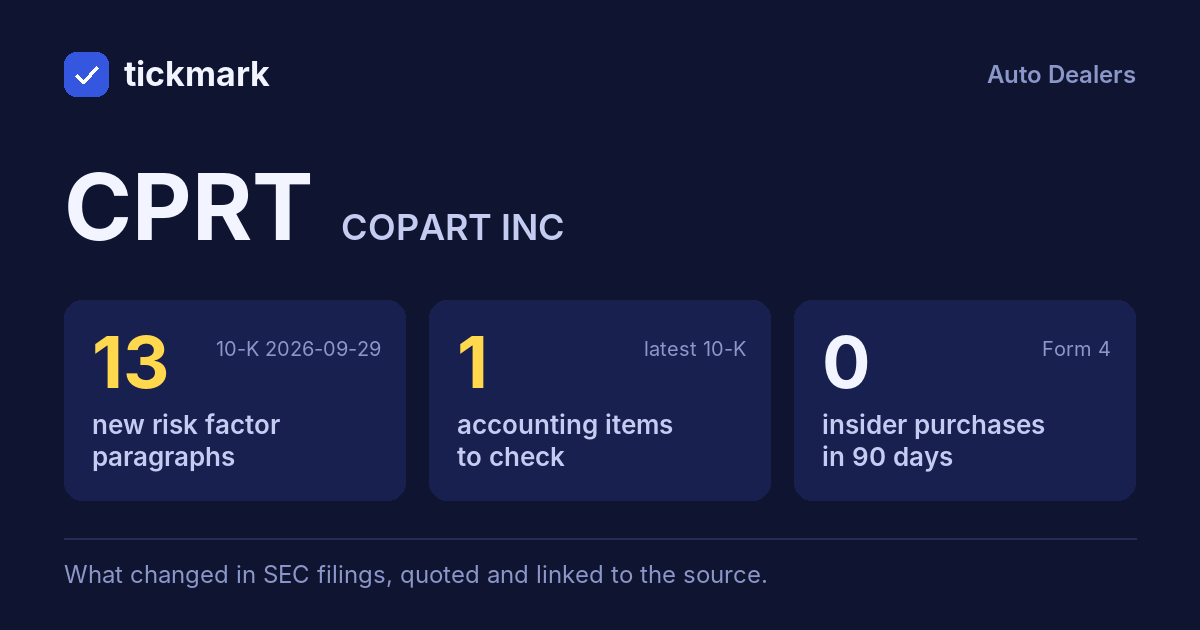
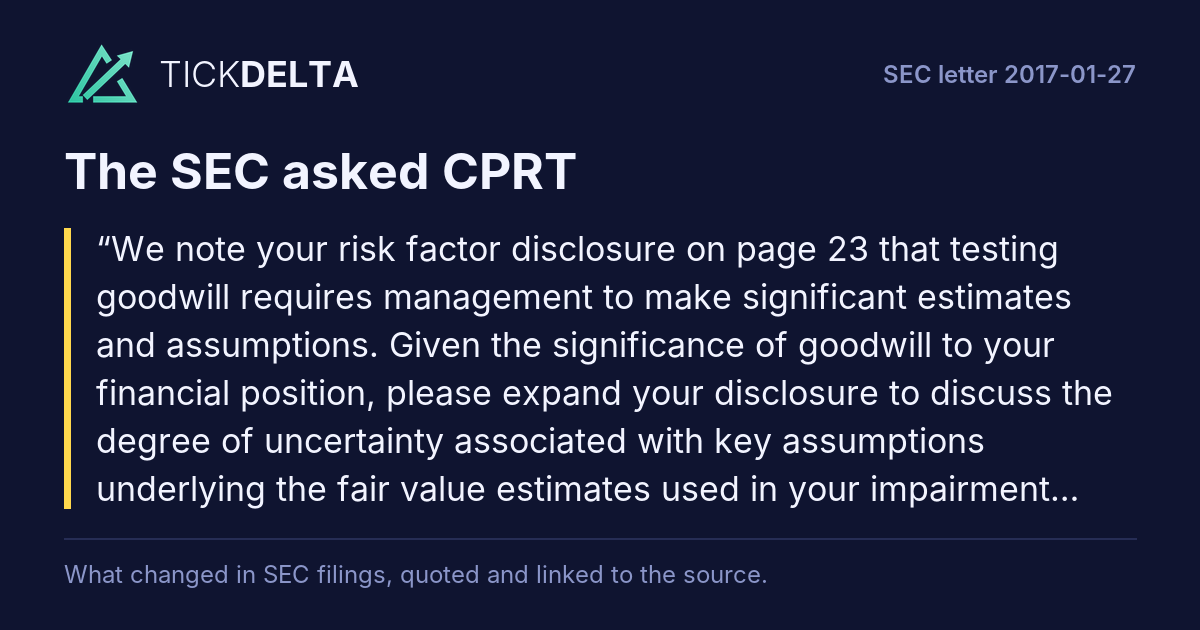
Read in the reply ↗
In its next report

First report after the company's reply of 2009-02-23: 10-Q filed 2009-03-12 ↗, against the 10-Q filed 2008-12-10 ↗.

Tickdelta does not hold the text of both reports, so they are not compared here.

Executive Compensation, page 18 · Compensation Discussion and Analysis, page 18
SEC asked (7)
We reviewed your response to comment 17 from our letter dated December 17, 2008. Please define the term performance-based in this instance and the types of compensation which you consider performance based. Also, please indicate why the board believes that performance-based compensation such as cash bonus or equity compensation should represent a substantial portion of an executive officer’s compensation package.
Rest of the question

* * * * * Please respond to these comments within 10 business days or tell us when you will provide us with a response. Please furnish a letter that keys your response to our comment and provides any requested information. Detailed letters greatly facilitate our review. Please understand that we may have additional comments after reviewing your responses to our comment.

CPRT answered
consider “performance-based” compensation to be the portion of an executive’s total compensation that is determined based on (i) the executive’s individual contribution to the Company’s strategic goals and operating results, as in the case of discretionary cash bonuses and equity awarded in recognition of individual performance, or (ii) the Company’s degree of success in meeting certain performance targets as established under the Executive Bonus

Plan.

board of directors believes that performance-based compensation, such as cash bonuses and equity awards, drives business performance and
Rest of the answer

aligns the interests of the executives with those of the Company’s shareholders. For instance, equity awards in the form of stock options align executive officer financial interests directly with shareholders via stock price appreciation over the vesting period of the options. In addition, the Company’s cash bonus program helps translate the Company’s overall strategic initiatives

(which are geared toward improvement in the Company’s financial strength) into daily actions, with rewards provided to employees who accomplish their goals. The Company will include similar disclosures in future filings.

* * *

* *

Copart further acknowledges that:

· Copart is responsible for the adequacy and accuracy of the disclosure in the filing;

· Staff comments or changes to disclosure in response to Staff comments do not foreclose the Commission from taking any action with respect to the filing; and

· Copart may not assert Staff comments as a defense in any proceeding initiated by the Commission or any person under the federal securities laws of the United States.

Read in the reply ↗
In its next report

First report after the company's reply of 2009-02-23: 10-Q filed 2009-03-12 ↗, against the 10-Q filed 2008-12-10 ↗.

Tickdelta does not hold the text of both reports, so they are not compared here.

Operations, page 35 · Critical Accounting Policies and Estimates, page 44
SEC asked (1)
We reviewed your response to comment three in our letter dated February 5, 2009. Please note that if you include net income and diluted earnings per share in the sensitivity analysis related to income taxes, deferred tax assets and the allowance for doubtful accounts in future filings you should also provide the non- GAAP disclosures required by Item 10(e) of Regulation S-K.
Rest of the question

Please acknowledge this obligation or otherwise revise.

CPRT answered
to the Staff’s comments, the Company will not use non-GAAP measurements when discussing the sensitivity of provisions for income taxes, deferred taxes and the allowance for doubtful accounts in future filings. The Company acknowledges that it must comply with Item 10(e) of Regulation S-K when non-GAAP measurements are used in future filings. Read in the reply ↗
In its next report

First report after the company's reply of 2009-03-24: 10-Q filed 2009-06-09 ↗, against the 10-Q filed 2008-12-10 ↗.

Tickdelta does not hold the text of both reports, so they are not compared here.

Note (1) Summary of Significant Accounting Policies, page 64 · Revenue Recognition, page 65
SEC asked (2)
We reviewed your response to comment five in our letter dated February 5, 2009 and understand your arguments. However, if the sale of vehicles sold on your own account exceeds 10% of consolidated sales, we continue to believe that you should separately state revenues from services and resale of acquired vehicles as well as related costs and expenses in accordance with Rule 5-03(b) of Regulation S-X.
Rest of the question

Please tell us revenues, cost of revenues and gross profit related to purchased vehicles for each year presented and explain to us why you do not meet the quantitative thresholds in Rule 5-03(b). Otherwise, please revise your disclosure in future filings to comply with Rule 5-03(b) of Regulation S-X.

CPRT answered
We reviewed your response to comment five in our letter dated February 5, 2009 and understand your arguments. However, if the sale of vehicles sold on your own account exceeds

10% of consolidated sales, we continue to believe that you should separately state revenues from services and resale of acquired vehicles as well as related costs and expenses in accordance with Rule 5-03(b).
Rest of the answer

Otherwise, please revise your disclosure in future filings to comply with Rule 5-03(b) of

Regulation S-X.

The Company supplementally informs the Staff that future filings will comply with Rule 5-03(b) of Regulation S-X.

Note

(14) Segments and Other Geographic Information, page 87

Read in the reply ↗
In its next report

First report after the company's reply of 2009-03-24: 10-Q filed 2009-06-09 ↗, against the 10-Q filed 2008-12-10 ↗.

Tickdelta does not hold the text of both reports, so they are not compared here.

Note (14) Segments and Other Geographic Information, page 87
SEC asked (3)
We reviewed your response to comment six in our letter dated February 5, 2009. It still appears to us that you have identified more than one operating segment, but that you have aggregated the segments into one reportable segment in accordance with paragraph 17 of SFAS 131. Thus, it seems that you should disclose the factors used to indentify reportable segments and whether operating segments have been aggregated.
Rest of the question

Please advise. Refer to paragraph 26.a. of SFAS 131. Please respond to these comments within 10 business days or tell us when you will provide us with a response. Please furnish a letter that keys your response to our comment and provides any requested information. Detailed letters greatly facilitate our review. Please understand that we may have additional comments after reviewing your responses to our comment.

CPRT answered
We reviewed your response to comment six in our letter dated February 5, 2009. It still appears to us that you have identified more than one operating segment, but that you have aggregated the segments into one reportable segment in accordance with paragraph 17 of SFAS 131. Thus, it seems that you should disclose the factors used to identify reportable segments and wh operating segments have been aggregated. Please advise. Refer to paragraph 26.a.
Rest of the answer

of SFAS 131.

The Company supplementally informs the Staff that it will discuss in future filings the factors used to identify reportable segments and when operating segments have been aggregated.

* * *

* *

Copart further acknowledges that:

· Copart is responsible for the adequacy and accuracy of the disclosure in the filing;

· Staff comments or changes to disclosure in response to Staff comments do not foreclose the Commission from taking any action with respect to the filing; and

· Copart may not assert Staff comments as a defense in any proceeding initiated by the Commission or any person under the federal securities laws of the United States.

Read in the reply ↗
In its next report

First report after the company's reply of 2009-03-24: 10-Q filed 2009-06-09 ↗, against the 10-Q filed 2008-12-10 ↗.

Tickdelta does not hold the text of both reports, so they are not compared here.

Also in this review: request for more time, 2008-12-19, request for more time, 2009-01-14, closing letter, 2009-04-02

1 other letter: notices that a filing will not be reviewed, requests to declare a registration effective, and the like
  • 2011-02-17 · SEC: letter · Copart, Inc. · Form 10-K for the Fiscal Year Ended July 31, 2010 · Filed September 23,...

From the SEC's correspondence on EDGAR: staff letters (form UPLOAD) and company letters (form CORRESP), 24 letters filed since 2008-12-22. Questions and answers are matched by their numbers; topics come from words in each question. The reports are compared word for word (same form, before the first SEC letter against the first report after the company's reply). No AI.

Work on CPRT in a spreadsheet: Excel workbook (a sheet per section, ten years by column, charts, links to the filings) · CSV. For a Google Sheet that stays up to date, paste =IMPORTDATA("https://tickdelta.com/company/CPRT/export.csv") into a cell.