Form 10-K
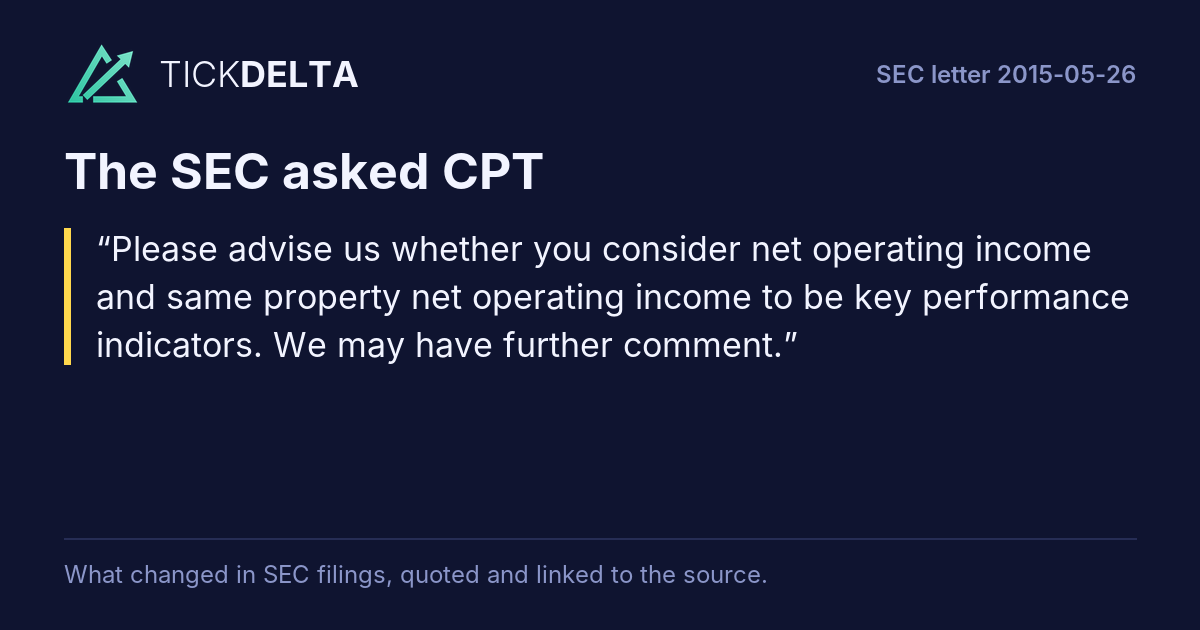
Please advise us whether you consider net operating income and same property net operating income to be key performance indicators. We may have further comment.
We do not consider net operating income and same property net operating income to be key performance indicators. They are two of many individual operating metrics used by the real estate industry to assess company performance. Accordingly, Camden provides these measurements to securities analysts and investors.
Unlike Funds From Operations as defined by the National Association of Real Estate Investment Trusts (“NAREIT”), there is no standard industry definition regarding the method of calculation of either net operating income or same property net operating income.Read in the reply ↗Rest of the answer
As a result, neither net operating income nor same property net operating income is consistently defined or calculated by peer companies or investors. Net operating income, for example, does not take into account all aspects of the Company’s performance as net operating income does not include the impact of certain revenues and expenses such as equity in income of joint ventures, interest expense, income taxes, and general and administrative expenses.
We note that your Geographic Diversification table on page 26 indicates that 18.4% of your real estate assets were concentrated in Washington, D.C. Metro and 9.5% of your real estate assets were concentrated in Houston, Texas.Rest of the question
To the extent that you consider this geographic concentration to represent a material risk, please include a risk factor specifically addressing this risk in future Exchange Act periodic reports.
We refer you to the first risk factor on page 3 of our Form 10-K under the heading “Risks Associated with Capital Markets, Credit Markets, and Real Estate - Volatility in capital and credit markets, or other unfavorable changes in economic conditions, either nationally or regionally in one or more of the markets in which we operate, could adversely impact us.”
In this risk factor, we discuss key economic risks for (a) local conditions in the first bullet point, (b) declines in market rental rates in the third bullet point, and, (c) regional economic downturns affecting geographic markets inRead in the reply ↗Rest of the answer
the sixth bullet point.
First report after the company's reply of 2015-06-03: 10-Q filed 2015-07-31 ↗, against the 10-Q filed 2015-05-01 ↗.
Tickdelta does not hold the text of both reports, so they are not compared here.
We note your disclosure to the effect that your operating properties have an average age of 12 years, “calculated on the basis of investment dollars.” In future Exchange Act periodic reports, please clarify how this number is calculated.
The average age of our operating properties is based upon the average of the product of the gross capitalized cost of each property multiplied by the property’s physical age divided by gross capitalized costs. We will clarify this calculation in future Exchange Act periodic reports. Read in the reply ↗
First report after the company's reply of 2015-06-03: 10-Q filed 2015-07-31 ↗, against the 10-Q filed 2015-05-01 ↗.
Tickdelta does not hold the text of both reports, so they are not compared here.
In future Exchange Act periodic reports, with respect to any disclosure on costs incurred with respect to completed construction in lease-up, please clarify whether costs incurred include leasing costs.
With respect to our disclosure on costs incurred for completed construction in lease-up, we do not include leasing costs. Leasing costs are expensed as incurred. We will clarify leasing costs are expensed as incurred in future Exchange Act periodic reports. Read in the reply ↗
First report after the company's reply of 2015-06-03: 10-Q filed 2015-07-31 ↗, against the 10-Q filed 2015-05-01 ↗.
Tickdelta does not hold the text of both reports, so they are not compared here.
We were unable to locate the disclosures required by Item 407(d)(4) of Regulation S-K. Please revise your future Exchange Act periodic reports or proxy statements, as applicable, to include such disclosures or advise.
The establishment of a separately-designated audit committee, comprised solely of independent trust managers, is disclosed on page 4 of our recently-filed proxy statement and a further description of the Company’s Audit Committee, including the identity of each committee member, is disclosed on page 7 of our proxy.Read in the reply ↗Rest of the answer
In future filings, we will clarify the Audit Committee has been established in accordance with Section 3(a)(58)(A) of the Exchange Act.
We acknowledge:
• the Company is responsible for the adequacy and accuracy of the disclosure in the filing;
staff comments or changes to disclosure in response to staff comments do not foreclose the Commission from taking any action with respect to the filing; and, the Company may not assert staff comments as a defense in any proceeding initiated by the Commission or any person under the federal securities laws of the United States.
First report after the company's reply of 2015-06-03: 10-Q filed 2015-07-31 ↗, against the 10-Q filed 2015-05-01 ↗.
Tickdelta does not hold the text of both reports, so they are not compared here.
Also in this review: closing letter, 2015-06-30