Form 10-K for the Year Ended December 31, 2018
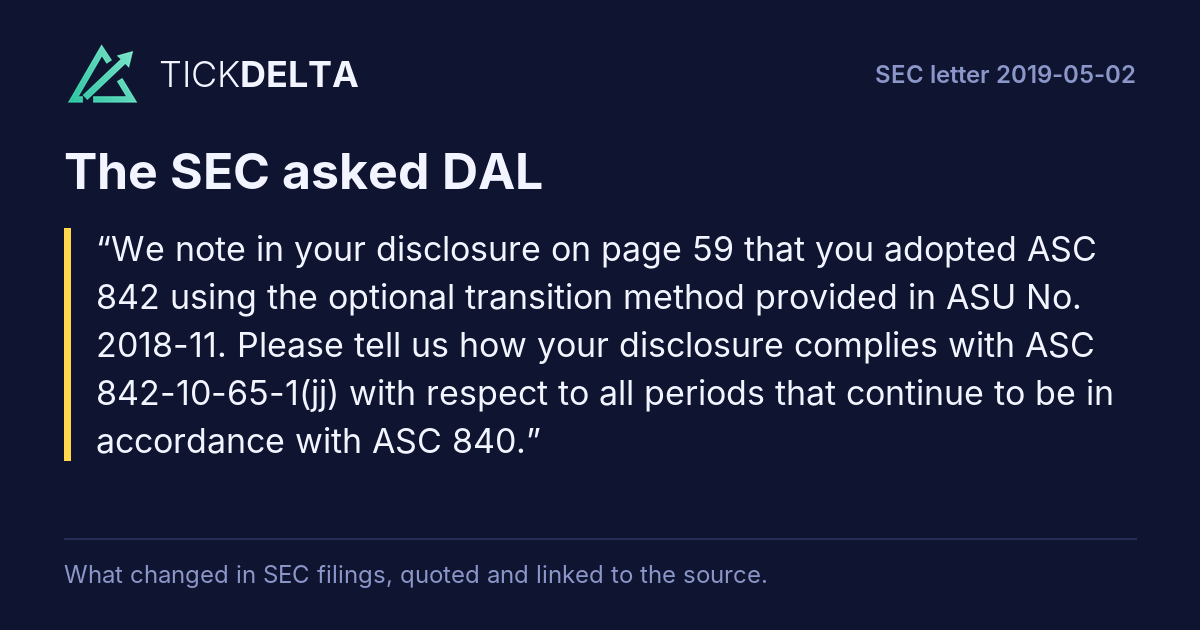
We note in your disclosure on page 59 that you adopted ASC 842 using the optional transition method provided in ASU No. 2018-11. Please tell us how your disclosure complies with ASC 842-10-65-1(jj) with respect to all periods that continue to be in accordance with ASC 840.
In preparing our disclosures, we evaluated the guidance in ASC 842-10-65-1(jj) regarding prior periods that continue to be in accordance with ASC 840. We provide relevant disclosures under ASC 840, and considered the overlapping disclosure requirements of both standards. To comply with both standards, within Note 8, “Leases,” we provide detailed qualitative information regarding our lease agreements overall and by each major type of lease, including a general description of relevant terms and the related accounting. These qualitative disclosures apply to all periods presented.Read in the reply ↗Rest of the answer
Regarding capital leases, we disclose within Note 1, “Summary of Significant Accounting Policies,” that depreciation and amortization expense includes amortization expense for capital leased assets, as well as the amounts of the gross asset value and accumulated amortization. Our disclosure of operating lease costs under ASC 840 relies on the income statement presentation of the line items where those costs are primarily recorded: Landing fees and other rents and Aircraft rent. In future annual filings that require lease cost disclosures, we will supplement our disclosure with a separate total operating lease costs amount for prior periods, primarily aggregating these line items. ASC 840 also requires disclosure of future minimum rentals for the latest balance sheet presented. However, we believe that the presentation required under ASC 842 of the future undiscounted cash flows as of December 31, 2018 provides the users of the financial statements with the most relevant information on our current financial position and future obligations; therefore, the similar ASC 840 disclosure was not presented.
First report after the company's reply of 2019-05-15: 10-Q filed 2019-07-11 ↗, against the 10-Q filed 2019-04-10 ↗.
Tickdelta does not hold the text of both reports, so they are not compared here.
We note your disclosure that when available, you use the rate implicit in the lease to discount lease payments to present value; however most of your leases do not provide a readily determinable implicit rate. Please tell us if you have used the rate implicit in the lease for any of your lease payment calculations.Rest of the question
If so, describe the circumstances and how you obtained the inputs to determine the rate implicit in the lease.
We have used the rate implicit in the lease for our lease payment calculations related to an insignificant number of information technology finance leases. The liability balance for these leases totaled approximately $60 million as of December 31, 2018, representing less than 1% of our total lease liability. The inputs needed to determine the rates implicit in these leases were readily determinable from the lease payment schedules and the fair values of the underlying assets as obtained from the lessors’ purchase invoices and/or quotes.Read in the reply ↗Rest of the answer
We also considered the value of the assets at the end of the term; however, there are no residual values for the lessors at lease expiry.
First report after the company's reply of 2019-05-15: 10-Q filed 2019-07-11 ↗, against the 10-Q filed 2019-04-10 ↗.
Tickdelta does not hold the text of both reports, so they are not compared here.
We note that you have entered into lease agreements related to redevelopment projects at both Los Angeles International Airport and New York-LaGuardia Airport. Please explain to us how you accounted for these projects and lease agreements under ASC 842.Rest of the question
In closing, we remind you that the company and its management are responsible for the accuracy and adequacy of their disclosures, notwithstanding any review, comments, action or absence of action by the staff.
Los Angeles International Airport (“LAX”)
We evaluated the guidance in ASC 842-40-55-5 regarding lessee control of underlying assets during construction when determining our accounting for the LAX redevelopment project.
Based on our assessment, we concluded that we do not control the underlying assets being constructed, and therefore, we do not have the project asset and related obligation recorded on our balance sheet. Our conclusion is supported by an assessment of the indicators in ASC 842, such as we do not legally own both the land and the property improvements.Read in the reply ↗Rest of the answer
Also, we do not have the ability to obtain any partially constructed assets. Furthermore, these assets have an alternative use by the airport authority (the lessor) by leasing the assets to other airlines, and we are not leasing the land for substantially all of the economic life of the property improvements. These indicators demonstrate that we do not control the underlying assets being constructed.
The lease agreement is accounted for in accordance with ASC 842 as disclosed within Note 8, “Leases,” specifically under “Airport Facilities.”
Because our lease payments specific to LAX are variable in nature, like many of our airport facilities, this lease is not recorded on our balance sheet as a right-of-use asset and lease liability.
In future annual filings, we will supplement our disclosure by adding that we have concluded that we do not control the underlying assets for the LAX redevelopment project, and therefore, have not recorded a project asset and related obligation.
New York-LaGuardia Airport
As we are funding the majority of the LaGuardia redevelopment project, we are accounting for the related assets as leasehold improvements. We entered into loan agreements to fund a portion of the construction, which are recorded on our balance sheet as debt with the proceeds reflected as restricted cash, as disclosed in Note 7, “Long-Term Debt.”
Lease payments for LaGuardia are accounted for in accordance with ASC 842 as disclosed within Note 8, “Leases,” specifically under “Airport Facilities.”
The fixed portion of our lease payments are recorded on our balance sheet as a right-of-use asset and lease liability.
our disclosure by adding that the assets being constructed for the LaGuardia redevelopment project are accounted for as leasehold improvements.
We sincerely hope that we have thoroughly addressed your comments on our 2018 Form 10-K filed on February 15, 2019.
We will be pleased to respond promptly to any additional requests for information or material that we may provide in order to facilitate your review.
First report after the company's reply of 2019-05-15: 10-Q filed 2019-07-11 ↗, against the 10-Q filed 2019-04-10 ↗.
Tickdelta does not hold the text of both reports, so they are not compared here.
Also in this review: closing letter, 2019-06-07