Added10-Q 2026-11-03 vs 10-K 2026-02-17
ITEM 2. UNREGISTERED SALES OF EQUITY SECURITIES, USE OF PROCEEDS AND ISSUER PURCHASES OF EQUITY SECURITIES
Tickdelta is free for now. Sign up and get Pro free
Throughout this Annual Report on Form 10-K, except as otherwise noted by the context, the terms "DuPont" or "Company" used herein mean DuPont de Nemours, Inc. and its consolidated subsidiaries. 10-K, Item 1
11 paragraphs in Risk Factors of the 10-K filed Feb 17, 2026 with nothing like them in the 10-K filed Feb 14, 2025. Quoted exactly. Paragraphs that were only edited are under 10-K change.
Compared with the Risk Factors in the latest 10-K of the other 81 Industrials companies: a paragraph with at least half its words the same at another company is called similar, and the companies are listed under it. A paragraph most of them have is marked boilerplate. No line means no other company has one like it. This counts text; it does not say how serious a risk is.
In addition, the Electronics Separation and Distribution Agreement and that certain assignment agreement, effective as of November 1, 2025, between DuPont and Qnity (the “Legacy Liabilities Assignment Agreement”) provide that, among other things, each of DuPont and Qnity are responsible for their respective Applicable Percentage of certain legacy and other liabilities (including Legacy Liabilities (as defined in the Corteva Letter Agreement), funding obligations of DuPont under the MOU, legacy PFAS liabilities and liabilities related to businesses and operations of DuPont that were previously discontinued or divested).
Read in the 10-K ↗
other reasons, including if the IRS were to disagree with the conclusions in the DWDP Tax Opinions that are not covered by the IRS Ruling.
Read in the 10-K ↗
The timing and outcome of the Aramids Divestiture is subject to risk and uncertainties.
The Aramids Divestiture is expected to close around the end of the first quarter 2026, subject to customary closing conditions and receipt of regulatory approvals. Factors that could affect DuPont’s ability to realize the anticipated benefits from the Aramids Divesture include, but are not limited to: (i) the parties’ ability to meet expectations regarding the timing, completion (if at all), accounting and tax treatment of the proposed transaction, including (x) any failure to obtain necessary regulatory approvals or to satisfy any of the other conditions to the proposed transaction, (y) the possibility that unforeseen liabilities, future capital expenditures, revenues, expenses, earnings, synergies, economic performance, indebtedness, financial condition, losses, future prospects, business and management strategies that could impact the value, timing or pursuit of the proposed transaction, and (z) risks and costs and pursuit and/or implementation, timing and impacts to business operations of the separation of business lines in scope for the proposed transaction; and (ii) the impact of the Aramids Equity Consideration on DuPont’s results of operations.
Read in the 10-K ↗
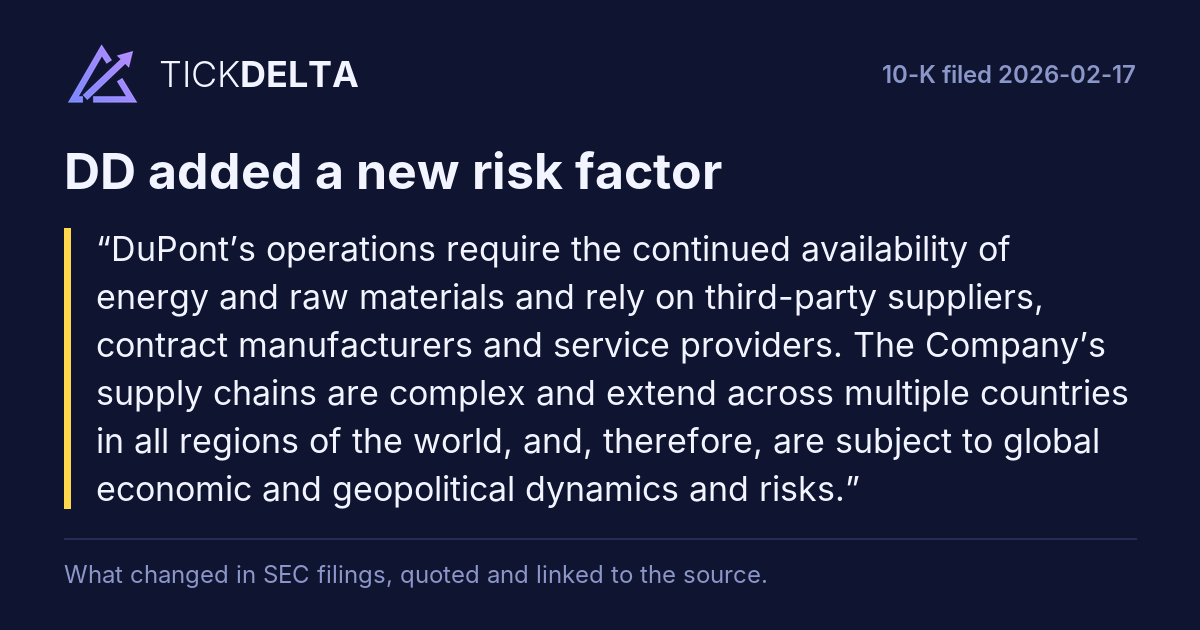
DuPont’s operations require the continued availability of energy and raw materials and rely on third-party suppliers, contract manufacturers and service providers. The Company’s supply chains are complex and extend across multiple countries in all regions of the world, and, therefore, are subject to global economic and geopolitical dynamics and risks.
Read in the 10-K ↗
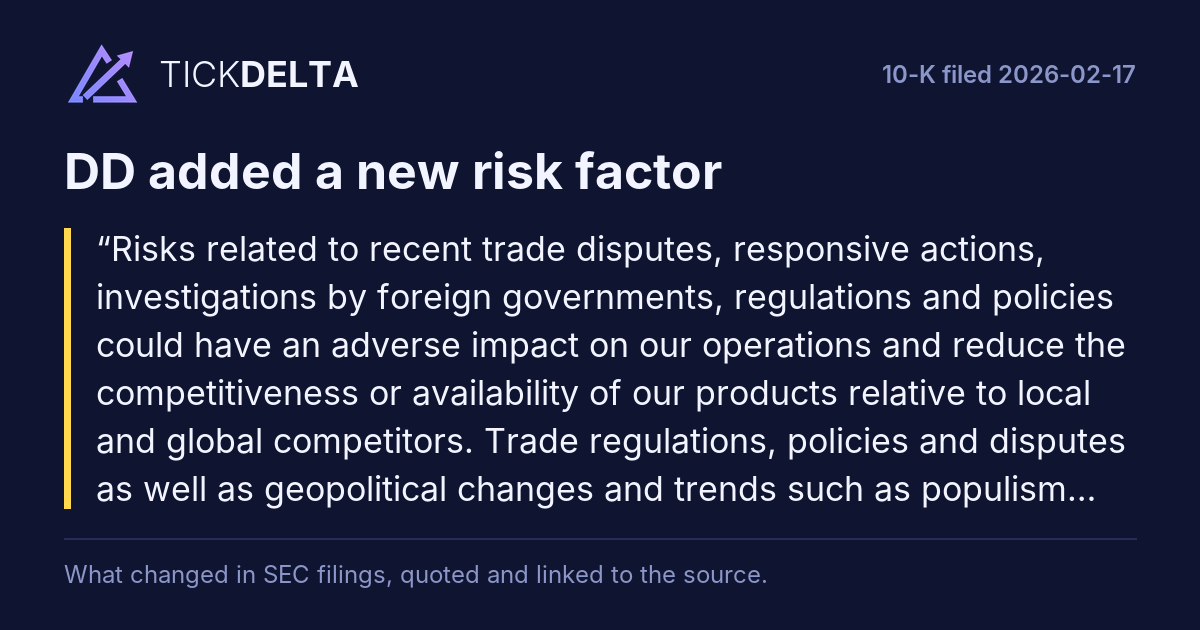
Risks related to recent trade disputes, responsive actions, investigations by foreign governments, regulations and policies could have an adverse impact on our operations and reduce the competitiveness or availability of our products relative to local and global competitors.
Trade regulations, policies and disputes as well as geopolitical changes and trends such as populism, protectionism and economic nationalism can and have resulted in increased tariffs and trade barriers, which can and have limited DuPont’s ability to sell certain products to certain customers, and have otherwise impacted its global supply and distribution chains and research and development activities. The extent, duration or escalation in specific trade tensions, such as between the U.S. and China, or in the global trade conflict more broadly, could be harmful to global economic growth, increase market uncertainty and volatility and adversely impact the Company’s business in or with China or other countries. The resulting impact on general economic conditions and on DuPont’s business are uncertain and depend on various factors, such as negotiations between the U.S. and affected countries, the responses of other countries or regions, exemptions or exclusions that may be granted, availability and cost of alternative sources of supply, and DuPont’s ability to change its supply chains or otherwise execute its sourcing model to offset the effects of the tariffs and other trade barriers.
In addition, the Company is subject to export control and economic sanctions laws and regulations that restrict the delivery of some products and services to certain countries (and nationals thereof), to certain end users, and for certain end uses. These restrictions have and may in the future prohibit the transfer of certain of DuPont’s products, services and technologies, and have and may in the future require us to obtain a license from the U.S. government before delivering the controlled item or service. Obtaining export licenses may be difficult, costly and time-consuming, and DuPont may fail to receive licenses it applies for on a timely basis or at all. The Company must also comply with export control and economic sanctions laws and regulations imposed by other countries. DuPont’s export and trade control compliance program may be ineffective or circumvented, exposing us to legal liabilities. Compliance with these laws could significantly limit the Company’s sales in the future.
Ultimately, changes in, and responses to, U.S. trade controls have the potential to reduce the competitiveness of DuPont products and cause sales to decline, which could have a material adverse effect on the Company’s business, financial condition and results of operations. Such risks may be especially exacerbated as they relate to China and Hong Kong, a market that represented approximately 10 percent of the Company’s consolidated net sales for the year ended December 31, 2025.
On April 4, 2025, the Company announced that it was aware of a report that the State Administration for Market Regulation of the People’s Republic of China (“SAMR”) initiated an investigation in connection with the Company’s Tyvek® business. SAMR has suspended the antitrust investigation process. DuPont Tyvek® sales to China in full year 2025 were approximately 1 percent of DuPont’s 2025 consolidated net sales.
Read in the 10-K ↗
On July 4, 2025, the One Big Beautiful Bill Act (the “OBBBA”) was enacted into law in the United States. The OBBBA modifies international corporate income tax law by, among other things, changing the tax rates for certain Global Intangible Low-Taxed Income (now known as Net CFC Tested Income) and Foreign-Derived Intangible Income (now known as Foreign Derived Deduction Eligible Income), modifying the allocation of expenses in calculating foreign tax credits, as well as changing foreign tax credit limitations. The OBBA introduced complex changes and it is possible that future clarifications of the provisions could create additional complexities and challenges. However, the Company believes that the overall impact of the OBBBA will not be material to its ongoing effective tax rate.
Read in the 10-K ↗
12 paragraphs in the 10-Q filed Nov 3, 2026 with nothing like them in the 10-Q filed Aug 4, 2026 (at least half the words must differ; new numbers alone do not count). Quoted exactly, grouped by the item heading above them. This is text that changed, not a judgement of how serious it is.
For the three months ended September 30, 2026 and 2025, total lease income was $29 million and $17 million, respectively, for which the net profits recognized from these leases were approximately $10 million and $5 million, respectively. For the nine months ended September 30, 2026 and 2025, total lease income was $86 million and $51 million, respectively, for which the net profits recognized from these leases were approximately $29 million and $14 million, respectively. Total lease income for each period presented is recorded in "Selling, general, and administrative expenses" and "Research and development expenses". Contractual lease income for the remainder of 2026 through 2041 ranges from $1 million to $91 million annually.
Read in the 10-Q ↗
The carrying value of the Arclin equity interest was $ 324 million as of September 30, 2026. The carrying values of the Derby equity interest as of September 30, 2026 and December 31, 2025 were $ 137 million and $ 111 million, respectively.
Read in the 10-Q ↗
DuPont's aggregate MOU escrow deposits of $ 35 million, not including interest, were used to pay the State of New Jersey Settlement on September 8, 2026. In addition, since the aggregate payments to be made in connection with the State of New Jersey and State of North Carolina Settlements will qualify for withdrawal from the MOU escrow account and exceed the future escrow contribution obligations, all future contributions to the MOU escrow account are deemed satisfied.
Read in the 10-Q ↗
The NJ Settlement also requires the Company and Corteva to provide $ 475 million of additional financial assurance for remaining remediation obligations, with the Company responsible for 71 percent and Corteva responsible for 29 percent of such financial assurance. The surety bond supporting the financial assurance was put in place in October 2026.
Read in the 10-Q ↗
The NC Settlement also required the Company and Corteva to provide $ 135 million of financial assurance for Chemours' remaining obligations under the 2019 North Carolina Consent Order, with the Company responsible for 71 percent and Corteva responsible for 29 percent of such financial assurance. Pursuant to the NC Settlement, the bond supporting the financial assurance is required to be in place within 60 days of the effective date of the NC Settlement.
Read in the 10-Q ↗
4. Reflects interest income earned on cash held in escrow related to notes transferred to Qnity upon consummation of the Qnity Distribution. See Note 3 for additional information.
Read in the 10-Q ↗
4. Reflects interest income earned on cash held in escrow related to notes transferred to Qnity upon consummation of the Qnity Distribution. See Note 3 for additional information.
Read in the 10-Q ↗
Healthcare & Water Technologies Three Months Ended Nine Months Ended Percentage change from prior year September 30, 2026 September 30, 2026 Change in Net Sales from Prior Period due to: ───────────────────────────────────────────────────────────────────────────────────────────────── Organic Sales1 4% 4% Currency — 1 Portfolio & other — — Total 4% 5%
Read in the 10-Q ↗
Diversified Industrials Three Months Ended Nine Months Ended Percentage change from prior year September 30, 2026 September 30, 2026 Change in Net Sales from Prior Period due to: ───────────────────────────────────────────────────────────────────────────────────────────────── Organic Sales1 5% 3% Currency (1) 1 Portfolio & other — — Total 4% 4%
Read in the 10-Q ↗
The NJ Settlement also requires the Company and Corteva to provide $475 million of additional financial assurance for remaining remediation obligations, with the Company responsible for 71 percent and Corteva responsible for 29 percent of such financial assurance. The surety bond supporting the financial assurance was put in place in October 2026.
Read in the 10-Q ↗
The settlement also required the Company and Corteva to provide $135 million of financial assurance for Chemours' remaining obligations under the 2019 North Carolina Consent Order, with the Company responsible for 71 percent and Corteva responsible for 29 percent of such financial assurance. The Company expects the bond supporting the reserve fund to be in place by November 2026.
Read in the 10-Q ↗
The following tables reflect cash activity related to the NJ Settlement, NC Settlement, Insurance Proceeds MOU and other insurance recoveries discussed in Note 13 to the interim Consolidated Financial Statements:
Read in the 10-Q ↗
Item 1A of the 10-Q filed Nov 3, 2026 against Item 1A of the 10-K filed Feb 17, 2026.
A 10-Q repeats only the risks that changed, so a 10-K paragraph that is missing from it is not counted as removed.
Added is a paragraph with nothing like it in the 10-K, Reworded a sentence that is in both with several words changed,
Quiet changes a sentence in both where one to four words changed and one is a hedge or a modal
(cut words struck through, new words highlighted and underlined).
Text on the page, not a score; each links to the filing at sec.gov.
What the 10-Q itself says about its risk factors:
Read in the 10-Q ↗
Other than updates to the risk factor set forth below, there have been no material changes in the Company's risk factors discussed in Part I, Item 1A, Risk Factors, in the Company’s Annual Report on Form 10-K for the year ended December 31, 2025.
Work on DD in a spreadsheet:
Excel workbook (a sheet per section, ten years by column, charts, links to the filings) ·
CSV.
For a Google Sheet that stays up to date, paste =IMPORTDATA("https://tickdelta.com/company/DD/export.csv") into a cell.