Form 10-K
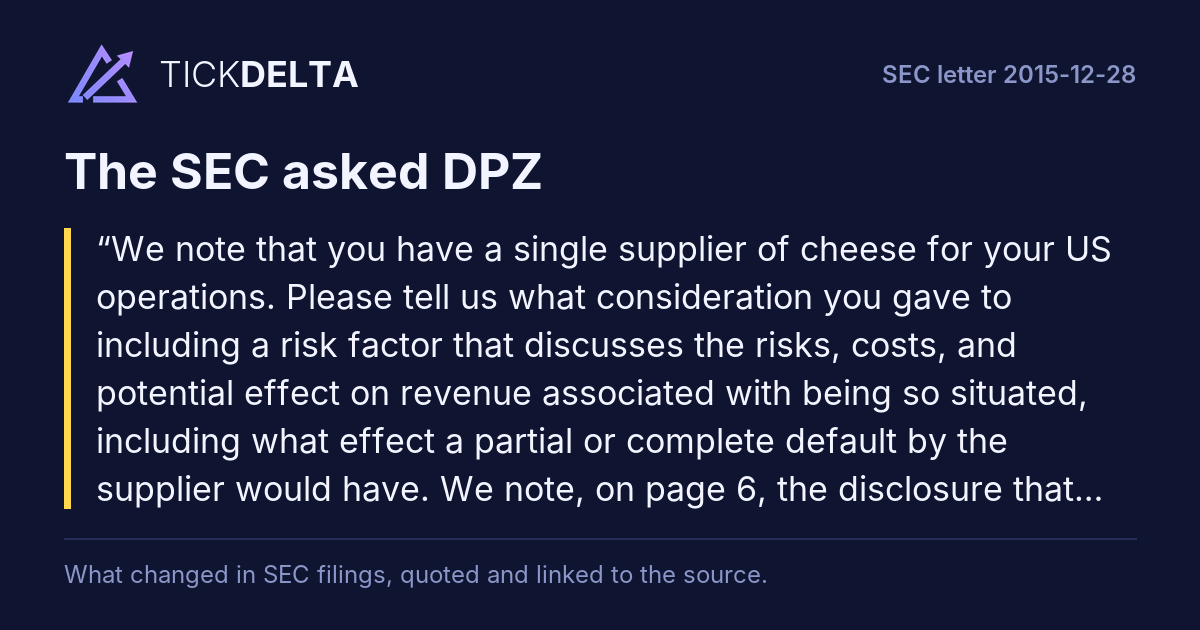
We note that you have a single supplier of cheese for your US operations. Please tell us what consideration you gave to including a risk factor that discusses the risks, costs, and potential effect on revenue associated with being so situated, including what effect a partial or complete default by the supplier would have. We note, on page 6, the disclosure that the replacement costs would not be material.Rest of the question
We also note, on page 12, the risk factor discussing suppliers and the risk factor discussing interruption of your supply chain generally.
The Company acknowledges the Staff’s comment and, in response, intends to include the following additional disclosure in its risk factors commencing with the risk factors to be included in the Company’s Annual Report on Form 10-K for the fiscal year ended January 3, 2016 (new language in bold and underline):
“Shortages or interruptions in the supply or delivery of fresh food products could adversely affect our operating results.
We and our franchisees are dependent on frequent deliveries of fresh food products that meet our specification.Read in the reply ↗Rest of the answer
In addition, the Company has single suppliers or limited number of suppliers for certain of its ingredients, including pizza cheese. While the Company believes there are adequate reserve quantities and potential alternative suppliers, shortages or interruptions in the supply of fresh food products caused by unanticipated demand, problems in production or distribution, financial or other difficulties of suppliers, inclement weather or other conditions could adversely affect the availability, quality and cost of ingredients, which could adversely affect our operating results.”
The Company’s disclosure on page 6 of its 2014 10-K states that the Company would incur additional costs if the Company is required to replace any of its suppliers, but that the Company believes that such additional costs would not have a material adverse effect on its business. The Company notes that it has a long-term pricing arrangement with its current domestic pizza cheese supplier, with mandated delivery requirements to help mitigate the risk that the supplier fails to deliver the necessary supply.
In addition, the Company’s domestic pizza cheese supplier maintains an average of more than 12 frozen storage warehouses (including plants and public warehouses) that are strategically positioned around the United States. Absent a catastrophic event affecting multiple storage warehouses that would make the cheese supply at these storage warehouses unavailable or damaged, the Company would still be able to access cheese from the other storage facilities, which the Company believes would be adequate for its business needs. None of the frozen storage warehouse locations used by the Company’s domestic pizza cheese supplier maintains more than 26% of the Company’s weekly cheese requirements at any one time. Further, the Company’s domestic pizza cheese supplier has, over the past two years, averaged 9.9 weeks of total required cheese inventory on hand, and an additional 3.3 weeks of total required cheese inventory in transit. While the need to obtain cheese from alternative storage warehouse locations in the event that one or more of the storage warehouses became damaged or unavailable may result in increased distribution costs, the Company does not believe that any such increased distribution costs would be material to the Company’s business.
The Company believes that, if necessary, it could obtain readily available alternative sources of supply for pizza cheese. For example, there are some alternate suppliers in North America who provide pizza cheese to Domino’s Pizza stores in Canada and Mexico, as well as cheese producers who currently provide cheeses other than pizza cheese (such as provolone, cheddar and feta) to the Company in the United States.
While the Company may incur additional costs in obtaining pizza cheese from an alternative source of supply, the Company does not believe that such additional costs would be material to its business. Further, the Company generally passes along any increase in food costs, including pizza cheese costs, to its franchisees, which could mitigate the impact to the Company of an increase in pizza cheese cost associated with switching suppliers. In fiscal 2014, the Company purchased approximately $323 million of pizza cheese for its domestic operations and the costs of this pizza cheese was passed on to the Domino’s Pizza stores in the United States (approximately 92% of which are owned and operated by franchisees) at a constant dollar margin. As a result, the Company’s supply chain margins would be expected to remain unchanged, even if its cost of pizza cheese increased. The Company includes the following disclosure regarding the impact of changes in cheese prices on its revenue and cost of sales (and describes its fixed dollar margin on cheese) in the description of its Supply Chain segment revenue and operating margin within its Management’s Discussion and Analysis of Financial Condition and Results of Operations on page 30 of the Company’s 2014 10-K:
“Changes in U.S. cheese prices increased both revenues and costs by $33.0 million in 2014. If the 2014 U.S. cheese prices had been in effect during 2013, the supply chain operating margin as a percentage of supply chain revenues would have decreased by 0.3 percentage points. However, the dollar margin would have been unaffected.”
In addition, the Company has included the following sensitivity analysis relating to the impact of changes in pizza cheese prices on its Company-owned stores food costs in the risk factor titled “Increases in food, labor and other costs could adversely affect our profitability and operating results,” which appears on page 12 of the Company’s 2014 10-K:
“The cheese block price per pound averaged $2.13 in 2014, and the estimated increase in Company-owned store food costs from a hypothetical $0.25 adverse change in the average cheese block price per pound would have been approximately $2.2 million in 2014.”
Definitive Proxy Statement on Schedule
14A
Compensation Discussion and Analysis
Long-Term Incentives
Performance Shares,
First report after the company's reply of 2016-01-08: 10-K filed 2016-02-25 ↗.
No earlier 10-K before the SEC's letter is in Tickdelta, so there is nothing to compare with.
In future filings, please disclose the performance metric used in determining whether to award performance shares under your 2004 Equity Incentive Plan. See Item 402(b) of Regulation S-K. Please provide us with a sample of your proposed disclosure.
The Company confirms that in future filings it will disclose the performance metric used in determining whether to award performance shares under its 2004
Equity Incentive Plan. The Company’s proposed disclosure is as follows (which is expected to be included in the first paragraph of the Performance Shares subsection in the Long-Term Incentive section of the Company’s Compensation
Discussion and Analysis):
“For performance shares granted in 2015 and prior, the measurement of performance established by the Compensation
Committee was segment income as defined by the Company under ASC 280,Read in the reply ↗Rest of the answer
with certain adjustments (the same “adjusted net segment income” used by the Company for annual performance incentives). The performance shares for each named executive officer vest only in the event that the Company achieves at least 85% of the annual performance target (with no additional performance shares granted for performance above 85% of the annual performance target). Beginning January 4, 2016, the required achievement percentage for vesting of all future performance share grants will be 90% or more of the annual performance target (with no additional performance shares granted for performance above 90% of the annual performance target).”
* * *
* *
Please be advised that, in connection with the Staff’s comments in the Staff Letter and the
Company’s responses thereto, the Company hereby acknowledges the Staff’s position that (i) the Company is responsible for the adequacy and accuracy of the disclosure in the above-referenced filings; (ii) the Staff’s comments or changes to disclosure in response to the Staff’s comments do not foreclose the Commission from taking any action with respect to the filings; and (iii) the Company may not assert the Staff comments as a defense in any proceeding initiated by the Commission or any person under the federal securities laws of the United States.
We hope that the foregoing has been responsive to the
Staff’s comments. If you have any questions about this letter or require further information, please contact the undersigned at 734-930-3205.
First report after the company's reply of 2016-01-08: 10-K filed 2016-02-25 ↗.
No earlier 10-K before the SEC's letter is in Tickdelta, so there is nothing to compare with.
Also in this review: closing letter, 2016-01-12