tickdelta
Sign in

Tickdelta is free for now. Sign up and get Pro free

← Screener

DRIDarden Restaurants

Consumer discretionary · Restaurants · NYSE
Compare with peers → Embed
The 10-K against last year's

117 changes: 17 added, 18 removed, 80 reworded, 2 quiet changes

10-K Jul 24, 2026 vs Jul 18, 2025
Risk FactorsRedline ↓
14.8%
of the text changed · 9,596 words now
27.5%
of the text changed · 5,398 words now
Legal ProceedingsRedline ↓
8.6%
of the text changed · 433 words now
Accounting PoliciesRedline ↓
19.3%
of the text changed · 5,824 words now

10-K 0000940944-26-000025 (2026-07-24) vs 10-K 0000940944-25-000038 (2025-07-18)

The redline

The paragraph that changed most in each section

Marked against last year's 10-K: cut words struck through, new words highlighted and underlined.

Accounting Policies 170 words changed in this paragraph; it is 47% similar to last year's version.
Land, buildings and equipment, operating lease right-of-use assets assets, and certain other assets, including definite-lived intangible assets, are reviewed for impairment whenever events or changes in circumstances indicate that the carrying amount of an asset may not be recoverable. Recoverability of assets to be held and used is measured by a comparison of the carrying amount of the assets to the future undiscounted net cash flows expected to be generated by the assets. Identifiable cash flows are measured at the lowest level for which they are largely independent of the cash flows of other groups of assets and liabilities, generally at the restaurant level. If such assets are determined to be impaired, the recognized impairment is measured by the amount by which the carrying amount of the assets exceeds their fair value. Fair value is generally determined based on appraisals, sales prices of comparable assets or discounted future net cash flows expected to be generated by the assets. Restaurant sites and certain other assets to be disposed of are reported at the lower of their carrying amount or fair value, less estimated costs to sell, and are included in assets held for sale on our consolidated balance sheets when certain criteria are met. These criteria include, among other factors, the requirement that the likelihood of disposing of these assets within one year is probable. Assets not meeting the “held for sale” criteria remain in land, buildings and equipment until their disposal is probable within one year.

Source: Item 8, Note 1 – SUMMARY OF SIGNIFICANT ACCOUNTING POLICIES, 10-K 0000940944-26-000025 vs Item 8, Note 1 – SUMMARY OF SIGNIFICANT ACCOUNTING POLICIES, 10-K 0000940944-25-000038

Risk Factors 151 words changed in this paragraph; it is 33% similar to last year's version.
The restaurant industry is subject to extensive federal, state, local local, and international laws and regulations. The development and operation of restaurants depends on the selection and acquisition of suitable sites to a significant extent, which are subject to building, zoning, land use, environmental, traffic and other regulations and requirements. We are subject to licensing and regulation by state and local authorities relating to health, sanitation, safety and fire standards and the sale of alcoholic beverages. We are subject to laws and regulations relating to the preparation and sale of food, including regulations regarding product safety, nutritional content and menu labeling. We are subject to federal, state, and local laws governing employment practices and working conditions. These laws cover minimum wage rates, wage and hour practices, labor relations, paid and family leave, workplace safety, and immigration, among others. The myriad of laws and regulations being passed at the state and local level creates unique challenges for a multi-state employer as different standards apply to different locations, sometimes with conflicting requirements. We must continue to monitor and adapt our employment practices to comply with these various laws and regulations.

Source: Item 1A, 10-K 0000940944-26-000025 vs Item 1A, 10-K 0000940944-25-000038

MD&A 115 words changed in this paragraph; it is 46% similar to last year's version.
On October 23, 2023, we entered into a $1.25 billion Revolving Credit Agreement (Revolving (the “Revolving Credit Agreement) Agreement”) with Bank of America, N.A. (BOA), (“BOA”), as administrative agent, and the lenders and other agents party thereto. The Revolving Credit Agreement is a senior unsecured credit commitment to the Company and contains customary representations and affirmative and negative covenants (including limitations on liens and subsidiary debt and a maximum consolidated lease adjusted total debt to total capitalization ratio of 0.75 to 1.00) and events of default usual for credit facilities of this type. As of May 25, 2025, we had no outstanding balances and were in compliance with all covenants under the Revolving Credit Agreement. As of May 25, 2025, $0.2 million of letters of credit were outstanding, which was backed by this facility. After consideration of letters of credit backed by the Revolving Credit Agreement, as of May 25, 2025, we had $1.25 billion of credit available under the Revolving Credit Agreement.

Source: Item 7, 10-K 0000940944-26-000025 vs Item 7, 10-K 0000940944-25-000038

Legal Proceedings 52 words changed in this paragraph; it is 87% similar to last year's version.
At May 25, 2025 31, 2026 and May 26, 2024, 25, 2025, we had $76.5 $83.3 million and $71.0 $76.5 million, respectively, of guarantees associated with leased properties that have been assigned to third parties, primarily related to the disposition of Red Lobster in fiscal 2015. 2015 and the sale of the Olive Garden Canada Restaurants during the first quarter of 2026. These amounts represent the maximum potential amount of future payments under the guarantees. The fair value of the maximum potential payments discounted at our weighted-average cost of capital at May 25, 2025 31, 2026 and May 26, 2024, 25, 2025, amounted to $61.2 $64.7 million and $57.7 $61.2 million, respectively. In the event of default by a third party, the indemnity and default clauses in our assignment agreements govern our ability to recover from and pursue the third party for damages incurred as a result of its default. We do not hold any third-party assets as collateral related to these assignment agreements, except to the extent that the assignment allows agreements permit us to repossess recapture the building and personal property. At May 25, 2025 and May 26, 2024, the related leasehold interest. The liability recorded for our expected credit losses under these leases as of May 31, 2026 and May 25, 2025 was $10.4 million and $10.6 million. million, respectively. These guarantees expire over their respective lease terms, which range from fiscal 2026 2027 through fiscal 2034. 2035.

Source: Item 3, via Note 16 – COMMITMENTS AND CONTINGENCIES, 10-K 0000940944-26-000025 vs Item 3, via Note 16 – COMMITMENTS AND CONTINGENCIES, 10-K 0000940944-25-000038
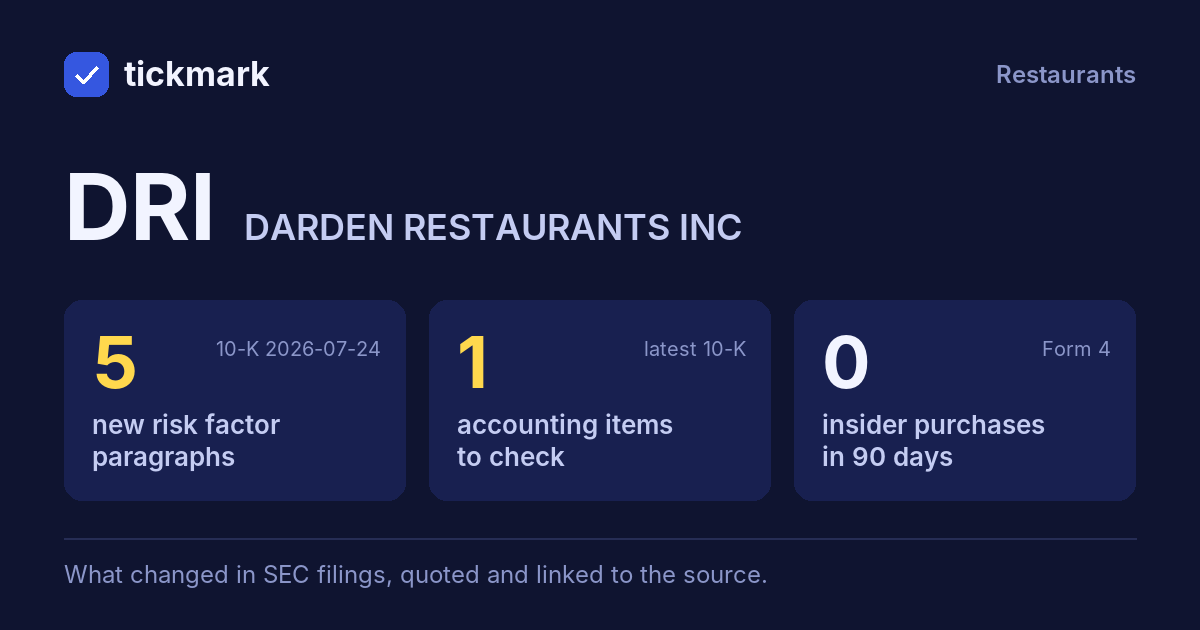
Every change, by type

Sentences and paragraphs added, removed or reworded

Sentences and paragraphs of DRI's Risk Factors and MD&A, 10-K 2026-07-24 against 10-K 2025-07-18. Each links to the text at sec.gov.

AddedRisk Factors
In addition, our ability to offset the effects of inflation through pricing actions may be constrained by competitive dynamics and consumer demand sensitivity, and if menu pricing does not sufficiently offset rising costs or adversely affects guest traffic, our operating margins and results of operation could be adversely affected.

Read it in 10-K 2026-07-24 at sec.gov ↗

AddedRisk Factors
may also increase at any time, thereby further increasing our costs. In addition, if property and liability insurance becomes less available or more difficult to obtain, we may incur higher premium costs and face increased exposure to uninsured losses.

Read it in 10-K 2026-07-24 at sec.gov ↗

AddedRisk Factors
efforts to ensure that our providers are observing proper standards and controls, we cannot guarantee that breaches or failures caused by these outsourced providers will not occur.

Read it in 10-K 2026-07-24 at sec.gov ↗

AddedRisk Factors
The restaurant industry is subject to extensive federal, state, local, and international laws and regulations. The development and operation of restaurants depends on the selection and acquisition of suitable sites to a significant extent, which are subject to

Read it in 10-K 2026-07-24 at sec.gov ↗

AddedRisk Factors
Consumers are continually changing health and dietary preferences. As a result, our diverse portfolio of restaurant brands is continually challenged to evolve our menu offerings to appeal to these changing customer preferences, while maintaining our

Read it in 10-K 2026-07-24 at sec.gov ↗

AddedMD&A
On July 14, 2025, we closed on the sale of the Olive Garden Canada Restaurants to Recipe. All gains and losses on disposition have been aggregated in impairments and disposal of assets, net on our consolidated statement of earnings. See Note 4 for additional information. At the closing, Darden and Recipe entered into an area development agreement and franchise agreements, pursuant to which Recipe will operate current and any new restaurants contemplated thereunder under the Olive Garden trade name and will pay royalties for use of the trade name.

Read it in 10-K 2026-07-24 at sec.gov ↗

AddedMD&A
On our June 2025 earnings call, we announced the decision to explore strategic alternatives for the Bahama Breeze brand, which, at that time, included 28 company-owned restaurants and one franchised restaurant. As part of this review, we evaluated a potential sale of the brand as well as the conversion of certain restaurants to other Darden brands. On February 3, 2026, we announced the completion of this process and our decision to permanently close approximately half of the remaining Bahama Breeze restaurants, which we completed on or about April 5, 2026, and our expectation to convert the remaining restaurants to other Darden brands over the next 12–18 months. As of the end of fiscal 2026, we have completed one conversion. See Note 4 for additional information.

Read it in 10-K 2026-07-24 at sec.gov ↗

Show the other 9
AddedMD&A
•Impairments and disposal of assets, net decreased as a percentage of sales, primarily due to the gain on sale of the Olive Garden Canada Restaurants in fiscal 2026. This decrease was partially offset by costs associated with additional Bahama Breeze closures in fiscal 2026, as compared with fiscal 2025, when we closed a total of 22 underperforming restaurant locations, including 15 Bahama Breeze restaurants, during the fourth quarter.

Read it in 10-K 2026-07-24 at sec.gov ↗

AddedMD&A
H.R. 1., also known as the One, Big, Beautiful Bill Act (“OBBBA”), was enacted on July 4, 2025. The legislation includes several provisions that impact the timing and magnitude of certain tax deductions, including restoring 100% bonus depreciation for qualifying property and the immediate expensing of domestic research and development costs. The Company has evaluated the impacts of the OBBBA, and the effects of these provisions have been incorporated into the accompanying financial statements.

Read it in 10-K 2026-07-24 at sec.gov ↗

AddedMD&A
Fiscal Year Ended Change Segment May 31, 2026 May 25, 2025 2026 vs 2025 Olive Garden 22.5% 22.3% 20 basis points LongHorn Steakhouse 18.6% 19.3% (70) basis points Fine Dining 17.7% 18.6% (90) basis points Other Business 15.9% 15.7% 20 basis points

Read it in 10-K 2026-07-24 at sec.gov ↗

AddedMD&A
We estimate the fair value of each reporting unit using the best information available, including market information, also referred to as the market approach, and discounted cash flow projections, also referred to as the income approach. A market approach estimates fair value by applying sales or cash flow multiples to the reporting unit’s operating performance. The multiples are derived from observable market data of comparable publicly traded companies with similar operating and investment characteristics of the reporting units. The income approach uses a reporting unit’s projection of estimated operating cash flows which are based on a combination of historical and current trends, organic growth expectations, and residual growth rate assumptions. These cash flows are discounted using a weighted-average cost of capital (“WACC”) that reflects current

Read it in 10-K 2026-07-24 at sec.gov ↗

AddedMD&A
We estimate the fair value of trademarks using the relief-from-royalty method, which requires assumptions related to projected sales from the reporting unit’s projection of estimated operating cash flows; assumed royalty rates that could be payable if we did not own the trademarks; and a discount rate based on the WACC for each reporting unit. We recognize an impairment loss when the estimated fair value of the trademark is less than its carrying value.

Read it in 10-K 2026-07-24 at sec.gov ↗

AddedMD&A
We performed our annual impairment test of our goodwill and trademarks as of February 23, 2026, which was the first day of our fiscal 2026 fourth quarter. As of February 23, 2026, no impairment of goodwill or trademarks was indicated based on our testing.

Read it in 10-K 2026-07-24 at sec.gov ↗

AddedMD&A
The $500.0 million of unsecured 3.850 percent senior notes due in May 2027 are classified as current on the fiscal 2026 balance sheet. We expect to satisfy this maturity through available liquidity, which may include cash on hand, operating cash flows, borrowings under our existing credit facility, commercial paper issuances, or refinancing transactions, depending on market conditions and other factors.

Read it in 10-K 2026-07-24 at sec.gov ↗

Next Related parties →