9 paragraphs in Risk Factors of the 10-K filed Feb 6, 2026
with nothing like them in the 10-K filed Feb 20, 2025. Quoted exactly.
Paragraphs that were only edited are under 10-K change.
Compared with the Risk Factors in the latest 10-K of the other 59 Health care companies:
a paragraph with at least half its words the same at another company is called similar, and the companies are listed under it.
A paragraph most of them have is marked boilerplate. No line means no other company has one like it.
This counts text; it does not say how serious a risk is.
Revenues from the Medicare and Medicaid programs are determined, in whole or in part, by the federal government and/or applicable state governments, and base premium rates paid by each state or federal agency differ depending upon a combination of factors such as defined upper payment limits, a member’s health status, age, gender, county or region, benefit mix, member
Read in the 10-K ↗
We are periodically subject to government audits, including CMS RADV audits of our Medicare Advantage Plans to validate diagnostic data, patient claims and financial reporting, and audits of our Medicare Part D plans by the Medicare Part D Recovery Audit Contractor (“RAC”), as well as state Medicaid RAC programs. Certain of our contracts currently have pending RADV audits
Read in the 10-K ↗
Furthermore, legislative or regulatory actions intended to address rising health-care costs or affordability concerns may result in the imposition of additional requirements on health insurers, including mandated benefits, restrictions on premium increases, or other pricing limitations, which could increase costs, constrain pricing flexibility, and adversely affect our financial condition and results of operations.
Read in the 10-K ↗
The direct provision of healthcare services by certain of our subsidiaries involves risks of additional litigation brought against us or our associates for alleged malpractice or professional liability claims arising out of the delivery of healthcare and related
Read in the 10-K ↗
Federal and state legislatures and regulators also regularly consider new laws and regulations as well as changes to existing requirements that could adversely affect current industry practices and our business. These new and changing laws and regulations include or could include changes to compensation, prohibitions or limitations on spread pricing contracting, requirements regarding rebates and/or fees, additional data reporting to plan sponsors and public sources, restrictions on the development and use of formularies and other utilization management tools, the use of average wholesale prices or other pricing benchmarks, pricing for
Read in the 10-K ↗
Recently, California enacted legislation that significantly regulates pharmacy benefit managers and pharmacy pricing practices. The law imposes requirements related to price transparency, restrictions on spread pricing, rebate pass-through obligations, licensing, and fiduciary duties. In addition, Congress recently passed the Consolidated Appropriations Act of 2026, which includes pharmacy benefit manager reforms requiring pharmacy benefit managers to remit all rebates, fees (other than bona fide service fees), and other remuneration received from entities such as manufacturers and group purchasing organizations to commercial plan sponsors, and to provide detailed commercial claims reporting, effective thirty months after enactment. The legislation also imposes extensive reporting requirements and delinks pharmacy benefit manager compensation in Medicare Part D by prohibiting pharmacy benefit managers from receiving remuneration related to Part D drugs in any form other than bona fide service fees that cannot be based on a drug’s price, effective in 2028. There continues to be the potential that similar or additional legislation may be adopted at the state or federal level. These changes in legislation within the prescription drug industry and pharmacy benefit management practices have both short-term and long-term impacts that could have an adverse effect on our business and results of operations.
Read in the 10-K ↗
2021 Appropriations Act, which requires reporting of plan spending, the cost of plan pharmacy benefits, enrollee premiums and any manufacturer rebates received by the plan or issuer, may adversely affect our competitive position, cash flows, financial condition and results of operations.
Read in the 10-K ↗
•a significant failure of our internal control over financial reporting or a failure to remediate identified deficiencies;
Read in the 10-K ↗
1 more
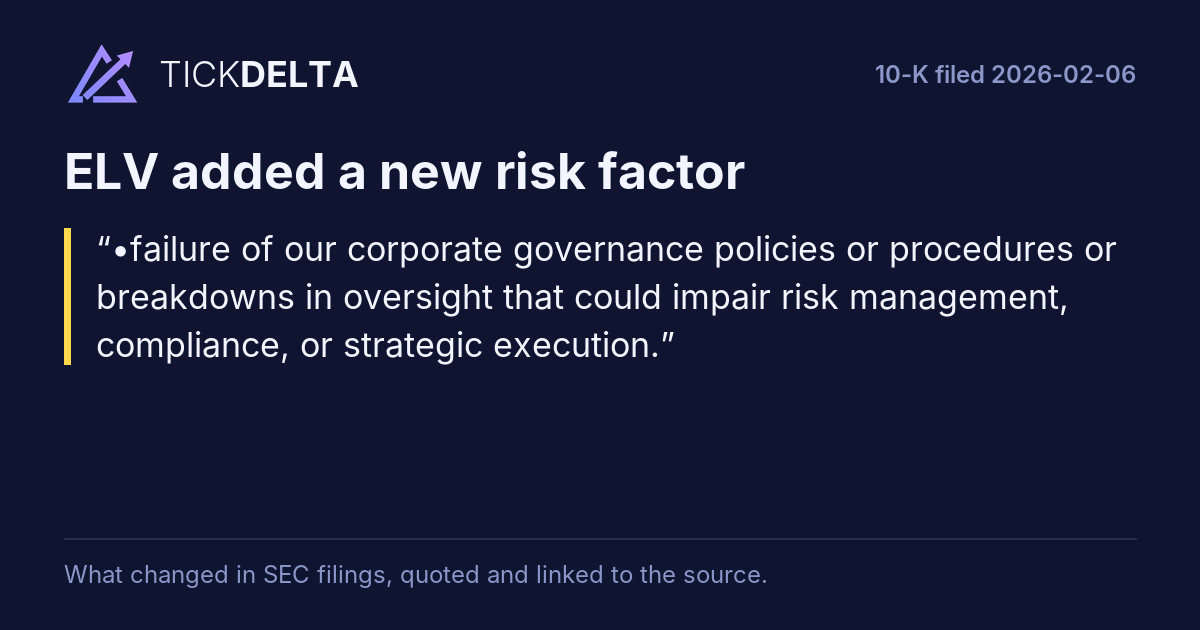
•failure of our corporate governance policies or procedures or breakdowns in oversight that could impair risk management, compliance, or strategic execution.
Read in the 10-K ↗
New in the latest 10-Q
6 paragraphs in the 10-Q filed Oct 21, 2026 with nothing like
them in the 10-Q filed Jul 15, 2026 (at least half the words must differ; new numbers alone do not count).
Quoted exactly, grouped by the item heading above them. This is text that changed, not a judgement of how serious it is.
Financial statements and notes
benefit payments under these programs are excluded from benefit expense. In addition, certain Medicaid payments received from government agencies that are required to be passed through to providers and where we do not assume claims risk associated with those payments are excluded from both revenue and benefit expense.
Read in the 10-Q ↗
Net realized losses from sales of fixed maturity securities (74) (12) (118) (117)
Read in the 10-Q ↗
Under the No Surprises Act, certain out-of-network provider reimbursement disputes arising within the Company's commercial business are resolved through the federal IDR process. The Company evaluates IDR matters on an ongoing basis and records liabilities for matters when losses are considered probable and reasonably estimable. Following the finalization and implementation of the Federal IDR Operations Final Rule, the Company recorded liabilities of $ 669, consisting of $ 44 related to fully insured arrangements and $ 625 related to administrative service arrangements, for certain IDR judgments and disputes that met these recognition criteria. Because amounts related to administrative services arrangements are generally recoverable from the applicable customers under the terms of those contracts, the Company also recorded corresponding self-funded receivables of $ 575, net of an allowance for doubtful accounts, as of September 30, 2026.
Read in the 10-Q ↗
The Company is also involved in other pending IDR matters for which potential additional liabilities could amount to $ 324, before any related customer recoveries. Approximately 94 % of these potential liabilities relate to administrative service agreements. No liabilities have been recorded for these matters because losses were not considered probable as of the reporting date. The ultimate resolution of these matters remains uncertain and may be affected by future regulatory developments, litigation, and governmental reviews.
Read in the 10-Q ↗
In May 2025, a putative federal securities class action, Miller v Elevance Health, Inc., et al., No. 1:25-cv-923, (S.D. Ind.) (the “Securities Action”), was filed against the Company and certain of its executives in the U.S. District Court for the Southern District of Indiana. The plaintiff in the lawsuit alleges that the Company made false and misleading statements with respect to the Company’s 2024 earnings guidance in violation of federal securities laws. The Company filed a Motion to Dismiss in November 2025 and the Court issued an opinion in September 2026. The Court denied the Company’s motion allowing certain portions of the allegations to proceed. Three related derivative lawsuits have been filed against the Company, as a nominal defendant, members of the board of directors, and certain officers. These cases remain pending, are: Jones v. Boudreaux, et al., No. 49D11-2506-PL-028778, (In Superior), Silva v. Boudreaux, et al., No. 1:25-cv-01270-RLY-TAB, (S.D. Ind.) and Holzman v. Boudreaux, et al., No. 49D01-2509-CE-044598, (In Superior) (the “Derivative Actions”). The plaintiffs in the Derivative Actions allege that the individual defendants breached their fiduciary duties and committed other alleged misconduct in connection with the statements at issue in the Securities Action. The Company will continue to vigorously defend these cases, which we believe are without merit; however, their ultimate outcome cannot be presently determined.
Read in the 10-Q ↗
CarelonRx: CarelonRx markets and offers pharmacy services to our affiliated health plans nationwide and to unaffiliated customers. The pharmacy services market continues to evolve toward greater cost transparency and predictability. We support multiple contract structures, including rebate pass-through and fee-based arrangements, and are expanding offerings focused on net client cost. Rising drug spending and affordability pressures are also driving demand for coordinated medical and pharmacy management. These trends present opportunities to expand existing client relationships through our clinical programs, specialty pharmacy, and home-delivery capabilities.
Read in the 10-Q ↗
The 10-Q's risk factors against the 10-K
Item 1A of the 10-Q filed Oct 21, 2026 against Item 1A of the 10-K filed Feb 6, 2026.
A 10-Q repeats only the risks that changed, so a 10-K paragraph that is missing from it is not counted as removed.
Added is a paragraph with nothing like it in the 10-K, Reworded a sentence that is in both with several words changed,
Quiet changes a sentence in both where one to four words changed and one is a hedge or a modal
(cut words struck through, new words highlighted and underlined).
Text on the page, not a score; each links to the filing at sec.gov.
Reworded10-Q 2026-10-21 vs 10-K 2026-02-06
Additional risks and uncertainties not presently currently known to us or that we currently believe deem to be immaterial also may also materially and adversely affect us. our business, financial condition or future results.
Read it in the 10-Q at sec.gov ↗ · The 10-K sentence ↗