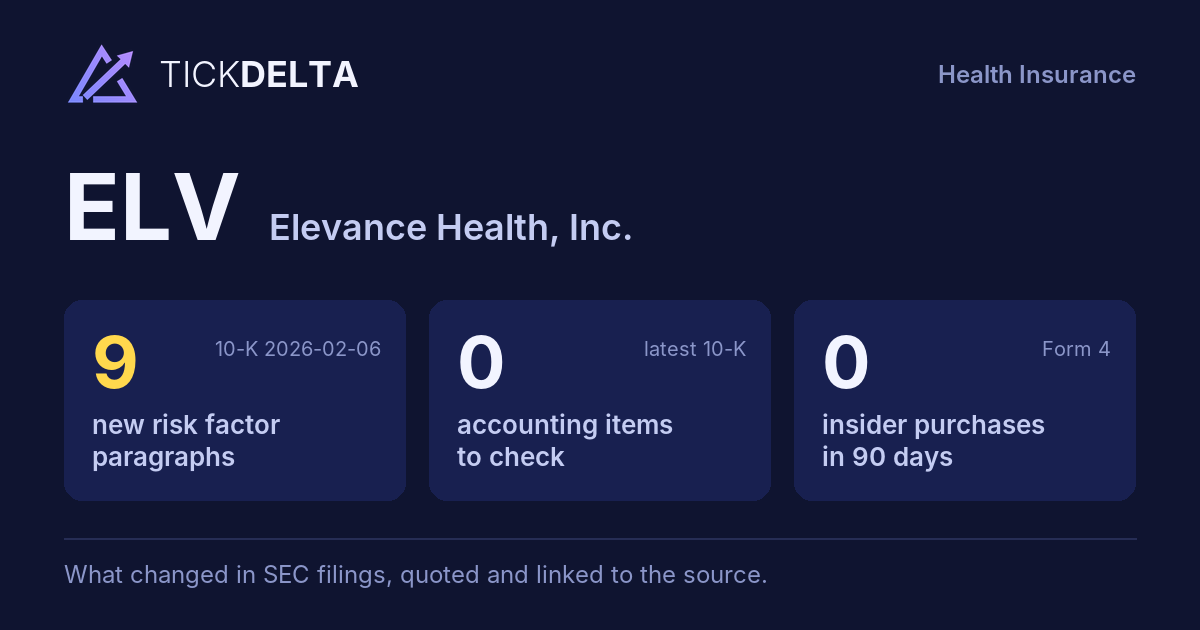
Sentences and paragraphs of ELV's Risk Factors and MD&A, 10-K 2026-02-06 against 10-K 2025-02-20.
Each links to the text at sec.gov.
AddedRisk Factors
Revenues from the Medicare and Medicaid programs are determined, in whole or in part, by the federal government and/or applicable state governments, and base premium rates paid by each state or federal agency differ depending upon a combination of factors such as defined upper payment limits, a member’s health status, age, gender, county or region, benefit mix, member
Read it in 10-K 2026-02-06 at sec.gov ↗
AddedRisk Factors
We are periodically subject to government audits, including CMS RADV audits of our Medicare Advantage Plans to validate diagnostic data, patient claims and financial reporting, and audits of our Medicare Part D plans by the Medicare Part D Recovery Audit Contractor (“RAC”), as well as state Medicaid RAC programs. Certain of our contracts currently have pending RADV audits
Read it in 10-K 2026-02-06 at sec.gov ↗
AddedRisk Factors
Furthermore, legislative or regulatory actions intended to address rising health-care costs or affordability concerns may result in the imposition of additional requirements on health insurers, including mandated benefits, restrictions on premium increases, or other pricing limitations, which could increase costs, constrain pricing flexibility, and adversely affect our financial condition and results of operations.
Read it in 10-K 2026-02-06 at sec.gov ↗
AddedRisk Factors
Federal and state legislatures and regulators also regularly consider new laws and regulations as well as changes to existing requirements that could adversely affect current industry practices and our business. These new and changing laws and regulations include or could include changes to compensation, prohibitions or limitations on spread pricing contracting, requirements regarding rebates and/or fees, additional data reporting to plan sponsors and public sources, restrictions on the development and use of formularies and other utilization management tools, the use of average wholesale prices or other pricing benchmarks, pricing for
Read it in 10-K 2026-02-06 at sec.gov ↗
AddedRisk Factors
Recently, California enacted legislation that significantly regulates pharmacy benefit managers and pharmacy pricing practices. The law imposes requirements related to price transparency, restrictions on spread pricing, rebate pass-through obligations, licensing, and fiduciary duties. In addition, Congress recently passed the Consolidated Appropriations Act of 2026, which includes pharmacy benefit manager reforms requiring pharmacy benefit managers to remit all rebates, fees (other than bona fide service fees), and other remuneration received from entities such as manufacturers and group purchasing organizations to commercial plan sponsors, and to provide detailed commercial claims reporting, effective thirty months after enactment. The legislation also imposes extensive reporting requirements and delinks pharmacy benefit manager compensation in Medicare Part D by prohibiting pharmacy benefit managers from receiving remuneration related to Part D drugs in any form other than bona fide service fees that cannot be based on a drug’s price, effective in 2028. There continues to be the potential that similar or additional legislation may be adopted at the state or federal level. These changes in legislation within the prescription drug industry and pharmacy benefit management practices have both short-term and long-term impacts that could have an adverse effect on our business and results of operations.
Read it in 10-K 2026-02-06 at sec.gov ↗
AddedRisk Factors
2021 Appropriations Act, which requires reporting of plan spending, the cost of plan pharmacy benefits, enrollee premiums and any manufacturer rebates received by the plan or issuer, may adversely affect our competitive position, cash flows, financial condition and results of operations.
Read it in 10-K 2026-02-06 at sec.gov ↗
Show the other 12
AddedRisk Factors
•failure of our corporate governance policies or procedures or breakdowns in oversight that could impair risk management, compliance, or strategic execution.
Read it in 10-K 2026-02-06 at sec.gov ↗
AddedMD&A
Membership shifts from Medicaid into our Individual ACA (as defined below) business following the redetermination process that began in April 2023, together with lower membership effectuation rates, particularly in geographies with high concentrations of highly subsidized members, have driven a market-wide increase in morbidity, resulting in elevated medical cost trends. Medicaid cost trends remain elevated due to higher population acuity and increased utilization of services. In response, we are working on program improvements in partnership with the states, strengthening care management, and optimizing our clinical strategy to improve effectiveness and lower costs.
Read it in 10-K 2026-02-06 at sec.gov ↗
AddedMD&A
Affordable Care Act: We continue to participate in the Individual state- or federally-facilitated marketplaces (the “Public Exchange”) in nearly all of our Anthem Blue Cross and Anthem Blue Cross and Blue Shield service areas. In 2025, we expanded our operations into select service areas in Florida, Maryland, and Texas through our Simply Healthcare and Wellpoint brands. Going forward, we expect the Public Exchange to be influenced by policy and regulatory changes, particularly around federal subsidies, compliance requirements, and market stability.
Read it in 10-K 2026-02-06 at sec.gov ↗
AddedMD&A
The federal budget reconciliation legislation, known as the One Big Beautiful Bill Act (the “OBBBA”) was signed into law on July 4, 2025. The OBBBA includes provisions that could impact our business and operations including: requiring more frequent Medicaid redeterminations for beneficiaries receiving coverage under a state's Medicaid expansion program implemented pursuant to the Patient Protection and Affordable Care Act and the Health Care and Education Reconciliation Act of 2010, as amended, (collectively, the “ACA”); imposing work or community engagement requirements on certain adults in the ACA Medicaid expansion population; and requiring specific cost-sharing for certain services used by adults in the ACA Medicaid expansion population. The OBBBA also makes changes to federal requirements regarding Medicaid state directed payments and provider taxes, including taxes on managed care organizations; delays implementation of Medicaid final regulations on certain eligibility and enrollment provisions; reduces the allowable home equity asset threshold for individuals seeking eligibility for long-term care under Medicaid; establishes a new Rural Health Transformation program; eliminates the repayment limit for excess advanced Premium Tax Credits (“PTCs”) under the ACA; modifies the rules regarding Health Savings Account (“HSA”) eligible plans under the ACA and makes permanent an extension of the safe harbor first established under the Coronavirus Aid, Relief, and Economic Security Act, allowing pre-deductible coverage of telehealth services for HSA eligible high-deductible health plans; among other provisions.
Read it in 10-K 2026-02-06 at sec.gov ↗
AddedMD&A
Additional federal and state guidance is being issued to implement these OBBBA provisions. Implementation dates vary, with many provisions impacting commercial plans effective January 1, 2026, and many Medicaid-related provisions effective in 2027 and 2028. States may choose to implement certain Medicaid provisions as early as 2026.
Read it in 10-K 2026-02-06 at sec.gov ↗
AddedMD&A
In February 2026, Congress passed the Consolidated Appropriations Act, which includes pharmacy benefit manager reforms requiring pharmacy benefit managers to remit all rebates, fees (other than bona fide service fees), and other remuneration received from entities such as manufacturers and group purchasing organizations to commercial plan sponsors, and to provide detailed commercial claims reporting, effective thirty months after enactment. The legislation also imposes extensive reporting requirements and delinks pharmacy benefit manager compensation in Medicare Part D by prohibiting pharmacy benefit managers from receiving remuneration related to Part D drugs in any form other than bona fide service fees that cannot be based on a drug’s price, effective in 2028.
Read it in 10-K 2026-02-06 at sec.gov ↗
AddedMD&A
In addition, in June 2025, CMS finalized the Marketplace Integrity and Affordability Regulation, which modifies the Public exchange open enrollment period beginning in plan year 2027 and eligibility for PTCs, among other requirements. In September 2025, a federal court delayed the effective dates for several provisions of the Marketplace Integrity and Affordability Regulation pending the resolution of ongoing litigation challenging the legality of those provisions. Also, in September 2025, CMS issued guidance modifying eligibility requirements for ACA catastrophic plans.
Read it in 10-K 2026-02-06 at sec.gov ↗
AddedMD&A
In addition, subsequent budget reconciliation legislation enacted during 2023-2025 included provisions affecting Medicaid eligibility enrollment and program financing, which may influence state Medicaid policies and beneficiary coverage dynamics over time.
Read it in 10-K 2026-02-06 at sec.gov ↗
AddedMD&A
Operating expense increased primarily due to increases in premium tax expenses and assessments and increases in targeted investments to support and strengthen our workforce and accelerate technology adoption, partially offset by non-recurrence of the BCBSA provider settlement recorded in 2024.
Read it in 10-K 2026-02-06 at sec.gov ↗
AddedMD&A
Other expense increased primarily due to higher interest expense related to our issuance of senior notes during the fourth quarter of 2024. The increase also related to higher intangible asset amortization expense related to acquisitions in the fourth quarter of 2024.
Read it in 10-K 2026-02-06 at sec.gov ↗
AddedMD&A
Our effective income tax rate decreased from 24.5% to 15.6%, due to a discrete non-operating tax benefit and favorable resolution of uncertain tax positions. The discrete non-operating tax benefit related to an internal restructuring of certain Elevance Health subsidiaries.
Read it in 10-K 2026-02-06 at sec.gov ↗
AddedMD&A
1 Operating revenue within our Commercial line of business related to our Individual business, including ACA products, was $9,295, $8,295 and $6,187 for the year ended December 31, 2025, 2024, and 2023, respectively.
Read it in 10-K 2026-02-06 at sec.gov ↗