Form 10-Q
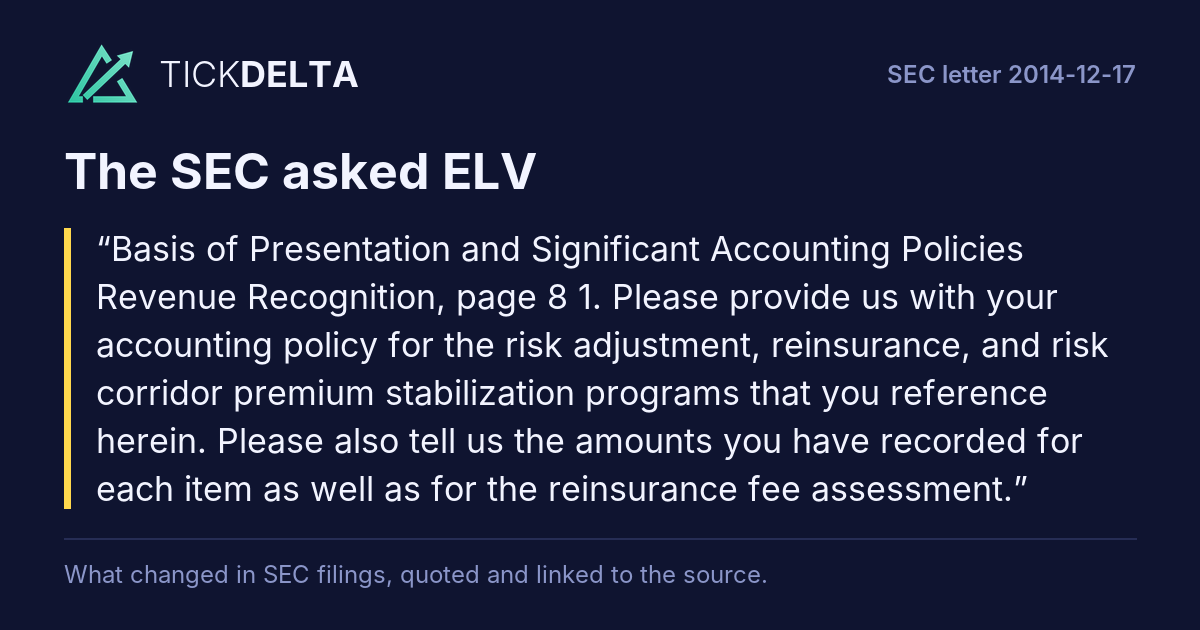
Basis of Presentation and Significant Accounting Policies Revenue Recognition, page 8 1. Please provide us with your accounting policy for the risk adjustment, reinsurance, and risk corridor premium stabilization programs that you reference herein. Please also tell us the amounts you have recorded for each item as well as for the reinsurance fee assessment.
The risk adjustment program is a permanent program that began in 2014. The risk adjustment program transfers dollars from insurers who enroll individuals with lower relative health risk to insurers who enroll individuals with higher relative health risk, based on the assignment of risk scores to each covered member. We estimate an average risk score by legal entity at the individual and small group market level within each state, which is then compared to an estimate of the average risk score of all eligible providers
- within each state.Read in the reply ↗Rest of the answer
Plans with an average risk score less than the state average will pay into the state pools while plans with an average risk score greater than the state average will receive money from the state pools. We estimate our expected risk adjustment receipt or payment throughout the year by utilizing the Payment Transfer Formula established within the rules and regulations of the risk adjustment premium stabilization program and we reflect the estimate as an adjustment to premium revenue on a pro-rata year-to-date basis. Our estimate of risk adjustment receipts and payments recognized as adjustments to consolidated premiums for the nine months ended September 30,
2014 include an estimated risk adjustment receivable of $49.7 million and an estimated risk adjustment payable of $30.6 million, resulting in a net reduction to premiums of $19.1 million, or less than 0.04% of consolidated premiums. Risk adjustment receipts and payments are classified as current or long-term in the consolidated balance sheets based on the timing of expected settlement.
The reinsurance program is a temporary program effective for years 2014 through 2016. It is funded through assessing each covered member in the commercial health insurance market, including members of self-funded health benefit plans. The reinsurance program is intended to help stabilize premiums by reimbursing issuers of fully-insured non-grandfathered individual market plans for eligible claims between a defined attachment point and ceiling, at a coinsurance rate set by the Department of Health and Human Services (“HHS”). Accordingly, in our consolidated statements of income, we recognize assessments upon fully-insured non-grandfathered individual market plans that are eligible for reinsurance recoveries as a reduction to premiums, and estimated reinsurance recoveries, as a reduction to benefit expense. For the nine months ended September 30, 2014, we recognized $35.7 million of reinsurance assessments as ceded premiums, representing approximately 0.07% of consolidated premiums. Additionally, for the nine months ended September 30, 2014, we recognized $452.1 million in estimated reinsurance recoveries as a reduction to benefit expense, representing approximately 1.08% of consolidated benefit expense. Assessments upon all other lines of business not eligible for reinsurance recoveries are recognized in general and administrative expense in our consolidated statements of income. For the nine months ended September 30, 2014, we recognized $346.0 million of reinsurance assessments as selling, general and administrative expense, representing approximately 3.97% of consolidated selling, general and administrative expense. Reinsurance assessments and estimated recoveries are classified as current or long-term in the consolidated balance sheets based on the timing of expected settlement.
The risk corridor program is a temporary program effective for years 2014 through 2016. The program is intended to protect insurers from inaccurate pricing of individual and small group qualified health plans and substantially similar off-exchange products. The risk corridor program redistributes gains and losses realized by qualified health plans based on a ratio comparing allowable costs incurred to a targeted amount prescribed by HHS. Qualified health plans with ratios below 97% are required to remit a portion of the difference to HHS while qualified health plans with ratios above 103% will receive a portion of the difference from HHS. We estimate our risk corridor receipt or payment throughout the year by projecting our allowable costs and ultimate premium revenue for the year and we reflect the estimate as an adjustment to premium revenue on a pro-rata year-to-date basis.
For the nine months ended September 30, 2014, we recognized $9.6 million of estimated risk corridor payments as ceded premiums, representing approximately 0.02% of consolidated premiums. Risk corridor receipts and payments are classified as current or long-term in the consolidated balance sheets based on the timing of expected settlement.
As demonstrated above, we believe that our estimates for the risk adjustment, reinsurance and risk corridor premium stabilization programs are not material to our consolidated financial statements, nor do we anticipate that these premium stabilization programs will have a material impact to our consolidated financial statements in future periods. Due to the immaterial impact of the premium stabilization programs upon our consolidated financial statements and our current disclosure within our significant accounting policy for revenue recognition that premiums are recognized on a net basis, including net of amounts recognized for the risk adjustment, reinsurance and risk corridor premium stabilization programs, we believe that our current disclosure meets the needs of users of our financial statements. We confirm that, in future filings, we will provide more specific disclosures as outlined above, when applicable, if any of our estimates related to any of the premium stabilization programs were to become material to the consolidated financial statements.
* * * * *
In connection with our response to the Commission’s comments, the Company acknowledges that:
• the Company is responsible for the adequacy and accuracy of the disclosure in the filing referenced above;
staff comments or changes to disclosure in response to staff comments do not foreclose the Commission from taking any action with respect to the filing referenced above; and the Company may not assert staff comments as a defense in any proceeding initiated by the Commission or any person under the federal securities laws of the United States.
Also in this review: company letter, 2015-01-16, closing letter, 2015-01-27