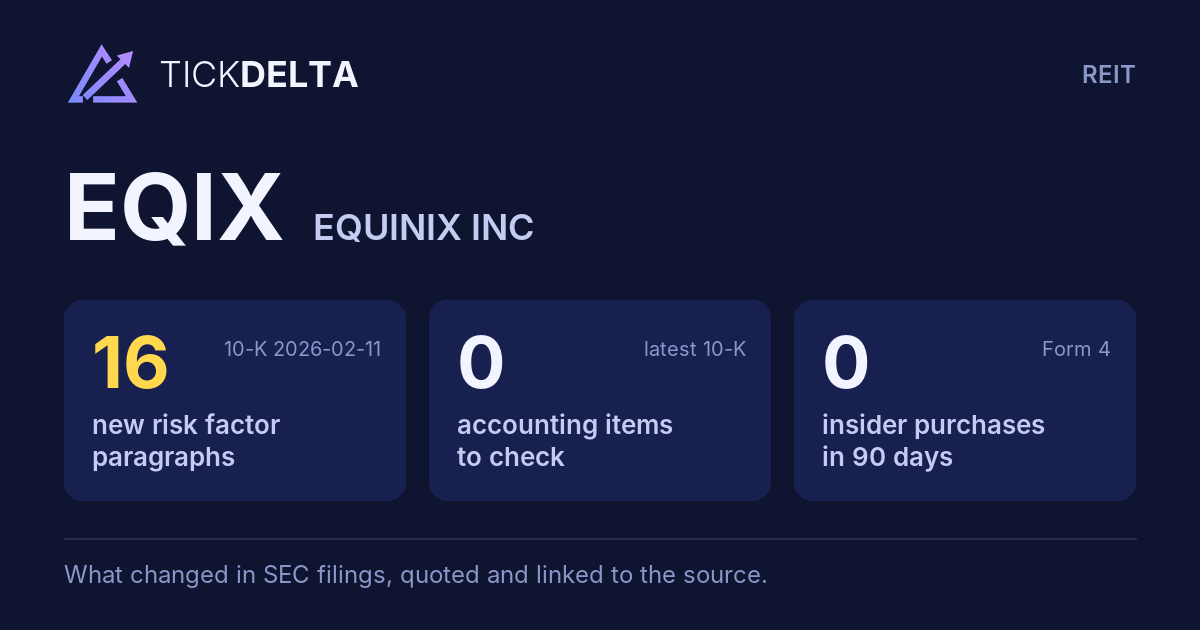
Sentences and paragraphs of EQIX's Risk Factors and MD&A, 10-K 2026-02-11 against 10-K 2025-02-12.
Each links to the text at sec.gov.
AddedRisk Factors
Geopolitical events, including trade tensions between the U.S. and other countries, the war between Russia and Ukraine, and ongoing conflicts in the Middle East, could negatively affect our global operations, and their future impact remains unpredictable. In addition, uncertainty surrounding the legality, enforceability, and interpretation of U.S. and international laws, executive actions, regulatory frameworks, and enforcement priorities could result in compliance challenges, significant penalties, operational restrictions, reputational harm, or adverse effects on our business and results of operations. Periodic risks of a U.S. government shutdown could further disrupt economic conditions. Moreover, actual or proposed U.S. tariffs and potential counter tariffs may increase costs and disrupt our supply chain, with their scope and duration dependent on evolving negotiations and exemptions, making their impact difficult to predict. Our inability to effectively manage these developments could have a material adverse effect on our business, financial condition, results of operations, and the price of our common stock.
Read it in 10-K 2026-02-11 at sec.gov ↗
AddedRisk Factors
Further, because of the expected growth and opportunity related to AI, we anticipate significant investments in the data center industry by both current competitors and new investors and companies looking to capture this opportunity. If Equinix is unable to compete against these new market entrants, or capture a proportionate share of these investments, we could lose market share during this expected period of growth. We also must compete against certain of these competitors to secure the land and power needed for our expansion plans.
Read it in 10-K 2026-02-11 at sec.gov ↗
AddedRisk Factors
Current relations between the U.S. and China have created increased supply chain risk due to successive U.S. legislation promoting decoupling from China on semiconductors and specific telecommunications equipment makers as well as the threat of increased tariffs and having to source from alternative suppliers for key components outside of China. We are currently using our global supply chain to manage the evolving tariff environment and reduce impacts on our business and customers. At this time, we believe the largest potential tariff impact for us is related to steel and steel derivatives. Tariffs on steel and steel derivatives could lead to significant building cost increases for us if we are unable to source alternative options. Any additional tariffs to be imposed by the U.S. on imports from certain countries and potential counter-tariffs in response, could lead to increased costs and supply chain disruptions.
Read it in 10-K 2026-02-11 at sec.gov ↗
Show the other 16
AddedRisk Factors
•our joint venture structures may come with complex governance obligations that may be challenging to meet;
Read it in 10-K 2026-02-11 at sec.gov ↗
AddedRisk Factors
•difficulties in managing varying business standards and construction speeds across markets;
Read it in 10-K 2026-02-11 at sec.gov ↗
AddedRisk Factors
•unexpected changes in political environments and government relations including trade wars;
Read it in 10-K 2026-02-11 at sec.gov ↗
AddedRisk Factors
Environmental and sustainability laws and regulations may impose upon us new or unexpected costs.
Read it in 10-K 2026-02-11 at sec.gov ↗
AddedMD&A
In 2025, we opened 16 new data centers, including new sites added via our joint ventures and acquisitions. These openings included sites in the following metros: Chennai, Chicago, Dublin, Frankfurt, Jakarta, Lisbon, Madrid, Manila, Monterrey, Mumbai, Salalah, São Paulo and Washington, D.C. This resulted in an increase in our total number of data center facilities to 280. Additional 2025 highlights include:
Read it in 10-K 2026-02-11 at sec.gov ↗
AddedMD&A
•We had 52 active major development projects underway as of January 2026 across 35 metros around the world. We anticipate these development projects will deliver 55,000+ cabinets of retail capacity and 100+ MW of xScale capacity through 2028.
Read it in 10-K 2026-02-11 at sec.gov ↗
AddedMD&A
•We surpassed 500,000 interconnections, further demonstrating our market-leading position as we enable our customers to meet their real-time operational demands and networking requirements.
Read it in 10-K 2026-02-11 at sec.gov ↗
AddedMD&A
•We closed strategic land acquisitions in several locations, including the greater Amsterdam, Chicago, London, Milan, Mumbai and Toronto metros, which will support approximately 1 GW of retail and xScale capacity.
Read it in 10-K 2026-02-11 at sec.gov ↗
AddedMD&A
•We completed our acquisition of all outstanding shares of TIM NextGen DC Corporation, consisting of three data centers in the Philippines, for total purchase consideration of $183 million. This marked our entry into the Philippines market. See Note 3 within the Consolidated Financial Statements.
Read it in 10-K 2026-02-11 at sec.gov ↗
AddedMD&A
•We raised $4.4 billion of capital to support organic growth, land and building acquisitions and required debt refinancings. This included the following:
Read it in 10-K 2026-02-11 at sec.gov ↗
AddedMD&A
In 2025, we publicly disclosed our Annualized Gross Bookings metric. Annualized Gross Bookings represents the annualized revenue impact of stated monthly recurring revenues ("MRR") on newly executed contracts with a term of 12 months or more, net of any MRR decreases from cancellations or terminations associated with the new contracts and adjusted for the impact of pricing changes on existing contracts. This measure excludes contracts for recurring revenue from our joint ventures and the impact of power price adjustments. This measure only includes contracts that we anticipate will start generating revenue within 90 days. During the year ended December 31, 2025, we had total Annualized Gross Bookings of $1.6 billion, up 27% from 2024. This growth reflects the overall momentum in customer demand and our ability to capture that demand across our global platform.
Read it in 10-K 2026-02-11 at sec.gov ↗
AddedMD&A
Our business is primarily based on a recurring revenue model comprised of colocation, interconnection and managed infrastructure offerings. We consider these offerings recurring because our customers are generally billed
Read it in 10-K 2026-02-11 at sec.gov ↗
AddedMD&A
On July 4, 2025, the One Big Beautiful Bill Act (“OBBBA”) was enacted, making permanent or extending key provisions of the Tax Cuts and Jobs Act, including 100% bonus depreciation, domestic R&D expensing, business interest expense limitations and the qualified business income deduction for ordinary REIT dividends. The OBBBA also revises international tax rules such as the net controlled foreign corporation ("CFC") tested income (before January 1, 2026, global intangible low-taxed income) inclusion and raises the REIT asset threshold for taxable REIT subsidiaries from 20% to 25%, effective for tax years beginning after December 31, 2025. The legislation does not have a material impact on our income tax position.
Read it in 10-K 2026-02-11 at sec.gov ↗
AddedMD&A
The remainder of the increase was driven by higher office and accretion expenses, offset by lower costs to provide non-recurring services.
Read it in 10-K 2026-02-11 at sec.gov ↗
AddedMD&A
Adjusted EBITDA is used by management to evaluate the operating strength and performance of our core, ongoing business, without regard to our capital or tax structures. It also aids in assessing the performance of, making operating decisions for, and allocating resources to our operating segments. In addition to the uses described above, we believe this measure provides investors with a better understanding of the operating performance of the business and its ability to perform in subsequent periods.
Read it in 10-K 2026-02-11 at sec.gov ↗
AddedMD&A
•restructuring and other exit charges, which primarily include employee severance, facility closure costs, lease or other contract termination costs and advisory fees related to the realignment of our management structure, operations or products and other exit activities
Read it in 10-K 2026-02-11 at sec.gov ↗