tickdelta
Sign in

Tickdelta is free for now. Sign up and get Pro free

← Screener

ETREntergy

Utilities · Electric Utilities · NYSE
Compare with peers → Embed
The 10-K against last year's

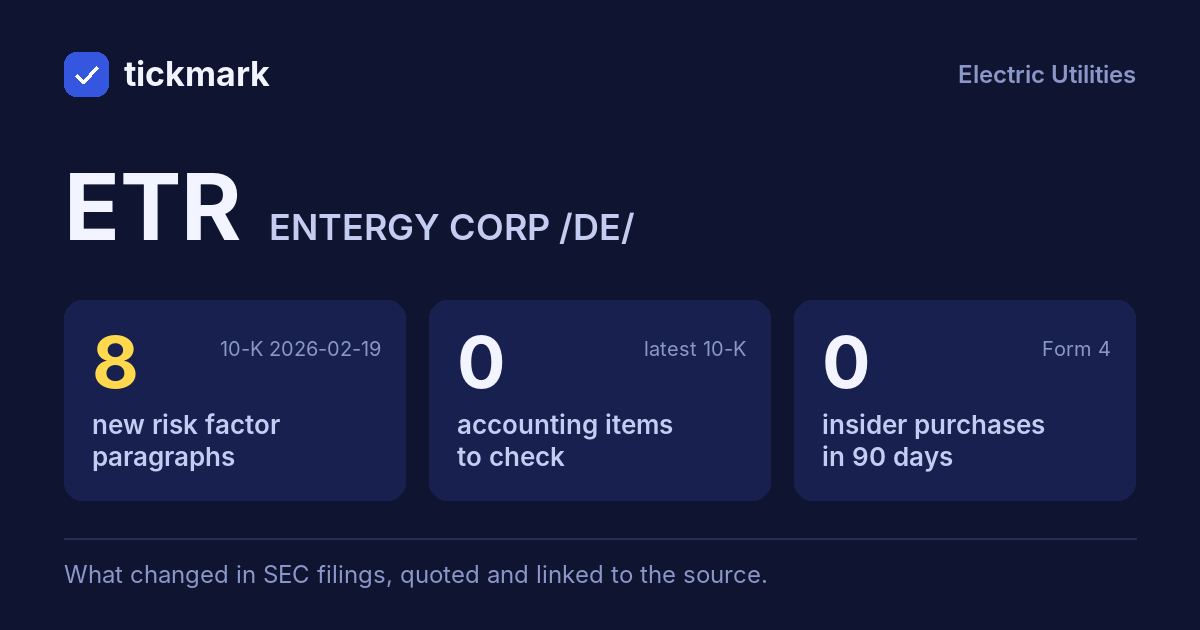
78 changes: 8 added, 5 removed, 63 reworded, 2 quiet changes

10-K Feb 19, 2026 vs Feb 18, 2025
Risk FactorsRedline ↓
15.1%
of the text changed · 18,981 words now

10-K 0000065984-26-000174 (2026-02-19) vs 10-K 0000065984-25-000012 (2025-02-18) Not compared: MD&A, Legal Proceedings, Accounting Policies.

The redline

The paragraph that changed most in each section

Marked against last year's 10-K: cut words struck through, new words highlighted and underlined.

Risk Factors 239 words changed in this paragraph; it is 66% similar to last year's version.
As with any company, Entergy’s and its Registrant Subsidiaries’ reputations are an important element of their ability to effectively conduct their businesses. Entergy’s and its Registrant Subsidiaries’ reputations could be harmed by a variety of factors, including: failure of a generating asset or supporting infrastructure; failure to restore power after a hurricane or other severe weather event or catastrophe in a manner perceived as timely by regulators or customers; the incurrence of storm restoration costs perceived as excessive by regulators or customers; failure to effectively manage land and other natural resources; failure to obtain land and secure permits for infrastructure investments; failure to execute on and/or obtain regulatory approvals for generation, transmission, or other facilities; real or perceived violations of environmental regulations, including those related to climate change; real or perceived issues surrounding the safety or environmental concerns regarding carbon capture and storage; real or perceived issues concerning the environmental impact of new generation, new large load customers, and potential rate increases resulting from investments relating to serving these customers; real or perceived issues with Entergy’s safety culture; challenges or negative reaction to Entergy’s diversity, inclusion, employee inclusion and belonging efforts, or work culture and workplace environment; challenges or negative reaction to Entergy’s climate goals; goals or aspirations; inability to meet their climate goals, goals or aspirations, including as a result of increased sales growth, or to achieve their human capital strategies, or failure to demonstrate meaningful progress toward such goals or strategies; deterioration in relations with bargaining employees and labor unions representing them; inability to effectively prepare for major storms and other weather events, including accelerated resilience planning and projects and challenges in execution thereof, including obtaining necessary regulatory approvals for scope and timing of such plans and projects; inability to keep their electricity rates stable; inability to provide quality customer service, including timely and accurate billing; involvement in a class-action or other high-profile lawsuit; significant delays in, or termination of, construction projects, including as a result of or in connection with changes in regulation or governmental policy (such as tax and trade policy, including increased tariffs and supply chain challenges) or governmental programs (such as tax incentives or tax credits, loans, grants, guarantees, and other subsidies); occurrence of or responses to cyber attacks, data breaches or physical- or cyber- security vulnerabilities; acts or omissions of Entergy management or acts or omissions of a contractor or other third party working with or for Entergy or its Registrant Subsidiaries, which actually or perceivably reflect negatively on Entergy or its Registrant Subsidiaries; measures taken to offset reductions in demand or to supply rising demand; a significant dispute with one of Entergy’s or its Registrant Subsidiaries’ customers or other stakeholders; or negative political and public sentiment resulting in a significant amount of adverse press coverage and other adverse statements affecting Entergy or its Registrant Subsidiaries.

Source: Item 1A, 10-K 0000065984-26-000174 vs Item 1A, 10-K 0000065984-25-000012

Every change, by type

Sentences and paragraphs added, removed or reworded

Sentences and paragraphs of ETR's Risk Factors and MD&A, 10-K 2026-02-19 against 10-K 2025-02-18. Each links to the text at sec.gov.

AddedRisk Factors
Under the Atomic Energy Act and Energy Reorganization Act, the NRC regulates the operation of nuclear power plants. The NRC may modify, suspend, or revoke licenses, shut down a nuclear facility and impose civil

Read it in 10-K 2026-02-19 at sec.gov ↗

AddedRisk Factors
leverage. Material leverage increases could negatively affect the credit ratings of Entergy, the Utility operating companies, and System Energy, which in turn could negatively affect access to the capital markets.

Read it in 10-K 2026-02-19 at sec.gov ↗

AddedRisk Factors
could result in unintended consequences not yet identified that could have a material adverse impact on Entergy’s financial results and future cash flows.

Read it in 10-K 2026-02-19 at sec.gov ↗

AddedRisk Factors
The above risks are heightened by the number and size of the capital projects that Entergy and the Utility operating companies currently plan to undertake to serve load growth driven primarily by large-scale data centers.

Read it in 10-K 2026-02-19 at sec.gov ↗

AddedRisk Factors
including the Utility operating companies and System Energy, have incurred and expect to incur significant costs related to environmental compliance. To the extent that any such changes in law or regulation impact data centers or facilities that power data centers, these risks may be heightened by Entergy’s and the Utility operating companies’ increasing reliance on large-scale data center customers for revenue and load growth.

Read it in 10-K 2026-02-19 at sec.gov ↗

AddedRisk Factors
Entergy and its subsidiaries have in the past, and may in the future, enter into financial arrangements that are subject to variable interest rates and transactions to hedge variable interest rate risk associated with such financing arrangements, such as interest rate swaps, caps or collars. Entergy’s and its subsidiaries’ use of such hedging strategies may not be effective and may adversely affect their business, results of operations, or financial position. Furthermore, no hedging strategy can completely mitigate exposure to variable interest rate risk, and such strategies may limit Entergy’s and its subsidiaries’ ability to participate in the benefits of lower interest rates. Entergy cannot predict the outcome or effectiveness of such hedging strategies to mitigate this risk.

Read it in 10-K 2026-02-19 at sec.gov ↗

AddedRisk Factors
small number of large-scale data center customers which makes recovery of Entergy’s significant investments in transmission and generation assets to power those new large-scale data centers subject to a significant degree to the success of those customers. The contractual and credit and collateral protections included in the agreements with these customers may prove insufficient to protect Entergy under certain circumstances, such as in the event of a bankruptcy of the customer or a guarantor of its obligations. If any such customer is unable to fulfill its contractual obligations, there is a risk that the associated Utility operating company may not be able to fully recover its investment in and/or a return on those assets or meet its debt obligations.

Read it in 10-K 2026-02-19 at sec.gov ↗
Next Related parties →