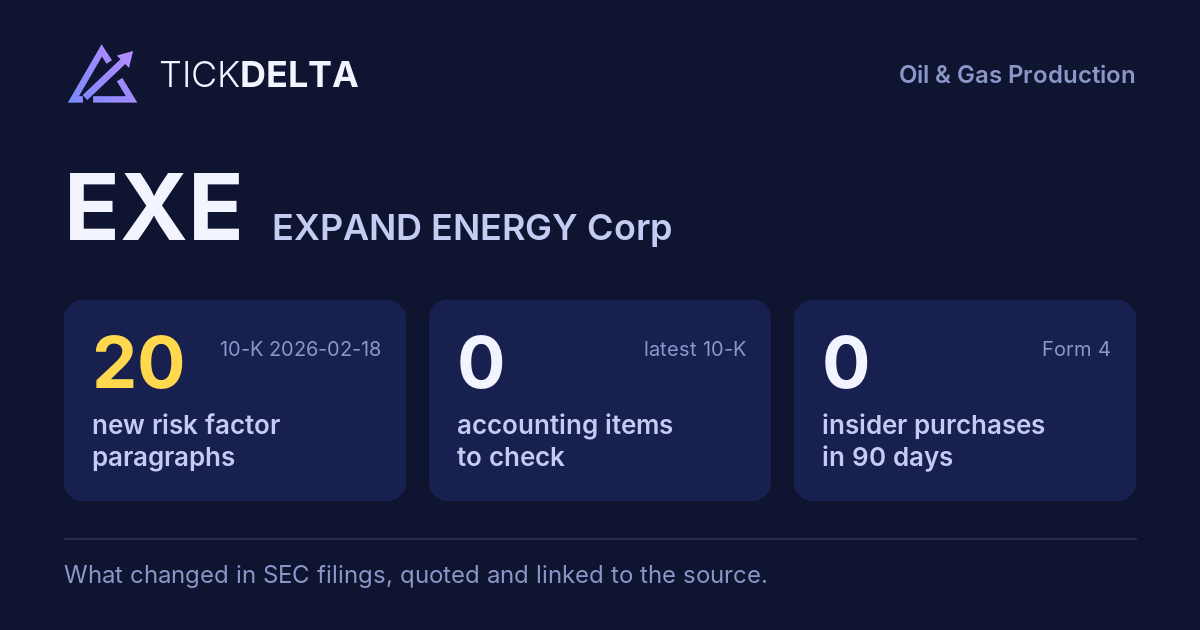
Marked against last year's 10-K:
cut words struck through, new words highlighted and underlined.
Risk Factors 439 words changed in this paragraph; it is 55% similar to last year's version.
Climate Change and Regulation of Methane and Other Greenhouse Gas Emissions. Political and social attention to the issue of climate change has resulted in legislative, regulatory and other initiatives to reduce GHG emissions, such as carbon dioxide and methane. Policy makers at both the U.S. federal and state levels have adopted, or are considering adopting, rules designed to quantify and limit the emission of GHGs through inventories, limitations and/or taxes on GHG emissions. For example, the IRA appropriates significant federal funding for renewable energy initiatives and, for the first time ever, imposes a fee on GHG emissions from certain facilities (discussed above). The emissions fee and funding provisions of the law could increase operating costs within the oil and gas industry and accelerate the transition away from fossil fuels, which could in turn adversely affect our business and results of operations. However, in January 2025, the current Presidential Administration issued an executive order directing an immediate pause on the disbursement of funds appropriated through the IRA. In addition, the EPA has issued regulations for the control of methane emissions, which include leak detection and repair requirements, for the gas and oil industry. In November 2021, the EPA proposed new performance standards and emissions guidelines for new, modified, reconstructed and existing oil and gas facilities. The proposed rule sought to make the existing regulations in Subpart OOOOa more stringent and create a Subpart OOOOb to expand reduction requirements for new, modified, and reconstructed oil and gas sources, including standards focusing on certain source types that have never been regulated under the CAA (including intermittent vent pneumatic controllers, associated gas, and liquids unloading facilities). In addition, the proposed rule sought to establish “Emissions Guidelines,” creating a Subpart OOOOc that would require states to develop plans to reduce methane emissions from existing sources that must be at least as effective as presumptive standards set by EPA. In November 2022, the EPA issued a supplemental proposed rule, which among other things, removed an emissions monitoring exemption for small wellhead-only sites and created a new third-party monitoring program to flag large emissions events, referred to in the proposed rule as “super emitters”. In December 2023, the EPA issued the final rule, which imposes See Exploration and Production, Environmental, Health and Safety and Occupational Laws and Regulations included in Item 1 of Part I of this report for more stringent requirements information on the natural gas EPA’s and oil industry, including phasing out routine flaring of natural gas from new oil wells, requiring all well sites and compressor stations to be routinely monitored for leaks and eliminating or minimizing emissions from common pieces of equipment used in oil and gas operations, such as process controllers, pumps and storage tanks. Notably, EPA updated the applicability date for Subparts OOOOb and OOOOc to December 6, 2022, meaning that sources constructed prior to that date will be considered existing sources with later compliance dates under state plans. The final rule gives states, along with federal tribes that wish to regulate existing sources, until March 2026 to develop and submit their plans for reducing methane from existing sources. The final emissions guidelines under Subpart OOOOc provide until 2029 for existing sources to comply. The final rule is subject to ongoing litigation but remains in effect. This and other rules may require us to incur additional costs or otherwise impact the economics of certain of our operations. Additionally, in April 2024, the BLM finalized a rule to reduce the methane waste from venting, flaring, and leaks during oil and gas production activities on federal and Indian leases. The final rule took effect in June 2024. However, in May 2024, the states of North Dakota, Texas, Montana, Wyoming and Utah challenged the rule. In September 2024, a North Dakota district court granted a motion prohibiting the BLM from enforcing the rule against those states pending the outcome of the litigation. However, in January 2025, the current Presidential Administration issued an executive order directing the heads of all federal agencies to identify and begin the processes to suspend, revise, or rescind all agency actions that are unduly burdensome on the identification, development, or use of domestic energy resources. Consequently, future implementation and enforcement of these final rules remains uncertain at this time. BLM’s rules.
Source: Item 1A, 10-K 0000895126-26-000011 vs Item 1A, 10-K 0000895126-25-000021
MD&A 161 words changed in this paragraph; it is 42% similar to last year's version.
In October 2024, our Board of Directors authorized the Company to repurchase up to $1.0 billion, in aggregate, of the Company’s common stock and/or warrants. Additionally, In 2025, we also announced our enhanced capital returns framework which is designed to more effectively return cash to shareholders and reduce net debt. The plan became effective January 1, 2025, and prioritizes prioritized paying the base dividend of $2.30 per share and a targeted $500 million $1.0 billion of annual net debt reduction in 2025, which target will be redetermined annually. Once both have been funded, it is anticipated that reduction, with 75% of the remaining free cash flow will be distributed distributed, as market conditions warrant, between warranted, through share repurchases and additional dividend payments. The remaining free During 2025, we made dividend payments of $765 million, repurchased 0.9 million shares for an aggregate price of $100 million, reduced the principal amount of our debt through senior notes repayments as noted above, and increased our cash flow would be maintained on hand. See Note 10 of the balance sheet. notes to our consolidated financial statements included in Item 8 of Part II of this report for further discussion on our dividend payments and share repurchases. In 2026, the Company will continue to prioritize debt reduction while continuing to effectively return cash to shareholders.
Source: Item 7, 10-K 0000895126-26-000011 vs Item 7, 10-K 0000895126-25-000021
Accounting Policies 100 words changed in this paragraph; it is 46% similar to last year's version.
In December 2023, 2025, the FASB issued ASU 2023-09, Income Taxes 2025-11, Interim Reporting (Topic 740): Improvements 270): Narrow-Scope Improvements. ASU 2025-11 clarifies interim disclosure requirements and the applicability of Topic 270. Additionally, ASU 2025-11 includes a disclosure principle that requires entities to Income Tax Disclosures. ASU 2023-09 intends to provide investors with additional information about an entity’s income taxes by requiring disclosure of items such as disaggregation disclose events since the end of the effective tax rate reconciliation as well as information regarding income taxes paid. last annual reporting period that have a material impact on the entity. This ASU is effective for interim reporting periods within annual reporting periods beginning after December 15, 2024, 2027, with early adoption permitted for annual financial statements that have not yet been issued or made available for issuance. permitted. We are evaluating the impact this ASU will have on our disclosures.
Source: Item 8, Note 1 – Basis of Presentation and Summary of Significant Accounting Policies, 10-K 0000895126-26-000011 vs Item 8, Note 1 – Basis of Presentation and Summary of Significant Accounting Policies, 10-K 0000895126-25-000021
Legal Proceedings 67 words changed in this paragraph; it is 75% similar to last year's version.
See Note 5 of the notes to our consolidated financial statements included in Item 8 of Part II of this report for information regarding our estimation and provision for potential losses related to litigation and regulatory proceedings. Based on management’s current assessment, we are of the opinion that no pending or threatened lawsuit or dispute relating to our business operations is likely to have a material adverse effect on our future consolidated financial position, results of operations or cash flows. Pursuant to this item, we use a threshold of $1 million for purposes of determining whether any legal proceedings in regards to federal, state or local environmental laws with a governmental authority require disclosure. This $1 million disclosure threshold does not imply that this amount is necessarily material to our business or financial condition, and as of December 31, 2025, there were no environmental proceedings to disclose. The final resolution of such matters could exceed amounts accrued, however, and actual results could differ materially from management’s estimates.
Source: Item 3, 10-K 0000895126-26-000011 vs Item 3, 10-K 0000895126-25-000021