Form 10-12G
You state that you provide support for over 21,000 crypto assets. Please provide a description of your internal policies and procedures for how you determine whether crypto assets, including NFTs and staking products, are securities within the meaning of the U.S. federal securities laws.Rest of the question
Also clarify that such processes are risk-based assessments made by the company and are not legal standards binding on any regulatory body or court. Further, please include a risk factor that addresses the specific risks inherent in your policies and procedures for determining whether or not a crypto asset is a security, and describe the potential regulatory risks under the U.S. federal securities laws if such crypto assets are determined to be securities. Similarly please address how you determine that you are in compliance with the rules, regulations and laws of the jurisdictions in which you offer your products and services.
to the Staff’s comment, Exodus has revised its risk factor, “Certain digital assets traded using third-party services integrated within our platform or other programs could be viewed as ‘securities’ for purposes of federal or state regulations and could subject us to regulatory scrutiny, inquiries, investigations, fines and other penalties,” on page 23 of the Amended Registration Statement to make clear that it does not analyze crypto assets to determine whether they are securities.
Similarly please address how you determine that you are in compliance with the rules, regulations and laws ofRead in the reply ↗Rest of the answer
the jurisdictions in which you offer your products and services.
The Company reviews the laws of jurisdictions in which it operates and engages with outside counsel as necessary to ensure that it remains in compliance with applicable laws and regulations.
Please revise to disclose your policies related to whether you provide services for crypto assets that are securities, and, if so, how you do so in compliance with the federal securities laws and the risks to your business if you are found to be engaging in transactions for unregistered securities in violation of the federal securities laws.Rest of the question
In this regard, we note that your website indicates you offer staking products for Cosmos and Tezos, which have been identified as securities in separate SEC complaints.
The Company acknowledges the Staff’s comment and has revised its risk factor, “Certain digital assets traded using third-party services integrated within our platform or other programs could be viewed as ‘securities’ for purposes of federal or state regulations and could subject us to regulatory scrutiny, inquiries, investigations, fines and other penalties,” to make clear that, if the Company were to receive compensation based on the percentage of digital assets exchanged by persons located in the United States and such assets are deemed to be securities under the federal securities laws,Read in the reply ↗Rest of the answer
then the Company could be deemed to be in violation of the federal and state securities laws, which could have a negative effect on our business, financial condition and results of operations.
The Company’s service is providing a visual interface for users to send, receive and store digital assets self-custodially. We believe that self-custody of financial assets, whether they are deemed to be a security or otherwise, is in compliance with current regulations. All other services involving crypto assets that may be considered securities, such as Cosmos and Tezos, including transactions such as swaps, staking and purchases, are performed by third-party API Providers.
In this regard, we note that your website indicates you offer staking products for Cosmos and Tezos, which have been identified as securities in separate SEC complaints.
The Company acknowledges the Staff’s comment and has revised the disclosure on its website to describe the products and services it offers in a manner consistent with the disclosure contained in the Amended Registration Statement. The
Company respectfully advises the Staff that, consistent with the Company’s terms of service currently disclosed on its website, Exodus does not have any contact with, control over, or ability to take control of any assets that a user stakes.
Rather, Exodus currently allows users to “stake” supported digital assets held in their Exodus wallets by participating in blockchain validation through a third-party API provider, Everstake.
Please provide to us a list of the each of the crypto assets material to your business, organized by the aggregate volume of transactions involving the crypto asset that also includes the blockchain on which each crypto asset exists, the volume of transactions involving the crypto asset in each jurisdiction in which you provide products and services for the crypto asset and the services you provide for each.Rest of the question
In addition, revise your registration statement to include a table that, by volume of transactions, lists the crypto assets that are material to your business, and describe the characteristics of these crypto assets. Also disclose whether there are any jurisdictions in which you do not provide services related to any of these crypto assets.
The Company acknowledges the Staff’s comment and has provided the information requested by the Staff below and has also revised page 30 of the Amended Registration Statement. Please note that a description and characteristics of these assets is included in Item 1 under the Cryptocurrency section.
Digital Asset
Blockchain(s)
Exchange
Aggregation Revenue
For The Year Ended
December 31, 2022
December 31, 2023
BTC
Description: Store of value and payment cryptocurrency.
Bitcoin
$12,279,502
$14,071,926
Tether USD
Description: Stablecoin.
Ethereum, Algorand, Avalanche, BinanceRead in the reply ↗Rest of the answer
Smart
Chain, Arbitrum, Polygon, Optimism, Solana, Tron, Fantom, Polygon, Solana
$10,562,800
$14,525,850
Ether
Description: Blockchain economy or blockchain platform.
Ethereum
$6,360,680
$6,106,462
USD Coin
Chain, Arbitrum, Fantom, Polygon, Optimism, Solana, Tron
$3,645,060
$2,478,815
The Company does not directly provide products and services with respect to crypto assets other than basic wallet functionality (i.e., users can send, receive and store digital assets self-custodially) on the Exodus platform. The Company provides access to the products and services for crypto assets that are offered and performed by the API Providers. The
Company does not track the volume of basic wallet transactions, as this information is not pertinent to the Company’s business model. Rather, the Company tracks and measures the revenue generated by the underlying crypto asset. The crypto assets material to the Company’s business based on revenue are described in the table above and these digital assets are generally available in all jurisdictions in which the Exodus Platform is available.
The Company provides access to the API Providers’ services globally, with the exception of those jurisdictions comprehensively sanctioned by the U.S. Treasury Department’s Office of Foreign Assets (“OFAC”), and the States of New York and Washington.
We refer you to our December 2022 Sample Letter to Companies Regarding Recent Developments in Crypto Asset Markets, located on our website at the following address: https://www.sec.gov/corpfin/sample-letter-companies-regarding-crypto-asset- markets. Please consider the issues identified in the sample letter as applicable to your facts and circumstances, and revise your disclosure accordingly.
The Company has considered the issues identified in the sample letter as applicable to its facts and circumstances at this time and has revised its disclosures accordingly. The disclosure under the heading, “Uncertainty and Volatility in the Digital Asset Markets,” on pages 8 and 9 of the Amended Registration Statement addresses Comments 1, 2 and 3 of the sample letter.Read in the reply ↗Rest of the answer
The Company has revised the risk factor, “The regulatory regime governing blockchain technologies, digital assets and securities is uncertain and new regulations or policies may materially adversely affect the development and utilization of the Exodus Platform,” to address Comment 10 of the sample letter.
Please revise your filing to provide the address of your principal executive offices.
The Company acknowledges the Staff’s comment and has revised the cover page of the Amended Registration
Statement. As provided in the explanatory footnote on the cover page of the Amended Registration Statement, the Company is a remote-first company and does not maintain a principal executive office but has provided its mailing address. Read in the reply ↗
Please revise to identify the jurisdictions in which you offer your platform and services and disclose the percentage of revenue earned in each. In addition, we note that U.S. federal and state and foreign laws prohibit you from making available your platform or certain of its functionalities in all jurisdictions.Rest of the question
Please disclose the methods you use to prohibit the Exodus Platform and certain of its functionalities from being accessed in such jurisdictions, and identify these jurisdictions and functionalities. Also revise your disclosure in the Regulatory Environment section on page 6 to discuss, to the extent material, the laws, rules and regulations that impact your business in the jurisdictions in which you offer your platform and services. For example, you disclose on page 15 that you offer products and services in China. If material, describe the laws, rules and regulations in China regarding crypto assets and any other laws, rules and regulations that may impact your business.
The Company acknowledges the Staff’s comment and has revised page 9 of the Amended Registration Statement accordingly. The Company offers the Exodus Platform in all jurisdictions not prohibited by U.S. law.
In addition, we note that U.S. federal and state and foreign laws prohibit you from making available your platform or certain of its functionalities in all jurisdictions.Read in the reply ↗Rest of the answer
Please disclose the methods you use to prohibit the Exodus Platform and certain of its functionalities from being accessed in such jurisdictions, and identify these jurisdictions and functionalities.
The Company uses geo-blocking technology to block the Exodus Platform’s availability in jurisdictions subject to
U.S. comprehensive sanctions—currently, the Crimea region and so-called Donetsk People’s Republic and Luhansk People’s Republic in Ukraine, Cuba, Iran, North Korea, and Syria. The Company also uses geo-blocking technology to block the availability of
API integrations for third-party crypto-to-crypto exchange services in the states of New York and Washington.
Also revise your disclosure in the Regulatory Environment section on page 6 to discuss, to the extent material, the laws, rules and regulations that impact your business in the jurisdictions in which you offer your platform and services. For example, you disclose on page 15 that you offer products and services in China. If material, describe the laws, rules and regulations in China regarding crypto assets and any other laws, rules and regulations that may impact your business.
The Company offers the Exodus Platform in all jurisdictions not prohibited by U.S. law, and in so doing, it reviews the laws, rules and regulations of any jurisdiction other than the United States if material to its business. As an example, while the Exodus Platform is not prohibited in China, the revenue from China-based users represents an immaterial portion of the Company’s total revenue.
Please identify the crypto assets you hold for your own account. In this regard, we note your disclosure on page 25 that, as of December 31, 2023, you held Bitcoin, Ethereum, USDC and "other digital assets." To the extent that you hold your crypto assets on an exchange, please identify the exchange.Rest of the question
To the extent that they are held with a third-party custodian, please identify the custodian and describe the material terms of the agreement, including: • disclose how the custodian stores the private keys, including the percentage that are held in cold storage, and the geographic location of where they are stored; • disclose whether your assets are comingled with the assets of other customers; • identify who has access to the private key information; • disclose whether any entity is responsible for verifying the existence of your crypto assets; and • disclose whether and to what extent the custodian carries insurance for any losses of the crypto assets it holds for you. To the extent that you self-custody your crypto assets, please revise to disclose your policies and procedures related to storing the private keys, including whether they are held in cold or hot storage, the geographic location where they are stored and who has access to the private keys. In addition, we note your disclosure on page 12 that you do not have insurance that covers your Bitcoin in the event of loss or fraud. Please revise to clarify, if true, and on page 12 that you do not have insurance that covers your crypto assets. If you do have insurance that covers your crypto assets, please revise to disclose to what extent the insurance covers the loss of your crypto assets.
The Company acknowledges the Staff’s comment and has revised page 7 of the Amended Registration Statement accordingly.
To the extent that they are held with a third-party custodian, please identify the custodian and describe the material terms of the agreement, including:
● disclose how the custodian stores the private keys, including the percentage that are held in cold storage, and the geographic location of where they are stored;
disclose whether your assets are comingled with the assets of other customers;
identify who has access to the private key information;
disclose whether anyRead in the reply ↗Rest of the answer
entity is responsible for verifying the existence of your crypto assets; and disclose whether and to what extent the custodian carries insurance for any losses of the crypto assets it holds for you.
To the extent that you self-custody your crypto assets, please revise to disclose your policies and procedures related to storing the private keys, including whether they are held in cold or hot storage, the geographic location where they are stored and who has access to the private keys. In addition, we note your disclosure on page 12 that you do not have insurance that covers your Bitcoin in the event of loss or fraud. Please revise to clarify, if true, and on page 12 that you do not have insurance that covers your crypto assets. If you do have insurance that covers your crypto assets, please revise to disclose to what extent the insurance covers the loss of your crypto assets.
The Company acknowledges the Staff’s comment and has revised pages 7 and 8 of the Amended Registration Statement
Please revise to disclose whether the fees you earn are paid in fiat currency or crypto assets. To the extent that the fees are paid in crypto assets, please disclose the crypto assets that you accept as payment, how and when you value the crypto assets accepted as payment, your policies related to monetizing the crypto assets, where you exchange the crypto assets for fiat currency and whether you have agreementsRest of the question
with any of the third- party exchanges or counter parties that you use for such purposes. If you do have agreements with third-party exchanges or the counter parties used to exchange your crypto assets, please disclose the material terms of the agreements. In addition, to the extent that you accept crypto assets as payment, please disclose whether you or the API pays the expenses, such as gas fees, related to the transfer of the crypto assets from the API to you.
The Company acknowledges the Staff’s comment and has revised page 8 of the Amended Registration Statement
To the extent that the fees are paid in crypto assets, please disclose the crypto assets that you accept as payment, how and when you value the crypto assets accepted as payment, your policies related to monetizing the crypto assets, where you exchange the crypto assets for fiat currency and whether you have agreements with any of the third-party exchanges or counter parties that you use for such purposes.Read in the reply ↗Rest of the answer
If you do have agreements with third-party exchanges or the counter parties used to exchange your crypto assets, please disclose the material terms of the agreements.
The Company acknowledges the Staff’s comment and has revised page 8 of the Amended Registration Statement to disclose that Exodus receives its revenues primarily in Bitcoin and USDC and has expanded its disclosure to include how and when Exodus values the crypto assets accepted as payment, the policies related to monetizing the crypto assets, where the
Company exchanges the crypto assets for fiat currency (on the Coinbase and Kraken exchanges with the exception of USDC) and the standard business accounts the Company maintains with the third-party exchanges for such purposes. The Company considers the terms of the agreements with these exchanges to be in accordance with customary industry practice and accepted forms of such contracts and therefore has not identified any specific terms as material for disclosure purposes.
In addition, to the extent that you accept crypto assets as payment, please disclose whether you or the API pays the expenses, such as gas fees, related to the transfer of the crypto assets from the API to you.
disclose that the expenses, such as gas fees, related to the transfer of the crypto assets from the API to Exodus are typically paid by the sender.
We note your disclosure on your YouTube channel that you distribute USDC to users that recommend your product to others. Please revise to disclose the circumstances in which you distribute USDC and the amount of USDC distributed to users of your platform.
The Company respectfully advises the Staff that the referral program referenced in the YouTube channel, which is also described on the Company’s website as the “Exodus referral program,” has resulted in the distribution of an immaterial amount of USDC. For example, less than $10,000 of USDC was distributed pursuant to such program during the fiscal year ended
December 31, 2023. The first payment for the referrals was in March 2023.Read in the reply ↗Rest of the answer
Accordingly, the Company did not include information about such program in the Registration Statement as it is not a material method by which Exodus attracts users and does not involve a material amount of USDC. To the extent that the Exodus referral program becomes a material part of Exodus’s business and results in the distribution of a material amount of USDC, the Company will disclose the circumstances in which it distributes USDC and the amount of USDC distributed to users on our platform.
Please revise to disclose whether and to what extent you have insurance for any losses of assets in your users' wallets.
include a cross reference to the risk factor disclosing that Exodus does not maintain insurance that covers its users’ digital assets in the case of loss or fraud. Read in the reply ↗
Please describe the AML, KYC and any other procedures conducted by you or for you by third parties to determine, among other things, whether the counter-party in any transaction is not a sanctioned entity or whether a user of your platform is not a sanctioned entity. Similarly, please describe the AML, KYC and any other procedures related to the sale or acquisition of crypto assets for your own account.
The Company respectfully advises the Staff that while the Company conducts Know Your Buyer (KYB) diligence with respect to the API Providers, including those API Providers through which the Company buys or sells crypto assets for its own account. Because the Company is a self-custody wallet software provider, it does not, and is not obligated to, conduct AML or KYC procedures with respect to its users. The third-party API Providers conduct AML or KYC procedures with respect to their users in accordance with their respective policies, procedures and regulatory obligations.Read in the reply ↗Rest of the answer
The Company also maintains a risk-based sanctions compliance program in line with OFAC guidance. As described above, the Company uses geo-blocking technology to block the Exodus Platform’s availability in jurisdictions subject to U.S. comprehensive sanctions. In addition, the
Company maintains a blacklist that prevents transactions between third-party APIs and sanctioned cryptocurrency wallet addresses. The Company has implemented an automated OFAC sanctions list search in its customer support system, which operates in instances where wallet holders have provided their names.
Please revise here to disclose that you are a controlled company and that Jon Paul Richardson, your CEO and director, and Daniel Castagnoli, a director, control 85% of the voting power of your outstanding capital stock and that holders of your Class B common stock collectively control 98% of the voting power of your outstanding common stock.
No numbered answer found in the reply. Read the reply ↗
Please revise to clarify what you mean by the “trustworthiness of a bank’s online portal." In this regard, we note that you are not a banking institution or otherwise a member of the FDIC and that the assets held in your wallets are not subject to the protections of depositors with FDIC institutions and that crypto asset transfers, which due to human error, theft or criminal action, may be improperly transferredRest of the question
from a user's wallet and never recovered due to the characteristics of crypto assets and the blockchain.
The Company acknowledges the Staff’s comment and has removed this reference from the Amended Registration
Statement accordingly. Read in the reply ↗
Please revise your disclosure in this section to provide a balanced description. For example purposes only, we note the following: • you state that “[a]s a result, blockchain technology has a reputation of being difficult to access and use, and the current options for managing digital assets do not provide integrated or seamless solutions” but do not explain that many crypto asset exchanges allow users to accessRest of the question
multiple blockchains through the exchanges’ platforms; • you state that certain cryptocurrencies are primarily used to pay for goods and services and are often considered a substitute for gold, cash or forms of electronic payment but do not discuss the limited use of crypto assets to pay for retail and commercial services; • you discuss privacy coins but do not discuss the ban of such crypto assets in several jurisdictions or that the anonymity provided by the crypto assets facilitates the use of these crypto assets for illicit financing and crime; • you state that crypto assets “can also be transferred in real time, often with no or low fees,” but do not address the volatility of transfer fees and settlement times; • you state that “[o]ften wallets have cumbersome interfaces,” but do not disclose that the private key that your users must enter to utilize the crypto assets in their wallets on your platform is an alphanumeric code with hundreds of digits, which, if lost, renders the assets in the wallets lost; and • you state that "[s]tablecoins are cryptocurrencies whose value is connected to an asset that will not significantly fluctuate in value" but do not discuss the potential for significant fluctuations in value.
The Company acknowledges the Staff’s comment and has revised the disclosure within this section of the Amended Registration Statement accordingly. Read in the reply ↗
We note your disclosure on page 3 that you are “adapting and innovating the Exodus Platform to support [y]our users’ ability to store other types of valuable assets such as personal information, traditional fiat currencies and other tokenized financial products.” Please revise to disclose the assets that your wallets currently are able to hold.
The Company acknowledges the Staff’s comment and has removed the cited language and expanded its disclosure on pages 4 and 5 to describe the Exodus Platform’s ability to currently support fungible cryptocurrency assets ledgered on public blockchains as well as non-fungible tokens ledgered on public blockchains.
In addition, please discuss your plans for developing additional wallet capabilities, the steps involved for such development, the related costs, the source of the capital necessary for the development and any challenges you may encounter, including compliance with the relevant laws,Read in the reply ↗Rest of the answer
rules and regulations in each of the jurisdictions in which you operate.
The Company acknowledges the Staff’s comment and has added disclosure on page 4 of the Amended Registration
Statement to provide that the Company has no current plans to expand the breadth of asset classes supported within the Exodus Platform or otherwise develop additional wallet capabilities beyond incremental improvements to existing functionalities.
In addition, please revise to clarify what you mean by “other tokenized financial products.”
As noted above, the Company has removed this reference from the Amended Registration Statement.
We note that, on page 3, you disclose that "[c]urrently products do exist to permit users to migrate from fiat currency to digital assets; however, they often have poor user interface/user experience (“UI/UX”) designs and require numerous transactions to move between different types of digital assets” but it appears that one of the ways you facilitate transfers of crypto assets is by giving users access toRest of the question
third-party exchanges. Please clarify how the use of your platform differs from the use of third-party exchanges,
The Company acknowledges the Staff’s comment and has revised page 4 of the Amended Registration Statement to disclose the Exodus Platform’s ability to operate irrespective of the type of digital asset versus asset or blockchain specific platforms that limit users to a particular asset or blockchain. We also refer the Staff to the description of the
Company’s Exchange Aggregation on page 5 of the Amended Registration Statement. Read in the reply ↗
Please identify all of the products and services you offer on your platform, identify any of your products and services that you do not offer to U.S. users and discuss the different pricing models you use depending on whether a customer is a U.S. person, including the reasons for the use of such different pricing models.Rest of the question
In addition, please identify all of your API providers, including the jurisdiction of each, and disclose the material terms of the agreements you have with the providers, including how you earn fees from each. In this regard, we note your disclosure on page 45 in your financial statements that addresses exchange aggregation, fiat onboarding and staking revenue earned through an API provider.
The Company acknowledges the Staff’s comment and has revised page 5 of the Amended Registration Statement accordingly. For ease of reference, the Company respectfully notes for the Staff that discussion of its products and services begins on page 5 of the Amended Registration Statement, including discussion regarding Exodus’ fee structure and pricing model for (i) exchanges made by persons located in the United States trading digital assets, charging its API Providers a monthly subscription fee and (ii) exchanges made by persons located outside the United States, charging its third-partyRead in the reply ↗Rest of the answer
providers a percentage of the digital assets exchanged.
In addition, please identify all of your API providers, including the jurisdiction of each, and disclose the material terms of the agreements you have with the providers, including how you earn fees from each. In this regard, we note your disclosure on page 45 in your financial statements that addresses exchange aggregation, fiat onboarding and staking revenue earned through an API provider.
The Company acknowledges the Staff’s comment and has revised page 5 of the Amended Registration Statement to explain that Exodus maintains its updated list of API providers within the terms of service located on its website and has expanded its description of the various API agreements in the Business section, particularly on page 5 of the Amended
Registration Statement. As discussed above, the Company respectfully submits to the Staff that it has included its form API agreements (both the form U.S. agreement and the form international agreement) as exhibits to the Amended Registration
Statement. The Company notes that its API agreements generally follow these forms, and it does not view any single API agreement as being material on its own or substantially deviating from these forms.
Please identify the fiat currencies that may be used to purchase crypto assets and the fiat currencies that may be received for the sale of crypto assets on or through your platform.
provide that, where available, users can use 30 different fiat currencies to buy crypto assets, including major currencies such as the U.S. Dollar, EURO and British Pound Sterling. Exodus users can sell U.S. Dollar, EURO and British Pound Sterling for crypto via MoonPay where available. Read in the reply ↗
We note your disclosure that you "have a streamlined approach to aggregate the exchanges and aim to provide users with the best exchange rate within their jurisdictional limitations." Under an appropriately captioned heading, please revise to describe in detail what your Exchange Aggregator is and how it works.Rest of the question
Please revise to identify the exchanges you use, the jurisdiction of each exchange and whether you have separate agreements with each exchange or whether one of your APIs provides the connection with the third-party exchanges. In addition, please disclose whether the third-party exchanges that users may access through your platform provide services for the 21,000 types of crypto assets that users may hold in their wallets on your platform.
accordingly. Information concerning the Company’s Exchange Aggregator can be found under the “Exchange Aggregation” heading on page 5 of the Amended Registration Statement.
Please revise to identify the exchanges you use, the jurisdiction of each exchange and whether you have separate agreements with each exchange or whether one of your APIs provides the connection with the third-party exchanges.
clarify that the Company’s API Providers provide the connection with the exchanges.Read in the reply ↗Rest of the answer
The Company identifies information about the exchanges in its Terms of Service.
In addition, please disclose whether the third-party exchanges that users may access through your platform provide services for the 21,000 types of crypto assets that users may hold in their wallets on your platform.
clarify that access to the 21,000 digital assets is dependent on API provider, availability and jurisdiction.
We note your disclosure that users can "send, receive and swap over 21,000 crypto assets without having to access centralized exchanges or trade across multiple order books." Please revise to describe how users send, receive and swap crypto assets on your platform without accessing centralized exchanges, and describe your involvement in such transfers.
clarify that the Company’s users are able to send digital assets by inputting a public blockchain address and an amount to transfer and receive digital assets by providing the sending party with the users’ own public blockchain address. The Company’s involvement in these transfers is generally limited to providing a visual interface to access the blockchain. Read in the reply ↗
We note your disclosure that the "platform also provides important information for users regarding accurate and real-time information on crypto asset prices and other relevant market data." Please describe how you determine the real-time crypto asset prices and describe the "other relevant market data" that you provide on your platform.
The Company acknowledges the Staff’s comment and has expanded its disclosure on page 5 of the Amended
Registration Statement accordingly. Read in the reply ↗
We note your disclosure that the creation of the Exodus Platform has been downloaded over 12.4 million times as of December 31, 2023. Please revise to disclose how many times your platform was downloaded during the fiscal year ended December 31, 2023.Rest of the question
We also note your disclosure that "[a]s of December 31, 2023, [y]our users have swapped approximately $12.3 billion digital assets." Please revise to disclose the volume of transactions during the most recently completed fiscal year. In addition, we note your disclosure on page 8 that “[t]he success of [y]our business depends on [y]our ability to attract and retain Exodus Platform users.” Please revise to disclose the metrics you use to evaluate your attraction and retention levels. In addition, we note your disclosure on page 23 regarding monthly active users. Please revise to provide a definition of “monthly active users” and disclose how many you had throughout the most recently completed fiscal year and how many you had as of December 31, 2023.
The Company acknowledges the Staff’s comment and has revised page 31 of the Amended Registration Statement to provide a definition of “monthly active users” and to describe how management uses it to monitor the business. Read in the reply ↗
Please revise to disclose your policies and procedures relating to forks and airdrops of crypto assets in situations where your wallet does not support the incidental right. In addition, to the extent that users may need to forgo potential economic benefits associated with incidental rights, please include risk factor disclosure.
Regarding forks, the Company acknowledges the Staff’s comment and has revised page 5 of the Amended Registration
Regarding airdrops, the Company respectfully advises the Staff that these events take place on-chain, and because the Company’s users take these actions on their own, it does not require any involvement from the Company. As a self-hosted wallet software, the Company’s users are able to utilize other wallet services when and where applicable. For these reasons, the Company believes that responsive disclosure regarding the usage of airdrops by its users is not required. Read in the reply ↗
Please identify the crypto assets for which you offer staking products, and revise to disclose the terms of each of the staking products offered on your platform. In addition, please disclose the risks to users of utilizing the staking products offered on your platform.
No numbered answer found in the reply. Read the reply ↗
We note your disclosure on page 6 that you pay your employees in Bitcoin and your disclosure on page 12 that the salaries are denominated in U.S. dollars. Please revise to disclose how and when you value the Bitcoin used for compensation. In addition, we note your disclosure that 130 of your team members are located outside the United States.Rest of the question
Please identify the countries in which your team members are located and the number of employees located in each jurisdiction. In addition, please disclose when and where you obtain the Bitcoin used to pay your employees and contractors and whether you or the employees and contractors pay the transfer costs associated with the transfer of Bitcoin.
The Company acknowledges the Staff’s comment and has expanded its disclosure on page 8 of the Amended
In addition, we note your disclosure that 130 of your team members are located outside the United States.
Please identify the countries in which your team members are located and the number of employees located in each jurisdiction.
In addition, please disclose when and where you obtain the Bitcoin used to pay your employees and contractors and whether you or the employees and contractors pay the transfer costs associated with the transfer of Bitcoin.
The Company acknowledges the Staff’sRead in the reply ↗Rest of the answer
comment and has revised pages 8 and 16 of the Amended Registration Statement
We note your disclosure that you had 195 "full time equivalents" as of December 31, 2023 and that TriNet co-employs your U.S. team members. Please revise to explain what you mean by "full time equivalents," and disclose the material terms of your agreement with TriNet, including the term and termination provisions.
No numbered answer found in the reply. Read the reply ↗
Please revise to disclose here that the FTX app was available on the Exodus Platform until you removed it in November 2022. In addition, please disclose here that Alameda Research Ventures LLC held 42.2% of your Class A common stock as of December 31, 2023.
No numbered answer found in the reply. Read the reply ↗
We note that several of your risk factors are generally applicable to companies in your industry and not specific to Exodus Movement. Please revise your risk factor disclosure to provide specific examples that have occurred at your company or to third parties with which you conduct business.Rest of the question
For example purposes only and not as an exhaustive list, we note the following: • You address the risks of disruptions in your agreement with third-party APIs. To the extent that you have experienced any such disruptions, please discuss. • You discuss the risks related to malware, security breaches or other cybersecurity incidents. To the extent that you have or your APIs have been impacted by any material incidents, please discuss. • You discuss disputes with users and other third parties. To the extent that you have experienced any material disputes, please discuss. • You discuss licenses or other authorizations that may be required in certain states. Please identify the percentage of your users and any services that you provide that will be impacted by such regulations, and, to the extent material, please discuss these regulations in greater detail in your Regulatory Environment section on page 6.
The Company acknowledges the Staff’s comment and has expanded its disclosure throughout the risk factors section, including adding additional risk factors on pages 17 and 18 of the Amended Registration Statement.
The Company acknowledges the Staff’s comments were provided for example purposes only but notes that with respect to the Staff’s comments at bullets 1, 2 and 3, the Company respectfully advises the Staff that for the reporting periods covered by the Amended Registration Statement up to and including the date of this letter the Company has not experienced such a material disruption,Read in the reply ↗Rest of the answer
incident or dispute. Therefore, the Company respectfully submits that this portion of the comment is not applicable.
With respect to the Staff’s comment at bullet 4 above, the Company respectively advises the Staff that it is currently unaware of any licenses or authorizations that may be required by the Company at this time. Therefore, the Company respectfully submits that this portion of the comment is not applicable.
Please provide a materially complete description of the risks related to the crypto assets that you support, including: • the use of crypto assets in illicit transactions; • the lack of adoption of and ability to use crypto asset to purchase goods; • the risk of a "51%" attack on certain crypto asset networks; • the risk presented by the concentration of ownership of a crypto asset; and • the risk that rewards forRest of the question
mining Bitcoin are designed to decline over time, which may lessen the incentive for miners to process and confirm transactions on the Bitcoin network. In addition, please discuss the extent to which material aspects of the business and operations of trading platforms are not regulated. For example, please address the fact that trading platforms are not subject to regulation in a similar manner as other regulated trading platforms, such as national securities exchanges or designated contract markets. Also discuss the risk of fraud, manipulation, front-running, wash-trading, security failures or operational problems at trading platforms, including your own or ones that may be accessed through your platform.
No numbered answer found in the reply. Read the reply ↗
Please add a risk factor that addresses the risk to your users if you, one of your subsidiaries or one of your APIs experiences insolvency or bankruptcy.
The Company acknowledges the Staff’s comment and has added disclosure on page 9 of the Amended Registration
Statement disclosing that it believes that an API Provider experiencing insolvency or bankruptcy presents an immaterial risk to the Company and its users because the Company’s users possess their crypto assets at all times and the Company’s users’ only exposure to an API provider experiencing insolvency or bankruptcy would be the brief period of time during which wallet users are engaged in an active crypto-asset transaction.Read in the reply ↗Rest of the answer
Therefore, the Company respectfully advises the Staff that the insolvency or bankruptcy of one of its API Providers is not, under Item 105 of Regulation S-K, a “material factor that makes an investment in the registrant or offering speculative or risky.” Similarly, the Company respectfully advises the Staff that the Company submits that, to users, the risk of the Company’s insolvency or bankruptcy is not material or significant because the Company offers a self-hosted wallet and the Company’s users have the ability to import their mnemonic seed phrase or private key into another wallet platform. Therefore, the Company does not believe the risk factor as requested in this comment is warranted at this time.
To the extent material, please include risk factor disclosure addressing the risks associated with operating as an unregistered investment company.
The Company does not consider the risk that it will be determined to be operating as an unregistered investment company to be material to the Company. The Company has policies and procedures in place to assess its status under the Investment Company Act of 1940. Based on the Company’s calculations, the Company is well under the threshold amount of investment securities that would qualify the Company as an investment company. Therefore, the Company does not believe the risk factor as requested in this comment is warranted at this time.Read in the reply ↗Rest of the answer
Please see our discussion of Item 105 of Regulation S-K above.
Please revise to add quantitative examples demonstrating the volatility of bitcoin and other crypto assets you hold.
No numbered answer found in the reply. Read the reply ↗
Please add a separate risk factor that addresses the liability to the company if Exodus users engage in illegal or criminal activity on or through the Exodus platform. Similarly please add a separate risk factor that addresses the liability to the company if the API providers fail to comply with the rules, laws and regulations in the jurisdictions in which they provide services to your users.
No numbered answer found in the reply. Read the reply ↗
Please revise to clarify that you are not listing your securities on a national securities exchange.
The Company acknowledges the Staff’s comment and has revised the Amended Registration Statement to indicate that the Company has applied to list its Class A common stock on the NYSE American. Read in the reply ↗
Please revise your next amendment to break out the material components of general and administrative expenses. Discuss any material trends between periods. Refer to Item 303(b)(2) of Regulation S-K.
No numbered answer found in the reply. Read the reply ↗
We note your disclosure that you do not currently have an audit committee, compensation committee or nominating and corporate governance committee but that your board of directors intends to establish an audit committee composed entirely of independent directors. Please disclose when the board of directors intends to establish these committees.Rest of the question
In this regard, we note that you have added two new independent directors to your board in fiscal year 2024.
The Company acknowledges the Staff’s comment and has revised page 41 of the Amended Registration Statement accordingly. In March 2024, our Board of Directors established an Audit Committee composed entirely of independent directors. Because Jon Paul Richardson and Daniel Castagnoli control a majority of the voting power of the Company’s outstanding capital stock, the Company expects to qualify as a “controlled company” within the meaning of the corporate governance standards of NYSE American if successfully listed on such exchange.Read in the reply ↗Rest of the answer
Under these rules, the Company may elect not to comply with certain corporate governance requirements, including the requirements that director nominees be selected or recommended to our Board of Directors by a nominating committee comprised entirely of independent directors and compensation of our chief executive officer and all other officers be determined or recommended by a compensation committee comprised entirely of independent directors. The Company intends to rely on these exceptions if successfully listed on the NYSE American. As a result, the Company does not currently have a compensation committee or a nominating and corporate governance committee and does not currently intend to establish such committees.
We note your disclosure on page 16 that you are not in compliance with the United Kingdom Financial Conduct Authority rules and that you have been placed on the Warning List. Please revise to disclose how you are in non-compliance and the impact if you are unable to reach an agreement with the United Kingdom Financial Conduct Authority.
The Company respectfully submits that the matter regarding the Company’s compliance with the United Kingdom
Financial Conduct Authority rules is not a “material pending legal proceeding” under Regulation S-K 103. As described in “Item 1A. Risk Factors – Risks Related to Regulation – The regulatory regime governing blockchain technologies, digital assets and securities is uncertain and new regulations or policies may materially adversely affect the development and utilization of the Exodus Platform,” the Company has outlined the risks to our business as a result of the regulatory regimeRead in the reply ↗Rest of the answer
governing blockchain technologies, digital assets and securities, including the potential for a material adverse affect on the development and utilization of the Exodus Platform.
Please revise to disclose whether you issue and have outstanding tokenized shares of common stock. To the extent that you do, please disclose the rights of the holders of the tokenized shares, how such rights are memorialized, how you comply with the proxy rules in connection with tokenized shares, whether and, if so, when and how such rights or characteristics can be modified, whether the token has been subjectedRest of the question
to a third-party security audit of the code and, if so, who conducted the audit and the results of the audit, the blockchain on which it exists and the AML/KYC procedures you preform for issuance and other transfers.
As the Company states on page 42 of the Amended Registration Statement, which language was also in the
Registration Statement, “Common Stock Tokens are only digital representations of our Class A common stock, contain no voting, governance, economic or other rights, and cannot be traded independently of the Class A common stock. The ownership and transfer of shares of our Class A common stock will be recorded in book-entry form by the Transfer Agent.” The Company’s transfer agent is Securitize LLC, which is an SEC-registered transfer agent.Read in the reply ↗Rest of the answer
The Company is unaware of whether Securitize LLC has performed AML/KYC procedures with respect to the common stock tokens that it issues, or whether Securitize LLC has commissioned a third-party security audit of the code. The Class A Common Stock has not been subject to the SEC’s proxy rules to date because it has not been registered under Section 12 of the Exchange Act.
Please revise to clarify whether your shares of common stock are made available on an ATS. In this regard, we note your disclosure on page 32 that you ceased making your shares of Class A common stock available on tZero and on Securitize Markets.
No numbered answer found in the reply. Read the reply ↗
Please tell us why you classify your mutual funds as a cash equivalent. If the disclosure is meant to refer to money market accounts, please revise to clarify. Refer to the definition of cash equivalents in the FASB Master Glossary.
The Company acknowledges the Staff’s comment and has revised Note 2 (Summary of Significant Accounting Policies –
Cash and Cash Equivalents) and Note 12 (Fair Value Measurements) to clarify that the mutual fund referenced herein is a money market mutual fund. Read in the reply ↗
Please revise your next amendment to expand your disclosure related to Accounts Receivable to provide the following: • A rollforward of accounts receivable in the periods presented; • the specific GAAP guidance you followed to form your accounting policy for your allowance for doubtful accounts; • if you have had any receivables charged-off in the periods presented; and • your charge-off policy under ASCRest of the question
310-10-35-41.
Accounts Receivable) to the Amended Registration Statement accordingly. Read in the reply ↗
On page 43, you disclose that you developed an un-hosted self-custodial digital asset wallet on the Exodus Platform and you contract with third parties to provide various services to users that utilize your wallet through the platform. Please respond to the following: • Revise the disclosure to clarify the nature of your performance obligation(s).Rest of the question
Clarify how many performance obligations are in the contract and, if more than one, how you allocate the transaction price to the separate performance obligations in the contract. • Summarize for us the pertinent rights and obligations of the parties in your agreements with API providers and, if applicable, end users. • Disclose who is your customer. Refer to ASC 606-10-15-3. • Tell us whose customer is the end user and why. Tell us whether the end user enters into a contract with the API providers. • You disclose that you have determined that for your transaction based contracts, you are an agent under ASC 606. Provide us with your accounting analysis supporting this determination. Refer to ASC 606-10-55-36 through 55-40. • Disclose the form of consideration and timing of payment under your agreements. • If the form of consideration is noncash, disclose your accounting policy for the timing and method of measuring the noncash consideration. Refer to ASC 606-10-32- 21 to 32-24. • For transaction-based API fees, you disclose that you recognize revenue when the API interaction is complete. For non-transaction-based API fees, you disclose that you recognize revenue based on when performance obligations in the underlying contracts have been identified, priced, allocated, and satisfied.o Explain to us how the timing of your revenue recognition policy considered when you satisfy your performance obligations by transferring a promised good or service to a customer and the customer obtaining control of that good or service. Refer to ASC 606-10-25-23. o Disclose whether you recognize revenue at a point in time or over time and why. o For both types of revenues, revise the disclosure to clarify when you recognize revenue and how you considered the transfer of control. • You disclose on pages 16 and 17 that you charge your third-party providers a monthly subscription fee for exchanges made by U.S. persons trading digital assets and you charge a percentage of the digital assets exchanged for exchanges made by non-U.S. persons. Revise your disclosure to discuss how you account for the monthly subscription fees. Explain whether the monthly subscription fee is recurring revenue.
The Company acknowledges the Staff’s comment and has revised Note 2 (Summary of Significant Accounting
Policies – Revenue Recognition) to the financial statements of the Amended Registration Statement accordingly.
Summarize for us the pertinent rights and obligations of the parties in your agreements with API providers and, if applicable, end users.
As discussed above, the Company respectfully submits to the Staff that it has included its form API agreements (both the form U.S. agreement and the form international agreement) as exhibits to the Amended Registration Statement.Read in the reply ↗Rest of the answer
The pertinent rights and obligations in the Company’s Terms of Service are as follows:
(a)
Agreement with API Provider, not Exodus: Users agree that interactions with the API Providers are governed by the terms of the agreement between the API Provider and the user. Exodus is not a party to this agreement.
(b)
Acknowledgment of Use of Third-Parties: Users agree that all services, including informational services, are executed by third party service providers and acknowledge that Exodus does not directly exchange virtual currencies or serve as the source of any pricing data.
(c)
Customer Service Provided by API Providers: Exodus does not provide customer service for any services provided by the API Provider pursuant to the agreement between the API Provider and the user.
Disclose who is your customer. Refer to ASC 606-10-15-3.
Tell us whose customer is the end user and why. Tell us whether the end user enters into a contract with the API providers.
The Company respectfully advises the Staff that for revenue recognition purposes, the end user is ultimately the customer of the API Provider because: (a) Exodus does not charge the end user any fees or otherwise handle or possess user funds, (b) Exodus does not provide any services to the end user and (c) the end user enters into a contract with the API Providers here. See analysis below under “Step 1 – Identify the Contract.”
You disclose that you have determined that for your transaction based contracts, you are an agent under ASC 606. Provide us with your accounting analysis supporting this determination. Refer to ASC 606-10-55-36 through 55-40.
The following table outlines the Company’s accounting analysis supporting this determination in accordance with
ASC 606-10-55-36 thru 606-10-55-40.
Exodus’ Analysis
ASC 606-10-55-36 through 55-40
Summary
● The Company’s API Provider agreements and user Terms of Service, along with the self-custodial nature of its product, provide that the responsibility for transactions flowing through the APIs are exclusively the responsibility of the API Provider and the user (ASC 606-10-55-36).
● The Company does not control the digital asset being provided before it is transferred to the buyer, does not have inventory risk related to the digital asset, and is not responsible for the fulfillment of the digital asset (ASC 606-10-55-36 through 37).
● A reporting entity is an agent if it does not control the specified good or service before it is transferred to the end consumer (ASC 606-10-55-39).
● The Company does not set the price for the digital asset (ASC
606-10-55-37).
ASC 606-10-55-36
Analysis
1. Identify the specified goods or services to be provided to the customer (which, for example, could be a right to a good or service to be provided by another party.
The specified good or service is the exchange of digital assets or fiat.
2. Assess whether it controls (as described in paragraph
606-10-25-25) each specified good or service before that good or service is transferred to the customer. Assess whether it has the ability to (1) direct the use and (2) obtain economic benefits.
The Company cannot direct the digital asset exchange nor does the Company ever have access to the digital asset to use for itself. As such, the Company does not have the ability to obtain economic benefits from selling/staking/participating in appreciation of the digital assets.
ASC 606-10-55-37
ASC 606-10-55-39
Indicators that an entity controls the specified good or service before it is transferred to the customer
(and is therefore a principal [see paragraph 606-10-55-37]) include, but are not limited to, the following:
1. The entity is primarily responsible for fulfilling the promise to provide the specified good or service. This typically includes responsibility for the acceptability of the specified good or service (for example, primary responsibility for the good or service meeting customer specifications). If the entity is primarily responsible for fulfilling the promise to provide the specified good or service, this may indicate that the other party involved in providing the specified good or service is acting on the entity’s behalf.
Exodus is not responsible for fulfilling the obligation to the end-user to complete a desired transaction. As such, the API Provider is responsible for fulfillment of the performance obligation in the executed contract.
2. The entity has inventory risk before the specified good or service has been transferred to a customer or after transfer of control to the customer (for example, if the customer has a right of return). For example, if the entity obtains, or commits to obtain, the specified good or service before obtaining a contract with a customer, that may indicate that the entity has the ability to direct the use of, and obtain substantially all of the remaining benefits from, the good or service before it is transferred to the customer.
Exodus does not have inventory risk before, during, or after the specified good or service has been transferred to a customer. Exodus does not obtain, or commit to obtain, the specified good or service and does not have the ability to direct the use of or obtain substantially all of the remaining benefits from the good or service before it is transferred to the end user.
3. The entity has discretion in establishing the price for the specified good or service. Establishing the price that the customer pays for the specified good or service may indicate that the entity has the ability to direct the use of that good or service and obtain substantially all of the remaining benefits.
Exodus does not have discretion in setting the price for the exchange of digital assets or flat (i.e., specified good or service) to the end user.
The indicators in paragraph 606-10-55-39 may be more or less relevant to the assessment of control depending on the nature of the specified good or service and the terms and conditions of the contract. In addition, different indicators may provide more persuasive evidence in different contracts. Management concluded that the indicators noted above and as prescribed in ASC 606-10-55-39 provide further evidence that Exodus does not control the exchange services provided by the API Providers before being provided to the end user.
If the form of consideration is noncash, disclose your accounting policy for the timing and method of measuring the noncash consideration. Refer to ASC 606-10-3221 to 32-24.
For transaction-based API fees, you disclose that you recognize revenue when the API interaction is complete. For non-transaction-based API fees, you disclose that you recognize revenue based on when performance obligations in the underlying contracts have been identified, priced, allocated, and satisfied.
Explain to us how the timing of your revenue recognition policy considered when you satisfy your performance obligations by transferring a promised good or service to a customer and the customer obtaining control of that good or service. Refer to ASC 606-10-25-23.
The Company respectfully advises the Staff to please see the Company’s analysis provided below under
“Analysis of ASC 606 – Step 1 – Identify The Contract.”
Disclose whether you recognize revenue at a point in time or over time and why.
The Company respectfully advises the Staff to please see the
Company’s analysis provided below under “Analysis of ASC 606.”
For both types of revenues, revise the disclosure to clarify when you recognize revenue and how you considered the transfer of control.
Company’s analysis provided below under “Analysis of ASC 606 – Step 5 – Recognize Revenue.”
You disclose on pages 16 and 17 that you charge your third-party providers a monthly subscription fee for exchanges made by U.S. persons trading digital assets and you charge a percentage of the digital assets exchanged for exchanges made by non-U.S. persons. Revise your disclosure to discuss how you account for the monthly subscription fees. Explain whether the monthly subscription fee is recurring revenue.
The Company acknowledges the Staff’s comment and has revised page 23 in Risk Factors, Certain digital assets traded using third-party services integrated within our platform or other programs could be viewed as “securities” for purposes of federal or state regulations and may be subject to regulatory scrutiny, inquiries, investigations, fines and other penalties, of the Amended Registration Statement accordingly.
Analysis of ASC 606
Step 1 – Identify The Contract: For purposes of this analysis, there are three contracts to consider:
(1)
Exodus’ contract with the API Provider (identified as a “contract”);
(2)
Exodus’ contractual Terms of Service between it and the end user (identified as a “contract”, but disregarded);
and
(3) the API Provider’s contractual Terms of Service with the end user (not identified as a “contract”).
Exodus does not consider the agreement between the API Provider and the end user to be a contract and disregards the contractual Terms of Service between Exodus and the end user to which Exodus is a party under ASC 606 and instead considers the API Provider itself to be Exodus’ customer and contractual counterparty for the reasons noted in the tables below:
ASC
606-10-25-1
Exodus Analysis
The parties to the contract have approved the contract (in writing, orally, or in accordance with other customary business practices) and are committed to perform their respective obligations.
Exodus is a party to the agreement with the API Provider.
The entity can identify each party’s rights regarding the goods or services to be transferred.
The API
Provider is receiving an agency service of facilitating the API’s ability to provide services to the end user.
The entity can identify the payment terms for the goods or services to be transferred.
The agreement between Exodus and the API Provider identifies the payment terms for the goods or services to be transferred pursuant to the agreement.
It is probable that the entity will collect substantially all of the consideration to which it will be entitled in exchange for the goods or services that will be transferred to the customer (see paragraphs 606-1055-3A through 55-3C).
Exodus is entitled to consideration pursuant to the agreement between the Company and the API Provider.
Step 2—Identify Performance Obligations
The performance obligations between the API Provider and Exodus provide that the Company introduces the API to the Exodus platform users by allowing for the interface to the API integration. API Providers may provide software services to Exodus’ end users that permit an end user of Exodus’s unhosted and non-custodial cryptocurrency software wallet to exchange one cryptocurrency for another cryptocurrency (the “Exchange Services”).
The Company introduces the API to the Exodus platform users by allowing for the interface to the API integration and the
API Providers supply an application program interface to permit the Exchange Services to be integrated into the unhosted wallet software (the “Exchange API”). Under the terms and conditions of the agreements between the API Providers and
Exodus, Exodus and the API Providers have integrated the Exchange APIs into the Exodus unhosted wallet.
Step 3—Determine Transaction Price
For non-transaction based contracts: In consideration for the integration by Exodus of the Exchange APIs into the
Exodus unhosted wallet software, API Providers pay Exodus a subscription fee for the duration of the integration until the contract is terminated by either party.
For transaction based contracts: In consideration for the integration by Exodus of the Exchange APIs into the
Exodus unhosted wallet software, API Providers pay Exodus an API Integration Fee for each Exchange Transaction.
“Exchange Transaction” means a transaction of services between the API Provider and an end user, effected through the API, in which (i) the end user sends cryptocurrency from the end user’s Exodus Unhosted Wallet to Provider, and (ii) the Provider sends, in response, a different type of cryptocurrency to the end user’s Exodus
Unhosted Wallet.
“API Integration Fee” means, for each Exchange Transaction, an amount equal to a percentage of the BTC value exchanged, paid in digital assets.
Step 4—Allocate Transaction Price to Performance Obligations
Both transaction based contracts and non-transaction based contracts have a single performance obligation. Our performance obligation in both of these types of contracts is to provide the API Providers access to the Exodus Platform and its users via the API integration.
Step 5—Recognize Revenue
For non-transaction based contracts:
We evaluate the performance of the API services and recognize revenue on the associated subscription-based contracts monthly. Once the performance obligation is met, the user simultaneously receives the benefits and Exodus continues to recognize revenue over time based on the aggregate performance obligation during the period by application of the output method.
For transaction based contracts:
For transaction based contracts, we evaluate the performance of the API services and recognize revenue on a daily basis as the transaction is completed. Exodus recognizes revenue at that point in time by application of the variable consideration allocation exception because the fees paid relate to our efforts to satisfy the performance obligation on that day and allocating consideration to the day in which it is earned is consistent with the allocation objective, since Exodus has a present right to payment for the asset by application of the output method.
Provide us with your accounting analysis regarding whether you provide a service to safeguard end users crypto-assets and whether you, or an agent acting on your behalf, is therefore obligated to secure these crypto-assets and protect them from loss, theft or other misuse.Rest of the question
Your analysis should include how you considered the regulatory, technological and legal risks and loss exposure associated with safeguarding the crypto- assets for the end users. In your response address whether the end user can transact without any involvement by you and whether you have the ability to recover a customer’s private key or their crypto assets. If applicable, tell us how you account for any safeguarding obligation and provide us a detailed analysis, including contextual citation to authoritative guidance, that supports your determination.
The Company respectfully advises the Staff that Exodus does not provide a service to safeguard end users crypto-assets and is not obligated under our Terms of Service to secure such crypto-assets or protect them from loss, theft or other misuse. The Company’s analysis, conducted in accordance with the AICPA Practice Aid, including Appendix B, Question
7, is as follows:
AICPA
Practice Aid, Appendix B, Question 7
The nature of the entity’s involvement (including that of its agents) with the safeguarded assets.
The degree to which the entity can transact in the “crypto-assets” without theRead in the reply ↗Rest of the answer
involvement of other parties (for example, move them between wallets).
● Exodus provides the visual interface and an API to enable users to interact with API Providers whereby the API Provider may integrate its services into the Exodus Platform for use by users of the Exodus Platform. Users can use our Mobile wallet with ‘Wallet Connect’ to connect to, and interact with thousands of dApps across Ethereum, Solana, Avalanche, BNB Chain, Algorand, Polygon and Fantom blockchains. Interfaces vary by platform for a variety of cosmetic and design reasons, however interaction between Users and API Providers functions in the same manner regardless of platform.
○ Exodus also provides users who own a Trezor hardware wallet to their
Trezor device to store their cryptocurrency and interact with the Exodus Desktop platform. Exodus has no access to the private keys used by the Trezor platform.
● Exodus does not act as an Agent of the API Providers. For the avoidance of doubt, the reference to “Agent” used in this sentence is different from the accounting definition and corresponding analysis under ASC 606-10-55-39; see Section 2a and 2e of our API Provider Agreement in Appendix B.
● The private keys to the users’ blockchain assets are generated and encrypted locally and stored on their own device. Only the user can authorize/sign any transaction. The private keys to the users’ blockchain assets are generated and encrypted locally and stored on their own device. Exodus does not have access to users of the Exodus Platform private cryptographic keys that would be required for Exodus to authorize transactions with the API Providers.
● Additionally, Exodus Users can interact directly with the API
Providers and access their services outside of the API.
The entity’s level of involvement (including that of its agents) with the safeguarded assets.
The perception of the third parties whose “crypto-assets” are being safeguarded. For example, would the third party believe the entity is responsible for safeguarding the “crypto-assets”?
Exodus does not have access to the User’s private cryptographic keys and therefore is unable to have any involvement with their assets.
● Per Section 1.1 of our Terms of Service, Exodus is not responsible for any loss or damages – including loss of funds or lockout from accounts accessed via the Software – resulting from users failure to keep the device on which the Software is installed safe and free of any malware.
Exchanges and other transactions between Exodus Users and API Providers are conducted without involvement of Exodus.
● Exodus’ user interface shows that these services are provided by
API Providers (and not Exodus) consistent with Exodus’ Terms of Service. For example, our exchange widget appearing on the interface shows a disclaimer at the bottom advising users that exchange is available through a third-party API.
● The design of Exodus’ wallets provide that all private keys and 12 word phrases remain 100% on the user’s end device(s) and are never transmitted to Exodus servers. For this reason, if Exodus was hacked, no customer keys could be compromised because they are not stored within our infrastructure.
● Transactions between Exodus Users and API
Providers are conducted through the account of the individual Users and not through any Exodus account. Exodus Users are subject to the Terms and Conditions of the API Providers and acknowledge this in the Exodus User Interface. Exodus has no control over transactions between Users and Providers either technologically or legally.
○ For example, from our marketing (as a selfor non-custodial solution, highlighted by “Control Your Wealth”) through the actual interfaces with APIs, the user is sent messages highlighting that Exodus does not have responsibility for safeguarding their assets.
● Exodus regularly audits its Code to aim to ensure that Exodus has no access to these keys. Our Security team has numerous programs, policies, and procedures in place to audit and test released products.
The contractual terms of the arrangement with the third party whose assets are being safeguarded.
Users must agree to the Exodus Terms of Service. For ease of reference, certain relevant provisions are shown below.
● Exodus cannot access User funds:
● Exodus cannot recover passwords or unlock account information stored on the Software in any circumstances
● Exodus does not have an agency relationship with its API
Providers
● We do not control the terms, policies, or performance of any third party, and are not responsible for any performance, or failure to perform, of any Third Party Software, Site, or Services, including pricing information, exchange rates, processing of transactions, and similar activities. We do not provide customer support for transactions performed on third-party API provider’s Software, Site, or Services (See Appendix B).
● Exodus is not responsible for any loss or damages – including loss of funds or lockout from accounts accessed via the Software – resulting from your failure to keep the device on which the Software is installed safe and free of any malware.
● The User understands and agrees that all cryptocurrency exchanges and information provided through the Services are executed by Third Party Service providers, and that Exodus does not itself directly exchange virtual currencies or serve as the source of any pricing data.
The contractual terms of any arrangement between the entity and other parties involved in the safeguarding of the assets.
● All contracts contain detailed Independent Contractor Relationship clauses clarifying that there is no agency relationship between the parties (see both the form U.S. agreement and the form international agreement attached as exhibits to the Amended Registration Statement).
The level of involvement the entity has in handling complaints and resolving disputes.
● Exodus does not have the ability to troubleshoot beyond basic wallet functionality such as sending and receiving. Therefore, absent an issue or dispute around wallet functionality, Exodus is only able to refer the User to the API Provider and has no ability to resolve disputes with API Providers on the
User’s behalf.
● In the case of an issue or dispute with wallet functionality, because Exodus is a non-custodial wallet it gives the user 100% control over their funds, because the private keys that control access to their funds are encrypted locally on their device. This also means that Exodus can never touch or move
(or even see) any of their digital assets. As long the user has their 12-word secret recovery phrase, the user will be able to restore funds into another BIP39-compatible non-custodial wallet.
The entity’s involvement with recordkeeping, including whether the entity knows the public key information or balances, or both of “crypto-assets” safeguarded for third parties.
● Exodus has no record keeping involvement.
● Exodus does not know all transactions between any individual User and an API Provider. Exodus has some visibility to transactions processed through the API. However, Exodus has no visibility into transactions in which a user accesses the API Provider services outside of the Exodus API Agreement using the basic send and receive functionality of the Exodus wallet.
● As noted above, the design of Exodus’ wallets provide that all private keys and 12 word phrases remain 100% on the user’s end device(s) and are never transmitted to Exodus servers.
The degree of the entity’s involvement with transactions involving the safeguarded “crypto-assets,” including who controls the flow of transactions.
● Exodus has no control over the flow of the transactions. The user initiates all transactions with API Providers. Given our lack of control, if users have issues with a transaction entered into with an API Provider, Exodus is extremely limited in its ability to assist the user, with support generally limited to helping search public blockchain data and providing contact information of the API Provider.
Please revise your next amendment to include a rollforward for each of your digital assets for the periods presented.
The Company acknowledges the Staff’s comment and has revised Note 6 (Intangible Assets) to the financial statements of the Amended Registration Statement accordingly. Read in the reply ↗
With respect to the table of non-cash activities, please tell us why the conversion of digital assets and USDC to cash is a included as a non-cash activity. Please address the • Tell us how you considered the classification in the statement of cash flows of any cash proceeds from sales of digital assets accounted for as intangible assets and separately sales of USDC accounted for as financial assets and whetherRest of the question
those proceeds should be classified as operating or investing activities; and • Tell us how you considered the classification in the statement of cash flows of the non-cash impact of the related realized gain on sale or settlement.
The Company respectfully advises the Staff that we have retitled the line item previously reported as “non-cash activities settled in digital assets and USDC” to “other operating activities settled in digital assets and USDC” in recognition of the fact that there were cash conversions included in this total. In connection with this, the Company has also revised Note 6 (Intangible Assets) to the Amended Registration Statement to update for an error in the disclosure for the years ended December 31, 2023 and 2022 of other operating activities settled in digital assets and USDC.Read in the reply ↗Rest of the answer
The effects of the corrections on the current and prior periods are in Note 2, (Summary of Significant Accounting Policies - Correction of Previously Issued Financial Statements) to the financial statements.
In considering the classification in the statement of cash flows, the Company respectfully advises the Staff that there is no authoritative guidance on the presentation of digital assets in the statement of cash flows. Depending on the nature of activities associated with the purchase and sale of digital assets, entities have classified the cash flows from such purchases and sales as either operating or investing activities.
In 2023, the Company’s primary conversion activity was related to USDC received as revenue and converted to cash to pay operational expenses. The Company considers USDC conversions to be an operating activity because USDC does not earn interest, is not expected to appreciate in value, and therefore the Company does not hold USDC for investing purposes. Of the $17.8 million of digital asset and USDC conversion activities in 2023, $17.2 million was USDC and $0.6 million was digital assets. The holding period for digital asset conversion activities was a range of 0-21 days, with an average of seven days before converting to cash.
Due to the nature of receipt and use of digital assets and USDC, the Company considers these operational activities and has classified as operating activities on the consolidated statement of cash flows.
The non-cash impact of the realized gain on settlement of digital assets is recorded in the consolidated statement of cash flows under “Gain on settlement of digital assets.”
The Company is adopting FASB Accounting Standards Update (ASU) No. 2023-08, Accounting for and Disclosure of Crypto Assets, in the first quarter of 2024. The ASU requires crypto assets earned as part of an entity’s ordinary operations that are liquidated nearly immediately to be classified as an operating cash flow. As part of the adoption, the Company will be updating our accounting policy prospectively with respect to the conversion of digital assets such that any digital asset we hold longer than seven days will be classified as investing activities in the consolidated statement of cash flows.
We note you have recorded a partial allowance for your deferred tax asset at December 31, 2023 and have released a portion of the valuation allowance during fiscal year 2023. Please provide us with specific detailed information to support the realizability of the net deferred tax asset, and your accounting, at December 31, 2023 under the guidance in ASC 740-10-30-16 through 25.
The Company respectfully advises the Staff that pursuant to ASC 740-10-31-21 through 30-23, the Company considered all available evidence and applied judgment in determining the effect of positive and negative evidence and the weight that should be given to that evidence, based on its ability to objectively verify such evidence for the years ended
December 31, 2022 and December 31, 2023.
As of December 31, 2023, Exodus maintained a valuation allowance (“VA”) of $0.2 million on its deferred tax assets related entirely to the Switzerland Net Operating Loss carryforward of Exodus’s ControlledRead in the reply ↗Rest of the answer
Foreign Corporation (CFC) subsidiary. The release of $4.6 million in Exodus’s VA from $4.8 million on December 31, 2022 was based on the increase in fair value of Exodus’s digital assets above its tax basis at December 31, 2023. The change was a full release on a specifically identified deferred tax asset (“DTA”) due to its capital nature and not a change in judgment of the Company’s ability to realize net deferred tax assets overall.
As of December 31, 2022, Exodus had total tax basis in its digital assets of $47.5 million, book (GAAP) basis of
$19.1 million and the fair value of the digital assets was $25.8 million. Therefore, Exodus’s total deferred tax asset related to digital assets was $28.4 million ($47.5 million - $19.1 million), tax effected of $5.9 million. If Exodus’s digital assets would have been sold at the end of 2022, there would have been a book gain of $6.7 million ($25.8 million - $19.1 million) and a tax loss of $21.7 million ($47.5 million – $25.8 million). Because Exodus did not have any capital gain assets available to utilize any capital losses generated from digital assets, Exodus determined a valuation allowance equal to its estimated tax loss from the sale of its digital assets, if they were sold, would be appropriate under the guidance.
Accordingly, Exodus put a valuation allowance of $4.6 million ($21.7 million tax effected) against its total digital asset deferred tax asset of $5.9 million (tax effected).
As of December 31, 2023, Exodus had total tax basis in its digital assets of $58.6 million, book (GAAP) basis of
$35.0 million and the fair value of the digital assets was $83.7 million. At the end of 2023, Exodus’s DTA for digital assets was $23.6 million ($58.6 million - $35.0 million). However, based on the fair value of its digital assets, if the assets were sold as of year-end, Exodus was in a net taxable gain position. Therefore, all of the DTA related to Exodus’s tax basis would be realized because the fair value of Exodus’s digital assets is more than its tax basis.
ASC 740-10-30-17 requires that all available evidence, both positive and negative, be considered to determine whether, based on the weight of that evidence, a valuation allowance for deferred tax assets is needed. Since the DTA considered here is capital in nature, the Company evaluated evidence specific to the reversal of the digital asset temporary difference. The Company does not have any capital loss carryforwards and has not had any expire unused. As of December 31, 2023, there was minimal negative evidence identified. The only negative evidence is that there is an unlikely scenario where the value of the assets decreases below tax basis at the point of sale. There are two likely scenarios that would result in the reversal of this DTA. One would be future sales of the assets held for investment. As discussed above, as of the balance sheet date, the fair market value of the assets far exceeds tax basis and would result in a taxable gain. The other is the change in the book basis of the assets. The Company knew as of December 31, 2023 that it will be implementing ASU 2023-08 as it pertains to measurement of digital assets on the balance sheet under GAAP as of January 1, 2024 with retrospective application. As a result of this change, the assets on the balance sheet will be recorded at fair market value and will yield a deferred tax liability rather than a deferred tax asset as was presented originally as of December 31, 2023. This change will be a better reflection of the future impact of transactions related to these digital assets. Therefore, the positive evidence overwhelmingly exceeds the negative evidence identified.
ASC 740-10-30-18 states that future realization of the tax benefit of an existing deductible temporary difference or carryforward ultimately depends on whether the company has sufficient taxable income of the appropriate character (for example, ordinary income or capital gain) within the carryback/carryforward period available under the tax law. In addition to the evidence presented above that supports the release of the valuation allowance, Exodus’s management has the control and intent to implement a tax planning strategy if necessary, allowed under ASC 740-10-30-19, that would accelerate Exodus’s recognizing capital gains from its digital assets which can be sold on an active market in order to offset any capital losses carryforwards that could be generated and at risk of expiring. There are no capital losses anticipated due to the FMV as of the balance sheet date, but the Company is prepared to execute on this strategy, if needed.
In summary, all positive and negative evidence was evaluated as of December 31, 2023, and the Company concluded that a valuation allowance on the deferred tax asset for digital assets was not appropriate since realization upon sale of these assets would result in a taxable gain.
On page 51, you disclose that the rights of the holders of Class A and Class B common stock are identical, except with respect to voting and conversion rights. Please respond to the following: • Show us how you calculated the basic and diluted net income (loss) per share for the Class A and Class B shares, including the allocation of net income (loss) to each class; • Show us how you determined the diluted weightedRest of the question
average common shares for each class for fiscal 2023; • Tell us why the earnings per share for each class are different if the dividend rights for each class are identical; • If the two classes of common stock have different dividend rates, tell us your consideration of ASC 260-10-45-59A and 45-60B; and • Based on your response, consider whether you should update your earnings per share accounting policy disclosure on page 47.
Corrections to Previously Issued Financial Statements) and Note 13 (Earnings Per Share) to the financial statements of the Amended Registration Statement accordingly. Specifically, the Company has updated our earnings per share accounting policy disclosure and revised its basic and diluted net income (loss) per share for its Class A and Class B common stock to correct misstatements in the original calculations that were due to the undistributed earnings not being appropriately allocated to each class of common shares.Read in the reply ↗Rest of the answer
The revised calculations allocate the undistributed earnings to the Class A and Class B weighted average common shares, respectively, such that the earnings per share for each class are equal. The diluted average common shares for each class is determined by taking the quotient of: (i)(a) the weighted average of shares outstanding of such class adjusted for cancellations and forfeitures, multiplied by (b) number of days and (ii) total weighted average common shares. The Company intends to disclose revisions to its prior interim period earnings per share in its future filings to the extent such revised figures are presented for comparison.
Refer to your response to comment 24. We note your website indicates that the platform users can stake crypto assets and enable "Auto Restaking" on select assets. Please revise to provide disclosure regarding the Auto Restaking program and the crypto assets to which the program pertains.Rest of the question
Please also provide us with your legal analysis as to how your activities supporting staking are executed in compliance with the federal securities laws, including why these activities do not involve the offer and sale of securities under Section 2(a)(1) of the Securities Act. In this regard, we note your disclosure on page 24. In responding to this comment, please address and provide us copies of all agreements relating to these activities, including user agreements and agreements with Everstake.
to the Staff’s comment requesting legal analysis relating to Exodus’ “activities supporting staking,” the Company respectfully submits that (1) Everstake’s activities do not involve the offer and sale of securities under Section 2(a)(1) of the Securities Act and (2) even if Everstake’s services were deemed to involve the offer and sale of securities, Exodus is not a “statutory underwriter” under Section 2(a)(11) of the Securities
Act.Read in the reply ↗Rest of the answer
This response, including the applicable legal analysis, is based on the Company’s view of its relationship with Everstake, which it understands is generally consistent with Everstake’s view.
I.
Everstake’s services do not involve the offer and sale of securities under Section 2(a)(1) of the Securities Act
As discussed in its Amended Registration Statement, Exodus does not have a staking function. Rather, Exodus provides connectivity to Everstake, which offers staking services. As a result of this connectivity, Exodus users can access the
Everstake platform and take self-custodied digital assets from the Exodus’ wallet and “stake” supported digital assets on the Everstake platform. Exodus’ association with Everstake is limited to the commercial arrangement set forth in the API
Agreement between the two parties. Exodus does not have an equity ownership in Everstake, and Everstake does not have an equity ownership in Exodus. Exodus is not affiliated with Everstake, and Everstake does not control or otherwise influence
Exodus’ operations.
The definition of a “security” under the Securities Act does not include crypto staking activities, but it includes “investment contracts.” The Howey test is used to define an investment contract and consists of three prongs: (i) an investment of money, (ii) in a common enterprise, (iii) with a reasonable expectation of profits to be derived from the efforts of others. As outlined below, the Company believes that Everstake’s staking services are not an “investment contract” and are distinguishable from other staking services that the Commission has alleged involve the offer and sale of securities under Section 2(a)(1) of the Securities Act.
A.
Description of Everstake’s Services
The following reflects the Company’s understanding of Everstake’s staking services. Everstake is a staking validator that verifies transactions to support the consensus process for various digital assets on behalf of digital asset holders that use
Everstake’s services. Rather than users becoming validators themselves, Everstake acts as the validator for multiple blockchain networks, allowing users to stake their digital assets without running their own validator nodes. Nodes are key to blockchain networks because they are devices that run the blockchain protocol’s software by validating transactions and securing the network. Nodes also broadcast transactions to the rest of the network. Everstake’s platform enables users to use the validation features of a blockchain network without having to individually build the technological infrastructure or own a large sum of crypto assets to support a node.
B.
Exodus does not play a substantial role in Everstake’s staking process.
Everstake is a staking service provider that pays Exodus a subscription-based fee, based on the amount of assets staked by users, for the ability to connect to the Exodus Platform and interact with users. Exodus does not have any contact with, control over, or ability to take control of any digital assets that a user stakes through the Everstake platform. In contrast to the staking functions of certain competitor wallets such as MetaMask, Exodus maintains no substantial role in the staking process. Exodus does not in any way handle or transfer assets on behalf of any user. Instead, Exodus users directly interact with Everstake. Exodus users are not offered “liquid staking,” and in no case does an Exodus user receive a token or other asset that enables use of a staked asset before such asset is unstaked.
C.
Everstake’s staking services are not an “investment contract” and are distinguishable from other staking services that the Commission has alleged involve the offer and sale of securities.
Everstake’s services to users do not involve the offer or sale of a security. As noted above, the definition of a “security” under the Securities Act does not include crypto staking activities, but it includes “investment contracts,” i.e., instruments through which a person invests money in a common enterprise and reasonably expects profits or returns derived from the entrepreneurial or managerial efforts of others.3
On March 27, 2024, in SEC. v. Coinbase, the District Court denied in part Coinbase, Inc.’s (“Coinbase”) motion for judgment on the pleadings with respect to the
SEC’s claims that Coinbase has operated as an unregistered securities exchange, broker, and clearing agency and has engaged in an unregistered offer and sale of securities through Coinbase’s staking program. This decision was rendered in response to a motion to dismiss and based on the preliminary nature of the proceedings in this case, the outcome of this matter, whether or not Coinbase’s staking program is a security, remains uncertain. Whether staking is a security under the federal securities laws is a highly fact-intensive analysis, and in the cases brought by the SEC, federal district courts across the United States are grappling with these questions with each defendant party to such proceedings coming to analyses and conclusions at odds with the positions being asserted by the SEC. Assuming, arguendo, that some of these staking services are deemed to be securities, Everstake’s staking services are distinguishable from other staking services that the Commission has alleged involve the offer and sale of securities.
Everstake’s program does not involve an investment of money because Everstake’s users retain custody and control over their own assets and there is no exchange for value.
The SEC’s complaint against Payward (which does business as Kraken) stated, in relevant part, that:
Investors put their crypto assets at risk as part of the Kraken Staking Program. Defendants have control over all the crypto assets invested in the Kraken Staking Program and choose when and how to use them. (As explained above, Defendants do not actually stake all crypto assets received from investors.) Moreover, according to the Kraken Terms of Service, these crypto assets may be encumbered by Kraken’s creditors. . . .Defendants market the
Kraken Staking Program’s advantage of “instant unbonding” and instant return of “staked” crypto assets. But, as noted above, Defendants do not disclose the extent of their crypto-asset reserves and whether these reserves are sufficient to meet all redemption demands. If these reserves are insufficient, Kraken may be unable to honor a redemption request in a timely fashion, if at all. Investors could suffer market losses if the value of their crypto assets declines while waiting for redemption.4
Everstake’s users retain custody and control over their own assets – they do not transfer their assets to Everstake (and Exodus does not have any contact with, control over, or ability to take control of any digital assets that a user stakes).5 When staking is alleged to meet the Howey test, the first prong is typically tied to the digital asset having been purchased or otherwise acquired in exchange for value, whether in the form of fiat currency, another digital asset, or other type of consideration. Because users do not transfer their assets to Everstake, there is no exchange for value. Because there is no exchange for value, the first prong of Howey – that is typically tied to a digital asset having been purchased or otherwise acquired in exchange for value – is not met. Because the first prong of Howey is not met, the Company believes that Everstake’s program does not involve “an investment of money” under Howey.
Howey Co., 328 U.S. at 299.
Complaint at 19-20, S.E.C. v. Payward Ventures et al, No. 23-cv-588 (N. D. Cal. Feb. 9, 2023) [hereinafter Kraken].
As a general note regarding characterization of staking services: the Company understands the staking arrangements that Exodus users engage in with Everstake as a use of the blockchain or a participation in the operations of the relevant blockchain protocol, rather than an investment. Under this view, Everstake’s services relate to information technology services and enable use of a blockchain’s network and protocols. This view is more consistent with the facts related to Everstake, whereby Everstake does not control or have custody of the digital assets and the processes and results related to a user’s interaction with the underlying blockchain network are governed only by the rules of the blockchain, and not the rules or specifications of a promoter, issuer, or enterprise.
It is worth noting that the concerns regarding counterparty risk raised by the Commission in Kraken stemming from Kraken’s possession of users’ digital assets are not present for Everstake because
Everstake’s users retain custody and control over their own digital assets.
Everstake’s program does not involve a common enterprise because Everstake does not manage or have custody over users’ digital assets and, except for Ethereum, does not pool digital assets.
According to the SEC’s complaint, in Kraken’s program,
…investor tokens are transferred and pooled in wallets for the purposes of the Kraken Staking Program, and Defendants determine when and how many of these pooled tokens to stake. During this time, and for as long as the investor chooses to stake his or her tokens, investors receive a pre-calculated payout from Defendants. Defendants market that these payouts are distributed pro rata to investors depending on the amount of tokens they have staked (i.e., Defendants advertise a fixed return for all investors). Defendants do not segregate or separately manage an individual investor’s crypto assets as part of the Kraken Staking Program. . . .[a]ll rewards generated from the Kraken Staking
Program also flow directly to Defendants, who determine whether and how many tokens in the pool to stake, and how often (and how much in rewards) to pay investors.6
The Kraken complaint provides specific detail as to Kraken’s activities with respect to offering and selling its digital asset “staking services” to the public. These “staking services” involved Kraken taking possession of digital assets that users transferred to Kraken, Kraken pooling these digital assets, and Kraken determining whether and how many of the pooled digital assets to stake on users’ behalf. This was done in exchange for Kraken providing users with advertised annual investment returns and other benefits (including no staking minimums, Kraken’s technical expertise in staking, and an easy-to-use platform).
Everstake’s staking services are materially different from Kraken’s “staking services” in that Everstake relies on the processes and results related to a user’s interaction with an underlying blockchain that are governed only by the rules of such blockchain, and not the rules or specifications of a promoter, issuer, or enterprise. Unlike Kraken, Everstake (1) does not take custody of users’ digital assets, (2) does not have management authority over users’ digital assets, (3) does not advertise annual investment returns to users (beyond disclosing the parameters of the blockchain protocol) and (4) users’ rewards are not tied to Everstake or any particular entity because staking rewards are determined by the protocol, not by
Everstake or any other entity.
Regarding Everstake’s staking services for individuals desiring to stake Ethereum, a user would first connect its Ethereum wallet to the Everstake platform and provide the required identification and onboarding information. Once a user successfully connects its wallet to Everstake, they enter the amount of Ethereum they desire to stake (Everstake allows as little as 0.1 ETH, whereas solo-staking requires 32 ETH to create a node). The user completes the transaction by signing it with their Ethereum wallet. Once 32 ETH is gathered in a “pool” from users, Everstake’s platform starts a new validator for that pool, which starts generating rewards to users. Rewards are proportional to the size of the user’s stake.
The purpose, structure and function of Everstake’s pooling activities for Ethereum are materially different from the pooling activities identified in the Kraken complaint:
•
Everstake does not exercise discretionary authority to determine when and how many of these pooled tokens to stake. Rather, once 32 ETH is gathered in a “pool” from users, Everstake’s platform starts a new validator for that pool.
Rewards generated from the Everstake Staking Program do not flow directly to Everstake and Everstake does not determine how often (and how much in rewards) to pay investors. Rather, Everstake provides that the parameters of blockchain protocol govern which validator nodes receive rewards and the amount of rewards paid with respect to each digital asset that is staked by that node.
Everstake users staking Ethereum are not offered “liquid staking” and Everstake does not issue tokens representing the investor’s interest in the program that could be traded on the secondary market.
For the reasons set forth above, Everstake’s program is materially different than Kraken’s in these respects and does not meet the definition of a “common enterprise.”
Everstake’s program does not involve an “expectation of profits from the effort of others.”
Kraken Complaint, at 20-21.
The SEC’s complaint against Kraken states:
From its inception, Defendants have marketed the Kraken Staking Program as an investment opportunity. As detailed above, through the kraken.com website, a Kraken blog, and social media channels,
Defendants have promoted the Kraken Staking Program as a way for investors to earn a high investment return—“the highest fixed-rate returns in the industry.”… Investors are led to expect that Defendants will expend efforts to generate the investment returns. For example, Defendants advertise that they have the technical ability and expertise to stake crypto assets, to undertake strategies about when and how to stake crypto assets, and to obtain and manage the regular and frequent reward payouts.
Defendants’ efforts are essential to the success or failure of the enterprise.7
Everstake’s staking services do not rely on the rules or specifications of a promoter, issuer, or enterprise and instead rely on the processes and results related to a user’s interaction with an underlying blockchain. Everstake provides that the parameters of blockchain protocol govern which validator nodes receive rewards and the amount of rewards paid with respect to each digital asset that is staked by that node. Everstake uses software that is publicly available to perform validation services. These software technologies are passive, information technology services that do not involve judgement and therefore are ministerial/administrative (not managerial) under Howey and stand in contrast to the active efforts Kraken undertook to “generate the investment returns.”
Everstake’s Program is Similarly Distinguishable from the Coinbase, Lido and Rocket Pool Staking Programs
In Coinbase, the U.S. District Court in the Southern District of New York declined to grant a motion to dismiss the Commission’s allegations that Coinbase’s staking program is a security because:
…[t]o stake with Coinbase, customer participants must transfer their staking-eligible assets to Coinbase’s omnibus wallets, where they are commingled with Coinbase’s own crypto-assets and treated as fungible. Coinbase then stakes the assets, at which point they are locked-in to participate in the staking. During this time, participants are unable to transact in their crypto-assets, including to quickly react to market price fluctuations, and thus their control over their crypto-assets is necessarily constrained. As such, staking participants provide “specific consideration” in return for financial rewards derived from staking.8
In contrast, and as discussed above, Everstake’s services are non-custodial and allow users to retain self-custody of staked assets. Exodus users are not required to transfer their staking-eligible assets to Everstake.
Id. at 21.
S.E.C. v. Coinbase, No. 23 CIV. 4738 (KPF), 2024 WL 1304037 at *31 (S.D.N.Y. Mar. 27, 2024). Note that this decision was rendered in response to a motion to dismiss; in other words, the Court found that the S.E.C. sufficiently pled the Howey prongs for the litigation to move forward. Whether or not Coinbase’s staking program is a security remains an open question.
Similarly, in the SEC’s complaint against Consensys, the SEC identified two staking programs provided by Lido and Rocket Pool that allegedly offered and sold “liquid staking” programs, pursuant to which Lido and Rocket Pool issued investors a tradable token in exchange for depositing funds into the programs. The issued tokens represented the investor’s interest in the program that could be traded on the secondary market. One of the allegations is that:
[U]pon receipt of an investor’s ETH, Lido and Rocket Pool issue the investor a new crypto asset in return—stETH or rETH, respectively—representing the investor’s pro-rata interest in the staking pool and its rewards. For example, Lido referred to its staking programs as “liquid” because investors’ interests in the programs—represented by the stETH and rETH tokens—are tradable on the secondary market, thereby providing investors a mechanism to exit their investment position, whereas tokens staked directly on the blockchain cannot be easily accessed while they are staked.9
Unlike Lido’s liquid staking program – which the SEC alleged was an investment contract – users cannot access liquid staking services with Everstake using the Exodus Platform. Among other key distinctions between Everstake and Lido, Exodus users do not receive a token or other asset than enables trading on the secondary market or otherwise provides users with liquidity of the staked digital asset prior to the completion of the user’s unstaking instruction.
II.
Exodus is not an underwriter even if Everstake’s staking services are deemed to be an “investment contract.”
The Company respectfully submits that the Amended Registration Statement already includes the risk factor titled, “We do not consider ourselves a statutory underwriter under the Securities Act, though a regulator may disagree,” because the Company believes that it is not such an underwriter but nonetheless has provided this risk factor disclosure in furtherance of its transparency efforts.
The Company notes that as a general matter, the Exodus Platform provides self-custodial wallet services with the ability for users of the Exodus Platform to choose to access services provided by third parties that are
API Providers, with each such API Provider paying Exodus an API fee for the ability to interact with Exodus Platform users. As relevant background, integral to a digital asset owner’s exercise of control over her digital asset is the “private key” associated with that asset. A private key allows owners to transfer their assets. Digital wallets, such as ones provided by the Exodus Platform, offer a method to store and manage information about the digital assets, including the private key associated with a digital asset. Because the private key is stored locally on the user’s device, only the person who physically has access to that device can transact on that user’s behalf. It is for this reason that digital wallet applications are frequently described as “self-custodial.”
To enhance its functionality, the Exodus Platform also interlinks with third-party platforms that enable certain functionality with respect to digital assets. Specifically, the Exodus Platform allows users to access third-party trading platforms for users to initiate trades and services for users to receive, swap, or stake their digital assets with no involvement by Exodus. In relation to staking, the user does not pay fees to Exodus. Instead, Everstake – the only staking service provider with a connection to the Exodus Platform – pays an API fee for the ability to interact with Exodus Platform users.
Thus, given the fact that Exodus has no significant role in carrying out Everstake’s services, including having no direct or indirect contact with the user during the staking process, Exodus does not believe that it can reasonably be construed as participating or having direct or indirect participation in the distribution of a security, even if Everstake’s services were considered the offer and sale of an investment contract security under Howey.
The self-custodial nature of Exodus’s services fundamentally contrast with the centralized staking models of Kraken and Coinbase. The Company further notes that its services, including as it relates to staking, also significantly differ from the types of services the SEC alleges in its complaint against Consensys. The complaint states “[w]hen using the MetaMask Swaps platform to request a trade, the investor does not—indeed, cannot—interface directly with the third-party liquidity provider; rather, Consensys effects the trade through software that it has programmed, including (a) MetaMask Wallet, (b) blockchain-based smart contracts, and (c) “Adapter” smart contracts that interface with third party software applications.” None of this is true with respect to the staking services offered to Exodus users. In contrast, once a user connects itself to Everstake and provides onboarding information based on
Everstake’s requirements, Exodus has no substantial role in the staking process. Exodus does not in any way handle or transfer assets on behalf of any user. Exodus does not itself interpose any smart contract or similar functionality to facilitate asset transfer from users’ wallets to Everstake. Instead, Exodus users directly interact with Everstake. In this sense, the Exodus wallet is truly self-custodial and simply a technological interface that provides an ability for users to access and directly interact with a third-party staking service provider, Everstake. Exodus does not participate in any of the key securities issuance or distribution processes that characterize underwriting activity. It therefore cannot be reasonably argued that Exodus is an underwriter or has any direct or indirect participation in an underwriting.
Complaint at 3, S.E.C. v. Consensys Software, 1:24-cv-04578 (E.D. N.Y June 28, 2024).
III.
Copies of all agreements relating to these activities, including user agreements and agreements with Everstake.
There are two relevant agreements relating to staking services for Exodus’ users: (1) the agreement between the user and Everstake and (2) the agreement between Exodus and Everstake. The Company is providing both agreements directly to the Staff under separate cover. With respect to the agreement between Exodus and Everstake, the Company is providing such agreement on a confidential and supplemental basis pursuant to Rule 12b-4 under the Securities Exchange Act of 1934, as amended (the
“Exchange Act”). In accordance with such rule, such materials are being provided together with a request that these materials be returned promptly following completion of the Staff’s review thereof. Such materials are not, and will not be, filed with or deemed to be part of the Amended Registration Statement, including any further amendments thereto. By separate letter, request for confidential treatment of these materials pursuant to the provisions of 17 C.F.R. §200.83 has been made by the
Company.
Refer to your response to comments 1 and 2 that you do not have any policies or processes in place to determine whether the crypto assets your wallet supports and the crypto assets you hold for your own account are securities within the meaning of Section 2(a)(1) of the Securities Act or whether the exchanges that take place on your platform between users of the platform, the exchanges that take place on yourRest of the question
platform via your APIs and the services such as staking that you provide to your users constitute the offer and sale of "securities" and whether such services are provided in compliance with the federal securities laws. We note that certain of the crypto assets your wallets support, the crypto assets you hold, the crypto assets for which you provide trading services and staking services have been identified as securities in separate SEC complaints such as Cosmos, Tezos, Solana, Polygon and Algorand. Please revise your disclosure to (i) clarify that you do not have policies or processes in place to determine whether the crypto assets you support and provide services for are securities within the meaning of Section 2(a)(1) of the Securities Act, (ii) disclose that certain of the crypto assets you provide access to services for have been identified as securities in SEC complaints and (iii) expand your disclosure regarding the impacts to your business if your products and services are found to be in violation of the federal securities laws.
The Company acknowledges the Staff’s comment and has revised Amendment No. 2 accordingly. Please refer to pages 4 and 12. Read in the reply ↗
Refer to your response to comment 1. Please revise your disclosure to address your policies and processes for determining whether you are in compliance with the rules, regulations and laws of the jurisdictions outside of the U.S. in which you offer your products and services and describe the material rules, regulations and laws that impact your business in such jurisdictions.
The Company acknowledges the Staff’s comment and has revised Amendment No. 2 accordingly. Please refer to page 12. Read in the reply ↗
Please revise the table you provided in response to comment 3 to: • identify each of the crypto assets material to your business, organized by aggregate revenue earned involving the crypto assets; • for each crypto asset listed, identify the blockchain on which the crypto asset exists; • for each crypto asset, include revenue earned from transactions involving the crypto asset in each jurisdiction in which youRest of the question
provide products and services for the crypto asset; and • for each crypto asset, identify the services you provide for the crypto asset. In addition, please revise your registration statement to include a table that, by revenue earned, lists the crypto assets that are material to your business and the jurisdictions in which you provide services for each of these crypto assets, and describe the characteristics of each of these crypto assets. In this regard, we note your disclosure on pages 30 and 60.
The Company acknowledges the Staff’s comment and has provided the relevant information below and has also revised pages 36 and 37 of Amendment No. 2.
As further discussed elsewhere in this letter, the Company does not earn revenue by charging users for products or services. The Exodus wallet is offered to users for free; the majority of the Company’s revenue is earned by charging fees to the API Providers that engage in digital asset transactions with our users.Read in the reply ↗Rest of the answer
For transaction services provided by API Providers to users located in the United States, we charge API Providers a monthly tiered subscription fee payable to us in arrears once a month. For transaction services provided by API Providers to users located outside the United States, we generally utilize a transaction-based structure to charge API Providers a percentage of the underlying value of the digital asset transactions. Revenue earned from API Providers is categorized as (1) exchange aggregation, (2) fiat onboarding and (3) staking based on the type of digital asset transaction in which the API Provider engages with the user. The
Company also earns revenue from consulting and other services, which does not involve digital assets. During the first half of 2022, the Company ceased provided gaming services on the Exodus Platform and currently has no plans to provide gaming services on the Exodus Platform. See Note 3—Revenue Recognition to our consolidated financial statements included in Amendment No. 2.
While we do not engage in the trading of digital assets on our platform, we receive compensation from the API Providers as discussed above. Based on the services offered and transactions conducted by API Providers, the following table shows the digital assets that are most material to our business by revenue.
Digital Asset
API Provider Services
Blockchain(s)
BTC
Store of value and payment cryptocurrency
Exchange Aggregation; Fiat Onboarding
Bitcoin
Tether USD
Stablecoin
Ethereum, Algorand, Avalanche, Binance Smart Chain, Arbitrum, Polygon, Optimism, Solana, Tron, Fantom, Polygon, Solana
Ether
Blockchain economy or blockchain platform
Exchange Aggregation; Fiat Onboarding; Staking
Ethereum
USD Coin
Ethereum, Algorand, Avalanche, Binance Smart Chain, Arbitrum, Fantom, Polygon, Optimism, Solana, Tron
Other
All other digital assets
Multiple Blockchains
The following table shows revenue earned from our API Providers in relation to our primary revenue driver, exchange aggregation, involving the digital assets shown in the table above, disaggregated by geography (based on the addresses of the Company’s API Providers). Because no jurisdiction other than those listed accounted for more than 2.5% of exchange aggregation revenue for the years ended December 31, 2023 and 2022, we believe that including the four jurisdictions included in the table below, along with a category for “Other” combining the revenues from all other jurisdictions, addresses this comment, and that a further breakdown of such revenue by geography would not be useful to investors. This is consistent with our presentation in Note 3—Revenue Recognition to our consolidated financial statements included in the Registration Statement.
(in thousands, except percentages)
Revenue for the Years Ended December 31,
2023
2022
Republic of the Marshall Islands
$7,545
46.8%
$1,437
13.7%
Hong Kong
3,285
20.4
3,472
33.2
British Virgin Islands
2,594
16.1
1,842
17.6
Seychelles
2,511
15.6
3,586
34.2
Other(1)
180
1.1
136
1.3
Total
$16,115
100.0%
$10,473
$3,773
32.9%
$3,991
36.1%
3,171
27.6
3,411
30.9
2,176
18.9
1,323
12.0
2,196
19.1
2,205
20.0
176
1.5
116
$11,492
$11,046
$1,976
28.6%
$953
19.2%
1,686
24.3
735
14.8
2,331
33.6
2,053
41.4
869
12.5
1,177
23.7
0.9
$6,928
$4,964
100%
$611
22.1%
$674
18.1%
467
16.9
648
17.4
960
34.9
892
24.0
649
23.5
1,449
39.0
2.6
$2,760
3,719
Other Digital Assets
$3,907
25.7%
$7,648
40.3%
2,983
19.6
3,103
16.4
3,120
20.5
3,358
17.7
4,296
28.2
4,383
23.1
920
6.0
486
$15,226
$18,978
All Digital Assets
$17,812
33.9%
$14,703
29.9%
11,592
22.1
11,369
11,181
21.3
9,468
19.3
10,521
12,800
26.0
1,415
2.7
840
1.7
$52,521
49,180
No other individual jurisdiction accounted for more than 2.5% of exchange aggregation revenue in each year.
Please provide a detailed legal analysis as to why you believe the Company would not be a “broker” or “dealer” under the Exchange Act as a result of their operation of the Exodus Platform. In your response, please cite to applicable case law, no-action letters, or other guidance.
Whether a digital asset or staking is a security under the federal securities laws is a highly fact-intensive analysis, and in the cases brought by the SEC, federal district courts across the United States are grappling with these questions, often coming to analyses and conclusions at odds with the positions being asserted in those cases by the SEC.Read in the reply ↗Rest of the answer
Assuming, arguendo, that some of the digital assets or staking services made available on the Exodus platform are deemed to be securities, Exodus’ role is sufficiently removed from any transactions that it should not be deemed to be effecting transactions.
Exodus simply makes available technology services provided by API Providers to Exodus Platform users, a role that does not equate to substantially participating in key steps of transactions between its users and API Providers. Given Exodus’ limited role in the transaction chain, it cannot be reasonably argued that Exodus effects the transactions sought out by wallet users. The Company’s limited role as a software provider does not require registration as a broker-dealer.
Background on Relevant Services
As described in the Amended Registration Statement, and referenced herein, Exodus has developed proprietary software that enables users to store, send, and receive digital assets using online wallet functionality. The Company’s involvement in such activity is generally limited to providing a visual interface to access the blockchain. The Company does not take possession of the user’s assets (i.e., it has no access to the keys). Instead, the Exodus Platform provides a streamlined interface that connects its users to functionality provided by third-party API Providers.
API Providers furnish connection to exchanges to allow users to transact in digital assets without having to directly access centralized exchanges or similar venues. The Exodus Platform also provides important information for users regarding accurate and real-time information on digital asset prices and other relevant market data, such as news articles and historical pricing. Exodus aggregates the APIs of several industry-leading pricing services to provide real-time digital asset pricing information to users.
Exodus charges the API Providers that furnish exchange services a monthly subscription fee, with subscription tiers based on transaction volume processed by the API Provider, with respect to the volume of connections facilitated for users located in the United States. With respect to services offered by API Providers to persons located outside the United States, the Company generally charges each API Provider a percentage of the underlying value of any digital asset transaction occurring through that API Provider. Similarly, Exodus receives a fee from Everstake for software technology services and portions of this fee are based on the amount of assets staked on Everstake by Exodus users.10
In contrast to the exchange and staking functions of certain competitor wallets, Exodus does not handle or transfer assets on behalf of any user. Exodus does not itself interpose any smart contract or similar functionality to facilitate asset transfer from users’ wallets to Everstake. Instead, Exodus users connect to the relevant API Provider, provide identifying information to the API Provider based on such provider’s onboarding requirements, and then users directly interact with the API
Provider with respect to all elements of the exchange or staking service.
As described supra in response to comment 1, the user determines the amount of digital assets to stake, retains full control and ownership of the digital assets, and can unstake them at any time. Exodus does not have any contact with, control over, or ability to take control of any assets that a user stakes.
The Company’s Limited Role as a Software Provider Does Not Require Registration as a Broker-Dealer.11
Exodus does not effect transaction in securities.
a.
Digital Asset Transactions
Whether a person (inclusive of an entity) is “effecting” transactions in securities is a facts-and-circumstances inquiry that analyzes whether such person participates in various activities considered to be “key points” in a security’s sales or distribution chain.12 Effecting includes soliciting transactions, negotiating between the issuer/promoter and the investor,13 taking, routing or matching orders, and handling customer funds or securities,14 among other things. Examples of what have been considered key points in a security’s distribution range from generally having some role in the securities transaction process to actively soliciting or structuring securities transactions.15
Whether a person is “engaged in the business” of effecting transactions for the accounts of others turns on many factors that indicate a regularity of business, including the number of transactions and clients, the dollar amount of securities sold, and whether a person holds itself out as a broker, as executing trades, or as assisting others in settling securities transactions. However, one significant factor is whether a person receives transaction-based compensation. The SEC Staff has described compensation to be transaction-based if such compensation is “tied to the size, value or completion of any transaction.”16 That said, transaction-based compensation has no bearing on whether a person is receiving that compensation for effecting securities transactions.17 For example, in a recent court decision regarding digital asset wallet services, a court found that a wallet service that charged transaction-based fees did not constitute broker-dealer services because involvement in effecting securities transactions was minimal.18
Section 3(a)(4) of the Exchange Act of 1934 generally defines a “broker” to mean a person “engaged in the business” of “effecting” transactions in securities for the account of others, and not for such person’s own account. Section
3(a)(5) of the Exchange Act generally defines a “dealer” to mean a person “engaged in the business” of both “buying and selling” securities for such person’s own account, through a broker or otherwise – for example, a dealer is a person who, as a “business,” purchases and, then, sells such securities, presumably at a higher price, in order to profit from the “spread” between the purchase and sale prices, like an underwriter, exchange market maker, or over-the-counter market maker. A “person” for these purposes includes both individuals and entities. Section 15(a)(1) of the Exchange Act generally requires that all broker-dealers who use the U.S. mails or any means of interstate commerce be registered with the SEC under the Exchange Act. The Company does not purchase assets for its own account to eventually capture a spread from customers and so only analysis related to brokerage activity, and not dealer activity, is relevant here.
See Mass. Fin. Svcs., Inc. v. Securities Investor Protection Corp., 411 F. Supp. 411, 415 (D. Mass.), aff’d, 545
F.2d 754 (1st Cir. 1976), cert. denied, 431 U.S. 904 (1977).
See SEC v. Martino, 255 F. Supp. 2d 268, 270 (S.D.N.Y. Apr. 2, 2003).
See The Investment Archive, LLC, SEC Staff No-Action Letter (May 14, 2010).
See BD Advantage, Inc. SEC Staff Denial of No-Action Request, (Oct. 11, 2000) (hereinafter “BD Advantage Letter”); Bondglobe,
Inc., SEC Denial of No-Action Request (Feb. 6, 2001).
See, e.g., Loffa Interactive Corp., Inc., SEC Staff No-Action Letter, (Sept. 12, 2003). The SEC stated that the fee in Loffa was “not as commission,” and granted relief on this basis. The SEC characterized such fee as “a flat, predetermined fee per message transmission.”
See Rhee v. SHVMS, LLC, No. 21 Civ. 4283 (LJL), 2023 WL 3319532, at *9 (S.D.N.Y. May 8, 2023) (“[C]ommission-based payment, standing alone, is not dispositive of whether a party acts as a broker-dealer under the Exchange Act.”) (quoting Quantum Cap., LLC v. Banco de los Trabajadores, No. 14 Civ. 23193 (UU), 2016 WL 10536988, at *7 (S.D. Fla.
Sept. 8, 2016); see also SEC v. Mapp, 240 F. Supp. 3d 569, 592-93 (E.D. Tex. 2017) (holding that a person was not a broker notwithstanding transaction-based compensation because he “was merely facilitating securities transactions rather than performing the functions of a broker”).
SEC v. Coinbase Inc., No. 23 CIV. 4738 (KPF), 2024 WL 1304037 (S.D.N.Y. Mar. 27, 2024).
Here, Exodus is provider of technology services, but does not substantially participate in the key steps of transactions19 and it therefore cannot be reasonably argued that Exodus effects the transactions sought out by wallet users.
Exodus serves a very limited role in the transaction chain. Exodus simply makes available technology services provided by API Providers to Exodus Platform users. All Exodus users maintain sole custody of their assets.
As such, users themselves must elect to send the transactions to the relevant API Provider. The user can view certain market data about products that they may wish to transact in. Once a user “clicks” to send their transaction to an API Provider
(which occurs once the Exodus Platform algorithm suggests options based on the user’s intended transaction), the user provides onboarding information to the API Provider and Exodus has no further involvement or role in the ultimate transactions that occur (or do not occur) between users and API Providers. Accordingly, as discussed further below, given its limited role, Exodus does not have the requisite involvement, ability, or authority to effect transactions for the accounts of its users.
Exodus does not engage in any activities that are hallmarks of brokers, including:
Taking possession, control, or custody of users’ assets or securities;
Structuring prospective securities transactions;
Identifying potential purchasers of securities;
Soliciting or recommending securities transactions
Participating in negotiations between potential transaction participants;
Providing valuation or other advice with respect to the merits of a potential investment;
Handling users’ funds or securities in connection with securities transactions; or
Participating in the execution, settlement, or clearance of the securities transactions.
Courts have held that there is a distinction between facilitating transactions among other persons/entities and effecting transactions for the account of others, and that the former is non-broker conduct.20 Here, Exodus does not effect transactions for the accounts/wallets of others. Instead, Exodus merely provides technology to ease the process for Exodus Wallet users to access API Providers that facilitate swaps of assets.21 (Exodus Wallet users can also take their key and engage in transactions independently of using any of the Exodus technology for accessing trading venues/counterparties).
In addition, the Company notes that the SEC Staff has granted no-action relief to operators of technology platforms and service providers that facilitate or otherwise passively participate in transactions but that are not deemed to be having a role in effecting transactions for purposes of Section 3(a)(4) of the Exchange Act. For example:
In S3 Matching Technologies LP22, the Staff granted no-action relief to a financial services software company that offered a computerized system that electronically linked registered broker-dealers to one another. The S3 system contained analytical tools relating to order routing and order execution as well as an order message communication tool, but the owner and operator of the system was not involved in the execution, settlement or clearance of transactions. Importantly, the S3 system was solely an electronic communications system that performed none of the services that would constitute effecting transactions in securities under Section 3(a)(4) of the Exchange Act.23
For rhetorical ease, the foregoing discussion refers to transactions generally, without reference to securities.
SEC v. M&A West, Inc., 2005 WL 1514101, at *9 (N.D. Cal. June 20, 2005) (distinguishing between “the business of facilitating securities transactions among other persons” and being in the business of “effecting transactions for the account of others” and concluding that the former is not tantamount to the latter) (emphasis added); see also SEC v. Mapp, 240 F. Supp. 3d 569, 592-593 (E.D. Tex. 2017) (holding that a person was not a broker because he “was merely facilitating securities transactions rather than performing the functions of a broker”).
5 Law Sec. Reg. § 14:56 (“Definitions of Broker and Dealer”) (“Merely providing information that may facilitate investors will not classify the provider as a broker-dealer.”).
SEC No-Action Letter (July 19, 2012).
With respect to fees, the S3 system offered participants a range of pricing tiers. Tiers with a higher flat monthly fee would be applied to participants who utilized higher specified message levels, but this fee structure was not deemed by the Staff to be compensation that was based directly or indirectly on the size, value, or occurrence of securities transactions.
In GlobalTec Solutions LLP24, the Staff granted no-action relief with respect to a desktop application that allowed users to develop personalized trading strategies for publicly traded securities, and to submit orders to participating broker-dealers. Users of the GlobalTec system could only send orders to a participating broker-dealer after opening an account with that broker-dealer. Although the platform facilitated, among other things, the transmission of order information in addition to the foregoing functionality, GlobalTec was not required to register as a broker-dealer.25
In Neptune Networks Ltd.26, the Staff granted no-action relief for Neptune to operate a fixed-income data connectivity network without registering as a broker-dealer. Neptune developed a passive electronic data connectivity and communication system for institutional participants in the fixed-income market. Neptune’s system was developed to facilitate the transfer of fixed income market pre-trade data from sell-side (sender of data) market participants to buy-side (recipient of data) market participants, in each case who subscribed to Neptune’s system, via a secure, password-protected website. All messaging on Neptune’s system was secured via end-to-end encryption, which provides complete confidentiality to buy-side and sell-side participants engaging on the system. Neptune could not decrypt any communications that occurred on the system, and thus had no access to the content of the messages. In their request for relief, Neptune highlighted that Neptune did not (a) structure prospective transactions; (b) assist participants in identifying potential purchases of securities; (c) screen potential participants in transactions for creditworthiness; (d) solicit securities transactions; (e) receive transaction-based compensation; (f) participate in negations between transaction participants; (g) provide valuation or other advice as to the merits of an investment;
(h) handle customer securities or funds in connection with security transaction; or (i) prepare or send confirmations for any transactions that may be entered into by buy-side and sell-side participants that utilized Neptune’s system.
Staking
Please refer to the Company’s response to Comment #1. As noted therein, Exodus users may choose to access Everstake and engage in staking. Exodus has no contact with the user during the staking process. Exodus does not believe that it can be construed as effecting securities transactions, even if, for the sake of argument, Everstake’s services were considered the offer and sale of an investment contract security.
D.
The Company’s Analysis is Supported by Recent Court Decisions.
The U.S. District Court for the Southern District of New York, in considering a service offering with fundamentally identical attributes to the services provided to Exodus users, recently held that self-custodial wallet services do not constitute broker-dealer activity.27
In Coinbase, the court recognized that the services were carried out in a manner whereby Coinbase did not “maintain custody over the crypto-assets traded through the Wallet [service . . .] as the assets held through Wallet [were] ‘self-custodied.’”28 As such, the “private key” was stored locally on the user’s device, and no one but the person who physically had access to that device, including the creator of the wallet application, could transact on that user’s behalf. The court continued:
To enhance its functionality, Coinbase’s Wallet application also interlinks with third-party platforms to facilitate a user’s transactions. Specifically, Wallet allows a Coinbase customer to access third-party decentralized trading platforms (or DEXs) to participate in retail trades outside the Coinbase Platform. A user can therefore transact in crypto-assets from numerous blockchains, including to buy, sell, receive, “swap,” or “bridge,” via assets held in that user’s Wallet. Coinbase advertises that “Coinbase Wallet brings the expansive world of DEX trading to your fingertips, where you can easily swap thousands of tokens, trade on your preferred network, and discover the lowest fees,” and further proclaims that Wallet “makes it easy to access [] tokens through its trading feature, which compares rates across multiple exchanges.” In exchange for this service, through at least March 2023, Coinbase charged a flat fee of 1% of the principal amount for each transaction executed through the swap/trade feature in Wallet.29
Key to the court’s reasoning was whether a promoter’s conduct could be characterized by “a certain regularity of participation in securities transactions at key points in the chain of distribution.” The court stated that the SEC’s allegations did not implicate many of the factors courts use in identifying a “broker” and although Wallet services were associated with a 1% commission and compared prices across third-party platforms, among other things, the court characterized Coinbase’s participation in brokerage-related services as “minimal” and “insufficient to establish brokerage activities.”30 The court stated that its views were underscored by the fact that Coinbase had no control over a user’s crypto-assets or transactions via Wallet, which product simply provides the technical infrastructure for users to arrange transactions on other venues in the market. In addition, only a user had control over her own assets, and the user was the sole decision-maker related to transactions.
The Exodus Platform provides services in the same manner as Coinbase Wallet but without charging a transaction-based fee directly to users. Exodus users hold their assets on a self-custodial basis and all decisions on the dispositions of their assets, including with respect to trading and staking, are solely made by the user. Like Coinbase Wallet, Exodus has no control over a user’s crypto-assets or transactions, and the platform simply provides the technical infrastructure for users to arrange transactions in the market.
SEC No-Action Letter (Dec. 28, 2005).
GlobalTec charged fees including setup fees and a tiered fee structure to access its system rather than based on the size, value or occurrence of securities transactions conducted through the system.
SEC No-Action Letter (Mar. 3, 2020).
Coinbase, No. 23 CIV. 4738 (KPF), 2024 WL 1304037 at *35 (S.D.N.Y. Mar. 27, 2024) (“The SEC does not allege that Coinbase performs any key trading functions on behalf of its users . . . Coinbase has no control over a user’s crypto-assets or transactions via Wallet . . . while Wallet helps users discover pricing on decentralized exchanges, providing pricing comparisons does not rise to the level of routing or making investment recommendations.”).
Id. at *38.
Id. at *34.
Id.
We note your references throughout to "digital assets," "cryptocurrency," "crypto assets" and "virtual currency." To the extent you are using these terms interchangeably, please revise your disclosure to use one term. If these terms are instead being used to mean different things, please revise to define each term on first use.
The Company acknowledges the Staff’s comment and has revised Amendment No. 2 accordingly, which now references only “digital assets” and “cryptocurrency” and defines each term on page 2. Read in the reply ↗
Refer to your response to comment 6. Please revise to identify the jurisdictions in which you offer your platform and services. In this regard, we note that you provide a map on your website that shows the jurisdictions in which you operate.
The Company respectfully advises the Staff that, as previously discussed in our response to comment 6 and as disclosed in the Registration Statement, the Company offers the Exodus Platform in all jurisdictions not prohibited by U.S. or international law. In addition, the Company discloses the specific list of jurisdictions in which it uses geo-blocking technology to block the Exodus Platform’s availability in those jurisdictions.Read in the reply ↗Rest of the answer
Given the number of countries the Exodus Platform is offered in throughout the world (100+ countries), the Company respectfully believes that the existing disclosure addresses this comment when considered in its totality, and that a list of 100+ countries would not be useful to investors.
The Company acknowledges the Staff’s comment regarding the map on the Company’s website and respectfully notes that such map was presented for illustrative purposes only and did not purport to be indicative of the jurisdictions in which the Exodus
Platform is offered. Nonetheless, the Company has removed the map from its website.
Refer to your response to comment 11. Please describe the AML, KYC and other procedures conducted by your third-party API Providers, and describe your AML, KYC and other procedures related to the sale, acquisition and distribution of crypto assets for your own account or in connection with your referral program. In this regard, we note your disclosure on pages 4 and 9.
The Company acknowledges the Staff’s comment and has revised Amendment No. 2 accordingly to describe the other procedures related to the sale, acquisition and distribution of digital assets for its own account and in connection with its referral program. Please refer to page 13.
Regarding the AML, KYC and other procedures conducted by third-party API Providers,
The Company acknowledges the Staff’s comment and has revised Amendment No.Read in the reply ↗Rest of the answer
2 to clarify that the Company conducts Know Your Buyer (KYB) diligence with respect to the API Providers and, in turn, the third-party API Providers conduct AML or KYC procedures with respect to their users (including any users from the Exodus Platform) in accordance with their respective policies, procedures and regulatory obligations. The Company’s API agreements and user Terms of Service provide that all transactions flowing through the API Providers are solely between the API Provider and the user and, as a result, the Company is not a party to such transactions. Pursuant to the Company’s agreements with its API Providers, the API Providers represent to the Company that they have AML, KYC and other procedures reasonably designed to prevent their platform from being used to facilitate money laundering, terrorist financing, and other illicit activities, or to do business in countries or with persons and entities included on designated country or person lists promulgated by the U.S. Department of the Treasury’s Office of Foreign Assets Controls and equivalent authorities in other countries. The Company relies on the representations, warranties and covenants provided by the API providers to us in the API agreements we have with such providers (forms of which are filed as exhibits to Amendment No. 2) and, absent any perceived or known issue that may warrant an independent verification, the Company does not investigate such statements.
We note your disclosure that Exodus offers access to over 21,000 crypto assets. We also note that your website indicates that 100,000+ crypto assets are supported. Please reconcile this difference or explain.
The Company acknowledges the Staff’s comment and has revised Amendment No. 2 accordingly to clarify that these numbers refer to two distinct concepts: (1) the number of digital assets supported by Exodus wallet’s basic functionality; and (2) the number of digital assets for which services are offered and performed by the API Providers. The Exodus wallet supports over 100,000 digital assets with basic wallet functionality that allows users to send, receive and store digital assets self-custodially.Read in the reply ↗Rest of the answer
There is a smaller number of digital assets, currently over 21,000, with respect to which the API Providers offer services. Not all assets included in this group are supported by API Providers in all jurisdictions. These services primarily include exchange aggregation, staking and fiat onboarding.
Refer to your response to comment 14. Please expand the last bullet point on page 2 to clarify that stablecoins may deviate from the pegged value for many reasons, including supply and demand and market conditions that cause reputational harm. Our Products and Services, page 5
The Company acknowledges the Staff’s comment and has expanded the last bullet point on page 2 of Amendment No. 2 accordingly. Read in the reply ↗
Refer to your response to comment 17. Please identify all of your API providers as of the most recent practicable date, including the jurisdiction of each and the services provided to users of your platform by each, including whether the API provides such services to U.S. persons. In addition, please revise your disclosure to clarify the fees users pay for the use of your services and products.Rest of the question
In this regard, we note your disclosure on page 4 that "[w]here permitted, each new app provides [you] with an opportunity to monetize user transactions involving digital assets held in the Exodus Platform through commissions, subscription fees or other means."
The Company acknowledges the Staff’s comment and has identified all of our API providers as of June 26, 2024 in the table below, including the jurisdiction of each and the services provided to users of your platform by each, including whether the API provides such services to U.S. persons.
API Provider
Service Provided
US and/or INTL1
Jurisdiction
1inch
Exchange Aggregation
INTL
Aeroswap
US and INTL
ChangeHero
Changelly
ChangeNow
Saint Vincent and Grenadines
Cripto InterCambio
Dexhunter
Exolix
Ukraine
Juniper
Singapore
LetsRead in the reply ↗Rest of the answer
Exchange
Lifi
Germany
N.Exchange
Switchain
Everstake
Ukraine (2022)
England (2023)
Moonpay
Fiat Onboarding
PayPal
US
USA
Ramp
England
Robinhood
Sardine
Hedera Hashgraph
Hosting Fee
Bitrefill
Affiliate Revenue
Sweden
Magic Eden
SportX
Canada
Trezor
Czech Republic
Wallet of Satoshi
US and INTL (2022)
INTL in (2023)
Australia
Lightning
P2P Sending/Receiving
API Providers are subject to legal and regulatory restrictions depending on the laws of the jurisdictions in which they operate. Services offered by API Providers may vary by jurisdiction, including variances in the number and type of services offered by API Providers to persons located outside of the U.S. as compared to services offered to persons located within the U.S. For example, Moonpay offers Uniswap (UNI) to its non-U.S. customers but does not offer UNI in the
U.S. In addition, even within the U.S., services offered by API Providers may vary from state to state depending on applicable law. We have no control over an API Provider’s decision to provide certain services in a specific jurisdiction or over an API Provider’s decision to discontinue providing services in any jurisdiction.
Additionally, we have revised Amendment No. 2 to clarify that the Company does not earn revenue from its users and instead monetizes its platform through commissions and fees paid by third-party API Providers.
Refer to your response to comment 19. Please expand your Exchange Aggregation section on page 5 to describe in detail what your Exchange Aggregator is and how it works. For example, please disclose how your platform identifies and communicates (i) the trading pairs of crypto assets that users may exchange, including the number of crypto assets the user will transfer and receive in such exchange, (ii) the fiatRest of the question
currencies users may use to purchase crypto assets, including the cost of purchasing such crypto assets and (iii) the crypto assets that users may exchange for fiat currencies, including the amount of fiat currency the user will receive. Also identify the exchanges that the Exchange Aggregator aggregates, the jurisdiction of each exchange and whether the Exchange Aggregator offers services for all 21,000 crypto assets, including the NFTs, that your wallet supports. Also describe the mechanics of how a user sends, receives and exchanges crypto assets by using the Exchange Aggregator, including whether the user transfers its crypto assets or fiat currency to the API Provider in connection with the transaction.
The Company acknowledges the Staff’s comment and has revised Amendment No. 2 accordingly. Please refer to pages 5 and 6. Read in the reply ↗
Refer to your response to comment 21. Please revise your disclosure on page 5 to describe how you aggregate the APIs of several industry-leading pricing services to provide realtime information on crypto asset prices on your platform. Also identify the industryleading pricing services.
The Company acknowledges the Staff’s comment and has revised Amendment No. 2 accordingly. Please refer to page 6.
14 .
Refer to your response to comment 22. We note that you define a monthly active user as any user “with transaction history” that opens a wallet on your platform in a given month. Please revise your disclosure on page 31 to clarify what you mean by “with transaction history.” Also please describe here to clarify how you use MAU to measure the retention levels of your users as well as the size of your global funded user community.Read in the reply ↗Rest of the answer
Please also provide a brief definition of “funded user community.”
The Company acknowledges the Staff’s comment and has revised Amendment No. 2 accordingly and to discuss “funded user” instead of “funded user community.” Please refer to pages 38 and 39.
15. We note your disclosure that an updated list of Exodus’ API providers is available within the terms of service located on Exodus’ website. We are unable to locate the “terms of service” on your website.
The Company respectfully advises the Staff that the “terms of service” are located at the following URL: https://www.exodus.com/legal/exodus-tos-20240219-v29.pdf.
16. Refer to your response to comment 23. Please revise to disclose how you inform users whether or not your wallet will support a fork. Also please clarify what you mean by your disclosure on page 5 that “[b]ecause the Company is a self-hosted wallet, the Company’s users have the ability to import their mnemonic seed phrase or private key into another wallet platform that may support forks that Exodus does not support.” Also, please disclose whether you inform users of airdrops, and, if so, how.
The Company acknowledges the Staff’s comment and has revised Amendment No. 2 accordingly. Please refer to pages 4 and 5.
17. Refer to your response to comment 24. Your disclosure on page 6 that users can un-stake their crypto assets at any time appears to be inconsistent with the disclosure that users staking Cosmos coins on Exodus will be required to wait twenty-one days to un-stake their Cosmos coins. Please revise for clarity and consistency and describe the terms of each of the staking products offered on your platform. In addition, please disclose the risks to users of using the staking products offered on your platform.
The Company acknowledges the Staff’s comment and has revised Amendment No. 2 accordingly. Please refer to pages 7 and 24.
Digital Asset and Stablecoin Holdings, page 7
18. Refer to your response to comment 7. Please disclose the percentage of your private keys that you hold in cold storage. In addition, we note your disclosure that you self-custody 4,625,187 units of “Other” crypto assets. Please revise to disclose the crypto assets in the “Other” category.
The Company acknowledges the Staff’s comment and has revised Amendment No. 2 accordingly. Please refer to page 9.
19. Refer to your response to comment 8. We note that your policy related to when you monetize your crypto assets is to maintain a 50/50 balance of crypto assets and fiat currency. Please disclose how often you evaluate the balance and how often you rebalance your holdings. You also disclose that you have never and likely will never achieve a 50/50 split. Please revise to disclose the splits you have had over the most recently completed fiscal year and as of the most recent practicable date.
The Company acknowledges the Staff’s comment and has revised Amendment No. 2 accordingly. Please refer to page 10.
Human Capital Management, page 8
20. Refer to your response to comments 25 and 26. On page 8, you disclose that your employees are paid exclusively in Bitcoin. However, it appears that almost all of your employees are actually contractors who work for you pursuant to your agreement with TriNet and that, pursuant to the agreement, TriNet assumes the liabilities for the business of employment such as compensation. Please revise to clarify whether you pay TriNet’s employees in Bitcoin or whether you reimburse TriNet for its expenses in Bitcoin. Also disclose how you determine the “current Bitcoin rate.” In addition, please revise to disclose the term of your agreement with TriNet and the administrative fee you pay for
TriNet’s services, including whether the fees you pay TriNet are in Bitcoin or fiat currency.
The Company acknowledges the Staff’s comment and has revised Amendment No. 2 accordingly. Please refer to pages 10-11.
Finally, we note your disclosure that “[y]our team members are critical to [y]our mission.” Please add a risk factor that addresses the risk that your “team members” are
TriNet’s employees, if true, and that, if your agreement with TriNet is terminated, you may lose your “team members.”
TriNet is the employer of record for certain employment-related purposes, such as payroll, benefits administration, and compliance, but the Company retains control over day-to-day employee management, including hiring, firing, and job responsibilities. If the Company’s agreement with TriNet is terminated, the Company would not lose its “team members” but instead would engage another professional employer organization (PEO) to provide similar services. There are other PEOs that can provide the services that TriNet currently provides; for this reason, we do not believe that our relationship with TriNet presents a material risk to investors.
Risks Related to Our Business
Operational cost may exceed the award, page 20
21. Refer to your response to comment 29. Please revise your risk disclosure to describe the April 19, 2024 Bitcoin halving event.
The Company acknowledges the Staff’s comment and has revised Amendment No. 2 accordingly. Please refer to page 23.
Risks Related to Regulation, page 22
22. Refer to your response to comment 29. Please add a risk factor that addresses the extent to which material aspects of the business and operations of trading platforms are not regulated. In addition, please add risk factors that separately discuss the risk of frontrunning, wash-trading and security failures or operational problems at trading platforms, including ones that may be accessed through your platform.
The Company acknowledges the Staff’s comment and has revised Amendment No. 2 accordingly. Please refer to page 18.
23. Refer to your response to comment 33. Please add a separate risk factor that addresses the liability to the company if one of your API providers fails to comply with the rules, laws and regulations in the jurisdiction in which they provide services to your users.
The Company acknowledges the Staff’s comment and has revised Amendment No. 2 accordingly. Please refer to page 19.
24. Refer to your response to comment 30. As users may lose assets if one of the APIs experiences insolvency or bankruptcy, please add a risk factor that addresses the risk.
The Company acknowledges the Staff’s comment and has revised Amendment No. 2 to disclose the risk to the Company’s brand and reputation if one of the APIs experiences insolvency or bankruptcy. Please refer to page 18.
The Company respectfully advises the Staff that consistent with its prior response to comment 30, the Company believes that an API Provider experiencing insolvency or bankruptcy is neither a “material factor that makes an investment in the registrant or offering speculative or risky” nor a significant risk to the Company’s users. With respect to the former, the transactions in question occur solely between the API Provider and the user and the Company has no involvement or legal obligation to the user or API Provider in connection with any such transaction. With respect to the latter, the scenario whereby a user would lose assets if one of the API Providers experiences insolvency or bankruptcy is itself remote given any such transaction would occur over a matter of seconds.
Under Item 105 of Regulation S-K, the Company is required to disclose a “material factor that makes an investment in the registrant or offering speculative or risky.” The Company’s API Provider agreements and user Terms of Service explicitly provide that all transactions flowing through the API Providers are solely between the API Provider and the user and the Company has no legal obligation to the user or API Provider as a result of such transactions – a fact which is disclosed in the
Terms of Service and throughout the Exodus platform. As a result, there is no material risk to the Company of a direct financial obligation arising from the insolvency of an API Provider. Further, in its risk factor titled “[i]f we are not able to maintain our brand or reputation, our business and results of operations may be adversely affected,” the Company has already disclosed the risk arising from the performance and reputation of its third-party API Providers and the negative impact it may have on the Company’s brand and reputation if users do not have a positive experience with its API Providers. This is the risk to the Company and its investors. Therefore, the Company respectfully advises the Staff that it does not believe that the risk factor as requested in this comment is warranted at this time and that the existing disclosure adequately addresses the matters noted above.
Further, the Company does not believe that an API Provider’s insolvency or bankruptcy is a significant risk to its users’ experience, as such users’ only exposure to an API Provider experiencing insolvency or bankruptcy would be the very brief period of time – a matter of seconds – when wallet users are engaged in an active crypto-asset transaction on an API Provider’s platform. Once the transaction is complete, the users’ assets return to the users’ self-hosted wallets on the Exodus
Platform. Therefore, the scenario in which a user may lose its assets if one of the APIs experiences insolvency or bankruptcy is itself remote because a user’s exposure to the API Provider’s platform in a given transaction occurs over a matters of seconds. In the unlikely scenario that an API Provider would experience insolvency or bankruptcy during the few seconds a user’s assets are exposed to the API Provider’s trading platform, it is possible that such digital assets may be considered the property of a bankruptcy estate and subject to bankruptcy proceedings and such users could be treated as our general unsecured creditors. However, in this unlikely scenario, we understand that bankruptcy laws are designed to protect the user’s assets in such an instance from an API Provider’s insolvency or bankruptcy. For example, in Coinbase’s Form 10-K for the year ended December 31, 2023 it noted the following: “[w]e place great importance on safeguarding digital assets we custody and keeping them bankruptcy remote from our general creditors, and in June 2022 we updated our Retail User Agreement to clarify the applicability of UCC Article 8 to custodied digital assets – the same legal protection that our institutional custody and prime broker clients also rely upon. UCC Article 8 provides that financial assets held by Coinbase are not property of Coinbase and not subject to the claims of its general creditors. In light of UCC Article 8, we believe that a court would not treat custodied digital assets as part of our general estate; however, due to the novelty of digital assets, courts have not yet considered this type of treatment for custodied digital assets.”
Due to the revenue structure for our Exchange Aggregator…., page 25
25. We note your disclosure on page 25 that you could be deemed to be a broker-dealer if certain crypto assets are securities due to your revenue structure, as well as your statement that some digital assets may be considered securities by regulators “in the future….” Please revise to remove “in the future” as several crypto assets have been identified as securities. Please also expand this risk factor to disclose the risk that you may be acting as an unregistered broker-dealer in connection with the staking feature on your platform. In addition, and given the broad definition of broker, please add a separate risk factor to clarify that you may be acting as an unregistered broker-dealer regardless of your revenue structure due to crypto assets on your platform that may currently be securities.
The Company acknowledges the Staff’s comment and has revised Amendment No. 2 to remove “in the future” from this risk factor, to expand this risk factor to disclose the risk of the Company acting as an unregistered broker-dealer in connection with the staking feature and to add a separate risk factor clarifying that the Company may be acting as an unregistered broker-dealer regardless of its revenue structure due to digital assets on its platform that may currently be securities.
Director Independence, page 41
26. Refer to comment 36. Please revise to identify the board members who serve on your audit committee.
The Company acknowledges the Staff’s comment and has revised Amendment No. 2 accordingly. Please refer to page 48.
Legal Proceedings, page 41
27. Refer to your response to comment 37. Please tell us why you do not view your placement on the Warning List by the United Kingdom Financial Conduct Authority to be material.
Earlier this year, the United Kingdom Financial Conduct Authority (“FCA”) published new rules relating to how digital assets can be marketed to consumers. Specifically, companies seeking to promote digital assets in the UK to retail consumers are required to register with the FCA or have any marketing approved by an authorized company. The Company is not able to register with the FCA because it operates a self-custodial wallet, and the FCA’s rules are focused on asset custodians. In anticipation of these rules taking effect on October 8, 2023, the Company took steps before the deadline to comply with the new FCA rules by modifying its marketing materials to avoid a determination by the FCA that it was promoting digital assets.
Notwithstanding the steps taken by the Company, the FCA relied on the broad nature of the new rules to state that the Company was not in compliance with the rules and placed the Company on its Warning List in November 2023. In April 2024, following months of constructive dialogue with the FCA, the FCA removed the Company from its Warning List.
The Company does not view its temporary placement on the Warning List by the FCA to be material because at no time during the period in which it was placed on the Warning List was it prohibited from providing the Exodus Platform to existing users in the United Kingdom. Rather, the Company’s placement on the Warning List prohibited new users from downloading the Exodus Platform. Given the lack of impact on the Company’s existing United Kingdom users, the Company did not view its temporary placement on the Warning List as material.
Since April 2024, the Company has continued to provide the Exodus Platform in the United Kingdom to both existing users and to new users.
Market Price of and Dividends on the Registrant’s Common Equity and Related Stockholder Matters
Digital Format Exodus Common Stock, page 42
28. Refer to your response to comment 38. Please provide us with a materially complete description of the Common Stock Tokens,
Common Stock Tokens are a digital representation of the Class A common stock. What this means, in practical terms, is that an owner of Class A common stock can see a representation of the Class A common stock she owns, and she can see this representation in her digital wallet, in the form of the Common Stock Tokens. The Common Stock Tokens, however, are not the Class A common stock. The Class A common stock is a security whose ownership is recorded solely on the books of our transfer agent, Securitize LLC, an SEC registered Transfer Agent (“Securitize”). The Common Stock Tokens give no ownership interest in the Class A common stock. In addition, the Common Stock Tokens themselves carry no economic, governance, or other rights. The Common Stock Tokens cannot be transferred independently of the Class A common stock. The Common Stock Tokens are digital markers; they are devoid of any legal rights or economic value. This is a critical point: the
Common Stock Tokens -- which have no legal, economic or other rights associated with them – should not be confused or conflated with the actual shares of Class A common stock – which have all relevant legal and economic rights, the ownership of which is determined solely by the books and records of Securitize, and the ownership of which is not affected by the “ownership” of the Common Stock Tokens.
including the role of Securitize,
Securitize allocates Common Stock Tokens to the wallets of holders of Class A common stock precisely and solely based on the records maintained by Securitize. The “ownership” of the Common Stock Tokens is entirely dependent upon, and in no way independent of, the records maintained by Securitize. The Common Stock Tokens are not relevant to the clearance and settlement process for the purchase and sale of the Class A common stock.
As an example of the foregoing, if Securitize’s records show that Mary has sold 100 shares of Class A common stock and Sarah has purchased those shares, Securitize will mark in its books and records that Mary has 100 fewer shares and that Sarah has 100 additional shares. The sale of the Class A common stock will be cleared and settled in the same manner as the sale of any other shares that are maintained by Securitize and that are not sold on an exchange or
DTC-eligible. The existence (or non-existence) of the Common Stock Tokens is irrelevant to this process.
If, at the time of Mary’s sale of the Class A common stock to Sarah, both Mary and Sarah have chosen to have the Common Stock Tokens and have digital wallets, then Securitize will move 100 Common Stock Tokens out of
Mary’s digital wallet, and into Sarah’s digital wallet. Significantly, if Securitize were to not move the Common Stock Tokens out of Mary’s digital wallet and into Sarah’s, or if Securitize were to move the Common Stock Tokens incorrectly, or if
Mary and/or Sarah never opted to possess Common Stock Tokens and a digital wallet, it would make absolutely no difference to the clearance and settlement process, and it would make no difference to the legal ownership of the Class A common stock
(which is governed solely by the books of Securitize).
In order for any subsequent peer to peer transfer of Class A common stock utilizing the Common Stock Tokens to occur, (i) the holder and recipient of the Class A common stock must be on the whitelist (pre-approved or trusted users, entities, or actions are allowed to operate on a system or network) and (ii) the transfer must not violate any of the Class A common stock transfer restrictions that have been programed onto the holder’s Common Stock Tokens. Peer to peer transfers occur in the following way:
The holder types into the Offering App the wallet address that represents the person or entity to whom the holder wishes to transfer Class A common stock. The holder then types into their wallet the number of
Common Stock Tokens to be transferred from the holders’ wallet address to the wallet address representing the recipient. The holder then initiates the transfer. When the holder initiates the transfer, the holder is initiating a transfer of
Common Stock Tokens that represent the number of shares of Class A common stock that the holder wishes to transfer, and it is the Common Stock Tokens that will move on a blockchain network from the wallet address of the holder to the wallet address of the recipient.
When a transfer as described above has been initiated, the blockchain informs all relevant information about the transfer, including the identity of the holder and the wallet addresses of the holder and the potential recipient, via Securitize’s whitelisting process. The transfer agent’s Securitize DS Standard protocol checks the unique identification number assigned to both the sender’s and the receiver’s wallet addresses, which was assigned as part of the whitelisting process. If either the sender or the receiver do not have a whitelisted identification number, the transfer will not be permitted by the protocol. In addition, the Securitize DS Standard protocol checks the transfer restrictions encoded on the holder’s Common Stock Tokens to ensure that the proposed transfer does not violate any of the transfer restrictions.
When Securitize’s validation process is complete, and the Securitize DS Standard protocol has approved the transfer, the transfer of the Common Stock Token will be permitted. Simultaneous with the transfer of the Common Stock Token, Securitize will record a transfer of the Class A common stock in its records of the Company’s Class A common stock.
Securitize performs a reconciliation process between its transfer records of the Company’s Class A common stock and the movement of the Common Stock Tokens on their blockchain on a daily basis. The reconciliation process consists of Securitize’s compliance officer reviewing, at close of business, the transfer records of Securitize against the daily record of movements of the Common Stock Tokens on their blockchain network. The compliance officer will also communicate with Securitize’s customer service team so as to be informed of any pending or open transactions, or any disputes that have been raised in regard to Securitize’s transfer records. In addition to the compliance officer’s review, an automated review is also performed every 72 hours that compares the transfer records of Securitize against the number of Common Stock Tokens that have been provided to Exodus Class A common stockholders.
Securitize has standard internal procedures to identify and resolve any discrepancies it identifies during the reconciliation process. If a discrepancy is identified, and the compliance officer cannot determine the origin of, and a resolution to, the discrepancy, then the compliance officer will notify the general counsel of Securitize.
Holders of Class A common stock can request that Securitize review their transactions if holders of Class A common stock believe that there is a discrepancy between the record of the Common Stock Tokens’ movements on the blockchain and the book-entry records of the Company. To request a review, holders of Class A common stock must contact Securitize through its online support form, which can be accessed upon signing into the holder’s account with Securitize.
We retain the right to select and change our transfer agent. We may choose to change our transfer agent, and if we were to do so, Securitize, our current transfer agent, would directly provide all stockholder data to the new transfer agent.
what it means to be a “representation” of the Class A common stock
Common Stock Tokens are not shares of common stock; rather, they are digital representations of the number of shares purchased and held by a given stockholder. This digital representation of the number of shares purchased and held (the “digital stock record”) is a representation of how many shares of Class A common stock are owned by an individual, and a holder can reasonably expect that the digital stock record is correct, but the digital stock records are not the actual records of the transfer agent.
All record ownership and transfers must be, and will be, tracked and made through Securitize’s records independent of the Common Stock Tokens. The Company’s decision to provide Common Stock Tokens to investors has no legal effect or consequence on the underlying ownership of Class A common stock or the economic, governance or other rights associated with the Class A common stock. Common Stock Tokens contain no voting, governance, economic or other rights, and cannot be traded independently of the Class A common stock.
and the number of outstanding Common Stock Tokens outstanding.
Securitize allocates Common Stock Tokens to the wallets of holders of Class A common stock precisely and solely based on the records maintained by Securitize. As of December 31, 2023, there were 4,320,005 shares of Class A Common Stock outstanding which were held by approximately 6,934 record holders.
We note that once shares get deposited into DTC and transfers between brokerage accounts becomes more prevalent among holders of our Class A common stock, the use of Common Stock Tokens will decrease. This is because shares held in brokerage accounts are generally held by beneficial owners in “street name” with the bank, brokerage firm, or other nominee listed as the record holder on the record maintained by Securitize.
In responding to this comment, please explain the statement, “Common Stock Tokens are created, held, distributed, maintained and deleted by the Transfer Agent, and not by Exodus” and that Common Stock Tokens cannot be created or deleted by any entity other than the Transfer Agent.”
The Common Stock Tokens are not independent from the records maintained by Securitize. The Common Stock Tokens are maintained by Securitize and Securitize allocates those tokens to the wallets of holders of Class A common stock precisely and solely based on the records maintained by Securitize.
Common Stock Tokens are “Securitize DS Protocol” digital tokens that are transferrable between accounts approved by Securitize in peer-to-peer transactions on a blockchain network approved by Securitize. Common Stock
Tokens are created, held, distributed, maintained and deleted by Securitize, and not by Exodus. Common Stock Tokens cannot be created or deleted by any entity other than Securitize. Securitize uses the Securitize DS Standard (which can interface with various blockchain networks’ programming standards) to program any relevant compliance-related transfer restrictions that would traditionally have been printed on a paper stock certificate onto “smart contracts” (computer programs written to the relevant blockchain), which allows the smart contract to impose the relevant conditions on the transfer of the Common Stock Tokens. One example of such coding is a restriction on to whom Common Stock Tokens may be transferred. The restrictions are coded as a smart contract that overlays the Common Stock Token, and the restrictions act in the same way as transfer restrictions printed on a stock certificate do, in that they prevent the unauthorized transfer of shares. Relevant transfer restrictions will be provided to Securitize by the Company.
Moreover, if the “ownership and transfer of shares of our Class A common stock will be recorded in bookentry form by the Transfer Agent” and the Common Stock Tokens cannot be traded independently of the Class A common stock, what is the role of the Common Stock Tokens and what does it mean that the Common Stock Tokens are “transferrable between approved accounts on the Exodus Platform in peer-to-peer transactions on a blockchain network approved by the Transfer Agent.”
The Company respectfully advises the Staff that the Common Stock Tokens should be characterized as an innovative digital method of representing ownership of shares of Class A common stock. The Common Stock Tokens should not be confused or conflated with the actual shares of Class A common stock. In addition, the Common Stock Tokens should not be interpreted as creating additional restrictions on what would otherwise be freely tradable shares of Class A common stock. Common Stock Tokens are digital representations of shares of Class A common stock. Common Stock Tokens are not themselves common stock or any form of security.
The technology that underlies Common Stock Tokens will allow the Common Stock Tokens, as representations of the Class A common stock, to be transferred on a blockchain network, and the technology that permits such transfers also notifies the Company’s Transfer Agent of the movement of Common Stock Tokens, so that Securitize can record the movement in its books and records as the actual movement of shares of Class A common stock. We can analogize the movement of Common Stock Tokens on the blockchain as the equivalent of a digital transfer instruction letter to the transfer agent. At bottom, shares of Common Stock can only be recorded on the books and records of Securitize.
The Company respectfully advises the Staff that the intention of the Common Stock Tokens is to provide holders of the Company’s Class A common stock with an easier way of facilitating transfers of the shares that they hold as holders of record, in terms of communicating such transfers to Securitize through movements on the blockchain, rather than through instruction letters to Securitize.
Finally, in responding to this comment, please address the statement made by a representative of the company in connection with the uplisting that “…our common stock is tokenized on the Algorand (ALGO) blockchain, and so we’re the only company in the United States that has our common stock tokenized on the blockchain.” In this regard, it is not clear the significance of “tokenization” in this context if the Common Stock Tokens merely are representations of the Class A common stock.
The reference to “tokenized” refers to the technology that underlies Common Stock Tokens that allow the Common Stock Tokens, as representations of the Class A common stock, to be transferred on a blockchain network, and the technology that permits such transfers to notify Securitize of the movement of Common Stock Tokens, so that Securitize can record the movement in its books and records as the actual movement of shares of Class A common stock.
The Company respectfully acknowledges that the Common Stock Tokens should not be confused or conflated with the actual shares of Class A common stock. In addition, the Common Stock Tokens should not be interpreted as creating additional restrictions on what would otherwise be freely tradable shares of Class A common stock. Common Stock Tokens are digital representations of shares of Class A common stock. Common Stock Tokens are not themselves common stock or any form of security.
The speaker’s reference to “tokenization” was imprecise, and in the future, the Company will not use the phrase, “tokenized on the blockchain.” Rather, the Company will continue to describe the tokens as “digital representations of shares of Class A common stock.”
Finally, we note that once shares get deposited into DTC and transfers between brokerage accounts becomes more prevalent among holders of our Class A common stock, the use of Common Stock Tokens will decrease.
29. We note the statement in your response to comment 38 that “[t]he Company is unaware of whether Securitize LLC has performed AML/KYC procedures with respect to the common stock tokens that it issues.” In light of this statement, please explain what it means to be “approved” in the context of the statement on page 42 that the Common Stock Tokens are “transferrable between approved accounts on the Exodus Platform….”
The Company acknowledges the Staff’s comment and respectfully clarifies its remarks to note that the Company relies on Securitize, a third party, to perform the Company’s KYC obligations. Because Securitize is the entity conducting the KYC on behalf of the Company, the Company’s statement aimed to address the nature of third-party service provider relationships, including the fact that the Company is reliant on Securitize to conduct its KYC processes.
With respect to the meaning of “approved accounts”: prior to the distribution of any digital assets to Exodus’ users from a Securitize account, any proposed recipient of such digital assets must have an account at Securitize. Obtaining an account at Securitize is only available after following Securitize’s KYC policies and procedures. Following the customer onboarding process, Securitize performs ongoing monitoring of customers and transaction activity designed to ensure that potentially suspicious activity is appropriately detected, and when appropriate, reported. Because the account has been subject to Securitize’s KYC policies and procedures and has successfully complied with those policies and procedures, in that sense, such account is an “approved account.”
30. Please revise your disclosure here to clarify that the Common Stock Tokens cannot be traded on the OTC market or the NYSE.
The Company acknowledges the Staff’s comment and has revised Amendment No. 2 accordingly. Please refer to page 49.
Financial Statements
Note 2. Summary of Significant Accounting Policies
Accounts receivable, page 54
31. We acknowledge your response to prior comment 41. We note from your disclosure that substantially all of your contracts call for payment to be made in digital assets or USDC and have payment terms that are less than 30 days. Please tell us how you account for your receivables for digital assets or USDC. Cite the accounting literature applied and how you applied it to your facts and circumstances. Based on your response, consider providing additional disclosure about the nature of your receivables and to describe your accounting policies.
The Company acknowledges the Staff’s comment and has revised Note 2 (Summary of Significant Accounting Policies – Revenue Recognition) to the financial statements of Amendment No. 2 accordingly.
Accounts receivable are contractual rights to receive payment in the form of digital assets, stable coin, or cash, and is recognized as an asset on the consolidated balance sheets. Accounts receivable consists of consideration which we are entitled to in exchange for services provided for which revenue has been recognized under ASC 606.
The Company considers the guidance on embedded derivatives in ASC 815-15 in its accounting for receivables denominated in crypto assets or USDC. The Company acknowledges that there exists an embedded derivative related to changes in the fair value of crypto assets or USDC that requires bifurcation from the host receivable and separate accounting as a derivative asset or liability. However, given the short time period between when revenue is recognized and when the receivables are settled (typically a couple days) along with the fact that USDC fair value is pegged to $1, the Company has determined that the impact of applying derivative accounting is not material and will continue to monitor the impact on an ongoing basis.
Exchange Aggregation, Fiat Onboarding, and Staking Revenue Earned Through an API
Provider, page 56
32. We continue to evaluate the issues underlying prior comment 43 and may have further comment.
The Company acknowledges the Staff’s ongoing review of this disclosure and will be prepared to respond to any subsequently issued comments.
Revenue recognition, page 56
33. We acknowledge your response to prior comment 42. Please provide us with a detailed walkthrough of a representative exchange transaction on your platform. In your response, describe each of the steps in processing a transaction from an end user’s download of your platform, through a requested transaction, to the point where the requested transaction is completed and you are compensated in an API Integration Fee by the API Provider.
The below walkthrough details a non-U.S. user swapping Bitcoin for Ethereum, a very common transaction in the Exodus wallet. We note that a transaction for a U.S. user would be similar except for step xvii due to the subscription-based compensation model in U.S. API Provider contracts, in contrast to the transaction-based structure in non-U.S. API provider contracts.
i.
User downloads Exodus app from app store or Exodus.com ii.
Wallet loads, generating locally encrypted wallet seed phrase iii.
User takes an action to receive cryptocurrency into their wallet (they must have cryptocurrency in their wallet in order to be able to swap it). In this example, the user receives Bitcoin from their Coinbase account.
iv.
User enters the swap User Interface (UI) v.
Upon entering the swap UI, the user is presented with swaps onboarding. Onboarding includes and requires affirmative consent that the user has read and agrees to comply with our Terms of Service, understands that Exodus does not perform swaps, and that swap service is provided by third party API Providers vi.
Following swaps onboarding, the user is presented with two choices: Which asset they would like to swap from, and which asset they would like to swap to.
vii.
User selects an asset to swap from, requiring that they have a balance on the asset (in this case Bitcoin).
viii.
User then selects an asset to swap to (in this case Ethereum).
ix.
An algorithm selects the API Provider that has the best rate available to the user for the specific assets and units of the assets involved in the swap.
x.
The user is presented with a swap quote from the API Provider, showing how much Bitcoin they are swapping, how much Ethereum they will receive and any blockchain network fees that must be paid to sign and execute the swap transaction.
xi.
The user is presented with a “Swap” call to action.
xii.
Upon the user confirming this call to action, the user sends the asset they are swapping to the API Provider, initiating the swap transaction with the API Provider.
xiii.
The API Provider receives the swapped Bitcoin after sufficient on-chain confirmations have been achieved.
xiv.
The API Provider performs any AML/KYC functions per their policies and procedures.
xv.
The API Provider sends the quoted amount of Ethereum back to the user’s relevant blockchain address.
xvi.
The wallet software detects the receipt of the Ethereum on chain and reflects the new Ethereum balance in the user’s wallet.
xvii.
The swap is recorded in an interface provided by the API Provider and a payable to Exodus is accrued by the API Provider.
34. We note your disclosure on page 57 that you measure the value of noncash consideration when payment is received and allocate any difference between the transaction price and the value of noncash consideration received to revenue. Cite the section of ASC 606 you rely upon to support measuring noncash consideration at receipt rather than contract inception. Tell us your consideration of ASC 606-10-32-21, for noncash consideration, which states you should measure the estimated fair value of noncash consideration at contract inception not upon receipt. We further note that per ASC 606-10-32-23, while the fair value of the noncash consideration may vary after contract inception because of the form of the consideration, changes in the fair value of noncash consideration after contract inception that are due to the form of the consideration should not be included in the transaction price.
The Company acknowledges the Staff’s comment and has revised Note 2 (Summary of Significant Accounting Policies – Revenue Recognition) to the financial statements of the Amended Registration Statement accordingly to clarify previous statements.
Where changes in the fair value of noncash consideration are based on reasons other than the form of the consideration, the Company estimates the amount of variable consideration separate and apart from changes in the price of the noncash consideration and recognizes such changes as part of the transaction price. Changes in the fair value of noncash consideration related to the form of the consideration (e.g., changes in the price of crypto assets) are not material as the receivables settle very quickly (within a couple days of when revenue is recognized). Specifically, the impact of changes in fair value of crypto assets between the recognition of revenue and the settlement of the related receivables was less than 1% of total revenue in 2023.
Refer to your response to comment 22. We note that you define a monthly active user as any user "with transaction history" that opens a wallet on your platform in a given month. Please revise your disclosure on page 31 to clarify what you mean by "with transaction history." Also please describe here to clarify how you use MAU to measure the retention levels of your users as well as the size of your global fundedRest of the question
user community. Please also provide a brief definition of "funded user community."
No numbered answer found in the reply. Read the reply ↗
We note your disclosure that an updated list of Exodus' API providers is available within the terms of service located on Exodus' website. We are unable to locate the "terms of service" on your website.
No numbered answer found in the reply. Read the reply ↗
Refer to your response to comment 23. Please revise to disclose how you inform users whether or not your wallet will support a fork. Also please clarify what you mean by your disclosure on page 5 that "[b]ecause the Company is a self-hosted wallet, the Company’s users have the ability to import their mnemonic seed phrase or private key into another wallet platform that may support forks that Exodus does notRest of the question
support." Also, please disclose whether you inform users of airdrops, and, if so, how.
No numbered answer found in the reply. Read the reply ↗
Refer to your response to comment 24. Your disclosure on page 6 that users can un-stake their crypto assets at any time appears to be inconsistent with the disclosure that users staking Cosmos coins on Exodus will be required to wait twenty-one days to un-stake their Cosmos coins. Please revise for clarity and consistency and describe the terms of each of the staking products offered on your platform.Rest of the question
In addition, please disclose the risks to users of using the staking products offered on your platform.
No numbered answer found in the reply. Read the reply ↗
Refer to your response to comment 7. Please disclose the percentage of your private keys that you hold in cold storage. In addition, we note your disclosure that you self-custody 4,625,187 units of "Other" crypto assets. Please revise to disclose the crypto assets in the "Other" category.
No numbered answer found in the reply. Read the reply ↗
Refer to your response to comment 8. We note that your policy related to when you monetize your crypto assets is to maintain a 50/50 balance of crypto assets and fiat currency. Please disclose how often you evaluate the balance and how often you rebalance your holdings. You also disclose that you have never and likely will never achieve a 50/50 split.Rest of the question
Please revise to disclose the splits you have had over the most recently completed fiscal year and as of the most recent practicable date.
No numbered answer found in the reply. Read the reply ↗
Refer to your response to comments 25 and 26. On page 8, you disclose that your employees are paid exclusively in Bitcoin. However, it appears that almost all of your employees are actually contractors who work for you pursuant to your agreement with TriNet and that, pursuant to the agreement, TriNet assumes the liabilities for the business of employment such as compensation.Rest of the question
Please revise to clarify whether you pay TriNet's employees in Bitcoin or whether you reimburse TriNet for its expenses in Bitcoin. Also disclose how you determine the "current Bitcoin rate." In addition, please revise to disclose the term of your agreement with TriNet and the administrative fee you pay for TriNet's services, including whether the fees you pay TriNet are in Bitcoin or fiat currency. Finally, we note your disclosure that "[y]our team members are critical to [y]our mission." Please add a risk factor that addresses the risk that your "team members" are TriNet's employees, if true, and that, if your agreement with TriNet is terminated, you may lose your "team members."
No numbered answer found in the reply. Read the reply ↗
Refer to your response to comment 29. Please revise your risk disclosure to describe the April 19, 2024 Bitcoin halving event.
No numbered answer found in the reply. Read the reply ↗
Refer to your response to comment 29. Please add a risk factor that addresses the extent to which material aspects of the business and operations of trading platforms are not regulated. In addition, please add risk factors that separately discuss the risk of frontrunning, wash-trading and security failures or operational problems at trading platforms, including ones that may be accessed through your platform.
No numbered answer found in the reply. Read the reply ↗
Refer to your response to comment 33. Please add a separate risk factor that addresses the liability to the company if one of your API providers fails to comply with the rules, laws and regulations in the jurisdiction in which they provide services to your users.
No numbered answer found in the reply. Read the reply ↗
Refer to your response to comment 30. As users may lose assets if one of the APIs experiences insolvency or bankruptcy, please add a risk factor that addresses the risk. Due to the revenue structure for our Exchange Aggregator..., page 25
No numbered answer found in the reply. Read the reply ↗
We note your disclosure on page 25 that you could be deemed to be a broker-dealer if certain crypto assets are securities due to your revenue structure, as well as your statement that some digital assets may be considered securities by regulators “in the future….” Please revise to remove “in the future” as several crypto assets have been identified as securities.Rest of the question
Please also expand this risk factor to disclose the risk that you may be acting as an unregistered broker-dealer in connection with the staking feature on your platform. In addition, and given the broad definition of broker, please add a separate risk factor to clarify that you may be acting as an unregistered broker-dealer regardless of your revenue structure due to crypto assets on your platform that may currently be securities. Director Independence, page 41
No numbered answer found in the reply. Read the reply ↗
Refer to comment 36. Please revise to identify the board members who serve on your audit committee.
No numbered answer found in the reply. Read the reply ↗
Refer to your response to comment 37. Please tell us why you do not view your placement on the Warning List by the United Kingdom Financial Conduct Authority to be material.
No numbered answer found in the reply. Read the reply ↗
Refer to your response to comment 38. Please provide us with a materially complete description of the Common Stock Tokens, including the role of Securitize, what it means to be a “representation” of the Class A common stock and the number of outstanding Common Stock Tokens outstanding.Rest of the question
In responding to this comment, please explain the statement, “Common Stock Tokens are created, held, distributed, maintained and deleted by the Transfer Agent, and not by Exodus" and that "Common Stock Tokens cannot be created or deleted by any entity other than the Transfer Agent.” Moreover, if the “ownership and transfer of shares of our Class A common stock will be recorded in bookentry form by the Transfer Agent” and the Common Stock Tokens cannot be traded independently of the Class A common stock, what is the role of the Common Stock Tokens and what does it mean that the Common Stock Tokens are “transferrable between approved accounts on the Exodus Platform in peer-to-peer transactions on a blockchain network approved by the Transfer Agent.” Finally, in responding to this comment, please address the statement made by a representative of the company in connection with the uplisting that “…our common stock is tokenized on the Algorand (ALGO) blockchain, and so we're the only company in the United States that has our common stock tokenized on the blockchain.” In this regard, it is not clear the significance of “tokenization” in this context if the Common Stock Tokens merely are representations of the Class A common stock.
No numbered answer found in the reply. Read the reply ↗
We note the statement in your response to comment 38 that “[t]he Company is unaware of whether Securitize LLC has performed AML/KYC procedures with respect to the common stock tokens that it issues." In light of this statement, please explain what it means to be “approved” in the context of the statement on page 42 that the Common Stock Tokens are “transferrable between approved accounts on the Exodus Platform….”
No numbered answer found in the reply. Read the reply ↗
Please revise your disclosure here to clarify that the Common Stock Tokens cannot be traded on the OTC market or the NYSE.
No numbered answer found in the reply. Read the reply ↗
We acknowledge your response to prior comment 41. We note from your disclosure that substantially all of your contracts call for payment to be made in digital assets or USDC and have payment terms that are less than 30 days. Please tell us how you account for your receivables for digital assets or USDC. Cite the accounting literature applied and how you applied it to your facts and circumstances.Rest of the question
Based on your response, consider providing additional disclosure about the nature of your receivables and to describe your accounting policies.
No numbered answer found in the reply. Read the reply ↗
We continue to evaluate the issues underlying prior comment 43 and may have further comment.
No numbered answer found in the reply. Read the reply ↗
We acknowledge your response to prior comment 42. Please provide us with a detailed walkthrough of a representative exchange transaction on your platform. In your response, describe each of the steps in processing a transaction from an end user's download of your platform, through a requested transaction, to the point where the requested transaction is completed and you are compensated in an API Integration Fee byRest of the question
the API Provider.
No numbered answer found in the reply. Read the reply ↗
We note your disclosure on page 57 that you measure the value of noncash consideration when payment is received and allocate any difference between the transaction price and the value of noncash consideration received to revenue. Cite the section of ASC 606 you rely upon to support measuring noncash consideration at receipt rather than contract inception.Rest of the question
Tell us your consideration of ASC 606-10-32-21, for noncash consideration, which states you should measure the estimated fair value of noncash consideration at contract inception not upon receipt. We further note that per ASC 606-10-32-23, while the fair value of the noncash consideration may vary after contract inception because of the form of the consideration, changes in the fair value of noncash consideration after contract inception that are due to the form of the consideration should not be included in the transaction price.
No numbered answer found in the reply. Read the reply ↗
We note your revised disclosure on pages 4 and 12 in response to prior comment 2. Please revise your disclosure on pages 4 and 12 to clarify that the crypto assets you support and provide access to services for have been identified as securities in SEC complaints.Rest of the question
In addition, please revise your disclosure on page 12 to describe the policies and processes you have in place to determine whether the services that users can obtain from your API Providers are securities within the meaning of Section 2(a)(1) of the Securities Act.
The Company acknowledges the Staff’s comment and has revised Amendment No. 3 accordingly. Please refer to pages 4 and 16. Read in the reply ↗
Refer to your response to prior comment 16. Please revise your disclosure on page 4 to provide examples of the factors you consider to determine whether supporting a fork "makes sense for [y]our business and [y]our users."
The Company acknowledges the Staff’s comment and has revised Amendment No. 3 accordingly. Please refer to page 5. Read in the reply ↗
Refer to your response to comment 12. Please identify the exchanges and DeFi platforms that the API Provider uses for crypto asset exchanges and the jurisdiction of each. Also clarify how the users are able "to identify for themselves the best pricing, liquidity and order fulfillment by searching across multiple third-party API Providers" as it appears that you provide pricing information from pricing services andRest of the question
that, when a user chooses to exchange its crypto assets, an algorithm, and not the user, selects an API Provider. In addition, please disclose whether the user transfers its crypto assets to the API Provider in connection with the transaction, and please describe how the API Provider's fee is calculated. Further, as we note your disclosure that the "aggregation process starts with a pricing service (if available)," please disclose the percentage of transactions for which a pricing service is not available.
As described in Exodus’ responses to prior comments 1 and 5, the process whereby a user connects to a third-party API provider is as follows: “Exodus users connect to the relevant
API Provider, provide identifying information to the API Provider based on such provider’s onboarding requirements, and then users directly interact with the API Provider with respect to all elements of the exchange or staking service.” Moreover, “once a user connects itself to [an API Provider] and provides onboarding information based on [the API Provider’s] requirements, Exodus has no substantial role in theRead in the reply ↗Rest of the answer
[provision of services].” Exodus, which in this context is a provider of a technological interface and not of the services delivered by the third-party API Provider, understands and expects that users receive from each API Provider any relevant information and disclosures pursuant to the user onboarding process and relevant API Provider terms of service, including in relation to the exchange and DeFi platforms that the API Provider uses for exchanges and the jurisdiction of each. Because Exodus is not involved in the user onboarding process and does not have a role in the transactions between the API Provider and the user, it is not privy to information about the exchanges and DeFi platforms that an API Provider uses, which Exodus understands may change or be updated from time to time, given the dynamics of the digital asset market. However, Exodus generally understands that API providers that deliver exchange services source liquidity from a number of venues, including centralized exchanges, market makers, cross-chain bridges, aggregation protocols, and potentially other types of decentralized platforms. API Providers receive jurisdictional information from users during the onboarding process and are responsible for delivering services in compliance with applicable law, including with respect to the users’ jurisdictional information disclosed to the API Provider.
Also clarify how the users are able “to identify for themselves the best pricing, liquidity and order fulfillment by searching across multiple third-party API
Providers” as it appears that you provide pricing information from pricing services and that, when a user chooses to exchange its crypto assets, an algorithm, and not the user, selects an API Provider.
The Company acknowledges the Staff’s comment and has revised Amendment No. 3 to clarify the pricing information received by Exodus’ users, including clarifying that the digital asset prices and other relevant market data offered directly on the Exodus Platform are independent from the pricing information presented to users by third-party API Providers in connection with a potential transaction. Please refer to page 5. As noted in
Amendment No. 3, the Exodus Platform provides users with information regarding digital asset prices and other relevant market data. Exodus does not charge users to access this pricing information. Separate from this pricing service and in connection with a potential transaction, Exodus’ users are presented with pricing information from API Providers. For the avoidance of doubt, the digital asset pricing information offered on the Exodus Platform is independent of the pricing presented to users by third-party API Providers in connection with a potential transaction. In addition, because the pricing information on the Exodus Platform is made available to any user, users may use the Exodus Platform solely for this pricing information without engaging in transactions with our third-party API Providers.
In addition, please disclose whether the user transfers its crypto assets to the API Provider in connection with the transaction, and please describe how the API
Provider’s fee is calculated.
The Company acknowledges the Staff’s comment and has revised Amendment No. 3 accordingly. Please refer to page 7.
Further, as we note your disclosure that the “aggregation process starts with a pricing service (if available),” please disclose the percentage of transactions for which a pricing service is not available.
The Company acknowledges the Staff’s comment and has revised Amendment No. 3 to clarify that if a pricing service is not available, exchange aggregation is similarly not available.
Please refer to page 7.
Refer to your response to comments 12 and 13. We note your disclosure that you provide pricing information from Coingecko and Coinmarketcap for each crypto asset supported with the Exchange Aggregator and that "an algorithm is employed that compares the primary service's price to the price provided by other providers to ensure that the information from the primary provider does not vary materially from other sourcesRest of the question
in order to avoid inaccurate data from a single source." Please identify the primary and secondary providers and disclose what constitutes a material price difference. Also disclose whether the algorithm is continually monitoring the pricing information or if it happens at certain times per day. Also describe how you determine which price to display when a material price difference is identified.
No numbered answer found in the reply. Read the reply ↗
Refer to prior comments 11 and 15. You disclose that an updated list of your API providers is available within the Terms of Service located on your website, but the URL you provided in the June 9, 2024 response letter does not appear to include an updated list of all of your API providers.Rest of the question
In this regard, we note that Section 1.5 of the Terms of Service provides examples of the APIs that provide services on your platform but does not include a complete list of your API providers. Please revise to disclose where users can find a list of your API providers and include here the table that you provided in response to prior comment 11. Fiat on and off-ramps, page 6 We note your revised disclosure on page 6 that users may buy crypto assets with fiat currency through bank transfers, credit or debit card and Apple Pay and that users may sell crypto assets for fiat currency and transfer the currency to their bank account. Please disclose how your platform communicates (i) the fiat currencies that users may use to purchase crypto assets, including the cost of purchasing the crypto assets, and (ii) the 6. crypto assets that users may exchange for fiat currencies, including the amount of fiat currency the user will receive for selling the crypto assets. Also identify the jurisdiction of the exchange or exchanges that the API Provider uses to purchase and sell the crypto assets. In addition, please disclose the mechanics of how a user sends, receives and exchanges crypto assets and fiat currencies, including whether the user transfers its crypto assets or fiat currency to the API Provider in connection with the transaction. Staking, page 6 7. Refer to your response to comment 17. Please revise the table on page 7 to clarify what you mean by the disclosure that, for VeChain and Algorand, unstaking is not required. Elevate Technology, page 7 8. We note your revised disclosure on page 7 that "[c]urrently products do exist to permit users to migrate from fiat currency to digital assets; however, they often have poor user interface/user experience (“UI/UX”) designs and require numerous transactions to move between different types of digital assets” but it appears that one of the ways you facilitate transfers of crypto assets is by giving users access to third-party exchanges. Please clarify how the use of your platform differs from the use of third-party exchanges, and clarify what you mean by your disclosure that "[t]he Exodus Platform is asset agnostic, meaning [that you] have the ability to operate properly irrespective of the type of digital asset as opposed to asset or blockchain specific platforms that limit users to a particular asset or blockchain.” Digital Asset and Stablecoin Holdings, page 9 9. Refer to your response to comment 18. Please disclose the percentage of private keys that you hold in cold storage. In addition, please disclose whether you have policies regarding the percentage of private keys you hold in cold storage and, if so, provide disclosure regarding such policies. In this regard, we note your disclosure on page 10 that "[a]s of March 31, 2024, [you] held approximately 15% of wallets in cold storage." 10. Refer to your response to comment 19. Please revise your disclosure, including the table on page 10, to show the amount of USDC held and the splits between fiat currency and crypto assets, including USDC, held at each quarter. Human Capital Management, page 10 11. Refer to your response to comment 20. Please revise your disclosure on pages 10 and 11 to disclose whether your non-U.S. independent contractors are paid in fiat currency or crypto assets. In addition, please disclose the material terms of your agreement with TriNet, including (i) the term of your agreement with TriNet, (ii) the termination provisions of your agreement with TriNet, (iii) the administrative fee you pay TriNet for its services and (iv) whether the administrative fee is paid in U.S. dollars or bitcoin. Also disclose how and when Gilded Inc. values the bitcoin that you use for employee compensation and whether any fees that you pay to Gilded Inc. are paid in fiat currency or crypto assets. Uncertainty and Volatility in the Digital Asset Markets, page 11 12. Refer to your response to comment 24. We note your disclosure on page 12 that your users' exposure to an API Provider experiencing insolvency or bankruptcy would be limited to the brief period of time during which wallet users are engaged in an active crypto asset transaction. Please expand your disclosure on page 12 to provide examples of the potential impact of the API Provider's insolvency or bankruptcy for wallet users engaged in active crypto asset transactions. Regulatory Environment, page 12 13. Refer to your response to our prior comment 3. Please expand your disclosure on page 12 to describe the rules, regulations and laws that have a material impact on your business in the jurisdictions outside of the U.S. in which you offer your products and services and describe the policies and processes for determining whether you are in compliance with such rules, regulations and laws. In addition, please revise your risk factors section to address the specific risks related to your operations in the jurisdictions that are most material to your business. 14. Refer to your response to prior comment 7. On page 12, you disclose that "[t]he Company offers the Exodus Platform in all jurisdictions not prohibited by U.S. or international law." Please expand your disclosure to list the jurisdictions most material to your business. KYC and KYB Programs KYC Program For Referral Program, page 13 15. Refer to your response to prior comments 8 and 29. Please disclose the KYC and AML procedures conducted by Securitize related to (i) the distribution of crypto assets from your own account, (ii) the KYC and AML procedures performed by Securitize related to opening a wallet on the Exodus platform, including a discussion of what you mean by "approved accounts," and (iii) the ongoing monitoring of users and transaction activity. Similarly, please revise your disclosure to describe your KYB procedures. Risk Factors, page 15 16. Refer to your response to comment 22. Please add a risk factor that addresses the extent to which material aspects of the business and operations of trading platforms are not regulated or not in compliance with existing regulations. In addition, please add risk factors that separately discuss the risk of front-running, wash-trading and security failures or operational problems at trading platforms, including ones that may be accessed through your platform or that you use for your own account. In this regard, we note your revised disclosure on page 18. 17. We note your revisions to the risk factors discussing potential consequences if you were deemed to be a broker-dealer. Please also address the potential risks of rescission under Section 29(b) of the Exchange Act Financial Information Management's Discussion and Analysis of Financial Condition and Results of Operations Overview of Our Business, page 36 Refer to your response to comment 4. Please expand your disclosure regarding BTC, 18. Tether USD, Ether and USD Coin to describe the material characteristics of each. Legal Proceedings, page 48 19. We note your revised disclosure on page 33 that "[i]n June 2024, OFAC issued a Pre- Penalty Notice informing [you] that OFAC intends to impose a civil monetary penalty for alleged violations of U.S. sanctions laws." Please revise to disclose the alleged violations of U.S. sanctions laws and the impact if you are found to be in violation of U.S. sanctions laws. Market Price of and Dividends on the Registrant's Common Equity and Related Stockholder Matters Digital Format of Exodus Common Stock, page 49 20. Refer to your response to comment 28 in which you provide a description of the Common Stock Tokens. Using your response as a base for your disclosure, please revise your registration statement to include a materially complete description of the Common Stock Tokens, including, for example, the role of Securitize, what it means to be a representation of the Class A common stock, the number of Common Stock Tokens outstanding, the blockchain on which the Common Stock Tokens exist and whether consensus mechanism and software upgrades or modifications could have any impact on the governance of the tokens. In addition, the Tokens appear to be more than mere representations and appear to be a means by which a holder can instruct the transfer agent to transfer their shares on the books and records. Please revise your disclosure to clearly describe the use of the tokens in this manner, including the related risks. For example purposes only, if a holder transfers the tokens is that an irrevocable transfer, or, what happens if the holder changes their mind and the other party does not pay? Can the transfer be unwound? Note 2. Summary of Significant Accounting Policies Accounts Receivable, page 61 21. Refer to prior comment 31. Please revise your next amendment to disclose - similar to your response - your accounting policy for the embedded derivative in your accounts receivable denominated in crypto assets or USDC. Exchange Aggregation, Fiat Onboarding, and Staking Revenue Earned Through an API Provider, We note your responses to our prior comments 33 from our last letter and 43 from our April 3, 2024 letter. Please address the following with respect to your Exodus platform: • Clarify for us whether users can exchange fiat for crypto or vice versa from the Exodus app. • Please elaborate on how a wallet is set up in step ii of your response from prior comment 33. Specifically, explain to us whether the Exodus app generates a public/private key pair for the user at this time or whether the user is responsible for providing that information to the app. • To the extent the Exodus app creates a private key for the user, tell us whether the user knows or is aware of the private key at setup. 22. • If the private key is not known at setup, clarify whether the user can obtain the private key from the app and if so how they are able to gain access. • Explain to us if and how users are able to access their private key or transfer their private key to a different wallet provider if they lose access to the Exodus app. • Clarify for us what is meant by the statement in step iii to your response to our prior comment 33 that "the user takes an action to receive cryptocurrency into their wallet." In your response, explain to us whether a user can use an already established public address/private key with the Exodus app. • Provide us with the terms of service referenced in step v. 23. We acknowledge your response to prior comment 34. You disclose that you record noncash consideration when payment is received, the noncash consideration includes a variable amount, and the amount of noncash consideration differs from the fair value of the service and thus the variance is treated as an adjustment of the transaction price. Please respond to the following: • Walk us through a typical transaction to explain how and when you measure the value of noncash consideration, including the source of the value. • Tell us how your accounting considered ASC 606-10-32-21. • Explain to us why the consideration is variable and whether and how you constrain your estimate of variable consideration. • Explain to us why the amount of noncash consideration differs from the fair value of the service and why the variance is treated as an adjustment of the transaction price. Cite the accounting guidance applied and explain how you applied the guidance to your facts and circumstances. Form 10-Q for the Quarterly Period Ended March 31, 2024 Item 2. Management's Discussion and Analysis of Financial Condition and Results of Operations Non-GAAP Financial Measure, page 18 24. Please revise future filings to further expand your disclosure to more clearly explain how Adjusted EBITDA provides investors with useful information regarding your results of operations. Refer to Item 10(e)(1)(i)(C) of Regulation S-K. 25. Since the volatility of digital assets appears to be inherent to your operations, tell us why the gain on digital assets, net, is not part of your normal, recurring operations. Refer to Regulation G and question 100.01 of the Compliance and Disclosure Interpretations for Non-GAAP Financial Measures.
The Company acknowledges the Staff’s comment and has revised Amendment No. 3 accordingly. Please refer to page 6. The Company has also revised the Terms of Service to incorporate a list of all API providers in as an appendix. The revised Terms of Service is available at the following URL: https://www.exodus.com/legal/exodus-tos-20240219-v29.pdf. Read in the reply ↗
We note your revised disclosure on page 5 in response to prior comment 4 that you compare the primary or secondary pricing provider’s price to the price provided by other providers. Please clarify how you determine whether to use the price of the primary or secondary pricing provider. In addition, please identify the "other providers" you currently use and disclose how you select the other providers.Rest of the question
Services Offered and Performed by Our API Providers, page 5 We note your revised disclosure on page 6 in response to prior comment 5. Please include a footnote to explain what the years included in your table for Everstake and the Wallet of 2. Satoshi indicate. In addition, we note that the table states that Hedera Hashgraph provides a "hosting fee" and that Lightning provides "P2P Sending/Receiving." Please revise to describe these services and disclose the material terms of your agreements with the API Providers, if material. Also, the URL disclosed on page 6 opens the "Exodus Terms of Use" document, which does not include an appendix of all API providers and does not appear to be updated on a quarterly basis as it indicates that it was last updated on February 19, 2024. We also note that you disclose that the URL opens the "Terms of Service" document and not the "Exodus Terms of Use" document. Please revise your disclosure accordingly. Exchange Aggregation, page 6 3. We note your revised disclosure on page 7 in response to prior comment 3 that the user transfers its crypto assets to the API Provider in connection with the Exchange Aggregator transactions. Please disclose whether the API Provider fee includes the costs associated with transferring the crypto assets from the user's wallet to the API Provider. In addition, we note your response in your August 26, 2024 correspondence that you do not know the exchanges or platforms that the API Providers use for crypto asset transactions or the jurisdictions of such exchanges and platforms. Please revise to disclose this information here in your registration statement and also expand to discuss the risks to Exodus Movement and to the users of the Exchange Aggregator that such information is unknown. Fiat on and off-ramps, page 7 4. We note your response to prior comment 6. Please disclose how your platform communicates (i) the fiat currencies that users may use to purchase crypto assets and (ii) the crypto assets that users may exchange for fiat currencies. If users are only able to obtain such information by leaving the Exodus Platform and going to each API Provider's platform, please disclose. In addition, we note your disclosure that you do not know the KYC/AML procedures that the API Provider uses or the exchanges, market makers, aggregation protocols and other factors related to how the API Provider conducts the services it provides to your users. Please expand your disclosure to address the risks this causes for you and your users. In addition, please disclose the fees charged for such services and whether the fees include the transfer costs associated with the transfer of crypto assets. Human Capital Management, page 13 Refer to your response to prior comment 11. We note your disclosure on page 13 that the basis for employees is U.S. dollars and the amount owed is settled in bitcoin at the time of payment. Please revise to also disclose the basis for payment for non-U.S. independent contractors. In addition, please disclose how many "employees" you have and the number of employees that are "eligible employees" pursuant to the agreement with TriNet. Also disclose whether the TriNet agreement includes the human resources administration for the other FTEs, including the non-U.S. independent contractors, and, if so, please disclose the material terms of the agreement that pertains to the non-U.S. independent contractors. In addition, please disclose how the CryptoCompare Bitcoin/U.S. Dollar spot rate is calculated and disclose how you determine the amount of bitcoin to pay the non-U.S. 5. independent contractors. Regulatory Environment, page 14 6. We note your revised disclosure in response to prior comment 13 that the jurisdictions material to your business based on user transaction volume are the United States, Great Britain, Canada and Germany. Please expand your disclosure in this section to also describe the rules, regulations and laws of the material jurisdictions in which you earn revenue from your API Providers, and revise your risk factors section to address such jurisdictions. In this regard, we note your disclosure on page 43. KYC and KYB Programs, page 16 7. Refer to your response to prior comment 15. Please revise your disclosure to describe your KYB procedures. Risk Factors Risks Related to Our Business The platforms on which users trade digital assets are relatively new, page 24 8. Refer to your response to prior comment 16. We note the use of the term "unregulated" when referring to certain crypto asset trading markets. Please revise to qualify your use of this term by clarifying that such markets may be subject to regulation in a relevant jurisdiction but may not be complying. Legal Proceedings, page 48 9. We note your response to prior comment 19. Please revise here to disclose the alleged violations of U.S. sanctions laws and the impact if you are found to be in violation of U.S. sanctions laws. In this regard, we note your revised disclosure on pages 38 and 39. Digital Format Exodus Common Stock The Role of Securitize, page 56 We note your response to prior comment 20. On page 56, you disclose that "[t]he Common Stock Tokens are not relevant to the clearance and settlement process for the purchase and sale of the Class A common stock," but it appears that the Class A Common Stock can be transferred using the tokens and that the transfer agent may be bound by any such transfer. In your description of a "peer to peer" transfer of Class A common stock utilizing Common Stock Tokens on page 57, it appears that the transfer of Class A common stock will not occur until Securitize's validation process is complete, the Securitize DS Standard protocol has approved the transfer of the Common Stock Tokens and the Common Stock Tokens are transferred. Please revise the description of the "peerto-peer" transfer of Class A common stock utilizing Common Stock Tokens and your disclosure on page 56 for clarity and consistency. Also revise to describe Securitize's whitelisting process and address the risks of using the Common Stock Tokens to transfer Class A common stock. In addition, describe how discrepancies between Securtize's transfer records of the Common Stock Tokens, the movement of Common Stock Tokens and the number of Common Stock Tokens that have been provided to Class A common stockholders are resolved. Also include a more fulsome discussion of how the DS Protocol ensures that "upgrades or modifications to the Algorand blockchain will not 10. negatively impact governance of the Common Stock Tokens" and address the risks that the blockchain's consensus mechanism and software upgrades or modifications could have an impact on the governance of the Common Stock Tokens. 11. Please disclose the number of Common Stock Tokens that are currently outstanding as compared to the number of shares of Class A common stock outstanding. 12. We note your disclosure on pages 55 and 56 that you have applied to list your Class A common stock on the NYSE and that Common Stock Tokens cannot be traded on any national securities exchange. Please disclose whether you intend to continue to make Common Stock Tokens available to Class A common stock holders if your Class A common stock is listed on the NYSE. If so, please clarify whether and how a token holder will be able to trade common stock on the NYSE. Financial Statements Note 2. Summary of Significant Accounting Policies Revenue Recognition Exchange Aggregation, page 72 13. We are still considering your response to prior comment 22 and we may have further comments. We acknowledge your response to prior comment 23. Please respond to the following and provide separate responses as applicable to your transaction-based and subscription-based contracts: • Give us a representative sample contract with your API provider for each type of revenue (i.e., transaction-based and subscription-based). • Your response provided us with information for your transaction-based contracts. Provide us with a similar accounting analysis for the determination of the transaction price in your subscription-based contracts. • Substantiate for us why providing the API Providers access to the Exodus Platform and its users via the API integration is your performance obligation. • Tell us about the termination provisions of your contracts and whether your contracts can be terminated at any time without penalty. Refer us to the relevant portions of your sample contracts. • Tell us how you determined the date of contract inception (that is, the date at which the criteria in paragraph 606-10-25-1 are met) and the duration of your contracts with customers under ASC 606. • We note the changes to your accounting policy on page 73. Tell us how the changes impacted the amounts included in your financial statements. With respect to variable consideration, you disclose the API provider pays you a set percentage of the fees charged by the API provider to the user. In your response and disclosure, you also refer to variable consideration associated with network fees and liquidity costs. o Revise your disclosure to explain the nature of the network fees and liquidity costs and how you determine the total amount of consideration. With respect to your constraint of the variable consideration, tell us how you o • 14. considered ASC 606-10-32-11 and the timing of when the constraint no longer exists and why. Revise your disclosure to clarify your revenue recognition policy. o Clarify in your disclosure whether you have variable consideration related to the subscription-based contracts. If you do, disclose whether you constrain your estimates of variable consideration for those contracts. 15. Please tell us how you considered ASC 606-10-50-5 when selecting the appropriate categories to disaggregate revenue. Specifically, address how your disclosures meet the objective of depicting how the nature, amount, timing and uncertainty of revenue and cash flows are affected by economic factors. • Tell us your consideration of disclosing total revenues from transaction based contracts and subscription-based contracts for the periods presented. Refer to 606-1055-89 through 55-91. • On page 15 you disclose that the jurisdictions material to your business, based on the total dollar value of user transactions with your API Providers, for the year ended December 31, 2023 were the United States, Great Britain, Canada and Germany. We note that these countries are not reflected in the table you provide on page 76, which presents your operating revenues disaggregated by geography based on the addresses of your API Providers. Tell us your consideration of ASC 606-10-50-5 in determining the disaggregated geographic information for your revenue. Management's Discussion and Analysis of Financial Condition and Results of Operations Non-GAAP Financial Measure , page 20 16. We note your responses to prior comment 24. In your disclosure, you state your belief that Adjusted EBITDA is useful in evaluating your operating performance. In your response, you told us that the measure facilitates an analysis of the underlying trends in your financial results based on your core operations and management of ongoing cash operating expenses. Tell us, and revise future filings as applicable, why you believe an adjustment to exclude the loss (gain) on digital assets, net results in a measure that is useful in evaluating your operating performance and facilitates an analysis of the underlying trends in your financial results based on your core operations and management of ongoing cash operating expenses. Refer to Item 10(e)(1)(i)(C) of Regulation S-K. 17. We note your responses to prior comment 25. We note that, following the adoption of ASU 2023-08, the crypto assets you hold are measured at fair value with gains and losses recognized through net income. However, the adjustment for Loss (Gain) on digital assets, net (post-adoption of ASU 2023-08) has the effect of reversing your adoption of the new standard for your crypto assets held for investment. Please tell us why you believe this adjustment is appropriate and how you considered Question 100.04 of the Compliance and Disclosure Interpretations for Non-GAAP Financial Measures. We note your responses to prior comment 25. You told us in your response that you do not believe the volatility of digital assets is “inherent” to your operations; rather, once the market for digital assets is mature, then such volatility should significantly diminish. We 18. note your disclosure on page 22 that a large portion of your operating revenue generated from API providers is received in bitcoin and a decline in the market price of digital assets had (and could in the future, have) an adverse effect on your operations, the value of your digital assets, and your future operations and cash flows. Thus, your adjustment to remove the impairments on digital currencies in your calculation of non-GAAP Adjusted EBITDA for periods prior to your adoption of ASU 2023-08 results in the exclusion of normal, recurring operating expenses. Refer to question 100.01 of the Compliance and Disclosure Interpretations for Non-GAAP Financial Measures. Please revise the reconciliation of your non-GAAP Adjusted EBITDA in future filings to remove the adjustments for impairments on digital currencies and realized gain on sale of digital currencies.
The Company acknowledges the Staff’s comment and has revised Amendment No. 4 accordingly. Please refer to page 5. Read in the reply ↗
We note news articles about your partnerships with Blockchain.com and Ledger Live. Please revise to add disclosure regarding the XO Swap and Passkey Wallet & SDK products offered on your platform and, to the extent your agreements with Blockchain.com and Ledger Live are material, please revise to disclose the material terms of these agreements. Please refer to Item 601(b)(10) of Regulation S-K.
The Company acknowledges the Staff’s comment and has revised Amendment No. 5 accordingly. Please refer to pages 5 and 8.
The Company respectfully advises the Staff that the Company does not believe that the agreements with Blockchain.com or Ledger Live are material or that its business is substantially dependent on either agreement. The agreements with Blockchain.com and Ledger Live are of the type that ordinarily accompanies the type of business conducted by the Company, and the Company is not substantially dependent upon either agreement.Read in the reply ↗Rest of the answer
The financial terms of each agreement are immaterial in amount and significance to the Company’s financial statements. In addition, neither agreement contains any exclusive licenses or contains any milestone or royalty obligations.
We note your response to prior comment 1. Please revise your disclosure on page 5 to describe what qualifies as a "material" variance. Also revise to disclose, if true, that, if a material variance occurs between the primary and secondary providers without a material variance between the primary provider and the tertiary provider, the platform continues to display the primary provider's updated pricing information.
The Company acknowledges the Staff’s comment and has revised Amendment No. 5 to describe what qualifies as a “material” variance. Please refer to page 5.
Also revise to disclose, if true, that, if a material variance occurs between the primary and secondary providers without a material variance between the primary provider and the tertiary provider, the platform continues to display the primary provider’s updated pricing information.
The Exodus Platform does not check for the existence of a material variance (15%) between the primary provider and the tertiary provider.Read in the reply ↗Rest of the answer
This is because the Exodus Platform already checks (a) the primary provider’s pricing information against the secondary provider’s pricing information and (b) the secondary provider’s pricing information against the tertiary provider’s pricing information. Thus, in a situation where the primary provider’s pricing information differs from the secondary provider’s pricing information, the Company believes that the lack of a material variance between the secondary provider and the tertiary provider is sufficient support for the Exodus Platform to show the secondary provider’s price without conducting an additional check between the primary provider and the tertiary provider.
However, as disclosed in the Registration Statement, the Exodus Platform does check for widespread variances, considered to exist if there is a 2% variance in price across the primary and secondary providers and the additional verification source (e.g., due to a widespread outage across multiple service providers). In this situation, the Exodus Platform will continue to show the primary provider’s most recently available price before the 2% widespread variance occurred and until such 2% widespread variance no longer exists.
We note your response to prior comment 2. Please disclose the custody arrangements for users' assets held in lightning wallets provided by Wallet of Satoshi and disclose the risks to users in the event that Wallet of Satoshi experiences insolvency or bankruptcy.
The Company acknowledges the Staff’s comment and has revised Amendment No. 5 accordingly. Please refer to pages 11, 21 and 32. Read in the reply ↗
We note your response to prior comment 5. Please revise your disclosure on page 14 to describe how CryptoCompare calculates the bitcoin spot rate.
The Company respectfully advises the Staff that, given the technical nature of the bitcoin spot rate calculation and in light of the Company’s lack of involvement in such calculation, the Company is not in a position to provide disclosure that describes with sufficient certainty the technical processes and mechanics that underpin CryptoCompare’s calculation of its bitcoin spot rate.
As disclosed in the Registration Statement, the Company contracts with Gilded Inc. (“Gilded”) to help administer the Company’s bulk cryptocurrency payments system; in turn, Gilded contracts with
CryptoCompare.Read in the reply ↗Rest of the answer
This means the Company is not in direct privity of contract with CryptoCompare for this payroll function and therefore does not have contractual rights to access and is not otherwise privy to information regarding CryptoCompare’s bitcoin spot rate mechanics. However, in an effort to address any underlying concerns of the Staff with respect to CryptoCompare’s calculations and how this may impact the Company’s payroll function, the Company respectfully notes that the Company discloses to its employees and non-U.S. independent contractors that CryptoCompare is Gilded’s source for the bitcoin spot rate, and employees and non-U.S. independent contractors can compare CryptoCompare’s pricing data to other global pricing providers if they so choose. To date, the Company has not received any complaints from employees or non-U.S. independent contractors regarding CryptoCompare’s bitcoin spot rate calculation.
We note your response to prior comment 7. Please identify the third party that performs the KYB analyses of your API Providers and vendors as well as the material terms of the agreement with the third party. In addition, please describe your internal KYB policy, including the various procedures for documenting, reporting and responding to potential violations of applicable sanctions rules, along with the proceduresRest of the question
for assessing business relationships with API Providers or vendors that have been the subject of sanction violations.
to the Staff’s request to identify the material terms of these agreements, the Company notes that these agreements provide for the provision of services for an agreed-upon term and may renew automatically for a one-year period, or a period equal to the expiring service period, unless either party provides notice of its intent to not renew the agreement.Read in the reply ↗Rest of the answer
In addition, the agreements may be terminated by either party for a material breach which remains uncured following thirty days’ notice, or where continued performance of the agreement would violate applicable law or regulatory requirements, or in the event of the Company’s insolvency or inability to pay its debts.
In addition, please describe your internal KYB policy, including the various procedures for documenting, reporting and responding to potential violations of applicable sanctions rules, along with the procedures for assessing business relationships with API Providers or vendors that have been the subject of sanction violations.
The Company’s KYB policy outlines various procedures for documenting, reporting and responding to potential violations of applicable sanctions rules. For example, it is Company policy that Exodus’ full-time equivalents identify potential “red flags” that may violate the Company’s sanctions policy. These red flags, along with other suspicious activities, must be reported to Exodus’ legal and compliance teams. Once reported, the Company will conduct an internal investigation of potential violations of sanctions rules, including by gathering information from internal and third-party sources, analyzing facts surrounding the potential violation, assessing risk to the Company, and taking appropriate next steps with regards to such party, including, where appropriate, terminating the business relationship and/or reporting to the Office of Foreign Assets Control, or another relevant regulatory body.
Our Chief Compliance Officer, who is the dedicated sanctions compliance officer under the Company’s policy, must provide regular reports to the Audit Committee of the Board of Directors confirming compliance with sanctions obligations, including highlighting any issues that arise and noting actions taken in response. Copies of all submissions to regulatory authorities and related documentation must be maintained indefinitely or as required by the relevant regulatory body.
Your revised disclosure on pages 57 and 58 that Common Stock Tokens are analogous to paper stock certificates conflicts with your disclosure on page 58 that the Class A common stock is a security whose ownership is recorded solely on the books of our transfer agent and the Common Stock Tokens give no ownership interest in the Class A common stock.Rest of the question
Please revise to remove the analogy to paper stock certificates or advise. Digital Format Exodus Common Stock The Role of Securitize, page 58 We note your response to prior comment 10. On pages 58 and 59, you state that "[e]ach share of Class A common stock has a corresponding Common Stock Token ..." and that "[i]f a record holder of shares of Class A common stock chooses not to self-custody the corresponding Common Stock Tokens, then such holder’s Common Stock Tokens will be held in her name by Securitize." Please disclose how Securitize transfers the Common Stock Tokens it holds for the Class A stockholders when a Class A stockholder sells shares of Class A common stock. In addition, we note your revised disclosure that "[i]n the event of discrepancy, Securitize will investigate such discrepancy and take actions to resolve it, including, but not limited to, the reversal of any transactions as the facts and circumstances may warrant." Please disclose how Securitize can reverse a transaction on the Algorand blockchain. We also note your disclosure on page 59 that, "[w]hile Securitize’s Digital Securities Protocol ... itself is 7. not used on the Algorand blockchain because the Algorand blockchain does not support it, Securitize utilizes the Algorand standard assets and internal procedures to govern the Common Stock Tokens that exist on the Algorand blockchain ...." Please add a risk factor that addresses the potential impact to Securitize's ability to utilize the DS Protocol Equivalent to govern the Common Stock Tokens due to modifications of the Algorand blockchain. The Number of Outstanding Common Stock Tokens, page 59 8. We note your response to prior comment 11. Please revise to disclose the number of Common Stock Tokens that are outstanding as compared to the number of shares of Class A common stock outstanding as of the most recent practicable date. Common Stock Tokens May Not Trade on a National Securities Exchange, page 60 9. We note your response to prior comment 12. Please clarify what will happen to the Common Stock Tokens held by stockholders if you list your Class A common stock on the NYSE. For example, disclose how stockholders will move from record holders to book-entry form if they want to trade on the exchange and what happens to the Common Stock Tokens of stockholders that elect to hold their Class A common stock in “street name,” including whether the Common Stock Tokens will be held in the bank or broker-dealer account or by Securitize such that there are always the same number of Common Stock Tokens and shares of Class A common stock outstanding. If so, disclose the purpose of Common Stock Tokens associated with Class A common stock held in book-entry-form. Financial Statements Note 2. Summary of Significant Accounting Policies Revenue Recognition, page 74 10. With respect to your response to comment 22 from our letter dated August 12, 2024, we continue to consider your response and we may have further comments. We note your response to prior comment 14. Please respond to the following: • You told us that although your base subscription contracts call for payment in BTC or USDC, the contracts are denominated in U.S. dollars and you recognize revenue at the U.S. dollar amount as that amount constitutes the transaction price. Please walk us through a typical subscription-based transaction, explaining the process to us more fully, focusing on how and when you measure the value of noncash consideration and the source of the estimated fair value. You told us that for both transaction-based and subscription-based agreements, all criteria of ASC 606-10-25-1 are fully met at the date of signing the contract with the API Provider. Tell us how you considered that fact in your accounting under ASC 606-1032-21. For example, you told us that in the table provided in response to prior comment 23 in which you provided us a walkthrough of a typical transaction, your reference to contract inception was to the inception of the swap contract between the user and the API Provider. Tell us why you determined that the timing of inception for purposes of applying ASC 606-10-32-21 o • 11. is the inception of the swap contract between the user and the API Provider and not the inception of the contract between you and your customer, the API Provider. Tell us whether you are a party to the contract between the user and the API Provider. • Tell us how your accounting considered ASC 606-10-32-11. o For subscription-based contracts, clarify whether or not you constrain your estimate of variable consideration for those contracts: If you constrain your estimate of variable consideration, tell us when you no longer apply a constraint (i.e., the uncertainty is resolved). Provide an example. Revise your disclosure to clarify whether or not you constrain your estimate. o For transaction-based contracts, you told us receipt is the point in time when constraint of your estimate no longer exists. Tell us the timing of receipt of payment for those transactions. o Quantify for us the amount of any adjustments to the transaction price you have made in a subsequent accounting period (i.e., quarter) for the periods presented.
The Company acknowledges the Staff’s comment and has removed the analogy to paper stock certificates. Read in the reply ↗
While we note your disclosure that you had no revenue from the Passkeys Wallet for the three months ended September 30, 2024, please tell us whether you had any users of this product as of September 30, 2024. In addition, you disclose that a user's private key is encrypted using an encryption key provided by Exodus.Rest of the question
Tell us who holds the encryption key and whether you, as a company or your agent, hold the key (such as on your cloud-based server) or whether the key is held locally on the Exodus app and stored locally on the user's machine.
As we are at the early stages of this new product, there were less than 50 users of the Passkeys wallet during the week of September 30, 2024.
In addition, you disclose that a user’s private key is encrypted using an encryption key provided by Exodus. Tell us who holds the encryption key and whether you, as a company or your agent, hold the key (such as on your cloud-based server) or whether the key is held locally on the Exodus app and stored locally on the user’s machine.
The Company acknowledges the Staff’s comment and has revised Amendment No. 6 accordingly. Please refer to page 6. Read in the reply ↗
We note your response to prior comment 5. Please revise your disclosure on page 19 to identify the third-party providers you use for your KYB diligence. We remind you that the company and its management are responsible for the accuracy and adequacy of their disclosures, notwithstanding any review, comments, action or absence of action by the staff.
The Company acknowledges the Staff’s comment and has revised Amendment No. 6 accordingly. Please refer to page 19. Read in the reply ↗
Please confirm your understanding in writing that: • our decision not to issue additional comments should not be interpreted to mean that we either agree or disagree with your disclosure or responses, or, with respect to your business operations, any conclusions you have made, positions you have taken, or practices you have engaged in or may engage in.Rest of the question
• completing our review of the filing does not foreclose the Commission from taking any action or advancing any position with respect to the filing, the company, or the company’s practices.
The Company hereby confirms its understanding that:
The Staff’s decision not to issue additional comments should not be interpreted to mean that the Staff either agrees or disagrees with the Company’s disclosure or responses, or, with respect to the Company’s business operations, any conclusions the Company has made, positions the Company has taken, or practices the Company has engaged in or may engage in.
The Staff’s completing its review of the filing does not foreclose the Commission from taking any action or advancing any position with respect to the filing, the Company, or theRead in the reply ↗Rest of the answer
Company’s practices.
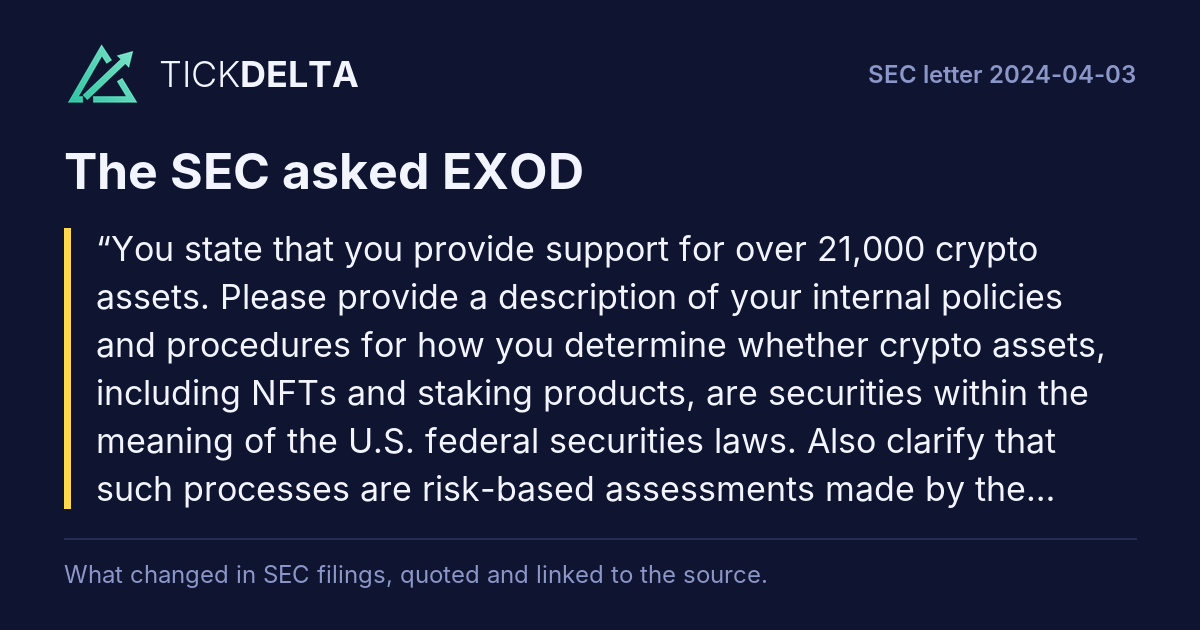
Also in this review: closing letter, 2024-12-05