Form 10-K for the Fiscal Year Ended March 31, 2019
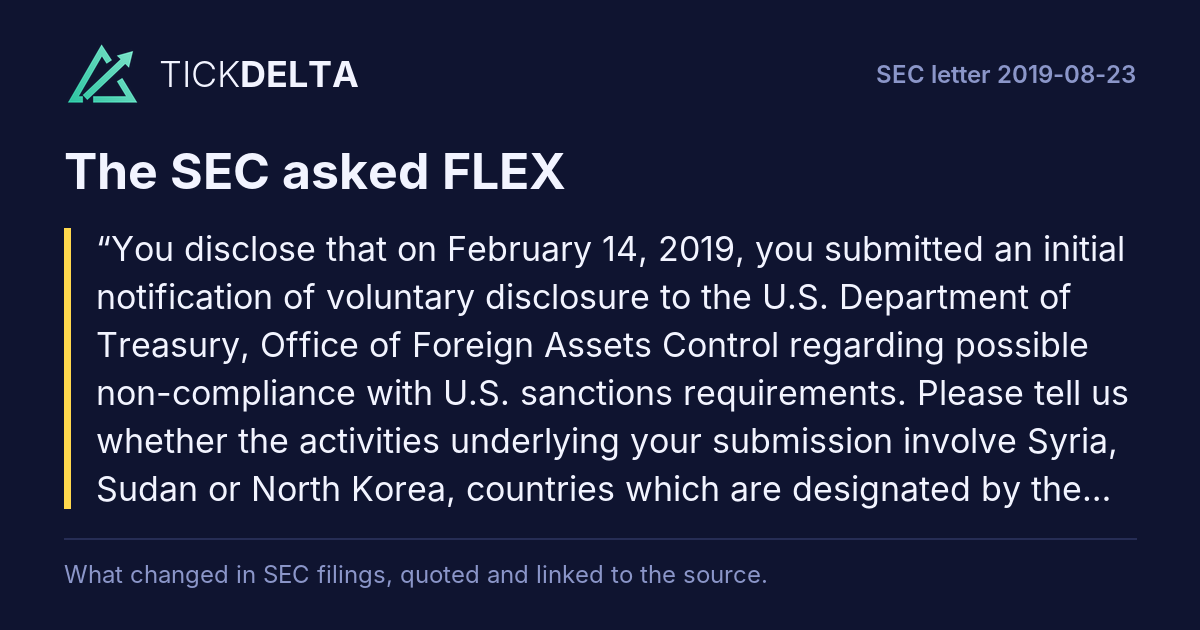
You disclose that on February 14, 2019, you submitted an initial notification of voluntary disclosure to the U.S. Department of Treasury, Office of Foreign Assets Control regarding possible non-compliance with U.S. sanctions requirements. Please tell us whether the activities underlying your submission involve Syria, Sudan or North Korea, countries which are designated by the U.S.Rest of the question
Department of State as state sponsors of terrorism and are subject to U.S. economic sanctions and/or export controls. If so, please describe to us the nature and extent of any past, current, and anticipated contacts with Syria, Sudan and North Korea, including contacts with those countries’ governments, whether through subsidiaries, distributors, customers, affiliates, or other direct or indirect arrangements.
The Company respectfully advises the Staff that the activities underlying the Company’s initial notification of voluntary disclosure to the U.S. Department of the Treasury, Office of Foreign Assets Control regarding possible non-compliance with U.S. economic sanctions requirements among certain non-U.S. Flex-affiliated operations do not involve Syria, Sudan or North Korea. Read in the reply ↗
First report after the company's reply of 2019-09-04: 10-Q filed 2019-10-30 ↗, against the 10-Q filed 2019-07-26 ↗.
Tickdelta does not hold the text of both reports, so they are not compared here.
On page 11 of your 10-K for the fiscal year ended March 31, 2018, you identified Huawei as a key customer in your CEC segment. Huawei and some its affiliates appear on the U.S. Department of Commerce’s Entity List because of certain activities with Iran, which is also designated as a state sponsor of terrorism.Rest of the question
Recent articles have discussed this ban on Huawei and its impact on you, including several articles that attributed a reduction in your workforce in China to this ban. A transcript of a June Bank of America Merrill Lynch Global Technology Conference quotes an analyst as stating that the bank has been getting investor questions about Huawei and its impact on you. Please discuss the potential for reputational harm from your relationship with Huawei. In this regard, we note that recent news articles have reported that Huawei may have secretly helped the North Korean government build its commercial wireless network, which it may have used to spy on people, and that helping to build the network may have violated U.S. export controls.
The Company respectfully advises the Staff that, to the Company’s knowledge and belief, the Company has conducted business with Huawei in compliance with all applicable laws, including U.S. export laws and regulations.
The Company believes that to date it has disclosed the risks related to its business with Huawei adequately; however, the Company will add reputational harm risk disclosure in future filings. Read in the reply ↗
First report after the company's reply of 2019-09-04: 10-Q filed 2019-10-30 ↗, against the 10-Q filed 2019-07-26 ↗.
Tickdelta does not hold the text of both reports, so they are not compared here.
Please revise to label the measure “adjusted free cash flow." We refer you to Question 102.07 of the Compliance and Disclosure Interpretations for Non-GAAP Financial Measures. Similar concerns apply to your earnings releases furnished on Form 8-K and to the presentations on your website.
The Company acknowledges the Staff’s comment and, in future filings, earnings releases furnished on Form 8-K and presentations on the Company’s website, the Company will revise to label the measure “adjusted free cash flow.” The Company has made this revision to the summary financials schedules on its website. Read in the reply ↗
First report after the company's reply of 2019-09-04: 10-Q filed 2019-10-30 ↗, against the 10-Q filed 2019-07-26 ↗.
Tickdelta does not hold the text of both reports, so they are not compared here.
Your presentation of the “adjusted net cash provided by operating activities” subtotal in your reconciliation to free cash flow implies that collections of deferred purchase price receivables are operating rather than investing cash flows. This results in a commingling of operating and investing cash flow results, which may not comply with Regulation G.Rest of the question
Accordingly, please remove this subtotal from your reconciliation as well as all related references to it in your narrative. Similar concerns apply to the earnings release slide decks and summary financials schedules on your website.
The Company acknowledges the Staff’s comment and, in future earnings releases, earnings release slide decks and summary financials schedules on the Company’s website, the Company will remove this subtotal from the reconciliation as well as all related references to it in any narrative. The Company has made these changes to the summary financials schedules on its website. Read in the reply ↗
First report after the company's reply of 2019-09-04: 10-Q filed 2019-10-30 ↗, against the 10-Q filed 2019-07-26 ↗.
Tickdelta does not hold the text of both reports, so they are not compared here.
We note your presentation of Free Cash Flow Conversion in your summary financials schedules on your website. Please revise to also present this measure on a GAAP basis in accordance with Rule 100(a) of Regulation G.
The Company acknowledges the Staff’s comment and will revise its presentation of its summary financials schedules on the Company’s website to label the measure “Adjusted Free Cash Flow Conversion” and to also present this measure on a GAAP basis. The Company has made these revisions to the summary financials schedules on its website. Read in the reply ↗
First report after the company's reply of 2019-09-04: 10-Q filed 2019-10-30 ↗, against the 10-Q filed 2019-07-26 ↗.
Tickdelta does not hold the text of both reports, so they are not compared here.
Also in this review: closing letter, 2019-09-09