GE Vernova GEV
New risk paragraphs, branching off last year
Each branch is a paragraph in Risk Factors with nothing like it in the 10-K filed Feb 6, 2025. A box jumps to the paragraph as filed, below.
Paragraphs with nothing like them in last year's 10-K
61 paragraphs in Risk Factors of the 10-K filed Jan 29, 2026 with nothing like them in the 10-K filed Feb 6, 2025. Quoted exactly. Paragraphs that were only edited are under 10-K change.
Compared with the Risk Factors in the latest 10-K of the other 81 Industrials companies: a paragraph with at least half its words the same at another company is called similar, and the companies are listed under it. A paragraph most of them have is marked boilerplate. No line means no other company has one like it. This counts text; it does not say how serious a risk is.
Quality issues among our products, solutions, and services could cause us to incur significant costs, reduce demand for our products and services, lead to claims for damages or regulatory actions, and harm our business or reputation. We design, manufacture, and service sophisticated, software-enabled industrial machinery and infrastructure (including gas turbines, onshore and offshore wind turbines, grid infrastructure, and nuclear power generation equipment), engineered for demanding conditions and compliance with stringent certification, performance, and reliability standards. A serious product, solution, or execution failure could result in injury or death, widespread power outages, suspension of power production or operations, delivery delays, environmental impacts, or other systemic issues.
Actual or perceived design, production, performance, or other quality issues in new introductions or existing product lines have resulted and can result in warranty, maintenance, and other damage claims, including costs for project delays, repairs, and replacements, potentially in significant amounts. These potential impacts are greater where the defects or issues affect an entire product line or component and can be more pronounced with new technologies.
Developing and maintaining offerings that meet these standards is complex, costly, and technologically challenging and requires extensive coordination across suppliers and global manufacturing and project sites. Failures to meet these standards, whether actual or perceived, may result in significant contractual or other claims and regulatory suspensions of installation or operations, with adverse financial, competitive, and reputational effects. Warranty and quality-related costs have represented, and may in the future represent, a meaningful portion of our expenses.
Significant supply chain and logistics disruptions, including volatility in the cost or availability of critical materials and components, could delay or impact our ability to deliver on customer obligations, increase costs, and expose us to contractual and reputational risks. We rely on third-party suppliers, contract manufacturers, service providers, and commodity markets for raw materials, parts, components, and subsystems. Our globally distributed supply chains are subject to economic and geopolitical dynamics, sanctions, tariffs, import/export restrictions, severe weather events, as well as other factors. We operate in a supply-constrained environment and have experienced, and may continue to experience, shortages of materials and skilled labor, inflationary pressures, transportation and logistics challenges, and manufacturing disruptions that affect revenues, profitability, cash flow, and on-time fulfillment. While we pursue mitigation measures, such as long-term supply agreements, dual-sourcing, increased inventory levels, factory capacity expansion, lean initiatives, alternative logistics, product or component redesign, and cost-sharing with customers and suppliers, supply chain pressures are expected to persist and may continue to adversely affect our operations and financial performance. Certain inputs are limited or sole-sourced, concentrated with a small number of suppliers, or primarily available from a single country, including semiconductor chips and critical materials (such as specialty metals and rare earths). Although prior disruptions have not been material, the inability of a supplier to deliver, and our inability to secure timely and cost-effective alternatives, could impair our ability to manufacture products or provide services.
Our operations may be adversely affected by delivery delays, capacity constraints, upstream or downstream production disruptions, price spikes, cyber-related attacks, or decreased availability of materials and commodities arising from war or other hostilities, natural disasters, public health emergencies, increased tariffs or trade restrictions, or other business continuity events. Supplier nonperformance or underperformance could impact our ability to fulfill customer commitments, trigger contract terminations or liability, and impair our competitiveness.
We depend on multiple forms of transportation and transportation routes. Logistics can be disrupted by weather, strikes or lockouts, inadequate infrastructure or port capacity, hostilities, terrorism, or other events, and transportation costs can be volatile. Any of these factors could impede our ability to deliver quality products, solutions, and services and have a material adverse effect on our results of operations, cash flows, and financial condition.
We also rely on our production facilities for critical components. If disturbances at these locations prevent us from producing sufficient quantities, we may need to source more from external suppliers, which could introduce delays, quality control issues, or additional costs.
A significant event affecting any of our production or operating facilities, particularly when capacity is at or near full utilization or alternative sites are unavailable, may disrupt our ability to supply customers, require us to defer or decline orders, or cause late deliveries. Expanding our capacity to meet current or future demand or support new products requires significant capital investment and lead time and may be delayed in execution.
Further, our capacity expansions and related commitments may outpace realized demand. We make capacity expansion decisions and supply commitments based on demand forecasts, orders, slot reservation agreements, and deposits. If anticipated demand is delayed or does not materialize, orders may be deferred, reduced, or canceled and slot reservation agreements may not result in orders. As a result, we could be over-invested in our facilities and could incur excess or idle capacity, under-absorption of fixed costs, production inefficiencies, inventory build and write-downs, penalties under supply agreements, lower margins, and impairment of long-lived assets.
We may fail to achieve anticipated cost savings. Achieving our long-term financial and cash flow goals depends on our ability to effectively manage operating costs. Because many costs are affected by factors outside our control, we rely on productivity initiatives (including lean operations and supply chain management) to drive savings, but there is no assurance they will succeed. Expected savings are based on estimates and assumptions that are inherently uncertain and subject to business, economic, and competitive factors. If we cannot identify, implement, and sustain initiatives that effectively manage costs and increase operating efficiency, or if implemented initiatives fail to generate expected savings, our financial results and cash flows could be adversely affected and we may fail to achieve our financial goals.
Our business success is dependent upon our ability to innovate and successfully commercialize new technologies in fast-changing markets, and manage our product cycles. We operate in industries where technology and customer needs evolve rapidly, and our growth and business depend on developing and bringing to market new products, solutions, and services. The commercial success of technologies such as small modular or other advanced nuclear power, hydrogen-based power generation, carbon capture and sequestration, and grid-scale batteries or other storage solutions depends on factors including the pace of innovation; development costs; capital resource availability; the intensity of competition; our customers’ ability to obtain and maintain required permits or certifications; the effectiveness of our production, distribution, and marketing, including our ability to successfully deploy technologies intended to cost-effectively enhance our production, such as robotics and automation, and integration of AI; the availability of raw materials and components; our supply chain; the economics for customers to deploy and support these technologies; overall market demand and acceptance; and the timing of market entry.
Global competition increasingly depends on innovation in emerging technologies, including nuclear fuels and advanced energy systems, where failure to innovate could limit our ability to participate in new markets. Failure to cost-effectively innovate and commercialize technologies, products, solutions, and services our customers demand could adversely impact our competitive position, growth, and financial results and position. Rapid innovation can shorten product cycles and accelerate market introductions, increasing quality and execution risks, raising costs, and challenging profitability for new products. These risks are heightened in our Nuclear Power business, which is constructing small modular reactors. Due to the nascent nature of the industry and higher ramp-up costs, new product introductions could result in losses in the near and long term. Further, breakthrough technologies deployed at scale by competitors may reduce the demand for legacy products and technologies.
We may not realize the benefits we expect from our strategic transactions. Our strategy includes acquiring technologies and businesses that expand, enhance or complement our portfolio through acquisitions, minority equity investments, joint ventures, and other alliances, and divesting non-core assets or businesses and reinvesting any proceeds in our core businesses. Success depends on identifying suitable opportunities and synergies, conducting effective due diligence, negotiating favorable terms, obtaining required approvals, closing transactions, effectively integrating acquired businesses or separating divested operations, and collaborating well with any joint venture participants, partners, and equity co-owners.
Strategic transactions may expose us to risks and uncertainties, including competition driving higher prices or less favorable terms; delays, costs, or failures in integration or separation of assets, people, systems, and products; noncompliance with multi-jurisdictional laws, regulations, disclosures, and filings; operational disruption and management distraction from core operations; dependence on external capital and financing availability and cost; antitrust or other regulatory reviews, conditions, or adverse rulings; legacy noncompliance or violations at acquired companies; inability to scale production or loss of distribution channels; inadequate IP rights or heightened scrutiny of acquired IP, or systems integration and transition complexities; failure to achieve expected growth, cost savings, synergies, or market acceptance; due diligence gaps or unidentified/underestimated liabilities; successor liability for pre-acquisition conduct; inadequate compliance and risk management organization and infrastructure at acquired companies; retained liabilities or continued losses after divestitures; loss of key customers or personnel; and adverse market reactions and stock price volatility.
Assessments and assumptions supporting a transaction may prove incorrect, and actual outcomes may differ significantly from expectations. In joint ventures and other strategic alliances, we may share ownership and, in some cases, management with others whose objectives, priorities, or resources may differ from ours, increasing governance and execution risk. Further, any such joint venture or other strategic alliance, may restrict us from taking certain actions in our business and we may be limited in our ability to exit such arrangements if we later desire to do so.
Divestitures may be delayed or prevented by difficulties finding buyers or by regulatory, governmental, or contractual constraints, including provisions of the Separation and Distribution Agreement described under “Certain Relationships and Related Person Transactions—
Agreements with GE" in Part III, Item 13 of our annual report on Form 10-K for the year ended December 31, 2024, as incorporated by reference from our definitive proxy statement relating to our 2025 Annual Meeting of Stockholders filed with the SEC pursuant to Regulation 14A.
Joint ventures, consortiums, and other third-party collaborations expose us to partner, governance, compliance, and financial risks that could impose additional costs and obligations, cause reputational harm and adversely affect our business, results of operations, cash flows, financial condition, or prospects. We have entered, and expect to continue entering, into joint ventures for manufacturing, commercial operations, and project development and funding, and into consortium arrangements to perform projects. These arrangements involve risks, including exposure to the economic, political, legal, and regulatory environments of partners’ jurisdictions; legal or regulatory violations by partners outside our control; and contractual, governmental, or exclusivity obligations that may restrict our operations. They may also require us to incur nonrecurring charges, increased expenditures, or disruption to our normal operations. If partners face financial distress, restructure, or declare bankruptcy, we may be required to provide additional investment or services, assume responsibility for contract breaches, or take on additional financial or operational obligations, which may expose us to credit risk. Our influence over joint ventures varies by ownership and negotiated rights, and major decisions often require consensus, creating risks of impasses and delays where partner interests diverge. Disputes may arise over performance milestones, interpretation of key terms (including financial obligations and termination rights), or ownership and control of intellectual property developed in the arrangement. We cannot control partner actions; in some projects we have joint and several liability and cannot ensure partners will satisfy their responsibilities. These arrangements may also restrict our access to cash flows or assets of a joint venture, and some joint ventures are subject to governmental limitations on cash distributions. Consortium project outcomes depend on partner performance. Partners may block or delay critical decisions, pursue strategies contrary to our interests, or fail to fulfill obligations, reducing expected returns. We may need to provide or procure additional services to compensate for such failures, which can increase costs and expose us to reputational harm and customer or counterparty complaints. Any of the foregoing could materially adversely affect our business, results of operations, cash flows, financial condition, or prospects.
Issues with grid connectivity and customers’ ability to sell generated electricity could delay projects, reduce output, demand and revenues, increase costs, and cause reputational harm. Many of our customers, projects, and offerings depend on timely grid connection. Factors beyond our control, including regulatory and permitting requirements and delays, interconnection constraints, limited land for connection infrastructure, and system failures, may impede or prevent grid connection. If customers cannot obtain grid access or agreements to sell their electricity on reasonable terms and timelines, order timing and project milestones may be delayed. Grid connection and operations are governed by statutory and regulatory frameworks intended to ensure safety and stability, but transmission constraints and operating practices can lead to curtailment (e.g., congestion, limited transmission capacity, or dispatch restrictions). Unplanned project execution or commissioning challenges due to delays from construction, contractors, or severe weather issues (e.g., wind speed or direction) can further delay project execution leading to reduced electricity output, reduced demand for our products and solutions, increased costs for us and our customers, and reputational harm.
Our failure to manage customer and counterparty relationships and contracts could adversely affect our financial results. Our success depends on delivering in accordance with contractual requirements and anticipating changes in customer and counterparty needs. Customers and counterparties, including those undertaking large infrastructure projects, may delay or cancel purchases or be unable to meet their obligations due to business deterioration, cash flow constraints, reduced availability of financing for certain technologies (such as prohibitions on financing for fossil fuel–based projects), macroeconomic conditions, changes in law or policy, disputes, or other delays. If a major customer reduces purchases, ceases doing business with us, favors competitors or new entrants, or changes purchasing patterns, our business could be harmed.
Many of our contracts are complex and contain warranty, performance, delivery, and availability provisions that can trigger significant repair or replacement costs, penalties, liquidated damages, or other unanticipated expenses if we fail, actually or allegedly, to meet specifications or schedules. For example, in our Wind business, delays in assembling and delivering critical components (such as nacelles) or other noncompliance with contract terms have increased costs, presented litigation risks, and exposed us to damages, and we may experience similar delays and possible consequences in the future. Warranty costs and contract-related penalties have represented, and may in the future represent, a meaningful portion of our expenses.
We also contract with U.S. and non-U.S. governmental and government-affiliated entities, which may delay, modify, or terminate contracts if funding or support is unavailable. Collecting receivables can be more challenging with sovereign or state-owned customers and in emerging markets.
Engaging in new types of transaction structures or unique contractual relationships with nontraditional customers, such as hyperscalers, government departments focused on energy, or other first‑time counterparties, or with new contracting approaches adopted by traditional customers, may challenge our ability to effectively negotiate and manage our relationships. Due to our limited experience with such customers, counterparties, and contracting parties, we may fail to anticipate or control the unique expectations, costs, and operational complexities associated with such arrangements. Some counterparties may have limited operating histories, different contracting practices, or weaker credit profiles. They may depend on external financing, subsidies, or project milestones, and may delay payment, seek to renegotiate terms, or default. Further, some counterparties to slot reservation agreements may not place orders equal to the value of their reservation amount or at all, and the volume of orders we expect under such agreements may fail to materialize.
Fixed‑price customer contracts expose us to reduced margins and project loss risks if costs exceed expectations. We enter into contracts that commit to a fixed price well before project completion. However, actual revenues and costs may differ from estimates due to factors that are difficult to predict or control, which include: procurement challenges and schedule disruptions on large projects; product performance failures; unforeseen site conditions; rejection or termination clauses in contracts that reduce revenue or increase costs; inability to be compensated for additional work arising from unanticipated technical issues or deficient customer‑provided designs, engineering information, products, or materials; inaccurate estimates based on historical data under current conditions (e.g., inflation, labor and material cost increases); weather and other force majeure events that cause delays or productivity losses; contractual obligations to pay liquidated or other damages for failure to meet schedule or performance requirements; difficulties engaging or overseeing third‑party subcontractors, manufacturers, or suppliers, or their underperformance or nonperformance, resulting in delays and added costs; and project modifications or change orders that create unanticipated costs or delays and potential claims or disputes. Any of these factors can reduce our margins or result in project losses. Cost overruns and related penalties have represented, and may in the future represent, a meaningful portion of our expenses.
We are subject to decarbonization and energy-transition dynamics, including shifting policies, market economics, and technology trajectories. We must anticipate and respond to market, technological, regulatory, governmental policy, and energy security changes driven by decarbonization and energy transition dynamics. For example, increased policy support for fossil fuels or the rollback or suspension of renewable-supportive policies could reduce demand for our renewable and other decarbonization products and services. Conversely, as a supplier to the power generation sector, falling renewable costs and evolving stakeholder expectations can reduce demand for and the competitiveness of sales of new gas turbines and service for unabated gas plants.
Continued increases in renewables’ share of capacity additions and generation, depending on pace and timing, could materially affect our Power segment and consolidated results. Key uncertainties include the level and timing of government subsidies and credits (including the implementation of U.S. and global policies), regulatory and permit approval timeframes, level of price competition among manufacturers, competition from solar and other technologies, deprioritization of renewables, the pace of grid modernization needed to maintain reliability with higher renewables penetration, and industrywide pressure on profitability.
Our long-term success depends on addressing both electrification and decarbonization by adapting our portfolio and scaling less carbon-intense and lower carbon technologies (such as gas as a replacement for coal, small modular or other advanced nuclear reactors, hydrogen-based power generation, carbon capture and sequestration, and grid-scale storage). These transitions require substantial investments by us and third parties in grids, infrastructure, R&D, and new technologies, and depend on timely governmental and regulatory support, incentives, and market design. If we do not succeed, or are perceived to not succeed, to advance our electrification and decarbonization objectives, or if investors and financial institutions shift funding away from certain types of generation, our and our customers’ access to capital could be negatively affected. Government actions may also affect these dynamics in unforeseeable ways. Developing new high-technology products and enhancing existing offerings to address dynamic energy markets is complex, costly, and uncertain, and strategies or investments may not be commercially successful within expected timeframes or at all. If the decarbonization landscape evolves faster or differently than anticipated, demand for our products, solutions, and services could be adversely affected. Changes in energy, environmental, and tax policies may reduce demand for our products and undermine project economics. Our businesses benefit from government incentives and policies supporting utility-scale renewable energy (e.g., tax incentives). In addition, regulatory policies influencing renewable energy mandates and grid integration standards directly impact the demand for wind energy. Reductions, elimination, suspension or adverse modifications have and could in the future limit markets for new projects, reduce returns on projects or manufacturing, lead to project abandonment, or impair investments. Eligibility and structuring rely on legal and regulatory guidance, which is subject to uncertainty, potential modification (possibly retroactive), and governmental audit challenge. Repeal, modification, suspension or unfavorable interpretations could reduce available credits, require changes to tax equity arrangements, or force alternative funding, adversely affecting our business and financing.
Separately, changes to environmental regulations and enforcement could increase costs or impede sales. For example, broader greenhouse gas regulations and carbon pricing could increase compliance costs for us and our customers. While such policies can increase demand for decarbonization technologies we are developing (e.g., hydrogen and carbon capture capabilities for our gas turbines and direct air capture), they may also impose significant compliance burdens that adversely affect our business and may reduce demand for our offerings.
Show the other 8
Operating globally, especially in emerging markets, creates complex legal, regulatory, and compliance risks. We operate across diverse legal and regulatory systems in approximately 100 different countries and, as a result, are subject to varying requirements, procedures and standards, including country-specific regulatory regimes relating to anti-corruption and anti-bribery laws, tax, trade controls, environmental, employment and labor requirements, sustainability, product safety, liability and design regulations, human rights laws, and privacy, data protection and cybersecurity laws. Further, we expect increasingly stringent environmental and safety standards across diverse global jurisdictions, including potential liabilities related to chemicals such as PFAS, that could affect product design, manufacturing, servicing, and financial results across various jurisdictions.
Navigating a variety of legal and regulatory regimes, which may evolve and be interpreted differently across jurisdictions, including on an extra-territorial basis, increases the complexity of compliance. Risks in emerging markets may be particularly complex due to less mature regulatory frameworks, inconsistent and aggressive enforcement, and heightened exposure to geopolitical and economic volatility, which can amplify the challenges of maintaining compliance across our global operations. Any actual or perceived failure to comply with relevant laws, regulations, or standards could damage our reputation and customer relationships, and expose us to investigations, inquiries, litigation, or other proceedings initiated by governmental entities, customers, or individuals. Such actions could result in significant fines, sanctions, penalties, awards, or judgments, all of which could negatively affect our business and operating results.
Further, as a global employer in more than 100 countries of permanent and fixed-term contract employees, contingent workers and contractors, we must design and maintain compensation programs, employment policies, cybersecurity and other intellectual property protections, compliance programs, and other administrative frameworks that align with the laws of multiple countries. Shifting requirements and interpretations may influence how we structure our operations and investments, and can lead to rising costs, including those associated with organizational changes and protective measures. We implement, communicate, audit and monitor, and enforce group-wide standards and practices across our businesses to address these risks; however, these efforts may not be successful. We are also responsible for communicating, monitoring, and upholding group-wide directives across our global network, including among suppliers, subcontractors, and other relevant stakeholders. Failure to manage our geographically diverse operations in light of these challenges could impair our responsiveness to changing conditions and our ability to enforce compliance with group-wide standards and applicable requirements.
Geopolitical events beyond our control may impact or increase our cost of doing business or disrupt our operations. Events such as armed conflicts, acts and threats of terrorism, civil unrest and political and economic instability in regions where we, our customers or our suppliers operate can damage facilities, cause partial or complete plant or distribution center closures, disrupt component supply, damage infrastructure and delay transportation to project sites. The broader consequences of geopolitical and terrorism threats, which may also include sanctions that prohibit our ability to do business in specific countries, embargoes, restrictions on repatriation of funds, the potential inability to service our remaining performance obligations, and potential contractual breaches and litigation, regional political and economic instability and geopolitical shifts, and the extent of any such threats effect our business and results of operations as well as the global economy, cannot be predicted. Geopolitical conflicts also contribute to volatility in financial markets, energy costs, and commodity prices. If global economic and market conditions were to deteriorate, we may experience material harm to our business, operating results, and financial condition.
Failure to meet expectations, standards, or our goals for sustainability could harm our business and reputation. Certain of our regulators and stakeholders focus on ESG topics, including emissions and climate risk, inclusive employment, responsible sourcing, human rights, and governance. We have set sustainability goals aligned with these objectives, but our ability to accomplish them presents numerous operational, regulatory, financial, legal, and other challenges, several of which are outside of our control. Perceived deficiencies in our sustainability policies or performance, or unfavorable ESG ratings of our voluntary disclosures (e.g., under the Global Reporting Initiative, the Sustainability Accounting Standards Board, and recommendations issued by the Financial Stability Board’s Task Force for Climate-related Financial Disclosures), could negatively affect investor sentiment, our stock price, and our cost of capital. Regulatory requirements are frequently changing, including EU CSRD, EU Taxonomy, and EU CSDDD, and U.S. state-level requirements. Given our extensive disclosures about our sustainability framework and goals and notwithstanding efforts we undertake to manage those disclosures appropriately, we also face increasing risks of allegations of inaccurate or misleading ESG statements. Failure to meet our goals or comply with evolving requirements could lead to penalties, supply chain disruption, operational restrictions, product redesign investments, carbon offset purchases, competitive disadvantages, reputational harm, talent attraction and retention challenges, and heightened scrutiny or enforcement.
International trade policies could limit market access, disrupt supply chains and operations, raise costs, and harm our competitiveness. Changes globally in various countries’ international trade and investment policies have increased and may in the future increase our costs and could meaningfully reduce demand for our offerings or restrict our ability to sell, manufacture, and transport to or in certain countries. Changes to tariffs, import/export controls, trade barriers, inflation, sanctions, licensing and authorization requirements, restrictions on outbound or inbound investment, inspections, cash and exchange controls, buy-national policies, local production requirements, supply chain impacts, and/or other barriers to entry have been and could in the future be disruptive and costly to us and our supply chain and adversely affect our results, creditworthiness, cash flows, and prospects. Failure to comply with such policies could increase our exposure to regulatory enforcement actions or penalties. Global or regional economic conditions and government policies may change in ways we do not anticipate. In addition, our responses to mitigate the impact of these conditions, such as potential price increases, could negatively impact our sales volume, market share, or relationships with our customers.
Failure to obtain, maintain, or comply with approvals, licenses, and permits could disrupt operations and growth. Parts of our business require international, federal, state, and local approvals, licenses, and permits that may be denied, revoked, suspended, modified, delayed or not renewed, or made more onerous. Noncompliance leads to suspended operations, curtailed work, penalties, and other sanctions. For example, our U.S. nuclear operations are regulated by the NRC; failure to obtain or renew NRC licenses could significantly disrupt our nuclear business. Obtaining and renewing approvals, licenses or permits can involve extended delays or suspensions and has and may in the future be jeopardized by noncompliance, violations, or community and political opposition, resulting in substantial costs. Heightened climate concerns and activism may slow approvals for fossil fuel-related activities in certain regions where we sell our products, affecting associated offerings. New or amended laws or changed enforcement may require additional approvals, facility, labor or product adaptations, leading to substantial costs. Our customers and suppliers are also subject to such approvals; their failures or difficulties in obtaining or complying with them may hinder our ability to provide products and services and execute projects.
Compliance with EHS laws and regulations could result in significant costs, sanctions, operational restrictions, and reputational harm. We are subject to extensive EHS regulations worldwide, including, for example, hazardous chemical handling laws, and may incur liabilities for personal injury, property damage, and health risks from exposures to hazardous substances, processes, or working conditions at current or former facilities, including from third-party contractor activities. Real or perceived safety issues can be costly, damage our reputation, divert management attention, and jeopardize our ability to operate in certain jurisdictions. We have and may in the future continue to face increased regulatory oversight and operational suspensions at our projects. We invest significant amounts to maintain policies and procedures designed to comply with EHS regulations, and we may need to invest increased amounts in the future if there are material changes in EHS regulations or in their interpretation or application or in potential environmental liability exposures. In some jurisdictions, environmental laws can impose strict, joint, and several liability for investigation and remediation, including for conduct compliant at the time or caused by others. We are subject to governmental safety-related requirements globally, including the U.S. Department of Energy and the NRC; noncompliance could lead to increased oversight, fines, or shutdowns. Changes to security and safety requirements could necessitate substantial expenditures.
For our nuclear operations, the handling of radioactive and hazardous materials exposes us and our customers to regulation, attendant costs and delays, and potential liabilities. Improper handling could cause personal injury, environmental contamination, property damage, and harm to surrounding communities. Accident severity may depend on the nature of the event, speed of corrective action, and factors beyond our control (such as weather). Releases may damage or destroy property, depress property values, injure people, and require costly response actions. Activities of contractors, suppliers, or other counterparties involving these materials may also expose us to contractual or legal liability. We are subject to international, federal, state, and local regulations that are complex and frequently change; new or stricter requirements, changed interpretations, or newly discovered contamination could require material expenditures or create unanticipated liabilities. Contractual protections and insurance may not be effective in all cases or cover all liabilities; defense costs and damages resulting from an accident or release (including those associated with a precautionary evacuation) could adversely affect our results, cash flows, and financial condition.
Claims, litigation, regulatory proceedings, and enforcement actions could be costly, disruptive, and unpredictable. We are, in the ordinary course of business, regularly subject to claims, lawsuits, regulatory proceedings, inquiries, investigations, and enforcement actions involving customers and their insurers, employees, joint venture and consortium participants, subcontractors, suppliers, and government agencies. We also face legacy risks associated with previously owned businesses or acquired businesses or liabilities assigned to GE Vernova in its Spin-Off from GE. Customers have asserted, and may assert in the future, contractual or other claims related to product performance, design, delivery, or commercial terms, among other claims. Given our size, the nature and type of our products, services, and contracts, large and long-duration projects and long-term relationships, claims can be significant. Global customs and anti-corruption enforcement (e.g., under the U.S. Foreign Corrupt Practices Act) is unpredictable, and in such proceedings, we have incurred, and may in incur in the future, liability for actions beyond our control, including with respect to prior actions taken by others we have assumed by acquisition or by assignment in connection with the Spin-Off. These proceedings may limit our access to financing from, or being involved with projects funded by, multilateral development banks, the World Bank, and other sources of financing. Outcomes are uncertain; plaintiffs and regulators may seek injunctive relief or very large or indeterminate amounts, and potential losses may remain unknown for extended periods. Initial claims in commercial disputes can be large even if ultimate liability is lower, and plaintiffs may seek punitive, consequential, or other damages. Defense can be costly and distract management from the operation of the business. We may incur significant defense costs and payments or be required to alter operations, adversely affecting results, cash flows, and financial condition. Insurance may not cover all liabilities or amounts and premiums may rise. See Note 22 in the Notes to the consolidated and combined financial statements for further information on material pending legal proceedings.
Noncompliance with antitrust and competition laws could result in fines, sanctions, business restrictions, and reputational harm. Antitrust and competition laws prohibit conduct deemed anti-competitive (e.g., price fixing, bid rigging, cartels, price discrimination, monopolization, tying, anti-competitive acquisitions, and market allocation). Authorities may impose fines, sanctions, restrictions, or conditions on our business, and violations can lead to suspension or debarment from certain contracts or transactions. The risk of investigation or enforcement may also chill or inhibit business activities. Many jurisdictions provide private rights of action for damages. Increased scrutiny or enforcement in this area could harm our business and reputation and result in increased compliance or defense costs.
Noncompliance with government contracting and procurement laws and rules could result in penalties, contract loss, or debarment. We sell to government entities globally and are subject to laws and rules governing government contracts and public procurement, which differ from private contracting and may impose additional risks and liabilities, including local presence, local manufacturing or sourcing, and technology or IP transfer requirements. Governments have a broader array of criminal, civil, administrative and other penalties than are available in purely commercial contract disputes.
Many government entities can terminate contracts for convenience or for default and their ongoing business with us may be subject to legislative or executive funding approvals. Termination or funding changes could reduce expected revenues; a default termination could trigger penalties and reprocurement costs.
We are subject to audits, investigations, and oversight; ensuring compliance imposes costs, and authorities may conclude our practices are noncompliant. Adverse findings could result in civil, criminal, and administrative penalties, damages, disgorgement, exclusion from programs, reputational harm, delayed or reduced payments, diminished profits, operational curtailment or restructuring, contract terminations, or suspension/debarment.
Failure to comply with financial services regulations or manage conflicts of interest could result in enforcement actions and reputational harm. Certain affiliates are a broker-dealer or a registered investment adviser, providing fee-based arranging and syndication of securities, advisory and structuring, and investment management (including tax equity). These activities may present conflicts of interest because they often involve investments in large energy infrastructure projects to which our businesses sell equipment and services, potentially leading to litigation or regulatory actions. Broker-dealers are regulated by the SEC and FINRA under the Exchange Act and FINRA rules; investment advisers are regulated by the SEC under the Advisers Act. These regimes are extensive and evolving, and complying with them, or failing to comply, could be costly, time consuming, and disruptive.
Risks Related to Technology, Cybersecurity, Data Privacy & Intellectual Property
We may fail to secure, successfully deploy, and protect our IP or defend against third party IP claims. We may be unable to secure, successfully deploy, and protect our IP rights. IP laws and enforcement requirements and standards vary by jurisdiction. In some countries where we do business, there are limited protection or effective remedies. Protecting proprietary technology is difficult and costly, and IP disputes are complex and unpredictable.
Our pending and future IP applications may not issue, and any issued rights may be narrower than expected, challenged, invalidated, held unenforceable, or circumvented. Competitors may infringe, misappropriate, or otherwise violate our IP; both our ability to detect it and the available remedies may be limited. In addition, our contracts with customers and other third parties often include indemnification or similar obligations for certain third-party IP claims; we may be unable to limit our liability and could face significant indemnity payments or damages for alleged contractual breaches. If we fail to obtain and protect our IP, secure necessary licenses and approvals, and defend against third-party IP claims, our competitiveness may be harmed and we may incur liabilities.
Security or data privacy incidents or disruptions of our or our third parties’ information technology systems could adversely affect our business. In some of our businesses, we design, build and support software that are embedded in our products and may operate within our customers’ IT environments and process data. In many jurisdictions, customers and regulators require built in cybersecurity protections. Techniques used to circumvent cybersecurity protections to gain unauthorized access or sabotage systems are constantly evolving and increasingly sophisticated, and our measures may not prevent, detect, or mitigate attacks across our installed base, current offerings, newly introduced products, or legacy technologies still in use.
Global cybersecurity threats, including malware and ransomware, human or technology errors, and attacks by state, state-affiliated actors or cybercriminal groups, pose risks to us and to our customers, partners, suppliers, and service providers as well as to those of companies we have acquired. Broader attacks on critical infrastructure could disrupt our operations even if our existing or new systems or products are not directly targeted. Industry wide third-party incidents continue to increase, and our large supplier base requires ongoing verification of cybersecurity practices. Growing interconnectedness and shared liability within our ecosystem heighten our exposure to cybersecurity risks. We also outsource certain cybersecurity functions, use managed service providers, and collaborate with GE during the transition period that follows our Spin-Off; these arrangements increase risk due to interconnectivity and potential impacts from a cybersecurity incident.
We rely on third-party hardware, software, and other components. A supplier’s cyber incident could interrupt component availability and our manufacturing or business process. Third-party software (including open source or embedded code), malicious code, or critical vulnerabilities could increase customer risk. A significant incident involving our systems or data could result in significant material investigation, remediation, and notification costs, damage our reputation, and expose us to litigation and regulatory enforcement. Evolving and divergent global data privacy and protection requirements, and any failure to comply with them or adequately safeguard personal information, could lead to significant costs, fines, litigation, operational restrictions, and reputational harm. We access sensitive, confidential, proprietary, and personal information subject to numerous jurisdiction specific laws and regulations contractual obligations, and customer-imposed controls. The legal environment for privacy, data protection, and security is increasingly complex and rigorous, with continually evolving requirements, including novel issues arising from new technologies such as generative AI.
These laws differ significantly and are interpreted and enforced inconsistently across jurisdictions, often with delayed guidance that creates prolonged uncertainty. Increasing cross border transfer restrictions and reliance on globally distributed third parties add complexity, potentially necessitating organizational changes, additional technical safeguards, vendor management measures, and external expertise, and may divert management attention and resources.
Any failure or perceived failure to comply with applicable laws, regulations, standards, contractual obligations, or customer-imposed controls relating to data privacy and security, or to adequately protect personal information, could damage customer and employee relationships and our reputation and result in our incurring significant costs.
Inability to attract, retain, and safely deploy highly qualified personnel could impair execution of our strategy and adversely affect our operations, reputation, and financial results. Our success depends on our personnel, particularly senior management, key employees, and technical staff, to develop, manufacture, and deliver our products and provide services worldwide. Competition for talent, our reputation, the availability of qualified individuals, and the emergence of new skills could limit our ability to hire and retain needed personnel. Difficulties hiring, ineffective succession planning, or depletion of institutional knowledge, as well as inefficient workforce utilization and ability to engage qualified contractors, could impede execution of our strategy and growth objectives and adversely affect our business performance, results of operations, liquidity, and financial condition.
Many projects require deploying personnel or contractors in geographically remote or high-risk locations. We incur significant costs to meet safety requirements and to attract and retain skilled workers, and some roles—such as the installation, operation, and maintenance of offshore wind turbines—are difficult, labor-intensive, costly, and depend on the availability of highly-skilled labor. Despite our safety precautions and compliance with applicable laws and regulations, we have experienced serious safety incidents, including injury and death. Safety concerns or incidents, regardless of fault, could harm our reputation and further impede our ability to attract and retain qualified employees and contractors.
Our defined benefit expense is determined under U.S. generally accepted accounting principles using actuarial valuations and annual remeasurements that rely on assumptions and market inputs, including discount rates (generally based on high-quality corporate bond yields), expected long-term returns on plan assets, compensation growth, and biometric factors (such as participant mortality). Changes in these assumptions or economic conditions, such as lower discount rates or sustained market volatility, can increase our obligations and pension expense and require us to make additional cash contributions to the defined benefit plans. Differences between actual experience and actuarial assumptions, as well as deviations in investment performance, can materially change net plan liabilities and funding requirements. In addition, changes in legislation, regulations, case law, or accounting standards could result in increased obligations, cash requirements, and expenses. For further information, see Note 13 in the Notes to the consolidated and combined financial statements.
Labor disputes, collective bargaining obligations, and other labor actions could disrupt our operations and increase our costs. A significant number of our employees are represented by labor unions under collective bargaining agreements, and many of our European employees are represented by works councils. These arrangements may limit our flexibility to manage costs and respond to market changes, and employees who are not currently represented may seek representation in the future. We cannot assure that existing collective bargaining agreements will prevent strikes or work stoppages, that we will successfully negotiate new agreements, or that negotiations will not result in increased labor costs (including wages, healthcare, pensions, and other benefits). Negotiations, potential work stoppages, and related disputes may divert management attention. In addition, labor actions affecting our customers or suppliers, or general country strikes or work stoppages, could disrupt our operations, project execution, supply chain, and deliveries.
Volatility in foreign currency exchange rates may adversely affect our financial condition, results of operation, and cash flows. Because we operate globally, we transact in a variety of currencies. Fluctuations in exchange rates can affect our pricing, cost structure, and margins. For transactions not denominated in the U.S. dollar, we are subject to foreign currency exchange translation risk. In addition, since our financial statements are denominated in U.S. dollars, changes in foreign currency exchange rates between the U.S. dollar and other currencies have had, and will continue to have, an impact on our financial condition, results of operations, and cash flows. Although we use hedging and derivatives to reduce earnings and cash flow volatility, our efforts may not be successful. For additional information, see Note 20 in the Notes to the consolidated and combined financial statements and Item 7A. “Quantitative and Qualitative Disclosures About Market Risk.”
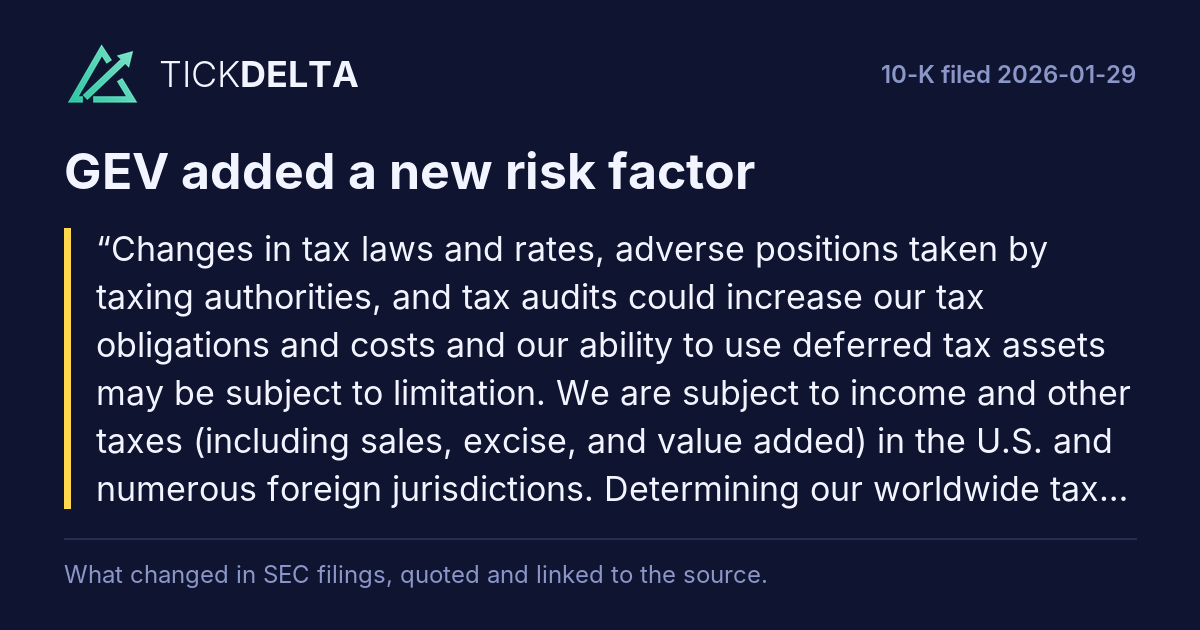
Changes in tax laws and rates, adverse positions taken by taxing authorities, and tax audits could increase our tax obligations and costs and our ability to use deferred tax assets may be subject to limitation. We are subject to income and other taxes (including sales, excise, and value added) in the U.S. and numerous foreign jurisdictions. Determining our worldwide tax provision requires significant judgment across diverse legal regimes. Changes in tax laws, tax rates, or interpretations; new or increased tariffs; adverse positions by taxing authorities; and the resolution of governmental audits and assessments may significantly increase our tax obligations and costs. We have deferred tax assets in certain countries, and their utilization depends on generating sufficient taxable income in those jurisdictions (and within applicable carryforward periods). Subsequent changes in tax laws, rates, or rules in those jurisdictions could restrict or delay utilization, reduce the value of these assets, and adversely affect our financial results.
The Spin-Off could result in significant tax liability to GE and its stockholders if it is determined to be a taxable transaction and we may have corresponding indemnification obligations. The Spin-Off may not qualify as tax-free, which could result in significant tax liabilities for GE and its stockholders and substantial indemnification obligations by us to GE. Although GE obtained an IRS private letter ruling and tax opinions supporting tax-free treatment under Sections 355 and 368(a)(1)(D), these are not binding on the IRS or courts, rely on compliance with specified agreements and representations, and do not cover state, local, or foreign taxes. The IRS could determine that the Spin-Off or related transactions are taxable, including due to incorrect assumptions, breaches of covenants, or post-Spin-Off ownership changes. If the Spin-Off is taxable, GE and its stockholders could face significant adverse tax consequences. Under our Tax Matters Agreement with GE, if tax-free treatment fails because of our actions or certain ownership changes (including a 50% or greater change in our stock by vote or value within the specified four-year period under Section 355(e), excluding the change that resulted from the Spin-Off), we may be required to indemnify GE for resulting taxes, interest, penalties, and related expenses, which amounts could be substantial.
The Tax Matters Agreement limits us from taking certain actions and may require us to indemnify GE significant amounts. We are subject to covenants under the Tax Matters Agreement for the period required under the agreement. These covenants are intended to preserve the non-recognition treatment of the Spin-Off under Section 355 and related provisions of the Code (and analogous state, local, and foreign tax laws). The covenants include limits on certain acquisitions, mergers, liquidations, sales, dispositions, transfers or stock redemptions involving our stock or assets; discontinuing the active conduct of our Gas Power business; issuing or selling stock or other securities (including convertibles, except certain compensatory arrangements); and selling, disposing or transferring assets outside the ordinary course. We may be required to indemnify GE for taxes, interest, penalties, and related expenses that may result from any violation of these covenants. Further, under the Tax Matters Agreement, we may be allocated a portion of liability relating to certain pre-Spin-Off tax matters. Any such allocation or indemnification amounts could be substantial. These covenants and indemnification obligations may require us to forgo, delay, or restructure strategic transactions and other initiatives, and may discourage third parties from proposing transactions that our stockholders might otherwise favor.
We may not realize expected benefits from the Spin-Off. We may not realize the benefits we expect from the Spin-Off, including greater strategic focus, operational simplification, cost savings, targeted innovation, and a tailored capital allocation policy. Achieving these benefits depends on timely and successful execution of our stand alone strategy and may be limited by the costs and distractions of operating as an independent public company, restrictions intended to preserve the tax-free treatment of the Spin-Off that may limit strategic transactions for a period of time, and reduced scale and diversification versus GE pre-separation. Building and sustaining standalone capabilities takes time, may be less effective, and could be costly and disruptive. Our ongoing relationship with GE creates potential conflicts of interest, including where directors or officers have roles or equity interests in both companies, and our governance policies may not fully mitigate these risks. We and GE are subject to multiple separation and transition agreements; if either party fails to perform (including with respect to indemnities, transition services, or other obligations), we could experience operational disruption and increased costs. Further, we may be obligated to indemnify GE for actions and positions taken prior to the Spin-Off, and we may have limited influence on the determination of the indemnifiable amounts, which could be significant. In addition, certain GE credit support and guarantees of our obligations may not be replaced or released when expected, which could impose contractual restrictions, require alternative credit support, and obligate us to indemnify GE for amounts paid. Any of these events could adversely affect our business, financial condition, cash flows, and results of operations and could limit our strategic flexibility.
Our stock price may be volatile, and we could face securities litigation. The market price of our common stock has in the past fluctuated, and may in the future fluctuate, significantly. Because we manufacture and sell products used in AI infrastructure, our performance and the market price of our common stock are frequently linked to AI investment trends and sector sentiment, which has resulted in, and may continue to result in, significant volatility. A significant decline could result in securities class action litigation, which could be costly, divert management’s attention, and adversely affect our business.
Paragraphs in the 10-Q filed Oct 28, 2026 that were not in the one before
New in the latest 10-Q
9 paragraphs in the 10-Q filed Oct 28, 2026 with nothing like them in the 10-Q filed Jul 22, 2026 (at least half the words must differ; new numbers alone do not count). Quoted exactly, grouped by the item heading above them. This is text that changed, not a judgement of how serious it is.
Item 6
Forward-looking statements reflect our current expectations, are based on judgments and assumptions, are inherently uncertain, and are subject to risks, uncertainties, and other factors, which could cause our actual results, performance, or achievements to differ materially from current expectations. Some of the risks, uncertainties, and other factors that may cause actual results to differ materially from those expressed or implied by forward-looking statements include the following:
Read in the 10-Q
Legal proceedings
Nine months ended September 30 Principal Other Principal Principal Other Principal
Read in the 10-Q
Principal Retiree Benefit. During the third quarter of 2026, the Company entered into agreements to transfer a portion of its principal retiree benefit obligations to a third-party insurance carrier who will assume full legal and administrative responsibility for future benefit obligations. The Company expects to pay a total of approximately $ 375 million within the next twelve months, of which $ 353 million was paid during the three months ended September 30, 2026.
Read in the 10-Q
September 30, 2026 Gross Notional All other All other assets All other All other
Read in the 10-Q
Other information
Disclosure provided pursuant to Item 8.01 of Form 8-K. Other Events. On October 25, 2026, GE Vernova Inc. (the “Company”) entered into a Sale and Purchase Agreement (the “Agreement”) with Triton Partners to acquire the Trench Group (the “Acquisition”) for approximately €8.0 billion (the “Purchase Price”).
Read in the 10-Q
Show the other 4
Trench Group is a global developer, manufacturer, and supplier of specialized high- and medium-voltage electrical components, including bushings, instrument transformers, and coils, with more than 3,000 employees across eleven manufacturing sites.
Read in the 10-Q
The transaction is expected to close in late 2027, subject to the satisfaction of customary closing conditions, including regulatory approvals. The Company has agreed to pay a customary termination fee if regulatory approvals are not obtained within specified timeframes. If the fee becomes payable, it would be paid no earlier than the second half of 2027.
Read in the 10-Q
The Agreement includes a fixed purchase price mechanism with relevant protections and customary representations, warranties, and interim operating covenants for transactions of this nature.
Read in the 10-Q
The Company currently expects to fund the Purchase Price equally between cash and debt.
Read in the 10-Q
The 10-Q's risk factors against the 10-K
Item 1A of the 10-Q filed Oct 28, 2026 against Item 1A of the 10-K filed Jan 29, 2026.
A 10-Q repeats only the risks that changed, so a 10-K paragraph that is missing from it is not counted as removed.
Added is a paragraph with nothing like it in the 10-K, Reworded a sentence that is in both with several words changed,
Quiet changes a sentence in both where one to four words changed and one is a hedge or a modal
(cut words struck through, new words highlighted).
Text on the page, not a score; each links to the filing at sec.gov.
This 10-Q has no Item 1A (Risk Factors) text of its own, so there is nothing to compare. Many companies leave it out when their risks have not changed.
Phrases used for the first time
Two-word phrases in Risk Factors of the 10-K filed Jan 29, 2026 that are in none of the 1 earlier 10-Ks stored, back to Feb 6, 2025
Where each one is used
- reduce demand: Quality issues among our products, solutions, and services could cause us to incur significant costs, reduce demand for our products and services, lead to claims for damages or regulatory actions, and harm our business or reputation. We design, manufacture, and service sophisticated, software-enabled industrial...
- increase costs: Significant supply chain and logistics disruptions, including volatility in the cost or availability of critical materials and components, could delay or impact our ability to deliver on customer obligations, increase costs, and expose us to contractual and reputational risks. We rely on third-party suppliers,...
- represent meaningful: Developing and maintaining offerings that meet these standards is complex, costly, and technologically challenging and requires extensive coordination across suppliers and global manufacturing and project sites. Failures to meet these standards, whether actual or perceived, may result in significant contractual or...
- meaningful portion: Developing and maintaining offerings that meet these standards is complex, costly, and technologically challenging and requires extensive coordination across suppliers and global manufacturing and project sites. Failures to meet these standards, whether actual or perceived, may result in significant contractual or...
- import export: Significant supply chain and logistics disruptions, including volatility in the cost or availability of critical materials and components, could delay or impact our ability to deliver on customer obligations, increase costs, and expose us to contractual and reputational risks. We rely on third-party suppliers,...
- slot reservation: Further, our capacity expansions and related commitments may outpace realized demand. We make capacity expansion decisions and supply commitments based on demand forecasts, orders, slot reservation agreements, and deposits. If anticipated demand is delayed or does not materialize, orders may be deferred, reduced,...
- reservation agreements: Further, our capacity expansions and related commitments may outpace realized demand. We make capacity expansion decisions and supply commitments based on demand forecasts, orders, slot reservation agreements, and deposits. If anticipated demand is delayed or does not materialize, orders may be deferred, reduced,...
- successfully deploy: Our business success is dependent upon our ability to innovate and successfully commercialize new technologies in fast-changing markets, and manage our product cycles. We operate in industries where technology and customer needs evolve rapidly, and our growth and business depend on developing and bringing to market...
Used at least twice, small words left out. Counted, not picked: a phrase can be new because the company renamed something.
What was taken out
167 paragraphs of last year's Risk Factors with nothing like them now. The longest are quoted.
Sources
Item 1A of each 10-K and 10-Q on EDGAR, quoted exactly. Each paragraph links to the filing at sec.gov.
Also
10-K change: what was reworded or cut, section by section.
Work with it
Excel workbook · CSV. Google Sheet that stays up to date: paste =IMPORTDATA("https://tickdelta.com/company/GEV/export.csv") into a cell.