Paragraphs with nothing like them in last year's 10-K
Quoted exactly
11 paragraphs in Risk Factors of the 10-K filed Feb 19, 2026
with nothing like them in the 10-K filed Feb 20, 2025. Quoted exactly.
Paragraphs that were only edited are under 10-K change.
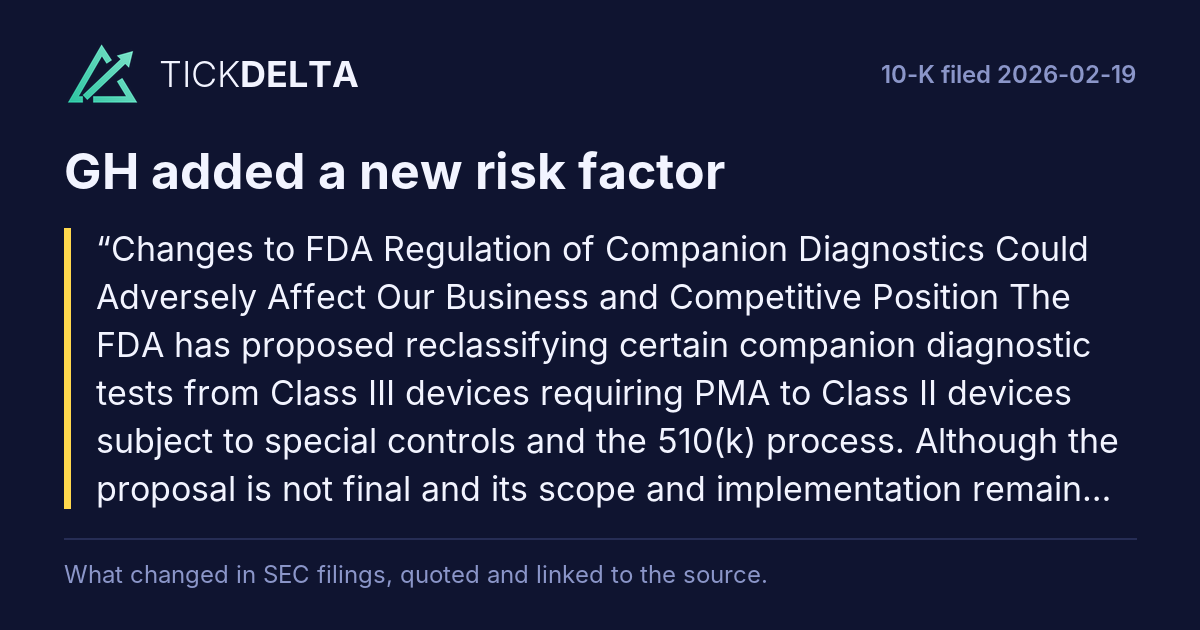
Changes to FDA Regulation of Companion Diagnostics Could Adversely Affect Our Business and Competitive Position
The FDA has proposed reclassifying certain companion diagnostic tests from Class III devices requiring PMA to Class II devices subject to special controls and the 510(k) process. Although the proposal is not final and its scope and implementation remain uncertain, any change to the regulatory framework for companion diagnostics could materially affect our business.
We have historically pursued the PMA pathway for our companion diagnostic tests, including liquid biopsy–based, next-generation sequencing assays developed in collaboration with biopharmaceutical partners. If companion diagnostics are down-classified, regulatory barriers to entry may be reduced, potentially increasing competition from new and existing diagnostic developers and leading to pricing pressure, reduced market share, or the need for increased investment to maintain differentiation.
In addition, changes in regulatory classification may require us to reassess our development strategies, evidentiary standards, quality systems, and lifecycle management plans. Uncertainty regarding the applicable regulatory pathway could complicate co-development timelines with pharmaceutical partners and affect contractual arrangements, launch sequencing, or the timing of associated revenues.
Because the proposal is subject to further review and potential modification, we cannot predict its final form or impact. Any significant changes to the regulation of companion diagnostics could have a material adverse effect on our business, financial condition, and results of operations.
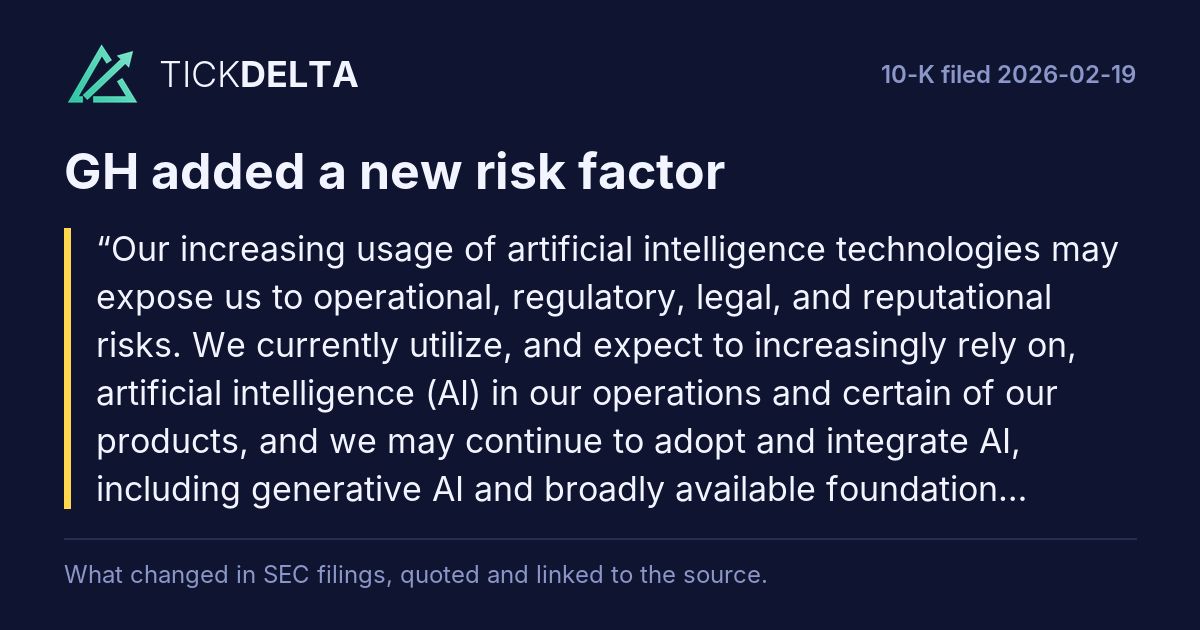
Our increasing usage of artificial intelligence technologies may expose us to operational, regulatory, legal, and reputational risks.
We currently utilize, and expect to increasingly rely on, artificial intelligence (AI) in our operations and certain of our products, and we may continue to adopt and integrate AI, including generative AI and broadly available foundation models from third parties, into our operations and products in the future. As adoption of AI technologies expands, our business may become dependent on the availability, performance, and integrity of these technologies, and integration challenges or failures could disrupt our operations. There is also a risk that we may not have access to the technology and resources to adequately incorporate ongoing advancements into our AI initiatives. If we are unable to match or surpass AI advances that our competitors implement, our competitive position could be impacted.
AI technologies may generate inaccurate, incomplete, biased, or otherwise misleading outputs. If we rely on flawed or deficient AI‑generated outputs, we could experience operational errors, diminished product performance, damage to our reputation and brand, and potential regulatory penalties or legal exposure.
Our reliance on third parties presents additional risks. Our partners and vendors are increasingly incorporating AI into their offerings, which may not meet existing or rapidly evolving regulatory or industry standards, including with respect to privacy and data security. We have limited control over our partners’ and vendors’ data practices, security measures, and review processes, and unfavorable changes in accuracy or functionality could harm our operations.
We also use AI technologies licensed from third parties, and our ability to continue to use such technologies at scale may be dependent on access to specific third-party software and infrastructure. We cannot control the availability or pricing of such third-party AI technologies, and we may be unable to negotiate favorable economic terms with the applicable providers. If any such third-party AI technologies become incompatible with our operations or unavailable for use, our business may be adversely affected. Additionally, the use of sensitive or proprietary data in AI workflows, by either us or third parties, may increase risks relating to privacy, cybersecurity, confidentiality, and intellectual property, including inadvertent disclosures or use of data for model training in ways that conflict with our legal obligations or customer expectations.
The legal and regulatory landscape for AI is rapidly evolving and may impose new requirements related to transparency, validation, documentation, governance, and data usage. Complying with these obligations could increase costs, slow product development and deployment, and create additional liability if we or our vendors fail to meet them. AI also presents emerging ethical and social issues and if our use of AI becomes controversial, we may experience competitive or reputational harm. If we are unable to effectively manage the risks associated with our increasing usage of AI technologies, including ensuring the accuracy and reliability of outputs, safeguarding data, and maintaining robust governance, our business, financial condition, and results of operations could be adversely affected.
Paragraphs in the 10-Q filed Nov 5, 2026 that were not in the one before
New in the latest 10-Q
11 paragraphs in the 10-Q filed Nov 5, 2026 with nothing like
them in the 10-Q filed Jul 30, 2026 (at least half the words must differ; new numbers alone do not count).
Quoted exactly, grouped by the item heading above them. This is text that changed, not a judgement of how serious it is.
Financial statements and notes
The Company also collaborates with biopharmaceutical companies by providing its tests and data services.
Read in the 10-Qopen_in_new
The Company determines if an arrangement contains a lease at inception. Operating lease right-of-use, or ROU, assets and operating lease liabilities are recognized based on the present value of the future minimum lease payments
Read in the 10-Qopen_in_new
In November 2026, the independent members of the Board of Directors of the Company approved the grant of PSU awards under the Company’s 2018 Plan to each of the Company’s founders and Co-Chief Executive Officers, Helmy Eltoukhy and AmirAli Talasaz (the “Co-CEOs”). Each Co-CEO received a grant of 465,413 PSUs at target (the “Target PSUs”). These Target PSUs will only be eligible to be earned if the Company’s total shareholder return relative to the constituents of the S&P 500 Index meets or exceeds certain performance requirements over three-year and five-year performance periods. The Company is currently evaluating the accounting for these awards and will include relevant disclosures in its Annual Report on Form 10-K for the year ended December 31, 2026.
Read in the 10-Qopen_in_new
Risk Factors
During the third quarter of fiscal 2026, there were no material changes to our previously disclosed risk factors, other than the following:
Read in the 10-Qopen_in_new
Cybersecurity incidents, including attacks facilitated by artificial intelligence, as well as those of our third-party service providers, could compromise sensitive information related to our business, prevent us from accessing it and expose us to substantial liability, which could adversely affect our business and reputation.
Read in the 10-Qopen_in_new
Show the other 6
We depend on information technology systems for significant elements of our operations, including our laboratory information management system, our computational biology system, our knowledge management system, our customer reporting and our GuardantConnect software platform. Our information technology systems store a wide variety of information critical to our business, including research and development information, patient data, commercial information and business and financial information. Our information technology systems and those of our third-party service providers are vulnerable to cybersecurity incidents, including ransomware, phishing, structured query language injections, social engineering schemes, insider threats, artificial intelligence, or AI, tool supported attacks, and distributed denial-of-service attacks conducted by actors including computer attackers, foreign governments and cyber terrorists, all of which could compromise this information or disrupt our operations. The frequency, intensity, and sophistication of cybersecurity incidents have significantly increased worldwide in recent years, including as a result of the increasing sophistication in the development and use of AI tools.
Read in the 10-Qopen_in_new
AI may enable malicious actors to automate attacks, increase their speed, scale and sophistication, and exploit previously unknown or unremediated system vulnerabilities. We expect the use of AI to identify, and potentially exploit, vulnerabilities in information technology systems to become more prevalent. These developments may shorten the time between vulnerability discovery and exploitation and make attacks more difficult to detect and counteract. Because techniques used to obtain unauthorized access or to sabotage systems change frequently and generally are not recognized until launched against a target, we may be unable to anticipate these techniques or to implement adequate preventative measures.
Read in the 10-Qopen_in_new
We and certain of our service providers are from time to time subject to cybersecurity incidents. For example, we recently learned of unauthorized access to our electronic ordering portal, which some physicians use to place test orders, receive and look up results, and other customer facing interfaces. We promptly initiated our cybersecurity incident response procedures to contain the activity, assess and investigate the nature and scope of the incident and implement appropriate remedial measures. While the full scope of unauthorized access remains under investigation, at this time we believe that an unauthorized party accessed certain patient records. This incident has not materially disrupted our business operations or its ability to serve patients. While we do not believe this or any other
Read in the 10-Qopen_in_new
cybersecurity incident we’ve experienced is material as of the date of this Quarterly Report on Form 10-Q, future cybersecurity incidents could materially impact our ability to operate our business as well as our results of operations and financial position.
Read in the 10-Qopen_in_new
A cybersecurity incident could result in unauthorized access to, disclosure, loss or misuse of sensitive information, interruptions or delays in our services, loss of customers, reputational harm, regulatory investigations or enforcement actions, fines, penalties, litigation and other consequences. Failures or significant downtime of our information technology or telecommunications systems or those used by our third-party service providers could prevent us from performing our comprehensive genomic analysis, preparing and providing reports to pathologists and oncologists, billing payers, processing reimbursement appeals, handling patient or physician inquiries, conducting research and development activities and managing the administrative aspects of our business. Cybersecurity incidents may remain undetected for an extended period, and we can provide no assurance that we or our vendors will be able to detect, prevent or contain the effects of such attacks or other information security risks or threats in the future. As cybersecurity threats evolve, including through the use of AI tools, we may be required to expend significant additional resources to continue to modify or enhance our protective measures or to investigate and remediate any information security vulnerabilities, and these efforts may not be successful. Any of these consequences could adversely affect our business, results of operations and financial position.
Read in the 10-Qopen_in_new
Other information
Terilyn Monroe, Chief People Officer Adoption 8/19/2026 11/18/2026 - 10/6/2027 Y Indeterminable (2)
Read in the 10-Qopen_in_new
The 10-Q's risk factors against the 10-K
Item 1A of the 10-Q filed Nov 5, 2026 against Item 1A of the 10-K filed Feb 19, 2026.
A 10-Q repeats only the risks that changed, so a 10-K paragraph that is missing from it is not counted as removed.
Added is a paragraph with nothing like it in the 10-K, Reworded a sentence that is in both with several words changed,
Quiet changes a sentence in both where one to four words changed and one is a hedge or a modal
(cut words struck through, new words highlighted).
Text on the page, not a score; each links to the filing at sec.gov.
Added10-Q Nov 5, 2026 vs 10-K Feb 19, 2026
Our business, financial condition and operating results are affected by a number of factors, whether currently known or unknown, including risks specific to us or the healthcare industry as well as risks that affect businesses in general. In addition to the information set forth in this Quarterly Report on Form 10-Q, you should consider carefully the factors discussed in Part I, Item 1A, “Risk Factors” in our Annual Report on Form 10-K for the fiscal year ended December 31, 2025, filed with the SEC on February 19, 2026. The risks and uncertainties disclosed in such Annual Report and in this Quarterly Report could materially adversely affect our business, financial condition, cash flows or results of operations and thus our stock price.
Read it in the 10-Q at sec.govopen_in_new
Added10-Q Nov 5, 2026 vs 10-K Feb 19, 2026
These risk factors may be important to understanding other statements in this Quarterly Report and should be read in conjunction with the unaudited condensed consolidated financial statements and related notes in Part I, Item 1, “Financial Statements” and Part I, Item 2, “Management’s Discussion and Analysis of Financial Condition and Results of Operations” of this Quarterly Report. Because of such risk factors, as well as other factors affecting our financial condition and operating results, past financial performance should not be considered to be a reliable indicator of future performance, and investors should not use historical trends to anticipate results or trends in future periods.
Read it in the 10-Q at sec.govopen_in_new
Added10-Q Nov 5, 2026 vs 10-K Feb 19, 2026
During the third quarter of fiscal 2026, there were no material changes to our previously disclosed risk factors, other than the following:
Read it in the 10-Q at sec.govopen_in_new
Added10-Q Nov 5, 2026 vs 10-K Feb 19, 2026
We depend on information technology systems for significant elements of our operations, including our laboratory information management system, our computational biology system, our knowledge management system, our customer reporting and our GuardantConnect software platform. Our information technology systems store a wide variety of information critical to our business, including research and development information, patient data, commercial information and business and financial information. Our information technology systems and those of our third-party service providers are vulnerable to cybersecurity incidents, including ransomware, phishing, structured query language injections, social engineering schemes, insider threats, artificial intelligence, or AI, tool supported attacks, and distributed denial-of-service attacks conducted by actors including computer attackers, foreign governments and cyber terrorists, all of which could compromise this information or disrupt our operations. The frequency, intensity, and sophistication of cybersecurity incidents have significantly increased worldwide in recent years, including as a result of the increasing sophistication in the development and use of AI tools.
Read it in the 10-Q at sec.govopen_in_new
Added10-Q Nov 5, 2026 vs 10-K Feb 19, 2026
AI may enable malicious actors to automate attacks, increase their speed, scale and sophistication, and exploit previously unknown or unremediated system vulnerabilities. We expect the use of AI to identify, and potentially exploit, vulnerabilities in information technology systems to become more prevalent. These developments may shorten the time between vulnerability discovery and exploitation and make attacks more difficult to detect and counteract. Because techniques used to obtain unauthorized access or to sabotage systems change frequently and generally are not recognized until launched against a target, we may be unable to anticipate these techniques or to implement adequate preventative measures.
Read it in the 10-Q at sec.govopen_in_new
Show the other 5
Added10-Q Nov 5, 2026 vs 10-K Feb 19, 2026
We and certain of our service providers are from time to time subject to cybersecurity incidents. For example, we recently learned of unauthorized access to our electronic ordering portal, which some physicians use to place test orders, receive and look up results, and other customer facing interfaces. We promptly initiated our cybersecurity incident response procedures to contain the activity, assess and investigate the nature and scope of the incident and implement appropriate remedial measures. While the full scope of unauthorized access remains under investigation, at this time we believe that an unauthorized party accessed certain patient records. This incident has not materially disrupted our business operations or its ability to serve patients. While we do not believe this or any other
Read it in the 10-Q at sec.govopen_in_new
Added10-Q Nov 5, 2026 vs 10-K Feb 19, 2026
cybersecurity incident we’ve experienced is material as of the date of this Quarterly Report on Form 10-Q, future cybersecurity incidents could materially impact our ability to operate our business as well as our results of operations and financial position.
Read it in the 10-Q at sec.govopen_in_new
Reworded10-Q Nov 5, 2026 vs 10-K Feb 19, 2026
Despite the precautionary measures we have taken in response to such incidents and to prevent other unanticipated problems that could affect our information technology and telecommunications systems, failures Failures or significant downtime of our information technology or telecommunications systems or those used by our third-party service providers could prevent us from performing our comprehensive genomic analysis, preparing and providing reports to pathologists and oncologists, billing payers, processing reimbursement appeals, handling patient or physician inquiries, conducting research and development activities and managing the administrative aspects of our business.
Read it in the 10-Q at sec.govopen_in_newThe 10-K sentenceopen_in_new
Reworded10-Q Nov 5, 2026 vs 10-K Feb 19, 2026
Cybersecurity incidents such as security breaches, loss of data and other disruptions in relation to our information technology systems, incidents, including attacks facilitated by artificial intelligence, as well as those of our third-party service providers, could compromise sensitive information related to our business, prevent us from accessing it and expose us to substantial liability, which could adversely affect our business and reputation.
Read it in the 10-Q at sec.govopen_in_newThe 10-K sentenceopen_in_new
Reworded10-Q Nov 5, 2026 vs 10-K Feb 19, 2026
As cyber cybersecurity threats evolve, including through the use of AI tools, we may be required to expend significant additional resources to continue to modify or enhance our protective measures or to investigate and remediate any information security vulnerabilities, and these efforts may not be successful.
Read it in the 10-Q at sec.govopen_in_newThe 10-K sentenceopen_in_new
Sources
Item 1A of each 10-K and 10-Q on EDGAR, quoted exactly. Each paragraph links to the filing at sec.gov.
Also
10-K change: what was reworded or cut, section by section.
Work with it
Excel workbook · CSV. Google Sheet that stays up to date: paste =IMPORTDATA("https://tickdelta.com/company/GH/export.csv") into a cell.