13 paragraphs in Risk Factors of the 10-K filed Feb 24, 2026
with nothing like them in the 10-K filed Feb 28, 2025. Quoted exactly.
Paragraphs that were only edited are under 10-K change.
Compared with the Risk Factors in the latest 10-K of the other 59 Health care companies:
a paragraph with at least half its words the same at another company is called similar, and the companies are listed under it.
A paragraph most of them have is marked boilerplate. No line means no other company has one like it.
This counts text; it does not say how serious a risk is.
In addition, future cell therapy products may be subject to a Risk Evaluation and Mitigation Strategy (“REMS”), which is a drug safety program that the U.S. Food and Drug Administration (“FDA”) may require for certain drugs. For example, until June 2025, Yescarta and Tecartus were subject to a REMS requirement to manage the risks of cytokine release syndrome and neurologic toxicities, which required a certification process for hospitals and clinics that dispense the products.
Read in the 10-K ↗
damage our reputation. In addition, we may not be able to sufficiently increase manufacturing network capacity to meet growing demand.
Read in the 10-K ↗
Additionally, we face public attention and scrutiny related to the complex decisions we make concerning the pricing, global supply and distribution, allocation and intellectual property of our commercialized products, as well as other factors that may contribute to patient access to our medicines, all of which may adversely affect our business and our corporate reputation.
Read in the 10-K ↗
•U.S. Congress has enacted the One Big Beautiful Bill (“OBBB”) Act, which made several changes to the Medicaid program, such as imposing Medicaid work requirements and imposing stricter eligibility and enrollment standards. Most of these policies will take effect in 2027. In addition, the OBBB Act did not extend the availability of enhanced premium subsidies, which subsidize patient premiums for Affordable Care Act (“ACA”) health insurance exchange
plans and expired at the end of 2025. If these subsidies are not reinstated, it is possible that patient enrollment in ACA exchange plans could substantially decrease. These changes, individually or in combination, could decrease health insurance coverage for patients taking our medicines, potentially disrupt access to our medicines for some individuals and negatively impact our financial results.
Read in the 10-K ↗
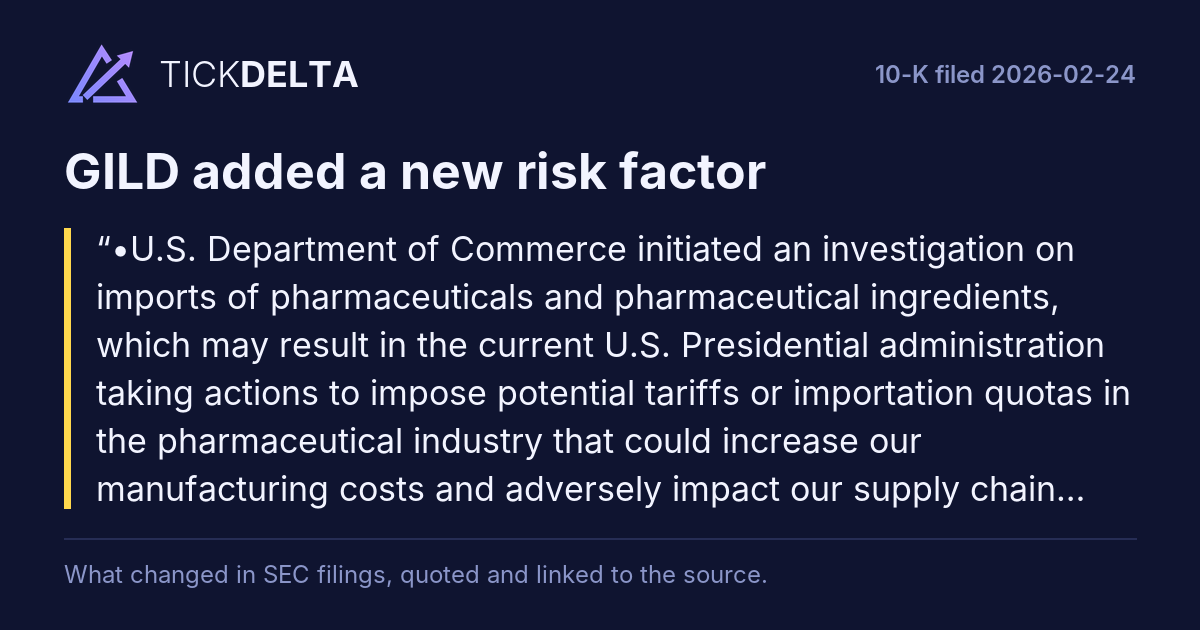
•U.S. Department of Commerce initiated an investigation on imports of pharmaceuticals and pharmaceutical ingredients, which may result in the current U.S. Presidential administration taking actions to impose potential tariffs or importation quotas in the pharmaceutical industry that could increase our manufacturing costs and adversely impact our supply chain resiliency and business competitiveness. For example, in September 2025, the U.S. Presidential administration announced plans to impose up to 100% tariffs on imported branded or patented pharmaceuticals, subject to certain exceptions. The specific impact remains uncertain at this time and is subject to the timing, scope and duration of any tariffs and actions imposed as well as broader tariffs and actions outside of the pharmaceutical industry.
•The current U.S. Presidential administration has indicated that it plans to pursue additional policies aimed at lowering prescription drug costs. The administration has issued multiple executive orders and statements that illustrate the intent to require pharmaceutical manufacturers to offer U.S. prices based on most favored-nation (“MFN”) lowest prices and that direct specified agency heads to take certain actions if significant progress towards such MFN prices is not achieved. In July 2025, the President sent letters to Gilead and other pharmaceutical manufacturers outlining the steps the President believes pharmaceutical manufacturers must take to bring down the prices of prescription drugs in the U.S. to match the MFN price offered in other developed nations. The administration has announced agreements with certain manufacturers, including Gilead, around these issues and has stated that it has paused the implementation of tariffs on pharmaceuticals to allow for negotiation of agreements with additional manufacturers. In December 2025, Gilead reached an agreement with the administration to (1) pause the imposition of Section 232 tariffs on Gilead for three years, (2) implement MFN prices in Medicaid for select existing and future launched products, (3) set a new direct-to-patient price for Epclusa and (4) return a portion of increased international revenues to the U.S. if the U.S. government is successful in increasing drug prices abroad. In addition, the administration announced several demonstration projects that would implement MFN pricing for certain Medicare Part B and Part D drugs through manufacturer inflation rebates based on utilization. The administration also recently called on Congress to enact legislation codifying the administration’s MFN deals, which are in part being effectuated under the GENErating cost Reductions fOr U.S. Medicaid (GENEROUS) Model. The specifics of these proposals and policies are evolving, and as a result, there is uncertainty as to how these and other potential legal and regulatory changes may impact our business.
•Actions by the current U.S. Presidential administration to reorganize federal health agencies or reduce or pause funding for domestic and international HIV treatment and prevention programs and grants, such as the U.S. President’s Emergency Plan for AIDS Relief (PEPFAR) and Centers for Disease Control and Prevention (CDC) grants for HIV prevention, may adversely impact our business. Some of these initiatives may be subject to litigation or other challenge, increasing the uncertainty of their effects on our business.
Read in the 10-K ↗
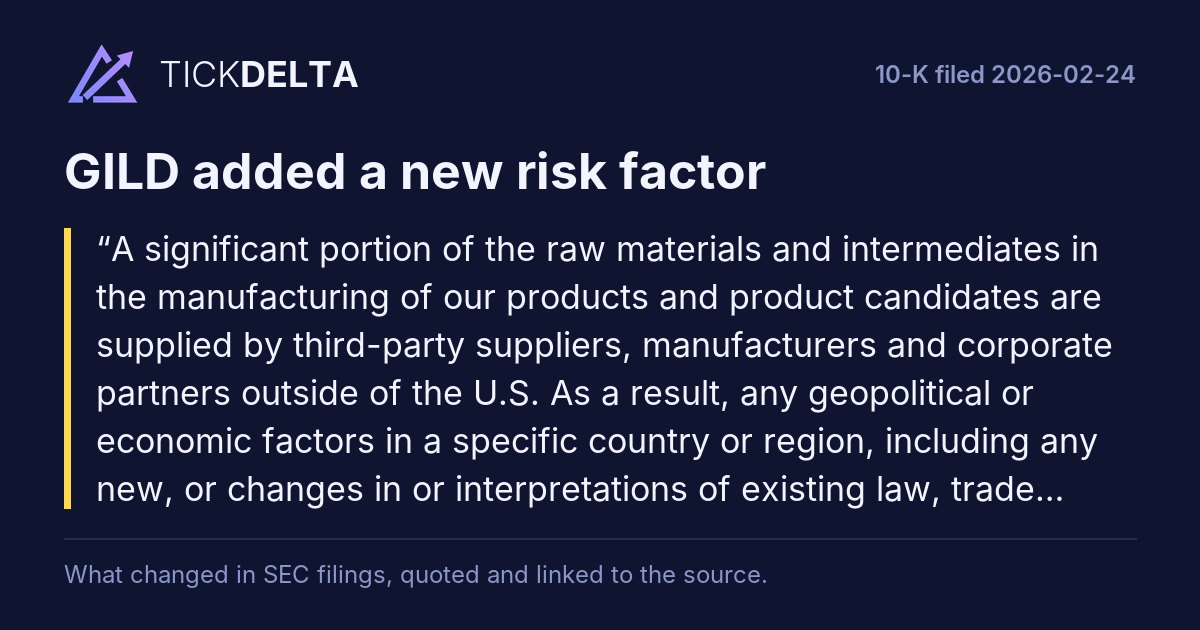
A significant portion of the raw materials and intermediates in the manufacturing of our products and product candidates are supplied by third-party suppliers, manufacturers and corporate partners outside of the U.S. As a result, any geopolitical or economic factors in a specific country or region, including any new, or changes in or interpretations of existing law, trade regulations, or compliance requirements (such as the recently enacted BIOSECURE Act) or tax that would limit or prevent third parties outside of the U.S. from supplying these materials could adversely affect our ability to manufacture and supply our products to meet market needs and have a material and adverse effect on our operating results. Such factors may also negatively impact our ability to supply our clinical trials and commercial product, which may result in the delay of our clinical trials and regulatory submissions, and could lead to regulatory delays, increased costs, and/or lost revenue.
Read in the 10-K ↗
foreign currency exchange rates, primarily in the Euro, and the impacts from foreign currency exchange, net of hedges, for the year ended December 31, 2025.
Read in the 10-K ↗
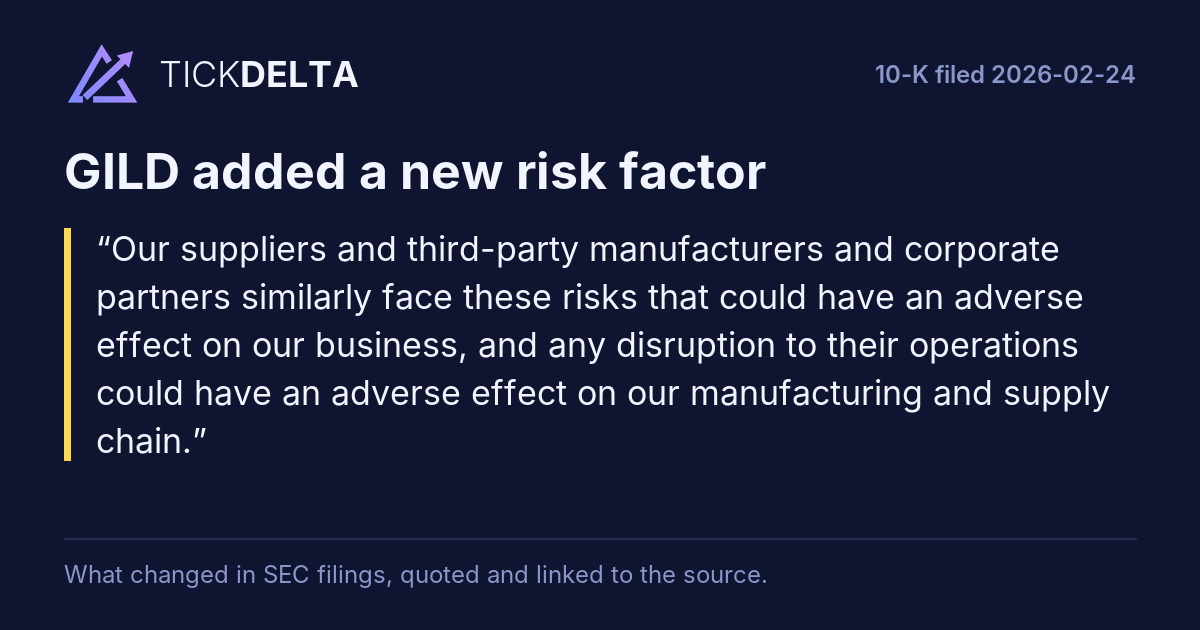
Our suppliers and third-party manufacturers and corporate partners similarly face these risks that could have an adverse effect on our business, and any disruption to their operations could have an adverse effect on our manufacturing and supply chain.
Read in the 10-K ↗
1 more
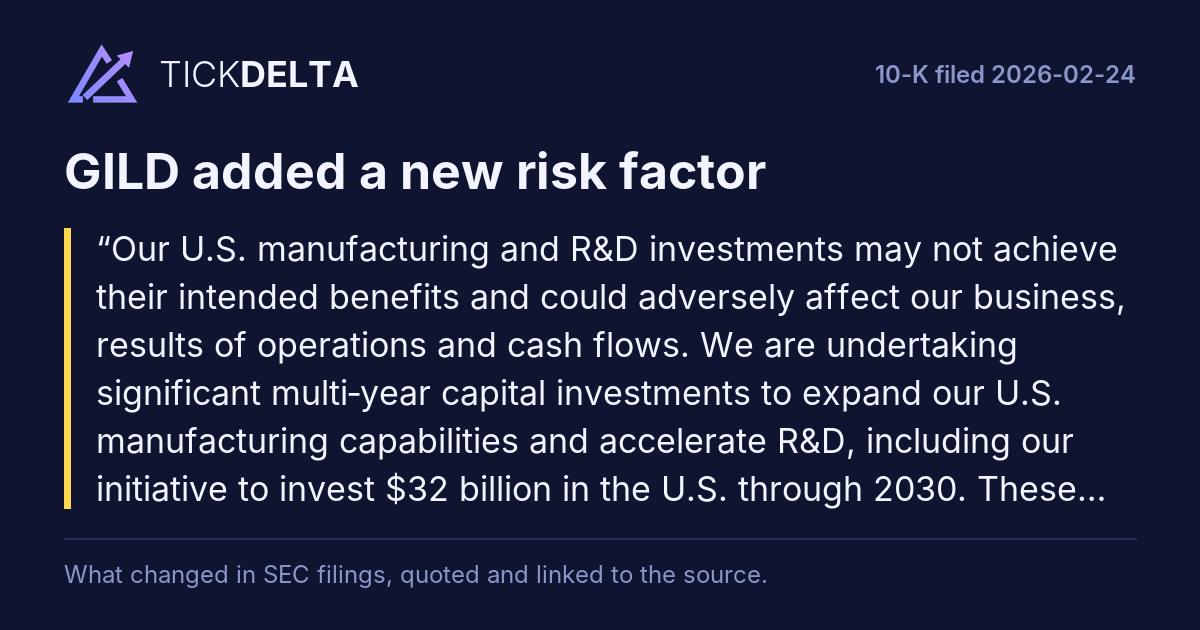
Our U.S. manufacturing and R&D investments may not achieve their intended benefits and could adversely affect our business, results of operations and cash flows.
Similar paragraph at 3 of 59 other Health care companies:
ILMN,
MDT,
ZBHWe are undertaking significant multi‑year capital investments to expand our U.S. manufacturing capabilities and accelerate R&D, including our initiative to invest $32 billion in the U.S. through 2030. These investments are subject to numerous risks, including construction and commissioning delays, cost inflation, supply chain constraints, contractor performance, permitting and zoning challenges and the availability of skilled labor, and we may not complete our announced investments on a timely basis or at all. New or expanded facilities must meet cGMP and other regulatory requirements, are subject to FDA and other inspections, process validation and qualification, and their construction depends on third-party suppliers and partners whose performance we do not control. Any failure, delay, observation or remediation requirement could defer or limit production, increase costs or result in enforcement actions or other liabilities. We may not realize anticipated economic, employment, productivity, scale or innovation benefits, anticipated cost savings or future growth, and our reputation may be damaged, if these projects are delayed or unable to be completed in a cost-effective manner. This could also lead to underutilized assets, inventory write‑offs or asset impairments. Changes in laws or policies, including drug pricing reform, tax credits and incentives, environmental, health and safety standards, or tariff, trade and sourcing rules, could reduce expected returns on our investments or increase investment or operating costs. In addition, these initiatives require significant attention from management, capital expenditures and ongoing operating expenses and may increase variability in our margins and cash flows. Any of the foregoing could materially adversely affect our business, financial condition, results of operations, cash flows and reputation.
Read in the 10-K ↗
New in the latest 10-Q
8 paragraphs in the 10-Q filed Oct 30, 2026 with nothing like
them in the 10-Q filed Aug 6, 2026 (at least half the words must differ; new numbers alone do not count).
Quoted exactly, grouped by the item heading above them. This is text that changed, not a judgement of how serious it is.
Financial statements and notes
In October 2026, we entered into a definitive agreement with PepStar Therapeutics Limited, a privately held, clinical-stage biotechnology company, to acquire PepStar IP Holdings Limited and its oral IL-23R inhibitor program, including lead asset HCXT-2001, for $ 1.275 billion in upfront cash consideration, which is subject to customary adjustments and payable at closing. The transaction is expected to close in the fourth quarter of 2026, subject to certain conditions. We expect to account for the transaction as an asset acquisition.
Read in the 10-Q ↗
• In October 2026, the Centers for Medicare and Medicaid Services completed the process of setting the Maximum Fair Price for Biktarvy under Medicare. The new price will be effective and impact our Biktarvy revenue starting January 1, 2028.
Read in the 10-Q ↗
• Received U.S. Food and Drug Administration (“FDA”) approval for Bixlenvo for the treatment of HIV in adults who are virologically suppressed on a stable antiretroviral regimen, including those switching from complex multi-tablet regimens. Bixlenvo is a complete single-tablet regimen indicated for the treatment of HIV to replace current antiretroviral regimens in people with virological suppression with no known or suspected resistance to bictegravir or lenacapavir.
Read in the 10-Q ↗
• Announced a definitive agreement to acquire an oral IL-23R inhibitor program, including lead asset HCXT-2001, from PepStar Therapeutics Limited, a privately held, clinical-stage biotechnology company. Closing of the transaction is subject to certain customary conditions.
Read in the 10-Q ↗
Risk Factors
discount program, limit the prices we can charge for our products, and increase the rebates we must provide government programs for our products, thereby reducing our profitability and negatively impacting our financial results.
Read in the 10-Q ↗
results were determined to be invalid, inadequate or in violation of Good Clinical Practices and related regulations, our own clinical data and results and related regulatory approvals may be adversely affected.
Read in the 10-Q ↗
public health emergency also could amplify many of the other risks described throughout the “Risk Factors” section of this Quarterly Report on Form 10-Q.
Read in the 10-Q ↗
significant costs to remedy the effects of such natural disasters and to resume or restore our operations, which could adversely impact us.
Read in the 10-Q ↗
The 10-Q's risk factors against the 10-K
Item 1A of the 10-Q filed Oct 30, 2026 against Item 1A of the 10-K filed Feb 24, 2026.
A 10-Q repeats only the risks that changed, so a 10-K paragraph that is missing from it is not counted as removed.
Added is a paragraph with nothing like it in the 10-K, Reworded a sentence that is in both with several words changed,
Quiet changes a sentence in both where one to four words changed and one is a hedge or a modal
(cut words struck through, new words highlighted and underlined).
Text on the page, not a score; each links to the filing at sec.gov.
Added10-Q 2026-10-30 vs 10-K 2026-02-24
discount program, limit the prices we can charge for our products, and increase the rebates we must provide government programs for our products, thereby reducing our profitability and negatively impacting our financial results.
Read it in the 10-Q at sec.gov ↗
Added10-Q 2026-10-30 vs 10-K 2026-02-24
results were determined to be invalid, inadequate or in violation of Good Clinical Practices and related regulations, our own clinical data and results and related regulatory approvals may be adversely affected.
Read it in the 10-Q at sec.gov ↗
Added10-Q 2026-10-30 vs 10-K 2026-02-24
The products we develop must be approved for marketing and sale by regulatory authorities and, once approved, are subject to extensive regulation by FDA, EMA and comparable regulatory agencies in other countries. We have filed, and
Read it in the 10-Q at sec.gov ↗
Added10-Q 2026-10-30 vs 10-K 2026-02-24
We may also become subject to new laws and regulations. For example, enacted and proposed legislation in the U.S., such as the BIOSECURE Act (which, among other things, prohibits U.S. executive agencies from contracting with, or expending loans or granting funds to, companies that use biotechnology equipment or services for certain activities from certain foreign-owned entities), the ABC Safe Drug Act (which, among other things, could prohibit U.S. federal health care programs from purchasing drugs and drug ingredients manufactured in China), and the Department of Treasury’s proposed rule to implement the COINS Act of 2025 (which, among other things, would prohibit certain U.S. investments and other transactions involving a broad range of biotechnology activities in China and other countries of concern), has the potential to adversely impact our ability to receive goods or services from such entities, including certain of which we use in connection with our clinical trials and our clinical and commercial manufacturing, impair our ability to engage in targeted outbound investment, increase the cost
Read it in the 10-Q at sec.gov ↗
Added10-Q 2026-10-30 vs 10-K 2026-02-24
or restrict the supply of material available to us, delay the procurement or supply of such material, delay or impact clinical trials and regulatory submissions, delay the launch of commercial products and adversely affect our financial condition and business prospects. In January 2026, the EMA and FDA jointly established new AI principles in drug development that provide broad guidance on AI use in evidence generation and monitoring across all phases of a medicine’s lifecycle - from early research and clinical trials to manufacturing and drug safety. These AI principles may lead to future regulatory guidance and requirements in various jurisdictions, which could affect the use of AI in our business. The EU has also proposed the General Pharmaceutical Legislation that, among other things, would reduce baseline market protection exclusivity for certain products and impose conditionalities that include manufacturer obligations to launch and supply products across member states.
Read it in the 10-Q at sec.gov ↗
Added10-Q 2026-10-30 vs 10-K 2026-02-24
public health emergency also could amplify many of the other risks described throughout the “Risk Factors” section of this Quarterly Report on Form 10-Q.
Read it in the 10-Q at sec.gov ↗
Added10-Q 2026-10-30 vs 10-K 2026-02-24
significant costs to remedy the effects of such natural disasters and to resume or restore our operations, which could adversely impact us.
Read it in the 10-Q at sec.gov ↗
Added10-Q 2026-10-30 vs 10-K 2026-02-24
Our future success as a global business will depend in large part on our continued ability to attract, develop and retain
Read it in the 10-Q at sec.gov ↗
Reworded10-Q 2026-10-30 vs 10-K 2026-02-24
For example, in January 2024, June 2026, we and Merck & Co., Inc. announced that our the discontinuation of the Phase 3 EVOKE-01 EVOKE-03 study evaluating sacituzumab govitecan-hziy (“SG”) did not meet its primary endpoint of overall survival in combination with pembrolizumab in certain patients with previously treated untreated metastatic non-small cell lung cancer (“NSCLC”), cancer, which resulted in us recording an impairment charge during the three months ended March 31, 2024 June 30, 2026 (for more information, see Note 8. 7.
Read it in the 10-Q at sec.gov ↗ · The 10-K sentence ↗
Reworded10-Q 2026-10-30 vs 10-K 2026-02-24
While the full impact of the IRA on our business and the pharmaceutical industry remains uncertain at this time, uncertain, we anticipate that the IRA will increase our payment obligations under the redesigned Part D discount program, limit the prices we can charge for our products, and increase the rebates we must provide government programs for our products, thereby reducing our profitability and negatively impacting our financial results.
Read it in the 10-Q at sec.gov ↗ · The 10-K sentence ↗
Reworded10-Q 2026-10-30 vs 10-K 2026-02-24
In December 2025, Gilead reached an agreement with the administration to (1) pause the imposition of Section 232 tariffs on Gilead for three years, (2) implement Medicaid (GENEROUS) Model and MFN prices in Medicaid the U.S. market for select existing and future launched products, (3) set a new direct-to-patient price for Epclusa and (4) return a portion of increased international revenues to the U.S. if the U.S. government is successful in increasing drug prices abroad.
Read it in the 10-Q at sec.gov ↗ · The 10-K sentence ↗
Reworded10-Q 2026-10-30 vs 10-K 2026-02-24
For example, see “Foreign Currency Exchange Impact” in Part II, I, Item 7 2 of this Annual Quarterly Report on Form 10-K 10-Q for a discussion of our exposure to movements in foreign currency exchange rates, primarily in the Euro, and the impacts from foreign currency exchange, net of hedges, for the nine months ended September 30, 2026.
Read it in the 10-Q at sec.gov ↗ · The 10-K sentence ↗
Reworded10-Q 2026-10-30 vs 10-K 2026-02-24
Department of Commerce initiated an investigation on pursuant to Section 232 to assess whether imports of pharmaceuticals and pharmaceutical ingredients, which may result in ingredients into the current U.S. United States pose a national security risk.
Read it in the 10-Q at sec.gov ↗ · The 10-K sentence ↗
Reworded10-Q 2026-10-30 vs 10-K 2026-02-24
For example, Veklury sales generally reflect reflected COVID-19 related rates and severity of infections and hospitalizations, as well as the availability, uptake and effectiveness of vaccines and alternative treatments for COVID-19, all of which contributed to significant uncertainty in forecasting demand for and future sales in the short- and long-term remain uncertain. of Veklury.
Read it in the 10-Q at sec.gov ↗ · The 10-K sentence ↗
Reworded10-Q 2026-10-30 vs 10-K 2026-02-24
For example, in January 2024, the FDA instituted has required a class class-wide labeling change for all approved CAR T-cell therapies, including a “boxed warning” about Boxed Warning regarding the possible risk of secondary T-cell malignancies in patients treated following treatment with CAR T-cell therapy.
Read it in the 10-Q at sec.gov ↗ · The 10-K sentence ↗
Reworded10-Q 2026-10-30 vs 10-K 2026-02-24
The administration has issued multiple executive orders and statements that illustrate the reflecting its intent to require pharmaceutical manufacturers to offer U.S. prices based on most favored-nation most-favored-nation (“MFN”) lowest and reference prices in certain foreign countries, and that direct specified agency heads to take certain actions if significant progress towards toward achieving such MFN prices is not achieved. made.
Read it in the 10-Q at sec.gov ↗ · The 10-K sentence ↗
Reworded10-Q 2026-10-30 vs 10-K 2026-02-24
(2) imposes an inflation-based rebate on Medicare Part B utilization starting in 2023 and Part D utilization beginning October 1, 2022; utilization; and (3) restructures the Medicare Part D benefit to cap out-of-pocket expenses for Part D beneficiaries beginning in 2024 and, effective January 1, 2025, beneficiaries, increases Part D plans’ contributions in the catastrophic coverage phase and increases manufacturers’ discount contributions across coverage phases such that manufacturers must pay a 10% discount in the initial coverage phase and a 20% discount in the catastrophic phase on drugs utilized by all Part D beneficiaries, including low income subsidy patients.
Read it in the 10-Q at sec.gov ↗ · The 10-K sentence ↗
Reworded10-Q 2026-10-30 vs 10-K 2026-02-24
The administration has also recently called on Congress to enact legislation codifying the administration’s MFN deals, which are in part being effectuated under the GENErating cost Reductions fOr U.S. pricing.
Read it in the 10-Q at sec.gov ↗ · The 10-K sentence ↗
Reworded10-Q 2026-10-30 vs 10-K 2026-02-24
Federal and state budget pressures, as well as the annual grant cycles for federal and state funds, may cause continue to contribute to variability in purchasing patterns to not reflect patient demand for our products. patterns.
Read it in the 10-Q at sec.gov ↗ · The 10-K sentence ↗
Reworded10-Q 2026-10-30 vs 10-K 2026-02-24
In addition, inventory is held at retail and specialty pharmacies and other non-wholesaler/distributor locations with whom we have no inventory management agreements and no control over buying patterns. non-
Read it in the 10-Q at sec.gov ↗ · The 10-K sentence ↗
Quiet changes10-Q 2026-10-30 vs 10-K 2026-02-24
These diverted products may be handled, shipped and stored inappropriately, improperly, which may adversely affect the quality and/or efficacy of the products and could harm patients and adversely impact us.
Read it in the 10-Q at sec.gov ↗ · The 10-K sentence ↗
The first 21 of 37 are shown (at most 12 of each type).