tickdelta
Sign in

Tickdelta is free for now. Sign up and get Pro free

← Screener

GLGlobe Life

Financials · Life Insurance · NYSE
Compare with peers → Embed
The 10-K against last year's

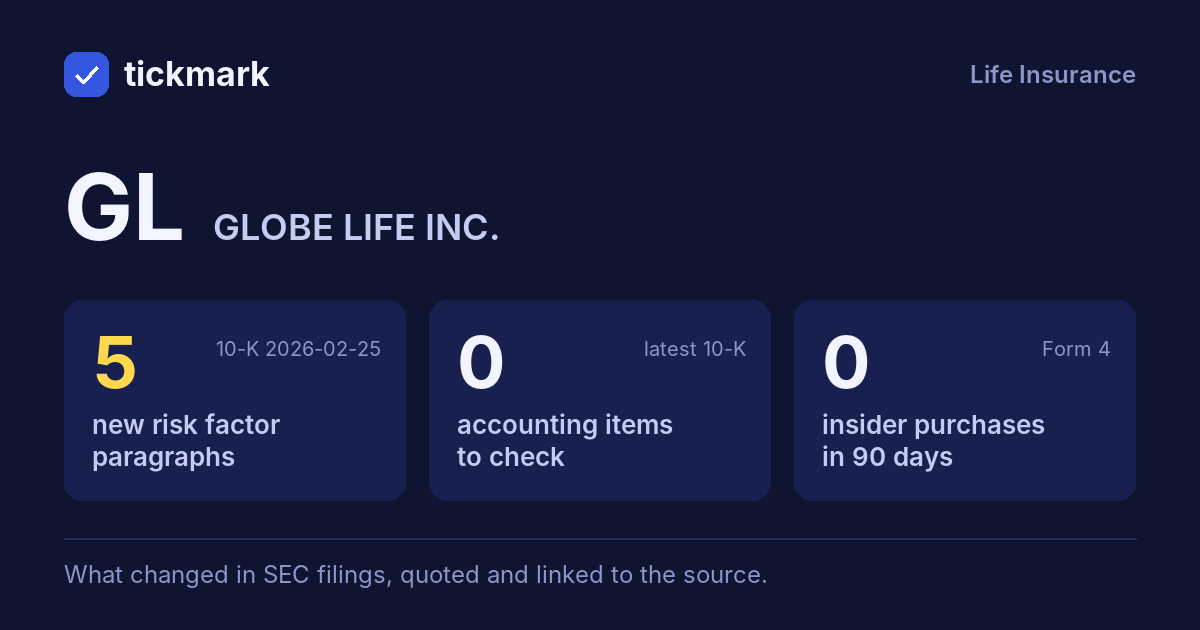
167 changes: 22 added, 5 removed, 135 reworded, 5 quiet changes

10-K Feb 25, 2026 vs Feb 26, 2025
Risk FactorsRedline ↓
11.7%
of the text changed · 5,307 words now
17.0%
of the text changed · 13,190 words now
Legal ProceedingsRedline ↓
49.3%
of the text changed · 2,710 words now
Accounting PoliciesRedline ↓
12.4%
of the text changed · 8,009 words now

10-K 0000320335-26-000090 (2026-02-25) vs 10-K 0000320335-25-000013 (2025-02-26)

The redline

The paragraph that changed most in each section

Marked against last year's 10-K: cut words struck through, new words highlighted and underlined.

Legal Proceedings 244 words changed in this paragraph; it is 60% similar to last year's version.
Also pending in the Eastern District of Texas is a consolidated shareholder derivative suit that is closely related to the putative securities class action disclosed above (the “City of Miami Matter”). On November 7, 2024, Globe Life Inc. shareholder Jui Cheng Hsiao (“Hsiao”) filed a shareholder derivative complaint against Globe Life Inc. as a nominal defendant, as well as certain current and former Globe Life Inc. executives and members of Globe Life Inc.’s its Board of Directors. On November 14, 2024, Globe Life Inc. shareholder Gautam Jadhav (“Jadhav”) filed a shareholder derivative complaint against the same set of defendants. Each shareholder derivative complaint asserts one claim for breach of fiduciary duty against the individual defendants and alleges that the individual defendants breached their fiduciary duties to Globe Life Inc. by causing or permitting Globe Life Inc. to make misleading statements about Globe Life Inc.’s its performance and financial results. The allegations are substantially similar to the allegations made in the City of Miami Matter and derive from the Fuzzy Panda a short seller report. Pursuant to Globe Life Inc.'s Restated Certificate of Incorporation and indemnification agreements with the individual defendants, Globe Life Inc. has agreed to indemnify them for all expenses and losses related to the litigation, subject to the terms of those indemnification agreements. On November 25, 2024, January 3, 2025, the two shareholder plaintiffs moved to consolidate Court consolidated the two actions into one and appointed Hsiao and Jadhav as Lead Plaintiffs and their counsel as Lead Counsel for the consolidated derivative action and the Court granted the motion on January 3, 2025 (In re Globe Life Inc. Stockholder Derivative Litigation, Lead Case No. 4:24-cv-00993-ALM (E.D. Tex.)). The case is before the same Court as the City of Miami Matter. On January 16, 25, 2025, the parties filed a Court granted the parties’ joint motion to stay such proceedings pending the Court’s resolution of the motion to dismiss filed by Globe Life Inc. in the City of Miami Matter. The On October 14, 2025, the parties informed the Court granted such joint that the motion to dismiss in the City of Miami Matter was denied and of their agreement for the terms of the stay to remain in place as they coordinated a schedule. On October 27, 2025 and December 5, 2025, the proceedings on January 25, 2025. parties again notified the Court of their continued agreement for the terms of the stay to remain in place and further notified the Court of two related derivative cases filed in the Eastern District of Texas by Globe Life Inc. shareholders, as referenced below.

Source: Item 3, via Note 5 – Commitments and Contingencies, 10-K 0000320335-26-000090 vs Item 3, via Note 5 – Commitments and Contingencies, 10-K 0000320335-25-000013

Accounting Policies 119 words changed in this paragraph; it is 36% similar to last year's version.
Future Policy Benefits: The liability for future policy benefits for traditional and limited-payment long duration life and health products comprises approximately 93% of the total liability for future policy benefits. The liability is determined each reporting period based on the net level premium method. This method requires the liability for future policy benefits be calculated as the present value of estimated future policyholder benefits and the related termination expenses, less the present value of estimated future net premiums to be collected from policyholders. Net level premiums reflect a recomputed net premium ratio using actual experience since the issue date or January 1, 2021, the Transition Date(1), and expected future experience. The liability is accrued as premium revenue is recognized and adjusted for differences between actual and expected experience. Long-duration insurance contracts issued by the Company are grouped into cohorts based on the contract issue year, distribution channel, legal entity, and product type.

Source: Item 8, Note 1 – Significant Accounting Policies, 10-K 0000320335-26-000090 vs Item 8, Note 1 – Significant Accounting Policies, 10-K 0000320335-25-000013

MD&A 106 words changed in this paragraph; it is 35% similar to last year's version.
Net policy obligations amounted to 53% of Health premium increased 9% in 2024 2025 as compared to 51% in both 2023 and 2022. 2024. This increase was primarily due attributable to significant sales growth in our Medicare supplement plans as a result of what we believe is a consumer shift from Medicare Advantage plans to Medicare supplement plans during the assumptions review current year. Premium growth in 2025 was also the result of lapses Medicare supplement rate increases that went into effect in 2025 in addition to an increase in agent count and morbidity resulting in a remeasurement loss of $10.5 million compared to a remeasurement gain of $5.2 million and $10.7 million in 2023 and 2022, respectively. productivity on other health business. Refer to Note 6—Policy Liabilities for further discussion of the Company's annual assumptions review.

Source: Item 7, 10-K 0000320335-26-000090 vs Item 7, 10-K 0000320335-25-000013

Risk Factors 84 words changed in this paragraph; it is 46% similar to last year's version.
We use institutional funding agreements originating from FHLB, which from time to time serve as a significant source of our liquidity. Additionally, we use agreements with the FHLB to meet near-term liquidity needs. If the FHLB were to change its definition of eligible collateral, we could be required to post additional amounts of collateral in the form of cash or other assets. Additionally, if our creditworthiness falls below the FHLB’s requirements or if legislative or other political actions cause changes to the FHLB’s mandate or to the eligibility of life insurance companies to be members of the FHLB system, we could be required to find other sources to replace this funding, which may prove difficult and increase our liquidity risk.

Source: Item 1A, 10-K 0000320335-26-000090 vs Item 1A, 10-K 0000320335-25-000013

Every change, by type

Sentences and paragraphs added, removed or reworded

Sentences and paragraphs of GL's Risk Factors and MD&A, 10-K 2026-02-25 against 10-K 2025-02-26. Each links to the text at sec.gov.

RemovedMD&A
As previously noted, a component of insurance underwriting margin is policy obligations, which includes for each reporting period the change in the liability for future policy benefits (LFPB). The LFPB is determined each reporting period based on the net level premium method. Net level premiums reflect a recomputed net premium ratio using actual experience since the issue date, and expected future experience based on future cash-flow assumptions. See Note 6—Policy Liabilities for additional information. The policy liability is accrued as premium revenue is recognized and adjusted for differences between actual and expected experience in the form of remeasurement gains and losses during the period. If actual mortality, morbidity, and lapse experience equals our expected assumptions used in the development of our liability for future policy benefits, there would be no impact to our financial results. Actual experience can have a material impact on financial results to the extent it significantly deviates from the expected assumptions which are used to develop our estimates of the liability for future policy benefits and amortization of the deferred acquisition cost asset (DAC). For example, deviations in actual versus expected lapses in the early policy years tend to have a larger impact on DAC amortization than LFPB change in reserves. Conversely, deviations in actual versus expected lapses in the later policy years typically have a larger impact on LFPB change in reserves than DAC amortization. This is due to the release of DAC and LFPB where DAC capitalization in earlier years is amortizing over time and the LFPB is increasing over time as the policy stays inforce. Disaggregated rollforwards of our present value of expected future net premiums and our expected future policy benefits are presented within Note 6—Policy Liabilities, which include disclosure of remeasurement gain (loss) for the effect of actual variances from expected experience and the changes in assumptions (mortality, morbidity, and lapses) on future cash flows.

Read it in 10-K 2025-02-26 at sec.gov ↗

RemovedMD&A
The Company performed an annual review of its assumptions in the third quarter of 2024 that resulted in favorable changes to its mortality and lapse assumptions on life and unfavorable changes to morbidity assumptions on health. In our life segment mortality assumptions generally decreased across most channels in line with recent experience consistent with decreasing levels of excess deaths. Lapse rate assumptions in the life segment were slightly increased across all channels. For the health segment, morbidity assumptions were increased, causing higher future policy benefit reserves. The assumption review process of the life and health segments resulted in a $46.3 million net remeasurement gain for the period ended December 31, 2024 as compared to a $3.2 million net remeasurement gain for the period ended December 31, 2023 and a $36.5 million net remeasurement loss for the period ended December 31, 2022.

Read it in 10-K 2025-02-26 at sec.gov ↗

RemovedMD&A
Excluding the impact of assumption changes, the Company's results for actual variances from expected experience for both life and health produced a $57.4 million net remeasurement gain for the period ended December 31, 2024, as compared to a $38.0 million net remeasurement gain for the period ended December 31, 2023 and a $4.6 million net remeasurement gain for the period ended December 31, 2022.

Read it in 10-K 2025-02-26 at sec.gov ↗

RemovedMD&A
Approximately 90% of our premiums are collected monthly; however, other premium payment options such as quarterly and annual are offered by the Company and may be elected by the policyholder. The majority of premiums are paid by way of automatic draft or electronic payment from our policyholders and to a lesser extent from other payment methods such as check, credit card, and worksite payroll deduction.

Read it in 10-K 2025-02-26 at sec.gov ↗

RemovedMD&A
Excluding our Direct to Consumer Division, we sell our policies primarily through independently contracted agents (“agents”) who earn commissions in accordance with contracts they have with the respective insurance subsidiary of the Company. These contract arrangements with agents cover commission structures and rates, contract periods, credit terms for settlement of agent advance accounts, vesting rights in future renewal commissions upon termination of contracts and responsibility for certain premium collections. Contract terms with agents vary, but generally commissions are earned over the life of the policy as premiums are paid. Commissions are calculated on a policy-by-policy basis and vary by product type and policy year. Commission rates are higher for the first-year premium when a policy is issued and are generally reduced for policies that remain in effect for renewal periods (e.g., commission rates may reduce in years 2-10 and again in year 11 and after). After a certain period (typically 10 years), commission rates become constant over the remaining life of the policy and are considered level commissions.

Read it in 10-K 2025-02-26 at sec.gov ↗

Next Related parties →