GMGeneral Motors
General Motors Company (sometimes referred to as we, our, us, ourselves, the Company, General Motors, or GM) was incorporated as a Delaware corporation in 2009. 10-K, Item 1
- Headquarters
- Detroit, MI
- CEO
- Mary T. Barra
- Next results
- around Jan 26, 2027
7 paragraphs in Risk Factors of the 10-K filed Jan 27, 2026 with nothing like them in the 10-K filed Jan 28, 2025. Quoted exactly. Paragraphs that were only edited are under 10-K change.
Compared with the Risk Factors in the latest 10-K of the other 46 Consumer discretionary companies: a paragraph with at least half its words the same at another company is called similar, and the companies are listed under it. A paragraph most of them have is marked boilerplate. No line means no other company has one like it. This counts text; it does not say how serious a risk is.
of our collective bargaining agreements, which limit our flexibility to adjust personnel costs to changes in demands for our products, may further exacerbate the risks associated with incorrectly assessing demand for our vehicles.
Read in the 10-K ↗
for commodities, raw materials, energy, and other inputs. These inflationary pressures could, in turn, negatively impact our profitability because we may not be able to pass all of those costs on to our customers or require our suppliers to absorb such costs.
Tariffs applicable to the automotive industry continue to evolve, including in the U.S., where the government has signaled tariff policy may shift in the future. Such tariffs could have a material adverse effect on our financial condition and results of operations. The U.S. and other governments have implemented import tariffs and tariff-related measures—including on vehicles, parts, raw materials, and other inputs—and have indicated further measures may be under consideration. New or existing trade agreements, including the ongoing review of the U.S.-Mexico-Canada Agreement, may also impact the tariff rate applicable to goods imported by GM or our suppliers. Additionally, certain tariffs are subject to pending legal challenges. In these respects, the global tariff environment remains highly dynamic, and the specific tariffs applicable to goods imported by GM and its suppliers into the U.S. and other countries where we operate continue to evolve.
We cannot predict with complete precision the breadth of tariffs and related costs that will impact GM in the future. As a result, the ultimate impact of tariffs on our business could exceed our current estimates, which could have a material adverse effect on our financial condition, results of operations and cash flows, and our expected financial results. Our efforts to mitigate the impact of tariffs, including, but not limited to, making changes to our U.S. production plan and reducing or pausing certain imports, may not be successful, and we do not expect such actions to fully offset the impact of tariffs in the near term. We have made and may need to make additional changes to our global production footprint and workforce, which could require significant capital expenditures and could result in asset impairments and other charges, including restructuring charges, any of which could be material. Evolving tariffs globally, along with other trade barriers and trade restrictions, may lead to supply chain disruptions, potentially resulting in increased production costs and the inability to receive certain critical parts.
Read in the 10-K ↗
agreements, requirements, and union relationships; (14) differing dealer and franchise regulations and relationships; (15) difficulties in obtaining financing in foreign countries for local operations; and (16) natural disasters, public health crises, and other catastrophic events.
Read in the 10-K ↗
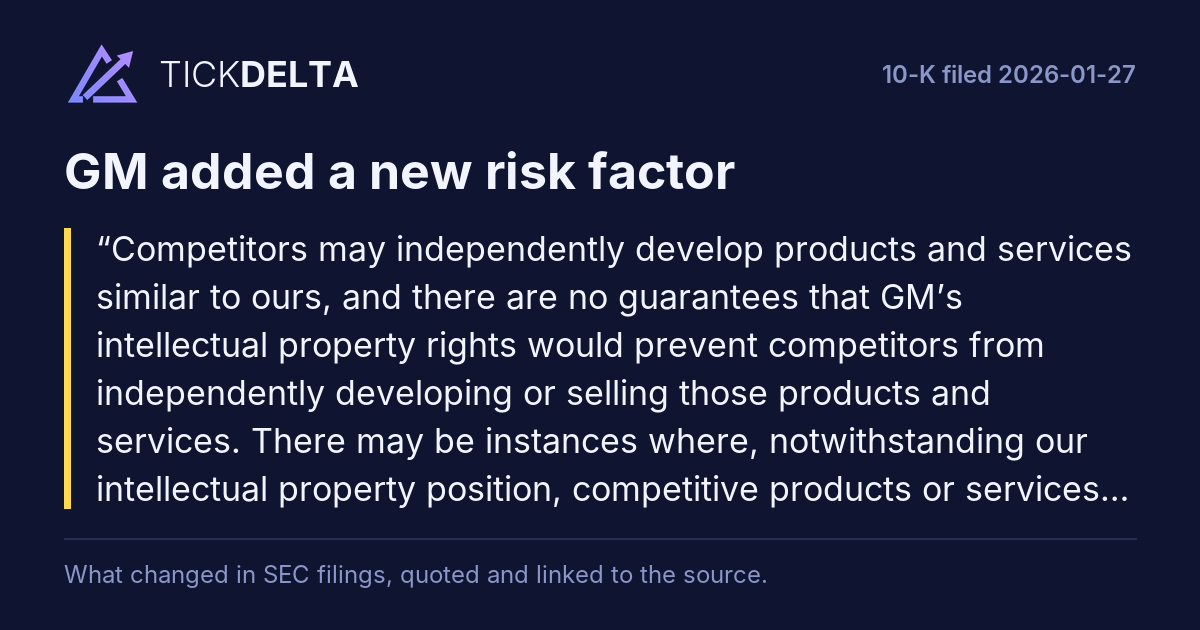
Competitors may independently develop products and services similar to ours, and there are no guarantees that GM’s intellectual property rights would prevent competitors from independently developing or selling those products and services. There may be instances where, notwithstanding our intellectual property position, competitive products or services may impact the value of our brands and other intangible assets, and our business may be adversely affected. Moreover, although GM takes
Read in the 10-K ↗
Security breaches and other disruptions of our in-vehicle systems could impact the safety of our customers and reduce confidence in GM and its products. Our vehicles contain complex information technology systems. These systems control various vehicle functions including engine, transmission, safety, steering, navigation, acceleration, braking, window and door
Read in the 10-K ↗
New in the latest 10-Q
11 paragraphs in the 10-Q filed Oct 20, 2026 with nothing like them in the 10-Q filed Jul 21, 2026 (at least half the words must differ; new numbers alone do not count). Quoted exactly, grouped by the item heading above them. This is text that changed, not a judgement of how serious it is.
10-Q
As of October 9, 2026 there were 843,549,423 shares of common stock outstanding.
Read in the 10-Q ↗
Financial statements and notes
(b) Includes a gain on the sale of an equity method investment of $ 254 million in the three and nine months ended September 30, 2026.
Read in the 10-Q ↗
In August 2026, we entered into an agreement with an intermediary that will advance funds from a syndicate of banks to certain suppliers in exchange for the suppliers acquiring and holding certain critical inventory (Inventory Banking Facility). The intermediary's funding provides for a maximum of $ 4.5 billion that can be drawn over a 12-month funding period that commenced on August 7, 2026. As of September 30, 2026, an insignificant amount has been drawn under the Inventory Banking Facility. Amounts drawn by the intermediary will be supported by irrevocable payment undertakings (IPUs) issued by us, which we will pay down following our consumption of the banked inventory, with any unpaid amounts due by August 6, 2029. Interest will accrue on the IPUs at a rate equal to the Secured Overnight Financing Rate plus 1.55 % per annum. The Inventory Banking Facility contains customary representations and warranties, covenants, and events of default for a program of this type with all outstanding amounts becoming immediately due and payable upon an event of default. Amounts outstanding under the Inventory Banking Facility are presented as unsecured debt.
Read in the 10-Q ↗
EV Supply Arbitrations We are a party to two arbitrations relating to long-term EV supply agreements. In June 2026, we filed an arbitration against a battery material joint venture partner seeking termination of a supply agreement and to clarify various other contractual rights and obligations. Separately, in July 2026, a supplier of a component for EV traction motors initiated an arbitration against us seeking damages after we terminated a strategic sourcing agreement. At this time, we are unable to estimate any reasonably possible material loss or range of loss for these matters.
Read in the 10-Q ↗
(b) Excludes equity securities with a fair value of $0.5 billion and $0.7 billion at September 30, 2026 and December 31, 2025.
Read in the 10-Q ↗
Nine Months Ended September 30, 2026 ────────────────────────────────────────────────────────────────────────────────────────────────────── Operating cash flow $ 13.7 Capital expenditures (5.8) Shares repurchased and dividends paid (6.2) Financing lease purchase option (0.2) Increase in available credit facilities 0.1 Other non-operating (0.1) Total change in Automotive available liquidity $ 1.5
Read in the 10-Q ↗
measure in any future periods in which there is an impact from the item. Our corresponding measure for our GM Financial segment is EBT-adjusted because interest income and interest expense are an integral part of its financial performance.
Read in the 10-Q ↗
(c) These adjustments consist of tax benefits from a change to a subsidiary's legal entity tax classification.
Read in the 10-Q ↗
Forward-Looking Statements This report and the other reports filed by us with the SEC from time to time, as well as statements incorporated by reference herein and related comments by our management, may include "forward-looking statements" within the meaning of the U.S. federal securities laws. Forward-looking statements are any statements other than statements of historical fact. Forward-looking statements represent our current judgment about possible future events and are often identified by words like “aim,” “anticipate,” “appears,” “approximately,” “believe,” “continue,” “could,” “designed,” “effect,” “estimate,” “evaluate,” “expect,” “forecast,” “goal,” “initiative,” “intend,” “may,” “objective,” “outlook,” “plan,” “potential,” “priorities,” “project,” “pursue,” “seek,” “should,” “target,” “when,” “will,” “would,” or the negative of any of those words or similar expressions. In making these statements, we rely on assumptions and analysis based on our experience and perception of historical trends, current conditions, and expected future developments as well as other factors we consider appropriate under the circumstances. We believe these judgments are reasonable, but these statements are not guarantees of any
Read in the 10-Q ↗
Controls and procedures
Changes in Internal Control over Financial Reporting We initiated actions to enhance our close, consolidation, planning, and reporting processes through a phased implementation of new systems and system architectures. In the three months ended September 30, 2026, we updated our close, consolidation, and financial reporting systems, processes, and related internal controls, inclusive of the discussion of our operating results in MD&A.
Read in the 10-Q ↗
Item 6
* Schedules and similar attachments have been omitted pursuant to Item 601(a)(5) of Regulation S-K. The Company agrees to furnish a supplemental copy of any omitted schedule or attachment to the Securities and Exchange Commission upon request.
Read in the 10-Q ↗
The 10-Q's risk factors against the 10-K
Item 1A of the 10-Q filed Oct 20, 2026 against Item 1A of the 10-K filed Jan 27, 2026.
A 10-Q repeats only the risks that changed, so a 10-K paragraph that is missing from it is not counted as removed.
Added is a paragraph with nothing like it in the 10-K, Reworded a sentence that is in both with several words changed,
Quiet changes a sentence in both where one to four words changed and one is a hedge or a modal
(cut words struck through, new words highlighted and underlined).
Text on the page, not a score; each links to the filing at sec.gov.
What the 10-Q itself says about its risk factors:
Read in the 10-Q ↗
We face a number of significant risks and uncertainties in connection with our operations. Our business and the results of our operations and financial condition could be materially adversely affected by these risk factors. There have been no material changes to the Risk Factors disclosed in our 2025 Form 10-K, other than as set forth in Part II, Item 1A. Risk Factors of our Quarterly Report on Form 10-Q for the three months ended March 31, 2026.
1 paragraph in the 10-Q's Item 1A, and none of them adds, rewords or quietly edits a paragraph of the 10-K's.
Work on GM in a spreadsheet:
Excel workbook (a sheet per section, ten years by column, charts, links to the filings) ·
CSV.
For a Google Sheet that stays up to date, paste =IMPORTDATA("https://tickdelta.com/company/GM/export.csv") into a cell.